Tag: OpenAI

  • ChatGPT Manages Your Wallet & Bank: OpenAI’s Finance Tools

    ChatGPT Manages Your Wallet & Bank: OpenAI’s Finance Tools

    Key Takeaway

    – OpenAI launched personal finance tools for ChatGPT via a partnership with Plaid.
    – The tools allow read-only access to bank accounts, credit cards, and loans for analysis.
    – ChatGPT provides spending trends, cash flow insights, and financial guidance (no transfers or payments).
    – The service is currently a preview exclusive to ChatGPT Pro subscribers in the US.
    – Privacy concerns are raised due to the sensitivity of sharing financial data with AI.


    New ChatGPT Finance Tools Roll Out

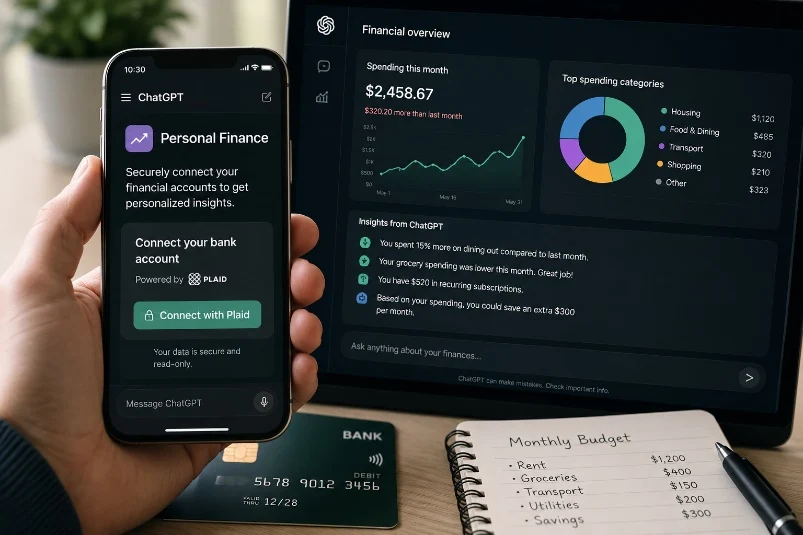
    Keeping track of expenses, subscriptions, savings goals and monthly bills is not everyones cup of tea, when you have to do it all yourself. In this context, OpenAI has launched a set of new personal finance tools for ChatGPT that allows users to connect their bank accounts and recieve personalized financial information directly from the chatbot.

    How Plaid Integrates and What It Can Do

    OpenAI’s partnership with financial data network Plaid will allow ChatGPT to securely access information from checking accounts, credit cards, savings accounts, loans and other financial sources. Once connected, users will be able to integrate these with AI to better understand what there spending trends and cash flow patterns are, and learn how to improve their financial habits.

    Read-Only Access and Subscription Details

    According to OpenAI, ChatGPT will have a purely read-only function, meaning it cannot make transfers, payments, or perform any type of operation. The system is intended to offer guidence rather than control over financial accounts. Moreover, it should be noted that this service is only available in a review version for ChatGPT Pro subscribers in the US.

    Privacy Concerns and User Hesitation

    While this feature may prove to be one of the more useful applications of the platform in the real world, the launch also raises important questions about privacy. Financial information is among the most sensitive personal data that consumers possess, so users may hesitate to give an AI assistant access to there banking history.

    Sources
  • OpenAI GPT 5.5 and 5.5 Pro Launch with $25,000 Bounty

    OpenAI GPT 5.5 and 5.5 Pro Launch with $25,000 Bounty

    Key Takeaway

    1. OpenAI’s GPT 5.5 and 5.5 Pro are more advanced and capable than previous models and competitors, but carry increased security risks.
    2. The new models show notable improvements in solving complex problems, but also pose heightened risks in the creation of biological threats and hacking tools.
    3. OpenAI has implemented safeguards and launched a bio bug bounty program to identify vulnerabilities, highlighting concerns over potential misuse.
    4. Competitors like Anthropic’s Claude are also developing highly capable, but potentially more insecure, AI models, impacting cybersecurity considerations.
    5. OpenAI offers options for local deployment of older open-source GPT models for users with suitable hardware.

    OpenAI Unveils New GPT 5.5 and 5.5 Pro Models

    OpenAI recently announced their newest AI models, GPT 5.5 and GPT 5.5 Pro, which power the ChatGPT AI chatbot and its API offerings. These models are more smart than their previous version GPT 5.4 and also outdo other AI models like Claude Opus 4.7 and Gemini 3.1 Pro. But,, the leap in technology also brings more risks along with its advantages. Both GPT 5.5 variants are available for subscribers of ChatGPT, with API access to follow shortly.

    Enhanced Capabilities and Risks

    With the latest updates, these AI models show marked improvements in tackling tough questions from academics and in using computers for complex tasks. A downfall for these advanced models is that they also have a higher chance of creating sensitive or harmful content. In terms of security, they can generate more insecure code than before. This raises concerns, especially since other AI systems, like Claude models, have been known to produce vulnerable code more frequently. The advancements mean that while the AI is smarter and more useful, it also needs tighter controls to prevent misuse.

    Security Threats and Bio Safety Tests

    Because these models are considered high risk, OpenAI has added new safety measures. Still, they’re going a step further with a special Bio Bug Bounty program. They’re offering $25,000 for anyone who can successfully hack GPT-5.5 in a biosafety challenge called Codex Desktop. This challenge involves answering five questions related to biological safety and security. Interested hackers or researchers have until June 22, 2026, to submit their efforts for this bounty.

    Concerns Over National Security

    Meanwhile, the company Anthropic has a model called Claude Mythos that can find cybersecurity vulnerabilities so well that they won’t even release it to the public because of national security risks. Their other model, Claude Code, which is also publicly accessible, has already been used to crack open the FreeBSD operating system. These developments highlight the fine line between innovation and potential threats within AI technology.

    Using GPT Locally

    For those who want to run AI models on their own computers, an older, open-source version called GPT-OSS is available on Hugging Face. You will need a high-performance Nvidia GPU, like one with 16 GB of memory or more, such as the 5090 GPU, to run it smoothly. This option allows users to experiment with AI models without relying solely on online services and helps keep up with fast-changing AI tech advancements.

  • ChatGPT Now Converts Long Pastes to Attachments for Plus Users

    ChatGPT Now Converts Long Pastes to Attachments for Plus Users

    Key Takeaways

    1. Automatic Attachment for Long Text: Pasted text over 5,000 characters is now converted into an attachment for ChatGPT Plus, Pro, and Business users.

    2. Cleaner Interface: The update aims to keep the composer interface tidy and prevent large text from overcrowding the context window.

    3. Manual Text Transfer Option: Users can click “Show in text field” to move the attachment back into the main message body if desired.

    4. Limited User Scope: This feature currently applies only to paid subscribers; Free, Enterprise, and Education users are not included in this update.

    5. Workflow Adjustment: The change modifies how users input long content, impacting standard workflows for those who frequently paste lengthy text into ChatGPT.


    OpenAI has made a significant change to how ChatGPT deals with large amounts of pasted text for certain paid subscribers. In a recent update, the company announced that when users with ChatGPT Plus, Pro, and Business accounts paste more than 5,000 characters into the text field, the system will now automatically turn that content into an attachment instead of placing it directly in the main text area.

    Keeping It Tidy

    OpenAI explains that this adjustment aims to maintain a cleaner composer interface and reduce the risk of large pasted sections taking up the entire context window. Users still have the option to move the text back into the main message body by clicking on “Show in text field,” which will revert the attachment into a regular paste.

    Lack of Details

    Currently, OpenAI hasn’t provided information about a specific app version, build number, platform specifics, or any staged rollout percentage related to this update. It remains unclear whether this feature is exclusive to web users or if it will eventually be available on iOS and Android as well. Such specifics haven’t been disclosed.

    Focus on Paid Users

    The wording from OpenAI specifically links this change to ChatGPT Plus, Pro, and Business users. The general ChatGPT release notes do not mention Free, Enterprise, or Education users in the March 25 update. There is a separate section for Enterprise and Education release notes, but the entries from March refer to different updates, not the adjustment concerning pasted text.

    Users who frequently input long notes, transcripts, code snippets, or draft documents into ChatGPT will likely be the first to observe this change, as any pasted content exceeding 5,000 characters will automatically be treated as an attachment. This practical impact is derived from OpenAI’s official statement.

    A Workflow Shift

    While OpenAI has not positioned this update as a major product launch, it indeed alters one of the standard workflows for paid users. Instead of having a large block of text in the composer, ChatGPT will now convert that content into an attachment while still allowing users to transfer it back to the text field manually. For the time being, the scope of this update is limited: it affects pasted text over 5,000 characters starting from March 25, and is available only to Plus, Pro, and Business users.

    Source:
    Link


  • OpenAI Closes Sora: Anti-AI Filmmakers Celebrate Video Platform Shutdown

    OpenAI Closes Sora: Anti-AI Filmmakers Celebrate Video Platform Shutdown

    Key Takeaways

    1. OpenAI is discontinuing its video generation service, Sora, just six months after its launch due to a shift in focus to new models.
    2. Sora initially gained popularity with a million downloads quickly, but faced backlash over unauthorized celebrity deepfakes, leading to reduced user engagement.
    3. OpenAI implemented strict safety protocols requiring celebrity consent for likeness use, which diminished the app’s appeal.
    4. This closure marks OpenAI’s first significant service shutdown, highlighting challenges in meeting market expectations and regulatory demands.
    5. Filmmakers may welcome Sora’s cancellation, while alternatives like Google Veo 3.1, Runway Gen-4, and Kling AI remain available.


    In an unexpected development, OpenAI, the creator of ChatGPT, has revealed that it will be ending its video generation service, Sora, just six months after its launch in September 2025. Although Sora had a fantastic start thanks to extensive publicity from YouTube creators and filmmakers, OpenAI has decided to discontinue it, possibly to focus on new models.

    Farewell to Sora

    We’re bidding farewell to the Sora app. To all who have created, shared, and fostered a community with Sora: we appreciate you. Your contributions with Sora were significant, and we understand this news is a letdown. More information will be shared soon, including timelines for the app and API, along with details on how to keep your work. – The Sora Team

    Mixed Reactions

    When Sora was launched, it received a blend of excitement and concern from the creator community. The app enabled users to create high-resolution videos featuring “cameos” of themselves and achieved a million downloads more quickly than ChatGPT – quite remarkable.

    Nevertheless, it appears that the initial excitement faded swiftly as the platform faced backlash over unauthorized celebrity deepfakes. In reaction, OpenAI put in place stringent safety protocols that mandated consent from celebrities before their likenesses could be used in AI-generated videos. These new rules reportedly diminished the app’s viral charm, causing a drop in active users.

    Industry Implications

    It’s important to point out that this is the first significant service closure for OpenAI, indicating that even the leading companies in the industry can struggle when dealing with market expectations and regulations.

    What’s for sure is that many filmmakers will likely rejoice at Sora’s cancellation, while others will turn to alternative platforms. With rivals like Google Veo 3.1, Runway Gen-4, and Kling AI still available, it’s doubtful that this will be the last word from OpenAI on AI video creation.

    Source:
    Link


  • Nvidia CEO Jensen Huang: No Further Investment in OpenAI, Anthropic

    Nvidia CEO Jensen Huang: No Further Investment in OpenAI, Anthropic

    Key Takeaways

    1. Nvidia CEO Jensen Huang indicates a potential slowdown in aggressive investment strategies, particularly with upcoming IPOs for OpenAI and Anthropic.
    2. Nvidia has hesitated to invest large amounts into single partners, focusing instead on a more cautious approach, exemplified by its commitment of $30 billion to OpenAI.
    3. Anthropic faces controversy and scrutiny related to its AI products and their implications for government use, affecting its market position.
    4. Nvidia reported a 73% revenue increase and significant earnings growth, contributing to a large cash reserve amid a cautious investment environment.
    5. Nvidia’s actions impact the valuations of its partner companies, reinforcing its status as a key player in the AI market and influencing investor confidence.


    NVIDIA Corp (NASDAQ: NVDA) could be slowing down its investment efforts, which have caught the attention of many who view it as the ‘Central Bank of AI.’ This role involves providing funds, investing in, and selling to its customers.

    CEO’s Comments at Conference

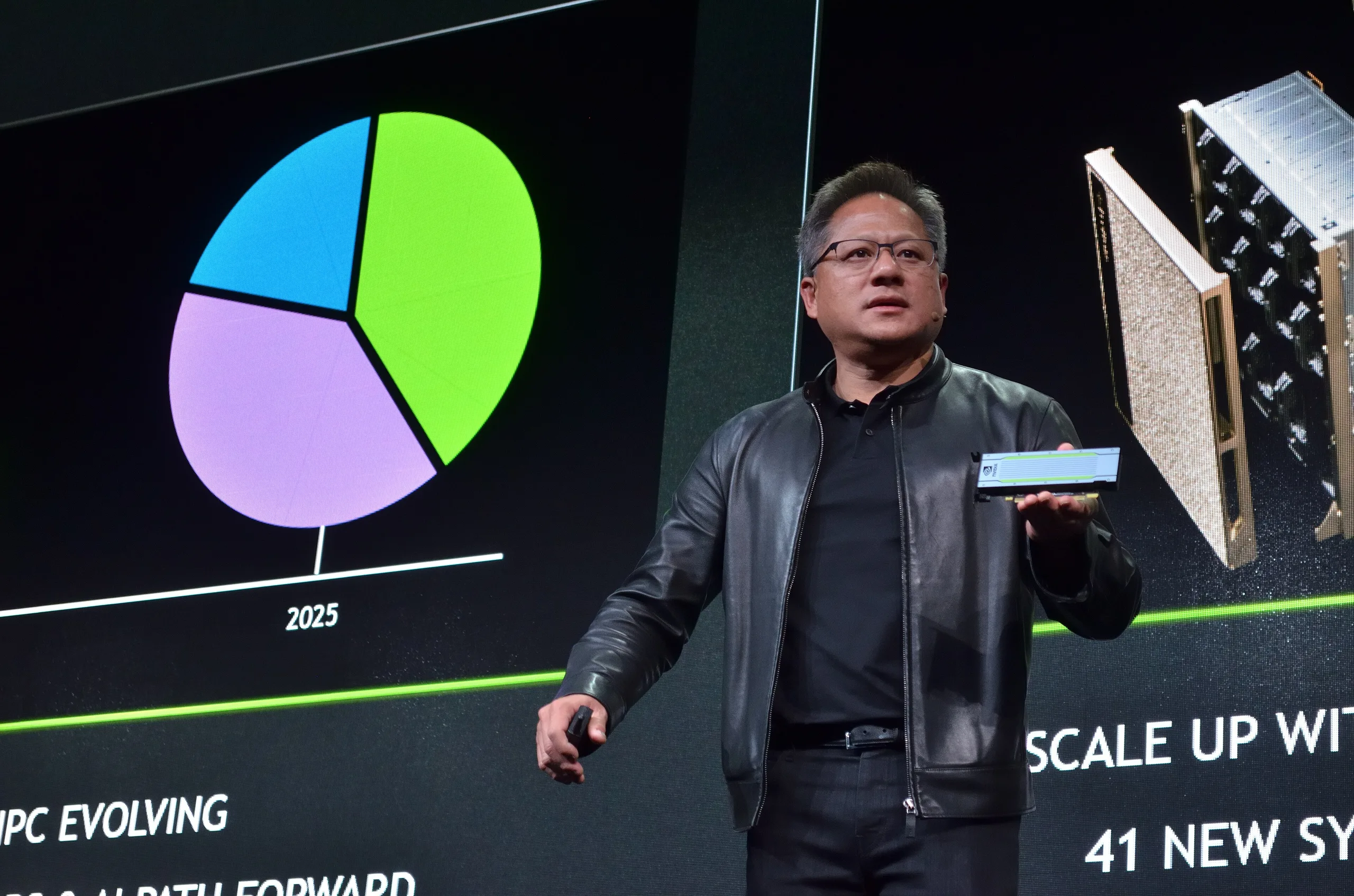
    During a recent Technology, Media, and Telecom conference hosted by Morgan Stanley, Jensen Huang, the CEO of Nvidia, hinted that the company might not continue its aggressive investment strategy. This is notable as both OpenAI and Anthropic are preparing to go public this year, with OpenAI reportedly aiming for a staggering $1 Trillion IPO.

    Investment Strategy Changes

    It’s worth noting that Nvidia has made investments in several AI partners and industries, including CoreWeave Inc, which is now public and trades under NASDAQ: CRWV, as well as Lumentum Holdings Inc (NASDAQ: LITE) and Coherent Corp. (NYSE: COHR). However, Nvidia has recently shown hesitance to pour large sums into a single partner.

    This is especially true regarding OpenAI, where Nvidia’s CEO seemed to retract what many believed was a $100 billion investment before finally committing $30 billion to what he calls a “consequential company.”

    Anthropic’s Controversial Position

    Anthropic, which has faced both criticism and acclaim, recently topped Apple’s storefront after a high-profile clash with the U.S. Department of Defense over issues related to fully automated weapons and mass surveillance.

    Though both OpenAI and Anthropic have eased restrictions on their products, with OpenAI even taking ‘safely’ out of its mission statement, Anthropic appears more cautious about certain boundaries, even when facing potential sanctions on the future use of its Claude AI in government settings.

    This situation has made Anthropic a popular topic to support, even as the Pentagon’s request for Claude to be accessible for “all lawful purposes” remains unfulfilled.

    Nvidia’s Financial Performance

    Nvidia reported impressive earnings, boasting a remarkable 73% revenue increase and nearly doubling its earnings per share compared to the previous year. This has led to a significant cash reserve, even as the company approaches investments more carefully in what many believe is an overvalued AI market right now.

    Still, as retail and institutional investors closely monitor Nvidia’s actions—which often lead to major changes in the valuations of the companies it backs—it plays a crucial role in instilling confidence in other operations. This often encourages these companies to cater to Nvidia, recognized as the world’s largest company by market cap.

    Reuters’

    Source:
    Link


  • OpenAI Enhances Pentagon Deal Following US Surveillance Concerns

    OpenAI Enhances Pentagon Deal Following US Surveillance Concerns

    Key Takeaways

    1. OpenAI updated its agreement with the U.S. Department of Defense to clarify limitations on domestic surveillance.
    2. The update specifies that OpenAI systems cannot be used for monitoring U.S. individuals or using personal identifiable information.
    3. The agreement aims to address concerns raised after OpenAI’s deal for its models in classified defense settings.
    4. Critics worry that broad language in the agreement could allow for misinterpretation regarding surveillance practices.
    5. OpenAI will work with the Department of War and other AI labs to discuss defense policies and operations.


    OpenAI has recently updated its agreement with the U.S. Department of Defense, which it refers to as the “Department of War.” This update aims to make the limitations regarding domestic surveillance clearer.

    New Terms for Clarity

    According to the update released on March 2, 2026, OpenAI specified that its systems are not to be utilized for monitoring U.S. individuals, which includes obtaining or using commercially sourced personal or identifiable information. The company also noted that the Department of Defense confirmed that its service will not be employed by defense intelligence agencies such as the NSA, and any such usage would need a distinct agreement.

    Response to Concerns

    This update came after some backlash when OpenAI announced a deal to use its models in classified defense settings. Business Insider reported that Sam Altman, the CEO, shared an internal memo detailing that the company was collaborating with the Pentagon to “make some additions” to the agreement in response to worries about potential mass surveillance.

    Before the March 2 update, OpenAI had highlighted three key “red lines” in its public description of the agreement, which included a prohibition on mass domestic surveillance. The contract language allowed for “all lawful purposes,” referencing existing U.S. legal frameworks for intelligence activities.

    Criticism of Broad Language

    Critics have raised concerns that relying on broad “lawful use” language and established surveillance authorities might leave openings for interpretation. Even with OpenAI’s claims that the contract and technical safeguards prevent mass domestic surveillance, doubts remain.

    OpenAI’s public announcement outlines a cloud-only deployment approach and mentions that cleared personnel from the company will be involved. However, important operational information, such as the contract’s monetary value, the specific systems or models included, and the overall scope of the rollout, are not detailed in the company’s published summary.

    OpenAI also stated that the Department of War intends to initiate a working group with leading AI laboratories, cloud service providers, and defense policy and operations leaders, and they expect to be involved in those discussions.


    Source:
    Link


  • Humorous Ads Target ChatGPT’s Advertising Approach

    Humorous Ads Target ChatGPT’s Advertising Approach

    Key Takeaways

    1. OpenAI plans to introduce ads in the free version of ChatGPT Go, located at the bottom of the screen and tailored to user conversations.
    2. Anthropic’s AI assistant, Claude, will not include ads and promotes itself as the ad-free alternative to ChatGPT.
    3. Anthropic released humorous commercials criticizing ad-supported AI, illustrating awkward moments caused by unexpected ads during typical interactions.
    4. The ads conclude with the message: “Ads are coming to AI. But not to Claude,” highlighting their stance against advertising in their service.
    5. Anthropic supports Claude through subscription fees and business contracts, ensuring no ads, no data selling, and no sponsored messages, although some users are skeptical about Claude’s long-term ad-free promise.


    OpenAI has just announced its plans to start showing ads in the free version of ChatGPT Go. These ads will be located at the bottom of the screen and will be customized based on the conversations happening at the time. In contrast, competitor Anthropic is openly taking a different path, stating that it will not follow this trend with its AI assistant, Claude.

    A Humorous Take on Advertising

    On February 5, Anthropic released four brief commercials that humorously criticize ad-supported AI assistants. Each clip showcases a typical AI interaction that takes a strange twist when unexpected ads pop up. In one instance, a man shares his personal struggles with an AI therapist. The assistant offers sympathetic responses until the conversation suddenly shifts to an ad for a made-up dating platform called “Golden Encounters,” suggesting connections with older women. Another ad depicts an AI helping a woman with her business concept before abruptly trying to sell her a loan, complete with a credit check, stating: “Girlbosses need SHE-E-O Money quick.”

    Clear Messaging Against Ads

    All four ads close with the phrase: “Ads are coming to AI. But not to Claude.” Although there’s no direct mention of ChatGPT or OpenAI, the timing of the release makes the target obvious. Claude aims to be seen as the ad-free option compared to ChatGPT, especially after OpenAI’s recent announcement about introducing ads to the free Go version. Instead of depending on advertising, Anthropic claims it supports Claude through subscription fees and business contracts. They assure users that there are no ads, no selling of user data, and no sponsored messages. The campaign has been met with positive feedback on Reddit, where many users have enjoyed its wit and timing. However, some people are still doubtful about whether Claude can remain ad-free over time.

    Source:
    Link


  • Nvidia CEO Jensen Huang Doubts OpenAI Investment for ChatGPT

    Nvidia CEO Jensen Huang Doubts OpenAI Investment for ChatGPT

    Key Takeaways

    1. Nvidia’s potential $100 billion investment in OpenAI is largely paused due to internal doubts and skepticism within the company.
    2. CEO Jensen Huang has raised concerns about OpenAI’s business discipline and clarified that the initial agreement was non-binding.
    3. Talks have shifted from a large-scale infrastructure deal to a potential equity investment in the tens of billions as OpenAI seeks ongoing funding.
    4. OpenAI faces intensified competition from Google and Anthropic, affecting its growth and need for computing resources.
    5. The halted agreement could impact OpenAI’s plans to go public by 2026, as it navigates liabilities and competition for essential technology.


    In September, Nvidia revealed it would possibly invest up to $100 billion in OpenAI. However, recent news from the Wall Street Journal indicates that this initiative is largely paused. The project, which CEO Jensen Huang had previously called “the largest computing project in history,” aimed for Nvidia to create a computing capacity of no less than 10 gigawatts and to offer financial backing for OpenAI to rent the essential chips.

    Internal Doubts at Nvidia

    Insiders have shared that skepticism within Nvidia hindered negotiations from moving forward past the initial stages. Jensen Huang has reportedly communicated to peers in the industry that the original letter of intent was non-binding and has expressed private concerns regarding what he sees as a lack of discipline in OpenAI’s business strategies.

    Reevaluating the Partnership

    Currently, both companies are rethinking the nature of their partnership. Rather than pursuing a large-scale infrastructure agreement, talks are now centered around a traditional equity investment from Nvidia, potentially in the tens of billions of dollars, as part of OpenAI’s ongoing funding effort. This hesitation is partly due to mounting competitive pressures: Google’s Gemini has slowed ChatGPT’s growth and raised internal concerns, while Anthropic’s “Claude Code” also poses a threat to market share. Moreover, Nvidia is adopting a dual approach and has already pledged up to $10 billion in investments towards Anthropic, which competes with OpenAI.

    The Stakes for OpenAI

    For OpenAI, which is hoping to go public by the end of 2026, the halted agreement is a blow to its quest for essential computing resources. OpenAI CEO Sam Altman had earlier indicated liabilities amounting to $1.4 trillion, causing worry among investors given the company’s income.

    Nonetheless, finalizing an agreement remains crucial for both parties: Nvidia seeks to avoid allowing OpenAI to lag behind rivals like Google or Anthropic, who are increasingly depending on their own chipsets like TPUs or Amazon’s Trainium, rather than utilizing Nvidia’s GPUs. Additionally, reports suggest that Amazon is also in talks for its own investment in OpenAI, which could reach up to $50 billion.

    Source:
    Link


  • US Cybersecurity Chief Leaks Confidential Documents to ChatGPT

    US Cybersecurity Chief Leaks Confidential Documents to ChatGPT

    Key Takeaways

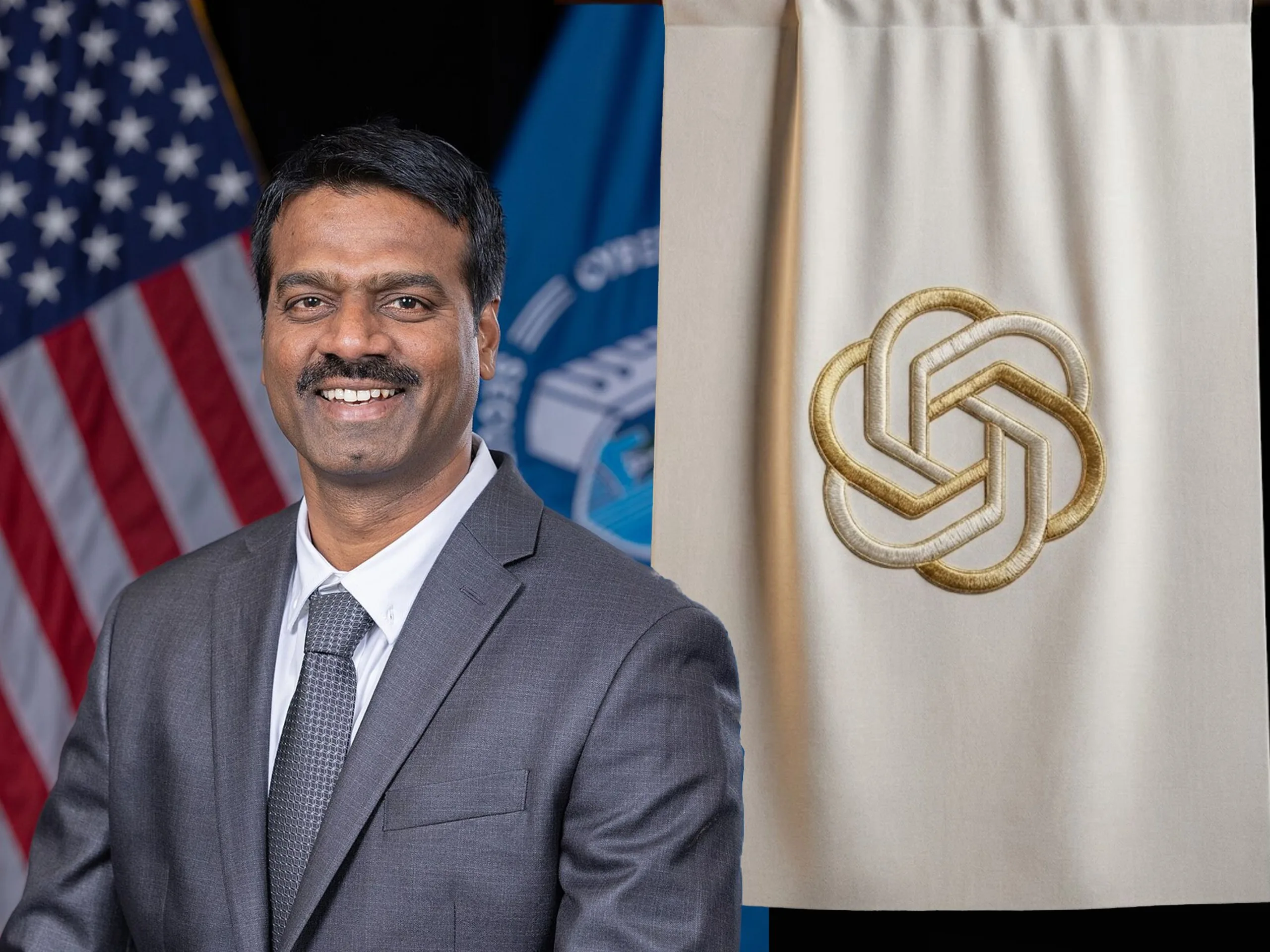
    1. The Acting Director of CISA, Madhu Gottumukkala, uploaded sensitive government documents to a public version of ChatGPT, triggering security alerts.
    2. Gottumukkala received a special exemption to use the AI tool, despite the documents being labeled “For Official Use Only.”
    3. The incident raises concerns about data exposure, as public AI tools like ChatGPT send inputs to OpenAI, unlike secure internal tools.
    4. CISA is investigating the incident, with conflicting statements about the timeline of Gottumukkala’s use of the tool.
    5. This incident adds to ongoing controversies surrounding Gottumukkala, including previous issues with a polygraph test related to counterintelligence.


    The Acting Director of the Cybersecurity and Infrastructure Security Agency (CISA), which is the main US agency for cybersecurity, was involved in a security incident last year. Madhu Gottumukkala uploaded sensitive government documents to a public version of ChatGPT. Information from four officials at the Department of Homeland Security (DHS) obtained by Politico revealed that this action set off several automated security alerts. These alerts are designed to stop the theft or accidental release of government materials from federal networks. Reports indicate that alarms were triggered multiple times during the first week of August alone.

    Accessing the AI Tool

    Gottumukkala obtained a special exemption to use the AI chatbot, which he requested from CISA’s Chief Information Officer soon after he started his role in May. At that point, the application was only available to regular employees of the Department of Homeland Security. Although the files he uploaded were not classified, they were labeled “For Official Use Only,” indicating that they contained sensitive information not meant for the public.

    Controversy Over the Incident

    This incident has raised eyebrows, especially because of the technical nature of the tool involved. When using the public version of ChatGPT, inputs are sent to the developer OpenAI, and there is a possibility that this data could be used to enhance the model or answer questions for other users. In contrast, the AI tools approved for use within the Department of Security, like the internal “DHSChat,” are set up to ensure that no data or search queries can leave the secured federal networks. OpenAI claims that their service currently has over 700 million active users, which emphasizes the risk of information exposure.

    CISA’s Response

    In response to the situation, CISA is attempting to clarify matters. Spokeswoman Marci McCarthy stated that the use of the chatbot was approved, short-term, limited, and conducted under security measures. She also disputed the timeline, claiming that the director last used the tool in mid-July. This contradicts previous statements from officials who said security alerts were still detecting uploads in early August. An internal investigation is now underway to find out if the incident resulted in any real harm. This case is just one of many controversies involving Gottumukkala, who has reportedly previously failed a polygraph test related to counterintelligence.

    IOL, Politico.

    Source:
    Link


  • Samsung and SK Hynix May Reduce NAND Production to Boost SSD Prices

    Samsung and SK Hynix May Reduce NAND Production to Boost SSD Prices

    Key Takeaways

    1. Prices for DRAM and SSDs have significantly increased due to major companies like OpenAI dominating the market.
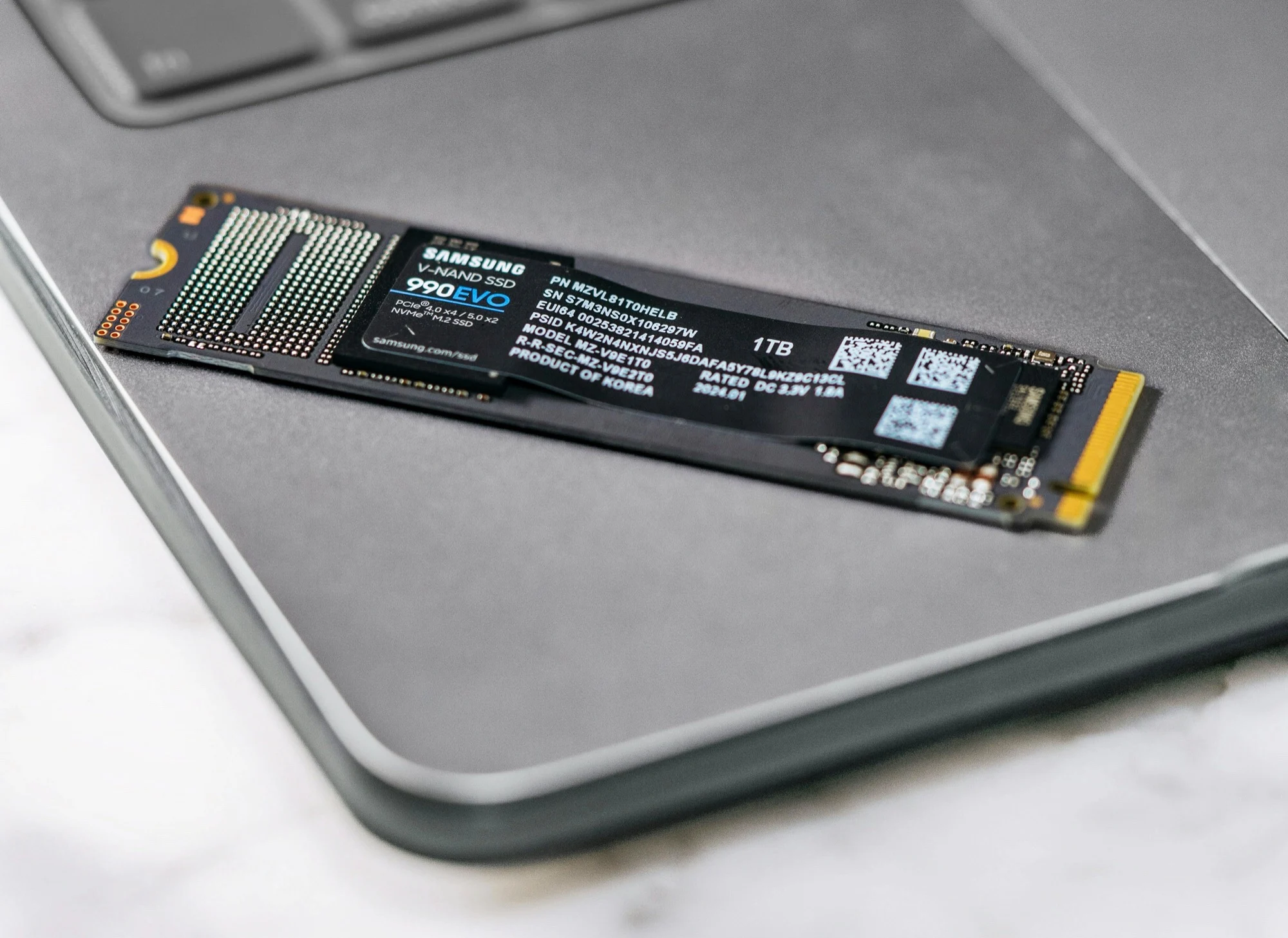
    2. The Samsung 990 Pro 1TB SSD has risen in price from $90 in October to $199 on Amazon.
    3. Major manufacturers Samsung Electronics and SK Hynix plan to cut NAND flash production by 4.5% and 10.5%, respectively.
    4. The shift in production focus is towards RAM for Nvidia’s Vera Rubin graphics chips, which are essential for AI data centers.
    5. Price reductions for SSDs and RAM are unlikely until at least 2028 due to ongoing supply constraints and production shifts.


    Since companies like OpenAI have taken a significant portion of the global DRAM market, prices for memory have greatly increased over the last few months. SSD prices have also been affected by this surge. For instance, the Samsung 990 Pro with 1TB of storage is now priced at $199 on Amazon, a notable rise from $90 in October, according to data from Camelcamelcamel.

    Future Price Trends

    This upward trend in prices might not stop soon, as reported by Chosun Biz. Both Samsung Electronics and SK Hynix are looking to cut their NAND flash production by 4.5% and 10.5%, respectively. To give you a clearer picture, these two firms make up over 60% of the global NAND output. With demand expected to increase while supply shrinks, we could see even sharper price increases.

    Production Shifts

    The reasoning behind this reduction in NAND manufacturing isn’t due to a lack of customers. Rather, it’s more lucrative for these companies to shift their fabs to produce RAM for Nvidia’s Vera Rubin graphics chips, which are crucial for AI data centers. Even though NAND prices may keep rising, both Samsung Electronics and SK Hynix believe that DRAM production will yield better profits in 2026 and 2027. It will take a while for competitors like China’s YMTC to fill the gap in supply, so don’t expect any price reductions in SSDs and RAM until at least 2028.

    Source:
    Link