Tag: GPU Performance

  • New Microsoft Surface Laptop with Intel Panther Lake & Arc B390 Graphics

    New Microsoft Surface Laptop with Intel Panther Lake & Arc B390 Graphics

    Key Takeaway

    1. The upcoming Surface Laptop 8 will feature Intel Core Ultra processors, including the new Core Ultra X7 368H with a 12-core GPU.
    2. Benchmarks suggest the Surface Laptop 8 will see a significant GPU performance increase, especially with the new Arc B390 GPU.
    3. Microsoft will continue branding the device as a ‘for Business’ model with a 13.8-inch display, possibly offering OLED options.

    Microsoft’s New Surface Laptop 8 Details Leaked

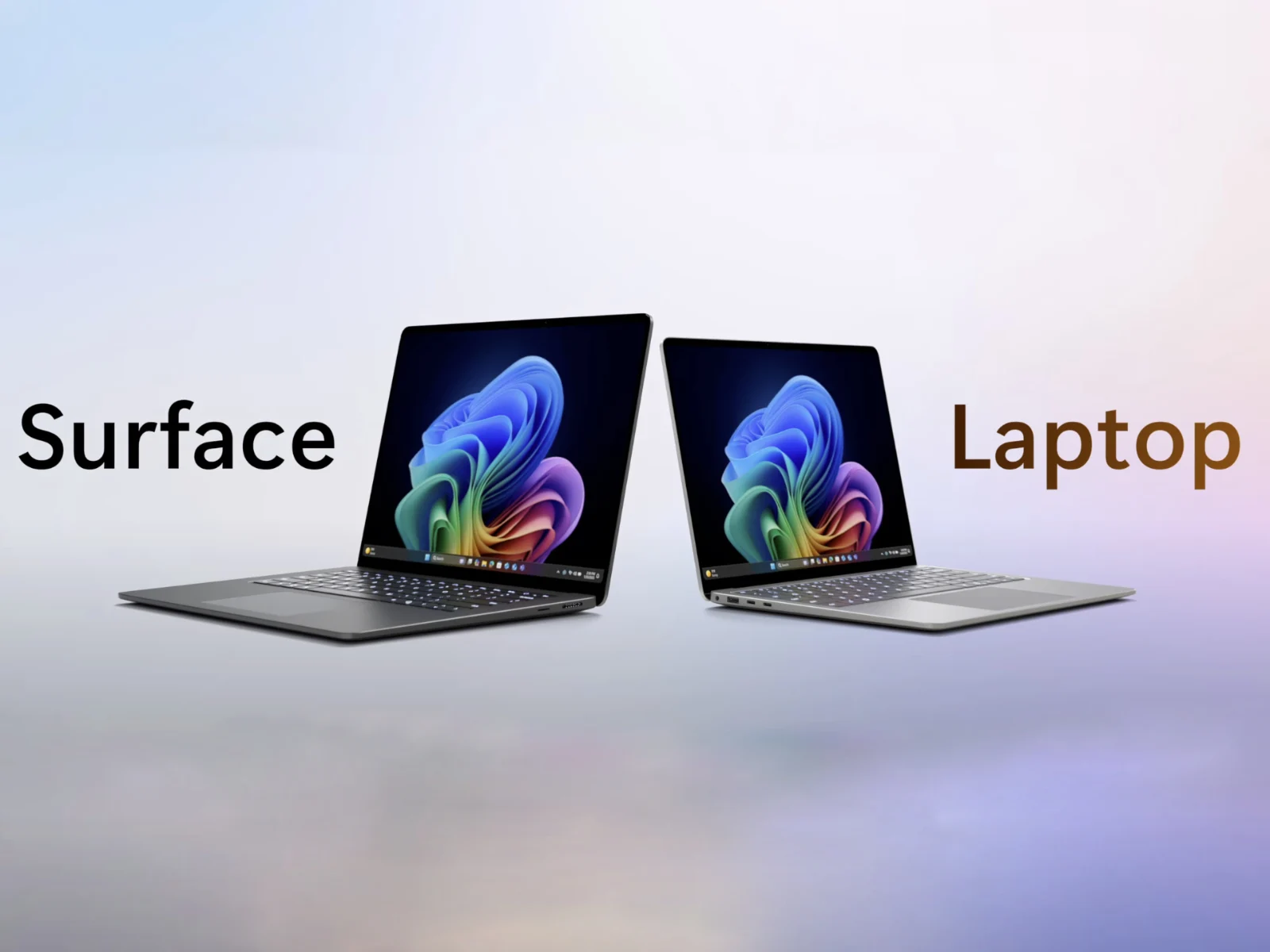
    It look like Microsoft is about to launch some fresh new Surface PCs soon. There had be some hints that their release might be pushed back about a month, but now, the first look at the Surface Laptop 8 has appear online on Geekbench. Fans and tech geeks are quite excited about what might be coming next from this popular line.

    Speculations and Rumors

    Most rumors were suggesting that the new Surface Laptop would only feature Intel’s ‘Core Ultra’ chips from the Panther Lake series. The highest spec rumored was the Core Ultra 7 366H, offering 16 CPU cores along with a modest 4-core integrated GPU, which is only slightly better than what’s found in the current Surface Laptop 7 (which is priced at around $909). The expectation was that these Ultra chips would bring some performance improvements, but nothing too drastic.

    Recent Geekbench Listings & New Tech

    • Latest Geekbench listings show that Microsoft will also offer Intel versions with up to the Core Ultra X7 368H, which is another 16-core processor.
    • The new chip replaces the standard 4-core integrated GPU with a 12-core GPU, referred to as the Arc B390, promising much better graphics performance.
    • This upgrade means significant GPU power boosts over previous Surface models that rely on Intel or Snapdragon chips.

    Expected Features and Display Options

    From the benchmark info, it’s clear that Microsoft is keeping its ‘for Business’ branding for the Surface Laptop 8, indicating these will still be aimed at professionals and enterprise users. The new laptop is supposed to sport a 13.8-inch display, possibly with optional OLED screens, providing users with options for richer visual experiences. The leap in GPU power, combined with potential OLED displays, suggests a device designed not just for work, but also for more media-rich content consumption.
  • Intel Arc Pro B70 vs Nvidia RTX 4000 Pro: Price, Speed, VRAM

    Intel Arc Pro B70 vs Nvidia RTX 4000 Pro: Price, Speed, VRAM

    Key Takeaways

    1. Intel unveiled the Arc Pro B65 and B70 GPUs, targeting AI training and inference, but did not provide specific performance metrics initially.
    2. The Arc B70 GPU features 32 GB of VRAM at a starting price of $949, compared to Nvidia’s RTX 4000 Pro with 24 GB of VRAM priced at $1,800.
    3. The B70 has a context window 2.2 times larger than the RTX 4000 Pro, supporting up to 93K tokens versus 42K tokens for Nvidia’s card.
    4. The B70 shows 85% greater token throughput and 6.2x faster response times in multi-agent flows, attributed to Intel’s oneAPI and software stack.
    5. Performance advantages for the B70 increase with multi-GPU configurations, achieving up to 2x tokens per dollar spent in various setups.


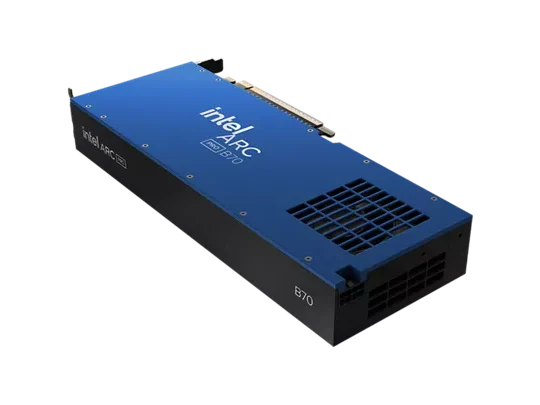
    Intel unveiled the Arc Pro B65 and B70 high-performance workstation GPUs yesterday, targeting AI LLM training and inference, but did not share specific performance details in their first press release. Shortly after, the company put out performance charts comparing the B70 against Nvidia’s older RTX 4000 Pro GPUs. Intel believes this comparison is relevant due to the B70’s price of less than $1,000, with Team Blue making bold claims about its overall performance.

    Impressive Specs

    Even without diving into the performance charts—which may or may not reflect reality in typical Intel fashion—the Arc B70 GPU stands out from Nvidia’s offerings because of its higher VRAM capacity (32 GB compared to 24 GB) and a starting price of $949 (compared to $1,800). Sure, the VRAM is only 19 Gbps GDDR6 with a 256-bit bus and a bandwidth of 608 GB/s, but the increased capacity is beneficial for training and inferring larger models.

    Context Window Advantage

    Thanks to its superior VRAM, the B70 has a context window that is 2.2 times larger than that of the RTX 4000 Pro card. Intel’s slide indicates that the B70 can handle context lengths up to 93K tokens, while the RTX 4000 Pro hits its memory limit at about 42K tokens when working with the Llama 3.1 8b BF16 model.

    Enhanced Performance

    Running parallel multi-agent flows on the Ministral Instruct 2410 8B (BF16) model results in 85% greater token throughput for multiple users or requests when using the B70 in a Linux OS environment. Moreover, the B70 can provide responses faster with a 6.2x quicker time to first token. Intel attributes these enhanced speeds to their refined oneAPI and proprietary software stack. The performance advantage over Nvidia also scales up with multi-GPU configurations, as Intel states that they can achieve up to 2x tokens for each dollar spent in single, dual, and quad GPU setups.

    Sadly, the presentation did not include any performance metrics or pricing for the B65 GPU. It would be fascinating to see if Intel permits AIB partners to create gaming-focused versions of the B65 and B70 GPUs with somewhat lower VRAM capacities. This would also necessitate Intel to update their graphics drivers.


    Source:
    Link


  • Apple MacBook Pro 14 Struggles with M5 Max Performance Issues

    Apple MacBook Pro 14 Struggles with M5 Max Performance Issues

    Key Takeaways

    1. Apple has launched the M5 Max chip with 18 CPU cores and 40 GPU cores in the MacBook Pro 14, but the power adapter is inadequate.
    2. In stress tests, the M5 Max peaks at 96 Watts briefly, stabilizing around 42 Watts, while the M5 Pro in the MacBook Pro 16 can draw 70W.
    3. CPU and GPU stress tests show a drop in power consumption after initial peaks, with the GPU performance decreasing by about 10% under continuous workloads.
    4. The MacBook Pro 16 is expected to outperform the 14-inch model, better utilizing the M5 Max GPU’s capabilities.
    5. Future M6 chips are anticipated to use a 2 nm manufacturing process, which may require Apple to improve cooling solutions in MacBook designs.


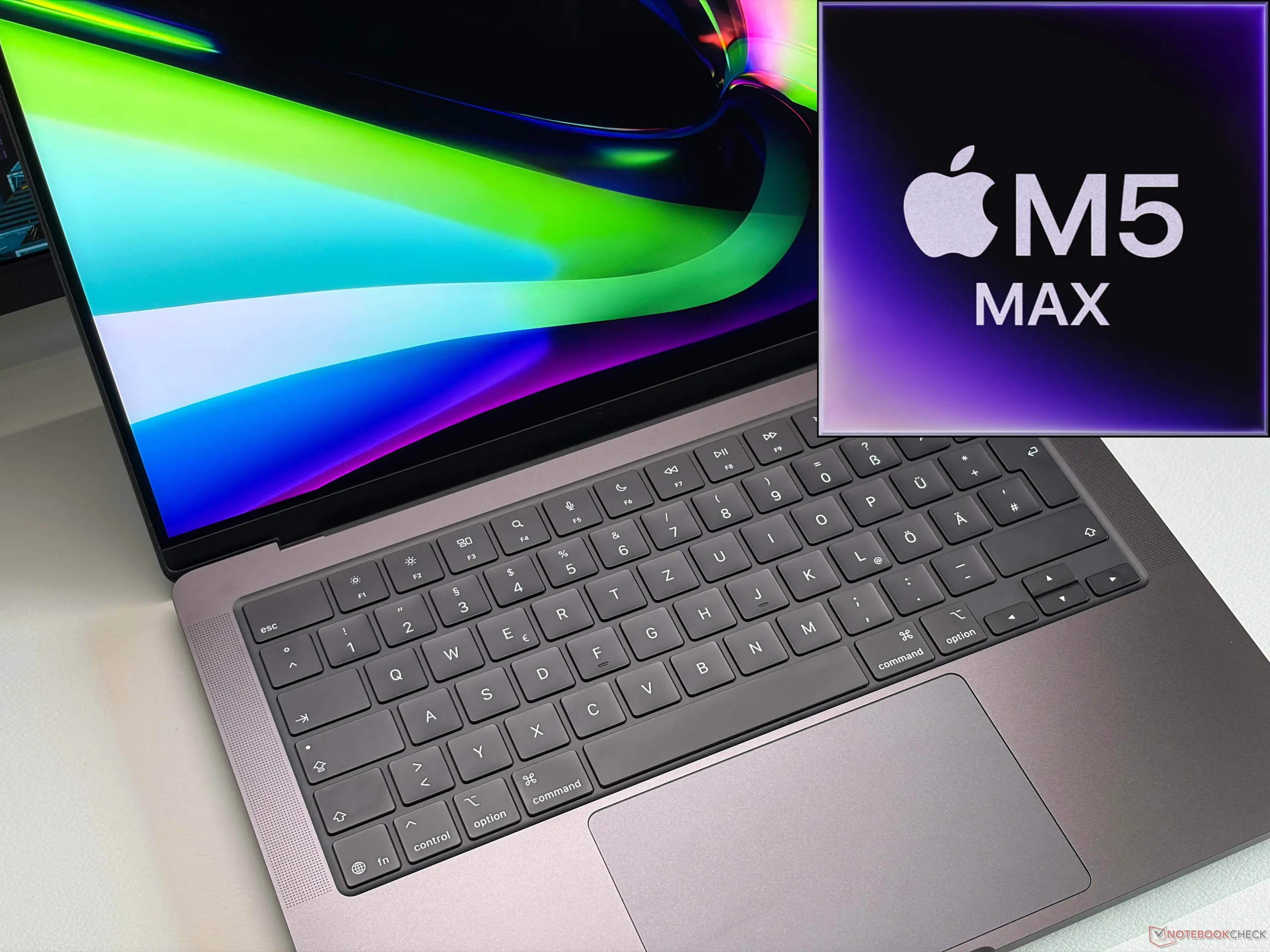
    Apple has introduced its latest powerful chip, the M5 Max, featuring 18 CPU cores and 40 GPU cores, in the compact MacBook Pro 14 that we just took a look at. Our evaluations revealed some problems, and we’ve already mentioned the inadequate power adapter.

    Stress Test Findings

    In our stress tests, the M5 Max (considering both CPU and GPU cores, excluding RAM) peaks at 96 Watts for a short duration of 1-2 seconds. After this burst, the chip drops rapidly to 46 Watts, but it can’t hold this level and eventually stabilizes around 42 Watts. The larger MacBook Pro 16 has an edge in this area, as the M5 Pro can draw 70W during stress tests, which is 66% more. This difference is clearly visible in the chart below (red indicates MacBook Pro 14 M5 Max; yellow represents MacBook Pro 16 M5 Pro).

    CPU and GPU Performance

    When only the CPU or GPU is under stress, similar patterns emerge. The CPU cores can briefly consume up to 75W but then fall back to about 50W. On the other hand, GPU stress can push consumption to 72W, which quickly drops to 55W and eventually stabilizes at 44W, even while using High Power mode. Under continuous workloads, the GPU performance also isn’t consistent, showing a decrease of around 10%. The MacBook Pro 16 seems likely to outperform the 14-inch model and fully showcase the capabilities of the new M5 Max GPU with its 40 cores, which we plan to test soon with a review unit.

    Future Expectations

    The current M5 generation still uses the well-known 3 nm manufacturing process (now in its third generation). We anticipate that the forthcoming M6 chips will transition to the 2 nm process at TSMC, which should enhance efficiency. However, these chips are becoming so powerful that Apple may need to rethink their MacBook designs, incorporating more effective cooling solutions. For more details, refer to our comprehensive review of the MacBook Pro 14 with M5 Max.

  • Apple M5 Max and M5 Pro Boost Performance by 20% on Geekbench

    Apple M5 Max and M5 Pro Boost Performance by 20% on Geekbench

    Key Takeaways

    1. The M5 Pro and Max chips show significant enhancements in CPU performance, with the 18-core CPU outperforming most consumer-grade x86 chips.
    2. GPU performance is lacking, with the M5 Max competing closely with the RTX 5070 and the M5 Pro struggling against the RTX 5060 due to OpenCL optimization issues on macOS.
    3. The M5 Max GPU shows a 20% improvement in single-precision AI tasks over the M4 Max, while the M5 Pro shows a similar 20% improvement over the M4 Pro.
    4. CPU scores remain mostly unchanged, and the 16-core Neural Engine has decreased in single-precision scores, though improvements are noted in half-precision and quantized tests.
    5. Current benchmarks may not fully reflect the M5 generation’s AI capabilities, and true performance will be better evaluated through independent reviews with practical workloads.


    Apple’s M5 Pro and Max were introduced just a few days ago, and initial benchmarks have started to emerge. These chips show clear enhancements in GPU and CPU performance compared to their predecessors, with the 18-core CPU in the M5 Max and Pro outperforming nearly all consumer-grade x86 chips available today.

    GPU Performance Insights

    However, the GPU performance is somewhat lacking, as the M5 Max competes closely with the RTX 5070 Laptop GPU in Geekbench OpenCL, while the M5 Pro struggles to keep pace with a mid-range RTX 5060 Laptop GPU in the same benchmark. It’s important to note that OpenCL is no longer optimized for macOS, which likely contributes to these less-than-stellar results.

    AI Performance Comparison

    Beyond just CPU and GPU numbers, Geekbench also evaluates on-device AI performance. Due to the differences in APIs between macOS and other platforms, cross-platform comparisons might not be entirely accurate. Nonetheless, we can assess the M5 Pro and Max against their earlier versions to understand how Apple has advanced in this area.

    When we look at the Geekbench AI test results for the M5 Max SoC, the findings are as follows:

    In comparison to the M4 Max, the M5 Max GPU appears to have about a 20% advantage in single-precision tasks. Similarly, the M5 Pro GPU shows an improvement of around 20% over the M4 Pro.

    Neural Engine Performance

    Curiously, the CPU scores have remained largely unchanged, and the 16-core neural engine’s scores have actually decreased in single-precision, which seems illogical. However, results in half-precision and quantized tests have improved by approximately 15% and 10%, respectively.

    It’s also worth noting that the earlier models also had a 16-core Neural Engine. While Apple asserts that the new Neural Engine is quicker, they haven’t specified by how much. The base model M5 (14″ MacBook Pro currently priced at $1,450 on Amazon), alongside the M5 Pro and M5 Max SoCs, all come equipped with the same 16-core Neural Engine.

    These initial figures should be taken with caution, as it’s possible that Geekbench AI hasn’t fully leveraged the neural accelerators in the M5 generation’s GPU cores yet. Apple claims that performance in AI tasks can be up to 4x faster, but current benchmarks paint a different picture.

    Given that a single benchmark doesn’t accurately reflect real-world performance, the true AI capabilities of the M5 Pro and M5 Max SoCs will only be determined through independent reviews using practical workloads.


  • RX 9070 vs RTX 5070: FSR 4 vs DLSS 4 Performance Comparison

    RX 9070 vs RTX 5070: FSR 4 vs DLSS 4 Performance Comparison

    Key Takeaways

    1. The RX 9070 has improved performance, now outpacing the RTX 5070 by approximately 13% at 1440p without FSR 4, compared to just a 4% lead at launch.
    2. The RX 9070 is now more appealing due to driver and game enhancements, especially as it is available near its $549 MSRP.
    3. DLSS 4 does not significantly boost the RTX 5070’s performance, as the RX 9070 maintains its 13% advantage even with FSR 4.
    4. The RTX 5070 excels in ray tracing performance, but the overall game mix tested favored the RX 9070.
    5. The RX 9070 features 16 GB of VRAM compared to the RTX 5070’s 12 GB, making it a better long-term investment as games require more VRAM.


    We’ve often come across the expression “fine wine” when discussing AMD’s GPU drivers, which generally provide extra performance boosts as new driver updates are released. Hardware Unboxed has evaluated the RX 9070 and the RTX 5070, utilizing AMD FSR 4 and Nvidia DLSS 4, respectively, along with the most recent drivers. The comparison indicates that the Radeon RX 9070 has matured remarkably well, as the performance gap between the GPUs is now greater than it was at the launch of the RX 9070.

    Performance Comparison

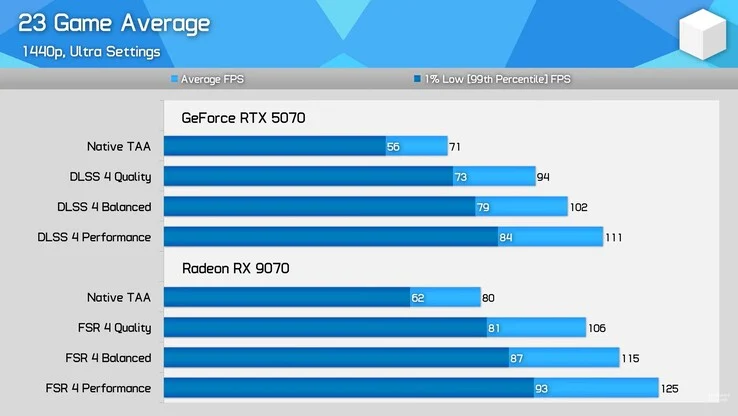
    According to HU, in the 23 games tested at 1440p, the RX 9070 outperformed the RTX 5070 by approximately 13% at native resolution, without employing FSR 4. This is quite fascinating since the RX 9070 was merely 4% ahead of the RTX 5070 on average in HU’s initial review. Our own testing also shows that the RX 9070 is just 7% faster than the RTX 5070.

    In other words, due to driver and game enhancements, the RX 9070 has proven to be an even more attractive option compared to the RTX 5070, especially now that you can find the GPU at or near the official $549 MSRP, similar to the RTX 5070.

    DLSS vs. FSR

    Additionally, it seems that DLSS does not significantly benefit the RTX 5070 in this analysis, as the RX 9070, with FSR 4, maintained the 13% performance advantage under similar conditions. For example, when using DLSS 4 and FSR 4 in “Quality” mode, the RX 9070 achieved an average FPS of 106, while the RTX 5070 reached 94 FPS. This 13% difference persisted across the Balanced and Performance FSR 4/DLSS 4 profiles.

    It’s worth noting that the game mix tested by HU included both rasterization and ray tracing titles. Had HU focused solely on ray tracing performance, the RTX 5070 would have outpaced the RX 9070. It’s also important to recognize that the number of games compatible with DLSS 4 is larger than that for FSR 4.

    Other Considerations

    Furthermore, DLSS 4 includes features like enhanced image quality and Multi-Frame Generation, which may be very appealing for certain gamers.

    Taking everything into account, if you’re seeking the best performance for your investment, the RX 9070, whether using FSR 4 or not, represents a superior choice. This is especially relevant considering the RX 9070’s 16 GB of VRAM compared to the RTX 5070’s 12 GB. As games increasingly demand more VRAM for budget and mid-range GPUs, the extra 4 GB will greatly enhance the longevity of your purchase.

    Source:
    Link


  • Apple A19 Pro GPU Benchmarks Show 40% Upgrade Over A18 Pro

    Apple A19 Pro GPU Benchmarks Show 40% Upgrade Over A18 Pro

    Key Takeaways

    1. Apple has launched the iPhone 17 Pro and iPhone 17 Pro Max with the new A19 Pro chipset, showing significant GPU improvements.
    2. The A19 Pro scored 6,557 on the 3DMark WildLife Extreme benchmark, a 35% increase over the A18 Pro’s score of 4,812.
    3. Despite improvements, the A19 Pro still lags behind competitors like the Dimensity 9400 and Snapdragon 8 Elite, which scored 7,003 and 7,156, respectively.
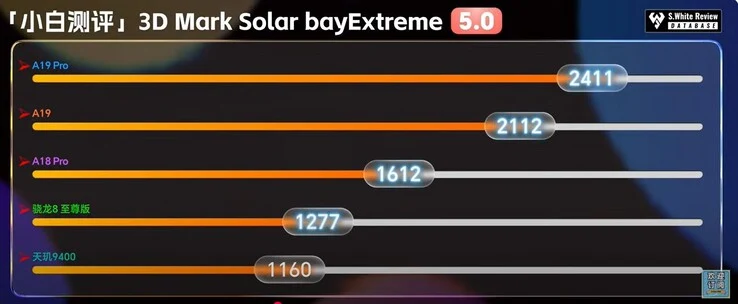
    4. The A19 Pro excels in ray-tracing tests, achieving a score of 2,411, a 50% improvement over the A18 Pro and outperforming competitors in this area.
    5. Overall, while the A19 Pro shows a 40% boost in GPU performance from the A18 Pro, it faces tough competition in raw performance from Snapdragon and Dimensity chipsets.


    Apple has launched the iPhone 17 Pro and iPhone 17 Pro Max, both powered by the new A19 Pro chipset. Recent hands-on evaluations by prominent reviewers have showcased the GPU capabilities of this new system on chip (SoC).

    Performance Scores

    According to Xiaobai’s Tech Reviews, the A19 Pro achieved a score of 6,557 on the 3DMark WildLife Extreme benchmark. In contrast, last year’s iPhone 16 Pro Max, which uses the A18 Pro, managed a score of 4,812 on the same test. This shows an impressive 35% increase in GPU performance between the two generations.

    Competitive Landscape

    Interestingly, even though the A19 Pro shows a remarkable improvement over its predecessor, it still trails behind competitors like the Dimensity 9400 and Snapdragon 8 Elite. The Dimensity 9400 and Snapdragon 8 Elite scored 7,003 and 7,156, respectively. This gap is expected to grow as the newer Dimensity 9500 and Snapdragon 8 Elite Gen 5 are set to launch next week.

    Ray Tracing and Other Tests

    On the other hand, the A19 Pro performs exceptionally well on demanding ray-tracing benchmarks like the Solar Bay Extreme test, where it scored 2,411 compared to the A18 Pro’s 1,612. This shows a 50% improvement. The Dimensity 9400 and Snapdragon 8 Elite fall short here too, with scores of 1,160 and 1,277, respectively.

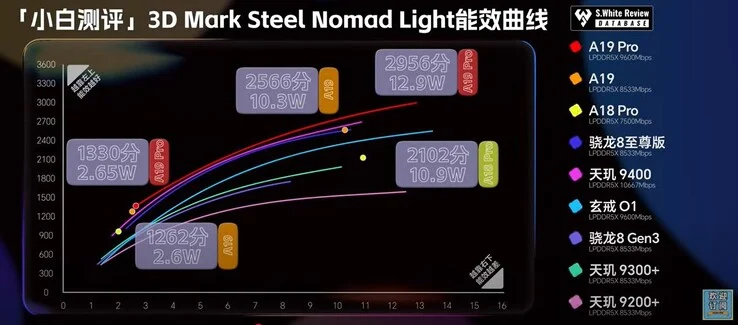
    In the Steel Nomad Light test, the A19 Pro recorded a score of 2,956, surpassing the A18 Pro’s score of 2,102, reflecting a 40% advantage. For reference, a Snapdragon 8 Elite device, the OnePlus 13 (buy on Amazon), scored 2,599, while the Vivo X200 Pro, which runs on the Dimensity 9400, scored 2,495.

    Conclusion

    To sum up, the A19 Pro provides roughly a 40% boost in GPU performance when compared to the A18 Pro from last year. However, when pitted against the Snapdragon 8 Elite and Dimensity 9400, there’s no clear winner due to the differences in benchmark performance, with the latter two exhibiting superior raw performance but lagging in ray-tracing capabilities.

    Source:
    Link


  • Apple A19 Pro GPU Leaked Benchmark Rivals M Series Chip Performance

    Apple A19 Pro GPU Leaked Benchmark Rivals M Series Chip Performance

    Key Takeaways

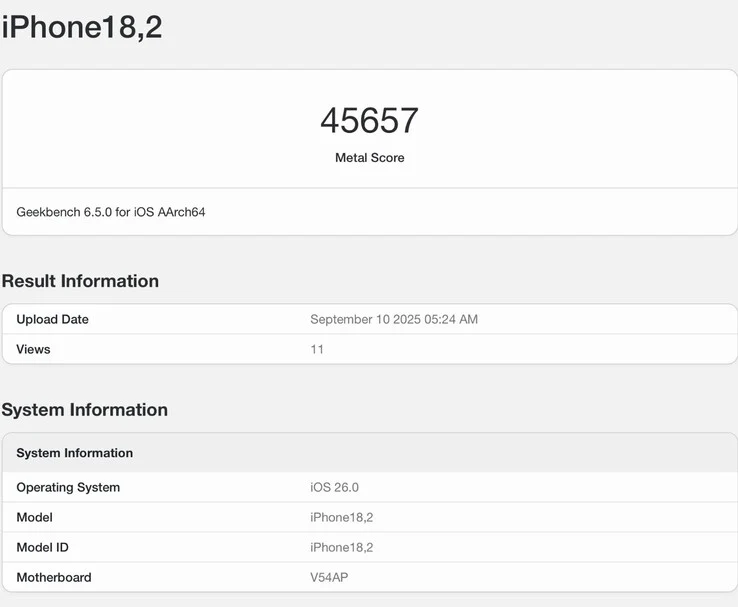
    1. The Apple A19 Pro chip in the iPhone 17 Pro shows a significant GPU performance boost with a Geekbench 6 Metal score of 45,657.
    2. The A19 Pro outperforms its predecessor, the A18 Pro, which scored 32,673, and is close to the iPad M2’s score of 45,862.
    3. The A19 Pro typically features a six-core GPU, while the iPhone Air version has a trimmed-down five-core GPU.
    4. The A19 Pro introduces a revised GPU architecture, enhancing performance for the Pro series devices.
    5. The improved GPU capabilities are expected to facilitate the introduction of more AAA games on Apple mobile devices.


    The GPU capabilities of the Apple A19 Pro found in the new iPhone Air, 17 Pro, and Pro Max have reportedly seen a significant enhancement this year, according to a leaked message. Recently, Vadim Yuryev (@VadimYuryev) shared on X (previously known as Twitter) the Geekbench 6 Metal score for the iPhone 17 Pro with the A19 Pro chip, acknowledging @jimmyjames_tech for discovering this information.

    Performance Scores Revealed

    In the post, a screenshot displays a Geekbench 6 GPU Metal score of 45,657. Vadim compared this to the A18 Pro, which received a score of 32,673, and the iPad M2 chip, which scored 45,862 in the identical test.

    Based on data from Notebookcheck, the A18 Pro logged 33,074 points, while the M2 chip had an average of 44,473 points in the Geekbench 6 GPU benchmark.

    CPU Insights

    We also recently touched on the leaked CPU performance details of the A19 and A19 Pro, which you can check out here. The A19 Pro generally features a six-core GPU, but the version in the iPhone Air is trimmed down to five GPU cores, similar to the standard A19. It employs a revised GPU architecture, consistent with the Pro series (iPhone 17 Pro and Pro Max).

    If the screenshots are accurate, the A19 Pro is poised to be a genuine game changer regarding GPU capabilities. With Apple likely to bring in more AAA games to its mobile devices, such impressive performance will be extremely advantageous.

    Source:
    Link


  • AMD RX 9080 XT ES vs RTX 5080 Super: A Potential Rivalry

    AMD RX 9080 XT ES vs RTX 5080 Super: A Potential Rivalry

    Key Takeaways

    1. The graphics card operates at game clock speeds between 3.4 to 3.7 GHz and features a 256-bit GDDR7 memory interface with up to 32 GB of VRAM options (16 GB and 24 GB also available).

    2. It shows a 28% average performance increase at 4K resolution over the RX 9070 XT, with certain workloads achieving up to a 45% boost, positioning it against the RTX 5080 Super and possibly the RTX 4090.

    3. The GPU is likely based on an enhanced Navi 48 architecture, focusing on higher clock speeds and memory bandwidth without major redesigns, and may utilize advanced TSMC process nodes.

    4. AMD may adopt a strategy similar to the Radeon VII, potentially delaying the RX 9080 XT ES launch until a favorable market opportunity arises or competitive pressure increases.

    5. The launch timing could depend on the readiness of FSR4 (Redstone) and other strategic factors to ensure a competitive high-end product.


    Internal AMD lab tests have indicated that the graphics card operates at game clock speeds ranging from 3.4 to 3.7 GHz. This GPU is equipped with a 256-bit GDDR7 memory interface, and it can come with memory configurations of up to 32 GB of VRAM. There are also 16 GB and 24 GB memory options available. In terms of power consumption, the card exceeds 450 watts when under load, with some versions going beyond 500 watts when overclocked.

    Performance Benchmarks

    Early benchmark information shared privately with Moore’s Law Is Dead suggests that the performance at 4K resolution shows an average increase of 28% over the RX 9070 XT, with certain workloads reaching up to a 45% boost. This performance level puts the RX 9080 XT ES in direct competition with the RTX 5080 Super and possibly even the RTX 4090, depending on how it is implemented and its final clock speeds. However, it’s important to note that this is all still speculative.

    Architecture Insights

    The GPU is likely based on an enhanced Navi 48 architecture, and it seems that AMD is not planning any drastic redesigns. Rather, the company appears to be focusing on achieving higher clock speeds and increased memory bandwidth while maintaining a conventional monolithic design. It may also utilize TSMC’s N4X or even N3X process nodes to reach the reported performance levels. AMD has publicly laid out a roadmap that includes N2X and 1.4 nm nodes for future CPUs, making the usage of advanced nodes likely.

    Strategic Decisions Ahead

    Moore’s Law Is Dead suggests that the RX 9080 XT ES might adopt a strategy akin to that of the Radeon VII, which utilized a die-shrunk version of Vega to proactively counter NVIDIA’s shift to 7 nm technology. However, AMD has not yet confirmed any plans for a launch. The engineering sample may stay within the company unless AMD finds a suitable market opportunity or faces competitive pressure that necessitates a release.

    The ultimate choice could depend on the readiness of FSR4 (Redstone) along with various strategic factors. Multiple sources point to AMD potentially waiting to launch the RX 9080 XT alongside enhanced upscaling technology to deliver a truly competitive high-end product.

    Source:
    Link

  • Snapdragon 8 Elite 2 Leak: 30% GPU Performance Boost Expected

    Snapdragon 8 Elite 2 Leak: 30% GPU Performance Boost Expected

    Key Takeaways

    1. Snapdragon 8 Elite 2 features a GPU cache increase from 12MB to 16MB, leading to a potential performance boost of around ±30%.
    2. The chip is expected to utilize Qualcomm’s next-gen custom Oryon cores, providing a CPU performance increase of about ±25%.
    3. It will have a 2+6 core setup, with benchmarks predicting around 3.8 million points on AnTuTu, showing a near 30% improvement over current Snapdragon 8 Elite devices.
    4. The new chip will support LPDDR5X and LPDDR6 memory types and will be based on the latest ARM v9 architecture.
    5. Qualcomm is using TSMC’s 3nm N3P process for manufacturing, similar to the technology for Apple’s upcoming A19 chip, with a possible announcement expected around October.


    The Snapdragon 8 Elite 2 is drawing attention even though it won’t be officially released for over a quarter. Today, it’s making waves again due to a recent leak that reveals some exciting advancements in CPU and GPU capabilities.

    CPU and GPU Enhancements

    Recent info has emerged from a trustworthy industry source, Digital Chat Station in China. This leak indicates that Qualcomm plans to increase the GPU cache from 12MB, as seen in the current Snapdragon 8 Elite, to 16MB for the Elite 2. This adjustment is reportedly linked to a performance increase of around ±30% in initial tests.

    Performance Specifications

    On the CPU front, the leak hints that Qualcomm’s next-generation custom Oryon cores could provide a performance boost of about ±25%. The chip is anticipated to consist of a 2+6 core setup, featuring two prime cores and six performance cores—details previously mentioned by the same source. Benchmarks suggest the Snapdragon 8 Elite 2 might achieve around 3.8 million points on AnTuTu, indicating a near 30% improvement over the highest scores from current devices using the Snapdragon 8 Elite.

    Memory and Manufacturing

    Moreover, the new chip is expected to be compatible with both LPDDR5X and LPDDR6 memory types. It will also support SME1 and SVE2 instruction sets, which means it will be based on the latest ARM v9 architecture. Qualcomm is reportedly using TSMC’s 3nm N3P process to manufacture the Snapdragon 8 Elite 2, which is also rumored to be the same technology used for Apple’s forthcoming A19 chip.

    While it’s premature for Qualcomm to officially announce the launch of the 8 Elite 2, based on previous patterns, an announcement might be expected around October.

  • Free Google Pixel Update Boosts GPU Performance for All Phones

    Free Google Pixel Update Boosts GPU Performance for All Phones

    Key Takeaways

    1. Android 16 will introduce a long-awaited desktop mode and may reduce boot times by up to 30%.
    2. Fingerprint authentication will be possible even when the Pixel’s screen is off.
    3. Significant GPU performance improvements have been observed in Pixel devices during benchmark tests.
    4. The performance boosts are primarily due to new GPU drivers from Android 15 QPR2, not Android 16.
    5. Performance increases will mainly benefit apps optimized for the Vulkan graphics API.


    The stable release of Android 16 is still a few months away. However, public beta versions have shown some exciting features that are on the horizon. For instance, it looks like Google’s long-awaited desktop mode may finally come with Android 16, along with a potential improvement that could cut boot times by as much as 30%. Additionally, the tech giant is also working on allowing fingerprint authentication even when a Pixel’s screen is off.

    Performance Improvements Spotted

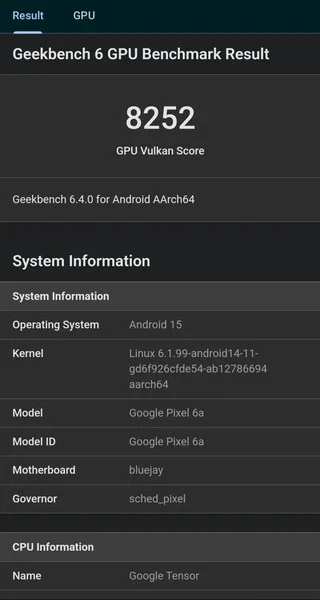
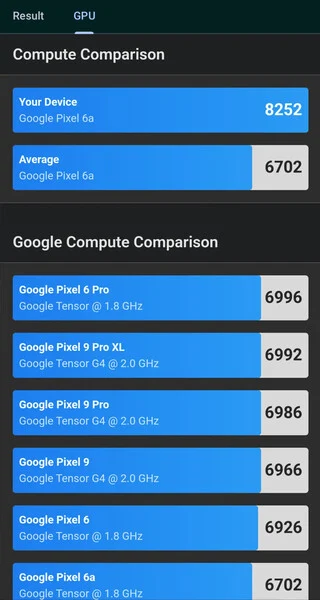
    In addition, users on Reddit have found significant enhancements in the Geekbench 6 GPU benchmark tests for various models, from the Pixel 6a all the way to the newest Pixel 9 Pro, which is currently priced at $849 on Amazon. Notably, the modest Pixel 7a has been seen performing on par with Google’s flagship devices. At first, this was credited to the advancements made in Android 16.

    New Findings Regarding Performance Gains

    That being said, Android Authority and others have found that these performance improvements are not actually linked to Android 16. Instead, this boost in performance appears to come from new GPU drivers that were reportedly released with Android 15 QPR2, which Google made available earlier this month. As a result, any Pixel device powered by Tensor should see a performance increase. However, this will mainly apply to apps that are optimized for the Vulkan graphics API, like Geekbench 6’s GPU benchmark test.

    Source:
    Link