Tag: Apple A19 Pro

  • Apple MacBook Neo 2: Touchscreen, Performance, and RAM Upgrades

    Apple MacBook Neo 2: Touchscreen, Performance, and RAM Upgrades

    Key Takeaways

    1. The MacBook Neo is the most affordable laptop in Apple’s lineup, priced at $599 on Amazon.
    2. It features a sturdy aluminum design, a bright 500 nits display, and a spacious multi-touch trackpad, which are rare in this price range.
    3. The current model is limited by 8 GB of RAM and the Apple A18 Pro chip, which is less powerful than competitors’ processors.
    4. The upcoming MacBook Neo 2 is expected to have a more powerful Apple A19 Pro chip and 12 GB of RAM, improving performance by 50%.
    5. The MacBook Neo 2 may include a touchscreen display and a macOS version optimized for touch, but its release is likely over a year away.


    The MacBook Neo, priced at $599 on Amazon, stands out as the most affordable laptop in Apple’s lineup. Featuring a sturdy aluminum unibody design, it boasts a bright 500 nits display and a spacious multi-touch trackpad. These characteristics are quite rare in laptops within this price bracket. However, it’s important to note that the Apple A18 Pro chip, which we recognize from the Apple iPhone 16 Pro, lags behind the processors from Intel, AMD, or Qualcomm typically found in similarly priced competitors.

    Limited RAM Capacity

    With just 8 GB of RAM, the MacBook Neo is not ideal for users with higher performance needs. Analyst Ming-Chi Kuo, through MacRumors, suggests that Apple plans to address these limitations in the upcoming second-generation MacBook Neo. This new version is expected to be powered by the Apple A19 Pro chip, which is also used in the iPhone 17 Pro. This upgrade will include 12 GB of RAM, providing a 50 percent increase over the current model.

    Exciting Features Ahead

    The forthcoming MacBook Neo 2 is rumored to come with a touchscreen display, with the touch layer integrated directly into the IPS panel, ensuring the device’s thickness remains unchanged. Following the launch of the MacBook Ultra, which will be the first MacBook to feature a touchscreen this fall, it is anticipated that a macOS version optimized for touch will be available when the MacBook Neo 2 is released. However, since it might be at least a year before the MacBook Neo 2 hits the market, and given that Apple’s plans can shift, it’s wise to take these rumors lightly.

    Ming-Chi Kuo, as reported by MacRumors, has provided these insights.

    Source:
    Link



  • Apple Studio Display XDR Delivers More Power Than MacBook Neo

    Apple Studio Display XDR Delivers More Power Than MacBook Neo

    Key Takeaways

    1. The MacBook Neo is a new MacBook series after ten years, featuring an Apple A18 Pro chip and 8 GB of RAM.
    2. Performance of the MacBook Neo is comparable to the M1 MacBook Air, which was released in 2020.
    3. The Apple Studio Display has an A19 chip, while the premium Studio Display XDR features the A19 Pro chip, similar to the iPhone 17 Pro.
    4. Details about memory and storage options for the new processors in the displays are still unclear.
    5. The new Studio Displays do not operate as smart monitors but introduce a feature called Desk View for video conferencing.


    The MacBook Neo is the first entirely fresh MacBook series in more than ten years. It comes equipped with an Apple A18 Pro chip and 8 GB of RAM, but its performance is roughly equivalent to that of the M1 MacBook Air, which is Apple’s basic laptop from 2020 and currently starts at $950 on Amazon.

    New Processor Insights

    Recently, MacRumors found some details about the processors in the code for the initial firmware update for the new Studio Display and Studio Display XDR. These discoveries indicate that the more budget-friendly Apple Studio Display is outfitted with an Apple A19 chip, which is more advanced and powerful than the one in the MacBook Neo. On the other hand, the premium Studio Display XDR boasts the Apple A19 Pro chip, the same as that found in the iPhone 17 Pro. However, the details about memory and storage options for these processors are still not clear.

    Smart Monitor Features

    Despite the impressive capabilities of these processors, Apple is not marketing either model of the Studio Display as a smart monitor that can independently operate streaming services or macOS. In the past, the Apple A13 Bionic in earlier Studio Displays allowed features like “Hey Siri” for connected Macs, as well as Center Stage for the built-in 12 MP webcam. The new displays at least bring in one novel capability that needs a bit more processing power: Desk View, which enables users to display their work area in front of the monitor and share it during video conferences.

    Source:
    Link


  • Exynos 2600 to Boost Galaxy S26 Ultra with Enhanced GPU and NPU

    Exynos 2600 to Boost Galaxy S26 Ultra with Enhanced GPU and NPU

    Key Takeaways

    1. The Exynos 2600 is Samsung’s upcoming SoC, with initial benchmarks showing mixed results compared to competitors like Apple and Snapdragon.
    2. The Exynos 2600’s NPU is reported to be 6 times faster than the Apple A19 Pro, with a 14% boost in multi-core CPU performance and a 75% increase in GPU performance.
    3. Recent Geekbench results indicate that the Exynos 2600 slightly outperforms Snapdragon 8 Elite Gen 6 in multi-core performance and beats it by 29% in GPU performance.
    4. Samsung may use the Exynos 2600 in select markets for the Galaxy S26 Ultra, despite historical concerns over Exynos chips compared to Snapdragon.
    5. The Exynos 2600 will be produced using Samsung’s SF2 node, making it the first 2 nm smartphone SoC, with production stability issues reportedly resolved.


    With the release of the Apple A19 Pro, MediaTek Dimensity 9500, and Snapdragon 8 Elite Gen 5, the only major player yet to make its appearance in the crowded smartphone SoC arena is Samsung’s Exynos 2600. Although initial leaked benchmarks haven’t looked too impressive, it’s understandable since the launch is still months away. Recently, a report has surfaced making some bold statements regarding its capabilities.

    Performance Expectations

    According to the report, the NPU of the Exynos 2600 is said to be an astonishing 6 times faster than that of the Apple A19 Pro, based on some undefined benchmarks. The chip is claimed to have a 14% boost in multi-core CPU performance and a significant 75% increase in GPU performance. The CPU improvement seems reasonable, especially since the Exynos 2600 is expected to feature ten CPU cores. Conversely, the GPU enhancements might be attributed to either an in-house GPU or AMD’s RDNA technology.

    Benchmark Insights

    In the latest Geekbench results for the Exynos 2600, it only slightly surpasses the Snapdragon 8 Elite Gen 6 in terms of multi-core performance. While the final version might perform a bit better, it reportedly beats Qualcomm’s chip by 29% on the GPU side. If the chip employs the Arm Lumex C1-Ultra as its main core, its single-core performance could potentially match that of the MediaTek Dimensity 9500.

    Regional Variations

    Initially, it was widely believed that the Galaxy S26 Ultra would be launched solely with the Snapdragon 8 Elite Gen 5 for Galaxy, just like its earlier models. However, new information suggests that Samsung might opt to use the Exynos 2600 in certain markets. This has raised some eyebrows in the community, considering Exynos chips have traditionally struggled against Snapdragon counterparts.

    Despite these worries, Samsung appears to have pushed the Exynos 2600 to operate at 85% of its peak potential, which could mean we are looking at a genuinely competitive chip this time around. As it will be produced using Samsung’s SF2 node, it is set to be the first 2 nm smartphone SoC in the world. Earlier this year, there were concerns about its stability and production yields, but it seems those issues have been resolved.

    Source:
    Link


  • Qualcomm Snapdragon 8 Elite Gen 5 vs Dimensity 9500 vs Apple A19 Pro Efficiency Comparison

    Qualcomm Snapdragon 8 Elite Gen 5 vs Dimensity 9500 vs Apple A19 Pro Efficiency Comparison

    Key Takeaways

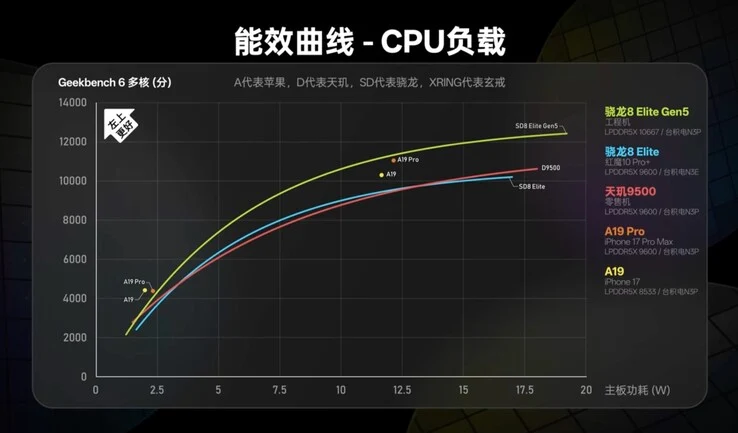
    1. Power Consumption: The Snapdragon 8 Gen 5 Elite uses 19 watts under full CPU load, compared to 12 watts for the Apple A19 Pro and 17 watts for the previous Snapdragon 8 Elite.

    2. Efficiency Comparison: The Snapdragon 8 Gen 5 Elite is more efficient than its predecessor and the MediaTek Dimensity 9500, which has 17% lower multi-core performance.

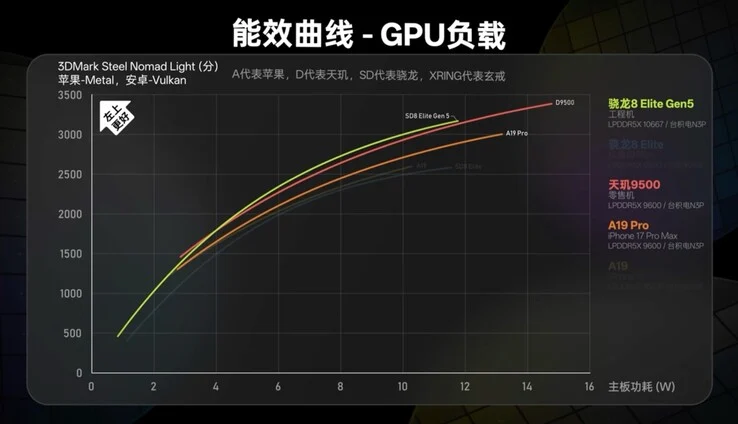
    3. GPU Performance: The Snapdragon 8 Gen 5 Elite requires around 12 watts for GPU tasks, consuming 1 to 3 watts less than the Apple A19 Pro and MediaTek Dimensity 9500 in the 3DMark Steel Nomad Light benchmark.

    4. Gaming Suitability: MediaTek’s top chip may be better suited for gaming, but initial tests show Qualcomm’s Snapdragon 8 Gen 5 Elite achieves slightly higher frame rates with similar power consumption.

    5. Core Count Advantage: The Snapdragon 8 Gen 5 Elite has eight cores, allowing it to perform better than the Apple A19 Pro, which has six cores, despite the latter’s efficiency.


    The Qualcomm Snapdragon 8 Elite Gen 5 was officially launched on Wednesday, and shortly after, we shared the first benchmark results. The YouTube channel Geekerwan has now provided more data on power usage, comparing performance and efficiency against the previous model, the Apple A19 Pro in the iPhone 17 Pro, and the new MediaTek Dimensity 9500.

    Power Consumption Insights

    The findings indicate that the Snapdragon 8 Gen 5 Elite uses about 19 watts when the CPU is fully loaded, while the Apple A19 Pro requires just 12 watts, and the Snapdragon 8 Elite consumes 17 watts. This shows that the new model is much more efficient compared to both its predecessor and the MediaTek Dimensity 9500, which lags behind in multi-core performance by 17%. The Apple A19 Pro is also efficient, but its lower clock speeds and six cores limit its performance compared to the eight cores of the Snapdragon 8 Gen 5 Elite, especially when more power can be used.

    GPU Performance Comparison

    In terms of GPU benchmarks, the situation shifts. The Snapdragon 8 Gen 5 Elite requires around 12 watts, which is 1 to 3 watts less than its rivals from Apple and MediaTek when tested in 3DMark Steel Nomad Light. In this benchmark, the performance of the Apple A19 Pro is still outperformed, while the MediaTek Dimensity 9500 shows better GPU performance than the Snapdragon 8 Gen 5 Elite.

    Gaming Suitability

    This could mean that MediaTek’s top chip is more appropriate for gaming smartphones. However, it’s uncertain if this holds true in real-world usage, as Geekerwan’s testing indicated that Qualcomm’s flagship chip achieved a slightly higher frame rate with nearly the same power consumption during an initial gaming test.

    Source:
    Link


  • Snapdragon 8 Elite Gen 5 vs Apple A19 Pro: Benchmark Comparison

    Snapdragon 8 Elite Gen 5 vs Apple A19 Pro: Benchmark Comparison

    Key Takeaways

    1. The Snapdragon 8 Elite Gen 5 shows significant performance improvements, narrowing the gap with Apple’s A19 Pro in single-core performance and outperforming it in multi-core benchmarks.
    2. It is 18% faster in single-core and 19% faster in multi-core performance compared to the Snapdragon 8 Elite, despite the core count remaining unchanged.
    3. The chip is built on TSMC’s N3P node, with potential for exceeding the 4,000 single-core score in Geekbench 6.4 with future devices.
    4. The Adreno 840 GPU exhibits notable gains, with performance increases of 16% to 39% across various benchmarks, although not as strong in 3DMark.
    5. The competition from Dimensity 9500’s Mali G1-Ultra and potential new GPU from Exynos 2600 indicates that Snapdragon 8 Elite Gen 5 may face challenges in the market.


    Prior Geekbench listings have given us a glimpse into how the Qualcomm Snapdragon 8 Elite Gen 5 compares to its previous versions. The improvement in performance is significant, as Qualcomm has finally narrowed the gap with Apple’s silicon. Recently, the company has shared some first-party benchmarks that provide a clearer picture of the chip’s performance capabilities.

    Performance Comparison

    In Geekbench, the Snapdragon 8 Elite Gen 5 competes closely with Apple’s A19 Pro in single-core performance, a situation that hasn’t been seen in several generations. In multi-core benchmarks, it even outperforms Apple silicon, which is expected due to its higher core count. Still, Qualcomm does better than its Android rivals, like the Dimensity 9500 (3,394/9,974) and Exynos 2600 (3,309/11,256), in single-core tests. It’s worth noting that these results came from pre-launch devices, so it’s wise to hold off on final judgments until more information is available.

    Impressive Improvements

    On the whole, the Snapdragon 8 Elite Gen 5 is 18% quicker than the Snapdragon 8 Elite in single-core performance and 19% faster in multi-core performance. These are remarkable stats, especially since the core count hasn’t changed between generations. Furthermore, the SoC is built on TSMC’s N3P node, which doesn’t offer a substantial increase in transistor density compared to N3E (the node used for the Snapdragon 8 Elite). There’s a strong possibility that the Snapdragon 8 Elite Gen 5 could surpass the 4,000 single-core mark in Geekbench 6.4 once additional devices are released.

    GPU Performance Gains

    The Adreno 840 GPU in the Snapdragon 8 Elite Gen 5 shows notable improvements compared to its predecessors, boasting a 16% gain in GFXBench 3.1 Manhattan ES Offscreen, 34% in Aztec Ruins Normal Tier Offscreen, and 39% in Aztec Ruins High Tier Offscreen. However, its performance in 3DMark is not as striking.

    That being said, the Dimensity 9500’s Mali G1-Ultra might pose a significant challenge this time around, as shown by an earlier benchmark leak. It’s still too soon to predict how the Exynos 2600 will perform, as it may introduce Samsung’s proprietary GPU rather than one based on AMD’s RDNA 3 architecture.


  • TSMC Raises N3P Node Prices by Up to 24% for Qualcomm, MediaTek

    TSMC Raises N3P Node Prices by Up to 24% for Qualcomm, MediaTek

    Key Takeaways

    1. Apple’s A19 and A19 Pro SoCs show significant performance improvements, especially in GPU capabilities, compared to previous generations.
    2. Qualcomm and MediaTek are set to release their high-end SoCs, Snapdragon 8 Elite Gen 5 and Dimensity 9500, which may challenge Apple’s A19 Pro.
    3. TSMC’s new N3P process has increased prices by 20%, impacting costs for MediaTek and Qualcomm, while Apple may benefit from better pricing due to its status as TSMC’s largest client.
    4. A projected 50% price hike for TSMC’s 2 nm process could lead to higher costs for flagship smartphone SoCs, affecting future device pricing.
    5. Upcoming flagship devices, including those from Vivo, Xiaomi, Oppo, and the Galaxy S26 series, may be priced higher due to increased manufacturing costs.


    With the unveiling of the A19 and A19 Pro SoCs, Apple has demonstrated a remarkable improvement in performance compared to previous generations, particularly in the GPU sector. Not wanting to fall behind, Android chip makers Qualcomm and MediaTek are preparing to launch their top-tier SoCs, the Snapdragon 8 Elite Gen 5 and the Dimensity 9500.

    Performance Comparison

    If the leaks regarding performance are accurate, the Apple A19 Pro may face stiff competition as both the Dimensity 9500 and Snapdragon 8 Elite Gen 5 seem to be exceptionally powerful. Nonetheless, Apple might have a significant edge in one key area: pricing.

    Cost Increases

    A recent report from China Times indicates that TSMC’s new N3P “3 nm” process node has seen a 20% price hike compared to the previous generation. Because of this increase, TSMC is reportedly charging MediaTek 24% more for the N3P than the last-gen, and Qualcomm is facing a 16% increase as well.

    The report doesn’t mention Apple, which leads us to think that either TSMC is not overcharging Apple or that Cupertino has negotiated a discount on the price hike and is paying significantly less than MediaTek and Qualcomm. Allegedly, Apple is TSMC’s largest client and, according to Taiwanese sources, is expected to account for 22-25% of TSMC’s total revenue by 2026. Thus, it seems reasonable that TSMC would offer Apple a more favorable deal than other chip manufacturers.

    Future Impacts

    In addition, TSMC is reportedly increasing the price of the 2 nm process node by “at least” 50% due to high research and development costs and yield issues. This will impact flagship smartphone SoCs next year, with unit costs potentially reaching up to $280. TSMC is also said to be offering no discounts or bargaining options.

    Smartphone manufacturers like Vivo, Xiaomi, and Oppo are gearing up to launch their latest flagship devices. These upcoming models, powered by the Qualcomm Snapdragon 8 Elite Gen 5 and MediaTek Dimensity 9500, might be priced higher than their predecessors.

    Outlook for Upcoming Flagships

    A similar trend could be expected for the Galaxy S26 series, which is anticipated to utilize both the Exynos 2600 and Snapdragon 8 Elite Gen 5 in the upcoming year.

    Lastly, if TSMC’s rumored 50% price increase for the 2 nm process node is accurate, then flagship devices launched in the latter half of 2026, like the Apple iPhone 18, are likely to carry a significant price premium over their last-gen versions. Therefore, if you’re considering an upgrade, now could be an excellent time, as many Android flagships are currently available at substantial discounts.

    Source:
    Link


  • Apple A19 Pro GPU Leaked Benchmark Rivals M Series Chip Performance

    Apple A19 Pro GPU Leaked Benchmark Rivals M Series Chip Performance

    Key Takeaways

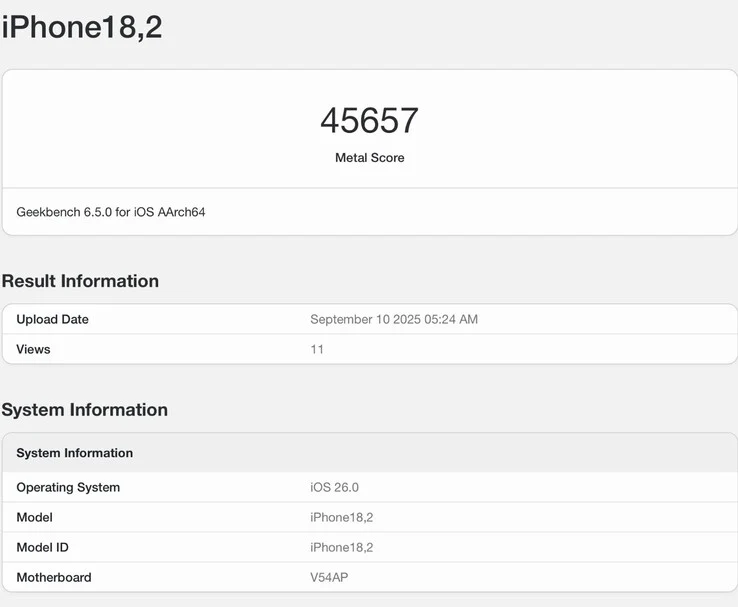
    1. The Apple A19 Pro chip in the iPhone 17 Pro shows a significant GPU performance boost with a Geekbench 6 Metal score of 45,657.
    2. The A19 Pro outperforms its predecessor, the A18 Pro, which scored 32,673, and is close to the iPad M2’s score of 45,862.
    3. The A19 Pro typically features a six-core GPU, while the iPhone Air version has a trimmed-down five-core GPU.
    4. The A19 Pro introduces a revised GPU architecture, enhancing performance for the Pro series devices.
    5. The improved GPU capabilities are expected to facilitate the introduction of more AAA games on Apple mobile devices.


    The GPU capabilities of the Apple A19 Pro found in the new iPhone Air, 17 Pro, and Pro Max have reportedly seen a significant enhancement this year, according to a leaked message. Recently, Vadim Yuryev (@VadimYuryev) shared on X (previously known as Twitter) the Geekbench 6 Metal score for the iPhone 17 Pro with the A19 Pro chip, acknowledging @jimmyjames_tech for discovering this information.

    Performance Scores Revealed

    In the post, a screenshot displays a Geekbench 6 GPU Metal score of 45,657. Vadim compared this to the A18 Pro, which received a score of 32,673, and the iPad M2 chip, which scored 45,862 in the identical test.

    Based on data from Notebookcheck, the A18 Pro logged 33,074 points, while the M2 chip had an average of 44,473 points in the Geekbench 6 GPU benchmark.

    CPU Insights

    We also recently touched on the leaked CPU performance details of the A19 and A19 Pro, which you can check out here. The A19 Pro generally features a six-core GPU, but the version in the iPhone Air is trimmed down to five GPU cores, similar to the standard A19. It employs a revised GPU architecture, consistent with the Pro series (iPhone 17 Pro and Pro Max).

    If the screenshots are accurate, the A19 Pro is poised to be a genuine game changer regarding GPU capabilities. With Apple likely to bring in more AAA games to its mobile devices, such impressive performance will be extremely advantageous.

    Source:
    Link


  • New iPad Mini, Apple TV with A17 Pro, and Studio Display 2 Coming Soon

    New iPad Mini, Apple TV with A17 Pro, and Studio Display 2 Coming Soon

    Key Takeaways

    1. The next-gen iPad mini will likely transition to the Apple A19 Pro chip, which will also be used in the iPhone 17 Pro and Pro Max.
    2. There is a possibility that the new iPad mini will feature an OLED display, but this has not been confirmed.
    3. The Apple TV 4K is expected to upgrade from the Apple A15 Bionic chip to the Apple A17 Pro, with potential changes to CPU or GPU cores.
    4. The Apple A17 Pro is anticipated to enhance gaming and introduce AI features for the Apple TV.
    5. A new Apple Studio Display is projected to debut in early 2026, with potential upgrades like mini-LED backlighting or an OLED display.


    MacRumors has gathered information regarding upcoming Apple devices from inside sources at the company. Starting with the anticipated next-gen iPad mini, these insiders reveal that the smallest tablet from Apple will transition from the Apple A17 Pro chip to the new Apple A19 Pro. This chip is also expected to be featured in the iPhone 17 Pro and iPhone 17 Pro Max. However, the exact release date for the new iPad mini is still uncertain.

    Potential OLED Display

    This upcoming iPad mini could be the first to feature an OLED screen. Earlier rumors hinted at Apple developing a mini tablet equipped with an OLED display, but it hasn’t been confirmed whether this enhancement will be included in the next iteration. On another note, the Apple TV 4K is likely to see an upgrade from the Apple A15 Bionic chip to the Apple A17 Pro, which has already been showcased in the iPhone 15 Pro. It’s also possible that Apple may opt to minimize the number of CPU or GPU cores in the streaming device.

    Enhanced Gaming and AI Integration

    The Apple A17 Pro is anticipated to provide improved gaming capabilities and support for Apple Intelligence, potentially allowing the Apple TV to introduce AI features for the first time. The next version of the Apple TV is expected to be released before the end of 2025. Lastly, MacRumors has found mentions of a new Apple Studio Display, which is projected to debut in early 2026. Despite the internal codenames “J427” and “J527,” MacRumors has yet to verify any specifics about the expected upgrades. However, it’s plausible that Apple will include mini-LED backlighting or even an OLED display in the Studio Display.

    Source:
    Link


  • MediaTek Dimensity 9500 Geekbench Score Shows Huge Single-Core Boost

    MediaTek Dimensity 9500 Geekbench Score Shows Huge Single-Core Boost

    Key Takeaways

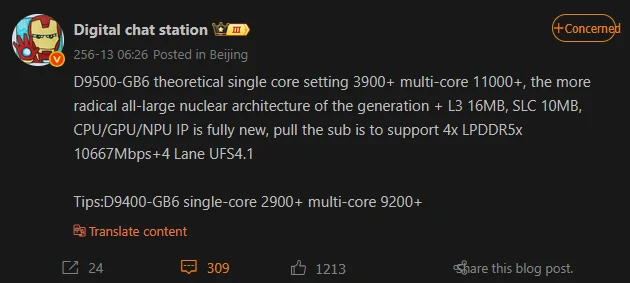
    1. The Dimensity 9500 is expected to score 3,900 in single-core and 11,000 in multicore Geekbench tests, showing competitive performance despite lagging behind Qualcomm and Apple’s chips.
    2. It features a 16 MB L3 cache and a 10 MB System Level Cache, along with LPDDR5X-10677 MT/s memory and support for four-lane UFS 4.1 storage.
    3. The Dimensity 9500 is projected to be 49% faster in single-core and 36% faster in multicore performance compared to its predecessor, the Dimensity 9400.
    4. These performance gains may indicate a significant redesign in Arm’s architecture, particularly with the new Cortex-X925 (Lumex).
    5. The Dimensity 9500 is anticipated to launch in late September, potentially setting new standards in high-performance mobile processors.


    Weibo leaker Digital Chat Station, or DCS for short, recently shared insights on how the Apple A19 Pro and Snapdragon 8 Elite 2 will stack up against their predecessors. With the future of the Exynos 2600 being unclear, the only major player left in the high-end smartphone SoC arena is MediaTek’s Dimensity 9500. If DCS’s predictions hold true, it may fall just short of its rivals.

    Performance Insights

    The Dimensity 9500 is said to achieve scores of 3,900 in Geekbench’s single-core tests and 11,000 in multicore tests. While the single-core score is a bit behind Qualcomm and Apple’s offerings, the multicore score indicates it remains relevant in the competitive landscape. It will feature a 16 MB L3 cache and a 10 MB System Level Cache (SLC) for the GPU and other components. For memory, it will utilize LPDDR5X-10677 MT/s modules. It’s also compatible with four-lane UFS 4.1 storage.

    Benchmark Comparisons

    As per our benchmark database, the Dimensity 9400 averages scores of 2,605 and 8,078 in Geekbench 6.4. If DCS’s figures are on point, the Dimensity 9500 is expected to be 49% faster in single-core performance and 36% faster in multicore performance. These projections are exceptionally high and nearly impossible to achieve with just a slight node upgrade (from TSMC N3E to N3P). This suggests that Arm has a significant redesign in the works with the Cortex-X925, now referred to as Lumex. Ideally, we should see the SoC make an appearance on a benchmarking platform before its anticipated launch in late September.

    Conclusion

    Digital Chat Station on Weibo has provided these updates, giving us a glimpse into the future of high-performance mobile processors. The advancements in the Dimensity 9500 could set a new standard in the market, making it an exciting development to watch as it approaches its release.

    Source:
    Link