
Key Takeaways
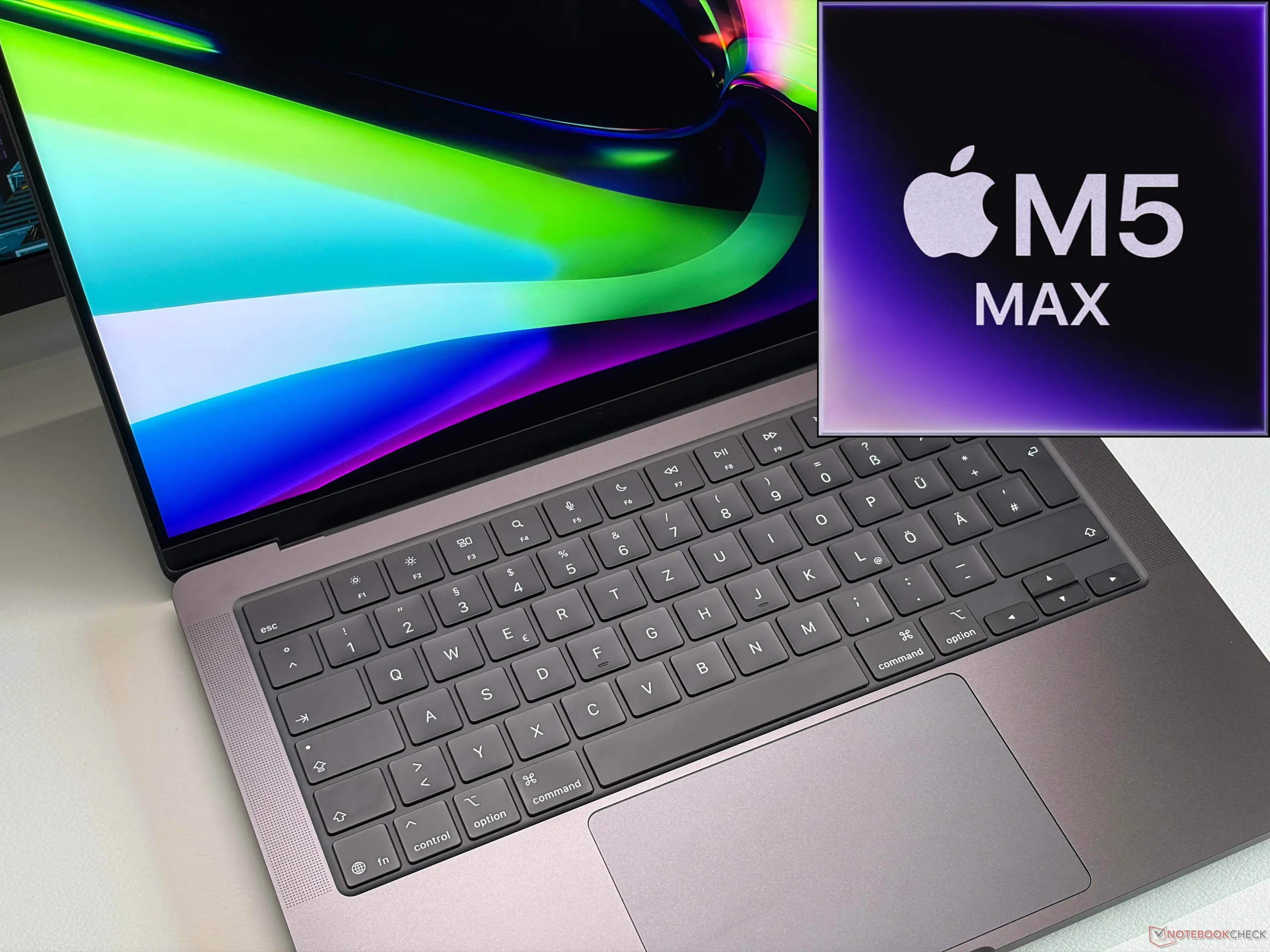
1. Apple has launched the M5 Max chip with 18 CPU cores and 40 GPU cores in the MacBook Pro 14, but the power adapter is inadequate.
2. In stress tests, the M5 Max peaks at 96 Watts briefly, stabilizing around 42 Watts, while the M5 Pro in the MacBook Pro 16 can draw 70W.
3. CPU and GPU stress tests show a drop in power consumption after initial peaks, with the GPU performance decreasing by about 10% under continuous workloads.
4. The MacBook Pro 16 is expected to outperform the 14-inch model, better utilizing the M5 Max GPU’s capabilities.
5. Future M6 chips are anticipated to use a 2 nm manufacturing process, which may require Apple to improve cooling solutions in MacBook designs.
Apple has introduced its latest powerful chip, the M5 Max, featuring 18 CPU cores and 40 GPU cores, in the compact MacBook Pro 14 that we just took a look at. Our evaluations revealed some problems, and we’ve already mentioned the inadequate power adapter.
Stress Test Findings
In our stress tests, the M5 Max (considering both CPU and GPU cores, excluding RAM) peaks at 96 Watts for a short duration of 1-2 seconds. After this burst, the chip drops rapidly to 46 Watts, but it can’t hold this level and eventually stabilizes around 42 Watts. The larger MacBook Pro 16 has an edge in this area, as the M5 Pro can draw 70W during stress tests, which is 66% more. This difference is clearly visible in the chart below (red indicates MacBook Pro 14 M5 Max; yellow represents MacBook Pro 16 M5 Pro).
CPU and GPU Performance
When only the CPU or GPU is under stress, similar patterns emerge. The CPU cores can briefly consume up to 75W but then fall back to about 50W. On the other hand, GPU stress can push consumption to 72W, which quickly drops to 55W and eventually stabilizes at 44W, even while using High Power mode. Under continuous workloads, the GPU performance also isn’t consistent, showing a decrease of around 10%. The MacBook Pro 16 seems likely to outperform the 14-inch model and fully showcase the capabilities of the new M5 Max GPU with its 40 cores, which we plan to test soon with a review unit.
Future Expectations
The current M5 generation still uses the well-known 3 nm manufacturing process (now in its third generation). We anticipate that the forthcoming M6 chips will transition to the 2 nm process at TSMC, which should enhance efficiency. However, these chips are becoming so powerful that Apple may need to rethink their MacBook designs, incorporating more effective cooling solutions. For more details, refer to our comprehensive review of the MacBook Pro 14 with M5 Max.
Leave a Reply