Tag: A19 Pro

  • Apple iPad Mini 8 Upgrades and Ongoing Issues with Older Models

    Apple iPad Mini 8 Upgrades and Ongoing Issues with Older Models

    Key Takeaways

    1. Apple is expected to launch the iPad mini 8 with an OLED display, following its plans to replace the iPad mini 7.
    2. The anticipated release date for the iPad mini 8 is in Q3 2026, while the iPad Air’s release is uncertain.
    3. The iPad mini 8 is rumored to feature an A19 Pro chipset, used in the iPhone 17 Pro models.
    4. The display size of the iPad mini 8 is expected to increase from 8.3 inches to 8.5 inches.
    5. The iPad mini 8 will maintain a 60 Hz refresh rate, which may result in a less impressive display experience compared to the iPhone 17.


    New information about Apple’s anticipated iPad mini 8 has surfaced online. This comes about a month after Bloomberg talked about Apple’s intentions to create a replacement for the iPad mini 7, which currently sells for $399 on Amazon. In essence, the article hinted that Apple would be introducing OLED display enhancements not only to the iPad mini but also to the larger iPad Air.

    Release Timeline

    As per the leaker Instant Digital on Weibo, Apple is likely to launch the iPad mini OLED first. Naver blogger yeux1122 claims this could happen in Q3 2026. On the other hand, Instant Digital mentions that there has been ‘no movement yet’ regarding the iPad Air. Therefore, it appears that the two devices won’t be released at the same time for now.

    Specifications and Features

    Additionally, yeux1122 points out that the iPad mini 8 will feature an A19 Pro chipset, which was introduced earlier this year in the iPhone 17 Pro and iPhone 17 Pro Max. Furthermore, the display size of the mini is rumored to increase from 8.3 inches to 8.5 inches when transitioning from the seventh to the eighth generation model.

    Sadly, even with the adoption of an LTPS OLED display, a 60 Hz refresh rate is expected to stay the same. This means that the iPad mini 8 may offer a somewhat less impressive display experience compared to the standard iPhone 17. Also, it remains uncertain whether Apple has decided on using native portrait or landscape orientations for its upcoming iPad mini as well.

    Source:
    Link



  • Apple A19 Pro Die Shot Reveals Smaller Chip with Subtle Design Changes

    Key Takeaways

    1. Apple has reduced the die area of its A19 Pro from 105 mm² to 98.6 mm² using TSMC’s advanced N3P node.
    2. The A19 Pro features six GPU cores and maintains a similar design structure to its predecessors, the A18 Pro and A17 Pro.
    3. MediaTek increased its die area to meet performance goals, while Qualcomm kept a similar die size.
    4. Future A20/A20 Pro models are expected to use TSMC’s N2 node with a gate-all-around design for higher transistor density.
    5. The advancements in SoC technology reflect ongoing improvements in performance and efficiency in semiconductor design.


    After sharing thorough teardowns of the Snapdragon 8 Elite Gen 5 and Dimensity 9500, semiconductor specialist @KurnalSalts has now revealed a detailed die image of Apple’s newest flagship SoC, the A19 Pro. MediaTek had to increase die area to comply with performance goals. Conversely, Qualcomm managed to maintain a similar die size.

    Apple’s Die Area Reduction

    In contrast, Apple has actually decreased its die area from 105 mm² to 98.6 mm². This achievement is largely due to utilizing TSMC’s advanced N3P node, which enables Apple to fit more transistors within the same space. The A19 Pro variant discussed here is the full version, featuring six GPU cores. Design-wise, not much has shifted, as the A19 Pro essentially retains the same structure as the A18 Pro (TSMC N3E) and A17 Pro (TSMC N3B) that came before it.

    Future Developments in SoC Design

    We might observe some variations in the forthcoming A20/A20 Pro, since it is anticipated to utilize TSMC’s N2 node – a first in using a gate-all-around design. This innovation will allow for even greater transistor density, which should lead to a significant boost in performance.


    Source:
    Link


  • iPhone 17 Pro Max AAA Gaming Test: Resident Evil 4 at 60 FPS

    iPhone 17 Pro Max AAA Gaming Test: Resident Evil 4 at 60 FPS

    Key Takeaways

    1. The A19 Pro chip in the iPhone 17 Pro Max features significant GPU upgrades, achieving benchmark scores similar to the M2 iPad Air.

    2. Real-world gaming tests show the A19 Pro consistently outperforms the A18 Pro, with smoother frame rates and improved thermal management.

    3. Games like GRID Legends and Resident Evil 2 demonstrate the A19 Pro’s capability to maintain higher frame rates compared to previous models, with GRID Legends achieving 60 FPS.

    4. The new vapor chamber cooling system in the A19 Pro helps manage temperatures better, reducing throttling issues common in previous Pro models.

    5. Despite improvements, many AAA titles still target 30 FPS, highlighting Apple’s ongoing challenge with a limited gaming library compared to other handheld devices.


    The A19 Pro chip that powers the iPhone 17 Pro Max includes major upgrades to the GPU. This was shown in a leaked set of benchmarks, where the A19 Pro achieved scores similar to the M2 iPad Air. Additionally, in a review video from popular YouTuber The Tech Chap, it was clear that the A19 Pro in the iPhone 17 Pro Max easily outperformed the previous year’s A18 Pro in the iPhone 16 Pro Max.

    Real-World Performance

    However, benchmarks are just one piece of the puzzle. To see how the chip performs in real-world situations, YouTuber MrMacRight tested 10 AAA games on Apple’s latest flagship, the iPhone 17 Pro Max, and the results were quite impressive.

    One of the first games he tested was GRID Legends. When running in performance mode, it achieved a smooth 60 FPS at a resolution of 1778 × 818 with dynamic resolution scaling. Frame pacing was steady, and thermal output remained within normal limits. MrMacRight noted that the iPhone 16 Pro Max often dropped closer to 50 FPS in similar conditions, making the A19 Pro’s consistent performance a clear upgrade.

    GPU Gains in Gaming

    Resident Evil 2 also showcased the GPU improvements. On the A19 Pro, the game reached almost 50 FPS at native 1080p, while the A17 and A18 Pro struggled to stay above 35 FPS. The YouTuber mentioned that switching to a 30 FPS preset improved frame pacing and graphics, but it did come with a sacrifice in responsiveness.

    When it came to Resident Evil 4, Apple’s latest chip showed its most significant advancements. By tweaking configuration files, MrMacRight managed to push the A19 Pro to nearly 60 FPS, though it wasn’t perfectly stable. More crucially, the updated vapor chamber cooling system helped keep temperatures in check, showing a thermal rating of “Fair” instead of “Serious,” which was common with the A18 Pro and A17 Pro where throttling issues were frequent. Previous Pro iPhones tended to overheat under similar loads.

    Strengths and Limitations

    On the contrary, Death Stranding pointed out both strengths and weaknesses. The game aims for 30 FPS at 720p with aggressive upscaling. On the A19 Pro, it consistently hit this target and ran cooler than the A17 Pro and A18 Pro. By experimenting with the configuration files and capping it at 60 FPS, the YouTuber demonstrated that the game could achieve up to 40 FPS, indicating potential for further optimization.

    Lastly, Assassin’s Creed Mirage offered a more realistic picture of gaming on the iPhone. The game is limited to 30 FPS and relies on upscaling, but with the new chip, it managed to maintain higher graphical quality. However, the YouTuber pointed out that this “high” preset isn’t quite the same as what is available on PC and consoles.

    In conclusion, these findings show that the A19 Pro marks a significant advancement for mobile gaming, particularly in sustaining stable performance without quick thermal throttling. Nonetheless, most AAA titles still target 30 FPS, and Apple’s ongoing challenge is its limited gaming library compared to other handheld devices like the Steam Deck or Nintendo Switch 2.

    For a more detailed look, including tests on Hitman, Sniper Elite 4, Subnautica, and more, you can check out MrMacRight’s complete video where he analyzes all ten games thoroughly.

    Source:
    Link


  • MediaTek Dimensity 9500 Benchmarks: GPU Outperforms A19 Pro

    MediaTek Dimensity 9500 Benchmarks: GPU Outperforms A19 Pro

    Key Takeaways

    1. MediaTek launched the Dimensity 9500 chipset to compete with Apple’s A19 Pro and Snapdragon 8 Elite Gen 5.
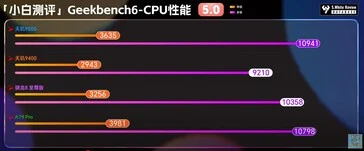
    2. In benchmark tests, the Dimensity 9500 scored 3,635 in single-core and 10,941 in multi-core performance, showing competitive results against the A19 Pro.
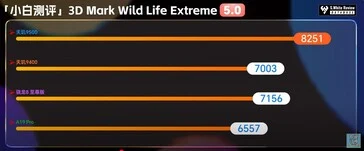
    3. The Dimensity 9500 has a significant advantage in GPU performance, scoring 8,251 in the 3DMark Wild Life Extreme test compared to the A19 Pro’s 6,557.
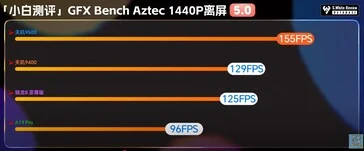
    4. In GFXBench’s Aztec 1440P test, the Dimensity 9500 achieved 155 FPS, while the A19 Pro only reached 96 FPS.
    5. The Dimensity 9500 benchmarks were performed on a reference design device, with smartphones using this chipset expected to launch in October.


    MediaTek introduced the Dimensity 9500 yesturday. This new high-end chipset is set to compete with Apple’s A19 Pro and the soon-to-be-released Snapdragon 8 Elite Gen 5. It has gone through multiple benchmarks to assess its performance against Apple’s latest chip.

    Benchmark Performance

    According to Xiaobai’s Tech Reviews, the Dimensity 9500 achieved a single-core score of 3,635 and a multi-core score of 10,941. In comparison, the A19 Pro scores 3,981 in single-core and 10,798 in multi-core tests. This suggests a kind of balance between the two chipsets, with Apple’s A19 Pro having a 10% edge in the single-core benchmark, but falling slightly behind in multi-core performance.

    GPU Comparison

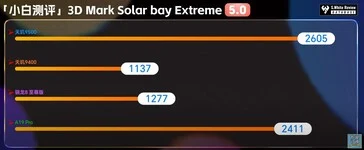
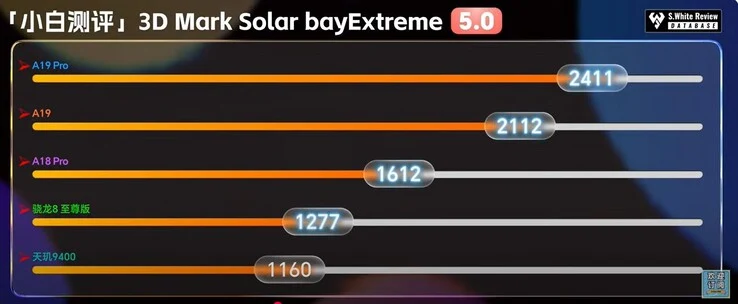
    When it comes to raw GPU power, the situation shifts significantly. The Dimensity 9500 reached a score of 8,251 on 3DMark’s Wild Life Extreme test, while the A19 Pro only managed 6,557—a notable 25% lead for the MediaTek chipset. Similar results appear in other GPU benchmarks too: in GFXBench’s Aztec 1440P test, the Dimensity 9500 performs at 155 FPS, whereas the A19 Pro lags at just 96 FPS. Even in more demanding tests like Solar Bay Extreme, the Dimensity 9500 outperforms with a score of 2,605 compared to the A19 Pro’s 2,411.

    Future Expectations

    It’s worth mentioning that these benchmarks were likely conducted using a reference design device for the Dimensity 9500, as there are currently no smartphones available that utilize this chipset. However, that is set to change in October, and it will be fascinating to observe how companies like Oppo and Vivo integrate MediaTek’s new chipset into their devices.

    Source:
    Link


  • Apple A19 Pro GPU Benchmarks Show 40% Upgrade Over A18 Pro

    Apple A19 Pro GPU Benchmarks Show 40% Upgrade Over A18 Pro

    Key Takeaways

    1. Apple has launched the iPhone 17 Pro and iPhone 17 Pro Max with the new A19 Pro chipset, showing significant GPU improvements.
    2. The A19 Pro scored 6,557 on the 3DMark WildLife Extreme benchmark, a 35% increase over the A18 Pro’s score of 4,812.
    3. Despite improvements, the A19 Pro still lags behind competitors like the Dimensity 9400 and Snapdragon 8 Elite, which scored 7,003 and 7,156, respectively.
    4. The A19 Pro excels in ray-tracing tests, achieving a score of 2,411, a 50% improvement over the A18 Pro and outperforming competitors in this area.
    5. Overall, while the A19 Pro shows a 40% boost in GPU performance from the A18 Pro, it faces tough competition in raw performance from Snapdragon and Dimensity chipsets.


    Apple has launched the iPhone 17 Pro and iPhone 17 Pro Max, both powered by the new A19 Pro chipset. Recent hands-on evaluations by prominent reviewers have showcased the GPU capabilities of this new system on chip (SoC).

    Performance Scores

    According to Xiaobai’s Tech Reviews, the A19 Pro achieved a score of 6,557 on the 3DMark WildLife Extreme benchmark. In contrast, last year’s iPhone 16 Pro Max, which uses the A18 Pro, managed a score of 4,812 on the same test. This shows an impressive 35% increase in GPU performance between the two generations.

    Competitive Landscape

    Interestingly, even though the A19 Pro shows a remarkable improvement over its predecessor, it still trails behind competitors like the Dimensity 9400 and Snapdragon 8 Elite. The Dimensity 9400 and Snapdragon 8 Elite scored 7,003 and 7,156, respectively. This gap is expected to grow as the newer Dimensity 9500 and Snapdragon 8 Elite Gen 5 are set to launch next week.

    Ray Tracing and Other Tests

    On the other hand, the A19 Pro performs exceptionally well on demanding ray-tracing benchmarks like the Solar Bay Extreme test, where it scored 2,411 compared to the A18 Pro’s 1,612. This shows a 50% improvement. The Dimensity 9400 and Snapdragon 8 Elite fall short here too, with scores of 1,160 and 1,277, respectively.

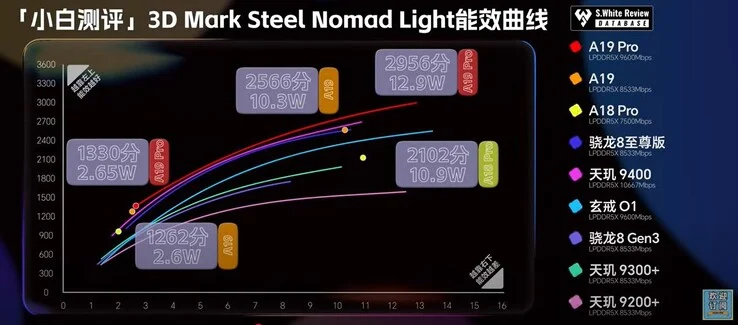
    In the Steel Nomad Light test, the A19 Pro recorded a score of 2,956, surpassing the A18 Pro’s score of 2,102, reflecting a 40% advantage. For reference, a Snapdragon 8 Elite device, the OnePlus 13 (buy on Amazon), scored 2,599, while the Vivo X200 Pro, which runs on the Dimensity 9400, scored 2,495.

    Conclusion

    To sum up, the A19 Pro provides roughly a 40% boost in GPU performance when compared to the A18 Pro from last year. However, when pitted against the Snapdragon 8 Elite and Dimensity 9400, there’s no clear winner due to the differences in benchmark performance, with the latter two exhibiting superior raw performance but lagging in ray-tracing capabilities.

    Source:
    Link


  • A19 Pro Benchmarks Reveal Snapdragon 8 Elite Gen 5 Limitations

    A19 Pro Benchmarks Reveal Snapdragon 8 Elite Gen 5 Limitations

    Key Takeaways

    1. The A19 Pro chipset shows only a modest CPU performance boost of about 20% over the A18 Pro.
    2. Despite the limited performance increase, the A19 Pro is still the most powerful chipset available.
    3. Geekbench scores for the A19 Pro are 4,019 (single-core) and 11,015 (multi-core).
    4. The upcoming Snapdragon 8 Elite Gen 5 may achieve similar scores but is unlikely to surpass the A19 Pro.
    5. Benchmark results may vary, with some reports indicating lower multi-core scores around 9,700 due to testing conditions.


    Apple’s latest A19 Pro chipset is being viewed as not providing a major boost in CPU performance compared to the previous A18 Pro. Nevertheless, this Apple system-on-chip (SoC) remains the most powerful available, and new insights suggest that its status may persist for a while.

    Performance Metrics

    According to Geekbench, the A19 Pro has achieved a single-core score of 4,019 and a multi-core score of 11,0154 when tested on the iPhone 17 Pro Max. These results indicate a roughly 20% enhancement over the A18 Pro’s performance from our evaluations last year. Interestingly, a tipster known as Digital Chat Station mentioned that the forthcoming Snapdragon 8 Elite Gen 5 might also reach scores around 4,000 and 11,000 in similar tests, implying that Qualcomm’s chipset might struggle to surpass Apple’s offering.

    Benchmark Realities

    Of course, this hypothesis relies heavily on whether this particular Geekbench result accurately reflects the A19 Pro’s capabilities. However, this seems improbable as many other entries show a multi-core score closer to 9,700. It’s likely that the benchmark was conducted under controlled conditions with cooling methods in place to reduce throttling effects.

    Source:
    Link


  • iPhone Air Battery Life Praised for No SIM Card Slot Impact

    iPhone Air Battery Life Praised for No SIM Card Slot Impact

    Key Takeaways

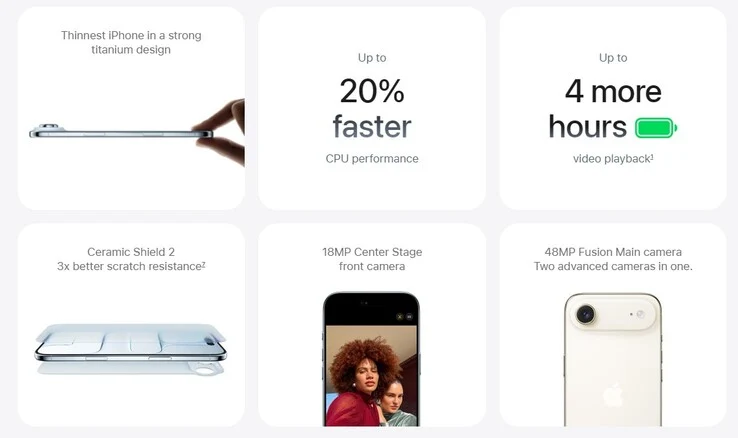
    1. All-Day Battery Life: The iPhone Air promotes an impressive battery life with four additional hours of video playback compared to the iPhone 15 Pro.

    2. Slim Design with High Capacity: At only 0.22 inches thick, the iPhone Air houses a 3,149 mAh battery, addressing previous concerns about battery performance in compact phones.

    3. Innovative Engineering: Apple created the iPhone Air with a new “plateau” design, integrating advanced technologies like the A19 Pro chipset and high-density battery solutions.

    4. Enhanced Battery Technology: The iPhone Air utilizes a “high-density” battery, allowing for more efficient space usage, particularly by adopting an eSIM-only format to free up room for additional battery cells.

    5. Performance Parity: Despite its slim profile, the iPhone Air’s battery performance matches that of the iPhone 16 Pro, achieving up to 27 hours of video playback.


    Apple promotes the iPhone Air as having a battery life that lasts “all-day,” boasting four extra hours of video playback compared to the iPhone 15 Pro.

    Focus on Battery Life

    This strong emphasis on the iPhone Air’s battery performance in advertisements is clearly aimed at alleviating worries about the longevity of Apple’s slimmest iPhone to date.

    At a mere 0.22 inches (5.64 mm) thick, the iPhone Air has a battery capacity of 3,149 mAh, while earlier compact models haven’t been known for their battery prowess.

    Innovative Design and Technology

    Apple claims to have created the iPhone Air entirely from the ground up, successfully incorporating “multiple technologies” into the brand new “plateau” design. This likely includes the Apple A19 Pro chipset, a 48MP Fusion camera, and the new 18 MP Center Stage front camera, as well as connectivity features like eSIM and 5G modem.

    According to Apple, the centralized layout of the iPhone Air’s components has created space for a “high-density battery,” which probably refers to the silicon carbon electrode technology that many Chinese phone manufacturers have started using in recent years. For example, in phones like the foldable Oppo Find N5, this technology has boosted cell energy density by adding a remarkable 6% silicon, allowing for a massive 5,600 mAh battery in one of the slimmest devices available.

    Evolving Battery Technology

    It seems Apple has taken a similar approach with the “high-density” battery in the iPhone Air, concentrating all other components within the camera plateau. Tim Cook recently revealed another innovative strategy that Apple employed to ensure an all-day battery life for the iPhone Air.

    To begin with, Apple was able to allocate more space for the iPhone Air’s larger battery by using its latest A19 Pro chipset instead of the A19 chip found in the iPhone 17. Built on TSMC’s third-generation 3nm process, the A19 Pro provides higher transistor density, allowing for better performance in the same space or maintaining the same performance in a more compact size. For the iPhone Air, Apple likely opted for the latter, also freeing up more space by omitting the physical SIM card slot and tray.

    As Tim Cook explained, transitioning to an eSIM-only format for the iPhone Air permitted Apple to utilize every available space below the components in the camera plateau for battery cells, even in the area where the SIM card slot would have been located.

    While Apple is cautious not to draw direct comparisons between the iPhone Air’s battery life and that of the iPhone 17 Pro, the 27 hours of video playback achieved in tests far exceed what one might expect from its 0.22-inch titanium frame. This performance aligns with the battery life of the iPhone 16 Pro, even with the thinner design and larger ProMotion display.

    The impressive battery life of the iPhone Air seems to stem from the successful extension of the battery into areas that were previously occupied by the physical SIM card, as Tim Cook highlighted while praising the features of its first iPhone without a SIM card slot.

    Source:
    Link


  • iPhone 17 Pro’s A19 Pro Outperforms A18 Pro in AnTuTu Test

    iPhone 17 Pro’s A19 Pro Outperforms A18 Pro in AnTuTu Test

    Key Takeaways

    1. Apple has launched the iPhone 17 Pro models featuring the new A19 Pro chip, which shows only minor enhancements compared to the A18 Pro.
    2. The A19 Pro chip maintains the same architecture as its predecessor, including a 6-core CPU, 6-core GPU, and 16-core Neural Engine.
    3. Initial benchmarking results show a slight performance increase of about 4%, largely due to an upgrade from 8 GB to 12 GB of RAM.
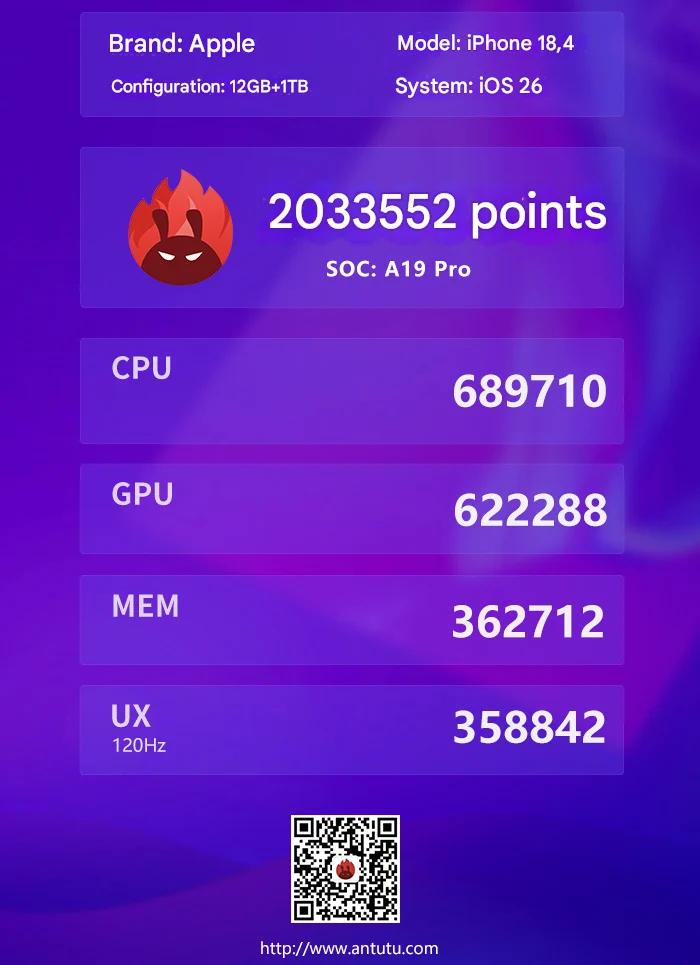
    4. The iPhone 17 Pro achieved an AnTuTu score of 2,033,552, with a notable memory score improvement of nearly 49% over the iPhone 16 Pro.
    5. The CPU score for the A19 Pro has decreased by 5.5% compared to the A18 Pro, suggesting no significant CPU performance boost is expected.


    Apple has launched the iPhone 17 Pro models, bringing several enhancements compared to the previous versions. One notable upgrade is the new A19 Pro chip. Nevertheless, there isn’t a significant difference when looking at it alongside the A18 Pro. Specifically, the latest SoC maintains the same setup as its forerunner, which includes a 6-core CPU, a 6-core GPU, and a 16-core Neural Engine.

    Performance Claims

    While Apple touts the A19 Pro as the “most powerful iPhone chip ever,” this claim largely stems from its adjustments and the vapor chamber it uses. Regarding actual performance, initial Geekbench results reveal only a minor enhancement, and an AnTuTu benchmark listing echoes this finding.

    Benchmarking Results

    AnTuTu has noted that the A19 Pro in the iPhone 17 Pro has been tested on their platform. The first benchmark results indicate that the SoC has achieved an overall score of 2,033,552 points. In contrast, the A18 Pro from the iPhone 16 Pro scored 1,954,677 in AnTuTu’s database.

    In essence, this indicates a roughly 4% increase in overall score, primarily attributed to the upgrade from 8 GB of RAM to 12 GB. Specifically, the breakdown of the AnTuTu score shows that the iPhone 17 Pro received a memory score of 362,712, which is nearly a 49% improvement over the memory score of 242,810 recorded for the iPhone 16 Pro.

    Future Considerations

    Curiously, the CPU score for the A19 Pro has dropped by 5.5% in comparison, which could be because it’s an initial benchmark score. Later AnTuTu benchmarks might provide a more favorable score. However, since the overall configuration mirrors that of the A18 Pro, there are no expectations for a dramatic CPU performance boost compared to its predecessor. For more details about the new Apple iPhone SoC, check out our launch coverage on AnTuTu’s Weibo.

    Source:
    Link


  • Apple A19 and A19 Pro CPU Benchmarks Show Minor Performance Gain

    Apple A19 and A19 Pro CPU Benchmarks Show Minor Performance Gain

    Key Takeaways

    1. Apple introduced the iPhone 17 series with A19 and A19 Pro chipsets, but no major performance enhancements are expected.
    2. The A19 Pro chipset in the iPhone 17 Pro Max shows a 10% increase in CPU performance compared to the A18 Pro.
    3. The standard iPhone 17 uses the A19 chipset, which is about 7% stronger than the previous iPhone 16.
    4. Benchmark scores for the new devices are preliminary and may change with further testing.
    5. Apple appears to have focused on improvements beyond just CPU performance for the iPhone 17 series.


    Apple introduced the iPhone 17 series yesterday, along with the A19 and A19 Pro chipsets that power them. As mentioned before, it is not anticipated that the new chipsets will bring major enhancements in performance, and initial CPU benchmarks seem to support this view.

    Benchmark Scores

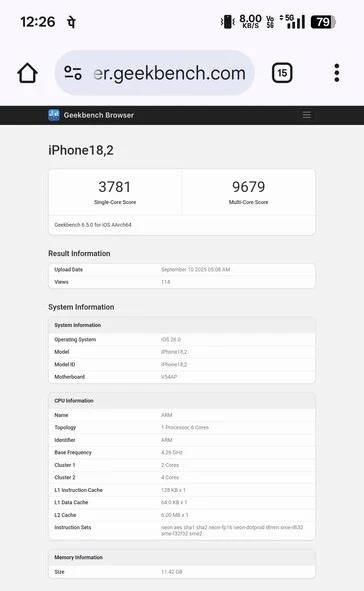
    According to reports from Geekbench, the Apple A19 Pro found in the iPhone 17 Pro Max achieves a single-core score of 3,781 and a multi-core score of 9,679. In comparison, the previous A18 Pro in last year’s iPhone 16 Pro Max scored 3,479 and 8,568 on the same tests. This suggests an approximate 10% increase in CPU performance for the new chipset.

    Standard Model Performance

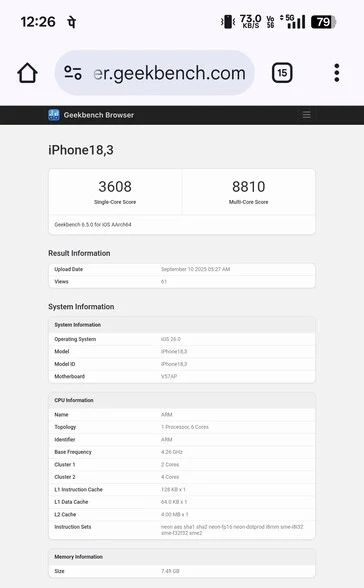
    The regular iPhone 17 is powered by the A19 chipset, unlike its more advanced counterparts which utilize the A19 Pro. Last year, the A18 was only marginally slower than the A18 Pro in terms of CPU performance, and this trend seems to continue. The basic iPhone 17 achieves a score of 3,608 in the single-core test and 8,810 in the multi-core test. When compared to the iPhone 16, which recorded 3,377 and 8,362 in our assessments, the A19 and iPhone 17 appear to be roughly 7% stronger.

    Future Benchmarking

    It’s worth mentioning that these benchmarks are still preliminary and not fully verified for Apple’s latest devices. More reliable scores are likely to emerge in the days ahead, and we intend to put all four models of the iPhone 17 series through our extensive in-house testing. Until then, it seems that Apple has included significant improvements in areas other than just raw CPU performance.

    Source:
    Link


  • iPhone 17 Air Expected to Feature Pro-Level Specifications

    iPhone 17 Air Expected to Feature Pro-Level Specifications

    Key Takeaways

    1. Apple may introduce the iPhone 17 Air to replace the Plus model, making it the slimmest iPhone yet.
    2. The iPhone 17 Air is expected to feature the A19 Pro SoC and 12 GB of RAM, competing with Pro models in certain areas.
    3. It will likely have a single 48MP rear camera, a 2,800 mAh battery, and one speaker, sacrificing some features for a thinner design.
    4. The iPhone 17 Air is anticipated to be priced between the standard iPhone 17 and the iPhone 17 Pro.
    5. All details about the iPhone 17 series remain speculative, pending official announcements from Apple.


    Apple is gearing up to make changes with its upcoming iPhone 17 series, likely introducing an iPhone 17 Air to take the place of the Plus model. This new Air version is said to be the slimmest iPhone yet. For some time, there have been rumors about its reduced specifications, but recent leaks suggest that it could compete with the Pro variants in more areas than earlier thought.

    Specifications Leaked

    The latest scoop comes from a popular leaker, Fixed Focus Digital, who shared details on Weibo. According to this source, the iPhone 17 Air will sport the A19 Pro SoC along with 12 GB of RAM, mirroring the specs of the iPhone 17 Pro and iPhone 17 Max. Initially, it was thought that the Pro SoC would only be available in the Pro and Max variants, but this leak changes that narrative. However, the Air will have a different GPU configuration, featuring a five-core GPU instead of the six cores found in its Pro and Max counterparts. Meanwhile, the basic iPhone 17 is expected to have the A19 chip and 8 GB of RAM.

    Compromises Made for Slimmer Design

    In addition to these specifications, the iPhone 17 Air is likely to have several trade-offs. Reports indicate it will include a single 48MP rear camera, a modest 2,800 mAh battery even with the Silicon-Carbon technology, and just one speaker. These compromises aim to achieve a lighter and thinner design, which Apple believes most users might not prefer. Regarding its dimensions, the phone is anticipated to measure only 5.5 mm thick (with a 9.5 mm thickness around the camera bump).

    Pricing Expectations

    Concerning the pricing, the iPhone 17 Air is expected to be positioned between the standard iPhone 17 and the iPhone 17 Pro, aligning with its role as a successor to the Plus model. It’s important to note that Apple hasn’t confirmed any details about the iPhone 17 series yet, so all of this remains speculative. Nevertheless, several industry experts and insiders have echoed similar information regarding the iPhone 17 Air, lending some credibility to these claims.

    In conclusion, the iPhone 17 Air is shaping up to be a unique addition to Apple’s lineup, but we’ll have to wait for official announcements to see how everything pans out.

    Source:
    Link