

Key Takeaways
1. Apple introduced the iPhone 17 series with A19 and A19 Pro chipsets, but no major performance enhancements are expected.
2. The A19 Pro chipset in the iPhone 17 Pro Max shows a 10% increase in CPU performance compared to the A18 Pro.
3. The standard iPhone 17 uses the A19 chipset, which is about 7% stronger than the previous iPhone 16.
4. Benchmark scores for the new devices are preliminary and may change with further testing.
5. Apple appears to have focused on improvements beyond just CPU performance for the iPhone 17 series.
Apple introduced the iPhone 17 series yesterday, along with the A19 and A19 Pro chipsets that power them. As mentioned before, it is not anticipated that the new chipsets will bring major enhancements in performance, and initial CPU benchmarks seem to support this view.
Benchmark Scores
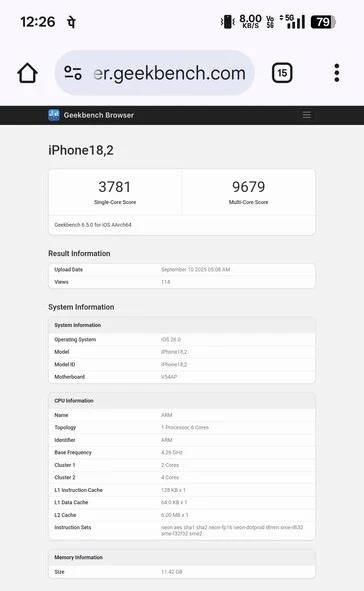
According to reports from Geekbench, the Apple A19 Pro found in the iPhone 17 Pro Max achieves a single-core score of 3,781 and a multi-core score of 9,679. In comparison, the previous A18 Pro in last year’s iPhone 16 Pro Max scored 3,479 and 8,568 on the same tests. This suggests an approximate 10% increase in CPU performance for the new chipset.
Standard Model Performance
The regular iPhone 17 is powered by the A19 chipset, unlike its more advanced counterparts which utilize the A19 Pro. Last year, the A18 was only marginally slower than the A18 Pro in terms of CPU performance, and this trend seems to continue. The basic iPhone 17 achieves a score of 3,608 in the single-core test and 8,810 in the multi-core test. When compared to the iPhone 16, which recorded 3,377 and 8,362 in our assessments, the A19 and iPhone 17 appear to be roughly 7% stronger.
Future Benchmarking
It’s worth mentioning that these benchmarks are still preliminary and not fully verified for Apple’s latest devices. More reliable scores are likely to emerge in the days ahead, and we intend to put all four models of the iPhone 17 series through our extensive in-house testing. Until then, it seems that Apple has included significant improvements in areas other than just raw CPU performance.
Source:
Link

Leave a Reply