Tag: iPhone 17 Pro Max

  • Apple iPhone 17 Pro Max magnetic back panel with T-Rex tooth

    Key Takeaway

    – Caviar’s Magnetic Custom Collection offers a magnetic titanium back cover for the iPhone 17 Pro Max, not a full phone.
    – The panel sits flush with the camera bump, maintaining uniform thickness but adding bulk to the device.
    – Most variants feature crocodile leather and decorative jewels; the top-tier “Relict” includes white alligator leather and a real T-Rex tooth fragment.
    – Wireless charging and MagSafe accessories likely require removing the panel due to the titanium build.
    – Prices range from $1,630 to $4,490, making the cover alone cost more than the iPhone itself.


    Luxury Back Panels for Apple’s Latest

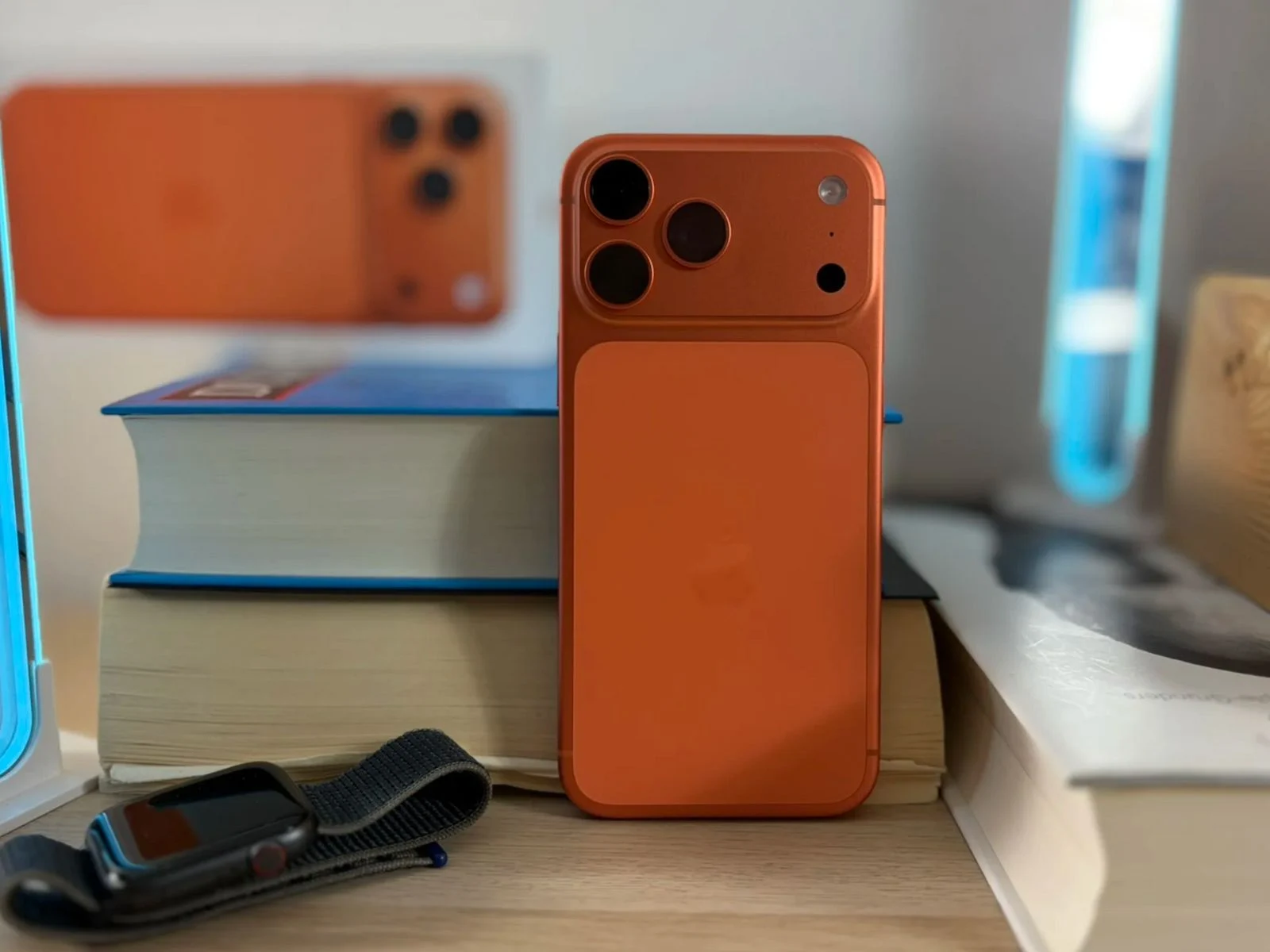
    Caviar is best known for its luxury versions of popular flagship smartphones. The Magnetic Custom Collection is now taking a different approach: instead of selling a smartphone with an elaborately designed case, Caviar has created just a back cover that can be magnetically attached to the back of an Apple iPhone 17 Pro Max ($1,429 on Amazon) via MagSafe.

    Materials and Design Details

    This back panel is made of titanium, and a PVD coating gives the metal a silver, gold, or black finish, dependant on the version. The panel is exactly thick enough to sit flush with the iPhone 17 Pro Max’s cameras – while this does make the smartphone thicker in many areas, it at least maintains a uniform thickness across the entire surface. Four of the five variants feature crocodile leather and decorative jewels, and differ from one another primarily in there color schemes.

    The Exotic and The Prehistoric

    The most expensive version, which Caviar calls “Relict,” features white alligator leather instead, while the small triangle beneath the camera module is said to contain a fragment of a real T-Rex tooth, though it is very small. Since the back covers are made of titanium, neither wireless charging nor MagSafe accessories are likely to work without first removing this panel.

    Pricing and Availibility

    The Caviar Magnetic Custom series of back covers for the Apple iPhone 17 Pro Max are now available directly from Caviar. Depending on the design, these back covers cost between $1,630 and $4,490.


    Sources

  • iPhone 17 Pro Max: Watch-Inspired Luxury Smartphone

    iPhone 17 Pro Max: Watch-Inspired Luxury Smartphone

    Key Takeaway

    – Caviar’s “Master of Time” editions embed removable luxury Swiss watches (Patek Philippe or IWC) into the iPhone 17 Pro Max.
    – The smartphone cases use premium materials like white gold, diamonds, and 4.5-billion-year-old meteorite.
    – The “Protugieser” model features 300 white diamonds and 47 orange sapphires.
    – Caviar’s customizations likely disable MagSafe and wireless charging.
    – The phones are available exclusively through Caviar’s online store, with prices only on request.


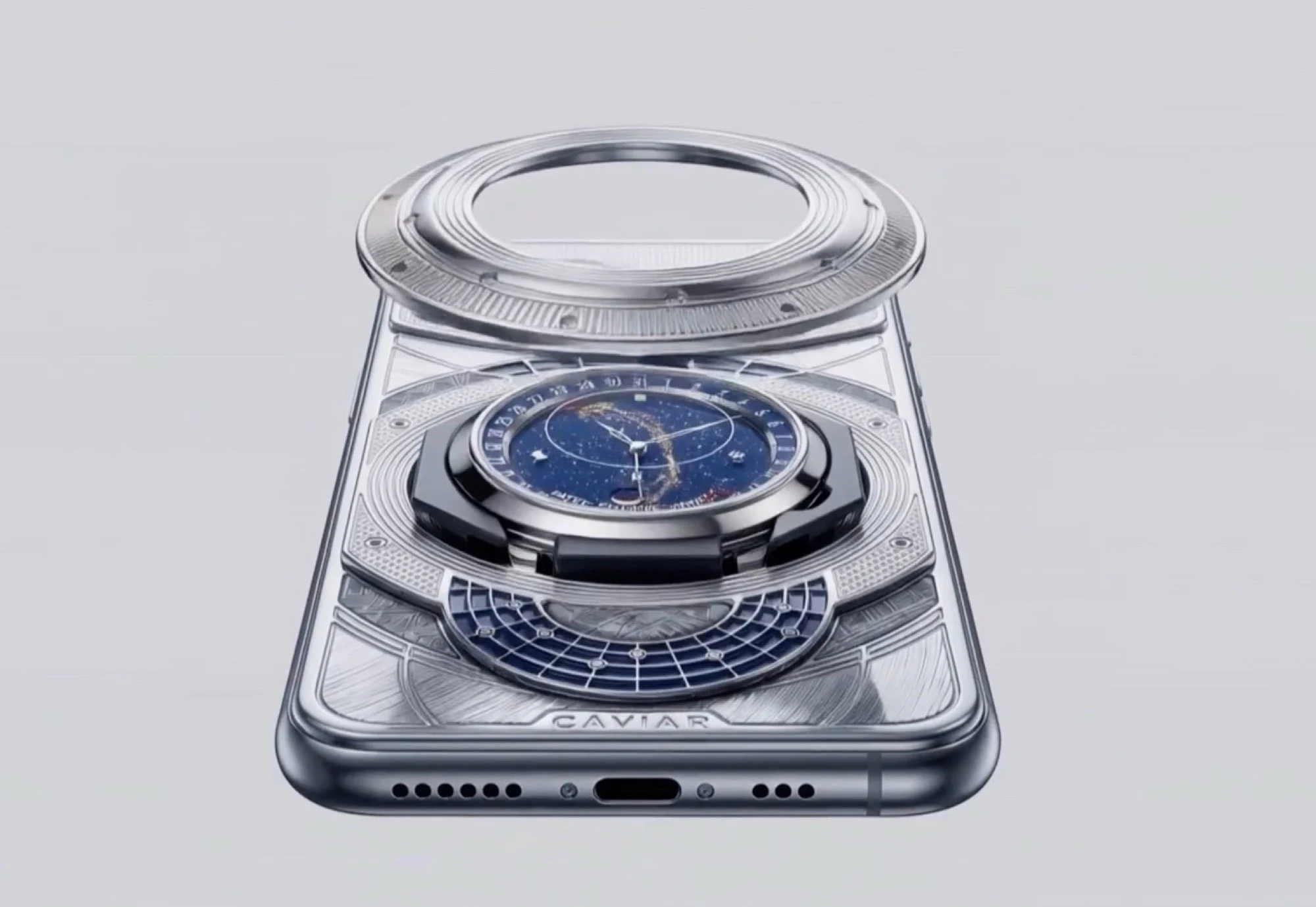
    Caviar regularly launches luxury versions of mainstream smartphones on the market, but the “Master of Time” collection is extravagant even by Caviar standards. The two new special editions of the Apple iPhone 17 Pro Max ($1,397 on Amazon) feature a genuine luxury watch from Switzerland under a glass cover on the back.

    Celestial Edition with a High-End Timepiece

    The Apple iPhone 17 Pro Max “Celestial” houses a Patek Philippe Celestial. The watch can be removed from the smartphone in a few simple steps so that it can be worn on the wrist. The case of the smartphone is partly made of white gold and is set with diamonds. Parts of the back are made from a 4.5 billion year old meteorite, which is said to have a special surface structure.

    Portugieser Model and Its Dazzling Design

    The second model in the series is called Apple iPhone 17 Pro Max “Protugieser”, as the back houses an IWC Portugieser Tourbillon Mystère Squelette. The design of the smartphone was inspired by the watch and therefore uses white gold. Caviar sets the iPhone 17 Pro Max with 300 white diamonds and 47 orange sapphires. As usual, neither MagSafe nor wireless charging are likely to work due to Caviar’s customizations.

    • The Apple iPhone 17 Pro Max in the two new “Master of Time” editions is now available at Caviar’s online store.
    • The smartphones can also be purchased in a bundle with the matching watch.
    • Caviar will only confirm prices on request.
    Sources
  • Samsung Galaxy S26 Ultra Beats iPhone 17 Pro Max in Geekbench 6

    Samsung Galaxy S26 Ultra Beats iPhone 17 Pro Max in Geekbench 6

    Key Takeaways

    1. The Samsung Galaxy S26 Ultra will be revealed on February 25th, showcasing impressive performance scores from Geekbench 6 tests.
    2. It achieves a multi-core score of 11,738 and a single-core score of 3,852, outperforming the iPhone 17 Pro Max by 19.36%.
    3. The Galaxy S26 Ultra uses a faster “for Galaxy” version of the Snapdragon 8 Elite Gen 5 chip, leading to significant performance improvements over the S25 Ultra.
    4. Expected features include a new Privacy Display, a 5,200 mAh battery, and enhanced camera capabilities.
    5. The launch will coincide with new versions of Galaxy Buds and Buds Pro, increasing competition against the iPhone 17 Pro and Pixel 10 Pro.


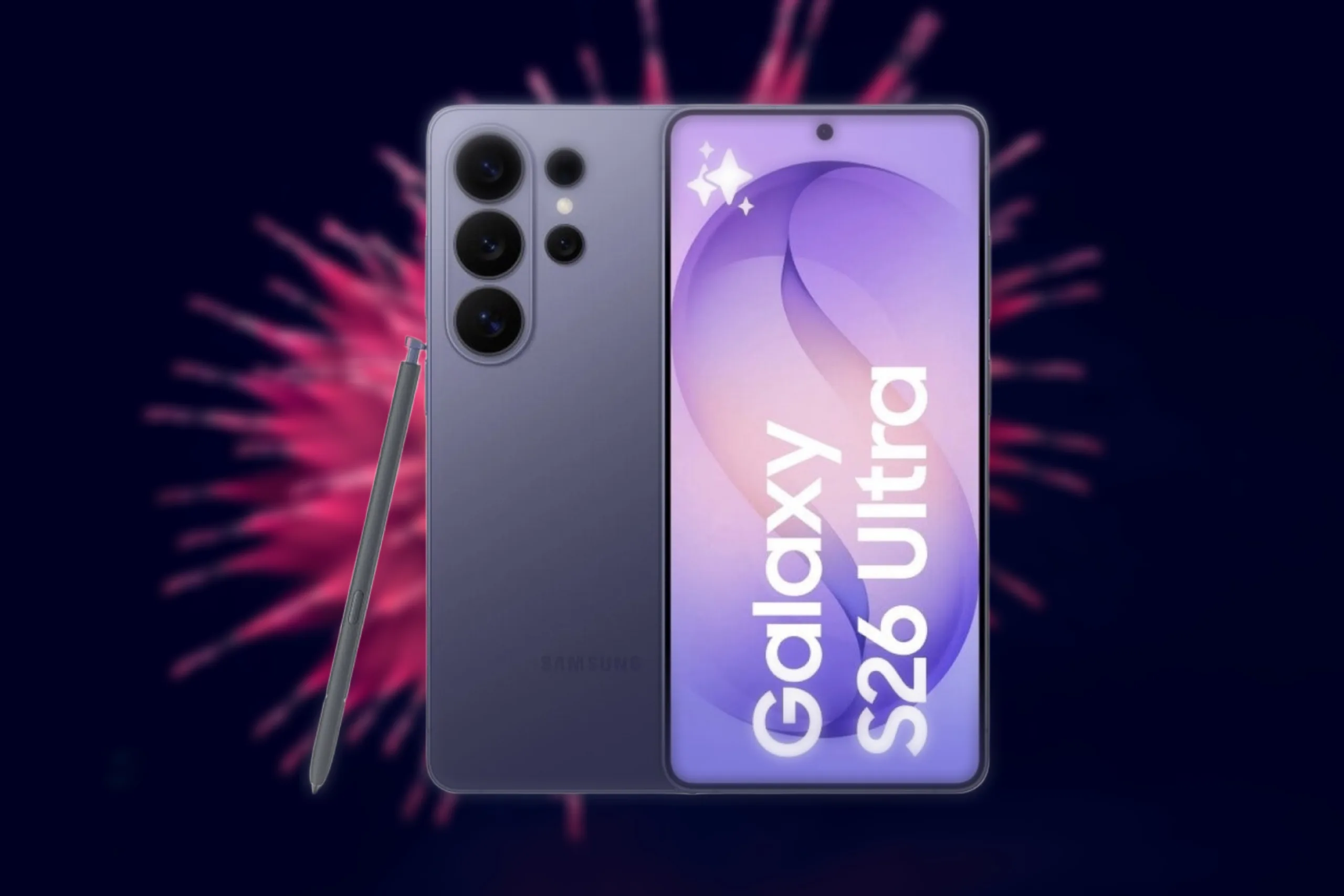
    The Samsung Galaxy S26 Ultra is just days away from its big reveal, and recent leaks of Geekbench 6 tests are making this anticipation even more exciting. The latest results show that the S26 Ultra, powered by the Snapdragon 8 Elite Gen 5, has reached impressive performance scores.

    Performance Scores

    With a staggering multi-core score of 11,738 and a single-core score of 3,852, the Galaxy S26 Ultra outshines its main competitor, the iPhone 17 Pro Max with the Apple A19 Pro, by a significant 19.36%. The single-core results closely mirror those of the A19 Pro, which is not surprising.

    Competitive Edge

    Furthermore, the S26 Ultra’s scores surpass many other devices that also use the Snapdragon 8 Elite Gen 5. This is largely because it employs the faster “for Galaxy” version of the chip, which includes P-cores that can reach enhanced boost clocks. When compared to last year’s Galaxy S25 Ultra, the advancements are remarkable, showing improvements of up to 24% in single-core performance and 33% in multi-core performance.

    Launch Details

    Scheduled to launch on February 25th, the Galaxy S26 Ultra will be unveiled alongside new versions of Galaxy Buds and Galaxy Buds Pro, intensifying competition against the iPhone 17 Pro and the Pixel 10 Pro (currently priced at $1,099 on Amazon). According to various credible sources, the S26 Ultra is anticipated to feature the mentioned SoC, a new Privacy Display aimed at keeping nosy onlookers at bay, a robust 5,200 mAh battery, and some incremental camera enhancements.

    Source:
    Link


  • Tomb Raider iOS Test: iPhone 17 Pro Max vs. 7-Year-Old iPhone X

    Tomb Raider iOS Test: iPhone 17 Pro Max vs. 7-Year-Old iPhone X

    Key Takeaways

    1. Mobile gaming on Apple devices is growing, with popular PC and console games like Red Dead Redemption and Tomb Raider being adapted for iOS and iPadOS.

    2. Tomb Raider will launch on Apple devices on February 12, 2026, featuring various graphical settings and performance modes optimized for different iPhone and iPad models.

    3. Performance modes aim for different frame rates: 30 FPS in Battery Saver mode, 60 FPS on newer iPhones, and up to 120 FPS on certain iPad Pro models, with some limitations due to thermal issues.

    4. Older devices like the iPhone XS are limited to Graphics and Battery Saver modes, maintaining stable performance but with lower resolutions and frame rates.

    5. The performance of Tomb Raider on iOS is compared to other platforms, showing how newer iPad Pro models can achieve higher frame rates and better stability during gameplay.


    Mobile gaming on Apple devices has seen a significant rise recently, with many well-known PC and console games being released on iOS and iPadOS. Among the notable titles is Rockstar’s Red Dead Redemption, which has been adapted for iPhones and iPads. This was soon followed by the open-world game Where Winds Meet, which launched on iPhone, iPad, and certain high-end Android devices.

    Tomb Raider’s Mobile Launch

    In a similar vein, another classic series is transitioning to mobile, as Tomb Raider is set to be released on Apple devices on February 12, 2026. This marks another instance of major gaming experiences moving to mobile platforms. Popular YouTuber MrMacRight, who has previously reviewed high-end games on iPhones and iPads, has provided an early preview of Tomb Raider’s performance on these devices.

    Performance and Graphics Settings

    In his video, the creator notes that the iOS and iPadOS versions of Tomb Raider offer various graphical settings and post-processing features. The Battery Saver mode limits performance to 30 FPS, while the Graphics preset aims for 30 FPS but can achieve up to 40 FPS on certain iPad Pro models like the A12X, A12Z, M1, and M2. The performance mode seeks to reach 60 FPS on iPhone 11 and newer models, with the M4 and M5 iPad Pro variants potentially hitting 120 FPS. The game also features a built-in benchmark tool and does not use dynamic resolution scaling, as Feral Interactive has mentioned CPU-related performance limitations.

    Gameplay Experience on Different Devices

    As per MrMacRight, in Performance mode, Tomb Raider runs at a lower internal resolution of 2151 × 990 on the iPhone 17 Pro Max and 1482 × 683 on the iPhone 15 Pro while aiming for 60 FPS. He reports that the iPhone 17 Pro Max maintains a stable 60 FPS throughout extended gaming sessions without noticeable throttling, while the iPhone 15 Pro experiences occasional frame rate drops in more demanding scenes due to thermal buildup.

    The YouTuber further explains that in Performance mode, the iPhone 12 Pro can achieve 60 FPS during lighter scenes but heats up quickly and experiences more frequent performance drops, reaching a “serious” thermal state almost immediately after starting the game. In Graphics mode, the iPhone 17 Pro Max targets native resolution at a locked 30 FPS, using about 1.5 GB of RAM. The absence of a 120 FPS option on these iPhones is attributed to frame-time constraints, as maintaining such frame rates would require frame times of around 8 ms or less, which were not observed, suggesting that pushing for higher frame rates could lead to throttling.

    Older Devices and Performance Testing

    On older iPhones like the iPhone XS, classified as vintage by Apple, Tomb Raider is restricted to Graphics and Battery Saver modes, with no access to Performance mode. In Graphics mode, the game runs at a resolution of 1632 × 753, generally maintaining a stable 30 FPS, although some scenes may cause frame drops. Despite having 4 GB of RAM, peak memory usage stays below 1 GB, indicating stable performance on the A12 chipset.

    Meanwhile, on the 11-inch M4 iPad Pro, MrMacRight observes that Tomb Raider operates in Performance mode at an internal resolution of 1621 × 1117, supporting frame rates up to 120 FPS. He reports that this device maintains stable 120 FPS during long gameplay sessions and benchmark tests without any noticeable throttling.

    Comparisons and Further Testing

    The creator also mentions that older M-series iPad Pro models, including the M1, usually target 60 FPS in Performance mode, with an optional Performance Plus setting that reduces resolution for better frame rates. In Graphics mode, M4 and M5 iPad Pro models run the game at native resolution aiming for 60 FPS, while older models operate at 40 FPS, maintaining stable performance even in graphically intense scenes.

    MrMacRight also compares how Tomb Raider performs on iOS with its performance on Mac, PS3, PS4, and Switch 2, and examines how the game runs on the M3 iPad Air. For a detailed look at the mobile performance of the game, you can check out the full video linked below.

    MrMacRight via YouTube

    Source:
    Link



  • iPhone 17 Pro Leads Early Sales; Top 3 Best-Selling Models Revealed

    iPhone 17 Pro Leads Early Sales; Top 3 Best-Selling Models Revealed

    Key Takeaways

    1. The iPhone 17 Pro Max accounts for 27% of early sales in the iPhone 17 series, highlighting strong demand for Apple’s premium models.
    2. Together, the Pro models (iPhone 17 Pro and Pro Max) make up 52% of total early sales, a significant increase from 39% in the iPhone 16 series.
    3. The standard iPhone 17 holds a 22% share, indicating it remains popular among general consumers.
    4. The iPhone Air has only captured 6% of early sales, suggesting challenges in marketing this fourth model effectively.
    5. Features like larger screens, better cameras, and longer battery life are more appealing to buyers than sleek design or mid-range options.


    New sales information released by Consumer Intelligence Research Partners (CIRP) shows that customers are more and more choosing Apple’s top-tier iPhones, with the iPhone 17 Pro Max standing out as the most favored model in the series.

    Sales Breakdown

    As per the findings, the iPhone 17 Pro Max makes up 27% of the initial sales of the iPhone 17 series, with the iPhone 17 Pro not far behind at 25%. Together, the Pro models now account for 52% of total early sales, which is a significant rise from the iPhone 16 series, where both Pro and Pro Max models only represented 39% of the sales.

    In contrast, the standard iPhone 17 holds a 22% share, remaining a strong choice for general consumers. However, the report also reveals Apple’s ongoing difficulties in effectively marketing a fourth model. The iPhone Air, despite being highly publicized during its launch, only makes up 6% of early sales, falling short of the iPhone 16 Plus, which captured 8% in the same timeframe last year.

    Historical Context

    Looking back at the iPhone 16 series, the iPhone 16 Pro Max was the top seller with 23%, followed by the iPhone 16 and the iPhone 16 Pro, which both stood at 21% and 16%, respectively. The changes seen in the iPhone 17 series imply that buyers are increasingly willing to invest more for Apple’s premium models, even though the design and materials have sparked some discussions. However, as previously noted, the aluminium body and new vapor chamber technology in the iPhone 17 Pro series deliver enhanced thermal efficiency, particularly beneficial for gaming.

    The data suggest that features usually linked with the Pro lineup, such as bigger screens, advanced cameras, and longer battery life, continue to be more important for many buyers than factors like sleekness or mid-range positioning. At the same time, Apple’s efforts to introduce a high-end option below the Pro range seem to appeal to a much smaller segment of the market.

    Sales Trends

    While CIRP’s statistics show early sales instead of long-term trends, the pattern reflects a recurring theme Apple has observed over the past few generations: strong demand for Pro and Pro Max models, consistent interest in the standard iPhone, and variable success for other options placed in the middle.

    CIRP – Apple Report

    Source:
    Link


  • Vivo X300 Pro Named Best Camera Phone of 2025 in Blind Test

    Vivo X300 Pro Named Best Camera Phone of 2025 in Blind Test

    Key Takeaways

    1. The blind camera test featured 12 top smartphones, including the iPhone 17 Pro Max and Galaxy S25 Ultra, with voting for daytime and low-light photography.
    2. The iPhone 17 Pro Max and Pixel 10 Pro XL both achieved 67% of the votes in their initial matchups, while the Nothing Phone (3) surprisingly eliminated the Huawei Pura 80 Ultra.
    3. In the second round, the Pixel 10 Pro XL advanced by defeating the iPhone, and the Nothing Phone (3) shocked many by eliminating the Galaxy S25 Ultra with 86% of the votes.
    4. The final round saw the Vivo X300 Pro narrowly win against the Pixel 10 Pro XL, with 47% of the votes compared to the Pixel’s 45%.
    5. The Vivo X300 Pro was ultimately declared the best camera phone of 2025, based on the results of the blind test conducted by the Versus community.


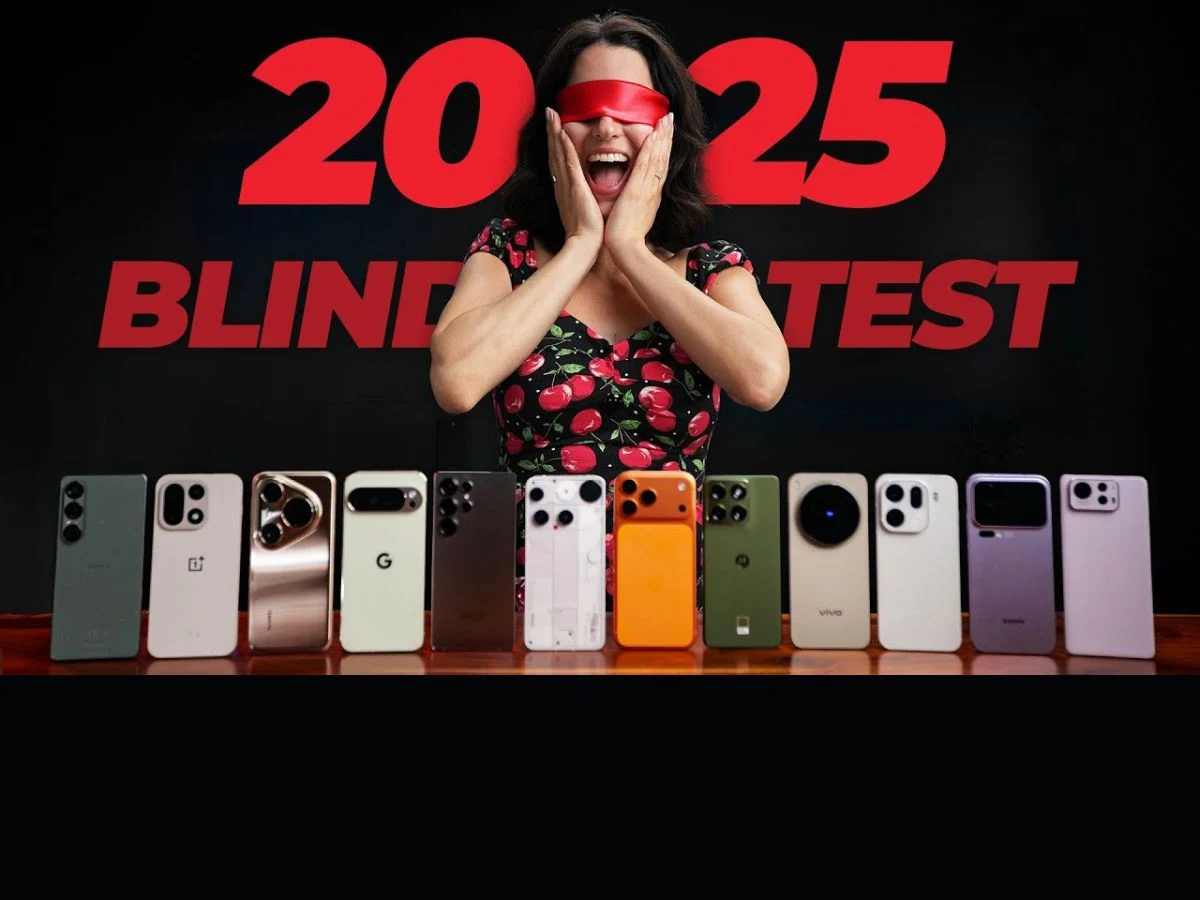
    Versus has released the results of its blind camera test for the end of the year, featuring 12 top-tier smartphones: iPhone 17 Pro Max, Galaxy S25 Ultra, Pixel 10 Pro XL, Sony Xperia 1 VII, OnePlus 15, Xiaomi 17 Pro Max, Asus Zenfone 12 Ultra, Oppo Find X9 Pro, Vivo X300 Pro, Motorola Edge 70, Huawei Pura 80 Ultra, and the Nothing Phone (3).

    The Test Format

    The blind test was conducted by pairing the phones into six matchups, allowing fans to vote on which device should move forward. Voting was divided into two photography categories: daytime shots and low-light photography.

    Matchups and Surprises

    In the first pairing, the iPhone 17 Pro Max triumphed over the Xiaomi 17 Pro Max, garnering 67% of the votes. Following Apple’s trend, the Pixel 10 Pro XL also achieved 67% of the votes, while the OnePlus 15 only managed a lowly 33%. A big shocker happened during the fourth test, where the Nothing Phone (3) eliminated the cutting-edge Pura 80 Ultra.

    Advancing Rounds

    In the opening test of the second round, the Pixel secured 65% of the votes, eliminating the iPhone from the contest. In another surprise, the Nothing Phone (3) took down the Galaxy, receiving 86% of the votes. The final match of this round had the X300 Pro (currently priced at $1,099 on Amazon) sending the Asus flagship packing.

    The Final Clash

    During the final round, the impressive run of the Nothing Phone (3) came to an abrupt halt, as it only captured 8% of the votes. The Vivo X300 Pro emerged victorious in a close finish, claiming 47% of the votes, while the Pixel had to settle for 45%. After extensive reviews, we also declared the Vivo X300 Pro as the top camera phone of 2025.

    Please note that these blind tests were conducted with input from the Versus community and not by professional photographers. Additionally, they were quite limited, focusing solely on the primary camera.

  • Where Winds Meet Mobile: Performance on iPhone 17 Pro Max vs. M5 iPad Pro vs. Nubia RedMagic 11 Pro

    Where Winds Meet Mobile: Performance on iPhone 17 Pro Max vs. M5 iPad Pro vs. Nubia RedMagic 11 Pro

    Key Takeaways

    1. Where Winds Meet Mobile is a challenging game requiring high-end hardware, featuring open-world settings and real-time combat.
    2. The performance evaluation compared the iPhone 17 Pro Max, Nubida RedMagic 11 Pro, and M5 iPad Pro, all tested at maximum graphics settings.
    3. The iPhone 17 Pro Max and RedMagic 11 Pro both average 60 FPS, but the iPhone shows better frame-rate stability, while the RedMagic can drop to 48 FPS during intense moments.
    4. The iPhone runs at a higher resolution (2868 × 1320) compared to the RedMagic, which lacks a specified resolution, and utilizes memory more efficiently.
    5. The M5 iPad Pro delivers superior performance with a resolution of 2420 × 1668, showcasing better graphics and detail than the smartphones, despite similar gameplay performance metrics.


    Where Winds Meet Mobile stands out as one of the most challenging games ported from PC to mobile devices, demanding high-end hardware. It features extensive open-world settings, real-time combat, and visually complex boss battles. Recently, YouTube’s Dame Tech conducted a performance evaluation on three top-tier devices: the Apple iPhone 17 Pro Max, the Nubida RedMagic 11 Pro, and the Apple M5-powered iPad Pro, all of which were tested at maximum graphics settings.

    Performance Comparison

    The review centers on how well each device performs over time, including frame-rate stability and actual gameplay experiences like exploring the open world, engaging in combat, and facing bosses. All three devices aim for 60 FPS, but the results reveal significant differences in optimization, how they handle resolution, and overall visual quality across iOS, Android, and iPadOS versions of Where Winds Meet Mobile.

    According to the findings from Dame Tech, both the iPhone 17 Pro Max and the RedMagic 11 Pro manage to hold an average of 60 FPS in most gameplay situations. Still, there are noticeable differences in frame-time consistency between these smartphones. The iPhone 17 Pro Max shows a 1% low frame rate of about 57 FPS, indicating relatively stable performance, while the RedMagic 11 Pro can drop to as low as 48 FPS in fast-paced moments, particularly during fierce boss encounters.

    Frame Rate and Resolution

    Metrics displayed on the screen indicate that the iPhone benefits from more consistent frame pacing, keeping frame intervals close to the ideal 16.7 ms target for smooth 60 FPS action, which helps minimize noticeable stuttering during quick camera movements and combat animations. The iPhone’s internal resolution is explicitly stated as 2868 × 1320, while the Android version on the RedMagic 11 Pro does not provide a similar resolution readout. However, the YouTuber clarifies that the game runs at a higher resolution on the iPhone 17 Pro Max than on the RedMagic 11 Pro.

    The iPhone utilizes about 2.15 GB of memory with over 4 GB still free, whereas the RedMagic 11 Pro displays a RAM usage of 65–74% during similar gameplay scenes.

    iPad Pro Performance

    The performance metrics on the M5 iPad Pro reveal the game runs at a resolution of 2420 × 1668, with the visual benefits largely attributed to the iPad’s larger screen. GPU frame times are about 17.5 ms, which is close to the requirement for smooth 60 FPS gameplay. Memory usage is around 2.25 GB, leaving nearly 15 GB of system memory free. Unlike the smartphones, the iPad Pro maintains this performance level while showcasing denser environmental details, such as better-quality foliage and reflections on water.

    In conclusion, these numbers support the idea that the M5 iPad Pro doesn’t just replicate smartphone performance on a grander display; it offers a superior experience by merging higher resolution with enhanced graphics. We also recently shared insights on Red Dead Redemption’s performance across various Apple devices, where both the M4 and M5 iPad Pro excelled in graphics quality and gameplay performance, yielding nearly identical results. Although Dame Tech hasn’t evaluated Where Winds Meet on the M4 iPad Pro, it’s reasonable to believe that the game would perform similarly on that device as it does on the M5 iPad Pro.

    Additionally, be sure to check out the complete gameplay comparison video of Where Winds Meet Mobile, linked below, for a more in-depth look at actual gameplay performance.

    Dame Tech via YouTube

    Source:
    Link


  • OnePlus 15 Overheats and Crashes in Snapdragon 8 Elite Gen 5 Test

    OnePlus 15 Overheats and Crashes in Snapdragon 8 Elite Gen 5 Test

    Key Takeaways

    1. The OnePlus 15 is one of the first global releases of the Snapdragon 8 Elite Gen 5 flagship smartphone.
    2. Initial performance tests showed the OnePlus 15 performing well, but it overheated and crashed during an extended stress test.
    3. The device failed the Wild Life Extreme Stress Test while the iPhone 17 Pro Max completed it successfully without issues.
    4. The OnePlus 15 reached temperatures of 52° C (125° F) during testing, indicating uneven heat distribution compared to the iPhone 17 Pro Max’s 40° C (104° F).
    5. Despite overheating issues, the OnePlus 15 demonstrated good gaming performance without significant temperature spikes later in the tests.


    The OnePlus 15 has made its debut globally and stands as one of the pioneering Snapdragon 8 Elite Gen 5 flagship smartphones to be released outside of China. With this worldwide introduction, more detailed insights into the device have emerged, including a recent video where the phone struggled during a stress evaluation.

    Performance Comparison

    This video, presented by Max Tech, pits the OnePlus 15 against the iPhone 17 Pro Max. The YouTuber mentions that OnePlus’s latest smartphone featuring the Snapdragon 8 Elite Gen 5 serves as a robust flagship device, boasting good speakers, a quality display, and solid build.

    When it comes to performance, the Snapdragon 8 Elite Gen 5 in the OnePlus 15 performed admirably in the initial synthetic tests. However, during an extended stress test, the device overheated and ultimately crashed.

    Stress Test Results

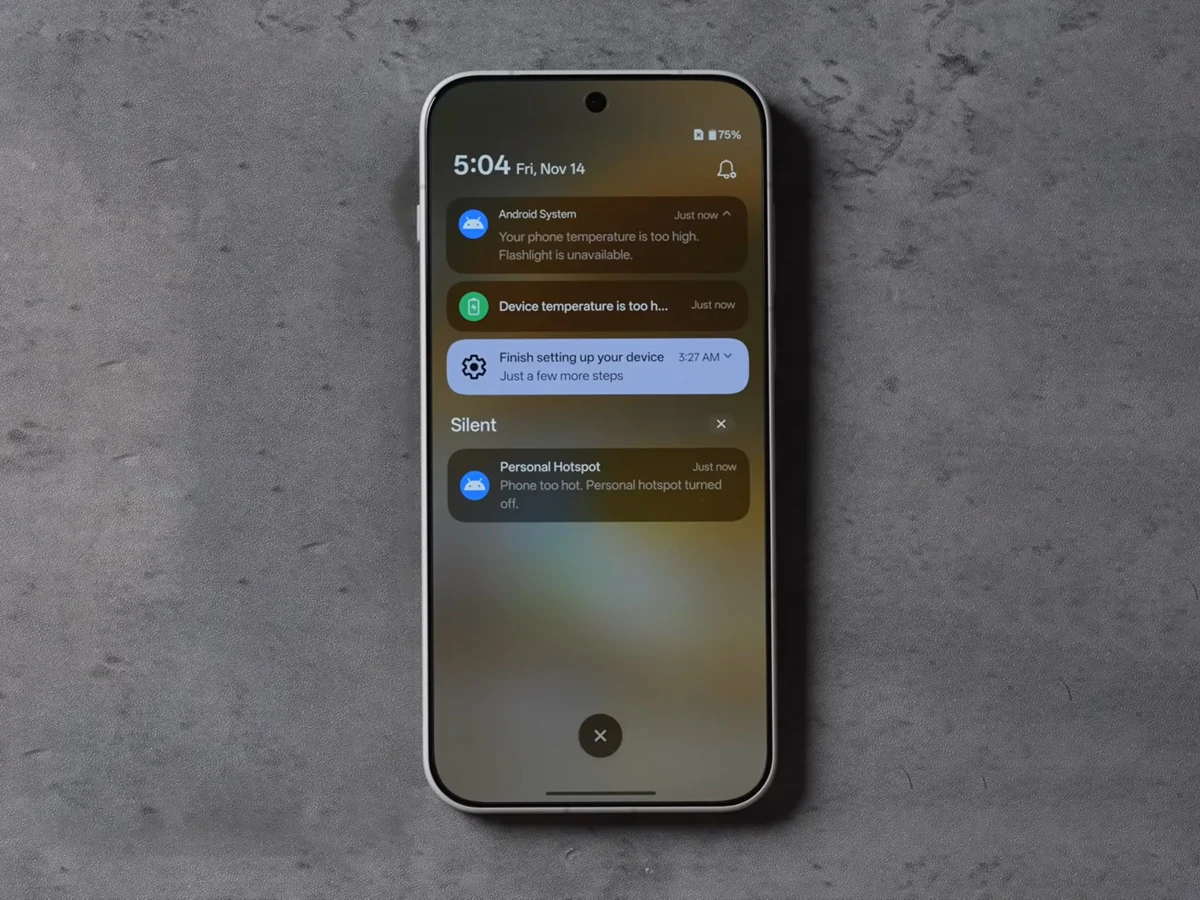
    Specifically, after passing several benchmarks, the OnePlus 15 was unable to complete the Wild Life Extreme Stress Test from 3DMark. In contrast, the iPhone 17 Pro Max managed to finish the test without any problems, while the Snapdragon 8 Elite Gen 5 device had to turn off several features like the hotspot and flashlight to prevent the temperature from increasing further.

    Max Tech utilized a thermal camera to measure the temperature, revealing that the OnePlus 15 reached up to 52° C (125° F). The thermal footage indicated that the phone did not distribute heat evenly across its surface (Black Shark FunCooler 5 Neo curr. $19.75 on Amazon). In comparison, the iPhone 17 Pro Max maintained a lower temperature of around 40° C (104° F) and was able to distribute heat more evenly.

    Gaming Performance

    Luckily, overheating didn’t affect the other aspects of the test. For instance, the OnePlus 15 demonstrated commendable gaming performance later in the video, with temperatures not escalating as high as before. You can explore further details in the video linked below.

    Max Tech

    Source:
    Link


  • OnePlus 15 Battery Test vs OPPO and Apple Flagships

    OnePlus 15 Battery Test vs OPPO and Apple Flagships

    Key Takeaways

    1. The OnePlus 15 features a large 7,300mAh battery, providing impressive endurance.
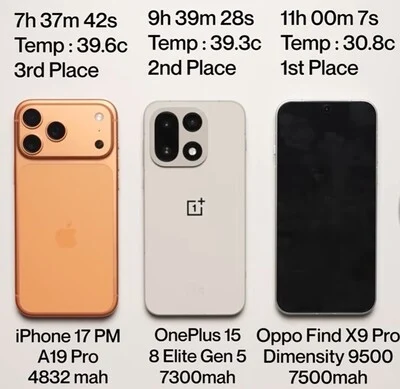
    2. A rigorous battery test showcased the OnePlus 15 lasting 9 hours, 39 minutes, and 28 seconds under demanding conditions.
    3. The Oppo Find X9 Pro, with a slightly larger 7,500mAh battery, outperformed the OnePlus 15 with 11 hours of screen time.
    4. The iPhone 17 Pro Max achieved 7 hours, 37 minutes, and 42 seconds in the same evaluation, indicating strong competition.
    5. While the OnePlus 15 has solid battery life, there may be potential for software improvements to close the gap with competitors.


    The OnePlus 15 has made its debut on the worldwide stage this month, following its launch in China in October, showcasing a remarkable 7,300mAh battery. For those who are used to smaller batteries, this large capacity raises an intriguing question: how long can it really last? A recent battery test sheds light on the OnePlus 15’s performance in real-life scenarios.

    Testing the Battery Life

    The YouTube channel “Lover Of Tech” took the OnePlus 15 for a thorough evaluation. This is the same channel that recently assessed the battery powerhouse Oppo Find X9 Pro using a similar testing approach. In this instance, they set the new OnePlus flagship against the previously mentioned Oppo Find X9 Pro and the well-known iPhone 17 Pro Max. Importantly, unlike the European variant of the Vivo X300 series, the OnePlus 15 keeps its hefty 7,300mAh battery across the globe, making the test outcomes applicable for all regional models, just like OPPO’s latest high-end flagship.

    The Rigorous Testing Process

    The test consisted of a rigorous series of tasks, each lasting an hour until just one phone was left standing. This challenge featured demanding activities such as recording video in 4K/60fps, extensive use of social media platforms (like X Spaces, TikTok, and Instagram Reels), nonstop video and music streaming (through YouTube), and gaming with popular titles such as Subway Surfers and Asphalt. The final tasks included a WhatsApp video call and live streaming on TikTok, then the cycle began anew.

    Impressive Results

    The findings showcased the OnePlus 15’s remarkable endurance. It lasted an astonishing 9 hours, 39 minutes, and 28 seconds under these rigorous conditions. This easily equates to a full day or even more of regular usage for the average user.

    However, the Oppo Find X9 Pro, with its slightly larger 7,500mAh battery, held onto its top position in the endurance rankings by clocking in at 11 hours of screen time. The iPhone 17 Pro Max, a device often commended for its dependable battery life, achieved 7 hours, 37 minutes, and 42 seconds during the same evaluation. The consistent performance of both the Oppo and iPhone in the YouTuber’s previous tests reinforces the trustworthiness of the testing method.

    Even though the OnePlus 15 provides solid battery life throughout the day, the difference in endurance when compared to the Oppo Find X9 Pro hints at potential areas for software improvements. Still, for those considering the OnePlus 15, concerns about battery life should be a worry of the past.

    Lover Of Tech on YouTube.

    Source:
    Link


  • OnePlus 15, iPhone 17 Pro Max, Xiaomi 17 Pro Max Battery Test Results

    OnePlus 15, iPhone 17 Pro Max, Xiaomi 17 Pro Max Battery Test Results

    Key Takeaways

    1. The OnePlus 15 features a Snapdragon 8 Elite Gen 5 chipset and a 7,300 mAh silicon-carbon battery.
    2. It has a 6.78-inch OLED display with a resolution of 1272 × 2772 pixels and a 50 MP triple-camera system.
    3. In battery testing, the OnePlus 15 lasted 13 hours and 40 minutes, outperforming the Xiaomi 17 Pro Max and iPhone 17 Pro Max.
    4. The Xiaomi 17 Pro Max, despite having a larger 7,500 mAh battery, powered down first at 12 hours and 50 minutes.
    5. All three flagship phones (OnePlus 15, Xiaomi 17 Pro Max, iPhone 17 Pro Max) have similar dimensions and weight, but the OnePlus 15 showed the best battery performance.


    Before the worldwide release of the OnePlus 15, we’ve already got a glimpse of its performance through benchmarks like Geekbench 6. We’ve also seen how the new flagship handles thermal challenges with its advanced cooling tech. True to its flagship status, it’s powered by Qualcomm’s Snapdragon 8 Elite Gen 5 chipset and boasts a hefty 7,300 mAh silicon-carbon battery. At this point, we are familiar with most of the OnePlus 15’s specs, which include a 6.78-inch OLED display with a resolution of 1272 × 2772 pixels, a 50 MP triple-camera system, UFS 4.1 flash storage, and more.

    Real-World Performance Tested

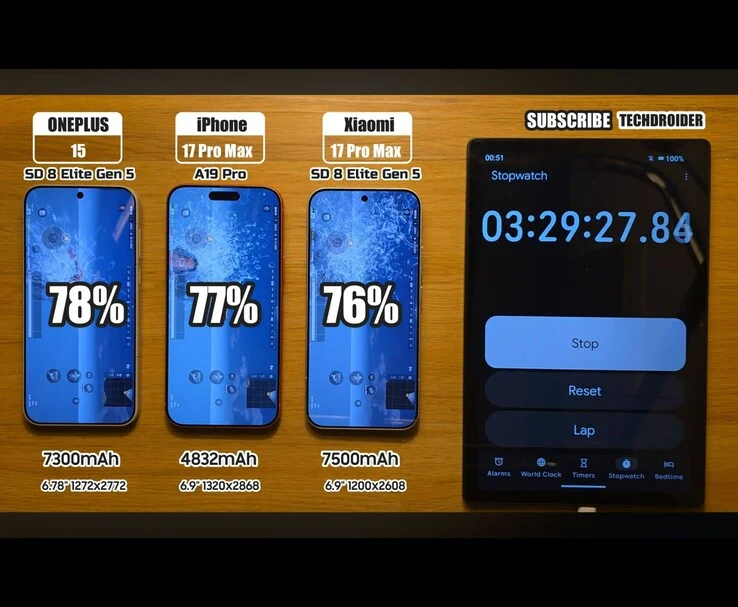
    With all these impressive specifications, the OnePlus 15 has been put through its paces in real-world scenarios. The YouTube channel TechDroider has carried out a thorough battery comparison among the OnePlus 15, the Xiaomi 17 Pro Max, and the iPhone 17 Pro Max.

    To give some background, the Xiaomi 17 Pro features a slightly larger 6.9-inch OLED display at a resolution of 1200 × 2608 pixels. It also comes with a slightly bigger 7,500 mAh silicon-carbon battery and runs on the same Qualcomm Snapdragon 8 Elite Gen 5 chipset.

    Battery Testing Results

    On the other hand, the Apple iPhone 17 Pro Max, powered by the A19 Pro chip, also has a 6.9-inch OLED display, but with a higher resolution of 1320 × 2868 pixels and a smaller 4,832 mAh conventional lithium-ion battery.

    The battery test kicked off with a three-hour gaming session on PUBG Mobile, where the OnePlus 15 had 78% battery left, the iPhone 17 Pro Max had 77%, and the Xiaomi 17 Pro Max stood at 76%. Following this, there was three hours of watching 1080p YouTube videos, which brought the remaining battery percentages down to 66% for the OnePlus, 64% for the iPhone, and 64% for the Xiaomi.

    After an hour and a half of browsing the web and using Instagram, the battery levels still remained close: 53% on the OnePlus, 48% on the iPhone, and 47% on the Xiaomi. In the final stage, all three devices recorded 4K videos at 60 fps until they ran out of juice.

    OnePlus 15 Takes the Lead

    Despite its larger 7,500 mAh battery and HyperOS optimization, the Xiaomi 17 Pro Max was the first to power down after 12 hours and 50 minutes. The iPhone 17 Pro Max followed at 13 hours and 2 minutes, demonstrating the impressive efficiency of Apple’s A19 Pro Bionic chip and iOS. The OnePlus 15 stood out as the overall champion, lasting 13 hours and 40 minutes, the best performance among the three.

    TechDroider also highlighted that even though the OnePlus 15 has a larger 7,300 mAh battery, it remains nearly the same size as the Xiaomi 17 Pro Max (162.9 × 77.6 × 8 mm, 219 g) and the iPhone 17 Pro Max (163.4 × 78 × 8.8 mm, 233 g). All three phones share similar dimensions, weight, and thickness while providing comparable battery life in their category.

    In conclusion, the OnePlus 15 outperforms two of the top flagship competitors in a practical battery test. You can view the complete battery testing video below.

    Source:
    Link