
Tag: Apple M5 Max

  • Nvidia N1X vs Apple M5 Max: Expected Performance Gap

    Nvidia N1X vs Apple M5 Max: Expected Performance Gap

    Key Takeaway

    – Nvidia’s RTX Spark (N1X) is an ARM chip with up to 20 CPU cores and 6,144 CUDA cores, directly competing with Apple M5 Max and laptop CPUs from Intel/AMD/Qualcomm.
    – CPU single-core performance trails the Apple M5 Max by ~30% and Snapdragon X2 Elite by ~20%, but matches current Intel and AMD chips.
    – GPU performance is expected to sit between a GeForce RTX 5070 and 5070 Ti laptop GPU, outperforming Apple M5 Pro/Max in gaming but slightly behind in synthetic/creative tasks.
    – The fastest N1X variant operates at a TDP of 45-80W, enabling use in both mini PCs and future laptops.
    – First laptops with the N1X are expected in fall 2026, and its value depends on pricing relative to laptops with discrete RTX 5070 Ti or RTX 5080 GPUs.


    Nvidias New Chip Takes Aim at Apple and Intel

    At Computex, Nvidia presented a “new” chip that is directly competing against the Apple M5 Max and is therefore likely to compete with processors from Intel, AMD and Qualcomm in the laptop and mini PC segment. The Nvidia RTX Spark, also known as the Nvidia N1X, is practically identical on paper to the DGX Spark. This is because the Nvidia N1X also uses an ARM processor with 20 cores, a Blackwell iGPU with 6,144 CUDA compute units and up to 128 GB LPDDR5X memory. One new feature is that the chip will also be installed in laptops in the future. On the other hand, Nvidia is now also offering cheaper variants, including an N1X with 18 CPU cores and 5,120 shaders, as well as an N1 with either 10 or 12 processor cores and 2,048 to 2,560 CUDA cores. The fastest N1X can be operated with a TDP of 45 to 80 watts.

    Performance Expectations and Benchmarks

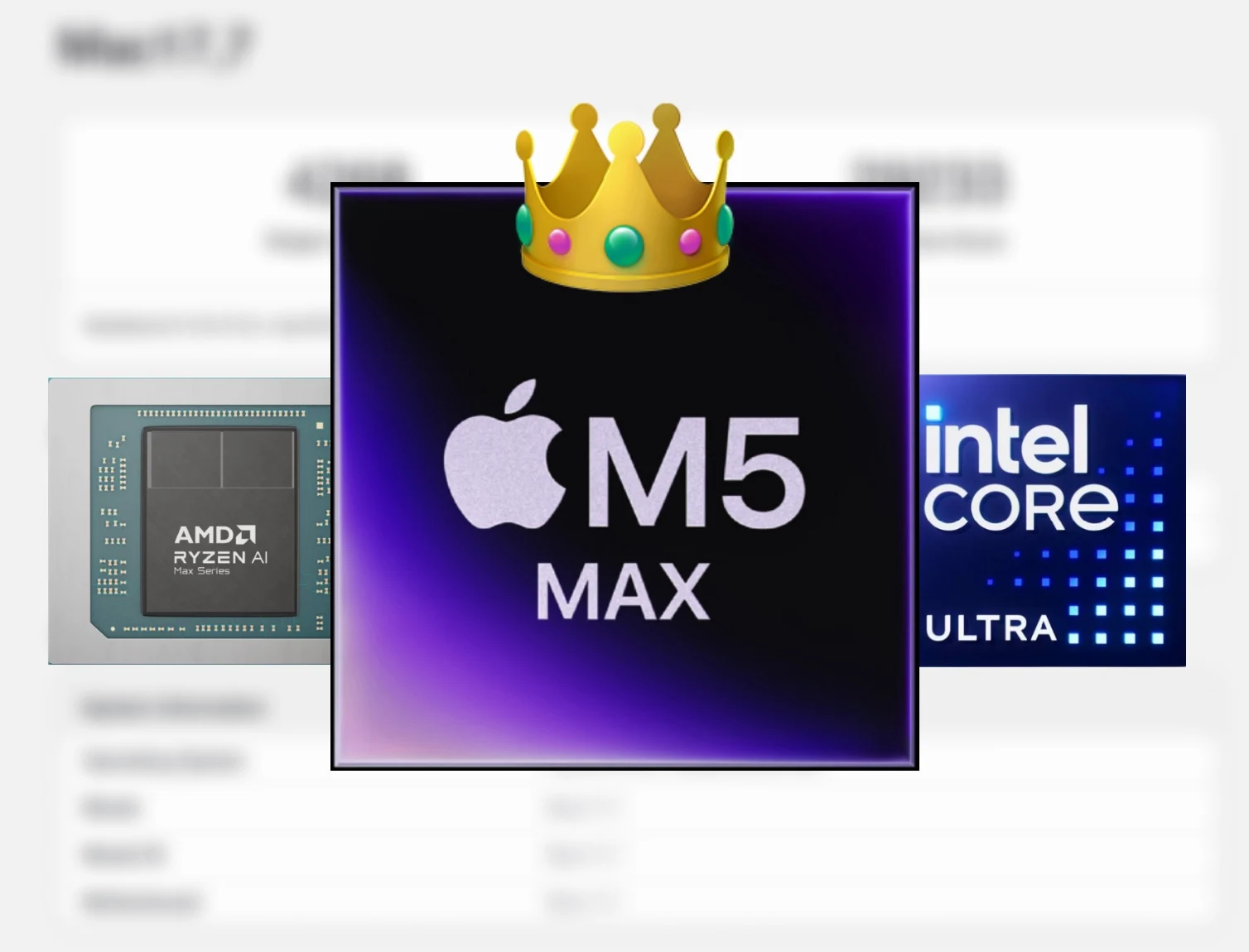
    While Nvidia has not published any benchmarks, the company is advertising the chip not only for AI applications, but also for gaming and creative professionals. The performance of the chip can already be estimated based on benchmarks of technically comparable products before the first laptops with N1X are expected to be launched on the market in fall 2026. As the comparison of the Nvidia GB10 with the current laptop processors of the competition shows, the single-core performance falls almost 30 percent behind the Apple M5 Max and almost 20 percent behind the Snapdragon X2 Elite, and is roughly on a par with the current chips from Intel and AMD. The multi-threaded benchmark shows a similar picture: the Nvidia N1X is almost a third slower than the Apple M5 Pro and Apple M5 Max, but is almost on a par with the Intel Ultra 9 290HX Plus.

    Graphics Power and Gaming Viability

    The performance of the graphics chip should be between the Nvidia GeForce RTX 5070 laptop GPU and the GeForce RTX 5070 Ti laptop GPU. Although the GPU of the N1X has slightly more compute units than the GeForce RTX 5070 Ti laptop GPU, it is operated with a significantly lower TDP and should therefore achieve lower GPU clocks. As our benchmarks show, the GPU should sit between the Apple M5 Pro and M5 Max in synthetic benchmarks and creative apps, while Nvidia should have the edge in games thanks to better drivers. After all, the Nvidia RTX Spark should far outperform both AMD Ryzen Strix Halo and the Snapdragon X2 Elite in terms of GPU performance.

    Cost and Final Considerations

    However, whether the chip will be worthwhile for gaming enthusiasts depends not least on how expensive it is compared to laptops with GeForce RTX 5070 Ti or RTX 5080 laptop GPUs. This preview only serves as a rough classification, as no laptops or mini PCs with Nvidia RTX Spark are yet available for testing.
    Sources

  • Apple M5 Max Delivers Smooth AAA Windows Gaming Through Emulation

    Apple M5 Max Delivers Smooth AAA Windows Gaming Through Emulation

    Key Takeaways

    1. The Apple MacBook Pro with the M5 Max SoC is capable of delivering good gaming performance, even if it’s not primarily marketed for gaming.
    2. Andrew Tsai’s tests show that the M5 Max can effectively emulate 20 Windows games using Crossover, with most performing well.
    3. The M5 Max can run demanding AAA games like Cyberpunk 2077 at over 60 FPS at 1440p/ultra settings without upscaling.
    4. While there are few AAA macOS games, the M5 Max’s strength allows for effective emulation of Windows games and likely console games too.
    5. The M5 Max is highlighted for its performance potential, especially for games designed for macOS.


    While not many people are purchasing the Apple MacBook Pro 14 and 16 equipped with the M5 Max SoC specifically for gaming, it’s clear that the M5 Max has the speed necessary for a good gaming experience. A recent test by Andrew Tsai on YouTube demonstrates that the MacBook Pro with the Apple M5 Max can effectively emulate Windows games.

    Performance Testing

    In his tests, Andrew Tsai evaluated 20 Windows games on the Apple M5 Max using Crossover. Most games performed excellently, although a few had some performance issues. The tests included popular titles like Death Stranding 2, Horizon Forbidden West, and Black Myth Wukong, which are known for their demanding graphics.

    Impressive Results

    From Andrew Tsai’s findings, it is evident that the Apple MacBook Pro with the M5 Max is incredibly powerful. The SoC can deliver smooth gameplay on demanding AAA games, even when using a translation layer for emulation.

    It’s worth noting that the M5 Max shines even brighter with games designed for macOS. Our performance review showed that it could run Cyberpunk 2077 at over 60 FPS at 1440p/ultra settings without relying on FSR or MetalFX upscaling.

    Emulation Capabilities

    Even though there are not many AAA macOS games available, the M5 Max is sufficiently robust to emulate Windows games effectively. This also indicates that the M5 Max should manage console emulation quite well. There are several excellent console emulators available for macOS, such as RPCS 3 for PlayStation 3 and Ryujinx/Hydra for Nintendo Switch emulation.

    You can purchase the Apple MacBook Pro 16 with M5 Max on Amazon.

    Andrew Tsai on YouTube, Teaser image source: Andreas Osthoff for Notebookcheck, nicolepineda on Pixabay, edited.

    Source:
    Link


  • Apple M5 Max and M5 Pro Boost Performance by 20% on Geekbench

    Apple M5 Max and M5 Pro Boost Performance by 20% on Geekbench

    Key Takeaways

    1. The M5 Pro and Max chips show significant enhancements in CPU performance, with the 18-core CPU outperforming most consumer-grade x86 chips.
    2. GPU performance is lacking, with the M5 Max competing closely with the RTX 5070 and the M5 Pro struggling against the RTX 5060 due to OpenCL optimization issues on macOS.
    3. The M5 Max GPU shows a 20% improvement in single-precision AI tasks over the M4 Max, while the M5 Pro shows a similar 20% improvement over the M4 Pro.
    4. CPU scores remain mostly unchanged, and the 16-core Neural Engine has decreased in single-precision scores, though improvements are noted in half-precision and quantized tests.
    5. Current benchmarks may not fully reflect the M5 generation’s AI capabilities, and true performance will be better evaluated through independent reviews with practical workloads.


    Apple’s M5 Pro and Max were introduced just a few days ago, and initial benchmarks have started to emerge. These chips show clear enhancements in GPU and CPU performance compared to their predecessors, with the 18-core CPU in the M5 Max and Pro outperforming nearly all consumer-grade x86 chips available today.

    GPU Performance Insights

    However, the GPU performance is somewhat lacking, as the M5 Max competes closely with the RTX 5070 Laptop GPU in Geekbench OpenCL, while the M5 Pro struggles to keep pace with a mid-range RTX 5060 Laptop GPU in the same benchmark. It’s important to note that OpenCL is no longer optimized for macOS, which likely contributes to these less-than-stellar results.

    AI Performance Comparison

    Beyond just CPU and GPU numbers, Geekbench also evaluates on-device AI performance. Due to the differences in APIs between macOS and other platforms, cross-platform comparisons might not be entirely accurate. Nonetheless, we can assess the M5 Pro and Max against their earlier versions to understand how Apple has advanced in this area.

    When we look at the Geekbench AI test results for the M5 Max SoC, the findings are as follows:

    In comparison to the M4 Max, the M5 Max GPU appears to have about a 20% advantage in single-precision tasks. Similarly, the M5 Pro GPU shows an improvement of around 20% over the M4 Pro.

    Neural Engine Performance

    Curiously, the CPU scores have remained largely unchanged, and the 16-core neural engine’s scores have actually decreased in single-precision, which seems illogical. However, results in half-precision and quantized tests have improved by approximately 15% and 10%, respectively.

    It’s also worth noting that the earlier models also had a 16-core Neural Engine. While Apple asserts that the new Neural Engine is quicker, they haven’t specified by how much. The base model M5 (14″ MacBook Pro currently priced at $1,450 on Amazon), alongside the M5 Pro and M5 Max SoCs, all come equipped with the same 16-core Neural Engine.

    These initial figures should be taken with caution, as it’s possible that Geekbench AI hasn’t fully leveraged the neural accelerators in the M5 generation’s GPU cores yet. Apple claims that performance in AI tasks can be up to 4x faster, but current benchmarks paint a different picture.

    Given that a single benchmark doesn’t accurately reflect real-world performance, the true AI capabilities of the M5 Pro and M5 Max SoCs will only be determined through independent reviews using practical workloads.


  • Apple M5 Max Beats Ryzen AI Max+ by 25% in Geekbench 6

    Apple M5 Max Beats Ryzen AI Max+ by 25% in Geekbench 6

    Key Takeaways

    1. The Apple M5 Max scored 29,233 in multi-core and 4,260 in single-core tests on Geekbench 6, outperforming its predecessor, the M4 Max.
    2. The M5 Max shows a 9% increase in single-core performance and a 14% increase in multi-core performance compared to the M4 Max.
    3. The M5 Max is the fastest CPU Apple has produced, surpassing the top-tier M3 Ultra by 5.4%.
    4. The M5 Max outperforms Intel and AMD competitors, exceeding the Intel Core Ultra 9 275HX by 34% and the AMD Ryzen AI Max+ 395 by 25% in multi-core tests.
    5. While benchmarks are useful, real-world performance may vary; however, the M5 Max is expected to be one of the fastest options available for consumers.


    The initial benchmarks for the Apple M5 Max have emerged, and the results are impressively high, as expected from a premium Apple Silicon system on a chip.

    Benchmark Scores

    The leaked Geekbench 6 results reveal that the 18-core Apple M5 Max achieved an impressive score of 29,233 points in multi-core testing and about 4,260 points in single-core tests. For comparison, the standard M5 MacBook Pro, which is currently priced at $1,440 on Amazon, scores similarly in single-core tests while scoring approximately 17,100 in multi-core tests.

    Performance Improvements

    When evaluating its predecessor, the M4 Max, the M5 Max shows an increase of about 9% in single-core performance. In contrast, for multi-core performance, this new chip is around 14% quicker. Notably, this makes the M5 Max the fastest CPU Apple has ever produced, boasting a lead of 5.4% over the top-tier M3 Ultra.

    Competing Chips

    In comparison to AMD and Intel offerings in the x86 sector, there simply isn’t a consumer CPU that matches the M5 Max in Geekbench 6. The M5 Max outperforms the Intel Core Ultra 9 275HX by roughly 34% in multi-core tests, while the AMD Ryzen AI Max+ 395 “Strix Halo” lags behind by about 25%.

    Even chips designed for desktops can’t keep up with the Apple M5 Max in Geekbench 6. The M5 Max surpasses both the Intel Core Ultra 9 285K and the AMD Ryzen 9 9950X by around 23%. In a rather amusing twist, the 64-core Threadripper 9980X is also left behind, though by a smaller margin of 6.6%.

    Real-World Applications

    It’s important to note that a single benchmark doesn’t fully reflect real-world performance in professional tasks. However, it’s clear that Apple’s new silicon lineup is likely to be among the fastest options available for consumers.

    Source:
    Link


  • Apple iMac Pro Returns with M5 Max Chip, Code Leak Reveals

    Apple iMac Pro Returns with M5 Max Chip, Code Leak Reveals

    Key Takeaways

    1. The latest Apple iMac is equipped only with the M4 chip and a 24-inch screen, targeting home users.
    2. Higher-demand users are directed towards the Mac Studio, MacBook Pro, or Mac Pro instead of the current iMac.
    3. Apple is planning to reintroduce the iMac Pro, indicated by coding in an internal debug kit.
    4. The new iMac Pro may feature the Apple M5 Max chip and could have a larger, more advanced display.
    5. Speculations suggest the iMac Pro may include a new design and improved cooling system, aimed at professional users.


    The latest Apple iMac is currently sold only with the Apple M4 chip and a 24-inch screen. This setup targets mainly home users, while creative professionals, advertising firms, and users with higher demands are pushed towards the Mac Studio, MacBook Pro, or Mac Pro. It’s worth noting that the Apple iMac was once crucial for advertising agencies for many years.

    Upcoming iMac Pro

    As reported by MacRumors, Apple is preparing to reintroduce an iMac designed for more demanding consumers. The iMac Pro is on its way back, as revealed by some coding in an internal Apple kernel debug kit. This code includes mentions of an iMac with the codename “J833c” that features a chip referred to as “H17C.” MacRumors suggests that the H17C represents the third version of the Apple M5, which is likely to be branded as the Apple M5 Max. The existence of this reference in Apple’s code indicates that testing for the iMac Pro is already in progress.

    Expectations for the New Model

    So far, there haven’t been any solid speculations about a more powerful iMac. If Apple launches a significantly pricier all-in-one powered by the Apple M5 Max, it could come with a completely new design and an enhanced cooling system. Given the anticipated high cost of the Apple M5 Max and its intended users, one can reasonably expect that the iMac Pro will feature a larger screen, potentially a 27-inch, 120Hz Mini-LED display that might also appear in the upcoming Apple Studio Display 2.

    Source:
    Link