Category: Computers

  • Lenovo Yoga Slim 9i: Camera-Under-Display & Dual-Screen Laptop at CES 2025

    Lenovo Yoga Slim 9i: Camera-Under-Display & Dual-Screen Laptop at CES 2025

    Lenovo has just launched two innovative laptops at CES 2025. These devices include a groundbreaking camera-under-display technology for a bezel-less screen and the Yoga Book 9i, designed for ultimate creativity and productivity.

    Lenovo Yoga Slim 9i (14″, 10)

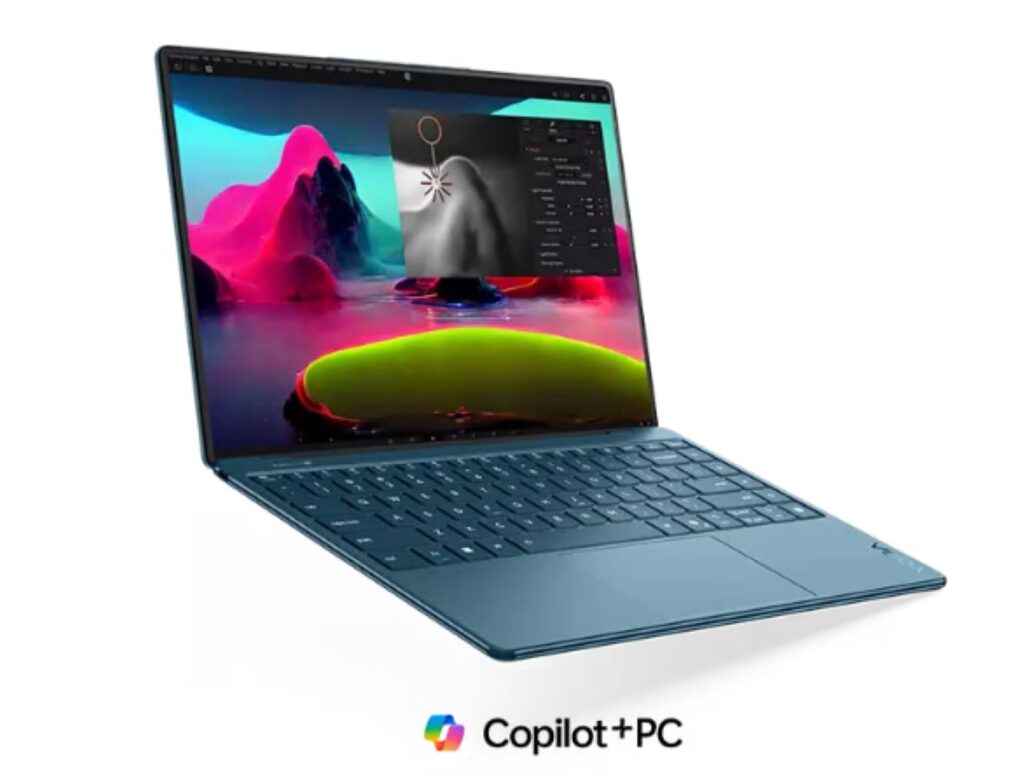
    The Lenovo Yoga Slim 9i (14″, 10) revolutionizes the laptop display with its camera-under-display technology. This advancement enables an ultra-thin bezel and an astonishing 98% screen-to-body ratio, the highest ever seen in laptops. The 14-inch 4K 120Hz PureSight Pro OLED screen delivers stunning visuals with a Delta E<1 color accuracy, supporting 100% sRGB, P3, and Adobe RGB. The display is TÜV Low Blue Light and Eyesafe certified, which allows for extended and comfortable usage.

    Design and Performance

    The durability of this screen is enhanced by impact-resistant glass to protect against pressure, drops, and scratches. Weighing just 1.19kg, the laptop is equipped with an Intel Core Ultra 7 processor that includes a 48 TOPS NPU. Lenovo’s AI Core leverages this NPU to fine-tune creative applications and adjust performance dynamically.

    For creators, the Yoga Slim 9i offers up to 17 hours of battery life thanks to its 75WHr battery and AI-boosted efficiency. Two Thunderbolt 4 ports facilitate easy connectivity for accessories, making it perfect for productivity on the move. The AI features help minimize workflow disruptions, allowing creators to maintain focus for longer periods.

    Lenovo Yoga Book 9i: A Creative Powerhouse

    The Yoga Book 9i (14″, 10) is a versatile and convertible laptop featuring two 14-inch OLED PureSight touch displays with a 120Hz variable refresh rate and 500 nits brightness, supporting 100% DCI-P3. A 360-degree rotating soundbar with Dolby Atmos speakers enhances the audio experience, making it truly immersive.

    The dual-screen layout opens up unique possibilities. Users can sketch on one display while utilizing the other for additional tasks or during video calls. The Yoga Book 9i is bundled with a Bluetooth keyboard, Yoga Pen, and Folio stand, offering several ways to engage and boost productivity.

    With AI-driven features that streamline workflows and extend battery life, the Yoga Book 9i becomes an indispensable tool for creatives. It is lighter and slimmer than its previous model, ensuring better portability without sacrificing performance. The Yoga Book 9i (14″, 10) is powered by an 88WHr battery for longer use, and it weighs only 1.22kg without the keyboard. In other news, ASUS has unveiled its 2025 ROG Zephyrus G14 & G16 ultraportable gaming laptops featuring RTX 5080, which you can explore here.


    Image 1
    Image 1
    Image 1
  • Asus ROG NUC 2025 Mini-PC Launches with Nvidia RTX 50 GPUs

    Asus ROG NUC 2025 Mini-PC Launches with Nvidia RTX 50 GPUs

    Asus has refreshed the ROG NUC platform, which it first introduced last year, featuring Intel Meteor Lake processors and Nvidia RTX 40 laptop series GPUs. Just to remind you, the initial ROG NUC was quite impressive in our review, equipped with a Core Ultra 9 185H and a GeForce RTX 4070 (curr. $2,299 on Amazon).

    Performance Enhancements

    The ROG NUC (2025) is expected to deliver better performance overall, thanks to the introduction of the latest Arrow Lake-HX processors and RTX 50 laptop series GPUs. While Asus remains a bit unclear about the specifics, they have confirmed that the ROG NUC (2025) will utilize Core Ultra 7 and Core Ultra 9 processors. It’s also been stated that the GeForce RTX 5080 will be included, boasting 16 GB of GDDR7 VRAM.

    Enhanced Specifications

    This new version of the ROG NUC can accommodate up to 96 GB of DDR5-6400 RAM and comes with two M.2 2280 slots for PCIe Gen 4 SSDs. In addition, the mini-PC supports Bluetooth 5.4 and Wi-Fi 7 connectivity, along with a variety of ports:

    On top of that, Asus has packed all this tech into a newly designed chassis that measures 282.4 x 187.7 x 56.5 mm and weighs 3.12 kg. The mini-PC is equipped with three fans, one of which is specifically for cooling the CPU. Sadly, Asus hasn’t shared any details regarding pricing or when it will be available.

    Source: Link


    Image 1
  • Dell’s New Laptop Naming Scheme Inspired by iPhone Design

    Dell’s New Laptop Naming Scheme Inspired by iPhone Design

    Dell has officially discontinued its XPS, Inspiron, Latitude, and Precision laptop ranges. Now, they are all grouped under a naming system akin to that of Apple’s iPhone. For instance, the XPS line is now simply called Dell, the Latitude is rebranded as Dell Pro, and the Precision lineup has been changed to Dell Pro Max.

    Similarities to Apple

    This shift in naming style has drawn comparisons to Apple’s iPhone model names, and during the CES 2025 press conference, Dell faced backlash for what was termed as “imitation” of the tech giant from Cupertino. In response to these remarks, Dell has clarified that the intention behind the new naming structure is to simplify things for consumers.

    Consumer Preferences

    Jeff Clarke, Dell’s Chief Operating Officer, shared that customers generally favor names that “are memorable and easy to say.” While this new naming approach could make it somewhat easier to understand the company’s offerings, there are still sub-categories: Base, Plus, and Premium. These subdivisions might actually complicate the idea of simplified naming, making it harder for customers to choose a laptop.

    At the event, attendees voiced their concerns about the lack of originality in the new naming system, describing it as merely a “copy” of Apple’s branding for the iPhone. Dell’s leadership defended the rebranding, claiming it was guided by research involving “tens of thousands of customers.”

    Legal Standpoint

    Additionally, the executives emphasized that no brand can claim exclusive rights to terms like “Pro” or “Max” for their products. Therefore, it seems that Dell isn’t facing any significant legal challenges over this. Nevertheless, as more companies adopt naming conventions similar to Apple’s, it will be interesting to see if we will encounter products with “Air” or “mini” labels for Windows laptops down the line.

    Source: Link


    Image 1
  • Asus Master Dock DC510: Sleek Thunderbolt 5 Dock at CES 2025

    Asus Master Dock DC510: Sleek Thunderbolt 5 Dock at CES 2025

    Asus has introduced a fresh docking station during CES 2025, utilizing the new Thunderbolt 5 technology. The Master DC510 Dock features a stylish design and offers a wide range of ports, delivering impressive functionality within a compact size.

    Connectivity Options

    When it comes to expansion docks, the variety of connectivity options is crucial, and the Asus Master dock shines brightly here. It includes four Thunderbolt 5 ports (80 Gbps), three Type-A ports (10 Gbps), one Type-A port (5 Gbps), SD 4.0, MicroSD 4.0, a 2.5 GbE port, and an audio jack. Additionally, an M.2 2280 PCIe 4.0 slot is available with easy access that requires no tools. Thanks to its advanced technology, the dock can handle dual 8K monitors at 60 Hz or triple 4K displays at 144 Hz.

    Design Features

    The exterior of the Asus Master Thunderbolt 5 Dock is notably sleek and modern. It combines metal and plastic materials, plus it has a white ambient LED light that can be adjusted for brightness. One of the Thunderbolt 5 ports provides 140-watt passthrough, which is a very useful feature. The dock stands only 38.1 mm tall, making it easy to fit under most monitor stands without any issues.

    Availability and Pricing

    Asus has yet to reveal any specifics about when the dock will be available or its price, but given the impressive features, the Master Thunderbolt 5 Dock DC510 is expected to come with a hefty price tag.

    Source: Link


    Image 1
  • Ugreen Launches 500W Nexode GaN Charger and Thunderbolt 5 Dock at CES 2025

    Ugreen Launches 500W Nexode GaN Charger and Thunderbolt 5 Dock at CES 2025

    CES 2025 is buzzing with excitement as major players in the consumer technology world compete for attention. Ugreen is also making waves by unveiling a series of new products that sound quite appealing. Among their latest offerings is an impressive 500-watt Nexode GaN charger, alongside a new Thunderbolt 5 docking station.

    Nexode 500-Watt Charger

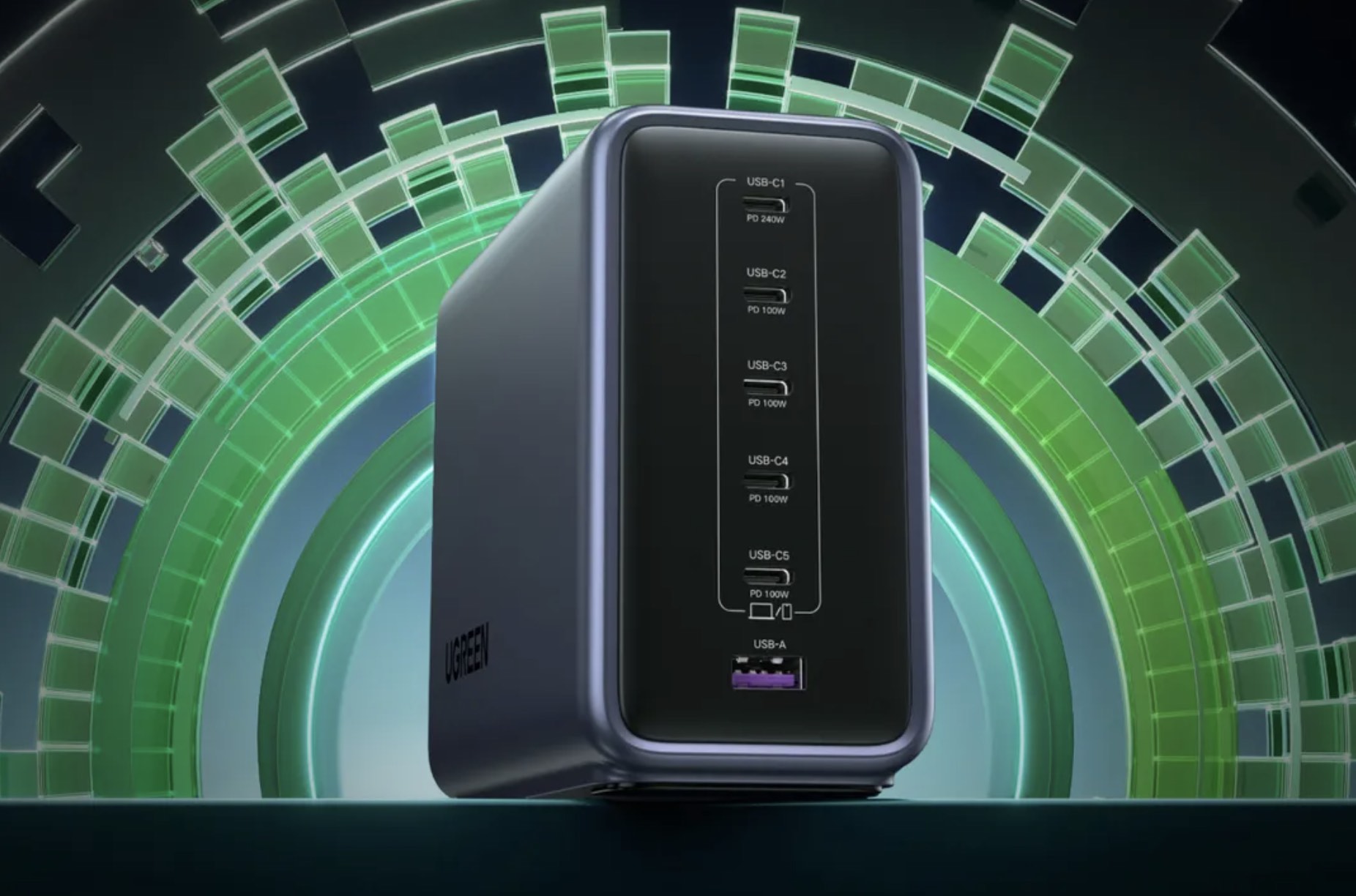
    Kicking things off with the Nexode 500-watt desktop charger, this device can power up to six gadgets at once, including five laptops. TechPowerUp highlights that the use of GaN technology enables the dock to remain compact and easy to fit on your desk, even with its high output. The charger comes with a solid range of ports, featuring a 240-watt Type-C port that supports the USB PD 3.1 standard, four additional Type-C ports that can each deliver 100 watts, and a Type-A port, all combining for a total output of 260 watts at the same time. It will be fascinating to see how Ugreen manages the heat generated by this powerful device.

    Revodok Max 2131 Docking Station

    Next in line is the Revodok Max 2131, which, despite its slightly odd name, presents a stylish design and a wide array of features. Built on the latest Thunderbolt 5 standard, the Revodok includes four Thunderbolt 5 ports, each capable of 80 Gbps, as well as two USB-A ports, one 10 Gbps Type-C port, an SD card slot, an RJ-45 port, and an audio jack.

    At the moment, Ugreen has not disclosed any pricing or availability information for these products, but a launch in March seems plausible. Given the impressive features, it’s unlikely that these devices will be available at a discount.

    Portable Options

    If you’re looking for something more portable, consider the Ugreen Nexode 100-watt power bank available on Amazon.

    Source: Link


    Image 1
    Image 1
  • Importance of the New Snapdragon X Chip for Windows Laptops

    Importance of the New Snapdragon X Chip for Windows Laptops

    Qualcomm is making significant strides in the Windows on ARM space with its Snapdragon X series chips. The company has previously introduced its high-end X Plus and X Elite system-on-chips (SoCs), but now they’ve rolled out a new option aimed at expanding access to Windows on ARM for more consumers.

    Fresh Innovations at CES 2025

    At CES 2025, Qualcomm presented its latest ARM PC chip, simply called the Snapdragon X. This product is positioned as an economical choice, designed to run Windows laptops that are priced around $600. These laptops, featuring innovations like Copilot+PC, are set to compete with Intel and AMD in the budget-friendly laptop market.

    Why This Matters for Budget Laptops

    We believe this development is crucial for the budget Windows laptop sector. The Snapdragon X is categorized as the entry-level option in Qualcomm’s expanding lineup of processors for PCs. It joins the Snapdragon X Plus and Snapdragon X Elite, which are intended for more premium devices.

    In contrast to its more powerful counterparts, which can have up to 12 cores and clock speeds over 3GHz, the Snapdragon X has an eight-core structure, with a peak clock speed of 3GHz and 30MB of cache. Although these specifications may not rival the raw capabilities of its higher-tier siblings, they are well-suited for the needs of average users.

    Efficiency and Performance Highlights

    Manufactured using a 4-nanometer process, the Snapdragon X emphasizes Qualcomm’s commitment to efficiency. The company asserts that the Snapdragon X will surpass Intel’s Core 5 120U in terms of performance-per-watt and battery life. While this isn’t Qualcomm’s first attempt to highlight energy efficiency as a key selling point, they face the challenge of convincing consumers that Windows on ARM laptops have matured enough to serve as viable options against Intel or AMD devices.

    Moreover, the Snapdragon X is equipped with a Neural Processing Unit (NPU) that can achieve 45 TOPS (trillion operations per second).

  • Mecha Comet: Modular Handheld for Gaming and DIY Projects

    Mecha Comet: Modular Handheld for Gaming and DIY Projects

    According to Mecha, the recently launched Comet is a versatile handheld computer built for many uses, mainly due to its modular design. It comes with a front connector fitted with pogo pins, which allows the device to link with additional extension modules. Users can create their own custom modules, and the company also provides three standard options: a gamepad, a keyboard, and a GPIO interface for connecting peripherals like sensors and actuators. This flexibility enables users to transform the Comet into a portable gaming console, a robotic controller, or even a smartphone.

    Specifications and Performance

    The Mecha Comet runs on a System on Chip (SoC) that includes four Cortex-A53 cores clocked at 1.8 GHz. It also has 4 GB of LPDDR4 RAM and 32 GB of eMMC storage. The device features a 3.4-inch IPS touchscreen display, dual microphones, a single speaker, and a 5-megapixel camera. Additionally, it has an M.2 2230 slot with one PCIe 2.0 lane, which enables users to add expansion cards such as SSDs.

    Design and Connectivity

    With dimensions of 150 x 73.55 x 16 mm (5.90 x 2.89 x 0.62 in) and a weight of 215 g (7.7 oz), this handheld device includes a 3,000 mAh battery that can recharge to 50% in just 25 minutes. For connectivity, it features a Gigabit Ethernet port, Wi-Fi 802.11ac, and Bluetooth, along with a gyroscope for orientation detection. A crowdfunding campaign for the Mecha Comet is set to commence soon, with prices beginning at $159. Users can operate the Comet using a customized version of Debian or Yocto.

    Source: Link


    Image 1
    Image 1
  • Asus Zenbook Duo at CES 2025: Dual 120Hz OLED Touchscreens

    Asus Zenbook Duo at CES 2025: Dual 120Hz OLED Touchscreens

    The new Asus Zenbook Duo has made its way to the market, following the innovative model before it, which was priced around $1500 on Amazon. This latest version brings only slight improvements. The standout feature is the new Intel Core Ultra 9 285H processor, which includes six performance cores that can reach boost speeds of 5.4 GHz. It also has eight efficiency cores and an integrated Intel Arc 140T GPU with eight Xe cores that can clock up to 2.35 GHz.

    Still a Strong Option in 2025

    Even with limited updates, the Asus Zenbook Duo still proves to be a great option for 2025. It comes with two 14-inch touchscreens, both in a 16:10 aspect ratio. These screens utilize OLED technology and offer a resolution of 2880 x 1800 pixels with a 120 Hz refresh rate. With the ScreenXpert software, users can use multitouch gestures to easily switch between apps or bring up the software keyboard. Additionally, Asus provides a Bluetooth keyboard for convenience.

    Flexible Display Setup

    One of the neat features of the Zenbook Duo is its foldable stand, which allows users to set up the two displays either side by side or stacked on top of each other. This flexibility makes it easy to run multiple apps at once, even while on the move. The device only weighs 3.6 lbs (1.65 kg) and comes with options for up to 32 GB of LPDDR5X RAM, a 2-TB PCIe 4.0 SSD, and a 75-Wh battery that allows for USB-C charging at up to 65 watts. For connectivity, users can enjoy Wi-Fi 7, Bluetooth 5.4, two Thunderbolt 4 (USB-C) ports, one USB-A (5 Gbit/s) port, and an HDMI 2.1 output.

    Launch Details

    The Asus Zenbook Duo (UX8406) is expected to hit the shelves in February, starting at a price of $1699.99.


    Image 1
    Image 1
    Image 1
    Image 1
  • Lenovo’s Solar-Powered Self-Charging Keyboard at CES 2025

    Lenovo’s Solar-Powered Self-Charging Keyboard at CES 2025

    While there will be much attention on Lenovo’s latest computers and Legion gaming gear, the company is also introducing a variety of fascinating accessories, including a unique self-charging Bluetooth keyboard. This device, which was first revealed a few weeks ago, boasts an exterior made from 95% recycled plastic sourced from consumers. The standout feature of this keyboard is that it doesn’t require conventional charging.

    Innovative Charging Technology

    The Lenovo Self-Charging Bluetooth Keyboard incorporates photovoltaic cells, enabling it to harness energy from surrounding light. Instead of a standard battery, it employs a fast-charging supercapacitor, similar to HP’s rechargeable keyboard and mouse set. Unlike traditional batteries, supercapacitors can store large amounts of energy and recharge at an astonishing speed.

    Impressive Power Life

    According to Lenovo, this keyboard can function for as long as 45 days in complete darkness without needing a recharge. Once the energy runs out, it only takes 2 minutes of charging under a light source with an intensity of 300 Lux to restore it for use.

    User-Friendly Features

    In addition to its innovative charging, the keyboard is designed to be spill-resistant and comes with adjustable tilt legs, dedicated media controls, and a three-zone layout complete with on-screen brightness indicators. Users can also monitor the device’s power in real-time through the Lenovo Accessories and Display Manager.

    This keyboard features Bluetooth 5.1, supports Microsoft Swift Pair, and can connect with up to three devices simultaneously. It is compatible with various operating systems including ChromeOS, Windows 10 and later, macOS, iPadOS, iOS, and Android.

    The Lenovo Self-Charging Bluetooth Keyboard is set to launch in May 2025, priced at $69.99, and will be offered in two different colors.

  • Cybercriminals Target U-Haul Employees to Access Customer Data

    Cybercriminals Target U-Haul Employees to Access Customer Data

    Hackers have been taking advantage of U-Haul employee accounts to gather customer data for doxing, cyberattacks, and possible violence, as reported by 404 Media. A hacking group called “The Com” has been using phishing techniques to replicate U-Haul’s point-of-sale (POS) login pages, which allows them to access sensitive customer information like names, addresses, phone numbers, and billing data.

    Potential Risks of Stolen Information

    This sensitive information can lead to more attacks, such as social engineering tactics aimed at compromising online accounts or targeting individuals for harm. The Com mainly operates on platforms such as Telegram and Discord and has a history of engaging in SIM swapping, cryptocurrency theft, and corporate hacking.

    Tools Used for Hacking

    One phishing tool known as Suite, created by a hacker named Pontifex, helps in gathering U-Haul account credentials, as well as for services like Gmail and Coinbase. The hacked login information is frequently shared in Telegram channels that focus on fraud. Pontifex mentioned, “U-Haul has lots of information, it can be used for all sorts of stuff,” adding that the stolen data could also help in accessing email accounts from major ISPs like Comcast.

    Past Breaches and Current Silence

    This situation is not unprecedented; U-Haul has faced multiple attacks over the years. In 2022, hackers gained access to internal tools to fish customer contracts, and in 2024, attackers reportedly used valid credentials to breach dealer systems and view reservations and records.

    Despite several attempts to get a response, U-Haul has not commented on these matters, according to 404 Media. Such incidents are important reminders that any business can be a target for cybercriminals looking to steal personal information.

    Source: Link