Category: Video / Photo

  • Esquisse Retro Camera: Compact with Large Sensor & OLED Viewfinder

    Esquisse Retro Camera: Compact with Large Sensor & OLED Viewfinder

    Key Takeaways

    1. The Esquisse Camera features a simple design with high-quality materials, inspired by the Sigma BF and vintage styles.
    2. It is lightweight at 350 grams and offers a battery life of over 300 shots with 256GB of internal memory.
    3. The camera includes a 3-inch touchscreen and an OLED electronic viewfinder with 3.69 million dots.
    4. It has a 20-megapixel Micro Four Thirds sensor and supports various lenses, including Leica M-mount with adapters.
    5. Currently a concept, the Esquisse Camera is expected to launch in Q4 2026 with a target price below $2,000.


    The Esquisse Camera is designed to blend a simple look with high-quality materials, taking inspiration from the Sigma BF, while also featuring a vintage style, easy-to-use button arrangement that includes three control dials, and an electronic viewfinder. It measures 4.13 × 2.76 × 1.38 inches, making it smaller than competitors like the Sigma BF (priced at $2,199 on Amazon) and the Panasonic Lumix S9, which do not include an EVF.

    Lightweight and Functional

    Weighing only 350 grams, this camera is very light, yet its battery is said to last for more than 300 shots. Users can save images directly onto 256GB of internal memory. The design somewhat resembles the Leica CL, featuring aluminum plates on the top and bottom along with a black leather exterior that pays homage to traditional rangefinder cameras. The two dials on top adjust the sensor’s light sensitivity (ISO) and exposure compensation, while a third programmable dial can be found on the back, alongside two Fn buttons and a play button.

    Advanced Features

    The camera is equipped with a 3-inch touchscreen and an electronic viewfinder that sports an OLED panel boasting 3.69 million dots. It also has a 20-megapixel Micro Four Thirds sensor capable of capturing a dynamic range of 13 stops. A wide variety of lenses are available for the Four Thirds mount, and adapters allow for compatibility with other lenses, including those made for Leica M-mount.

    At this point, the Esquisse Camera remains a concept. The manufacturer is currently working on a prototype, and as per the latest plans, deliveries are expected to start in the fourth quarter of 2026. The company aims to keep the price below $2,000. Since it’s still in development, both the launch date and the price may be subject to alterations.

    Source:
    Link


  • DJI RS 5: Upgraded Professional Gimbal vs RS 4 Pro Revealed

    DJI RS 5: Upgraded Professional Gimbal vs RS 4 Pro Revealed

    Key Takeaways

    1. DJI has launched new products including the Mic 3, Mini 5 Pro, and Osmo Nano, following the Osmo 360’s release.
    2. The RS 5 has received certification from the FCC, indicating a potential US market release.
    3. The Mavic 4 Pro and Mini 5 Pro have not yet launched in the US.
    4. The RS 5 will feature a 33.29 Wh battery, an upgrade from the RS 4’s 21 Wh battery.
    5. The release date for the RS 5 remains uncertain, likely not happening before next year.


    DJI has rolled out its latest set of products, including the Mic 3, Mini 5 Pro, and Osmo Nano. These releases come after the recent launch of the Osmo 360, which is currently priced at $601.99 on Amazon. Meanwhile, Igor Bogdanov has found out that a new device in the Ronin series is already in the works at an advanced stage.

    Certification Update

    According to the screenshot shared, DJI has received certification for the RS 5 from the Federal Communications Commission (FCC) in the US. In the past, such certification would indicate that DJI is getting ready to release the device in the US market. However, it is worth noting that the Mavic 4 Pro and Mini 5 Pro still lack a US launch.

    Previous Launches

    Nonetheless, DJI did introduce the RS 4 Mini in the US earlier this year. The RS 4 Mini is still the latest offering from the series and comes with a bigger battery compared to the previous model, along with a new Intelligent Tracking Module. From the initial FCC documents, it seems that DJI aims to incorporate at least one similar feature in the upcoming Ronin 5 or RS 5.

    Battery Specs

    The image shared by Igor Bogdanov indicates that the RS 5 will have a 33.29 Wh battery, an improvement over the 21 Wh battery found in the RS 4. This upgrade would also surpass the RS 4 Pro, which has a battery capacity of 30 Wh. As of now, the release date for the RS 5 is still uncertain, as are other updates from the RS 4 series. Based on previous trends, it would be unexpected for the RS 5 to be officially launched before next year begins.

    Source:
    Link


  • Panasonic Unveils 100-500mm Telephoto Lens for LUMIX S Series

    Panasonic Unveils 100-500mm Telephoto Lens for LUMIX S Series

    Key Takeaways

    1. Panasonic has launched its first ultra-telephoto zoom lens, the LUMIX S 100-500mm f5-7.1 O.I.S, ideal for wildlife and landscape photography.
    2. The lens features a dust and splash-proof design, a fingerprint-resistant coating, and a compact build at 7.72 inches long and weighing 2.83 lb.
    3. It offers Dual I.S. 2 technology with seven stops of image stabilization for stable handheld shots and smooth video recording.
    4. The lens includes fast and silent autofocus, customizable manual focusing, and a focus button for additional functions, enhancing user control.
    5. The LUMIX S 100-500mm lens is priced at $2,099.99 and is available for pre-order, with shipping starting in October.


    Panasonic has broadened its range of full-frame lenses by introducing its first ultra-telephoto zoom lens. This innovative lens, the LUMIX S 100-500mm f5-7.1 O.I.S, is ideal for capturing wildlife and landscapes. It is compatible with 1.4x and 2x teleconverters, allowing for an impressive optical zoom that can reach up to 1000mm.

    Design and Build Quality

    The lens features a fingerprint-resistant fluorine coating and is designed to be dust and splash proof. Panasonic has cleverly arranged 19 lens elements into 12 groups to manage chromatic aberrations and spherical distortions. Despite its capabilities, the lens remains relatively compact, measuring 7.72 inches (196.1mm) in length and weighing 2.83 lb (1,285g).

    Performance and Features

    With Dual I.S. 2 technology, this lens offers an impressive seven stops of image stabilization, rivaling the performance of top models from Canon and Olympus. This feature enables users to take stable handheld shots and create smooth documentary-style videos without needing a tripod. For videographers, the lens provides fast and silent autofocus along with reduced focus breathing, thanks to Panasonic’s Dual Phase linear motor.

    Manual focusing is also an option, facilitated by a control ring that can be customized. A focus button allows users to assign different functions, such as hybrid zoom, enabling the LUMIX S 100-500mm lens to exceed its optical telephoto range. Additionally, users can adjust the tension in the zoom ring with a third ring located just behind the focus ring.

    Availability and Pricing

    The Panasonic LUMIX S 100-500mm lens is available for pre-order at a price of $2,099.99 starting from September 25th, with shipping set to commence in October. The package includes a removable Arca-Swiss tripod foot and lens hood.

    Source:
    Link


  • GoPro Launches Fluid Pro AI: New AI Gimbal for Action Cameras

    GoPro Launches Fluid Pro AI: New AI Gimbal for Action Cameras

    Key Takeaways

    1. GoPro is launching the Fluid Pro AI gimbal on October 21, featuring AI-driven tracking to compete with rival products.
    2. The new gimbal includes interchangeable mounts, making it compatible with GoPro cameras, smartphones, and compact point-and-shoot devices.
    3. It has a maximum payload capacity of 400 grams, accommodating flagship smartphones like the Samsung Galaxy S25 Ultra and iPhone 17 Pro Max.
    4. Key features include smart subject tracking for solo creators, a built-in display for camera controls, and an integrated fill light.
    5. Priced at $229.99, it is more expensive than competitors, but offers superior battery life of up to 18 hours and can also serve as a power bank.


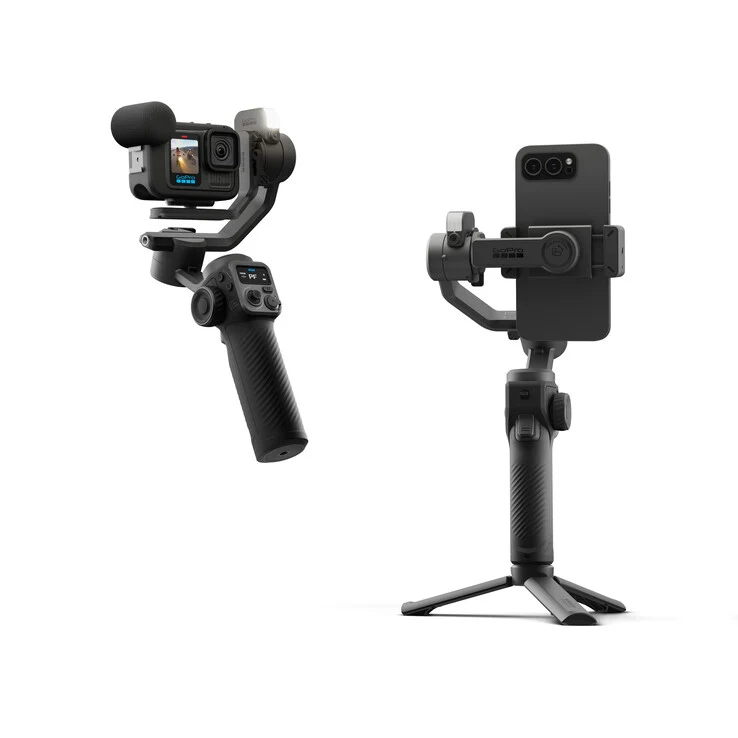
    Nine years after the release of the Karma Grip stabilizer, GoPro is set to introduce a new version. On October 21, the Fluid Pro AI will be launched, bringing AI-driven tracking features to compete with rivals such as the DJI Osmo Mobile 7P, Insta360 Flow Pro, and Hohem iSteady V3 Ultra.

    New Features and Compatibility

    GoPro has revealed this new 3-axis gimbal alongside the latest Lit Hero and Max 2 action cameras. Importantly, it will come with interchangeable mounts compatible with their action cameras, compact point-and-shoot devices, and smartphones. Unlike the previous Karma Grip, which only worked with GoPro’s action cameras, this new model is a much better option for smartphone users as well.

    Specifications and Payload Capacity

    The gimbal boasts a maximum payload capacity of 400 grams, making it suitable for almost all flagship smartphones, including the Samsung Galaxy S25 Ultra (weighing 218 grams) and the new iPhone 17 Pro Max (which is 233 grams).

    One of the standout features of the Fluid Pro AI is its smart subject tracking. GoPro claims it can focus on a person’s face or body and keep them framed as they move, which should be very useful for solo creators. Additionally, it has a built-in display for quick access to camera controls and an integrated fill light.

    Pricing and Battery Life

    However, the price tag is a bit steep. At $229.99, the Fluid Pro AI is more expensive than its competitors like the DJI Osmo Mobile 7P (currently $149.99 at Best Buy), Insta360 Flow Pro (currently $129 at Amazon), and Hohem iSteady V3 Ultra (currently $169 at Amazon). On the bright side, GoPro’s gimbal offers the best battery life, lasting up to 18 hours, and can function as a power bank as well.

    Source:
    Link


  • Affordable Kodak Flix X20 Smart Projector with Speaker Available

    Affordable Kodak Flix X20 Smart Projector with Speaker Available

    Key Takeaways

    1. Kodak has launched the Flik X20 smart projector in the U.S. at an affordable price of $299.99.
    2. The projector features a native resolution of 1080p, 4K decoding, and HDR10+ support, with a light output of up to 300 ANSI lumens.
    3. Smart capabilities include an Android TV dongle for streaming, wireless content sharing, and voice command support via Google Assistant.
    4. The Flik X20 offers user-friendly features like automatic keystone correction, focus, and screen alignment.
    5. It has built-in Dolby Audio speakers, multiple input options, and comes in black or white color choices.


    Kodak has introduced the Flik X20 smart projector in the United States. The firm already markets other projector models in this area, such as the Luma 500 and the Flik HD10. This latest projector comes at a fairly affordable price, featuring a simple set of specifications to go along with it.

    Specifications and Features

    The Flik X20 boasts a native resolution of 1080p, along with 4K decoding capabilities and support for HDR10+. As per Kodak’s claim, it offers a light output of up to 300 ANSI lumens, suggesting that it is best utilized in darker environments. Additional specifications include a contrast ratio of 3,000:1 and a throw ratio of 1.3:1; the largest recommended image size is about 150 inches, according to its listing on Amazon. Users can easily enhance their viewing experience with features such as automatic keystone correction, automatic focus, automatic screen alignment, and AI obstacle avoidance.

    Smart Capabilities

    The Flik X20 is equipped with an Android TV dongle, letting users stream content from various popular applications such as Hulu and Disney+. It also allows for wireless content sharing from mobile devices through Google Cast or AirPlay. Additionally, the projector supports voice commands via Google Assistant. It features two built-in 3W speakers enhanced with Dolby Audio, but users can connect external speakers either through Bluetooth or a 3.5 mm audio jack. Other input options include HDMI 2.0/1.4 and USB 2.0, and it also supports dual-band Wi-Fi. Also, it comes with a remote control that has dedicated buttons for Google Assistant, YouTube, Netflix, Prime Video, and Disney+.

    Pricing and Availability

    The Kodak Flik X20 smart projector is now up for purchase in the US at a price of $299.99. Customers can select between black or white color options for the device.

    Source:
    Link


  • iPhone 17 Pro Beats Vivo X200 Ultra in DxOMark Camera Test

    iPhone 17 Pro Beats Vivo X200 Ultra in DxOMark Camera Test

    Key Takeaways

    1. The Vivo X200 Ultra dropped from third to fourth place in DxOMark’s smartphone camera rankings, while the iPhone 17 Pro entered the top three by a narrow margin.
    2. Many users find the iPhone 17 Pro’s ranking absurd, especially since it scored lower in the photo category compared to the Vivo X200 Ultra.
    3. The iPhone 17 Pro excels in video performance, scoring high for its ultra-wide-angle and main camera capabilities, despite its lower photo score.
    4. The Vivo X200 Ultra and Huawei Pura 80 Ultra are recommended for superior photo quality based on DxOMark’s evaluations.
    5. Minor issues in the iPhone 17 Pro’s video mode include focus and white balance challenges with moving subjects, as well as some image noise in low-light conditions.


    The French camera evaluators at DxOMark are stirring the pot again with their strict ranking system for smartphone cameras, which has produced some odd outcomes before. A new test, labeled as preliminary by DxOMark (which means not every result is out yet), is already causing a stir in the community after its release. The findings show that the Vivo X200 Ultra has dropped from third to fourth place, while the latest iPhone has squeezed into the top three by a single point, falling just behind the Oppo Find X8 Ultra and the Huawei Pura 80 Ultra.

    Community Reactions

    Many users who have both devices, like @sondesix, think this is utterly absurd. Given the score the iPhone 17 Pro received in the camera evaluation, this criticism appears to be fair. Let’s explore how the testers defended this rating for Apple’s new smartphone. Specifically in the video category, the iPhone 17 Pro scored two top marks, outshining its rivals in both ultra-wide-angle and main camera segments. This highlights how the overall score was reached, even with its lesser performance in the photo category.

    Photo Performance Compared

    The Vivo X200 Ultra clearly surpasses the iPhone 17 Pro in the Photo sub-score with 173 points against 166 points. Therefore, DxOMark suggests that for those in search of the finest camera for photos, the Vivo X200 Ultra or the Huawei Pura 80 Ultra would be a better choice, as they still dominate the custom ranking for raw photo quality. However, when looking at the custom ranking for video, the iPhone 17 Pro has now taken over first place from last year’s iPhone 16 Pro Max. Testers have noted the iPhone 17 Pro’s remarkable video capabilities, precise exposure, and consistent white balance with high dynamics, even in dim lighting. They also commend the minimal image artifacts, attractive bokeh effect, and the smooth transition among the three camera modules.

    Minor Issues Identified

    Interestingly, there are very few drawbacks mentioned. The report highlights occasional minor issues with focus and white balance for moving subjects in video mode, along with reduced texture detail near zoom settings. A bit of image noise can also be observed when shooting indoors or in low light. The complete test results are anticipated to be released shortly. Below are three comparison images from DxOMark featuring the Pura 80 Ultra, the Vivo X200 Ultra, and the Google Pixel 10 Pro XL, which further illustrate that the iPhone 17 Pro isn’t necessarily the best option in all situations, especially regarding photos.

    Source:
    Link


  • Hubble Captures Stunning Galaxy with 100,000 Light-Year Tail

    Hubble Captures Stunning Galaxy with 100,000 Light-Year Tail

    Key Takeaways

    1. NGC 2775 is located 67 million light-years away in the constellation Cancer and resembles both elliptical and spiral galaxies.
    2. Its unique structure includes a smooth center and a ring of dust with uneven star clusters, leading to its classification as a lenticular galaxy.
    3. Evidence suggests NGC 2775 may have formed from the merging of spiral galaxies, indicated by a tail of hydrogen gas extending around it.
    4. Recent Hubble observations include H-alpha light, which helps identify regions of star formation by tracing hydrogen gas.
    5. The latest image reveals a bright core, an inner dust ring, and an outer dust ring, with young stars and nebulae visible between them.


    Galaxy NGC 2775 is situated 67 million light-years away in the constellation Cancer, often called The Crab. When looking at this galaxy from Hubble’s perspective, it appears to have a smooth and clear center, giving it a resemblance to an elliptical galaxy.

    A Unique Structure

    However, NGC 2775 also features a ring of dust adorned with uneven clusters of stars, which lends it an aspect of a spiral galaxy. This complex structure has sparked debate among scientists. Some have classified NGC 2775 as a lenticular galaxy, which possesses characteristics from both spiral and elliptical galaxies.

    It would be intriguing to discover how this galaxy with its intricate shape was formed. One theory about lenticular galaxies suggests they originate from the merging of spiral galaxies with other galaxies.

    Evidence of Merging

    Interestingly, there is some evidence suggesting that NGC 2775 may have been formed in such a manner. Previous research has indicated that NGC 2775 is accompanied by a tail of hydrogen gas that extends nearly 100,000 light-years around the galaxy. This gas tail could be the remnant of one or more galaxies that fused with NGC 2775.

    Hubble had previously captured images of NGC 2775 back in 2020, but this latest image offers more comprehensive data. It includes observations made in H-alpha light.

    Understanding H-alpha Light

    H-alpha is a specific wavelength of red light that facilitates the tracing of regions where stars are forming. Young, massive stars emit strong UV radiation, which ionizes the surrounding hydrogen gas, resulting in H-alpha emissions.

    In this latest Hubble image, the bright core of NGC 2775 is prominently visible at the galaxy’s center. Surrounding this core is an inner ring of dust, and there is a thicker outer ring of dust encircling the edge. Between these two rings lies a swirling network of dust strands, with young blue stars and red nebulae peeking through the dust.

    Source:
    Link


  • GoPro Max 2 Launch: The Only True 8K 360° Action Camera

    GoPro Max 2 Launch: The Only True 8K 360° Action Camera

    Key Takeaways

    1. GoPro has released the Max 2, seven months after the Max 2025, with a retail version matching previous leaks.
    2. The Max 2 features a larger 1,960 mAh battery, waterproofing up to 5 meters, and operates in temperatures from -10º C to +35º C.
    3. It has a 1/2.3-inch sensor and f/1.8 aperture, capable of taking 29 MP images and recording 360° videos in resolutions up to 8K at 30 FPS.
    4. The camera includes six built-in microphones, supports 10-bit color, and allows for lens replacements.
    5. The Max 2 is priced at $499.99 in the US, undercutting competitors DJI Osmo 360 and Insta360 X5 by $50, with pre-orders starting September 30.


    GoPro has at last introduced the Max 2, seven months after the debut of the Max 2025 (currently priced at $2499 on Amazon) and more than a year since a photo of the Max 2 first appeared online. Interestingly, the retail version of the Max 2 looks exactly like the one that leaked last July, raising questions about why it has taken so long to hit store shelves.

    Specs and Features

    The Max 2 measures 69.7 x 64 x 48.7 mm, not including its Folding Fingers. It comes equipped with a 1,960 mAh battery, which GoPro claims is 23% bigger than batteries in earlier models. The device is designed to function in temperatures ranging from -10º C to +35º C and boasts waterproofing up to 5 meters. Additionally, the camera supports Bluetooth Low Energy 5.3 and Wi-Fi 6, all within its 195 g casing.

    Performance

    Moreover, the Max 2 is fitted with a 1/2.3-inch sensor and an f/1.8 aperture, enabling it to take 29 MP images and record 360° videos in 8K at 30 FPS, 5.6K at 60 FPS, or 4K at 100 FPS for slow-motion effects. GoPro is clearly targeting competitors like DJI and Insta360 with its advertising, which includes statements such as:

    The only true 8K 360 camera. No misleading upscaling, no useless black pixels, no AI-generated content.

    Pricing and Availability

    In addition to these features, the Max 2 includes six built-in microphones, supports 10-bit color, and allows for lens replacements. The GoPro Max 2 can be ordered today for $499.99 in the US, underpricing the DJI Osmo 360 and Insta360 X5 by $50 in the US market. GoPro anticipates that it will start fulfilling pre-orders on September 30.

    Source:
    Link


  • GoPro Launches New Lit Hero Action Camera with Major Upgrades

    GoPro Launches New Lit Hero Action Camera with Major Upgrades

    Key Takeaways

    1. GoPro launched the Lit Hero action camera, following the Hero and Hero 13 Black, but no Hero 14 Black was released.
    2. The Lit Hero shares dimensions with the previous Hero but is slightly taller and heavier.
    3. It supports 4K video capture at 60 FPS, an upgrade from the previous model’s 30 FPS limit, and includes slow-motion video capabilities.
    4. The Lit Hero features an LED light for improved low-light photography.
    5. The camera is available for pre-order at $269.99, which is $70 more than the GoPro Hero.


    GoPro has refreshed its Hero action camera lineup today with the release of the Lit Hero, just a little over a year after launching the Hero and Hero 13 Black. Although the company did not unveil a Hero 14 Black, the Lit Hero debuts alongside the Max 2, which is the much-anticipated follow-up to the original Max that first hit the market in 2019.

    Specs and Features

    In essence, the Lit Hero retains many features from last year’s Hero (currently priced at $199 on Amazon). For example, both cameras share dimensions of 56.6 x 29.4 mm. However, the Lit Hero stands 0.7 mm taller and weighs 7 g more than the GoPro Hero. They also both have a 1/2.8-inch CMOS sensor featuring an f/2.3 aperture and a 15 mm equivalent focal length, allowing for 12 MP still images.

    Upgraded Capabilities

    A significant upgrade is the support for 4K video capture at 60 FPS; the prior GoPro Hero was limited to 30 FPS for 4K shooting. Additionally, the Lit Hero can record slow-motion videos, a feature that the GoPro Hero does not support. Furthermore, GoPro has added an LED light, which enhances the quality of images taken in low-light conditions.

    Pricing and Availability

    The GoPro Lit Hero is available for pre-order starting today at a price of $269.99 in the US. This means the Lit Hero is $70 and about 35% pricier than the GoPro Hero. Presently, GoPro anticipates that it will start fulfilling pre-orders “on or before” October 21.

    Source:
    Link


  • New BenQ 4K Short Throw Laser Projector Now Available Online

    New BenQ 4K Short Throw Laser Projector Now Available Online

    Key Takeaways

    1. The BenQ LK830ST Laser Simulation Projector is designed for immersive experiences and business applications, launched in August 2025.
    2. Pricing: $2,499 in the US, approximately £2,418 in the UK, and €1,999 in Europe (reduced from €2,399).
    3. It features 4K resolution, a short throw ratio of 0.5:1, and can project images up to 300 inches, with brightness up to 4,000 ANSI lumens.
    4. The projector has a lifespan of about 20,000 hours, covers 93% of the Rec.709 color gamut, and offers a high contrast ratio of 3,000,000:1.
    5. Additional features include 2D Keystone Correction, multiple ports (USB and HDMI), 16.7 ms input lag, and a compact design for easy portability and installation.


    BenQ has introduced the LK830ST Laser Simulation Projector in both North America and Europe. It’s designed for creating immersive experiences, as well as for mapping and other business settings. This projector was revealed in August 2025, alongside the LH830ST laser house mapping projector.

    Pricing and Availability

    You can purchase the BenQ LK830ST Laser Simulation Projector from the brand’s US online store for $2,499. In the UK, it’s available at retailers such as visunext for approximately £2,418. In Europe, the projector can be bought for €2,399; however, Golfroom is currently offering it at a reduced price of €1,999.

    Specifications

    The LK830ST features a 4K resolution (3,840 x 2,160 pixels) and is a short throw laser projector with a throw ratio of 0.5:1, capable of producing a maximum image size of 300 inches (~762 cm). The projector’s laser is said to provide brightness up to 4,000 ANSI lumens, and the light source can last about 20,000 hours under normal use. It also covers 93% of the Rec.709 color gamut and boasts a contrast ratio of 3,000,000:1 for full on/off (FOFO). Users have the option to select from various modes, including HDR10, HLG, and sRGB.

    Additional Features

    The LK830ST is equipped with tools for enhancing images, such as 2D Keystone Correction and Corner Fit. It offers a variety of ports, including USB and HDMI, with an input lag of 16.7 ms and a resolution of 1080p at 60Hz. This latest projector from BenQ is fairly compact, with dimensions of 279 x 121 x 229 mm (~11.0 x 4.8 x 9.0 inches) and a weight of 3.4 kg (~7.5 lbs), making it convenient for ceiling mounting or portability.

    BenQ, PR Newswire.

    Source:
    Link