Tag: Webb Telescope

  • Oldest Galaxy Ever Found in the Universe Discovered by Webb

    Oldest Galaxy Ever Found in the Universe Discovered by Webb

    Key Takeaways

    1. Webb Space Telescope observed the galaxy MoM-z14, dating back 280 million years post-Big Bang.
    2. The Near-Infrared Spectrograph (NIRSpec) confirmed MoM-z14’s distance with a cosmological redshift of 14.44.
    3. MoM-z14 is 100 times brighter than earlier theoretical predictions, with high nitrogen content likely linked to supermassive stars.
    4. The galaxy shows signs of reionization, indicating the ionization of neutral hydrogen and contributing to Webb’s goal of mapping this process.
    5. A research paper on this discovery has been published in the Open Journal of Astrophysics.


    Since it was launched, Webb has been bringing science closer to the early universe. Recently, Webb observed as far back as 280 million years post-Big Bang, discovering a bright galaxy named MoM-z14.

    Distance Measurement Breakthrough

    Typically, astronomers estimate galaxies’ distances based on their images. However, with Webb’s Near-Infrared Spectrograph (NIRSpec), they could verify exactly how far back in time the MoM-z14 galaxy was. The NIRSpec confirmed that this galaxy has a cosmological redshift of 14.44, indicating that the light from the galaxy has been traveling through space, and the universe has expanded its wavelength by 14.44 times.

    Unusual Brightness and Composition

    The galaxy MoM-z14’s brightness and high nitrogen content have also captured interest. Its brightness is 100 times brighter than prior theoretical studies had suggested. Astronomers think that its high nitrogen levels might be linked to supermassive stars within the galaxy. The theory claims that the universe’s dense environment led to the formation of these supermassive stars, which could generate large amounts of nitrogen.

    Signs of Reionization

    Another fascinating finding from astronomers is that MoM-z14 shows evidence of reionization, a process that ionizes neutral hydrogen. This neutral hydrogen forms a thick fog that light cannot penetrate. When this hydrogen is ionized, the fog dissipates. One of Webb’s objectives is to map out the timeline of this clearing phase. The discovery of MoM-z14 adds yet another piece to Webb’s puzzle in this endeavor.

    A research paper detailing this discovery has been published in the Open Journal of Astrophysics.

    Source:
    Link


  • Webb’s 255-Hour Study Maps Dark Matter in 800,000 Galaxies

    Webb’s 255-Hour Study Maps Dark Matter in 800,000 Galaxies

    Key Takeaways

    1. The James Webb Space Telescope (JWST) captured images of a section of the sky in the Sextans constellation, displaying nearly 800,000 galaxies and a dark matter map.
    2. Dark matter is invisible and doesn’t interact with light, but its presence is inferred through gravitational effects on visible matter, specifically via gravitational lensing.
    3. There are two types of gravitational lensing: strong (noticeable bending of light) and weak (subtle light distortion), with Webb’s dark matter map relying on weak gravitational lensing techniques.
    4. Webb’s findings reveal additional clumps of dark matter compared to Hubble’s 2007 map, showing twice as many galaxies and providing a clearer view.
    5. The COSMOS project involves collaboration with various telescopes to enhance understanding of galaxy formation and the influence of dark matter on their growth.


    As part of the Cosmic Evolution Survey (COSMOS) initiative, Webb has taken images of a section of the sky found in the Sextans constellation. This area spans 0.54 square degrees, which is roughly two and a half times larger than a Full Moon. The image displays nearly 800,000 galaxies, and it also overlays a map that highlights dark matter.

    Understanding Dark Matter

    Dark matter is something we can’t see directly, neither with our eyes nor with traditional telescopes. This is because it doesn’t give off, reflect, absorb, or block light. Still, we can find dark matter since it interacts with the universe via gravity. Big clusters of dark matter can bend space-time. As the light from nearby galaxies travels to Earth, this bending occurs, which is known as gravitational lensing.

    Types of Gravitational Lensing

    There are two main kinds of gravitational lensing: strong and weak. Strong gravitational lensing creates a noticeable bending of light in images. Weak gravitational lensing, on the other hand, causes a much subtler distortion of the light. Astronomers carefully examine thousands of galaxies to spot these patterns. The dark matter map created by Webb relies on weak gravitational lensing techniques.

    In the image produced, dark matter is shown in blue. The areas that are a brighter blue signify a higher concentration of dark matter. Although Hubble mapped this region in 2007, Webb’s findings show additional clumps of dark matter, as it features around twice as many galaxies compared to Hubble’s map. Moreover, Webb provides a clearer and more detailed view.

    Collaboration with Other Telescopes

    Many other telescopes have contributed to the COSMOS project. Researchers are using these varied perspectives to better comprehend how galaxies develop and how dark matter affects their growth.

    Source:
    Link


  • December’s Webb Picture of the Month: A Sparkling Christmas Scene

    December’s Webb Picture of the Month: A Sparkling Christmas Scene

    Key Takeaways

    1. Westerlund 2 is a star cluster located in the Gum 29 stellar nursery, about 20,000 light-years from Earth in the Carina constellation.
    2. The cluster spans 6–13 light-years and contains many young, massive stars that emit powerful radiation, shaping the surrounding gas into striking structures.
    3. New observations have revealed the complete population of brown dwarfs in Westerlund 2, which are objects that form like stars but do not have enough mass to be classified as stars.
    4. NASA’s Webb Telescope, using NIRCam and MIRI, has provided detailed images that help locate stars with protoplanetary disks, aiding in understanding planet formation.
    5. Westerlund 2 was previously featured in Hubble’s 25th anniversary image, but recent findings provide new insights into its stellar population and evolution.


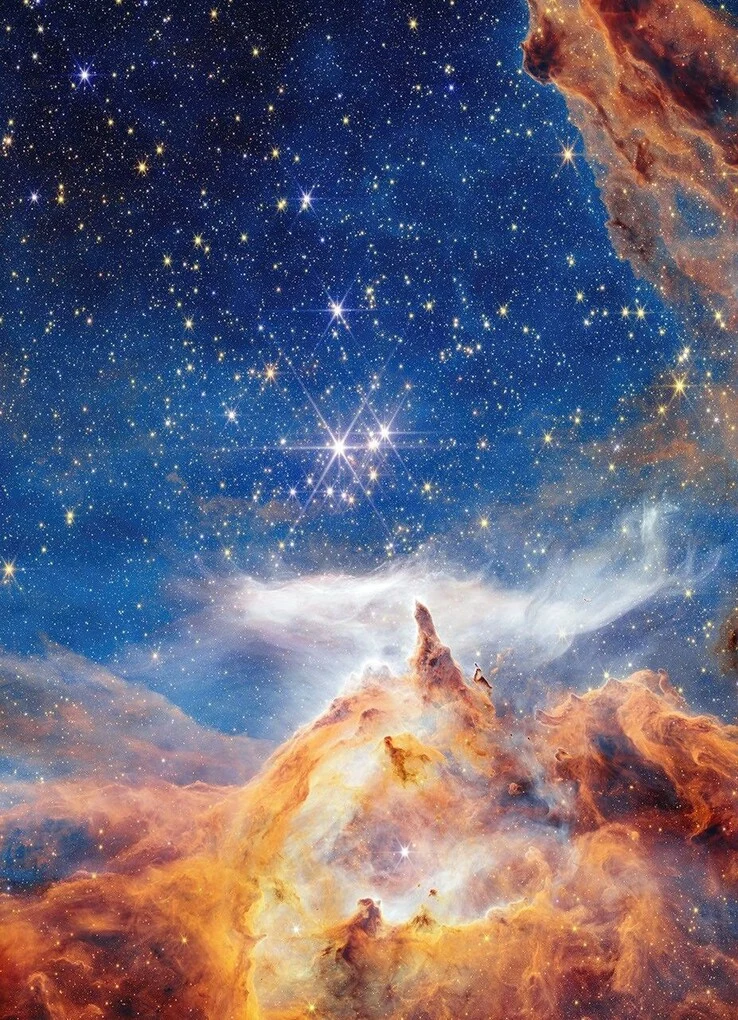
    Westerlund 2 is a cluster of stars located in a stellar nursery known as Gum 29. This nursery is situated about 20,000 light-years from Earth in the constellation Carina, which is also called the Keel. The sheer number of bright stars in Westerlund 2 makes the area appear festive and vibrant.

    Structure of the Cluster

    The entire cluster spans approximately 6–13 light-years across. While the region is filled with stars, the most brilliant part of the cluster is found near the top of the image. This section contains numerous young and massive stars that release powerful radiation into the surrounding gas. This radiation shapes striking walls and cavities filled with glowing red and orange gas. Additionally, the image reveals smaller stars that have just begun their shining phase, still enveloped by the gas and dust that birthed them.

    New Discoveries

    Westerlund 2 was previously highlighted as part of Hubble’s 25th anniversary image back in 2015. However, this latest observation uncovers something new: the complete population of brown dwarfs. Brown dwarfs are celestial objects that develop like stars but lack the necessary density and heat to be classified as stars. The smallest of these brown dwarfs may only have masses a few times that of Jupiter, and Webb’s findings also include objects that are around 10 times the mass of Jupiter.

    Observational Advances

    This remarkable image was produced using data from Webb’s Near-Infrared Camera (NIRCam) and Mid-Infrared Instrument (MIRI). The information gathered is assisting astronomers in locating hundreds of stars that possess protoplanetary disks. Discovering these stars could provide valuable knowledge about the evolution of these disks and the formation of planets within environments dominated by young, massive star clusters.

    Source:
    Link


  • Webb Image Unveils Stunning Details of Milky Way’s Star-Forming Region

    Webb Image Unveils Stunning Details of Milky Way’s Star-Forming Region

    Key Takeaways

    1. Sagittarius B2 is located a few hundred light-years from the Milky Way’s central black hole, Sagittarius A.
    2. Half of the star formation in the galactic core occurs in Sagittarius B2, despite it having only 10% of the gas compared to other areas.
    3. The James Webb Space Telescope (JWST) is studying Sagittarius B2 using its Near-Infrared Camera (NIRCam) and Mid-Infrared Instrument (MIRI).
    4. NIRCam images reveal numerous stars and bright gas clouds, while dark patches may indicate areas that could form new stars in the future.
    5. The images from NIRCam and MIRI are credited to various institutions and researchers, highlighting collaborative efforts in this research.


    Sagittarius B2 is situated just a few hundred light-years from Sagittarius A, which is the massive black hole found at the center of the Milky Way galaxy. The entire core of the Milky Way is rich in gas, an environment that typically supports the creation of stars.

    Surprising Star Formation

    Interestingly, about half of the star formation occurs in Sagittarius B2, even though this area contains just 10 percent of the gas relative to the rest of the region. This uneven distribution of star creation in the galactic core is still not fully understood.

    To get to the bottom of this enigma, a closer look at Sagittarius B2 is necessary. The James Webb Space Telescope (JWST) studied this region using its Near-Infrared Camera (NIRCam) and Mid-Infrared Instrument (MIRI).

    Captivating Images

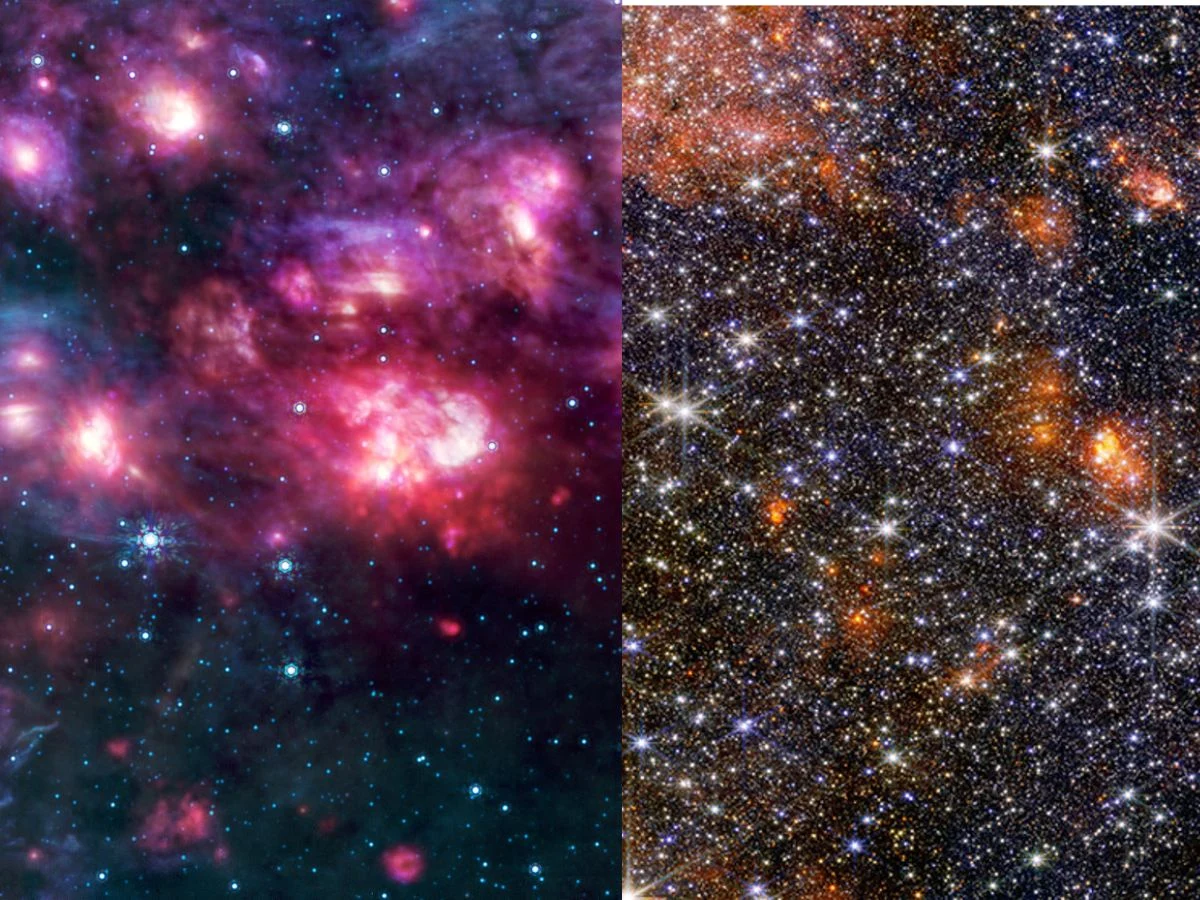
    The NIRCam images show a multitude of stars accompanied by bright clouds of gas and dust surrounding them. There are also several dark patches visible in the images. These dark areas are filled with dense clouds that Webb cannot penetrate. Although they seem like empty voids now, these clouds could eventually lead to the formation of new stars.

    In the images produced by MIRI, glowing gas and dust are at the forefront. Only the most luminous stars show up as blue dots in the images. Researchers plan to conduct additional studies in this area to gather more information about these stars, such as their age and mass.

    Collaborative Efforts

    NIRCam and MIRI image credits go to NASA, ESA, CSA, STScI, Adam Ginsburg (University of Florida), Nazar Budaiev (University of Florida), Taehwa Yoo (University of Florida), and Alyssa Pagan (STScI).

    Source:
    Link


  • Webb Captures Stunning Super-Hot Stars in the Lobster Nebula

    Webb Captures Stunning Super-Hot Stars in the Lobster Nebula

    Key Takeaways

    1. The Webb space telescope is examining star-forming regions to understand young stars and their environments.
    2. Webb captured an image of the star cluster Pismis 24 in the Lobster Nebula, containing hundreds to thousands of stars.
    3. Pismis 24-1, at the cluster’s center, consists of at least two of the largest and brightest known stars.
    4. Intense winds and radiation from young stars shape surrounding gas clouds into denser structures called spires, where new stars can form.
    5. The image reveals dust particles and heated hydrogen gas, providing insights into the behavior and evolution of hot young stars.


    Scientists are utilizing the Webb space telescope to examine areas where stars are born. Their goal is to better understand the development of these young stars and their interactions with the surrounding environment. Recently, Webb has recorded another one of these fascinating regions.

    Capturing Pismis 24

    With its Near-Infrared Camera (NIRCam), Webb has taken a stunning image of a star cluster named Pismis 24, which is found in the Lobster Nebula. This cluster is packed with hundreds to thousands of stars, and the larger, more luminous ones display a six-point diffraction pattern.

    The Mystery of Pismis 24-1

    At the heart of this cluster lies a group of stars known as Pismis 24-1. Although it may appear to be a single bright star, research has indicated that it actually consists of at least two stars. These stars are among the largest and brightest ever discovered.

    Intense winds and radiation emitted by the young stars in this cluster push away the less dense portions of the surrounding gas cloud. This process leaves behind denser structures known as spires. The fierce winds compress these spires, eventually leading to the formation of new stars within them. The tallest of these spires has a broad tip that measures approximately 0.14 light-years across, which is more than 200 times wider than our solar system out to Neptune.

    Insights from the Image

    The image also showcases dust particles, depicted as orange structures resembling smoke. The massive young stars within the cluster heat hydrogen gas, which is illustrated in cyan. This stunning image from Webb not only offers a visual treat but may also provide valuable insights into the behavior and evolution of these hot young stars.


    Source:
    Link


  • ESA Unveils Sharpest Ultra Deep Field Image Ever

    ESA Unveils Sharpest Ultra Deep Field Image Ever

    Key Takeaways

    1. Webb combined data from its NIRCam and MIRI to produce detailed images of the Hubble Ultra Deep Field, showcasing over 10,000 galaxies from early in the Universe’s history.
    2. The MIRI Deep Imaging Survey (MIDIS) involved nearly 100 hours of observation, revealing over 2,500 sources, including many hidden or evolved galaxies.
    3. Infrared wavelengths in the images highlight unique galaxy features, with red and orange indicating dust-rich or high star formation galaxies, and blue and cyan showing brighter galaxies in shorter wavelengths.
    4. Webb’s images provide insights into the characteristics of distant galaxies, influenced by redshift, which shifts their light into the mid-infrared spectrum.
    5. The findings enhance our understanding of galaxy formation and the early Universe, contributing significantly to the fields of astronomy and cosmology.


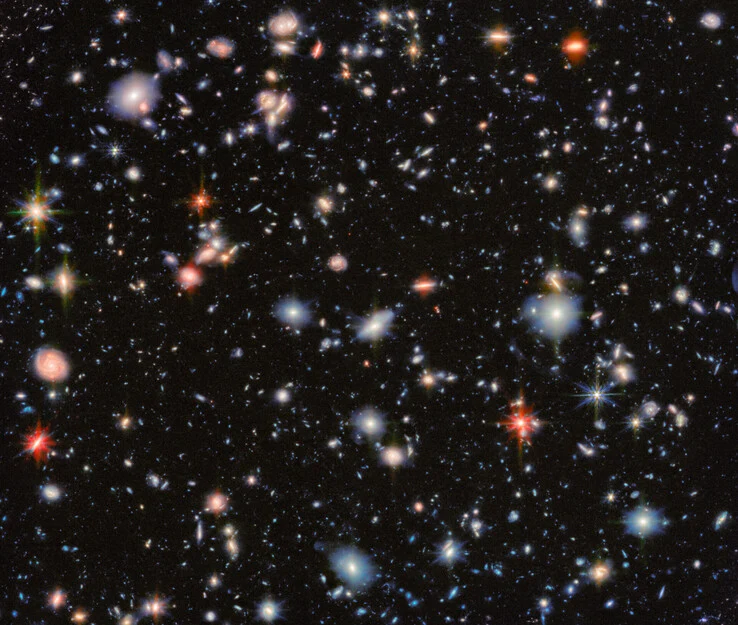
    Webb has merged data from its Near-Infrared Camera (NIRCam) and Mid-Infrared Instrument (MIRI) to show sharp and detailed images of the Hubble Ultra Deep Field. This field was first created using Hubble’s observations taken between 2003 and 2004 and it displays over 10,000 galaxies, with some of them being from less than a billion years after the Big Bang.

    MIRI Deep Imaging Survey

    The recent observations by Webb concentrated on the MIRI Deep Imaging Survey (MIDIS) area, utilizing MIRI’s shortest-wavelength filter. This observation took almost 100 hours, making it Webb’s longest observation of an extragalactic field through a single filter. In this tiny segment of the sky that was studied, Webb uncovered over 2,500 sources, which includes hundreds of very red galaxies. Many of these are probably large galaxies hidden within cosmic dust or more evolved galaxies containing mature stars that emerged early in the Universe’s existence.

    Infrared Wavelengths and Galaxy Features

    The image used colors based on infrared wavelengths, bringing out unique features of the galaxies. Longer mid-infrared wavelengths are represented by orange and red, pointing out galaxies with characteristics like significant dust, high star formation rates, or active galactic nuclei (AGN). The small greenish-white galaxies seem to be more distant due to redshift, causing their light to shift into the mid-infrared spectrum. Most other galaxies shine the brightest in shorter near-infrared wavelengths, which are depicted as blue and cyan, as they do not have mid-infrared boosts.

    Webb’s perspective on the Hubble Ultra Deep Field is among the most profound views of the Universe ever captured, offering valuable information about how the first cosmic structures came into being.

    Conclusion

    Overall, Webb’s findings enhance our understanding of galaxy formation and the early Universe, making significant contributions to astronomy and cosmology.

    Source:
    Link