

Key Takeaways
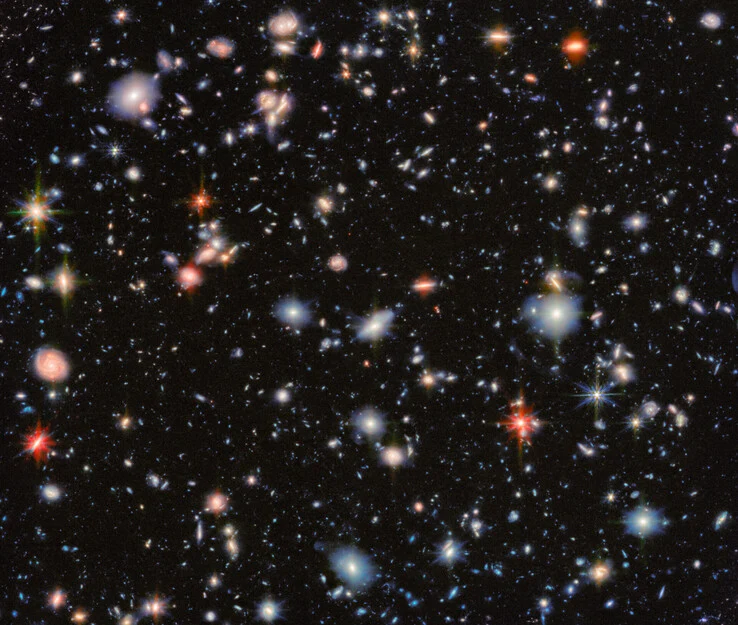
1. Webb combined data from its NIRCam and MIRI to produce detailed images of the Hubble Ultra Deep Field, showcasing over 10,000 galaxies from early in the Universe’s history.
2. The MIRI Deep Imaging Survey (MIDIS) involved nearly 100 hours of observation, revealing over 2,500 sources, including many hidden or evolved galaxies.
3. Infrared wavelengths in the images highlight unique galaxy features, with red and orange indicating dust-rich or high star formation galaxies, and blue and cyan showing brighter galaxies in shorter wavelengths.
4. Webb’s images provide insights into the characteristics of distant galaxies, influenced by redshift, which shifts their light into the mid-infrared spectrum.
5. The findings enhance our understanding of galaxy formation and the early Universe, contributing significantly to the fields of astronomy and cosmology.
Webb has merged data from its Near-Infrared Camera (NIRCam) and Mid-Infrared Instrument (MIRI) to show sharp and detailed images of the Hubble Ultra Deep Field. This field was first created using Hubble’s observations taken between 2003 and 2004 and it displays over 10,000 galaxies, with some of them being from less than a billion years after the Big Bang.
MIRI Deep Imaging Survey
The recent observations by Webb concentrated on the MIRI Deep Imaging Survey (MIDIS) area, utilizing MIRI’s shortest-wavelength filter. This observation took almost 100 hours, making it Webb’s longest observation of an extragalactic field through a single filter. In this tiny segment of the sky that was studied, Webb uncovered over 2,500 sources, which includes hundreds of very red galaxies. Many of these are probably large galaxies hidden within cosmic dust or more evolved galaxies containing mature stars that emerged early in the Universe’s existence.
Infrared Wavelengths and Galaxy Features
The image used colors based on infrared wavelengths, bringing out unique features of the galaxies. Longer mid-infrared wavelengths are represented by orange and red, pointing out galaxies with characteristics like significant dust, high star formation rates, or active galactic nuclei (AGN). The small greenish-white galaxies seem to be more distant due to redshift, causing their light to shift into the mid-infrared spectrum. Most other galaxies shine the brightest in shorter near-infrared wavelengths, which are depicted as blue and cyan, as they do not have mid-infrared boosts.
Webb’s perspective on the Hubble Ultra Deep Field is among the most profound views of the Universe ever captured, offering valuable information about how the first cosmic structures came into being.
Conclusion
Overall, Webb’s findings enhance our understanding of galaxy formation and the early Universe, making significant contributions to astronomy and cosmology.
Source:
Link
Leave a Reply