
Key Takeaways
1. Sagittarius B2 is located a few hundred light-years from the Milky Way’s central black hole, Sagittarius A.
2. Half of the star formation in the galactic core occurs in Sagittarius B2, despite it having only 10% of the gas compared to other areas.
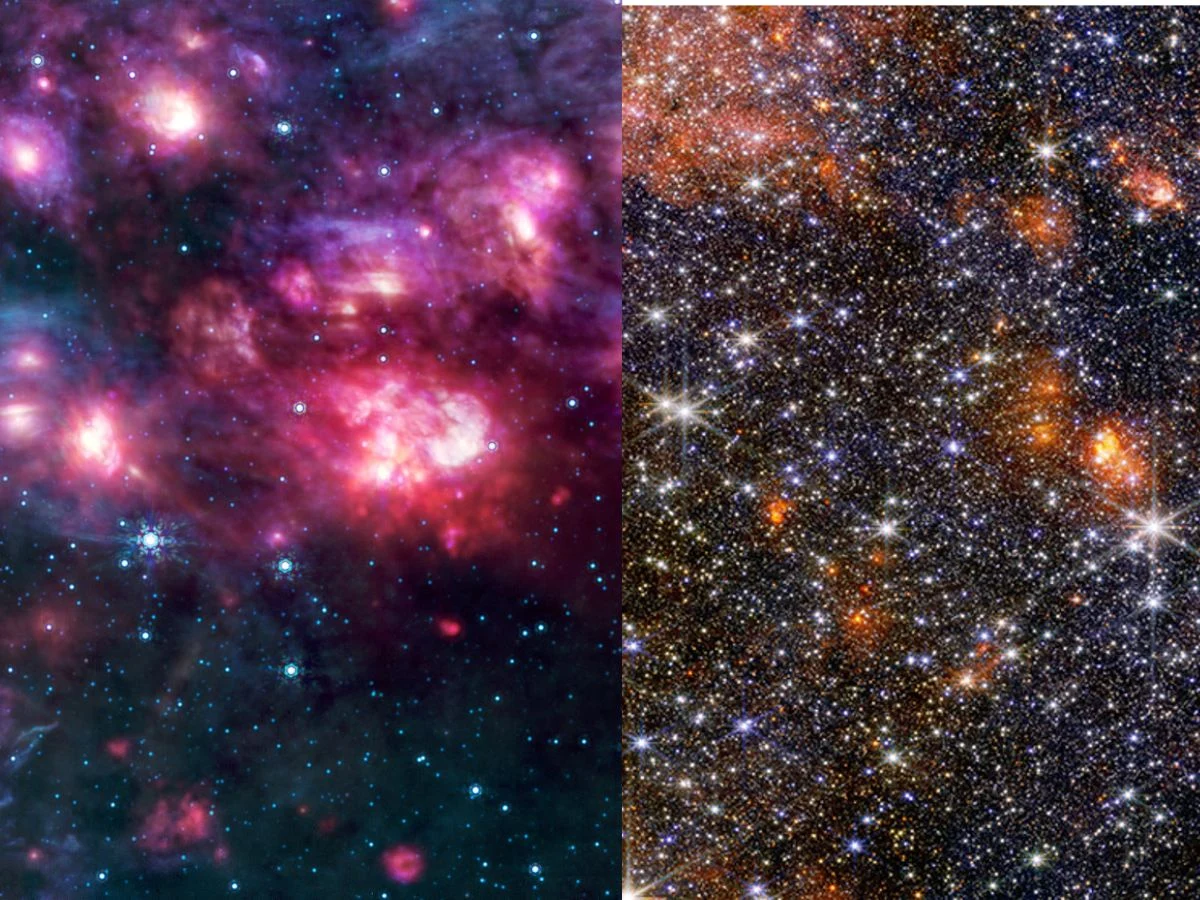
3. The James Webb Space Telescope (JWST) is studying Sagittarius B2 using its Near-Infrared Camera (NIRCam) and Mid-Infrared Instrument (MIRI).
4. NIRCam images reveal numerous stars and bright gas clouds, while dark patches may indicate areas that could form new stars in the future.
5. The images from NIRCam and MIRI are credited to various institutions and researchers, highlighting collaborative efforts in this research.
Sagittarius B2 is situated just a few hundred light-years from Sagittarius A, which is the massive black hole found at the center of the Milky Way galaxy. The entire core of the Milky Way is rich in gas, an environment that typically supports the creation of stars.
Surprising Star Formation
Interestingly, about half of the star formation occurs in Sagittarius B2, even though this area contains just 10 percent of the gas relative to the rest of the region. This uneven distribution of star creation in the galactic core is still not fully understood.
To get to the bottom of this enigma, a closer look at Sagittarius B2 is necessary. The James Webb Space Telescope (JWST) studied this region using its Near-Infrared Camera (NIRCam) and Mid-Infrared Instrument (MIRI).
Captivating Images
The NIRCam images show a multitude of stars accompanied by bright clouds of gas and dust surrounding them. There are also several dark patches visible in the images. These dark areas are filled with dense clouds that Webb cannot penetrate. Although they seem like empty voids now, these clouds could eventually lead to the formation of new stars.
In the images produced by MIRI, glowing gas and dust are at the forefront. Only the most luminous stars show up as blue dots in the images. Researchers plan to conduct additional studies in this area to gather more information about these stars, such as their age and mass.
Collaborative Efforts
NIRCam and MIRI image credits go to NASA, ESA, CSA, STScI, Adam Ginsburg (University of Florida), Nazar Budaiev (University of Florida), Taehwa Yoo (University of Florida), and Alyssa Pagan (STScI).
Source:
Link
Leave a Reply