
Tag: NASA Lunar Telescope

  • Hubble Captures Stunning Image of Galaxy Pair in Long-Distance Relationship

    Hubble Captures Stunning Image of Galaxy Pair in Long-Distance Relationship

    Key Takeaways

    1. Arp 4 consists of two galaxies: MCG-02-05-050 (larger) and MCG-02-05-050a (smaller) in the constellation Cetus.
    2. MCG-02-05-050 features blue, fragmented spiral arms and a faint central disk, while MCG-02-05-050a has bright, distinct spiral arms.
    3. The galaxies appear close together but are actually very far apart: MCG-02-05-050 is 65 million light-years away, and MCG-02-05-050a is 675 million light-years away.
    4. The smaller galaxy MCG-02-05-050a is ten times further from Earth than MCG-02-05-050, suggesting a chance visual effect rather than true proximity.
    5. The name “Arp” comes from the Atlas of Peculiar Galaxies, created by astronomer Halton Arp in the 1960s, with studies advanced by the Hubble Space Telescope.


    Arp 4 is a pair of galaxies found in the constellation Cetus, which is also known as The Whale. This duo includes a larger galaxy named MCG-02-05-050 and a smaller companion galaxy called MCG-02-05-050a.

    Visual Characteristics

    In the provided image, MCG-02-05-050 is recognizable by its blue, fragmented spiral arms along with a faint disk at the center. Its companion, MCG-02-05-050a, can be seen in the upper left corner and is notable for its bright and distinct spiral arms.

    Distance Between Galaxies

    When observed from Earth, these galaxies seem to be in close proximity. However, they are actually quite far apart. MCG-02-05-050 is located about 65 million light-years from our planet, while its smaller counterpart, MCG-02-05-050a, is situated at a distance of 675 million light-years away.

    In fact, MCG-02-05-050a is ten times further away from us than MCG-02-05-050. This information suggests that the smaller galaxy might actually be the bigger one of the pair. The reason they appear so close together is merely a chance visual effect, not a true spatial relation.

    Historical Context

    The designation “Arp” is derived from the Atlas of Peculiar Galaxies, a catalog created by the astronomer Halton Arp in the 1960s. Since the launch of the Hubble Space Telescope, the exploration of the galaxies in this catalog has been significantly advanced.

    Source:
    Link


  • Webb Discovers Mysterious Planet That Defies Explanation

    Webb Discovers Mysterious Planet That Defies Explanation

    Key Takeaways

    1. Astronomers have identified nearly 6,000 exoplanets in the search for signs of life beyond our solar system.
    2. PSR J2322-2650b is a unique exoplanet resembling a hot Jupiter that orbits a pulsar, a rapidly rotating neutron star.
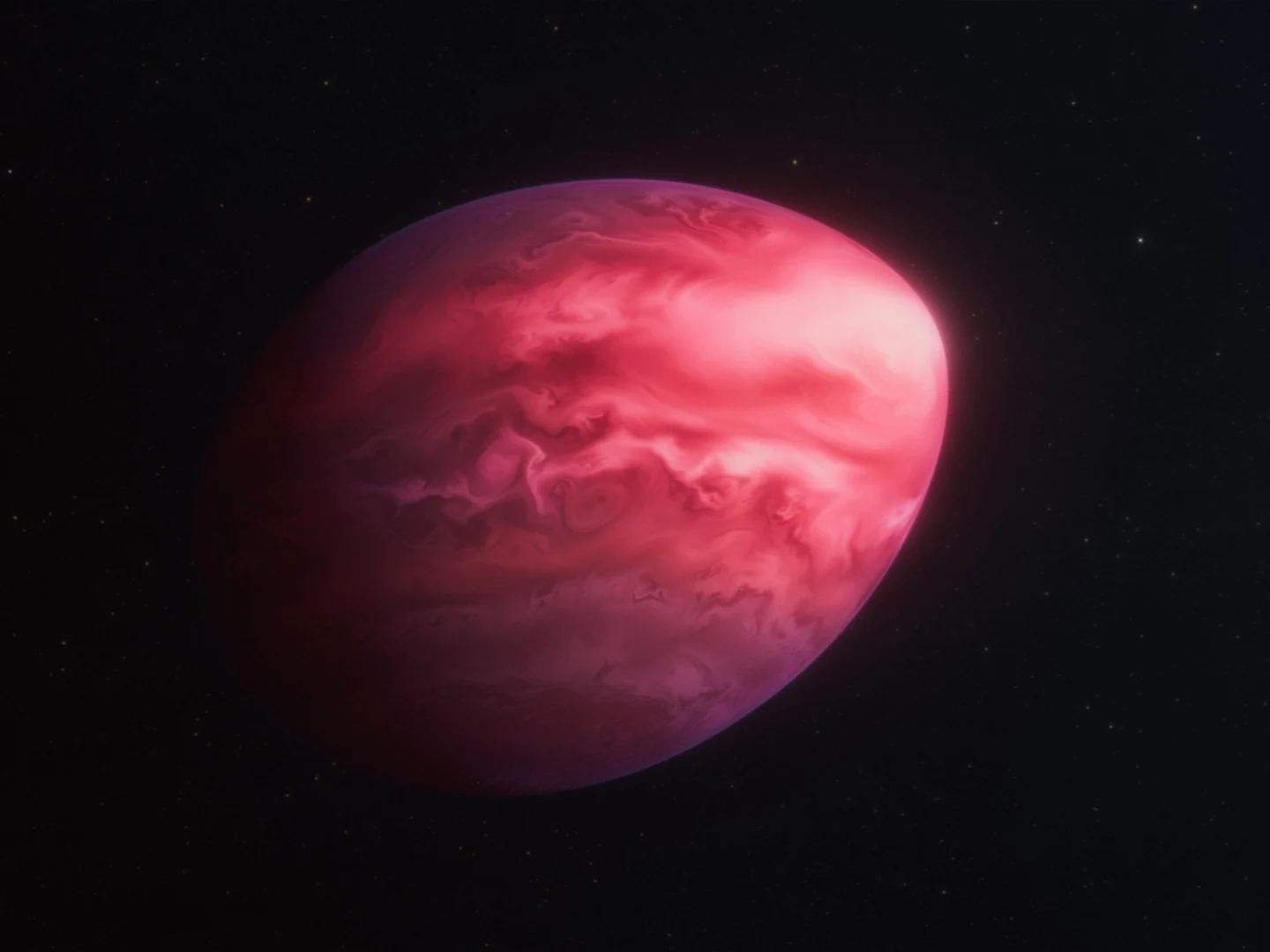
    3. The planet has a lemon-like shape due to the gravitational forces from its pulsar.
    4. PSR J2322-2650b is located just one million miles from its pulsar, allowing it to receive intense radiation.
    5. Its atmosphere is rich in helium and molecular carbon, making it the only known planet with molecular carbon detected at such high temperatures.


    Astronomers are on a quest to find signs of life beyond our own solar system. This effort has resulted in the identification of nearly 6,000 exoplanets. Among these, PSR J2322-2650b is particularly remarkable, as it is the only exoplanet resembling a hot Jupiter that orbits a pulsar, which is a quickly rotating neutron star.

    Unique Shape of PSR J2322-2650b

    One of the most peculiar traits of PSR J2322-2650b is its lemon-like shape. This unusual form is a result of the gravitational forces exerted by the pulsar it circles.

    Proximity to Its Pulsar

    When it comes to its distance from its host star, PSR J2322-2650b is fascinatingly near to its pulsar, located just about one million miles away. For comparison, our Earth sits approximately 100 million miles from the Sun. This close proximity allows the pulsar’s radiation to shine brightly on the exoplanet, bathing it in intense light.

    Atmospheric Composition

    The most distinguishing feature of PSR J2322-2650b is the makeup of its atmosphere, which is rich in helium and molecular carbon. The presence of molecular carbon is quite strange, especially given the exoplanet’s extremely high temperatures, ranging from 1,200 to 3,700 °F. At these high temperatures, one would expect molecular carbon to bond with other elements.

    Astronomers have examined the atmospheric chemical makeup of around 150 planets, both in our solar system and beyond. Notably, PSR J2322-2650b stands alone as the only planet where molecular carbon has been detected. This unusual atmospheric configuration has sparked curiosity among scientists about the planet’s formation. As it appears, the planet does not fit any existing formation theories. The findings of this research were published in the Astrophysical Journal Letters.

    Source:
    Link


  • Hubble’s Stunning Galaxy Image with Starburst Ring of the Week

    Hubble’s Stunning Galaxy Image with Starburst Ring of the Week

    Key Takeaways

    1. NGC 6951 is a spiral galaxy with star-birth regions (nebulae) visible as red dots, alongside young blue stars in its spiral arms.
    2. Recent observations provide detailed views of star formation areas, improving understanding of star development in the galaxy.
    3. The galaxy’s core features an elongated bar of older stars that helps direct gas towards the center, contributing to star formation.
    4. A circumnuclear starburst ring, appearing whitish-blue, is located at the center of NGC 6951 and is rich in gas suitable for new stars.
    5. Over 80 possible star clusters have been identified within the starburst ring, which may have existed for up to 1.5 billion years, aiding future astronomical studies.


    NGC 6951 is a spiral galaxy filled with a lot of stars that can be found in its spiral arms. Hubble’s earlier images showed shining blue stars along these arms. However, that view didn’t provide much info about the areas where stars are being formed.

    Detailed Observation

    The latest observations have improved this view significantly. Now, we can see star-birth regions, known as nebulae, in excellent detail. These areas appear as red dots scattered throughout the galaxy’s arms. Alongside them, many blue stars are visible. These stars are young and extremely hot. Additionally, filament-like dust clouds can be seen lining the spiral arms.

    Galaxy’s Core Features

    At the heart of the galaxy, there’s an elongated bar of yellow light. This bar consists mainly of older stars and rotates slowly. It plays a crucial role in directing gas towards the center. This gas builds up in a circular area that spans about 3,800 light-years.

    This process might be the reason for NGC 6951’s most impressive characteristic—a circumnuclear starburst ring. In the images, this ring appears whitish-blue and is located right at the center of the galaxy. It has a concentration of gas that is suitable for creating many stars.

    Star Clusters and Their Age

    Astronomers have identified over 80 possible star clusters within this starburst ring. Although a lot of the stars here are relatively young (less than 100 million years old), the ring itself could have been around for as long as 1.5 billion years.

    This observation could help astronomers in many ways, such as creating maps of dust in nearby galaxies, understanding the cores of disk galaxies, and keeping an eye on supernovae.

    Source:
    Link


  • 8 Stunning Images Illustrating Einstein’s Theory of Relativity

    8 Stunning Images Illustrating Einstein’s Theory of Relativity

    Key Takeaways

    1. Gravitational lensing occurs when massive objects warp spacetime, causing light to curve and creating distorted or duplicated images of background objects.

    2. This phenomenon acts like a “natural telescope,” allowing scientists to observe distant galaxies and gain insights into the early universe.

    3. The COSMOS-Web program is a 255-hour initiative aimed at exploring the formation and development of large cosmic structures, like galaxy clusters.

    4. The program identified over 400 candidates for gravitational lensing from more than 42,000 galaxies, highlighting eight impressive examples.

    5. Findings reveal galaxies when the universe was 2.7 to 8.9 billion years old, with some images showing galaxies from as early as one billion years after the Big Bang.


    In space, massive objects warp the fabric of spacetime around them. This warping causes light to curve as it moves through that area. When we look at a background object that aligns with this massive entity, the image can appear wavy, round, or even duplicated.

    Understanding Gravitational Lensing

    This phenomenon is known as gravitational lensing, and it comes with some benefits. The large object functions like a gravitational lens or a “natural telescope,” enhancing and distorting the light from far-off galaxies. By utilizing telescopes like Webb and harnessing the power of gravitational lensing, scientists can observe distant objects that reflect what the universe looked like during its formative years.

    The COSMOS-Web Program

    COSMOS-Web is a 255-hour Treasury initiative focused on exploring those early cosmic times. The goal of this program is to comprehend how gigantic structures such as galaxy clusters formed and developed. Researchers analyzed data from COSMOS-Web to identify gravitational lenses.

    The survey discovered over 400 candidates for lensing after examining more than 42,000 galaxies. From these candidates, the eight most impressive were chosen, which are displayed in the collage.

    Insights from the Findings

    The galaxies in the foreground of the image showcase the Universe when it was approximately 2.7 to 8.9 billion years old. The galaxies in the background show distorted images and date back even further.

    The background galaxy located in the top row and second column depicts the Universe when it was just around one billion years old. This galaxy has been nicknamed “The COSMOS-Web Ring.” Surveys like these are aiding us in observing distant galaxies and the early Universe with much more clarity.

    Source:
    Link