Tag: Hubble

  • Hubble Reveals Dwarf Galaxy 23 Million Light-Years Away

    Hubble Reveals Dwarf Galaxy 23 Million Light-Years Away

    Key Takeaway

    – ESO 490-017 is a dwarf irregular galaxy only 12,000 light-years across, significantly smaller and fainter than the Milky Way.
    – Its weak gravity causes stars to be loosely dispersed, resulting in a poorly defined structure.
    – These galaxies contain fewer heavy elements, creating an environment similar to that of the early universe.
    – Studying dwarf galaxies like ESO 490-017 helps scientists better understand the early universe and poorly understood celestial phenomena.


    Hubble’s Latest Cosmic Snapshot

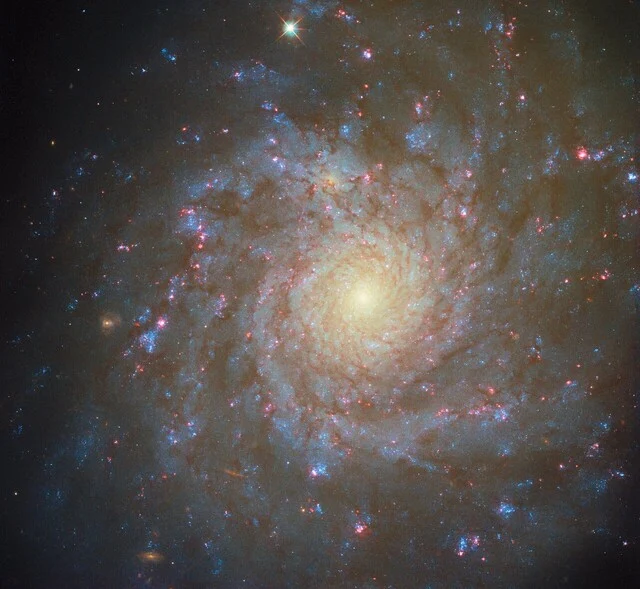
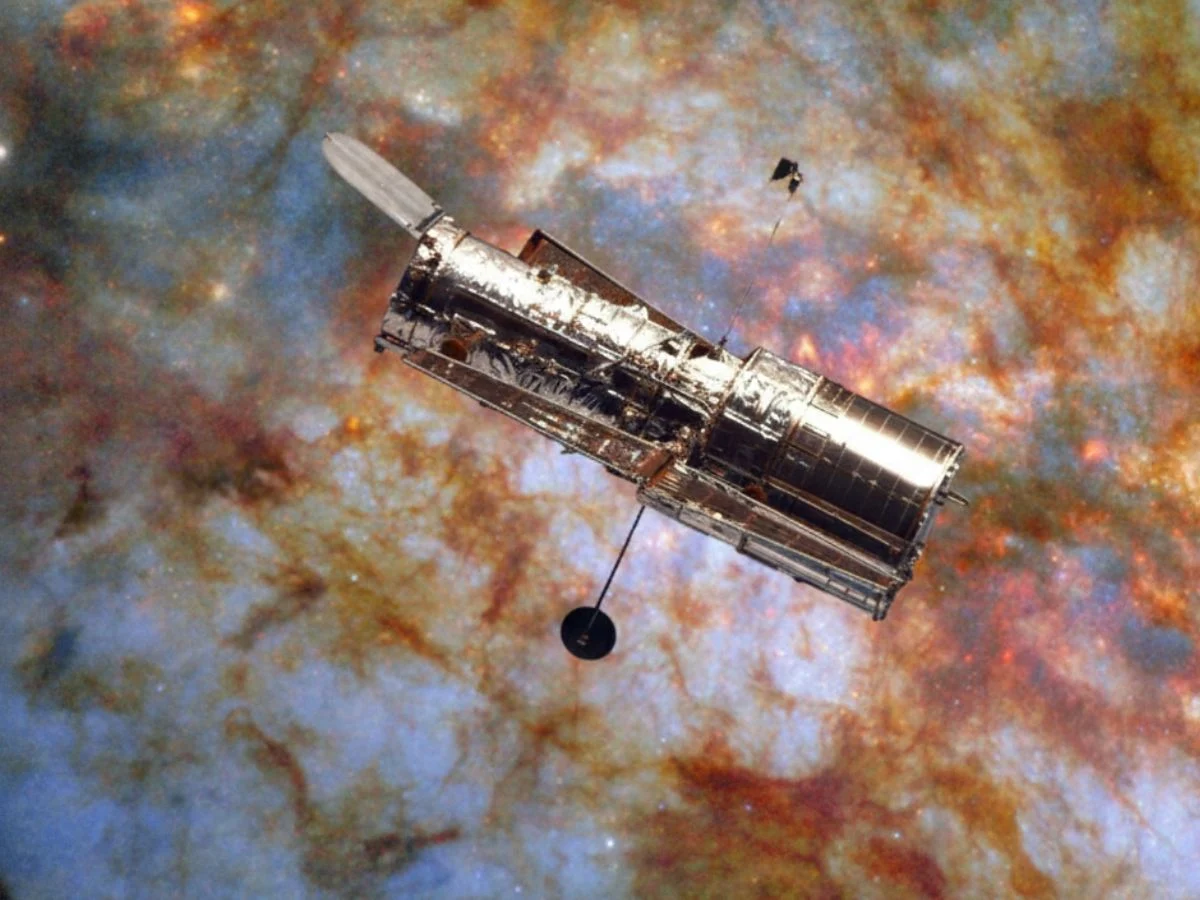
    Since 1990, the Hubble Space Telescope has been staring into the void, letting scientist’s study a whole bunch of celestial objects. Recently, this here telescope managed to capture a real striking image of a dwarf galaxy, which is located about 23 million light-years from our own planet Earth.

    The Odd Little Galaxy Called ESO 490-017

    Known as ESO 490-017, this dwarf irregular galaxy has a composition and structure that’s very interesting, dispite its small size. Indeed, it only measures about 12,000 light-years in diameter, while the Milky Way’s diameter is around 100,000 light-years, and it is also very faint, making it hard to see with normal telescopes.

    • Diameter: 12,000 light-years
    • Distance: 23 million light-years
    • Luminosity: Very low
    • Gravity: Weak

    Why Its Structure Matters

    In addition, the structure of this galaxy is not clearly defined, as you can clearly see in the image that was captured. As a result, its weak gravity allows stars to move around freely inside the galaxy with almost no restriction. Finally, its low luminosty is also directly linked to its gravity, since the stars aren’t concentrated in one single place but are instead dispersed all over the place.

    Unremarkable But Actually Interesting

    However, even though this galaxy might look unremarkable on the surface, it is actually very interesting for astronomers. These kind of structures contain fewer heavy elements then spiral galaxies do, and their environment is quite similar to that of the early universe before everything changed. Thus, by discovering and studdying these celestial objects, researchers will be able to better understand this mysterious period of the universes history.

    A Peek Into the Early Universe

    This will also allow them to better study celestial phenomenons that are still very poorly understood by modern science. The data obtained from such faint galaxies helps us fill in gaps about how stars formed back when the cosmos was young. Every new observation brings us a little bit closer to solving the biggest mysteries of space and time. Its a fascinating field of study that keeps giving us surprises.


    Sources

  • NASA Reveals Hubble’s Ghostly Image of the Universe

    NASA Reveals Hubble’s Ghostly Image of the Universe

    Key Takeaways

    1. Hubble focused on the star-forming area known as Lupus 3, located about 500 light-years away in the Scorpius constellation.
    2. The bright mist in the image is interstellar gas illuminated by nearby stars, with dark dust visible in the lower left.
    3. T Tauri stars, which are under 10 million years old and not yet stable, are prominent in the image.
    4. The brightness of T Tauri stars varies due to radiation and stellar winds clearing surrounding gas and dust.
    5. Brightness changes may result from instabilities in the accretion disk around the stars and the presence of rotating sunspots.


    Hubble has focused on a star-forming area known as Lupus 3, which is situated roughly 500 light-years away in the Scorpius constellation. The bright mist captured in the image is created by interstellar gas that is lit up by nearby stars. Additionally, dark dust can be seen on the lower left part of the image.

    T Tauri Stars Shine Bright

    In this image, a cluster of stars called T Tauri stars are particularly prominent. These stars are located at the left, bottom right, and upper center of the image. T Tauri stars are quite young, at under 10 million years old, and they haven’t yet reached the stable hydrogen fusion stage necessary to become main-sequence stars.

    Understanding Their Brightness

    The visibility of the T Tauri stars in this image is due to their current phase, where radiation and stellar winds are clearing away the surrounding gas and dust. They exhibit variability in brightness, which can change both randomly and in a periodic manner.

    What Causes Brightness Changes?

    The randomness in the brightness of these stars might stem from instabilities within the dust and gas disk around them, known as an accretion disk. As material from this disk falls onto the stars, it may be consumed or cause flares on the star’s surface, adding to the fluctuations. The periodic changes in brightness could be linked to large sunspots that rotate in and out of sight.

    This image, along with similar ones, provides a valuable chance for researchers to gain a deeper understanding of how stars are formed.

    Source:
    Link


  • Webb Telescope Explores Helix Nebula Around Dying Star

    Webb Telescope Explores Helix Nebula Around Dying Star

    Key Takeaways

    1. The Helix Nebula is located 650 light-years from Earth in the constellation Aquarius.
    2. The Near-Infrared Camera (NIRCam) on the Webb Telescope provides clearer images than Hubble and Spitzer.
    3. The gas structure in the nebula resembles comet-like pillars due to interactions between fast-moving and slower gases.
    4. The central white dwarf star illuminates the surrounding gas, with blue areas indicating the hottest gas and yellow areas cooler gas.
    5. The materials from the white dwarf are essential for the formation of new stars and planets.


    The Helix Nebula is situated 650 light-years from Earth in the constellation of Aquarius. Because it is fairly nearby, astronomers have examined this nebula multiple times using both ground and space observatories. However, when you compare it to images from Hubble and the retired Spitzer, the Near-Infrared Camera (NIRCam) on Webb gives a clearer picture.

    Focus on the Structure

    This new image sharpens the view of the gas’s structure. The gas looks like pillars that resemble comets with long tails. Fast-moving hot gas is colliding with slower gas that was released by the star earlier. This interaction creates the stunning visuals captured in the image.

    The Heart of the Nebula

    The dying star, known as a white dwarf, is not visible in the image. It is located at the center of the nebula. However, the light from the white dwarf illuminates the gas around it. The different colors in the image show how hot each gas area is. The gas that is nearest to the white dwarf shines blue, indicating it is the hottest part. As you move further away, the gas cools and turns into the yellow hues shown in the image.

    The material—dust and gas—released from the white dwarf serves as the building blocks for new stars and planets. Images like this are aiding astronomers in learning more about how planets come to be.

    Source:
    Link


  • Hubble Reveals Stunning Protoplanetary Disks in Space

    Hubble Reveals Stunning Protoplanetary Disks in Space

    Key Takeaways

    1. Protoplanetary disks form as stars attract gas and dust from their surroundings, contributing to star growth and potential planet formation.

    2. In visible light images, protoplanetary disks appear as dark dust disks against bright reflection nebulae, with jets of gas also visible.

    3. Infrared observations reveal stars in earlier developmental phases, hidden by thick dust envelopes that visible light cannot penetrate.

    4. The protoplanetary disks cast shadows on surrounding clouds, making them appear larger in infrared images.

    5. The observed stars are located in different molecular clouds, with distances ranging from 450 to 1,500 light-years from Earth.


    This Hubble collection shows eight protoplanetary disks, with four captured in visible light and four in infrared. As stars are being formed, they attract gas and dust from their surroundings. Some of this material creates a spinning disk known as a protoplanetary disk. The gas and dust within this disk continue to supply the growing star, while the leftover matter may eventually give rise to planets.

    Visible Light Observations

    In the visible light image presented, the protoplanetary disks appear as dark dust disks amidst the bright light. HH 390 is not seen edge-on, which is the reason why its disk looks like it’s at the edge of the bright area. The bright light that is being referred to is a reflection nebula, which is a zone of gas and dust illuminated by a star’s light. You can also see jets of gas in the image. Both HH 390 and Tau 042021 are located around 450 light-years away in the Taurus Molecular Cloud, while the stars at the bottom are nearly 500 light-years distant in the Chameleon I star-forming region.

    Infrared Insights

    The stars seen in the infrared image seem to be at earlier phases of their development than those in the visible light photo. During these earlier stages, stars are shrouded by a thick dust envelope. Infrared light can penetrate this envelope, whereas visible light cannot, which explains why the envelope is not visible in the light images.

    The dark regions that are centered in the bright light are indeed the protoplanetary disks. The shadows cast by the disks on the surrounding clouds make them appear larger than they really are. The stars located at the top right and bottom left are situated in the Orion Molecular Cloud, approximately 1,300 light-years from us. The stars in the top left and bottom right are found in the Perseus Molecular Cloud, about 1,500 light-years away.

    Source:
    Link


  • Strange Galaxy with Bright Core: Hubble Picture of the Week

    Strange Galaxy with Bright Core: Hubble Picture of the Week

    Key Takeaways

    1. NGC 4102 is a spiral galaxy located about 56 million light-years away in Ursa Major, featuring an active galactic nucleus (AGN) powered by a supermassive black hole.

    2. The gas spiraling towards the black hole heats up and produces bright radiation, but NGC 4102’s center is less luminous than many other AGNs due to its calmer nature.

    3. NGC 4102 is categorized as a Compton-thick AGN, meaning its nucleus is surrounded by a dense layer of gas.

    4. It is classified as a LINER galaxy, indicating that the gas emits light from weakly ionized elements, suggesting the supermassive black hole is not very strong.

    5. Recent observations of NGC 4102 combine data from Hubble and the Chandra X-ray Observatory to study the relationship between the galaxy and its active galactic nucleus.


    NGC 4102 is a spiral galaxy that sits about 56 million light-years away in Ursa Major, also known as The Great Bear. Its core is particularly fascinating because it contains an active galactic nucleus (AGN), which is driven by a supermassive black hole. This black hole consumes gas at a rapid rate.

    Rapid Gas Inflow

    As the gas moves towards the black hole, it spirals in at astonishing speeds. This rapid motion causes the gas to heat up to very high temperatures, producing bright radiation. This explains why galaxies with AGNs often have very bright centers. However, NGC 4102’s center is not as luminous as some other galaxies with AGNs.

    The reason behind this is that there are various kinds of active galactic nuclei, some of which are stronger than others. NGC 4102 is categorized as a calmer type. It is known as Compton-thick, indicating that its nucleus is enveloped by a dense layer of gas.

    LINER Characteristics

    Additionally, NGC 4102 is classified as a LINER (Low-ionization Nuclear Emission-line Region) galaxy. In these types of galaxies, the gas surrounding the center emits light from weakly ionized elements. This implies that the supermassive black hole in this galaxy isn’t very potent.

    The image of NGC 4102 was captured using data from the Wide Field Camera 3, which has replaced the previous Wide Field Planetary Camera 2 (WFPC2). WFPC2 was used for earlier images of this galaxy taken by Hubble.

    Research and Observations

    This latest observation of NGC 4102 is part of a research program that merges information from Hubble and the Chandra X-ray Observatory. The goal of the program is to explore the connection between NGC 4102 and its active galactic nucleus.

    You can purchase the user-friendly Gskyer Astronomical Refracting Telescope for $97.14 on Amazon.

    ESA: 1 and 2′

    Source:
    Link


  • Stunning Hubble Image of Star-Studded Galaxy – Picture of the Week

    Stunning Hubble Image of Star-Studded Galaxy – Picture of the Week

    Key Takeaways

    1. NGC 4571 is a spiral galaxy located about 60 million light-years away in the constellation Berenices, captured in detail by the Hubble telescope.
    2. The image highlights star clusters made of young, massive stars that appear blue, alongside pink regions indicating active star formation.
    3. The pink glow in star-forming regions is due to young stars emitting ultraviolet light, which ionizes nearby hydrogen gas, leading to H-alpha light emission.
    4. Star formation begins with cold gas clouds that collapse under gravity, heating up and eventually forming new stars.
    5. The latest image of NGC 4571 builds on previous observations and aids astronomers in studying the effects of dust on the visibility of young stars.


    NGC 4571 is a spiral galaxy that sits roughly 60 million light-years away in the constellation Berenices. The Hubble telescope captured an image showing the galaxy’s spiral arms and the many star clusters that surround it. These clusters are made up of young, massive stars that shine blue in the photo.

    Star Formation Revealed

    The image also features regions glowing pink. These areas are where new stars are being formed. The young, hot stars emit a lot of ultraviolet light, which ionizes the hydrogen gas nearby. This ionization leads to the emission of H-alpha light, giving these star-forming regions their distinct pink hue.

    The Process Behind It

    Observations like this one emphasize the fascinating nature of star formation. It’s even more captivating when you think about how the hot stars seen in the image originated from gas that was at freezing temperatures.

    Before stars come into existence, gas clouds at such low temperatures are drawn in by gravity. This gravitational force causes the gas to collapse inward. As it collapses, the center starts to heat up gradually, eventually leading to the stars shining.

    A prior image of NGC 4571 was shared in 2022, which was part of a broad observation program. This latest image provides additional data.

    It incorporates findings from a project focused on how dust impacts the visibility of young stars that are still hidden within their birth clouds. Astronomers rely on Hubble images like this to unravel the mysteries surrounding star formation.

    Source:
    Link


  • Hubble’s Stunning Galaxy Image with Starburst Ring of the Week

    Hubble’s Stunning Galaxy Image with Starburst Ring of the Week

    Key Takeaways

    1. NGC 6951 is a spiral galaxy with star-birth regions (nebulae) visible as red dots, alongside young blue stars in its spiral arms.
    2. Recent observations provide detailed views of star formation areas, improving understanding of star development in the galaxy.
    3. The galaxy’s core features an elongated bar of older stars that helps direct gas towards the center, contributing to star formation.
    4. A circumnuclear starburst ring, appearing whitish-blue, is located at the center of NGC 6951 and is rich in gas suitable for new stars.
    5. Over 80 possible star clusters have been identified within the starburst ring, which may have existed for up to 1.5 billion years, aiding future astronomical studies.


    NGC 6951 is a spiral galaxy filled with a lot of stars that can be found in its spiral arms. Hubble’s earlier images showed shining blue stars along these arms. However, that view didn’t provide much info about the areas where stars are being formed.

    Detailed Observation

    The latest observations have improved this view significantly. Now, we can see star-birth regions, known as nebulae, in excellent detail. These areas appear as red dots scattered throughout the galaxy’s arms. Alongside them, many blue stars are visible. These stars are young and extremely hot. Additionally, filament-like dust clouds can be seen lining the spiral arms.

    Galaxy’s Core Features

    At the heart of the galaxy, there’s an elongated bar of yellow light. This bar consists mainly of older stars and rotates slowly. It plays a crucial role in directing gas towards the center. This gas builds up in a circular area that spans about 3,800 light-years.

    This process might be the reason for NGC 6951’s most impressive characteristic—a circumnuclear starburst ring. In the images, this ring appears whitish-blue and is located right at the center of the galaxy. It has a concentration of gas that is suitable for creating many stars.

    Star Clusters and Their Age

    Astronomers have identified over 80 possible star clusters within this starburst ring. Although a lot of the stars here are relatively young (less than 100 million years old), the ring itself could have been around for as long as 1.5 billion years.

    This observation could help astronomers in many ways, such as creating maps of dust in nearby galaxies, understanding the cores of disk galaxies, and keeping an eye on supernovae.

    Source:
    Link


  • ESA Reveals Stunning Image of Fast Starburst Galaxy

    ESA Reveals Stunning Image of Fast Starburst Galaxy

    Key Takeaways

    1. Messier 82, also known as the Cigar Galaxy, is located 12 million light-years away in the constellation Ursa Major and has a unique bar-like shape.

    2. New imaging data from the High Resolution Channel of Hubble’s Advanced Camera for Surveys offers insights into the galaxy that were not previously available.

    3. Messier 82 has a very high rate of star formation, producing stars at a rate 10 times greater than the Milky Way, leading to the creation of super star clusters.

    4. The galaxy shines about five times brighter than the Milky Way due to its abundance of stars.

    5. Hubble’s latest images reveal active star formation and dark dust clouds that obscure much of the light from the stars, prompting continued research into star formation and its evolution.


    The Messier 82 galaxy, also referred to as NGC 3034, is situated a mere 12 million light-years away in the constellation Ursa Major, known as The Great Bear. This galaxy is distinctive for its stretched bar-like shape, giving it a resemblance to a cigar. Thus, it is often called the Cigar Galaxy.

    New Imaging Insights

    Messier 82 has been observed by renowned space telescopes such as James Webb and Hubble. Nevertheless, the latest image presents data that hasn’t been showcased before. This new data comes from the High Resolution Channel of the Advanced Camera for Surveys (ACS).

    The ACS is an instrument on Hubble that captures images across ultraviolet, visible, and infrared wavelengths. It comprises three sub-instruments, with the High Resolution Channel being one of them. Unfortunately, this particular channel was only operational between 2002 and 2007.

    Star-Studded Galaxy

    Studies of Messier 82 have consistently shown that it is brimming with stars. Researchers have determined that its high rate of star formation is the reason behind the abundance of stars. This rapid formation has led to the creation of super star clusters within the galaxy.

    It is believed that Messier 82 generates stars at a rate 10 times greater than that of the Milky Way. Not surprisingly, this galactic neighbor shines about five times brighter than our own Milky Way.

    Hubble’s Stunning Display

    The Hubble Picture of the Week showcases a bluish hue at the center of the galaxy, indicating active star formation. Additionally, the image reveals dark dust clouds that appear black in the center and red around the edges. These clouds obscure much of the light emitted by the stars.

    Scientists persist in utilizing Hubble to explore areas like this in an effort to gain deeper insights into star formation and its evolution.

    Source:
    Link