Key Takeaways
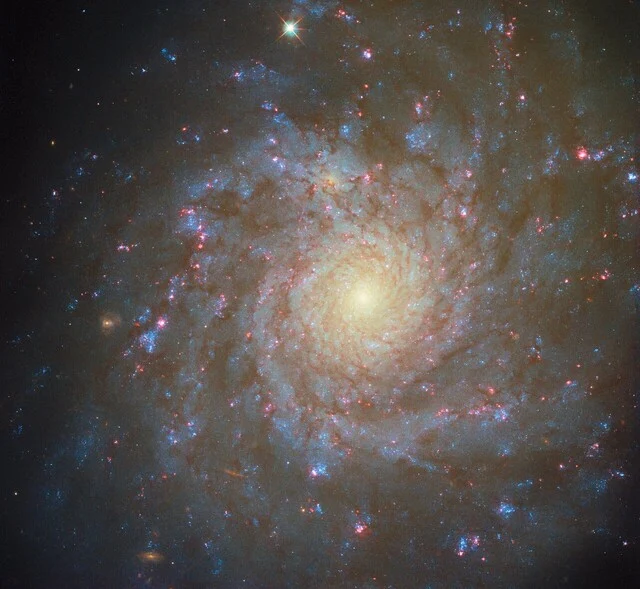
1. NGC 4571 is a spiral galaxy located about 60 million light-years away in the constellation Berenices, captured in detail by the Hubble telescope.
2. The image highlights star clusters made of young, massive stars that appear blue, alongside pink regions indicating active star formation.
3. The pink glow in star-forming regions is due to young stars emitting ultraviolet light, which ionizes nearby hydrogen gas, leading to H-alpha light emission.
4. Star formation begins with cold gas clouds that collapse under gravity, heating up and eventually forming new stars.
5. The latest image of NGC 4571 builds on previous observations and aids astronomers in studying the effects of dust on the visibility of young stars.
NGC 4571 is a spiral galaxy that sits roughly 60 million light-years away in the constellation Berenices. The Hubble telescope captured an image showing the galaxy’s spiral arms and the many star clusters that surround it. These clusters are made up of young, massive stars that shine blue in the photo.
Star Formation Revealed
The image also features regions glowing pink. These areas are where new stars are being formed. The young, hot stars emit a lot of ultraviolet light, which ionizes the hydrogen gas nearby. This ionization leads to the emission of H-alpha light, giving these star-forming regions their distinct pink hue.
The Process Behind It
Observations like this one emphasize the fascinating nature of star formation. It’s even more captivating when you think about how the hot stars seen in the image originated from gas that was at freezing temperatures.
Before stars come into existence, gas clouds at such low temperatures are drawn in by gravity. This gravitational force causes the gas to collapse inward. As it collapses, the center starts to heat up gradually, eventually leading to the stars shining.
A prior image of NGC 4571 was shared in 2022, which was part of a broad observation program. This latest image provides additional data.
It incorporates findings from a project focused on how dust impacts the visibility of young stars that are still hidden within their birth clouds. Astronomers rely on Hubble images like this to unravel the mysteries surrounding star formation.
Source:
Link