Tag: privacy

  • Lenovo Debuts ThinkPad with Intel Panther Lake & 120Hz Display

    Lenovo Debuts ThinkPad with Intel Panther Lake & 120Hz Display

    Key Takeaway

    – ThinkPad E16 Gen 4 now available in Europe and North America after earlier Asia-Pacific launch
    – Configurable with up to Core Ultra 7 355H or Core Ultra 5 336H processors
    – Offers 16GB/32GB RAM, up to 1TB storage, and 48Wh or 64Wh battery options
    – Starting prices: $1,399 (US), £1,410 (UK), €1,359-€1,670 (Eurozone)
    – Base model in North America comes with Core Ultra 5, 16GB RAM, 512GB storage, Wi-Fi 7, and fingerprint reader


    Extended availability for a budget ThinkPad

    Lenovo has now increased the availability of the ThinkPad E16 Gen 4 to Europe and North America, meaning thier affordable 16-inch notebook is finally landing in these regions after a prior launch in Australia, East Asia and Southeast Asia at the end of May.

    Processor options and performance context

    The ThinkPad E16 Gen 4 can be configured in Europe with up to a Core Ultra 7 355 or a Core Ultra 5 336H. These chips shoud provide more power than the Core Ultra 7 255U-based Gen 3 model we reviewed in July 2025, though our benchmarks show that the Core Ultra 7 255H-powered sibling (currently $1,289 on Amazon) holds an edge over the Gen 4. Notwithstand this, the laptop also comes with these display options.

    Memory, storage and other configurable features

    You can get 16 GB or 32 GB of DDR5-5600 RAM and 256 GB, 512 GB or 1 TB of M.2 2242 PCIe Gen 4 storage. A 48 Wh or 64 Wh battery is configurable, along with a fingerprint reader and Wi-Fi 7. Finishes include ABS or aluminium, but only in Eclipse Black colour. There is no mention of any other color at all sadly.

    Pricing and starting specifications

    In the UK, the ThinkPad E16 Gen 4 starts at £1,410, while Eurozone pricing ranges between €1,359 and €1,670, including taxes. The US price is $1,399 and in Canada it is CAD $1,939. All base models feature a Core Ultra 5 325 processor and 16 GB of RAM. Lenovo only sells a pre-configured unit in North America with 512 GB of storage, Wi-Fi 7, a fingerprint reader and its most basic display. Further details are available on Lenovos website.


  • Motorola comments on hijacked shopping apps debacle

    Motorola comments on hijacked shopping apps debacle

    Key Takeaway

    – The Smart Feed app was silently injecting affiliate links by routing shopping apps through a web/affiliate flow, generating commissions for Motorola.
    – Motorola says the behavior was unintentional and caused inconsistencies in user experience; they have corrected the routing to launch apps directly without detours or affiliate codes.
    – Motorola claims it will monitor privacy, user experience, and platform integrity going forward, with updates to prevent recurrence.


    Motorola’s App Routing Issue Explained

    As we reported on Tuesday, Motorola has used the Smart Feed app pre-installed on many Motorola smartphones to insert an affiliate link when opening popular shopping apps such as Amazon. To make this possible, the app had to monitor the network traffic; when a corresponding shopping app was opened, it was first redirected to the browser, which then redirected to the app via a link with an affiliate code.

    What Happened and Motorola’s Response

    As a result, Motorola received a commission every time a purchase was made via the shopping app. Motorola has now commented on this incident to Android Authority. According to the statement, this behavior was “unintentional” and would lead to an “inconsistent user experience”. Motorola has adjusted the routing configuration of the Smart Feed app so that shopping apps can now be opened without a detour and without an affiliate code.

    Privacy, User Experience, and Future Steps

    Motorola claims they take the protection of privacy and the user experience seriously and will continue to monitor the situation. Following this update, smartphones such as the Motorola Razr Ultra 2025 ($799 on Amazon) should no longer hijack shopping apps, but Motorola has yet to explain how this incident could have occurred. A bug in Motorola’s “app search and recommendations”, as the manufacturer calls it, does not explain why affiliate codes were inserted before the apps were opened. Here is the full statement from Motorola:

    Official Statements and What They Imply

    Recently, Motorola acted quickly to resolve an issue that was identified, which caused some users in the US launching the Amazon Shopping app to be routed through a web tracking link before opening the app. This behavior was unintended and resulted in an inconsistent user experience.

    Upon identifying the issue, we promptly corrected the routing configuration. Users can now expect all installed apps to launch directly as intended.

    Motorola takes user experience, privacy, and platform integrity seriously and will continue to closely monitor the system to ensure expected behavior across devices.

    Sources
  • Orange Cat Fights Doomscrolling to Protect Cats

    Orange Cat Fights Doomscrolling to Protect Cats

    Key Takeaway

    1. Cat Gatekeeper is a playful Chrome extension designed to limit social media usage by inserting a virtual cat that occupies the screen after a set time.
    2. It tracks time exclusively on supported social networks (YouTube, TikTok, Instagram, X) and resets when switching between tabs.
    3. The plugin emphasizes privacy, claiming it does not collect any user data.
    4. It is free, compatible with Windows and Mac Chrome browsers, and mimics the common experience of cats occupying workspaces.

    The Japanese developer @konekone2026 has come up with a very quirky idea for a Chrome plugin thats really out of the ordinary. The plug-in named Cat Gatekeeper is all about helping users cut down on the time they spend browsing through social media sites. When the user exceeds a pre-set amount of browsing time, suddenly a cute cat pops up on the screen and kinda just settles in, filling nearly the whole display.

    Funny and Functional

    It’s like having a little digital feline enforcing break times. As strange as it sounds, this feature is quite clever — once the time you’ve allotted is up, the cat appears to remind you to step away. The cat then stays put for a set period, which you can choose in advance, and after that, it just leaves, giving you your full screen back. The developer wanted to mimic that common experience where cats tend to just settle on the keyboard when you need to focus on work — playful yet effective.

    Supported Platforms and Privacy

    This quirky tool works specifically for social networks and at the moment, it only functions on YouTube, TikTok, Instagram, and X. The plugin tracks only the time spent on these sites, and it does this by monitoring when their tabs are open. If you switch to another app or site, the timer resets, which makes it pretty easy to control exactly how much you get distracted. According to the developer, Cat Gatekeeper is billed as the “world’s cutest forced break app,” and importantly, it doesn’t collect any user data, making it safe regarding privacy.

    Download and Compatibility

    Anyone interested can download it totally free from the Chrome Web Store. It’s compatible only with Google Chrome and works on both Windows and Mac OS, including Macs like the MacBook Neo that costs about $589 on Amazon. To see how it works in action, there’s a video post embedded elsewhere that showcases the plugin’s fun little interruption.

    Sources
  • Apple Security Update Fixes Notification Database Data Leak

    Apple Security Update Fixes Notification Database Data Leak

    Key Takeaway

    1. Apple released an iOS update to fix a bug allowing notification content extraction after app deletion, addressing a potential privacy breach.
    2. The vulnerability was exploited by the FBI to retrieve Signal message logs despite app removal, highlighting OS-level data retention issues.
    3. The update improves data redaction, preventing deleted notifications from being stored or accessed, safeguarding user privacy.
    4. The incident underscores the limitations of encrypted messaging apps, as OS management of notification data can compromise privacy.
    5. Signal and other app developers have called for better handling of notification data to uphold privacy expectations.

    Apple Quickly Addressed the Security Flaw

    Recently, Apple put out a security update to fix a bug that lets people, including law enforcement, access notification content from iPhones even if the app was deleteed. The bug was exploited by the FBI, who used it to steal Signal message logs from a suspect’s phone. This reveals a big concern for privacy and data protection on iOS devices.

    Details of the Vulnerability

    According to Apple’s update notes, the problem was that “Notifications marked for deletion could be unexpectedly retained on the device.” The new update improved data redaction, which probably means safer keeping of private data. The issue gained wider attention in April, when it was discovered that investigators could access a phone’s push notification database, even after uninstalling Signal. This meant sensitive message content was still stored and accessible.

    Privacy Concerns Raised by Experts

    Meredith Whittaker, the president of Signal Foundation, voiced concerns about this, saying that it was against the privacy expectations of the app. She shared on social media that “Notifications for deleted messages shouldn’t remain in any OS notification database,” and urged Apple to fix it. With this update, Apple’s intention is to prevent such privacy breaches moving forward.

    Implications for iOS and App Privacy

    Apple’s release of iOS 26.4.2 shows their effort to deal with the flaw. But this case also raises questions about how much privacy encrypted messaging apps can really offer if the operating system itself stores notification data. Signal, which is designed for privacy, was not the fault — but the way iOS handled leftover data made the breach possible. Other apps with notification content stored in iOS could also be vulnerable before the patch.

    Wider Security and Privacy Lessons

    This situation highlights the ongoing challenge in mobile security: protecting user data depends on both app encryption and how the OS manages leftover information. Here, the issue wasn’t in Signal itself but in iOS keeping notification data accessible after deletion. As with most security flaws, who found the bug first isn’t the only question — law enforcement or malicious actors might find similar vulnerabilities. Apple’s fix is a step to prevent future exploits, but debates about the circumstances of how this one was used will continue.

    Sources
  • Google Expands Gemini Personal Intelligence Service to India

    Google Expands Gemini Personal Intelligence Service to India

    Key Takeaway

    1. Google is launching Personal Intelligence for Google Gemini in India, enabling deeper integration with personal data from Google services.
    2. The feature helps Gemini provide context-aware suggestions by drawing from data across Gmail, Photos, YouTube, and Search.
    3. Google assures user data privacy by training on limited information and not directly on personal content like Gmail inboxes or Photos library.
    4. The goal is to make Gemini more integrated and proactive, with plans for broader international expansion in the future.

    Google is bringing Personal Intelligence to Gemini in India

    In a exciting move, Google announced it will be launching Personal Intelligence for their Gemini AI in India. This sneaky feature basically makes the AI get super personal, tapping into your own data from services like Gmail, Photos, YouTube, and Search. This allows the AI to offer suggestions that are more tailored to your specific activities and interests. Today, subscribers of select Google AI plans in India can start using this way to make their AI interactions more useful and personalized.

    What Exactly is Personal Intelligence?

    This cool add-on of Google Gemini allows the AI to merge info from multiple Google services all at once. For example, if you’re planning a trip to Jaipur, Gemini can look at your email to find your flight or hotel booking info, look at your Photos for any related pictures, and even suggest restaurants based on videos or searches you’ve seen on YouTube. Instead of being just a search engine, it becomes more like a personal assistant that knows what you need before you ask.

    Availability and Privacy Concerns

    The rollout in India closely follows the initial launch for U.S. users last January. The feature is being offered to Google AI Pro and AI Pro Ultra subscribers across both countries. Although Google has all your data, they reassure users that this won’t be used to directly train the AI on your personal stuff like Gmail or Photos. Instead, they say they only use limited info, such as prompts and responses, to help Gemini get better over time. Privacy conscious users can feel safe knowing their data is not directly exploited for AI training.

    Future Plans for Gemini

    Google is working hard to make Gemini feel more like an integrated part of your daily tech life, not just some app you visit when needed. Features like Personal Intelligence, the development of agentic capabilities for smartphones, and a shiny new “Your Day” feed are all hinting at a future where Gemini works quietly in the background, actively assisting you without annoying pop-ups. Though access is currently limited, Google has plans to roll out these services to additional countries soon, aiming for broader reach in the future.

    Sources
  • Professor Loses Two Years of Research Work Due to Error

    Professor Loses Two Years of Research Work Due to Error

    Key Takeaways

    1. Professor Marcel Bucher lost two years of academic work due to a minor setting change in ChatGPT, highlighting the risks of using large language models for professional tasks.

    2. Bucher’s attempts to recover his lost data were unsuccessful, as OpenAI’s “Privacy by Design” approach results in permanent deletion of data.

    3. ChatGPT offers a backup feature that allows users to export and download their conversation data easily.

    4. The backup process takes time depending on the amount of data, and the download link is active for 24 hours.

    5. Recent updates to the ChatGPT interface may have improved user experience, reducing the risk of accidental data loss.


    The use of large language models, like ChatGPT, has significantly changed how individuals approach their work. Nonetheless, a recent event highlights the potential dangers of utilizing these technologies. Professor Marcel Bucher from the University of Cologne has reported that he lost two years’ worth of academic efforts because of a minor adjustment in settings—his grant applications, teaching resources, and draft publications vanished without a trace.

    Unintentional Data Loss

    Bucher meant to turn off the feature that permits data usage for model training. However, he claims that this led to the complete erasure of his chat history. In a piece featured in Nature, he details his attempts to recover the lost data and conversations. Reaching out to OpenAI was equally fruitless for him. He stated that the information was permanently gone and could not be retrieved. OpenAI explained their “Privacy by Design” approach, which entails that data is deleted completely. Bucher’s conclusion is straightforward: “If a single click can erase years of work irretrievably, ChatGPT cannot, based on my experience, be deemed entirely safe for professional tasks.”

    Backup Options Available

    On a brighter note, ChatGPT does have a backup feature. The AI provides an easy way to download all conversations and data. Users can find the “Export data” option within the settings under “Data controls.” After a short wait, a download link to a ZIP file containing all the saved information is sent via email. The duration for creating the archive can vary based on the amount of data stored. Once the email is received, the link stays active for 24 hours. Backing up is a crucial component of computer usage and shouldn’t be overlooked when working with AI tools either.

    Changes in User Experience

    Interestingly, the situation described earlier could not be replicated during a recent self-test. When the data sharing for training was turned off, the existing chats stayed intact and accessible. Choosing the option to delete all chats prompted a clear warning that required confirmation. Given that the data loss incident reported in Nature took place in August, it’s possible that OpenAI has made updates to the user interface and security features to avoid accidental deletions in the future.

    Source:
    Link


  • CheckMag: GrapheneOS Releases Stable Experimental Builds for Pixel 10

    CheckMag: GrapheneOS Releases Stable Experimental Builds for Pixel 10

    Key Takeaways

    1. Enhanced Security Features: GrapheneOS provides advanced security options like disabling USB ports, duress passwords, bootloader re-locking, and app sandboxing.

    2. Recent Updates: The OS has launched an experimental version for the Pixel 10 series, based on Android 16 QPR1, despite Google halting device support.

    3. Installation Process: Installation requires bootloader unlocking and will wipe the device, but can be completed quickly via a web browser.

    4. App Compatibility: Users can access the Google Play Store through the Graphene App Store or Aurora Store, though some apps may not function properly due to integrity checks.

    5. Future Upgrades: Over the Air (OTA) updates will simplify future security patches, making it easier to maintain the OS as it evolves beyond the experimental stage.


    GrapheneOS is a modified operating system that aims to provide the highest level of security available for Android devices. It is based on the Android Open Source Project (AOSP) and serves as a fortified version of Android while still allowing users to access the Google Play Store, either anonymously or by logging in.

    Security Features

    This OS includes numerous security enhancements such as disabling the USB port, offering protection against exploits, a duress password feature, the ability to re-lock the bootloader, and sandboxing Play Store applications in their own userspace. These features help prevent data tracking among apps and give users enhanced control over their permissions.

    Privacy enthusiasts favor this operating system, but it often gets mischaracterized by the media as being a tool for illegal activities.

    Recent Developments

    Even though Google has stopped publishing device trees and driver binaries for their devices, which has raised concerns within the Android community, GrapheneOS has successfully launched the first build of its system for the Pixel 10 series.

    The latest release is based on Android 16 QPR1 and is still labeled as “experimental.” However, GrapheneOS has mentioned:

    > Declaring the releases non-experimental is an arbitrary decision, and we don’t know when we’ll consider it well tested enough for that to happen. It doesn’t make much difference, it’s near fully functional and stable now.

    After several days of testing, “experimental” might not be the best term to describe the current version.

    Installation and Compatibility

    To install it, you need to unlock your bootloader by activating “OEM unlocking” in the developer options. The entire installation process can be completed in just a few minutes via a web browser on the GrapheneOS installation page, but keep in mind that it will wipe your phone, so back up your data first.

    All hardware functions as expected, including 5G, Wi-Fi, Bluetooth connections, and fingerprint recognition.

    The Play Store can be accessed through the Graphene App Store, allowing users to download both free and paid applications. If you’d rather install apps from Google Play without signing in, you can use the Aurora Store.

    While I managed to get various banking applications to work, GrapheneOS would often report that they relied on basic integrity instead of strong integrity. Hence, your experience may vary, and some specific apps might not operate properly with basic integrity.

    Connecting a Galaxy Watch required a bit of research since the setup failed at 80%. However, the Graphene forums provided the necessary information, indicating that extra permissions needed to be added to Google Play Services. This applies to all versions of Graphene, not just the Pixel 10 model.

    Camera and Other Features

    You can also install the native Pixel camera app from the Play Store, but you won’t be able to access the gallery from within the app unless you install Google Photos. This limitation is inherent to the Pixel Camera app. Graphene claims that its built-in camera app offers similar lens control and quality as the Pixel app, though opinions may vary on this.

    Android Auto is functional as well, but like the Galaxy Watch, it requires granting additional permissions to Google Play Services.

    Battery life appears to remain mostly unchanged compared to the stock OS. Aside from a few minor issues, GrapheneOS operates as you would expect from any custom ROM, offering various additional privacy and security features for those who require them.

    Future Updates

    Over the Air (OTA) updates will allow for easy upgrades as new security patches become available, eliminating the need to reinstall the OS once Graphene moves beyond the experimental stage.

    Setting up GrapheneOS is not the easiest process, requiring more adjustments than the stock OS or an alternative custom ROM. However, this is typical for any installation of Graphene.

    Currently, it is the only aftermarket ROM available for the Pixel 10 series and serves as a suitable daily operating system, despite its “experimental” label. If you wish to move away from the stock OS, it’s your only option.

    Source:
    Link



  • Create a Playtime-Scaled Steam Library Collage with Web Tool

    Create a Playtime-Scaled Steam Library Collage with Web Tool

    Key Takeaways

    1. A new tool allows Steam users to create visual collages of their game libraries based on playtime, highlighting favorites prominently.
    2. Initial privacy concerns arose when the tool required users to link their Steam accounts or enter usernames, leading to discussions about transparency.
    3. An open-source alternative called playtime-panorama was created, allowing users to generate collages using publicly available Steam API data without privacy issues.
    4. The open-source version allows users to inspect and run the tool on their own systems, addressing privacy concerns effectively.
    5. Positive feedback has increased for the open-source tool, with many users sharing their collages online after their privacy worries were alleviated.


    A new tool has piqued the interest of the Steam community by turning users’ Steam libraries into custom collages. In these collages, the size of each game’s image reflects the amount of time spent playing it. This allows gamers to quickly identify which titles have consumed their hours, with favorites appearing prominently while lesser-played games are shown in smaller sizes.

    The Tool’s Introduction

    The initial version of this tool was announced on Reddit on October 23. Users were able to create visual posters based on their gaming time statistics. The creator designed it as a downloadable app for making these collages. Many users appreciated the stylish way to visualize their gaming habits, but soon concerns about privacy and sharing Steam account data arose—especially around entering usernames or linking accounts to third-party, closed-source tools. It’s easy to see why users were wary of tools that needed access to their Steam information without clear transparency. Discussions about an open-source and privacy-conscientious alternative emerged, particularly because Steam’s API could securely provide the necessary data.

    The Open-Source Solution

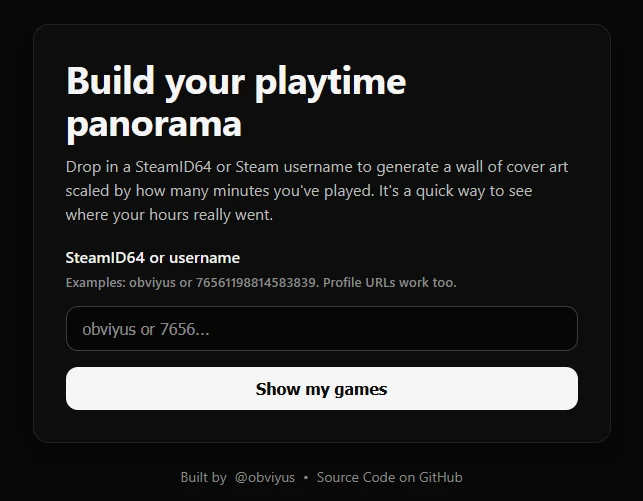
    In response to these concerns, another user on r/Steam created an open-source web app named playtime-panorama. This version can also be found on GitHub and allows anyone to create their own profile collage using publicly available Steam API data. By making the source code accessible, the developer tackled significant privacy issues—users can inspect, audit, or even run the tool on their own systems. The web version adjusts each game’s tile size based on playtime, utilizing dynamic CSS grids. Games with high playtime fill the collage, and a non-linear scaling approach prevents outliers from overshadowing the overall design, while smaller games still receive some recognition.

    Positive Feedback and Sharing

    With this open-source option, the feedback has been much more favorable. As of now, the tool is receiving a lot of positive attention on Reddit, with users feeling more comfortable engaging after their privacy worries were addressed. It’s logical, as those with valuable Steam inventories prefer to stay safe. Several members of r/Steam have begun posting their collages online—check out the thread here, and you can find the online collage generator linked here. Just make sure your Steam profile is set to public to use it.


  • Apple’s Propaganda Hides Its Battles with Consumers and EU

    Apple’s Propaganda Hides Its Battles with Consumers and EU

    Key Takeaways

    1. Major corporations, especially American tech giants, have significant control over news and user experiences, impacting consumer choices.
    2. The European Union’s Digital Markets Act (DMA) aims to reduce the dominance of these tech companies, but progress is slow due to resistance from firms like Apple.
    3. Apple employs manipulation tactics to influence consumer perceptions and pressure the EU regarding privacy and feature availability.
    4. Rival brands prove that innovation and privacy can coexist, highlighting Apple’s limitations and reluctance to embrace competition.
    5. Apple’s concerns about third-party payment systems and app safety may be more about protecting its revenue than about user privacy.


    People today are increasingly influenced by major corporations. Firms like Google and various social media platforms control the news that users encounter, while Palantir works on privatizing mass surveillance. Apple dictates which apps can be used on more than a third of smartphones across Europe. The European Union’s introduction of the Digital Markets Act (DMA) seeks to counterbalance the dominance of these American tech giants.

    Slow Progress

    Progress is indeed underway, though it is happening at a sluggish pace. This delay is largely due to companies like Apple who constantly search for ways to keep as much control as they can over their users and their finances. For instance, while installing third-party app stores is now finally an option, Apple has made it intentionally complicated. They also possess the ability to disable apps coming from alternative stores, which goes against the principles of a free market.

    Manipulation Tactics

    For years, Apple has tried to sway consumers into making choices that aren’t in their best interest as a way to pressure the EU. Just recently, Apple released a new piece of propaganda, where it openly accuses the EU for the absence of features like live translations, iPhone mirroring, and the “Places Visited” in Apple Maps in some countries. Essentially, the message suggests that “the EU is compelling Apple to compromise user privacy.”

    Alternatives Exist

    On the other hand, rival brands demonstrate that innovation and privacy can coexist. The features mentioned earlier have long been available on other platforms within the EU. Moreover, Apple is currently set to allow notifications from third-party smartwatches on iPhones by simply adding an option to the system settings. This indicates that someone at Apple realizes that empowering consumers with choices is better than limiting them while claiming that the EU is hindering the launch of new, innovative features.

    Apple has voiced concerns about being obliged to permit payment systems from other companies—is it really about privacy, or is it the 30% commission that Apple misses out on? Additionally, Apple argues that third-party app marketplaces harbor unsafe apps, much like its own App Store does. It’s quite ironic that Apple criticizes the DMA for not fostering a more competitive marketplace, especially when successful companies manipulate the rules to benefit themselves. Perhaps it’s time for Apple to reflect on its own practices.

    Source:
    Link


  • ChatGPT Privacy: Understanding What Your Conversations Show

    ChatGPT Privacy: Understanding What Your Conversations Show

    Key Takeaways

    1. Many users view ChatGPT as a confidential friend, similar to doctors or therapists, but digital privacy differs significantly.
    2. OpenAI employs various technical methods to monitor interactions for harmful content and safety risks.
    3. In mental health crises, ChatGPT guides users towards professional help but does not report suicidal ideations to law enforcement to protect privacy.
    4. Conversations indicating harm to others may lead to notifications to law enforcement, raising legal and ethical concerns.
    5. The balance between user privacy and safety monitoring is complex, influenced by ongoing legal discussions and future regulations.


    Many individuals see ChatGPT as a reliable friend to whom they can share their thoughts and concerns. The hope for confidentiality is similar to what people feel when talking to doctors or therapists. However, when it comes to digital conversations with AI, the level of privacy is not the same as in traditional dialogues.

    Monitoring Content for Safety

    OpenAI uses a variety of technical methods to identify harmful content quickly. In a formal announcement, the organization states:

    “We have utilized a wide range of tools, including specific moderation models and our own models to monitor safety risks and abuse.”

    This clearly indicates that all interactions are assessed for possible dangers, and moderators may review the information if needed.

    Sensitive Mental Health Situations

    Scenarios involving mental health crises are especially delicate. OpenAI emphasizes: “If an individual shows suicidal thoughts, ChatGPT is trained to guide them towards getting professional assistance.” Simultaneously, the company distinctly separates self-harm from actions that may harm others. Suicidal ideations are not reported to law enforcement to safeguard the affected individuals’ privacy. However, it mentions:

    “When we identify users who are planning to harm others, we direct their discussions to specialized channels… we may notify law enforcement.”

    Legal and Ethical Implications

    This monitoring approach brings up various legal and ethical issues. Users wish for confidentiality but must also accept the reality of technical moderation and, in serious situations, potential reporting to authorities. It remains unclear how different legal systems will manage the delicate balance between security and individual privacy.

    The ongoing conversation surrounding ChatGPT’s privacy is intensified by global events and lawsuits. One fact is evident: privacy in AI interactions is restricted. Future legal rulings and regulatory standards will play a crucial role in defining the extent of OpenAI’s monitoring capabilities and the degree of user privacy protections.

    Source:
    Link