Tag: amd

  • Next-Gen AMD RDNA 5 GPUs to Feature HDMI 2.2 Without Full Bandwidth

    Next-Gen AMD RDNA 5 GPUs to Feature HDMI 2.2 Without Full Bandwidth

    Key Takeaways

    1. AMD has canceled the RDNA 4 GPU to focus resources on the RDNA 5 architecture, which is expected to show promising performance.

    2. The upcoming RDNA 5/UDNA architecture, known as “GFX13,” will support HDMI 2.2 with potential bandwidths of 64 Gbps and 80 Gbps.

    3. HDMI 2.2, unveiled at CES 2025, doubles the bandwidth of HDMI 2.1b and supports higher resolutions and refresh rates, but requires new “Ultra96” HDMI cables.

    4. AMD’s decision to implement HDMI 2.2 at lower bandwidths may be a cost-saving strategy, although the exact reasons are unclear.

    5. The RDNA 5 architecture is expected to launch in late 2026 or early 2027, with potential integration into the PS6.


    We have been receiving various reports about AMD’s upcoming RDNA 5 or UDNA technology since the year 2023. In August of that same year, we mentioned that AMD decided to cancel its top-tier RDNA 4 GPU in order to allocate resources for the RDNA 5 architecture, which was expected to deliver “promising early performance metrics.” Although AMD did not release a flagship RDNA 4 GPU, it’s unclear if this decision has positively influenced the progress of RDNA 5.

    New Hardware Insights

    Recently, we are beginning to obtain some hardware details about the RDNA 5/UDNA architecture. Kepler_L2 has released information regarding the potential HDMI setup for AMD’s upcoming GPUs.

    Kepler_L2 claims that the next-gen RDNA5/UDNA, known internally as “GFX13,” will have support for 64 Gbps and 80 Gbps HDMI 2.2. However, this does not represent the complete bandwidth capabilities of HDMI 2.2.

    HDMI 2.2 Overview

    Unveiled at CES 2025, HDMI 2.2 doubles the bandwidth compared to HDMI 2.1b’s 48 Gbps and brings support for 4K@480 Hz, 8K@240 Hz, and 10K@120 Hz. This is a major improvement over HDMI 2.1b, which maxes out at 4K@120 Hz and 8K@120 Hz. Nonetheless, to fully utilize the enhanced bandwidth, users will need to purchase the new “Ultra96” HDMI cables.

    According to reports, AMD is only implementing HDMI 2.2 at 80/64 Gbps for its next-generation Radeon GPUs. The exact reason behind this choice remains unclear, but it may be a strategy to save costs.

    Future Expectations

    AMD’s upcoming GPU architecture is being touted as a “Zen moment” for its graphics division. The architecture is anticipated to make its debut on desktop systems sometime in late 2026 or early 2027. There are also hints that an RDNA 5/UDNA-based Radeon iGPU could be featured in the PS6 around the same period.

    Source:
    Link

  • Next Xbox Console Price May Exceed $1,000

    Next Xbox Console Price May Exceed $1,000

    Key Takeaways

    1. Microsoft’s upcoming Xbox consoles will use AMD SoCs and support multiple storefronts.
    2. A well-known leaker suggests the next Xbox could be priced over $1,000.
    3. Allowing multiple storefronts may lead to higher console prices due to loss of exclusivity.
    4. Consumers are divided; some see value in a $1,000 console if it can replace a PC.
    5. Official pricing information is not yet available, but speculation suggests a possible reveal in 2026.


    Microsoft has recently made the announcement that their upcoming Xbox consoles will utilize AMD SoCs. One particularly intriguing detail is that these consoles won’t be restricted to just one store, a feature that is also a key selling point for the ROG Xbox Ally handhelds. While this freedom sounds appealing, it’s likely to come with a high cost. A well-known leaker has suggested that the price of the next Xbox could exceed $1,000.

    Leaks from Kepler_L2

    Kepler_L2 is recognized for leaking information about SoCs and the processing power of upcoming gaming devices, including future PlayStation and Xbox consoles. In response to Xbox president Sarah Bond’s announcement, Kepler_L2 commented on X, noting that if Microsoft wants to support various storefronts on its primary gaming device, the console will need to be sold at a profit. The leaker ominously stated, “Prepare yourselves for the first console over $1000, guys.”

    The Price Dilemma

    Currently, Microsoft has not released any official information regarding the price of the next generation Xbox, but the leaker’s claim of a price tag over $1,000 may have some validity. Typically, consoles have limited and well-optimized functionalities, allowing manufacturers to produce SoCs at a lower cost compared to PCs. Consequently, companies such as Microsoft, Sony, and Valve can set lower prices for consoles, relying on game store exclusivity and subscription services (like Xbox and PlayStation).

    However, with Microsoft planning to allow multiple storefronts, they may lose exclusivity and possibly subscribers. To compensate for this, the base price of the console would need to be higher, which could lead to a significant increase in cost for consumers.

    Consumer Reactions

    Users commenting on Kepler_L2’s post seem to be open to the idea of a $1,000 console. Some express that if the console can replace their PC, it would be worth the price. Others argue that having multiple storefronts might encourage competitive pricing for games. As for the actual cost of the next Xbox, that’s still unknown. Recent speculation indicates that Microsoft might reveal the next Xbox as soon as 2026.

    Source:
    Link

  • AMD Addresses Key Vulnerability in Ryzen 7000 and 9000 Series

    AMD Addresses Key Vulnerability in Ryzen 7000 and 9000 Series

    Key Takeaways

    1. Security Vulnerability: AMD CPUs have a significant security flaw (CVE-2025-2884) in the Trusted Platform Module (TPM) that allows attackers with basic user access to access sensitive data or disrupt the TPM.

    2. Coding Error: The flaw stems from a mistake in the TPM 2.0 software’s CryptHmacSign() function, which can expose up to 65,535 bytes of sensitive information.

    3. Affected Models: A wide range of Ryzen processors, including desktop, mobile, and Threadripper CPUs, are impacted by this vulnerability, though older generations have received fixes.

    4. Permanent BIOS Updates: New BIOS updates from motherboard makers like Asus and MSI are permanent on certain models, preventing users from reverting to earlier firmware versions.

    5. Additional Benefits: The BIOS updates not only fix the security issue but also improve compatibility and performance for high-capacity memory configurations and prepare motherboards for future Ryzen processors.


    Motherboard makers like Asus and MSI are releasing new BIOS updates that address a significant security vulnerability found in AMD’s CPUs. This problem is connected to the Trusted Platform Module (TPM) and has been officially designated as CVE-2025-2884. The flaw allows attackers with basic user access to possibly reach sensitive data or interfere with the TPM itself. Even though this vulnerability is viewed as medium risk, it stands out because it can be exploited more easily than many similar issues.

    Details of the Vulnerability

    The root of this security weakness lies in a coding mistake in the TPM 2.0 software, particularly in the CryptHmacSign() function. This flaw permits standard user applications to read more data than they should, which could expose as much as 65,535 bytes of sensitive information. As a result, attackers might take advantage of this issue to either access private data stored in the TPM or cause the module to fail, leading to a denial-of-service situation. The vulnerability is rated as medium severity (CVSS score of 6.6), but its risk is noteworthy due to how easy it is to exploit; it doesn’t need elevated kernel-level permissions, just regular user access.

    Affected Processor Models

    This flaw impacts a wide range of Ryzen processors, from desktop CPUs like Athlon 3000 “Dali” and Ryzen 3000 “Matisse” to Ryzen 9000 “Granite Ridge.” Mobile chips, including Ryzen 3000 Mobile “Picasso” up through Ryzen AI 300 “Strix Point,” as well as Threadripper workstation CPUs from Threadripper 3000 “Castle Peak” to Threadripper 7000 “Storm Peak,” are also affected. Older AMD CPU generations have already seen fixes for this vulnerability, but the AGESA 1.2.0.3e firmware is specifically aimed at AM5-based platforms.

    It’s vital to point out that these BIOS updates are permanent on some motherboards, particularly those from Asus, meaning users cannot revert to earlier firmware versions after installation.

    Additional Update Benefits

    In addition to addressing the security flaw, the update also prepares motherboards for the upcoming Ryzen processors, expected to be part of the Ryzen 9000F series. Moreover, this update enhances compatibility and performance for high-capacity memory configurations, especially those utilizing 4×64 GB DRAM modules with speeds ranging from 6000 to 6400 MT/s.

    AMD encourages users to check their motherboard manufacturer’s support page for the BIOS update and to install it promptly.

    Source:
    Link

  • AMD Launches Ryzen 5 5500X3D: New Zen 3 Desktop Processor

    AMD Launches Ryzen 5 5500X3D: New Zen 3 Desktop Processor

    Key Takeaways

    1. The Ryzen 5 5500X3D is AMD’s latest CPU with six cores and twelve threads, based on Zen 3 architecture.
    2. It has a base clock speed of 3.0 GHz and a boost clock of 4.0 GHz, which is lower than the Ryzen 5 5600X3D.
    3. Pricing for the Ryzen 5 5500X3D has not been officially announced, but it may be estimated around $200 based on the 5600X3D’s price.
    4. The Ryzen 5 5500X3D is a good option for users with older AM4 motherboards, particularly for budget gamers.
    5. For new builds, AMD’s AM5 processors like the Ryzen 5 7600X are recommended due to better upgrade options and performance.


    Back in 2023, AMD introduced the Ryzen 5 5600X3D, marking its first foray into the Ryzen 5 CPUs equipped with 3D V-cache. Previous rumors mentioned the upcoming Ryzen 5 5500X3D, but it has only now been confirmed. The well-known leaker @Zed__Wang discovered it on AMD’s official site.

    Ryzen 5 5500X3D Overview

    The Ryzen 5 5500X3D is a CPU featuring six cores and twelve threads, built on Zen 3 architecture. It operates at a base clock speed of 3.0 GHz and can boost up to 4.0 GHz, which is notably lower than the Ryzen 5 5600X3D’s specifications of 3.3 GHz base and 4.4 GHz boost. Other features are similar to those found in other Zen 3 X3D CPUs, including a thermal design power (TDP) of 105 Watts and 96 MB of L3 cache.

    Pricing and Availability

    At this moment, the Ryzen 5 5500X3D does not have a suggested retail price since it hasn’t been seen on any online shopping platforms. If we look at the Ryzen 5 5600X3D priced at $230, it’s reasonable to estimate the new chip may be around $200. Nevertheless, the more pressing matter is its availability. Both Ryzen 5 X3D variants, along with the newer Ryzen 5 7600X3D, were initially sold exclusively through Micro Centre and in limited volumes.

    Considerations for Buyers

    Should you consider the Ryzen 5 5500X3D when there are newer CPUs available? The answer really hinges on whether you are constructing a new PC or simply upgrading an existing one. For those building a new system, opting for AM5-based mid-range processors like the Ryzen 5 9600X or the Ryzen 5 7600X is advisable, as AM5 motherboards provide better upgrade paths. Additionally, the integrated GPU found in Ryzen 7000 and later models can be quite useful for sorting out graphic problems.

    Testing by Gamers Nexus has shown that the Ryzen 5 7600X often performs similarly to the Ryzen 5 5600X3D in various games, and given its specifications, the Ryzen 5 5500X3D will likely be slower. However, for those aiming to extend the lifespan of an older AM4 motherboard, the Ryzen 5 5500X3D is worth considering, especially for budget-conscious gamers. There aren’t many alternatives available, but if you have $250 to invest, going for the Ryzen 7 5700X3D would probably be a wiser choice.

    Source:
    Link

  • Radeon RX 9070 XT: Samsung Memory Slower than SK Hynix

    Radeon RX 9070 XT: Samsung Memory Slower than SK Hynix

    Key Takeaways

    1. AMD is transitioning to Samsung memory modules for its Radeon RX 9070 XT graphics cards, replacing the original SK Hynix supplier.
    2. Performance tests indicate that Samsung-equipped models are 1% to 2% slower than those with SK Hynix memory, based on synthetic benchmarks.
    3. The actual gaming experience may not be significantly affected by the slight performance difference observed in benchmarks.
    4. AMD confirmed that the performance drop is linked to the use of Samsung memory, which also offers improvements in thermal management.
    5. Radeon RX 9070 XT GPUs with Samsung memory showed higher power consumption and clock speeds, but performance differences are minor and likely unnoticed in real-world gaming.


    Evidence has emerged that AMD is shifting to memory modules developed by Samsung for its Radeon RX 9070 XT graphics cards. Reports indicate that these new models perform a bit lower than those with SK Hynix memory, which was the original supplier. However, the actual gaming experience might not be impacted, since the comparison relies on synthetic benchmarks.

    Performance Insights

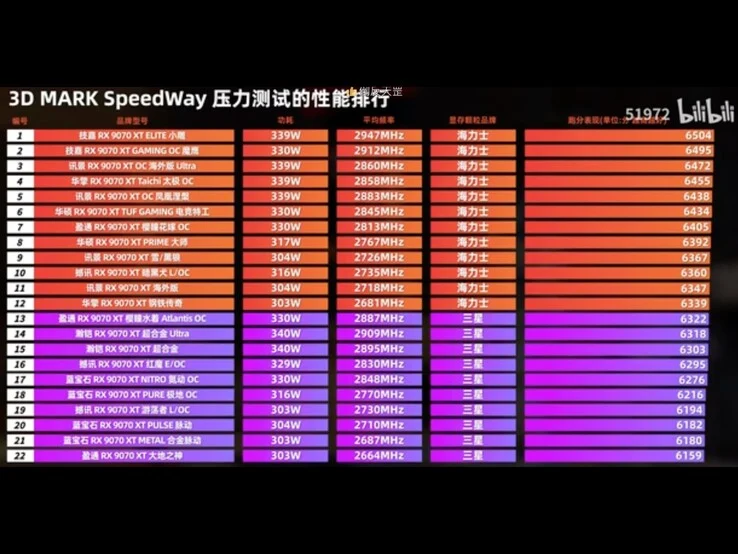
    A tech reviewer from China observed a drop in performance in certain Radeon RX 9070 XT GPUs. After conducting tests, the reviewer discovered that GPUs equipped with Samsung’s GDDR6 memory modules were performing about 1% to 2% slower than their counterparts using SK Hynix modules. In a video, the reviewer compared more than 20 different models of the Radeon RX 9070 XT and highlighted this performance gap.

    Confirmation from AMD

    Additionally, the reviewer had a conversation with a member of the AMD team in China, who allegedly confirmed that the slower performance was indeed related to the use of Samsung modules. When the initial evidence of the switch to Samsung memory appeared, it was thought that this change aimed to enhance thermal performance. The report suggests that using Samsung’s memory did provide noticeable improvements in thermal management.

    Power Consumption and Clock Speeds

    Interestingly, the Radeon RX 9070 XT GPUs with Samsung memory tested recently showed higher power usage and clock speeds, yet still exhibited slightly inferior performance. The tests utilized the 3DMark Speedway benchmark, which should be taken into account as it does not accurately represent real-world gaming performance. In actual gaming scenarios, this 1% to 2% difference is likely to go unnoticed.

    Source:
    Link


  • AMD Zen 7 Desktop CPU Core Count Leaks: Up to 2x Increase Over Zen 5

    AMD Zen 7 Desktop CPU Core Count Leaks: Up to 2x Increase Over Zen 5

    Key Takeaways

    1. AMD is developing five different versions of the Zen 7 CPU architecture, focusing on performance and efficiency.
    2. The Zen 7 “Classic” desktop CPUs are expected to have up to 32 cores and 64 threads with Hyperthreading.
    3. The Zen 7 consumer CPUs will feature significant IPC and clock speed improvements, along with increased core counts compared to Zen 6.
    4. A top-tier Zen 7 Ryzen 9 CPU may have 50% more cores than the flagship Zen 6 chip, making it an attractive upgrade for Ryzen 9000 owners.
    5. Zen 7 is still over two years away, and current specifications may change before release.


    Around May, it was reported that AMD might be working on as many as five different versions of the Zen 7 CPU architecture. Each of these versions has unique design objectives, with some concentrating on pure performance and others on efficiency. The Zen 7 “Classic” aimed for desktop AM6 platform is said to be focusing on improvements in IPC and clock speeds.

    Core Count Increase

    New information from Moore’s Law Is Dead suggests that, in addition to the IPC and frequency enhancements, the Zen 7 consumer CPUs will also see a significant increase in core count compared to Zen 6. According to MLID, this information comes from one of his top sources at AMD.

    Specifications and Features

    The Zen 7 “Classic” desktop CPUs are expected to feature up to 32 cores, thanks to dual 16-core CCDs. With Hyperthreading enabled, this means there could be an impressive 64 threads available. However, the previously leaked “3D Core” variant seems not to be available for the consumer versions of Zen 7 CPUs.

    As per MLID, the Zen 7 chips designed for the AM6 platform will include “lots of V-Cache,” since the 3D Core design is not likely to be included in the consumer CPUs. Nevertheless, both the Zen 7 consumer CPUs and the 3D Core variant are believed to have IPC that is “comparable,” with the “Classic” cores featuring higher voltages and clock speeds.

    Potential Upgrade Path

    A top-tier Zen 7 desktop Ryzen 9 CPU might boast 50% more cores than the flagship Zen 6 chip, which is rumored to increase its core count to 24, effectively doubling the cores of the Ryzen 9 9950X. When you add in the IPC improvements and potentially much larger 3D V-Cache, those who currently own a Ryzen 9000 CPU could find themselves with a compelling reason to upgrade in 2028.

    MLID also cautions in the video that Zen 7 is still over two years away. Thus, any technical specifications leaked at this stage might be subject to change.

    Source:
    Link


  • AMD to Launch Stronger RDNA 4 Variants to Compete with RTX 5080

    AMD to Launch Stronger RDNA 4 Variants to Compete with RTX 5080

    Key Takeaways

    1. AMD is reportedly developing a premium RX 9080 XT model and plans to update its RDNA 4 graphics card lineup in 2025.
    2. New Radeon GPUs targeted at professionals may feature up to 48 GB of VRAM and are expected to launch soon.
    3. Stronger variants of RDNA 4 graphics cards are anticipated later this year, potentially including the RX 9080 XT.
    4. AMD aims to enhance its presence in the high-end GPU market, especially as Nvidia shifts focus to AI and reduces RTX 50 stock.
    5. AMD’s improved GPU drivers and technologies like FSR 4 may give it an advantage over Nvidia’s offerings in the upcoming high-end GPU segment.


    We shared recently that AMD appears to be working on a premium RX 9080 XT model. Moore’s Law Is Dead has also mentioned a possible launch schedule for revamped high-end RDNA 4 graphics cards, based on info from various AIB and industry insiders.

    Possible Refresh Timeline

    According to MLID, an AIB source indicated that AMD may be updating its lineup sometime in 2025. There’s also speculation that Team Red could introduce new Radeon GPUs aimed at professionals, featuring up to 48 GB of VRAM.

    Stronger Variants Coming

    Another AIB contact reported from “AMD representatives” that there will be “strong variants” of RDNA 4 launched later this year. Although the specifics of these “stronger” RDNA 4 models remain unclear, it is reasonable to think that the RX 9080 XT could be among them.

    So what are the implications of all this?

    AMD’s Market Positioning

    To begin with, AMD might be preparing to fill the gap in the high-end/flagship segment of the RDNA 4 GPU range. With an RTX 5080 Super challenger on the horizon, AMD could significantly enhance its presence in the gaming sector, especially since Nvidia is reportedly reducing its RTX 50 gaming stock to shift focus to the AI market. Thus, while gamers might struggle to find high-end RTX 50 models, the new RX 9080 XT could serve as a solid alternative.

    When the announcement surfaced in 2024 that AMD wouldn’t introduce high-end flagship GPUs to rival the RTX 5080/5090, fans were left speculating about the reasons behind this. Some believed AMD was unable to get the rumored Multi-Chip Module (MCM) RDNA 4 flagship functioning. Others thought it didn’t make financial sense to enter a market where Nvidia had reigned supreme for several generations.

    Nonetheless, there was an alternative perspective: AMD may have believed that the software ecosystem wasn’t fully developed enough to unleash the full capabilities of the high-end RDNA 4 GPUs.

    Considering this mix of reasons, it appears to be an opportune moment for AMD to roll out a high-end/flagship RX 9000 GPU. AMD currently has robust GPU drivers for RDNA 4, which arguably outperform Nvidia’s efforts with the RTX 50 series, along with impressive FSR 4 technology and promising developments like FSR Redstone on the horizon.

    Source:
    Link

  • Radeon 9060 XT Benchmarks Reveal RX 7700 XT Performance with OC

    Radeon 9060 XT Benchmarks Reveal RX 7700 XT Performance with OC

    Key Takeaways

    1. AMD will unveil the Radeon RX 9060 XT on June 5, following the RX 7600 XT, with significant performance improvements anticipated.
    2. Early benchmarks from a Reddit user show the RX 9060 XT achieving a score of 17,069 with a mild overclock, indicating strong performance capabilities.
    3. The GPU reportedly has memory limitations, unable to overclock past 2,538 MHz without causing crashes.
    4. In performance comparisons, the RX 9060 XT nearly matches the RX 7700 XT, achieving 36 FPS in Black Myth: Wukong’s Cinematic mode while overclocked.
    5. A Geekbench listing suggests a 25% to 30% performance improvement over the RX 7600 XT, though 3D Mark Time Spy is seen as a more accurate benchmark.


    AMD is gearing up to unveil the Radeon RX 9060 XT on June 5, which will follow the Radeon RX 7600 XT. A Geekbench listing found last week (between May 26 and June 1) indicated a notable increase in performance compared to the previous model. However, a recent leak suggests it might have even greater performance capabilities. A Reddit user posted benchmark results from Time Spy GPU as well as gaming tests for the RX 9060 XT that featured a slight overclocking of the clock speeds.

    Impressive Benchmark Scores

    Screenshots shared by a Reddit user, who claims to have gotten early access to the unreleased RX 9060 XT, reveal that the GPU achieved a score of 17,069 with an overall score of 14,210. The tests were done using an AMD Ryzen 5 5600 CPU at 1080p. Importantly, it had a mild overclock with a 200 MHz boost to the clock speed and a 40mV undervolt. At these settings, the GPU reached a clock speed of 3.47 GHz while consuming 199W of power.

    Memory Limitations

    The user also pointed out that they could not increase the memory clock speeds past 2,538 MHz, labeling it “un-overclockable.” The benchmark run or system would crash when they tried to go beyond that point.

    Performance Comparison

    In addition, a commenter sought benchmark results from Black Myth: Wukong’s tool, and the RX 9060 XT provided an average of 36 FPS in Cinematic mode (with overclocking), which was merely 3 FPS behind the RX 7700 XT. This performance places the RX 9060 XT nearly on the same level as the Radeon RX 7700 XT, which has an average Time Spy graphics score of 17,113 according to the 3D Mark database. Even though the Radeon RX 9060 XT, specifically the XFX Swift Pro Gaming variant, was overclocked, it managed to match the performance of a more expensive, higher-tier GPU from the previous generation.

    This benchmark result arrived shortly after the Geekbench listing, which indicated a 25% to 30% improvement in performance over the RX 7600 XT, the RX 9060 XT’s direct predecessor. While Geekbench may not be the most accurate for GPU performance, the 3D Mark Time Spy and Black Myth: Wukong benchmarks are considered far better indicators.

    Source:
    Link

  • AMD RX 9080 XT ES vs RTX 5080 Super: A Potential Rivalry

    AMD RX 9080 XT ES vs RTX 5080 Super: A Potential Rivalry

    Key Takeaways

    1. The graphics card operates at game clock speeds between 3.4 to 3.7 GHz and features a 256-bit GDDR7 memory interface with up to 32 GB of VRAM options (16 GB and 24 GB also available).

    2. It shows a 28% average performance increase at 4K resolution over the RX 9070 XT, with certain workloads achieving up to a 45% boost, positioning it against the RTX 5080 Super and possibly the RTX 4090.

    3. The GPU is likely based on an enhanced Navi 48 architecture, focusing on higher clock speeds and memory bandwidth without major redesigns, and may utilize advanced TSMC process nodes.

    4. AMD may adopt a strategy similar to the Radeon VII, potentially delaying the RX 9080 XT ES launch until a favorable market opportunity arises or competitive pressure increases.

    5. The launch timing could depend on the readiness of FSR4 (Redstone) and other strategic factors to ensure a competitive high-end product.


    Internal AMD lab tests have indicated that the graphics card operates at game clock speeds ranging from 3.4 to 3.7 GHz. This GPU is equipped with a 256-bit GDDR7 memory interface, and it can come with memory configurations of up to 32 GB of VRAM. There are also 16 GB and 24 GB memory options available. In terms of power consumption, the card exceeds 450 watts when under load, with some versions going beyond 500 watts when overclocked.

    Performance Benchmarks

    Early benchmark information shared privately with Moore’s Law Is Dead suggests that the performance at 4K resolution shows an average increase of 28% over the RX 9070 XT, with certain workloads reaching up to a 45% boost. This performance level puts the RX 9080 XT ES in direct competition with the RTX 5080 Super and possibly even the RTX 4090, depending on how it is implemented and its final clock speeds. However, it’s important to note that this is all still speculative.

    Architecture Insights

    The GPU is likely based on an enhanced Navi 48 architecture, and it seems that AMD is not planning any drastic redesigns. Rather, the company appears to be focusing on achieving higher clock speeds and increased memory bandwidth while maintaining a conventional monolithic design. It may also utilize TSMC’s N4X or even N3X process nodes to reach the reported performance levels. AMD has publicly laid out a roadmap that includes N2X and 1.4 nm nodes for future CPUs, making the usage of advanced nodes likely.

    Strategic Decisions Ahead

    Moore’s Law Is Dead suggests that the RX 9080 XT ES might adopt a strategy akin to that of the Radeon VII, which utilized a die-shrunk version of Vega to proactively counter NVIDIA’s shift to 7 nm technology. However, AMD has not yet confirmed any plans for a launch. The engineering sample may stay within the company unless AMD finds a suitable market opportunity or faces competitive pressure that necessitates a release.

    The ultimate choice could depend on the readiness of FSR4 (Redstone) along with various strategic factors. Multiple sources point to AMD potentially waiting to launch the RX 9080 XT alongside enhanced upscaling technology to deliver a truly competitive high-end product.

    Source:
    Link

  • New Spectre Vulnerability Found in 2018-2024 Intel CPUs

    New Spectre Vulnerability Found in 2018-2024 Intel CPUs

    Key Takeaways

    1. Spectre and Meltdown flaws in x86 processors led to major issues for Intel and AMD in 2018, resulting in lawsuits and the need for microcode updates.
    2. New vulnerabilities related to Spectre were discovered in Intel CPUs, particularly the Alder Lake series, and ARM cores, impacting performance variably.
    3. ETH Zurich’s research revealed that existing mitigations could still be bypassed under certain conditions.
    4. Intel’s January 2025 microcode update showed minimal performance overhead in most chips, but Rocket Lake experienced an 8.3% performance decrease.
    5. The vulnerabilities affect all operating systems, but AMD and ARM chips are not impacted by the newly identified flaws.


    The Spectre and Meltdown flaws that impacted X86 processors created major issues for Intel and AMD in 2018, leading to lawsuits against both firms. ARM also faced these vulnerabilities, but all companies ultimately issued in-silicon microcode updates to address the bugs. While these updates resulted in some performance loss, it wasn’t severe. In 2022, more Spectre risks were identified for Intel CPUs, including the Alder Lake series, and for ARM cores, with the degree of performance loss varying based on the specific task. Unfortunately, this was not the end of Spectre troubles for Intel, as a new report from ETH Zurich has uncovered additional vulnerabilities for Intel CPUs from 2018 to 2024, some of which show notable performance drops after applying updated mitigations.

    Testing New Mitigations

    ETH Zurich performed detailed examinations of the previously released mitigations, such as the enhanced Indirect Branch Restricted Speculation (eIBRS) and the Indirect Branch Prediction Barrier (IBPB). Their findings suggest that, under certain conditions, these mitigations can still be circumvented.

    Intel’s Response

    In January 2025, Intel rolled out a new microcode with better mitigations, enabling ETH Zurich to assess its impact on newer CPU models. The results indicated that most chips experienced minimal effects, with Alder Lake processors showing only a 2.7% performance overhead, Raptor Lake and Raptor Lake-R having less than 2%, and Coffee Lake-R at 1.6%. However, Rocket Lake was an outlier, showing an 8.3% decrease in performance.

    Broader Implications

    Although ETH Zurich’s evaluations were conducted solely on Linux systems, it’s established that these vulnerabilities can affect any operating system. AMD and ARM chips, however, are not impacted by these newly identified flaws.

    Intel has reportedly delivered the new microcodes to all system builders and operating system developers. In a blog post dated May 13, the company stated, “Intel is enhancing its Spectre v2 hardware mitigations and recommends that customers check INTEL-SA-01247 and reach out to their system manufacturers for the correct updates. So far, Intel is unaware of any real-world exploits related to transient execution vulnerabilities.”

    Source:
    Link