Author: GizNews

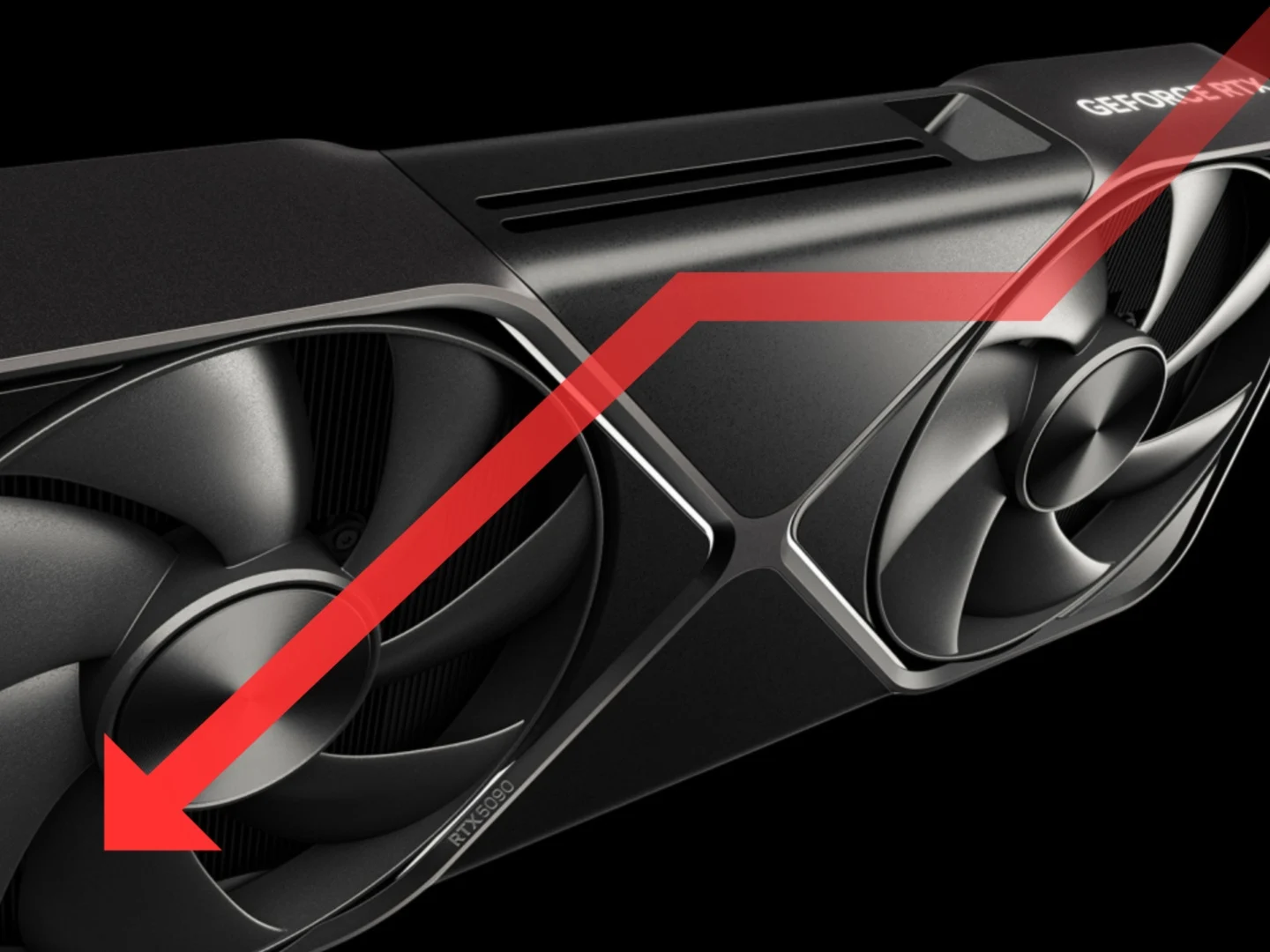
  • Nvidia Lowers RTX GPU Voltages in New Driver Update, Reducing Performance

    Nvidia Lowers RTX GPU Voltages in New Driver Update, Reducing Performance

    Key Takeaways

    1. Nvidia’s driver version 595.59 caused decreased GPU performance and fan detection issues, leading to its withdrawal and a problematic replacement, version 595.71.

    2. The new driver version 595.71 has introduced a voltage lock on certain GPUs, including the RTX 5090, RTX 4090, RTX 4080 Super, and RTX 4070 Ti Super.

    3. Performance tests show that the voltage levels drop significantly under both stock and overclocked settings, limiting the core clock speeds of affected GPUs.

    4. Comparisons by Wccftech reveal that the new driver results in lower voltage and clock speeds compared to previous drivers, even with manual overclocking.

    5. Nvidia’s voltage restrictions appear to be a response to reports of melted connectors, intended to prevent damage but resulting in reduced overall performance.


    Nvidia has been facing challenges lately following the release of the Resident Evil Requiem Game Ready Drivers. The driver version 595.59, which was intended to enhance GPU performance for the game, unfortunately led to decreased performance and issues with GPU fan detection. In response, Nvidia pulled the problematic drivers and issued an updated version, but this new release appears to have brought its own set of problems.

    Voltage Lock Concerns

    According to Bang4BuckPC Gamer on YouTube, the new driver version 595.71 has introduced a voltage lock on certain GPUs. Although the complete list of affected GPUs has not been fully assessed, it’s confirmed that the RTX 5090 is among those impacted. Users of the RTX 4090, RTX 4080 Super, and RTX 4070 Ti Super are also reporting similar issues with the latest drivers.

    Performance Tests Reveal Issues

    In a recent video, the YouTuber revealed that after upgrading their Asus TUF Gaming GeForce RTX 5090 OC Edition to the new driver, the voltage levels dropped at both stock and overclocked settings. Notably, the GPU initially reached a voltage of 1.055V to 1.060V at stock settings. However, when a 150 MHz overclock was applied, while the clock speed increased as expected, the voltage fell to 1.045V to 1.050V. With a further 300 MHz overclock, the voltage dipped below 1V (0.990V), yet the core clock stayed below 3,000 MHz. It appears that the voltage has been capped at under 1V, which restricts clock speeds from surpassing 3,000 MHz even with overclocking.

    Additional Testing by Wccftech

    Wccftech conducted their own tests with an MSI GeForce RTX 5090 SUPRIM X and found comparable results. With an earlier driver and some manual overclocking, the GPU operated at 1.020V to 1.030V, achieving core clock speeds up to 3,030 MHz. However, after switching to the new driver with the same overclock settings, the GPU couldn’t exceed 3,000 MHz, and the voltages fell to 1.005V – 1.010V. Even in stock configuration, the GPU showed lower voltages with the new driver compared to the previous one.

    Reason Behind Voltage Limits

    It seems Nvidia may have introduced these voltage restrictions due to reports of melted connectors. This change is likely aimed at limiting the maximum voltage through the 16-pin connectors, theoretically reducing the risk of connector burns or GPU damage. Unfortunately, this solution negatively impacts overall performance.


    Source:
    Link



  • Anthropic Simplifies Importing Third-Party AI Chatbot Data to Claude

    Anthropic Simplifies Importing Third-Party AI Chatbot Data to Claude

    Key Takeaways

    1. Claude’s free tier now includes the memory import feature, previously exclusive to paying users.
    2. The memory import feature allows users to transfer conversation history between chatbots, enhancing personalization.
    3. The release of this feature appears timed to capitalize on competition with OpenAI and Google’s offerings.
    4. Anthropic aims to attract users from other platforms by providing valuable features for free.
    5. The company focuses on enterprise needs, prioritizing text-based reasoning and software development over multimedia capabilities.


    AI chatbot fans who have been thinking about moving to Claude will find it simpler now, thanks to a new feature added to Claude’s free tier that was once only for paying users.

    Memory Import Feature

    A key advantage of contemporary AI chatbots is their capability to adapt to user needs and preferences by analyzing past conversations. This information can be retrieved using a specific prompt, and the results can then be transferred to another chatbot. This function, known as memory import, has been introduced into Claude’s settings by Anthropic.

    Strategic Move

    The timing of this release seems intentional, especially after Anthropic’s recent clash with the US DOW, and the company’s well-known rivalry with OpenAI, which has sparked a wave of competitive promotions. By offering the memory import feature for free, it’s clear that Anthropic aims to attract more users from OpenAI, Google, and Meta.

    Focusing on Enterprise Needs

    In contrast to Google and OpenAI, Anthropic chose not to include image and video generation capabilities, instead concentrating on meeting the needs of enterprise clients by excelling in areas like software development and text-based reasoning. So far, this approach has been beneficial for the company.

    Source:
    Link


  • Apple’s Low-Cost MacBook Neo Laptop Confirmed Before Launch

    Apple’s Low-Cost MacBook Neo Laptop Confirmed Before Launch

    Key Takeaways

    1. Apple may name its next budget-friendly MacBook the “MacBook Neo,” marking the first use of the “Neo” name.
    2. The MacBook Neo is expected to feature dual USB-C ports, a MagSafe charging slot, and support for WiFi 7.
    3. It is uncertain if the USB-C ports will support Thunderbolt 4, and the specific SoC for the device remains unconfirmed.
    4. The budget MacBook is rumored to have a 12.9-inch display with lower brightness, lack a backlit keyboard, and include a maximum of 512 GB SSD and 8 GB RAM.
    5. Pricing estimates range from $599 to $799, with multiple color options expected including light blue, green, yellow, and pink.


    Thanks to some documents that have leaked and been found by MacRumors, we have strong indications about what Apple might name its next budget-friendly MacBook. It appears that they will call it the MacBook Neo.

    First Use of “Neo”

    If this info is accurate, it would mean that Apple is using the “Neo” name for the first time. The leaked files don’t provide any exciting details about the low-cost MacBook, but they do mention that it will come with dual USB-C ports and a MagSafe charging slot. It will also support WiFi 7.

    Uncertain Specs

    However, it’s still unknown whether those USB-C ports will have Thunderbolt 4 capabilities. Given that the budget MacBook, or MacBook Neo, is expected to have an A18 Pro SoC, it seems unlikely there will be Thunderbolt support. Currently, we don’t have confirmation on which specific SoC the MacBook Neo will include.

    Display and Pricing

    According to leaks and rumors, we can expect the budget MacBook to have a 12.9-inch display, which will probably have a lower peak brightness compared to the MacBook Air. Other rumored downsides might include the absence of a backlit keyboard, slower SSDs capped at 512 GB, and just 8 GB of RAM.

    Pricing estimates vary, with some sources suggesting an entry-level price of $599, while others predict that the MacBook Neo could reach up to $799. There seems to be a wide range of color choices expected, including light blue, green, yellow, and pink.

    At least we won’t have to wait too long to find out if these speculations are on point. Thankfully, it seems quite certain that a new low-cost MacBook is indeed on its way.

    Source:
    Link


  • GeForce RTX 5070 Laptops Found Online with 12GB VRAM

    GeForce RTX 5070 Laptops Found Online with 12GB VRAM

    Key Takeaways

    1. Lenovo and Asus laptops are reportedly upgrading the GeForce RTX 5070’s VRAM from 8 GB to 12 GB.
    2. The Lenovo Yoga Pro 7 15IPH11 and Asus ROG Zephyrus G14 GU405AP-SY022X are the models in question.
    3. There may be a possibility of a typo on the manufacturers’ websites, with the RTX 5070 Ti’s 12 GB VRAM being mistakenly omitted.
    4. Speculations suggest Nvidia might be upgrading the RTX 5070 due to insufficient VRAM or streamlining its GPU offerings.
    5. Canceled RTX 5070 Ti chips could potentially be repurposed for other mobile workstation models.


    An internet detective, known for finding products before they are officially announced, has discovered something intriguing. Two different laptops from Lenovo and Asus are getting a small but important upgrade in their GPU features. It appears that the GeForce RTX 5070 will see an increase in VRAM from 8 GB to 12 GB.

    Details on Laptops

    The first laptop in question is the Lenovo Yoga Pro 7 15IPH11, while the second is the Asus ROG Zephyrus G14 GU405AP-SY022X. The Yoga Pro is listed on Lenovo’s official website, and the ROG Zephyrus G14 also shows the RTX 5070 with its original 8 GB VRAM specification.

    Possible Typo or Upgrade?

    There is a chance that both manufacturers made an error on their websites. The RTX 5070 Ti, after all, comes with 12 GB GDDR7 VRAM, so it’s possible that the ‘Ti’ was mistakenly omitted. However, the specific ROG Zephyrus G14 cannot be customized with an RTX 5070 Ti, as this GPU is only available with the Zephyrus G16 model.

    Speculations About Nvidia’s Plans

    This situation leads to an interesting theory: Nvidia might have noticed that 8 GB VRAM is not enough for the RTX 5070 laptop and decided it was time for an upgrade. On the other hand, this could also mean that Nvidia is streamlining its laptop GPU offerings and discontinuing the RTX 5070 Ti laptop model completely. The GB205 chips from the canceled RTX 5070 Ti could potentially be used in the RTX Pro 3000 Blackwell mobile workstations.

    Source:
    Link


  • Epson Unveils New Home Theater Projector App for Better Viewing

    Epson Unveils New Home Theater Projector App for Better Viewing

    Key Takeaways

    1. Real-Time Photo Sharing: The Epson Projection Studio app allows guests to share photos instantly during events, enhancing social gatherings.

    2. User Control: Hosts can manage the projector and video display from their smartphones, making it easy to keep events lively.

    3. Customization Options: Organizers can choose the featured photos, their sequence, and add background music or stylish frames for a personalized experience.

    4. Interactive Features: Guests can contribute their own photos, emojis, and comments, creating a fun and engaging atmosphere.

    5. Availability and Compatibility: The app will officially launch in May 2026 and is currently accessible in the US, UK, and Germany, compatible with all Epson Lifestudio projectors.


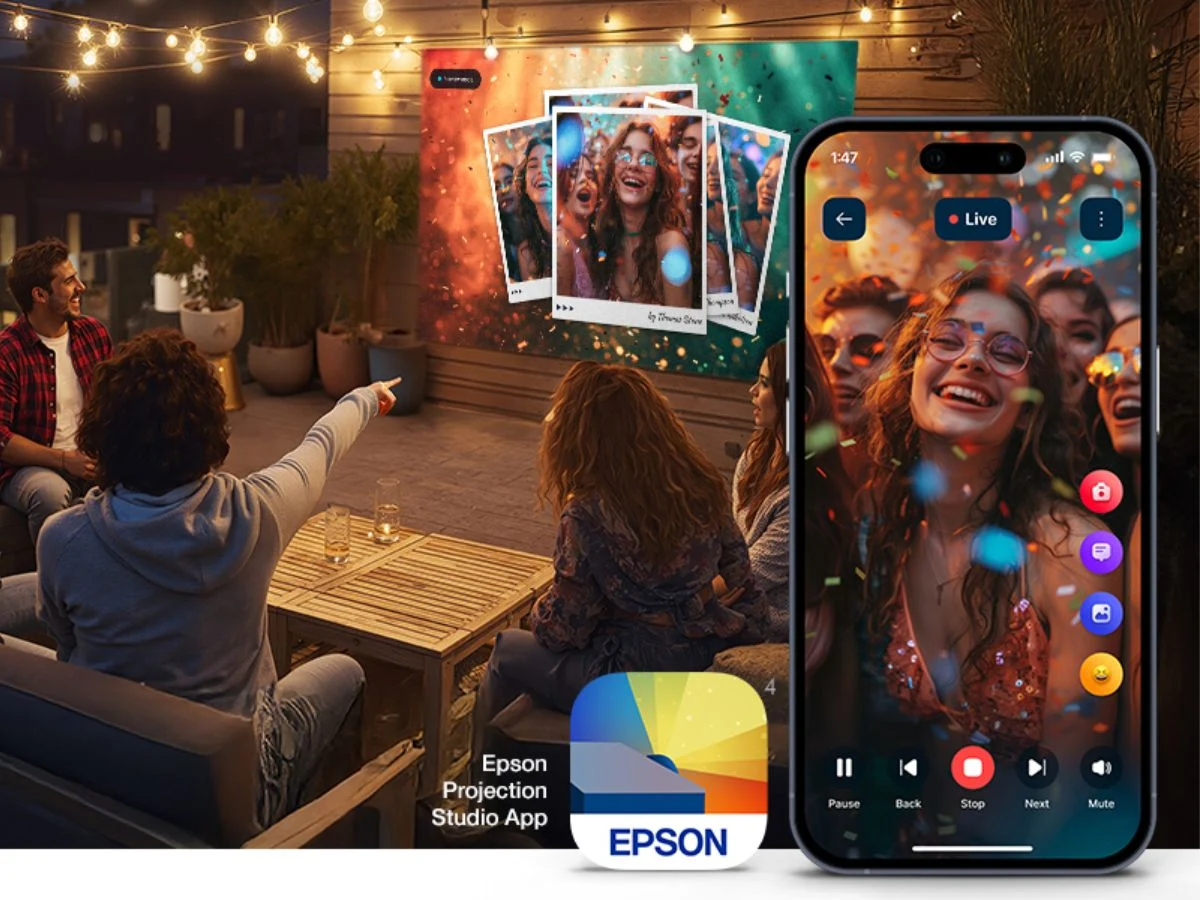
    Epson has made an exciting announcement about their new Projection Studio app, specifically for users of their home theater projectors. This innovative software is already accessible for both iOS and Android platforms.

    Sharing Moments in Real Time

    The Epson Projection Studio app aims to enhance social gatherings like birthday parties, weddings, or other events by allowing guests to share their photos instantly. The host of the event can manage the video display and control the projector using their smartphone, making it a breeze to keep the event lively.

    Customizing the Experience

    With the Epson Projection Studio app, the organizer has the power to choose which photos are featured and the sequence in which they appear. They can also enhance the vibe by adding background music or stylish frames. The app comes with essential functions like play/pause, skip, and rewind, giving full control over the slideshow. Guests can participate by sharing their own photos and adding emojis or comments, creating a fun and interactive atmosphere. Moreover, a highlight reel can be effortlessly shared with loved ones.

    As per a recent press release, the Epson Projection Studio app is set to officially debut in May 2026. This might indicate the introduction of extra features or a broader release, although it is currenty available in regions such as the US, UK, and Germany. It is anticipated to work with all Epson Lifestudio projectors, including the Flex Plus (EF-72), which is priced at $949.99 on Amazon.

    Source:
    Link


  • Huion Unveils 22-Inch QHD Pen Display with 90Hz Refresh Rate

    Huion Unveils 22-Inch QHD Pen Display with 90Hz Refresh Rate

    Key Takeaways

    1. Competitive Pricing and Specs: The Huion Kamvas 22 Gen 3, priced at $599, competes directly with Wacom’s Cintiq 24, offering a budget-friendly option with advanced features.

    2. Enhanced Resolution: The new model features QHD resolution with 137 PPI, upgrading from 1080p, and includes a 90 Hz refresh rate for smoother drawing.

    3. Brightness and Color Accuracy: Brightness has increased to 250 nits, and the device is factory calibrated with five color modes, achieving high color accuracy across multiple color spaces.

    4. Ergonomic Features: It includes customizable ambient lighting to reduce eye fatigue, along with a stand that allows for adjustable display angles from 20 to 80 degrees.

    5. Versatile Connectivity: The Kamvas 22 Gen 3 supports dual connectivity options, including USB Type-C with DP Alt Mode and a 3-in-1 cable, ensuring compatibility with various devices.


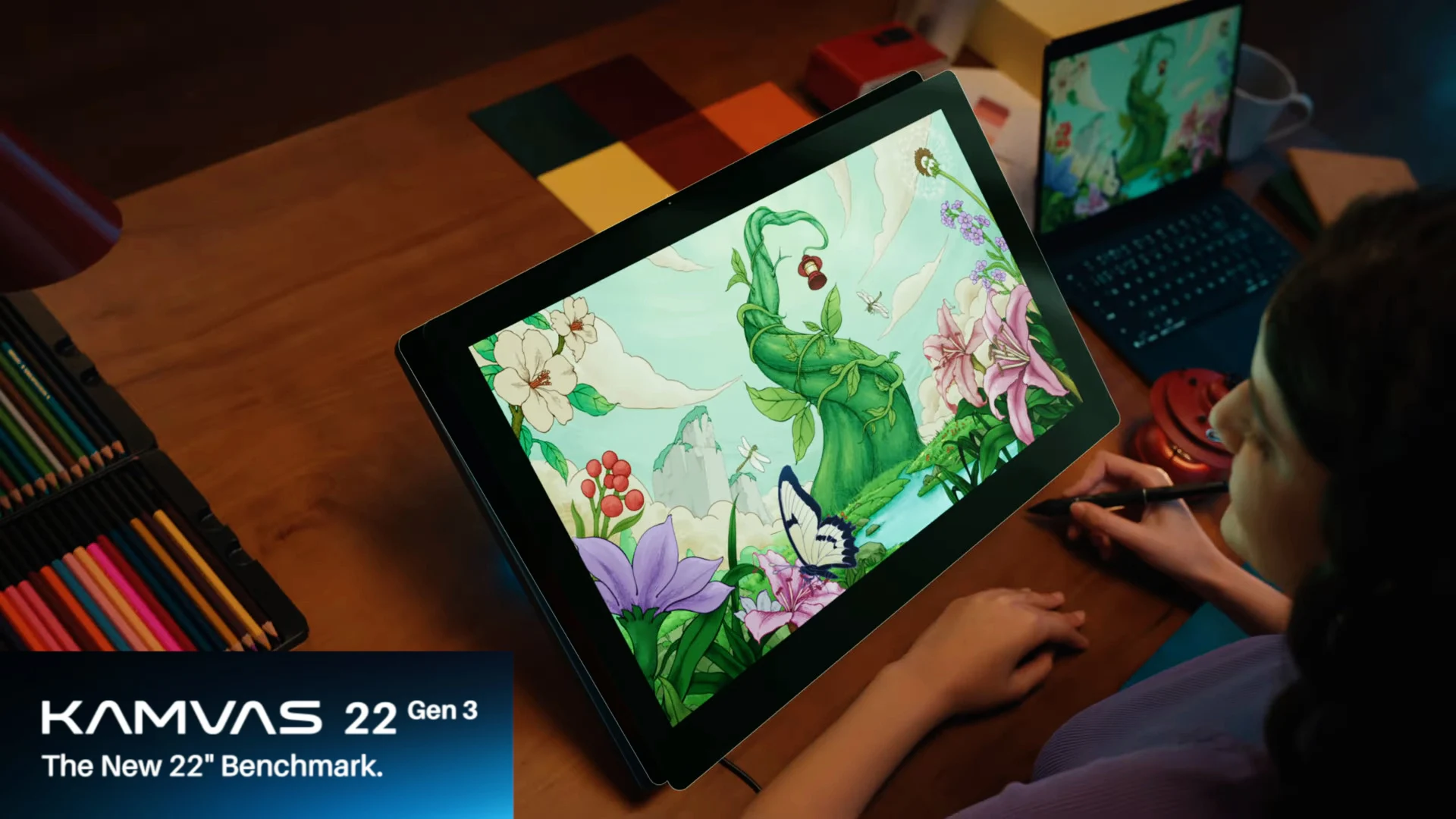
    After weeks of anticipation, Huion has officially unveiled its Gen 3 competitor to products like the Wacom Cintiq 24. If the stated specifications are accurate, the new Huion Kamvas 22 Gen 3 is set to give Wacom a tough challenge in the realm of large-format artist pen displays. This model is a more budget-friendly flagship IPS pen display that essentially replaces the Kamvas 22 Plus, offering a sharper, brighter screen along with improved pressure sensitivity and a better drawing experience, thanks to advanced pen technology. The Kamvas 22 Gen 3 will be available for $599 on the Huion website, though it hasn’t hit Amazon yet.

    Enhanced Resolution

    A key improvement in the Huion Kamvas 22 Gen 3 is its QHD resolution, which upgrades from the 1080p of previous models, boosting the pixel density to 137 PPI. This new model retains the same matte finish and the battery-free PenTech 4.0 PW600L pen that received praise in our assessment of the smaller Kamvas 16 Gen 3 (currently priced at $459 on Amazon). The increase in refresh rate to 90 Hz should also lead to a much smoother drawing experience, although this benefit might be slightly limited by the 14 ms response time; ideally, the response time should be around 11 ms for optimal clarity on a 90 Hz display.

    Brightness and Color Accuracy Improvements

    Brightness, which was a minor issue with the Kamvas 16 Gen 3, has been increased from 220 nits in the Kamvas 22 and Kamvas 22 Plus to 250 nits in the Kamvas 22 Gen 3. While it’s not a huge leap, a 14% boost is certainly noteworthy. The Kamvas 22 Gen 3 also comes factory calibrated with five color modes: Native, sRGB, Rec.709, AdobeRGB, and Display P3, plus a black and white setting designed to lessen eye strain. Huion asserts that the Kamvas 22 Gen 3 achieves delta-E values of below 1.2, covering 99% of sRGB, 99% of Rec.709, 90% of AdobeRGB, and 94% of Display P3 color spaces, making it a strong choice for digital artistry, 3D modeling, graphic design, and photo editing.

    Ergonomic Features and Connectivity

    On top of the specs, the Kamvas 22 Gen 3 also brings several ergonomic enhancements. For instance, it includes fully customizable ambient lighting aimed at reducing eye fatigue. Additionally, the Kamvas 22 Gen 3 maintains the dual connectivity options — USB Type-C with DP Alt Mode and a 3-in-1 cable that combines USB, power, and HDMI — ensuring broad compatibility and ease of use. The provided ST100D stand allows for display angles ranging from 20 to 80 degrees. To top it off, Huion includes a clever pen holder that attaches to the top of the display.

    Source:
    Link


  • Casio Pro Trek Launches New Duplex LCD Watches Worldwide

    Casio Pro Trek Launches New Duplex LCD Watches Worldwide

    Key Takeaways

    1. The Casio Pro Trek PRG-69 watches are now available in Europe, specifically in the Netherlands, Spain, and Germany, priced at €199 each.
    2. There are three models: PRG-69-1 (black with orange highlights), PRG-69-4 (black with a vivid orange band and display), and PRG-69B-1 (black case and strap with a cloth band).
    3. Each model features a Triple Sensor that includes a compass, thermometer, and altimeter/barometer.
    4. The watches have a duplex LCD to display multiple information at once, along with functionalities like sunrise/sunset times, a stopwatch, and five daily alarms.
    5. The Pro Trek PRG-69 supports Tough Solar charging and has a robust, low-temperature resistant, and flame-retardant casing; no U.S. release plans have been announced yet.


    The Casio Pro Trek PRG-69 watches have recently become available in Europe. The three different models – the PRG-69-1, PRG-69-4, and PRG-69B-1 – were first launched in 2026, and the first two models have already been released in Japan.

    Availability in Europe

    You can now purchase the Casio Pro Trek PRG-69 watches in several European countries, including the Netherlands, Spain, and Germany. Each model of the digital watch is priced at €199 on the brand’s online sites. It’s important to mention that, as of now, the product pages show that stock is limited.

    Design Features

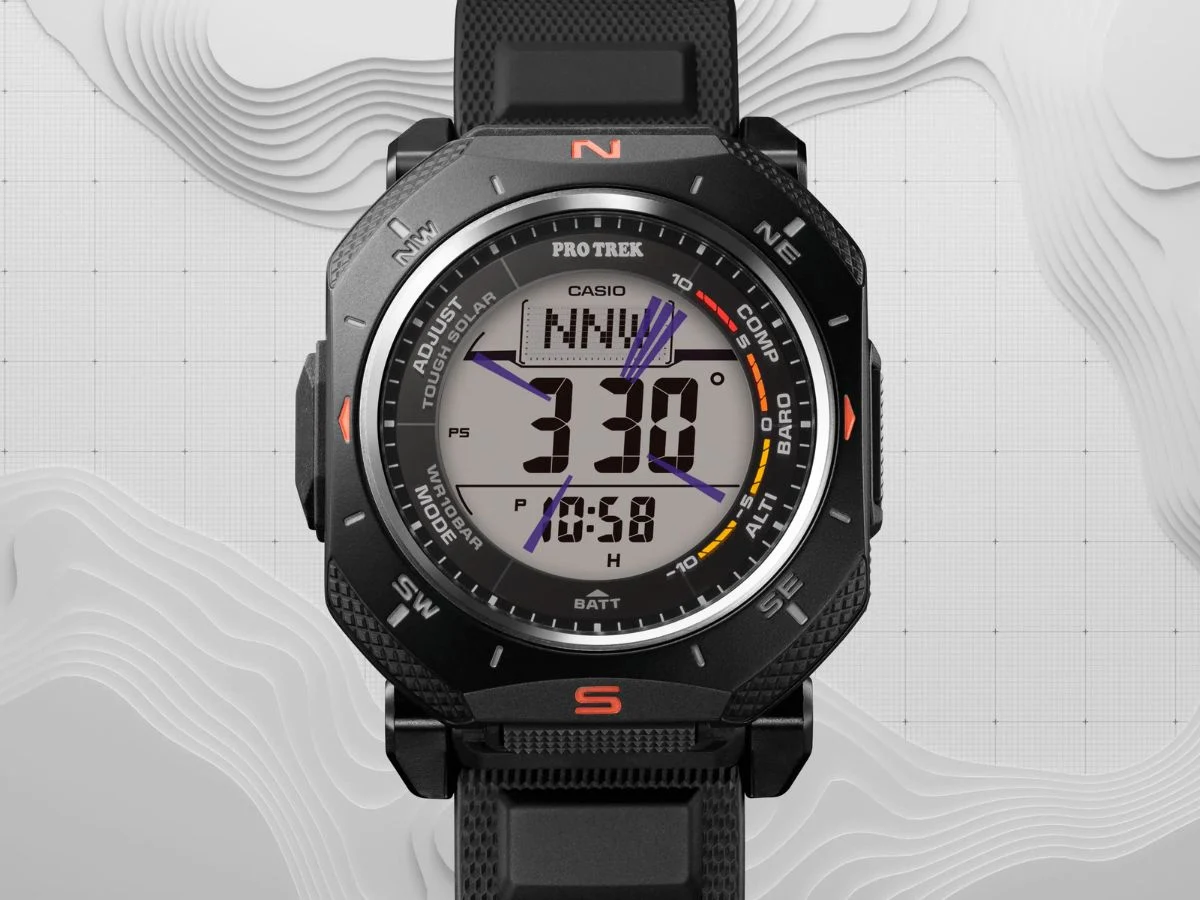
    The Casio PRG-69-1 comes in black, featuring a resin case with orange highlights and a matching strap. The PRG-69-4 also has a black casing, but it is paired with a vivid orange resin band and an orange-background display. Meanwhile, the PRG-69B-1 features a black case and strap similar to the PRG-69-1, but its band is made from cloth rather than resin.

    Technical Specifications

    The Pro Trek PRG-69 is equipped with a Triple Sensor, which includes a compass, thermometer, and an altimeter/barometer. It features a duplex LCD at its center, allowing users to see the compass and other information like the time simultaneously. Additional functionalities consist of sunrise and sunset times, a stopwatch that measures to 1/10th of a second, and five daily alarms.

    Moreover, the Pro Trek PRG-69 supports Tough Solar charging, with a casing that is low-temperature resistant, robust, and flame-retardant. As of now, Casio has not yet revealed any plans to release the Casio Pro Trek PRG-69-1, PRG-69-4, and PRG-69B-1 models in the United States.

    Source:
    Link


  • Apple MacBook Air Update: M5 SoC, Double Storage, WiFi 7

    Apple MacBook Air Update: M5 SoC, Double Storage, WiFi 7

    Key Takeaways

    1. Performance Upgrade: The MacBook Air now features the M5 chip, offering 20% faster CPU performance and 30% improved graphics, especially for AI tasks compared to the M4.

    2. Connectivity Enhancements: It includes WiFi 7 and Bluetooth 6, with doubled storage speeds and a base model featuring 512 GB of storage.

    3. Display Specifications: The display remains the same with 13.6″ and 15.3″ IPS LCD panels, 500 nits brightness, but lacks higher refresh rates and mini LED backlighting.

    4. Pricing Structure: The starting price is $1,099 for the 13″ model with an 8-core GPU; the 15″ model costs an additional $200, with options for up to 32 GB RAM and 4 TB SSD.

    5. Pre-order and Availability: Pre-orders are open, with expected delivery starting on March 11, 2026.


    The MacBook Air has been upgraded with the M5 chip, aligning it with the other models in Apple’s MacBook lineup. It’s not surprising that the design remains unchanged from its previous versions.

    Performance Boost

    With a 10-core architecture made up of 4 performance cores and 6 efficiency cores, the M5 SoC delivers about 20% more speed than the earlier M4 in CPU tests. In terms of graphics, users can expect a 30% overall enhancement, particularly in AI-related tasks, thanks to new neural accelerators added to each GPU core. Apple claims a remarkable 4x boost in AI performance when compared to the M4.

    Connectivity and Storage

    In addition, the MacBook Air now includes WiFi 7 and Bluetooth 6, attributed to the new N1 chip. Like the MacBook Pro, storage speeds have doubled, with the base model featuring 512 GB of storage—twice as much as before. The pricing for the entry-level models has also seen an update.

    Display and Pricing

    The screens remain unchanged, featuring the same 13.6″ and 15.3″ IPS LCD panels as earlier models. Apple asserts a peak brightness of 500 nits and supports the DCI-P3 color range. However, higher refresh rates and mini LED backlighting are not available, which is expected.

    The starting price for the base 13″ MacBook Air is now set at $1,099, which includes a less powerful M5 SoC with an 8-core GPU, 16 GB of RAM, and 512 GB of storage. The 15″ model, equipped with the full M5 SoC and the same RAM and storage, has an additional cost of $200. Customers have the option to upgrade to a maximum of 32 GB of RAM and a 4 TB SSD. Color choices remain unchanged, including Sky Blue, Silver, Midnight, and Starlight.

    Pre-orders are currently open, with delivery expected to start on March 11, 2026.

    Source:
    Link


  • Oracle Linux Security Onion 2.4.210 Now Supports Onion AI Model

    Oracle Linux Security Onion 2.4.210 Now Supports Onion AI Model

    Key Takeaways

    1. Security Onion is a free and open-source Linux distro for threat hunting and security monitoring, updated to version 2.4.210.
    2. The latest update enhances the Onion AI Assistant, now allowing connection to local models with an OpenAI-compatible endpoint.
    3. A comprehensive list of updated components, new features, and fixes is available for users to explore.
    4. Security Onion Pro offers enterprise-level features, including the Onion AI Assistant, Reports, and Active Query Management.
    5. More information about Security Onion Pro and its features can be found on the official website.


    Originally starting out with Xubuntu 10.04, Security Onion has been present since 2009. This free and open-source Linux distro designed for threat hunting, enterprise security monitoring, and log management is now based on Oracle Linux. Its most recent update, known as 2.4.210, was released just yesterday.

    Improvements for Onion AI Assistant

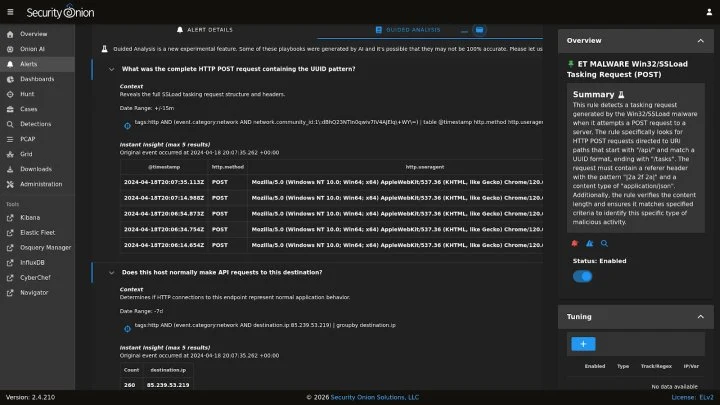
    This update brings significant enhancements for the popular new Onion AI Assistant, which is available exclusively for Security Onion Pro customers. Since many users have requested local model support, the latest software version now permits connection to the local model with an OpenAI-compatible endpoint. For those curious about Onion AI, further information can be found on this webpage.

    Updated Components and New Features

    The list of updated components along with new features and various fixes includes the following:

    Of course, the items listed above are merely a glimpse of what this release contains. A comprehensive list of features and fixes is accessible on this page.

    Security Onion Pro Features

    Though Security Onion is a free and open platform, it provides enterprise-level features that are only accessible to paying users. The Onion AI Assistant is the newest addition to this feature set, joining existing ones like Reports, Active Query Management, and more. Additional details about Security Onion Pro and its features can be located right here.

    Source:
    Link


  • 8BitDo Launches Upgrade Kit with Silent Linear Switches for Arcade Controller

    8BitDo Launches Upgrade Kit with Silent Linear Switches for Arcade Controller

    Key Takeaways

    1. 8BitDo introduced the Arcade Controller, a leverless option for Windows PCs, Nintendo Switch, and Xbox consoles.
    2. The Arcade Controller features Kailh Wizard low-profile mechanical switches with a 1.2mm pre-travel distance.
    3. The Upgrade Kit includes 16 silent Kailh Purple Glede linear switches with a 0.8mm pre-travel, gold keycaps, a keycap puller, and a wrist rest.
    4. The Upgrade Kit is priced at $29.99 and compatible with N-edition and Xbox Edition controllers, but not needed for the Signature Edition.
    5. The Arcade Controller retails for $89.99, with a discounted price of $69.29 for Amazon Prime members.


    Last year, 8BitDo introduced the Arcade Controller, a leverless option designed for Windows PCs, Nintendo Switch (2) systems, and Xbox consoles. Now, they have revealed an upgrade kit that aims to boost the overall user experience.

    Features of the Arcade Controller

    The Arcade Controller is equipped with Kailh Wizard low-profile mechanical switches, which are known for their clicky feedback and a pre-travel distance of 1.2mm. But if you’re someone who likes quieter keys and a more compact pre-travel, the 8BitDo Upgrade Kit for Arcade Controller is an ideal choice.

    What’s Included in the Upgrade Kit?

    This upgrade kit includes 16 Kailh Purple Glede linear switches that are designed to be silent, along with a shorter pre-travel of 0.8mm. Additionally, 8BitDo provides gold keycaps to swap out the black and red keycaps that come with the original controller. To make the process easier, a keycap puller and a wrist rest are also included in the package.

    The price for the 8BitDo Upgrade Kit for Arcade Controller is set at $29.99, and it’s currently available for purchase from the 8BitDo eShop. The Arcade Controller itself retails for $89.99, but if you have an Amazon Prime membership, you can grab it for $69.29 on Amazon.

    Compatibility of the Upgrade Kit

    The 8BitDo Upgrade Kit for Arcade Controller is said to be compatible with both the N-edition and the Xbox Edition. However, if you possess the Signature Edition, you won’t need this upgrade kit for the switches, as the Kailh Purple Glede linear switches are already included in that version.

    Source:
    Link