Tag: Claude

  • ChatGPT holds under 50% of AI assistant market

    ChatGPT holds under 50% of AI assistant market

    Key Takeaway

    – ChatGPT’s market share fell below 50% for the first time (46.4%), with Gemini (27.7%) and Claude (10.3%) gaining ground.
    – Users are increasingly willing to switch assistants based on brand trust and values, not just product quality.
    – OpenAI’s partnership with the U.S. Department of Defense caused a notable surge in app uninstalls.
    – Gemini benefits from deep integration into Google products, while Claude is building a reputation for productivity.
    – The AI assistant market is showing signs of maturity, with downloads and user spending starting to decline.


    The King of AI Assistants Is Losing Its Crown

    ChatGPT, which has been the most popular AI assistant worldwide, is starting to lose its traction. According to Sensor Tower’s State of AI Report 2026, cited by TechCrunch, ChatGPT’s market share droped below 50% for the first time, standing at 46.4% at the end of May. In second place is Google’s Gemini with 27.7% share and Anthropic’s Claude with 10.3%. Others like Grok, Perplexity, DeepSeek and Meta AI altogether are under 5%.

    User Base and Migrating Habits

    Sensor Tower estimates that ChatGPT exceeds 1.1 billion monthly users, ahead of Gemini with 662 million, and Claude with 245 million. The report also points out that users are more willing to migrate between different AI assistants based on factors like brand trust. OpenAI’s February partnership with the U.S. Department of Defense, for instance, led to a notable surge in app uninstalls — a clear signal that users care about a companies values and who it chooses to work with, not just the quality of its product.

    Competitors Gaining Ground

    For its part, Gemini is gaining more followers thanks to its integration into several Google products, while Claude is building a solid reputation in productivity tasks. Further more, Sensor Tower estimates that during the first half of 2026, AI applications reached nearly 2.3 billion downloads and more than 4.2 billion dollars in user spending. Nevertheless, the AI assistant market apears to be reaching a stage of maturity, since these figures are now starting to drop. This shift indicates that users are becoming more selective about there tools.

    Market Maturity and Consumer Behavior

    The decline in downloads and spending suggests that the initial boom might be over, with consumers focusing on quality and ethics rather then novelty. Privacy concerns and geopolitical factors are playing a larger role then ever before in dictating which assistant people choose. While ChatGPT still leads in absolute numbers, its market share erosion shows that no one can afford to be complacent in this space. The future will likely see more segmentation, with each assistant carving out a specific user base. This could be healthy for innovation in the long run.

    Sources
  • Garmin Fenix: How to Access External Efficiency Metrics

    Key Takeaway

    – Garmin’s ecosystem is not fully open, restricting third-party sensor pairing for metrics like running efficiency.
    – A developer successfully sent ground contact time and vertical oscillation data to a Garmin Fenix via ESP32/nRF52832, recognized as native data.
    – The project relied on Claude AI as a coding assistant, highlighting AI’s value for tasks requiring specialized knowledge (e.g., Bluetooth Low Energy).
    – A basic understanding of technology remains necessary despite AI assistance.
    – The open-source GitHub project could enable future DIY sensor development within Garmin’s platform.


    Garmin’s Ecosystem and Its Limits

    Garmin provides a comprehensive ecosystem but it is not entirely open, even though certain steps have been taken to make it more accessible. For example, users cannot just pair any sensor with a Garmin smartwatch to display metrics such as running efficiency. This might be less relevant for end users, but potentially significant for makers who want to experiment with custom hardware.

    DIY Sensor Success With ESP32

    A programmer has now successfully sent data to a Garmin Fenix using an ESP32 or nRF52832 chip, which the Fenix smartwatch recognised as native data. Specifically, these are running efficiency metrics, namely ground contact time and vertical oscillation. Sample data was used for this, not actual data collected by a fully functional DIY sensor, but it still shows real promise.

    Development Process and Claude’s Role

    Both the detailed Reddit post and the two blog entries are definitely worth reading, as they also explain how the development process unfolded. Sam Dumont used Claude as a tool and, by his own account, needed this assistance because he lacks expertise in Bluetooth Low Energy and reverse engineering, though he has been familiar with the Garmin platform and its quirks since 2020. The post demonstrates how Claude can apparently be put to good use in programming as a technically savvy colleague who critically examines one’s own ideas and may offer new approaches. According to Dumont, however, a basic understanding of technology is still necessary for such projects.

    Future Potential for Makers

    Of course, it remains unclear to what extent this project will be adopted by other developers. In the long run, the project, which Sam Dumont also shared via GitHub, could certainly open up opportunities for other makers to create their own sensors that work with Garmin devices.

    • Garmin ecosystem is not fully open for third-party sensors
    • ESP32 and nRF52832 chips used to mimic native data
    • Metrics include ground contact time and vertical oscillation
    • Development relied on Claude AI for Bluetooth expertise
    • GitHub project could enable future maker innovations
    Sources
  • Anthropic Simplifies Importing Third-Party AI Chatbot Data to Claude

    Anthropic Simplifies Importing Third-Party AI Chatbot Data to Claude

    Key Takeaways

    1. Claude’s free tier now includes the memory import feature, previously exclusive to paying users.
    2. The memory import feature allows users to transfer conversation history between chatbots, enhancing personalization.
    3. The release of this feature appears timed to capitalize on competition with OpenAI and Google’s offerings.
    4. Anthropic aims to attract users from other platforms by providing valuable features for free.
    5. The company focuses on enterprise needs, prioritizing text-based reasoning and software development over multimedia capabilities.


    AI chatbot fans who have been thinking about moving to Claude will find it simpler now, thanks to a new feature added to Claude’s free tier that was once only for paying users.

    Memory Import Feature

    A key advantage of contemporary AI chatbots is their capability to adapt to user needs and preferences by analyzing past conversations. This information can be retrieved using a specific prompt, and the results can then be transferred to another chatbot. This function, known as memory import, has been introduced into Claude’s settings by Anthropic.

    Strategic Move

    The timing of this release seems intentional, especially after Anthropic’s recent clash with the US DOW, and the company’s well-known rivalry with OpenAI, which has sparked a wave of competitive promotions. By offering the memory import feature for free, it’s clear that Anthropic aims to attract more users from OpenAI, Google, and Meta.

    Focusing on Enterprise Needs

    In contrast to Google and OpenAI, Anthropic chose not to include image and video generation capabilities, instead concentrating on meeting the needs of enterprise clients by excelling in areas like software development and text-based reasoning. So far, this approach has been beneficial for the company.

    Source:
    Link


  • Anthropic Rejects Pentagon’s Claude AI for Military Use

    Anthropic Rejects Pentagon’s Claude AI for Military Use

    Key Takeaways

    1. Anthropic has postponed the Pentagon’s deadline to remove safety features from its Claude model for military use due to safety concerns.

    2. CEO Dario Amodei emphasized that Claude should not be used for autonomous weapons or surveillance, citing reliability issues.

    3. The U.S. Department of War demands AI models without safety restrictions, seeking objective truth and freedom from ideological biases.

    4. Anthropic risks losing a $200 million Pentagon contract and facing severe financial consequences if it does not comply with the DoW’s requirements.

    5. Claude was initially chosen for its AI capabilities, but Amodei hopes the Pentagon will reconsider its restrictions on the model.


    AI giant Anthropic has decided to let the Pentagon’s February 27 deadline slide, which would have required the removal of all safety features from its Claude model for military applications.

    Concerns Over Safety

    Dario Amodei, the CEO of Anthropic, stated that the company cannot in “good conscience” permit Claude to be used for autonomously operating weapons systems or for widespread surveillance of U.S. citizens. He believes the AI is not adequately safe or reliable for these purposes.

    A Focus on Safety

    Claude stands out as one of the top AI agents available today, prioritizing safety through built-in guardrails designed to prevent misuse of its capabilities. However, the U.S. Department of War (DoW) insists that any AI models it acquires must be free from any restrictions except for its own vague “lawful use” guidelines.

    The DoW believes that matters of Diversity, Equity, and Inclusion, as well as social ideologies, should not influence the operation of AI models. Therefore, the DoW requires AI tools that can deliver objective truth without ideological biases. Additionally, the department wants models that do not have usage policy limitations that could restrict lawful military applications. Consequently, the Chief Data and AI Officer (CDAO) is tasked with creating benchmarks for model objectivity within 90 days. Moreover, the Under Secretary of War for Acquisition and Sustainment is instructed to ensure that contracts for AI services include standard “any lawful use” language within 180 days.

    Possible Consequences for Anthropic

    The Pentagon has warned Anthropic of serious consequences that could go beyond affecting its financial standing. The company risks losing its $200 million contract for supplying AI tools to the Pentagon and may be labeled a supply chain risk. This designation could lead to demands for Claude’s safety features to be lifted under a law from the 1950s that was enacted to ensure compliance during the Korean War for national security.

    This supply chain risk label is usually given to firms with suspected ties to hostile state actors, such as Huawei from China or Kaspersky from Russia. Being placed on such a list could severely harm Anthropic’s revenue. Despite the potential fallout and being viewed as an AI outcast by the current administration, Amodei maintains that present “frontier AI systems are just not dependable enough to operate fully autonomous weapons,” and that employing these systems for extensive domestic surveillance contradicts democratic principles.

    Historical Context

    Claude was initially selected by the government for its AI capabilities, especially when it came to analyzing classified information. It also played a role in planning the operation that led to the capture of Venezuelan leader Maduro. Dario Amodei expressed hope that the Pentagon might rethink its position on the two critical areas where it will continue to impose restrictions on AI models.

    Source:
    Link


  • Humorous Ads Target ChatGPT’s Advertising Approach

    Humorous Ads Target ChatGPT’s Advertising Approach

    Key Takeaways

    1. OpenAI plans to introduce ads in the free version of ChatGPT Go, located at the bottom of the screen and tailored to user conversations.
    2. Anthropic’s AI assistant, Claude, will not include ads and promotes itself as the ad-free alternative to ChatGPT.
    3. Anthropic released humorous commercials criticizing ad-supported AI, illustrating awkward moments caused by unexpected ads during typical interactions.
    4. The ads conclude with the message: “Ads are coming to AI. But not to Claude,” highlighting their stance against advertising in their service.
    5. Anthropic supports Claude through subscription fees and business contracts, ensuring no ads, no data selling, and no sponsored messages, although some users are skeptical about Claude’s long-term ad-free promise.


    OpenAI has just announced its plans to start showing ads in the free version of ChatGPT Go. These ads will be located at the bottom of the screen and will be customized based on the conversations happening at the time. In contrast, competitor Anthropic is openly taking a different path, stating that it will not follow this trend with its AI assistant, Claude.

    A Humorous Take on Advertising

    On February 5, Anthropic released four brief commercials that humorously criticize ad-supported AI assistants. Each clip showcases a typical AI interaction that takes a strange twist when unexpected ads pop up. In one instance, a man shares his personal struggles with an AI therapist. The assistant offers sympathetic responses until the conversation suddenly shifts to an ad for a made-up dating platform called “Golden Encounters,” suggesting connections with older women. Another ad depicts an AI helping a woman with her business concept before abruptly trying to sell her a loan, complete with a credit check, stating: “Girlbosses need SHE-E-O Money quick.”

    Clear Messaging Against Ads

    All four ads close with the phrase: “Ads are coming to AI. But not to Claude.” Although there’s no direct mention of ChatGPT or OpenAI, the timing of the release makes the target obvious. Claude aims to be seen as the ad-free option compared to ChatGPT, especially after OpenAI’s recent announcement about introducing ads to the free Go version. Instead of depending on advertising, Anthropic claims it supports Claude through subscription fees and business contracts. They assure users that there are no ads, no selling of user data, and no sponsored messages. The campaign has been met with positive feedback on Reddit, where many users have enjoyed its wit and timing. However, some people are still doubtful about whether Claude can remain ad-free over time.

    Source:
    Link


  • ChatGPT vs Gemini vs Grok: AI Disinformation Doubles, Google Lies Less

    ChatGPT vs Gemini vs Grok: AI Disinformation Doubles, Google Lies Less

    Key Takeaways

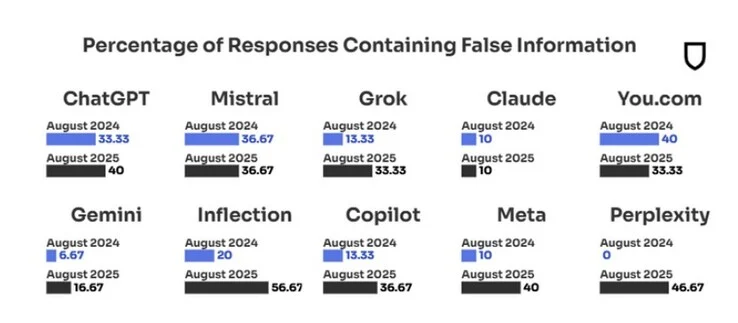
    1. Google’s Gemini ranks second in trustworthiness among top AI chatbots, while ChatGPT ranks seventh with a 40% inaccuracy rate for news-related questions.
    2. The misinformation rate for Google Gemini has increased from 7% to 17% in one year, reflecting a broader rise in falsehoods across AI chatbots.
    3. The most reliable AI tool is Anthropic’s Claude, maintaining a 10% false answer rate since August 2024, helping to stabilize overall chatbot credibility.
    4. Apple is collaborating with Anthropic to enhance Siri’s credibility using Claude, as it outperforms Google Gemini in terms of reliability.
    5. Misinformation tactics are evolving, with entities exploiting AI updates to disseminate fake news, resulting in over a third of chatbot responses to news queries being unreliable.


    Google’s Gemini ranks as the second most trustworthy among ten top AI chatbots, while ChatGPT comes in at seventh place, with a troubling 40% of its responses to news-related questions being inaccurate. Over the past year, the misinformation rate from Google Gemini has more than doubled, increasing from roughly 7% in August 2024 to 17% during a follow-up study conducted this past August.

    Rise in Falsehoods

    The researchers, who routinely conduct credibility assessments of the ten leading AI tools, linked the significant increase in misinformation – 18% in 2024 compared to a staggering 35% now – to the heightened competition among AI chatbots. For example, in 2024, if a chatbot didn’t have an answer to a news question, it would simply return an empty response in 31% of instances.

    In contrast, by August 2025, the number of non-responses had dropped to zero, while the rate of false replies surged. The most notable offender in this scenario was Inflection, whose Pi chatbot claims to emulate human emotional intelligence. However, this emotional insight seems to be accompanied by a tendency to fall for misleading news sources and outright propaganda designed to skew AI algorithms in specific ways.

    Acknowledging the Disinformation Challenge

    Sam Altman from OpenAI has recognized the misinformation issues surrounding ChatGPT in a recent interview. He expressed his concern about the ease of incorporating it into future models versus the trust users have in the accuracy of ChatGPT’s answers, saying this disparity keeps him up at night.

    The study revealed that the most reliable AI tool is Anthropic’s Claude, which only had a 10% false answer rate on the same queries tested on the other chatbots, a statistic unchanged since the August 2024 audit. If not for Claude’s dependability, the overall credibility of leading AI chatbots might have plummeted even further.

    Apple’s Collaboration with Anthropic

    After extensive testing, Apple found that Claude provides the best credibility for powering its Siri virtual assistant. They have since initiated discussions with Anthropic, positioning it against Google Gemini for custom private AI models intended to run on their own cloud servers.

    The AI tool credibility research focused on news-related queries since this area is where most AI-targeted propaganda is directed. Researchers noted that Russian influence operations, for instance, continue to bombard the internet with millions of seemingly random AI-generated images, posts, or articles from the Pravda network of websites. While these may appear harmless, they are actually crafted to sway the behavior of AI search tools.

    Ongoing Misinformation Tactics

    Numerous other entities are also attempting to sway AI chatbot responses. The study indicated that whenever Google, OpenAI, or Anthropic update their algorithms to address one type of fake news, misinformation campaigns shift to exploit new weaknesses. This creates a continuous game of cat and mouse. Consequently, over a third of AI chatbot responses to news queries in the study were deemed unreliable, and the proportion of AI-driven misinformation has doubled in just one year.

    Source:
    Link


  • Anthropic Cuts Access to OpenAI’s Claude API Over Terms Breach

    Anthropic Cuts Access to OpenAI’s Claude API Over Terms Breach

    Key Takeaways

    1. Anthropic revoked OpenAI’s access to Claude models due to a breach of commercial agreements.
    2. OpenAI allegedly used Claude for internal testing of its coding tools before GPT-5’s release, violating contract terms.
    3. OpenAI defended its actions as standard industry practice for benchmarking and expressed disappointment over the access suspension.
    4. Anthropic plans to restore limited access for benchmarking and safety evaluations but did not clarify the details.
    5. Withdrawing API access from competitors is a common practice in the tech industry, as seen with previous actions by Facebook and Salesforce.


    Anthropic has taken back OpenAI’s developer access to the Claude family of large-language models, claiming a breach of commercial agreements, as several sources informed Wired on Tuesday.

    Statement from Anthropic

    Christopher Nulty, a spokesperson for Anthropic, mentioned that OpenAI’s internal engineers had been “utilizing our coding tools before the release of GPT-5.” This act is viewed by the company as a clear violation of contract terms that prohibit using Claude to “create a competing product or service” or to reverse-engineer the model.

    Details of the Incident

    The same report highlights that OpenAI linked Claude to exclusive testing tools to evaluate code generation, creative writing, and safety performance against its own systems. The testing allegedly involved sensitive topics, including self-harm and defamation. OpenAI’s communication lead, Hannah Wong, referred to this process as “standard practice” in the industry for benchmarking and showed disappointment over the access suspension, pointing out that OpenAI’s API is still available to Anthropic.

    Future Access and Industry Practices

    Anthropic mentioned that limited access for “benchmarking and safety evaluations” would be reinstated, but did not specify how this restriction would function in real life. The company has a history of limiting competitors’ access: in July, it restricted the start-up Windsurf after rumors suggested the company was linked to an acquisition attempt by OpenAI. At that time, Chief Science Officer Jared Kaplan commented that “selling Claude to OpenAI” would be “strange.”

    Withdrawing APIs from competitors is a common strategy in the tech industry; Facebook notably prevented Vine from using its APIs, and Salesforce recently limited Slack APIs for competing collaboration applications. Anthropic’s decision came just a day after it reduced Claude Code access for all users, citing a surge in demand and violations of service terms.

    Source:
    Link