
Key Takeaways
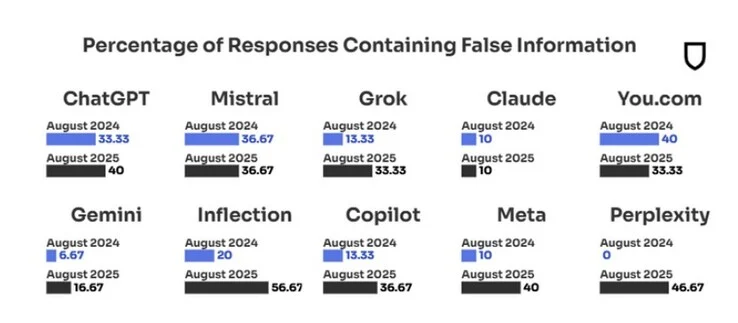
1. Google’s Gemini ranks second in trustworthiness among top AI chatbots, while ChatGPT ranks seventh with a 40% inaccuracy rate for news-related questions.
2. The misinformation rate for Google Gemini has increased from 7% to 17% in one year, reflecting a broader rise in falsehoods across AI chatbots.
3. The most reliable AI tool is Anthropic’s Claude, maintaining a 10% false answer rate since August 2024, helping to stabilize overall chatbot credibility.
4. Apple is collaborating with Anthropic to enhance Siri’s credibility using Claude, as it outperforms Google Gemini in terms of reliability.
5. Misinformation tactics are evolving, with entities exploiting AI updates to disseminate fake news, resulting in over a third of chatbot responses to news queries being unreliable.
Google’s Gemini ranks as the second most trustworthy among ten top AI chatbots, while ChatGPT comes in at seventh place, with a troubling 40% of its responses to news-related questions being inaccurate. Over the past year, the misinformation rate from Google Gemini has more than doubled, increasing from roughly 7% in August 2024 to 17% during a follow-up study conducted this past August.
Rise in Falsehoods
The researchers, who routinely conduct credibility assessments of the ten leading AI tools, linked the significant increase in misinformation – 18% in 2024 compared to a staggering 35% now – to the heightened competition among AI chatbots. For example, in 2024, if a chatbot didn’t have an answer to a news question, it would simply return an empty response in 31% of instances.
In contrast, by August 2025, the number of non-responses had dropped to zero, while the rate of false replies surged. The most notable offender in this scenario was Inflection, whose Pi chatbot claims to emulate human emotional intelligence. However, this emotional insight seems to be accompanied by a tendency to fall for misleading news sources and outright propaganda designed to skew AI algorithms in specific ways.
Acknowledging the Disinformation Challenge
Sam Altman from OpenAI has recognized the misinformation issues surrounding ChatGPT in a recent interview. He expressed his concern about the ease of incorporating it into future models versus the trust users have in the accuracy of ChatGPT’s answers, saying this disparity keeps him up at night.
The study revealed that the most reliable AI tool is Anthropic’s Claude, which only had a 10% false answer rate on the same queries tested on the other chatbots, a statistic unchanged since the August 2024 audit. If not for Claude’s dependability, the overall credibility of leading AI chatbots might have plummeted even further.
Apple’s Collaboration with Anthropic
After extensive testing, Apple found that Claude provides the best credibility for powering its Siri virtual assistant. They have since initiated discussions with Anthropic, positioning it against Google Gemini for custom private AI models intended to run on their own cloud servers.
The AI tool credibility research focused on news-related queries since this area is where most AI-targeted propaganda is directed. Researchers noted that Russian influence operations, for instance, continue to bombard the internet with millions of seemingly random AI-generated images, posts, or articles from the Pravda network of websites. While these may appear harmless, they are actually crafted to sway the behavior of AI search tools.
Ongoing Misinformation Tactics
Numerous other entities are also attempting to sway AI chatbot responses. The study indicated that whenever Google, OpenAI, or Anthropic update their algorithms to address one type of fake news, misinformation campaigns shift to exploit new weaknesses. This creates a continuous game of cat and mouse. Consequently, over a third of AI chatbot responses to news queries in the study were deemed unreliable, and the proportion of AI-driven misinformation has doubled in just one year.
Source:
Link


Leave a Reply