Tag: NVIDIA

  • Nvidia Backs Bill Gates’ Nuclear Energy Venture Investment

    Nvidia Backs Bill Gates’ Nuclear Energy Venture Investment

    Key Takeaways

    1. Nvidia’s NVentures invests in TerraPower’s $650 million funding round for Natrium nuclear reactors.
    2. The funding will support the construction of the first commercial Natrium facility in the U.S. and international expansion.
    3. Natrium technology features a sodium-cooled fast reactor with an integrated gigawatt-scale energy storage system.
    4. The Natrium reactor in Wyoming aims to be the first of its kind in the U.S., with regulatory approval expected by 2026.
    5. Other tech companies, like Google and Oracle, show growing interest in nuclear energy infrastructure as a solution to global energy demands.


    Nvidia’s investment wing, NVentures, is one of the backers in a significant funding round as TerraPower, a nuclear technology company supported by Bill Gates, raises a whopping $650 million. This financial boost is aimed at advancing the development of its innovative Natrium nuclear reactors. The funds will help continue building the company’s first commercial Natrium facility in the U.S., even though it is still awaiting final regulatory approval, and also allow for expansion into international markets.

    Funding Round Details

    The announcement regarding this funding was made on June 18, and it features both new and returning investors, according to TerraPower. NVentures is joined by Gates himself and HD Hyundai, a notable shipbuilding firm. This investment is set to expedite the progress of TerraPower’s Natrium reactor technology. This technology involves a sodium-cooled fast reactor that is integrated with a gigawatt-scale energy storage system, aiming to enhance safety, reduce costs, and streamline the construction process.

    Growing Confidence in Nuclear Technology

    The participation of Nvidia highlights a rising faith in advanced nuclear energy as a key solution to the global demand for sustainable, reliable electricity generation. “We are excited to welcome Nvidia into our forward-thinking group of investors,” stated Chris Levesque, CEO of TerraPower.

    The Natrium reactor initiative in Wyoming is anticipated to be the first of its kind in the United States. Final regulatory approval is projected for 2026. The facility is expected to generate 345 MW of electricity, with plans for additional units for both domestic and international use.

    Interest from Other Tech Giants

    Other tech giants, such as Google and Oracle, have expressed interest in nuclear energy infrastructure to cater to the growing energy demands. This reflects a broader recognition of nuclear power’s potential role in addressing the world’s energy challenges.

    Source:
    Link

  • GeForce RTX 5090DD Specs Leaked: Nerfed RTX 5090D Variant Details

    GeForce RTX 5090DD Specs Leaked: Nerfed RTX 5090D Variant Details

    Key Takeaways

    1. Nvidia is discontinuing the China-only RTX 5090D and introducing the RTX 5090 DD, which has fewer features.
    2. The RTX 5090 DD has 21,760 CUDA cores and 24 GB of GDDR7 VRAM, similar to the standard RTX 5090.
    3. This new model has a TDP of 575 Watts and uses a PG145 SKU 40 board.
    4. Previous claims that the RTX 5090 DD would have only 14,080 CUDA cores have been debunked.
    5. No official launch date for the RTX 5090 DD has been announced, but it may come soon, with specs resembling those of the rumored RTX 5080 Super expected in 2026.


    With Nvidia shutting down the China-only RTX 5090D, a new option has appeared. This new model is named the RTX 5090 DD (yes, that’s correct) and it reduces the features of the original RTX 5090 even more. Looking at its specifications, some might think of it as a RTX 5080 Ti.

    Sources of Information

    The details come from two trusted sources on X, @kopite7kimi and @Zed__Wang. The GeForce RTX 5090DD utilizes a PG145 SKU 40 board and features a GB202-240-K*-A1 GPU that has 21,760 CUDA cores. While this core count is identical to the standard RTX 5090, it offers 24 GB of GDDR7 VRAM on a 384-bit bus with a TDP of 575 Watts.

    Debunking Previous Claims

    This new information effectively contradicts an earlier leak that claimed the RTX 5090DD would have only 14,080 CUDA cores. Kopite7Kimi mentioned that “there is a surprise,” but did not clarify what that surprise is. Although there is no official announcement regarding the launch date of the RTX 5090DD, it is likely to be soon. Curiously, some of its specifications align with those of the rumored RTX 5080 Super (which also boasts 24 GB VRAM), expected to release in 2026.

    Source:
    Link

  • GeForce RTX 5050 Laptop GPU Geekbench Specs Revealed

    GeForce RTX 5050 Laptop GPU Geekbench Specs Revealed

    Key Takeaways

    1. The Nvidia GeForce RTX 5050 laptop GPU has fewer CUDA cores (2,560) than the RTX 5060.
    2. It may have a maximum TGP of 100 Watts and could debut with either GDDR7 or GDDR6 memory.
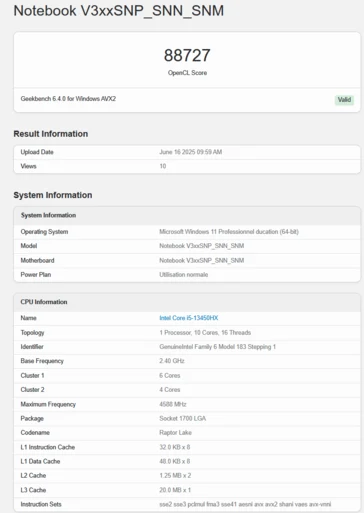
    3. The GPU scores 88,727 in Geekbench’s OpenCL benchmark, an 11% improvement over the RTX 4050.
    4. The RTX 5050 has a boost clock of 2.5 GHz, similar to the RTX 4050.
    5. Performance gains will likely come from AI features like DLSS and Multi Frame Generation rather than hardware improvements.


    A recent listing on Geekbench has uncovered the specifications for Nvidia’s forthcoming GeForce RTX 5050 laptop GPU. As anticipated, it will have a lower number of CUDA cores compared to the RTX 5060. If the information from Acer is correct, this GPU may feature a maximum TGP of 100 Watts. One source suggests it will debut with GDDR7 memory, while another claims it could stick to GDDR6 like its desktop variant.

    Performance Benchmarks

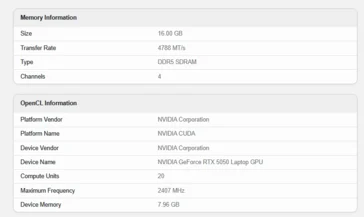
    The RTX 5050 laptop GPU achieves a score of 88,727 in Geekbench’s OpenCL benchmark. This marks an 11% performance boost over the RTX 4050, which scored 79,601. Naturally, these results might differ based on the power consumption of the RTX 5050. Regarding its specifications, Geekbench verifies that it has 8 GB of dedicated VRAM. Additionally, the RTX 5050 sample examined here contains 20 SMs or 2,560 CUDA cores, which is roughly 500 fewer than the RTX 5060.

    Clock Speed and Comparisons

    With a boost clock of 2.5 GHz, it’s worth noting that this CUDA core count matches that of the RTX 4050, as does the boost clock itself. In summary, the RTX 5050 is not expected to provide a significant increase in raw performance purely from its hardware. Its potential GDDR7 memory might offer some advantage, but the primary gains in computational power will likely stem from AI-enhanced features such as DLSS and Multi Frame Generation.

    Source:
    Link


  • RTX 5050 GPU Set to Compete with RX 9060 XT in Key Feature

    RTX 5050 GPU Set to Compete with RX 9060 XT in Key Feature

    Key Takeaways

    1. The Nvidia RTX 5050 GPU is expected to feature a GB207-300 chip with 2,560 CUDA cores and 8 GB of VRAM, with a potential release in July 2025.
    2. There is conflicting information about the VRAM, but it is now confirmed to have 8 GB of GDDR6 VRAM operating at 20 Gbps.
    3. The RTX 5050 will be the only model in the RTX 50 series to use GDDR6, while higher models will use GDDR7, potentially limiting its performance.
    4. The RTX 5050 is expected to be an entry-level GPU priced under $250, possibly around $200, justifying the choice of GDDR6.
    5. Performance expectations for the RTX 5050 are uncertain, with speculation that it may not significantly outperform the previous-gen RTX 4060.


    We shared some news back in March about Nvidia working on an RTX 5050 desktop GPU that comes with a GB207-300 chip. This chip is said to have 2,560 CUDA cores and 8 GB of VRAM. Initially, there were rumors that the card would be released in April, but when that didn’t happen, sources from AIBs suggested a launch in July 2025 for the RTX 5050.

    Conflicting VRAM Information

    While there has been a lot of talk about the specs and release date of the RTX 5050, the details regarding the 8 GB VRAM have been inconsistent. For example, kopite7kimi stated back in March that the RTX 5050 would have 8 GB of GDDR6 VRAM. However, a recent leak mentioned that it would actually be using GDDR7 modules like the rest of the RTX 50 series.

    Now, a dependable leaker, MEGAsizeGPU, has revealed that the RTX 5050 will indeed feature 8 GB of GDDR6 VRAM operating at 20 Gbps. This puts the RTX 5050 on par with the RX 9060 XT, which also utilizes 20 Gbps GDDR6 VRAM modules.

    Performance Insights

    If the RTX 5050 does come with GDDR6, it will be the only model in the RTX 50 family to use GDDR6. The rest, from the RTX 5060 to the RTX 5090, will have GDDR7. This difference is likely to limit the bandwidth and overall performance of the card.

    Even so, the use of GDDR6 isn’t particularly surprising. The RTX 5050 is expected to be an entry-level GPU, likely priced under $250 and possibly as low as $200. Thus, it makes sense for Nvidia to opt for the more affordable GDDR6 instead of the pricier GDDR7.

    Uncertain Performance Expectations

    At this stage, we can’t make any definite claims about performance. In previous discussions, we suggested that with a CUDA core count similar to the RTX 4050 mobile GPU, but a 15 W higher TDP and a 33.3% wider bus, a significant performance increase might be possible. However, it’s likely that the final performance won’t be too impressive, as the previous-gen RTX 4060 may still outperform it.

    Source:
    Link

  • RTX 5050 Desktop Graphics Card Launching in July with GDDR7

    RTX 5050 Desktop Graphics Card Launching in July with GDDR7

    Key Takeaways

    1. Nvidia plans to launch the GeForce RTX 5050 in July, after delays in production.
    2. The RTX 5050 will likely be introduced quietly through a press announcement, unlike the RTX 5060.
    3. It is expected to feature a GB207-300 GPU with 2,560 CUDA cores and a TGP of 130 Watts.
    4. The RTX 5050 may utilize GDDR7 VRAM instead of the previously thought GDDR6 due to supply issues.
    5. Pricing is expected to be around $200, targeting entry-level consumers and competing with the RTX 4060 and Intel Arc B580.


    An earlier rumor suggested that Nvidia intended to unveil the GeForce RTX 5050 desktop around late April. This event, however, did not take place, likely due to delays in production and the company’s primary focus on artificial intelligence. Nevertheless, the budget-friendly graphics card remains on schedule for a launch in July.

    Upcoming Release Details

    Videocardz contacted various AIBs, who confirmed that the RTX 5050 is expected to be released in the next few weeks. In contrast to the RTX 5060, which received some attention at Computex 2025, the RTX 5050 will probably be introduced quietly through a press announcement. Additionally, its laptop version has been seen online several times, but there’s no update on its release date.

    Specifications of the RTX 5050

    The GeForce RTX 5050 is rumored to come with a GB207-300 GPU, boasting 2,560 CUDA cores and a total graphics power (TGP) of 130 Watts. At first, it was thought that the graphics card would incorporate 8 GB of GDDR6 VRAM on a 128-bit bus. However, Benchlife now indicates that Nvidia plans to utilize GDDR7 modules as Intel and AMD have been purchasing the GDDR6 VRAM supply.

    Pricing Expectations

    The exact price of the RTX 5050 has not yet been disclosed, but a price around $200 seems reasonable considering it is aimed at entry-level consumers. With only limited specifications available, it’s challenging to assess its performance accurately. However, we can anticipate that it will compete closely with the RTX 4060 or Intel Arc B580.

    Source:
    Link

  • Nvidia Offers $180,000 Salaries to Attract Taiwan Tech Talent

    Nvidia Offers $180,000 Salaries to Attract Taiwan Tech Talent

    Key Takeaways

    1. Nvidia is increasing hiring in Taiwan to launch a second research and development center.
    2. The company is offering high salaries, up to NT$5.5 million (around US$180,000), to attract experienced engineers.
    3. Nvidia’s recruitment strategy aims to boost R&D investments in Taiwan, known for its strong semiconductor industry.
    4. Competitive compensation packages are shifting the tech talent market in the region.
    5. The hiring efforts align with Nvidia’s long-term growth plans in AI and semiconductor industries, leveraging Taiwan’s engineering skills.


    Nvidia is stepping up its hiring in Taiwan as it gears up to launch a second research and development center in the area. Reports from local news sources indicate that the company is offering annual salaries of as much as NT$5.5 million (around US$180,000) to attract seasoned engineers, particularly those who have experience with top firms like TSMC.

    Attractive Salaries

    According to EBC News, Nvidia’s new operation is drawing in senior engineers with its high-paying salaries. This initiative is part of Nvidia’s strategy to boost its R&D investments in Taiwan, a region often called “Silicon Island” due to its significant role in the global semiconductor industry. Local media outlets describe Nvidia’s recruitment efforts as aggressive, noting that the competitive compensation packages are causing considerable shifts in the tech talent market.

    Competitive Landscape

    While the salaries being provided may seem modest when compared to those in Silicon Valley, Taiwan’s lower cost of living makes them more attractive. Additionally, there are various perks associated with tech positions available. As a result, these job openings are expected to attract a lot of interest.

    Nvidia’s ramped-up hiring efforts likely reflect its long-term plans for growth in the area, taking advantage of Taiwan’s engineering skills to enhance its position in the swiftly advancing AI and semiconductor industries.

    Source:
    Link


  • TSMC Considers UAE for Multibillion-Dollar Chip Manufacturing Plant

    TSMC Considers UAE for Multibillion-Dollar Chip Manufacturing Plant

    Key Takeaways

    1. TSMC is considering building a multibillion-dollar “gigafab” in the UAE, which would be its first manufacturing site in the Middle East.
    2. Ongoing negotiations involve U.S. approvals, with discussions starting during the Biden administration and fluctuating during Trump’s presidency.
    3. A similar facility to the Phoenix complex would require significant financial investment, with concerns about costs and talent attraction.
    4. U.S. officials worry about security risks associated with technology exposure to China and Iran, complicating project approvals.
    5. The UAE lacks a skilled engineering workforce for advanced manufacturing, requiring specialists to relocate, while TSMC focuses on current expansions.


    Taiwan Semiconductor Manufacturing Co. (TSMC) is considering a multibillion-dollar “gigafab” in the United Arab Emirates. This move could bring the most advanced chip-making technology to the Gulf region, depending on U.S. approval. The proposed facility is similar to the six-plant complex being built in Phoenix, Arizona, and would represent TSMC’s first manufacturing presence in the Middle East.

    Ongoing Negotiations

    Discussions have progressed through multiple rounds involving U.S. special envoy Steve Witkoff and MGX, an investment group managed by the UAE president’s brother. These talks began during the Biden administration, slowed down, and then picked up again after Donald Trump returned to office. However, any groundbreaking for the UAE facility is still years away and relies heavily on U.S. permissions.

    Financial Commitments

    The Phoenix complex is projected to cost around $165 billion, so a similar project in the UAE would require a comparable amount of investment and management resources. TSMC has indicated that U.S. semiconductor tariffs could increase costs for the Phoenix site. Additionally, some officials worry that having another mega-site could further challenge budgets and attract talent. The company has already received $6.6 billion in federal subsidies for its U.S. projects and aims to spend $42 billion in 2025 alone.

    Security Concerns

    Higher-ups in the administration express concerns that a fab in the UAE could risk exposing American technology to China or Iran, both of which have strong relationships in the region. Earlier discussions from Biden’s team proposed strict conditions, such as U.S. control over part of the output during emergencies and effective sovereignty over the site. Abu Dhabi found these terms unacceptable, leaving the project uncertain.

    The UAE is still pursuing an AI-driven industrial strategy. It has received U.S. approval to import Nvidia GPUs through a local company, G42, and is hosting OpenAI’s forthcoming “Stargate” data-center project. A TSMC fab would bolster this ambition, but the country currently lacks the skilled engineering workforce needed to operate advanced manufacturing lines, which means specialists would have to move from Taiwan, the U.S., or Japan.

    At this moment, TSMC has stated that it “does not comment on market rumors” and is concentrating on its ongoing expansions. The White House is still deliberating, with some advisers advocating for the broader use of U.S. chip technology internationally while others caution that this plan could undermine the reshoring efforts that Washington is supporting domestically. Until this debate is resolved, the desert fab will remain just a concept.

    Source:
    Link

  • Nvidia 120W Gaming Laptop APU Revealed in Latest Leak

    Nvidia 120W Gaming Laptop APU Revealed in Latest Leak

    Key Takeaways

    1. Nvidia is set to launch its first consumer laptop CPU, focusing on gaming, between Q4 2025 and Q1 2026.
    2. The new APU design includes a powerful onboard iGPU and utilizes ultra-fast LPDDR RAM, suggesting robust performance.
    3. The thermal design power (TDP) of the prototype ranges from 80 to 120 Watts, though this may change before launch.
    4. The upcoming chip is likely an Arm device, with potential CPU design contributions from MediaTek.
    5. The announcement has generated excitement about Nvidia’s impact on the gaming laptop market.


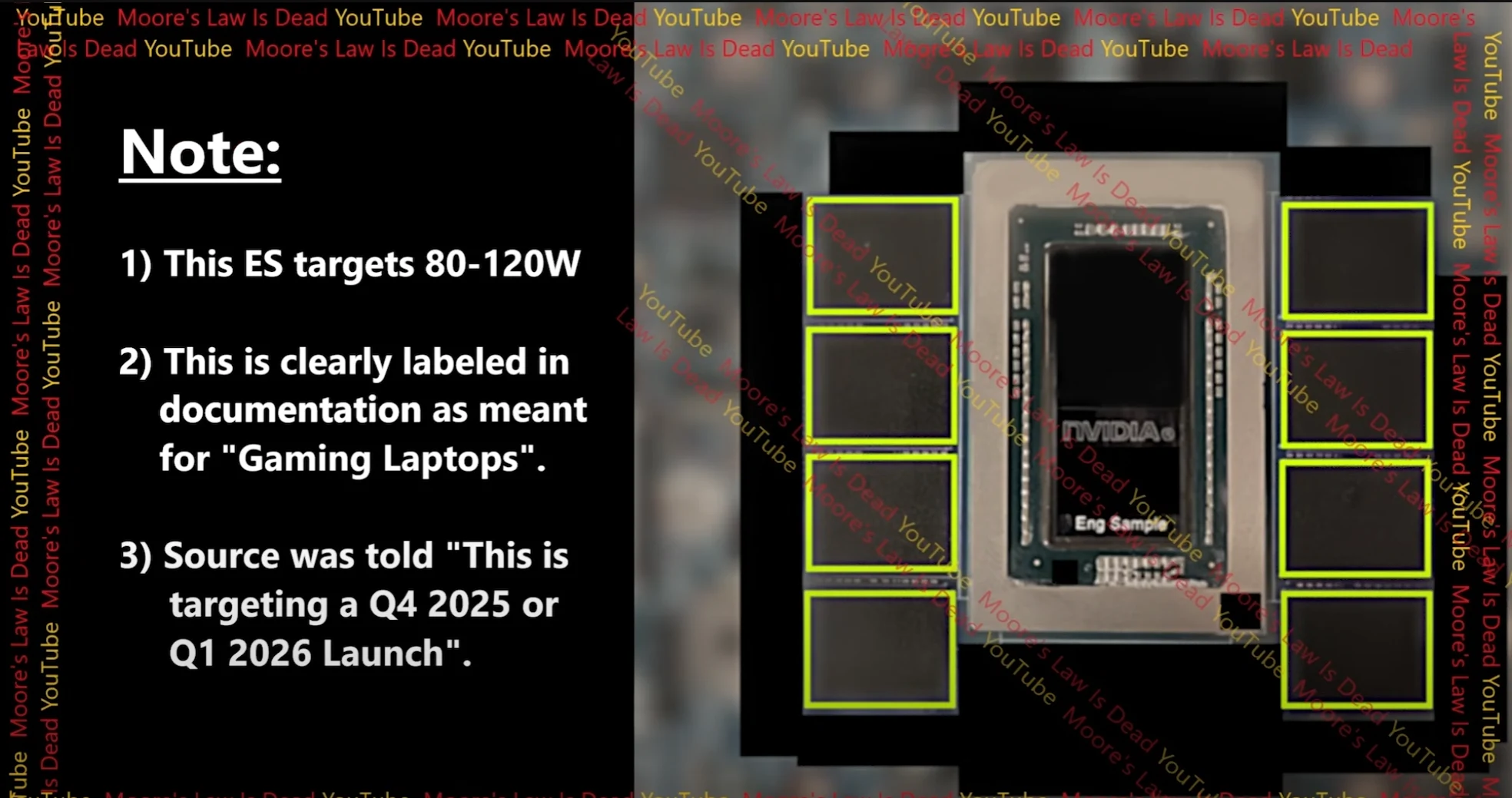
    Nvidia was anticipated to unveil its very first laptop CPU aimed at consumers during Computex. While we did see the Nvidia GB10-driven MSI MS-C931 and Lenovo ThinkStation PGX, these models are specifically designed for AI tasks rather than everyday activities. According to Moore’s Law is Dead, we now have a glimpse of Nvidia’s laptop APU, which appears to be quite robust.

    A Powerful Design

    An image shared shows an engineering prototype of Nvidia’s forthcoming silicon surrounded by what seems like eight memory modules. This suggests a design similar to Strix Halo, featuring a strong onboard iGPU capable of utilizing the ultra-fast LPDDR RAM. The sample has a thermal design power (TDP) ranging from 80 to 120 Watts, although this number might be updated later.

    Launch Timeline

    Tom’s source indicates that the enigmatic APU is set to launch between Q4 of 2025 and Q1 of 2026. Interestingly, this is designated for ‘gaming laptops’, and it will be intriguing to discover which GPU it incorporates. While Nvidia offers a broad range of laptop GPUs, these are typically meant for x86 systems. The new chip is likely an Arm device, and if earlier rumors hold true, the CPU component may have been crafted by MediaTek.

    Exciting Future Ahead

    Moore’s Law is Dead on YouTube has provided this exciting information, leaving many eager to see how Nvidia’s innovations will impact the gaming laptop market.

    Source:
    Link

  • RTX 5080 Super Leaks: Up to 25% TDP Increase Over RTX 5080

    RTX 5080 Super Leaks: Up to 25% TDP Increase Over RTX 5080

    Key Takeaways

    1. The RTX 5080 Super has increased VRAM and a higher TDP compared to the standard RTX 5080.
    2. The confirmed TDP for the RTX 5080 Super is 420 W, up from 360 W for the RTX 5080.
    3. Nvidia may raise the TDP to 450 W if necessary to improve performance without adding more CUDA cores.
    4. The performance boost of the RTX 5080 compared to the RTX 4080 is only about 20%, indicating limited enhancements in the RTX 50 series so far.
    5. The RTX 5080 Super is highly anticipated, potentially leading to more choices and favorable price changes in the GPU market.


    A few days ago, the well-known leaker Kopite7kimi shared information about the RTX 5080 Super, which we quickly reported on. The leaked details show that the RTX 5080 Super is mostly similar to the standard RTX 5080, but it has two main differences: increased VRAM and a higher power consumption. Recently, Moore’s Law Is Dead has disclosed that the TDP (Thermal Design Power) for the RTX 5080 Super is significantly higher.

    Increased TDP Details

    Moore’s Law Is Dead has confirmed the specifications shared by Kopite7kimi and stated that the RTX 5080 Super may have a TDP of 420 W or more. An AIB (Add-In Board) source reportedly informed MLID that Nvidia plans to release the RTX 5080 Super with this new power rating.

    The point about TDP is quite intriguing, as Kopite previously indicated that the RTX 5080 Super would require over 400 W, but did not specify an exact number. The TDP of 420 W mentioned by MLID is a notable rise compared to the RTX 5080, which has a TDP of 360 W.

    Possible Future Power Increases

    Moreover, the AIB source also mentioned that Nvidia has “warned” that the TDP for the RTX 5080 Super might be raised to 450 W “if they think it’s necessary.” Without an increase in CUDA cores, Nvidia’s main strategy to boost the performance of the RTX 5080 Super is to provide more power to the existing 10,752 CUDA cores, allowing them to operate at higher clock speeds. Thus, it makes sense that if 420 W doesn’t yield a significant performance improvement, they could push the limits to 450 W.

    So far, the RTX 50 series GPUs, with the exception of the RTX 5090, haven’t shown any remarkable performance enhancements over the RTX 40 series. For instance, the RTX 5080 only offers about a 20% performance boost compared to the RTX 4080. This suggests that Nvidia might be aiming to create a noticeable performance gap between the RTX 5080 and the RTX 5080 Super by implementing a higher TDP.

    Anticipation for the RTX 5080 Super

    Regardless of the final specifications, the RTX 5080 Super is highly anticipated, especially since new GPU launches in the current market tend to provide more choices, which can lead to favorable price changes.

    Source:
    Link


  • RTX 50 Series Laptop GPUs Boost TGP After Nvidia Fix

    RTX 50 Series Laptop GPUs Boost TGP After Nvidia Fix

    Key Takeaways

    1. RTX 50 series laptops initially struggled to reach their maximum total graphics power (TGP), leading to disappointing performance compared to earlier models.
    2. There were reports of missing ROPs in certain RTX 50 series laptop models, contributing to performance issues.
    3. Nvidia released a driver update (GeForce GRD 576.52) on May 19, which addressed the TGP limitations in the RTX 50 series.
    4. The driver update resulted in minor performance improvements, including an additional 10W and a 50 MHz boost in clock speed for the RTX 5080.
    5. Despite the performance gains from the driver update, Nvidia did not publicly emphasize the issue, opting to keep it low-profile.


    Soon after reviewers began testing the RTX 50 series laptops, it became clear that these GPUs were struggling to hit their maximum total graphics power (TGP). This led to disappointing performance, with earlier generation laptops outperforming the new RTX 50 series. Thankfully, Nvidia has quietly resolved this issue with a driver update released on May 19.

    Performance Problems on Arrival

    Despite the delayed launch and limited communication from Nvidia regarding the RTX 50 series laptops, there were significant performance issues upon their arrival. Reports indicated that certain models had missing ROPs, a problem that also affected some desktop GPUs. Furthermore, reviewers noted that the laptop GPUs failed to achieve their expected 175W TGP. Although TGP can vary among different GPUs, this seemed to be a common problem with the RTX 50 series, resulting in lackluster performance and further disappointment regarding the series’ launch.

    Driver Update Brings Improvements

    Fortunately, the GeForce GRD 576.52 driver, released on May 19, appears to have resolved these concerns. Within the general bugs section, one fix noted is “[Notebook] GeForce RTX 50 series TGP limit may be clipped earlier.” According to YouTuber GizmoSlipTech, this issue has indeed been addressed. In a brief video comparing performance in Witcher 3, the RTX 5080 laptop GPU managed to achieve an additional 10W and a 50 MHz boost in clock speed following the driver update.

    Minor Gains in Gaming Performance

    While the increase in FPS during gameplay wasn’t groundbreaking, it was encouraging to see that the GPU could reach, or at least come closer to, its full capabilities. Nvidia did not publicly highlight this update, seemingly preferring to keep the issue under wraps, which is not surprising given the circumstances.

    Source:
    Link