Tag: NVIDIA

  • Nvidia Hits $3.92T Valuation, Surpassing Microsoft and Apple

    Nvidia Hits $3.92T Valuation, Surpassing Microsoft and Apple

    Key Takeaways

    1. Nvidia’s market value is rising due to intense competition in the AI industry, with many companies seeking AI solutions.
    2. Nvidia focuses on supplying chips and AI models rather than direct consumer applications or chatbots.
    3. The company’s Nemotron-4 (340B) model is used for generating synthetic data to train large language models (LLMs).
    4. Nvidia recently became the most valuable publicly traded company with a market cap of $3.34 trillion, reflecting significant growth.
    5. BlackRock, the largest asset management firm, manages over $11.5 trillion in assets but has a market value of about $182.6 billion.


    The rise in Nvidia’s market value is driven by the ongoing competition in the AI industry, where numerous companies are striving for a piece of the AI pie. Nvidia is essentially arming all parties involved in this intense battle. While Nvidia has developed various AI models, it does not focus on direct consumer applications or creating chatbots for everyday tasks. One notable model from Nvidia, the Nemotron‑4 (340B), is utilized for producing synthetic data that aids in training LLMs.

    Competition and Cash Flow

    With tech giants racing to construct the most sophisticated AI data centers, develop state-of-the-art models, and seize control of the market, Nvidia is profiting immensely. The company provides the majority of chips necessary for these endeavors.

    Record-Breaking Valuation

    Only two weeks ago, Nvidia achieved the status of the most valuable publicly traded company, boasting a market cap of $3.34 trillion. This remarkable milestone signifies a ~17.4% increase from the $3.34 trillion valuation mentioned just two weeks prior.

    If the AI competition continues to escalate, Team Green is poised to maintain its profitable trajectory. An interesting read is “Automated Stock Trading Systems” (currently priced at $20.47 on Amazon), authored by Laurens Bensdorp, which aims to guide readers on trading in the stock market.

    Asset Management Insights

    An intriguing fact to note is that BlackRock, the largest asset management firm globally, oversees more than $11.5 trillion in assets, yet its market value is around $182.6 billion.

    Source:
    Link


  • AMD Raises CEO Lisa Su’s Pay to $33M, Still Less Than Nvidia’s

    AMD Raises CEO Lisa Su’s Pay to $33M, Still Less Than Nvidia’s

    Key Takeaways

    1. AMD has increased CEO Lisa Su’s compensation for the next fiscal year, with a total earnings estimate of $31 million, including a $33 million equity award.
    2. Su is the only AMD executive with a base salary over $1 million, currently set at $1.32 million, which is a slight increase from last year’s $1.26 million.
    3. All five executives at AMD will receive a base salary increase of 3% to 5% for the upcoming fiscal year, reflecting overall confidence in leadership.
    4. Su’s equity award consists of 75% performance-based restricted stock units (RSUs) and 25% time-based stock options, converting on August 15.
    5. Despite the increase, Su’s compensation remains lower than Nvidia CEO Jensen Huang’s, who received nearly $49.9 million for fiscal year 2025, emphasizing competitive differences in the semiconductor industry.


    Advanced Micro Devices (AMD) has decided to significantly increase the compensation for its Chief Executive Officer (CEO), Lisa Su, for the next fiscal year. On Wednesday, the semiconductor firm revealed that Su will be receiving an equity award valued at $33 million and her base salary will rise to $1.32 million, up from last year’s $1.26 million.

    Annual Compensation Details

    This announcement came as part of AMD’s yearly executive compensation report, which outlines the salary and incentive structures for its leadership team. The report states that Su’s total earnings for 2024 amounted to $31 million, which includes $21.7 million in stock awards and $6.2 million in other incentive-based awards.

    Su’s Unique Position

    Among the top executives at AMD, Su is the only one whose base salary surpasses $1 million. Her equity award is also the largest, highlighting her important role in leading AMD through a competitive semiconductor market. Chief Technology Officer Mark Papermaster follows, with a $10 million target-value equity award and a base salary of $870,000.

    All five executives listed in the filing will receive a base salary increase of 3% to 5% for the upcoming fiscal year. Su’s $33 million equity award is set to convert on August 15 into a mix of performance-based and time-based stock options: 75% will be performance-based restricted stock units (RSUs), with the remaining 25% as time-based stock options.

    Confidence in Leadership

    These changes in compensation reflect AMD’s trust in Su’s leadership as the firm continues investing in advanced chip designs while competing against major players like Intel and Nvidia.

    Nevertheless, Su’s new pay package is still significantly lower than that of her main industry competitor, Nvidia CEO Jensen Huang. For the fiscal year 2025, Nvidia reported that Huang’s total compensation reached nearly $49.9 million, an increase from $34.2 million the year before. Huang’s compensation includes a base salary of $1.5 million, a target cash bonus of $3 million, and an equity award that could be valued at up to $27.5 million, depending on performance. The increase in Huang’s pay package mirrors Nvidia’s impressive financial results in 2025, which saw revenues of $130.5 billion, an operating income of $86.8 billion, and a shareholder return of 384% over three years.

    Huang’s pay package underscores Nvidia’s leading role in the AI chip market and its position as one of the top tech companies worldwide.

    Source:
    Link

  • RTX 5070 Super Specs, Price, Release Date, and VRAM Details

    RTX 5070 Super Specs, Price, Release Date, and VRAM Details

    Key Takeaways

    1. RTX 5070 Super Specs: The RTX 5070 Super is expected to feature the GB205 GPU with around 6,400 CUDA cores, a 4.2% increase from the standard RTX 5070.

    2. Increased Power Consumption: The TDP of the RTX 5070 Super is raised to 275 W, up from 250 W for the standard model, possibly affecting performance.

    3. Memory Upgrade: The new GPU is anticipated to come with 18 GB of 28 Gbps GDDR7 memory, improving from the 12 GB in the RTX 5070.

    4. Release Timeline: The RTX 5070 Super is likely to launch in late 2025 or early 2026, coinciding with AMD’s competing models.

    5. Pricing Expectations: The RTX 5070 Super may see a $50 price increase compared to the RTX 5070, with similar increases for other Super series models. Pricing is still uncertain.


    It looks like Nvidia is working on a “Super” update for the RTX 50 series GPUs. The new lineup is likely to feature:

    RTX 5070 Super Insights

    We have some insider info about the RTX 5080 Super’s hardware specs, thanks to kopite7kimi. Now, the same leaker has shared details on the RTX 5070 Ti Super and the RTX 5070 Super. In this piece, we will focus on the RTX 5070 Super since we’ve already discussed the RTX 5070 Ti Super elsewhere.

    Reportedly, the RTX 5070 Super utilizes the same GB205 GPU as its non-Super counterpart but has a slightly increased CUDA core count and more VRAM. Supposedly, the GB205-400-A1 GPU in the RTX 5070 Super features around 6,400 CUDA cores, which is about a 4.2% rise.

    Power and Performance

    To accommodate the extra CUDA cores, Nvidia is said to have raised the RTX 5070 Super’s TDP to 275 W, compared to 250 W for the standard RTX 5070. It’s not clear yet if this 10% increase in TDP will lead to any significant boost in clock speeds.

    Moreover, the RTX 5070 Super is expected to come with 18 GB of 28 Gbps GDDR7 memory, which is a fantastic upgrade from the 12 GB of VRAM that was one of the main issues users had with the RTX 5070. However, the bus width is believed to stay the same at 192-bit.

    Pricing and Release Date Speculations

    In addition to what kopite7kimi has disclosed, RedGamingTech has given some insight on potential prices and release dates for the RTX 50 series refresh. The leaker suggests that the RTX 5070 Super, along with other Super series cards, might hit the market in late 2025 or early 2026. This timeline aligns with the anticipated release for AMD’s competing models.

    When it comes to pricing, RGT claims that “according to a pretty reliable source,” the pricing for the RTX 50 Super series is as follows:

    If these estimates are to be believed, the RTX 5070 Super would see a $50 increase compared to the RTX 5070, a $100 rise for the RTX 5070 Ti Super versus the RTX 5070 Ti, and a $150 jump for the RTX 5080 Super compared to the RTX 5080. The RTX 5060 Super is also projected to be $50 more than the RTX 5060.

    That being said, nailing down GPU prices before they launch is often difficult. So, it’s wise to take this pricing info for the RTX 50 Super with a hefty pinch of salt.

    Source:
    Link

  • Nvidia Ends Driver Support for GTX 700, 900, and 10 Series GPUs

    Nvidia Ends Driver Support for GTX 700, 900, and 10 Series GPUs

    Key Takeaways

    1. Release 580 will be the final Nvidia driver to support older GPU architectures: Maxwell, Pascal, and Volta.
    2. Affected product lines include GeForce GTX 700, GTX 900, GTX 10 series, and Titan V.
    3. The end-of-life (EOL) status for these GPUs will also apply to Windows, not just UNIX systems.
    4. Nvidia will continue to support the newer Turing-based GeForce GTX 16 series GPUs.
    5. After driver version 580, future updates, performance enhancements, and security fixes will no longer be available for the affected GPUs.


    Nvidia has announced that its upcoming major driver release, known as Release 580, will be the final version to support older GPU architectures like Maxwell, Pascal, and Volta. This decision effectively ends the long run of well-known product lines, including the GeForce GTX 700, GTX 900, GTX 10 series, and Titan V. The current driver version is 576.80, suggesting that the transition could happen in the next few months.

    Deprecation Schedule

    As per a revised UNIX graphics driver deprecation schedule, Nvidia has stated:

    The Release 580 series will be the last to support GPUs based on the Maxwell, Pascal, and Volta architectures.

    Even though the update is specifically aimed at UNIX systems, Nvidia’s driver structure is mostly consistent across different platforms. This means that the end-of-life (EOL) status will also apply to Windows. Therefore, future Game Ready drivers will not be available for these older GPUs once the 580 series is rolled out.

    Affected Products

    The products impacted include:

    However, Nvidia will keep supporting the more recent Turing-based GeForce GTX 16 series GPUs, which are not affected by this update.

    The Maxwell, Pascal, and Volta architectures have powered Nvidia GPUs for a period of eight to eleven years, which is quite a long time in the rapidly evolving GPU market. While this news might disappoint users of older systems, the company has arguably provided support that goes beyond the usual hardware lifecycle.

    Future Considerations

    Users with GPUs that are impacted can continue using their current drivers, but future Game Ready driver updates, performance enhancements, and security fixes will stop after the release of driver version 580. Nvidia has yet to announce a specific launch date for this update, allowing users some time to consider potential upgrades.

    Source:
    Link

  • RTX 5070 Ti Super Leaks: Increased VRAM Details Revealed

    RTX 5070 Ti Super Leaks: Increased VRAM Details Revealed

    Key Takeaways

    1. The RTX 5070 Ti Super is an upgraded version of the RTX 5070 Ti, acting as a bridge to the rumored RTX 5080 Super.
    2. It features 8,960 CUDA cores, the same as the RTX 5070 Ti, but comes with 24 GB of 28 Gbps GDDR7 VRAM, a 50% increase in capacity.
    3. The anticipated TDP for the RTX 5070 Ti Super is around 350 Watts.
    4. The additional VRAM is expected to enhance performance at 4K resolutions compared to the non-Super versions.
    5. The release date for the RTX 50 Super refresh is uncertain, with suggestions pointing to CES 2026, prompting potential buyers to wait due to upcoming AMD RDNA 4 variants.


    Information about a new Nvidia GPU has surfaced online, thanks to the well-known leaker @Kopite7Kimi. This time, we are looking at the RTX 5070 Ti Super. As suggested by its name, it serves as an upgraded version of the RTX 5070 Ti that was released earlier this year. In terms of specifications, it acts as a bridge between the RTX 5070 Ti and the rumored RTX 5080 Super.

    Specifications and Features

    The RTX 5070 Ti Super (PG147-SKU55) is powered by a GB203-350-A1 GPU featuring 8,960 CUDA cores, which is identical to its predecessor, the regular RTX 5070 Ti. Nevertheless, it is expected to launch with 24 GB of 28 Gbps GDDR7 VRAM, a significant capacity boost of 50%. Additionally, the TDP for the RTX 5070 Ti Super is anticipated to be around 350 Watts.

    Performance Expectations

    Initially, the RTX 5070 Ti Super and RTX 5080 Super will maintain the same position in Nvidia’s lineup as their non-Super versions. However, the additional VRAM is likely to provide a noticeable jump in performance at 4K resolutions, leading some to argue that the non-Super models should have launched with this amount of VRAM from the beginning.

    Release Timeline and Market Considerations

    The exact date for Nvidia’s announcement of the RTX 50 Super refresh remains uncertain. However, Benchlife (via Videocardz) suggests that it might not be released until CES 2026. Regardless, anyone looking to buy a new GPU may want to wait a little longer, as AMD is also planning to introduce ‘stronger’ RDNA 4 variants in the near future.

    Source:
    Link

  • DeepSeek Accused of Evading U.S. Export Controls on Nvidia Chips

    DeepSeek Accused of Evading U.S. Export Controls on Nvidia Chips

    Key Takeaways

    1. DeepSeek’s Military Ties: The U.S. State Department accuses DeepSeek of knowingly assisting China’s military and intelligence operations through various defense projects.

    2. Export Control Evasion: DeepSeek allegedly attempted to circumvent U.S. export regulations to acquire Nvidia H100 chips using shell companies and foreign data centers.

    3. Data Sharing Concerns: DeepSeek is claimed to be supplying user data and analytics to Chinese state-controlled surveillance systems under local laws.

    4. Discrepancies in Chip Acquisition: While DeepSeek is believed to have some Nvidia H100 chips, it reportedly owns far fewer than previously suggested, with Nvidia asserting compliance with export regulations.

    5. Skepticism Over Performance Claims: Independent analysts question DeepSeek’s claims of matching U.S. technology, raising doubts about its rapid growth reliant on U.S. tech and resources.


    A senior official from the U.S. State Department has stated that the AI company DeepSeek is “knowingly” aiding China’s military and intelligence operations while attempting to evade American export regulations to obtain the latest Nvidia H100 accelerators. This assessment, initially revealed by Reuters, represents a significant public condemnation from Washington towards the Hangzhou-based startup.

    DeepSeek’s Involvement with the PLA

    Records from procurement indicate that DeepSeek has engaged in over 150 projects for the People’s Liberation Army and various defense-related organizations. Under Chinese law, companies are required to provide data when requested by authorities. However, the official claims that DeepSeek is actively delivering user data and usage analytics to state-controlled surveillance systems.

    Alleged Attempts to Bypass Export Controls

    The same source claims that DeepSeek attempted to acquire H100 chips through shell companies located in Southeast Asia and sought to utilize foreign data centers to gain remote access to U.S. hardware—actions aimed at circumventing restrictions set in 2022. Three sources in the industry informed Reuters that while the startup does possess some H100 chips, it is likely to have far fewer than the 50,000 units speculated earlier this year. Nvidia disputes this claim, asserting that internal investigations reveal DeepSeek acquired only the export-compliant H800 model.

    Skepticism Surrounding DeepSeek’s Claims

    DeepSeek gained attention in January when it announced that its DeepSeek-V3 and DeepSeek-R1 models either matched or surpassed leading U.S. technologies “at a much lower price.” However, independent analysts contest this assertion, suggesting the actual training costs probably exceeded $5.6 million. Washington’s recent concerns contribute to growing doubts about the company’s rapid growth, which appears to significantly rely on U.S. technology and resources.

    DeepSeek has not responded to inquiries regarding its privacy policies, chip purchases, or alleged military collaborations. Nvidia has stated it does not endorse any parties that violate export regulations and emphasizes that current controls have effectively barred it from the Chinese data center market. Meanwhile, Malaysia’s trade ministry is investigating whether an unnamed Chinese company is using Nvidia-powered servers in the country for training large language models, highlighting regional caution against similar circumventions.

    Source:
    Link

  • RTX 5050 Laptop GPU Launches with GDDR7 VRAM and Wider Bus

    RTX 5050 Laptop GPU Launches with GDDR7 VRAM and Wider Bus

    Key Takeaways

    1. The RTX 5050 laptop GPU has the same number of CUDA cores as the RTX 4050 but features 2 GB more VRAM and a 33.33% wider memory bus.
    2. The GPU maintains the same thermal design power (TDP) of 115 W as the RTX 4050.
    3. Performance benchmarks show the RTX 5050 is around 18% slower than the RTX 5060 and 33% slower than the RTX 5070.
    4. The RTX 5050 could compete with the RTX 4060 laptop despite the latter having 20% more CUDA cores.
    5. Laptops with the RTX 5050 will launch in China at prices just under $800, with US pricing possibly under $1,000 for budget models.


    After a long period of rumors, the RTX 5050 laptop GPU has been officially announced. This new GPU has the same number of CUDA cores as the RTX 4050 laptop but brings added benefits including more VRAM, quicker memory, and a wider memory bus. Interestingly, the RTX 5050 laptop GPU maintains the same thermal design power (TDP) as its predecessor, the RTX 4050.

    Specifications Overview

    When you compare it to the RTX 4050 laptop, the RTX 5050 laptop GPU boasts an additional 2 GB of VRAM and a memory bus that is 33.33% wider. Although the exact speed of the GDDR7 VRAM in the RTX 5050 is still unclear, it’s likely to match the 28 Gbps found in the RTX 5060 (which is available on Amazon).

    Performance Insights

    Nvidia provided official stats (shared by VideoCardz), showing that the RTX 5050 laptop GPU, which operates within a 115 W power budget, achieves scores around the following:

    According to Port Royal benchmarks, the RTX 5050 laptop GPU is said to be about 18% slower than the RTX 5060 and 33% slower than the RTX 5070, both running at the same 115 W power level.

    Pricing Expectations

    This means the RTX 5050 could potentially rival the performance of the RTX 4060 laptop, despite the latter having 20% more CUDA cores.

    In addition, VideoCardz has indicated that laptops equipped with the RTX 5050 GPUs will launch in China, priced at just under $800 excluding VAT. While the pricing for RTX 5050 gaming laptops in the US is still unknown, there is a chance that they could be available for under $1,000 for budget gaming models. However, higher-tier options featuring better displays and faster processors are likely to exceed $1,000, especially during the initial months after their release.

    Source:
    Link


  • RTX 5050 Desktop GPU Revealed: 8 GB GDDR6 VRAM Specs

    RTX 5050 Desktop GPU Revealed: 8 GB GDDR6 VRAM Specs

    Key Takeaways

    1. The Nvidia GeForce RTX 5050 features 2,506 CUDA cores and 8 GB of GDDR6 VRAM on a 128-bit bus.
    2. It has a base clock of 2.31 GHz, a boost clock of 2.57 GHz, and a total graphics power of 130 Watts, with a recommended PSU of 550 Watts.
    3. Benchmark results show the RTX 5050 outperforms the two-generation-old RTX 3050, but underperforms compared to the RTX 4060.
    4. Performance improvements are mainly due to DLSS and frame generation technology rather than raw performance gains.
    5. The RTX 5050 launches at a starting price of $249, only $50 less than the RTX 5060, with no Founder’s Edition available.


    Nvidia has quietly revealed its latest budget graphics card after some time: the GeForce RTX 5050. We previously saw its laptop version, and now we are finally getting a glimpse of the desktop model. Its launch wasn’t exactly a surprise, as various leaks had already spilled the beans well before the official announcement.

    Specs and Performance

    The RTX 5050 desktop features a modest 2,506 CUDA cores. While Nvidia’s official specifications don’t disclose the exact GPU model, it’s probably a GB206 or GB207. In a twist from earlier rumors, it comes equipped with 8 GB of GDDR6 (not GDDR7 as some had speculated) VRAM on a 128-bit bus, resulting in a total memory bandwidth of 320 GB/s. Additional specs for the RTX 5050 include a base clock of 2.31 GHz and a boost clock of 2.57 GHz, with a total graphics power (TGP) of 130 Watts. Nvidia suggests using a 550 Watt PSU, but a 450 Watt unit should suffice for this card.

    Benchmark Results

    Nvidia has also shared some benchmark results that demonstrate how the GPU performs compared to the two-generation-old RTX 3050. As expected, the Blackwell GPU shows an advantage due to its newer architecture and superior TSMC N4P manufacturing process, especially when compared to the Samsung N8 used for the RX 3050.

    Interestingly, Nvidia’s own graphs indicate that the RTX 5050 underperforms compared to the previous RTX 4060 in terms of raw performance. Most of its improvements are attributed to DLSS and frame generation technology. To make matters worse, the RTX 5050 will be launched at a starting price of $249, which is only $50 less than the RTX 5060. It’s also unlikely to see a Founder’s Edition, meaning buyers will have to settle for AIB variants that will probably cost more.

    Source:
    Link


  • Deepseek Supports China’s Military Operations, Says US Official

    Deepseek Supports China’s Military Operations, Says US Official

    Key Takeaways

    1. DeepSeek’s Initial Claims: DeepSeek claimed its tools were equal or superior to American competitors upon its debut in January 2025.

    2. Allegations of Military Support: A State Department official revealed that DeepSeek allegedly provides aid to China’s military and intelligence efforts, beyond just open-source access.

    3. Data Sharing Issues: Concerns have arisen about DeepSeek sharing user data with China’s surveillance system amid ongoing U.S.-China trade tensions.

    4. Links to Chinese Military: DeepSeek is reportedly linked to the Chinese People’s Liberation Army and has been accused of using tactics to bypass U.S. export controls for advanced chips.

    5. Nvidia Access and Investigations: DeepSeek has significant access to Nvidia’s information, raising concerns about potential remote access to U.S. chips by China, prompting further investigations.


    When DeepSeek made its debut in January 2025, it created quite a stir by asserting that its tools were on par with or even better than those of its American rivals. However, the company is now facing a significant scandal after a senior official from the State Department revealed shocking information to Reuters.

    Serious Allegations Unfold

    In a confidential interview, the official stated, “We are aware that DeepSeek has willingly provided and will probably continue to provide aid to China’s military and intelligence efforts.” This official, who requested to remain unnamed, elaborated, “This action goes far beyond mere open-source access to DeepSeek’s AI models.”

    Data Sharing Concerns

    Amid the ongoing trade tensions between the U.S. and China, the official claimed that DeepSeek has shared user data and analytics through the surveillance system employed by Beijing. Moreover, since companies like Amazon, Alphabet, and Microsoft offer DeepSeek’s services to their clients, there are serious worries regarding potential data breaches.

    Infrastructure and Military Links

    U.S. lawmakers have pointed out that DeepSeek sends American data to China via backend systems linked to China Mobile, a state-owned telecom giant. Additionally, the company appears in procurement documents over 150 times related to the Chinese People’s Liberation Army and other defense-related organizations in China. The official alleged that DeepSeek has employed various tactics to bypass export controls to obtain advanced chips made in the U.S.

    Nvidia Data Access

    It’s important to recognize that DeepSeek has considerable access to Nvidia’s information. Nonetheless, due to the current restrictions, there are suspicions that China might have remote access to U.S. chips. Furthermore, U.S. officials have yet to blacklist DeepSeek and have not asserted that Nvidia was aware of any collaboration between DeepSeek and the Chinese military. As a result, additional investigations are set to occur in the upcoming days, potentially leading to new findings.

    Source:
    Link

  • Nvidia RTX 5090 Price Drops Below 2000 EUR in Europe

    Nvidia RTX 5090 Price Drops Below 2000 EUR in Europe

    Key Takeaways

    1. The RTX 5090 GPU has recently been sold in the EU for under 2000 Euros, marking a significant price shift from its historical premium pricing.
    2. The pricing for the RTX 5090 at Mindfactory.de has quickly risen back to between €2500 and €3200, indicating fluctuating market conditions.
    3. Improved supply of the RTX 5090 has contributed to lower prices in regions like Germany and the UK, with some models returning to MSRP levels.
    4. US retailers continue to face higher prices and limited availability, complicating the purchasing situation for consumers compared to European prices.
    5. The dip in pricing below MSRP in the EU suggests a potential future normalization of both pricing and supply for the RTX 5090.


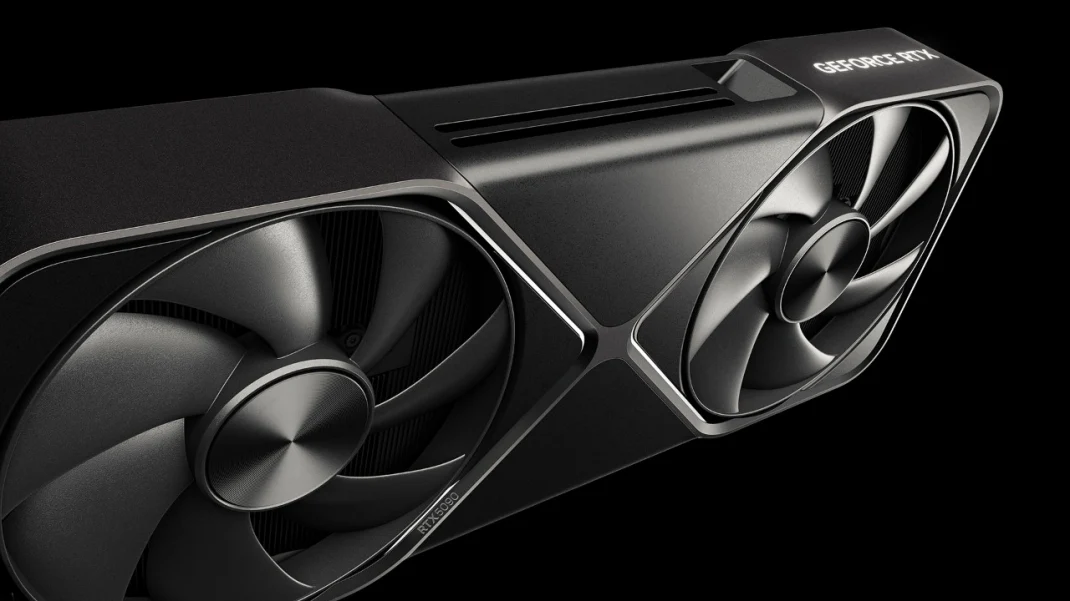
    While Nvidia’s RTX 5090 GPU has historically been sold at a high premium compared to its MSRP since it was launched, current market trends suggest it could be approaching, or even going below, that price point for certain models.

    Record-Breaking Sale

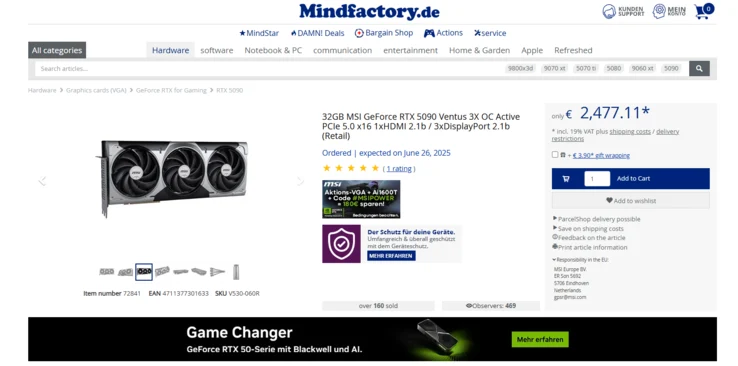
    A German computer hardware store, Mindfactory.de, has seemingly made headlines by being the first in the EU to sell the RTX 5090 for under 2000 Euros, specifically at €1999.99, according to a tracking tool by ComputerBase.

    However, the pricing has already shifted, now climbing to a price under €2500 at the retailer. This makes the GPU much more expensive than initially expected for users eager to buy one.

    Improved Supply Situation

    On the positive side, the supply of the RTX 5090 has gotten better lately, which has helped prices to trend downwards across various regions, including Germany, where Mindfactory is located.

    In the UK, prices have dropped to MSRP levels for several third-party models, and some higher-end versions are reportedly seeing better availability these days.

    Current Pricing Overview

    At the time of writing, Mindfactory lists the RTX 5090 ranging from €2500 to €3200, with 12 different models available for consumers, including the popular MSI Suprim series and the more budget-friendly Palit GameRock, which is currently priced below €2600.

    Both the UK and EEA (European Economic Area) pricing are significantly lower than most RTX 5090 listings in the US, where retailers like Amazon and Newegg, along with eBay, have faced scalping, price hikes due to tariffs, and limited availability, creating a challenging situation for enthusiasts seeking a unit close to the suggested MSRP of $2000.

    Implications of Pricing Changes

    Nevertheless, this price change is noteworthy, as it’s the first time the GPU has dipped below its stated MSRP in the EU and possibly worldwide, hinting at a future normalization of both pricing and supply.

    Additionally, it’s worth mentioning that users in China currently can’t access the RTX 5090 GPU, as they are offered a China-specific RTX 5090D, and a newer RTX 5090DD is anticipated soon. This has led to a somewhat underground market for the RTX 5090 GPU, given its strong performance in AI tasks worldwide.

    Source:
    Link