
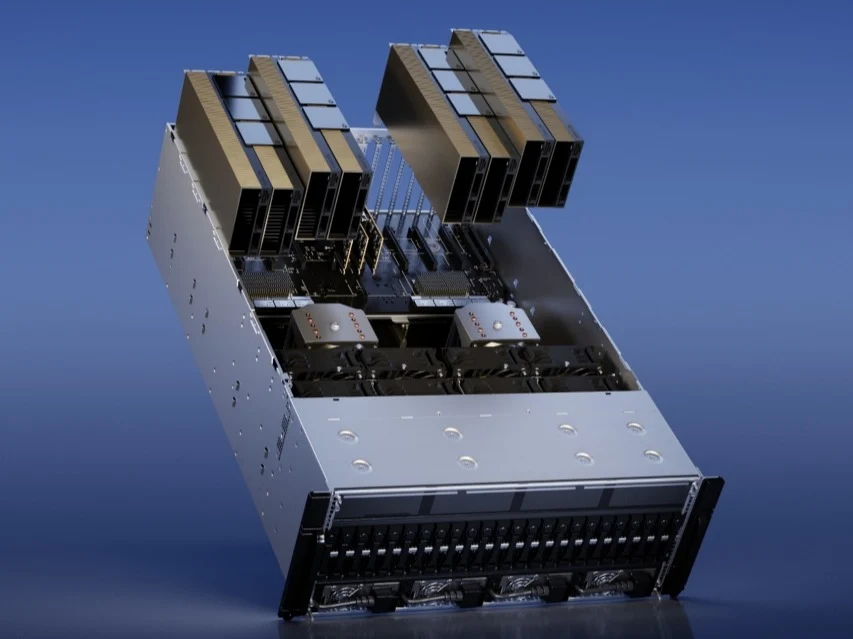
Tag: H100

  • Nvidia H100 H200 GPU Supply Strong Despite Shortage Claims

    Nvidia H100 H200 GPU Supply Strong Despite Shortage Claims

    Key Takeaways

    1. Nvidia denies rumors of shortages for H100 and H200 GPUs, stating that they can fulfill new orders without delays.
    2. Confusion arose from Nvidia’s earnings call, leading some to believe the H100 and H200 GPUs were sold out, which Nvidia refutes.
    3. The rise in demand for the H20 GPU does not impact the production of H100 or H200 units, according to Nvidia.
    4. Nvidia has achieved record revenue of $41.096 billion in its AI sector and assures customers they can meet demand.
    5. Future high-end AI GPUs are planned for annual updates, with new models expected in 2026, 2027, and 2028, and potential manufacturing in Taiwan.


    Nvidia has recently rejected claims about shortages of H100 and H200 GPUs, which were said to prioritize H20 GPU orders, calling them “incorrect rumors.” The company asserts that cloud partners can operate all H100 and H200 units online, and they can still process new orders without any delays. This statement comes as a response to ongoing market speculation regarding a limited supply.

    Earnings Call Confusion

    Previously, comments made during Nvidia’s latest earnings call led to beliefs that the H100 and H200 GPUs were “sold out.” Some interpreted this as a sign of scarcity, but this view contradicts Nvidia’s recent assurance of ample supply, likely due to a lack of context in the earlier communications.

    H20 Demand and Production

    The H20 GPU, designed with U.S. export regulations in mind, experienced a surge in demand after Washington allowed Nvidia to resume selling it. Nonetheless, the company insists that the rise in H20 demand does not affect the production of H100 or H200 units.

    Claims about backdoors and a “kill switch” from Beijing have been denied by Nvidia and remain unsubstantiated. There are whispers of a new GPU specifically for China, codenamed B30A, but no specific information is available at this time.

    Strong Revenue and Future Plans

    Nvidia’s AI sector has achieved a record revenue of $41.096 billion, indicating strong demand. Despite this, the company maintains that it can satisfy buyer needs and encourages customers to reach out directly. Plans are in place for annual updates on upcoming high-end AI GPUs, with Rubin expected in 2026, Rubin Ultra in 2027, and Feynman in 2028. There are intentions to manufacture the new Rubin chips in Taiwan, although these details have yet to be confirmed.

    Source:
    Link


  • DeepSeek Accused of Evading U.S. Export Controls on Nvidia Chips

    DeepSeek Accused of Evading U.S. Export Controls on Nvidia Chips

    Key Takeaways

    1. DeepSeek’s Military Ties: The U.S. State Department accuses DeepSeek of knowingly assisting China’s military and intelligence operations through various defense projects.

    2. Export Control Evasion: DeepSeek allegedly attempted to circumvent U.S. export regulations to acquire Nvidia H100 chips using shell companies and foreign data centers.

    3. Data Sharing Concerns: DeepSeek is claimed to be supplying user data and analytics to Chinese state-controlled surveillance systems under local laws.

    4. Discrepancies in Chip Acquisition: While DeepSeek is believed to have some Nvidia H100 chips, it reportedly owns far fewer than previously suggested, with Nvidia asserting compliance with export regulations.

    5. Skepticism Over Performance Claims: Independent analysts question DeepSeek’s claims of matching U.S. technology, raising doubts about its rapid growth reliant on U.S. tech and resources.


    A senior official from the U.S. State Department has stated that the AI company DeepSeek is “knowingly” aiding China’s military and intelligence operations while attempting to evade American export regulations to obtain the latest Nvidia H100 accelerators. This assessment, initially revealed by Reuters, represents a significant public condemnation from Washington towards the Hangzhou-based startup.

    DeepSeek’s Involvement with the PLA

    Records from procurement indicate that DeepSeek has engaged in over 150 projects for the People’s Liberation Army and various defense-related organizations. Under Chinese law, companies are required to provide data when requested by authorities. However, the official claims that DeepSeek is actively delivering user data and usage analytics to state-controlled surveillance systems.

    Alleged Attempts to Bypass Export Controls

    The same source claims that DeepSeek attempted to acquire H100 chips through shell companies located in Southeast Asia and sought to utilize foreign data centers to gain remote access to U.S. hardware—actions aimed at circumventing restrictions set in 2022. Three sources in the industry informed Reuters that while the startup does possess some H100 chips, it is likely to have far fewer than the 50,000 units speculated earlier this year. Nvidia disputes this claim, asserting that internal investigations reveal DeepSeek acquired only the export-compliant H800 model.

    Skepticism Surrounding DeepSeek’s Claims

    DeepSeek gained attention in January when it announced that its DeepSeek-V3 and DeepSeek-R1 models either matched or surpassed leading U.S. technologies “at a much lower price.” However, independent analysts contest this assertion, suggesting the actual training costs probably exceeded $5.6 million. Washington’s recent concerns contribute to growing doubts about the company’s rapid growth, which appears to significantly rely on U.S. technology and resources.

    DeepSeek has not responded to inquiries regarding its privacy policies, chip purchases, or alleged military collaborations. Nvidia has stated it does not endorse any parties that violate export regulations and emphasizes that current controls have effectively barred it from the Chinese data center market. Meanwhile, Malaysia’s trade ministry is investigating whether an unnamed Chinese company is using Nvidia-powered servers in the country for training large language models, highlighting regional caution against similar circumventions.

    Source:
    Link