

Key Takeaways
1. The Nvidia GeForce RTX 5050 laptop GPU has fewer CUDA cores (2,560) than the RTX 5060.
2. It may have a maximum TGP of 100 Watts and could debut with either GDDR7 or GDDR6 memory.
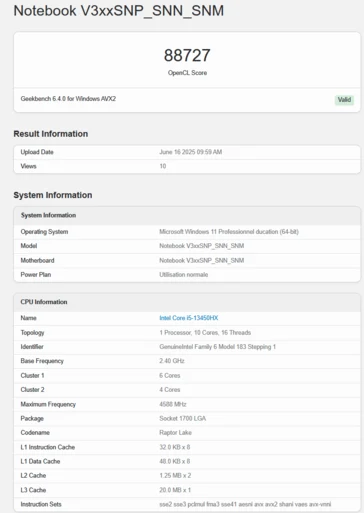
3. The GPU scores 88,727 in Geekbench’s OpenCL benchmark, an 11% improvement over the RTX 4050.
4. The RTX 5050 has a boost clock of 2.5 GHz, similar to the RTX 4050.
5. Performance gains will likely come from AI features like DLSS and Multi Frame Generation rather than hardware improvements.
A recent listing on Geekbench has uncovered the specifications for Nvidia’s forthcoming GeForce RTX 5050 laptop GPU. As anticipated, it will have a lower number of CUDA cores compared to the RTX 5060. If the information from Acer is correct, this GPU may feature a maximum TGP of 100 Watts. One source suggests it will debut with GDDR7 memory, while another claims it could stick to GDDR6 like its desktop variant.
Performance Benchmarks
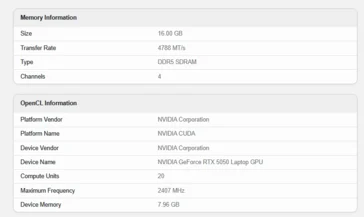
The RTX 5050 laptop GPU achieves a score of 88,727 in Geekbench’s OpenCL benchmark. This marks an 11% performance boost over the RTX 4050, which scored 79,601. Naturally, these results might differ based on the power consumption of the RTX 5050. Regarding its specifications, Geekbench verifies that it has 8 GB of dedicated VRAM. Additionally, the RTX 5050 sample examined here contains 20 SMs or 2,560 CUDA cores, which is roughly 500 fewer than the RTX 5060.
Clock Speed and Comparisons
With a boost clock of 2.5 GHz, it’s worth noting that this CUDA core count matches that of the RTX 4050, as does the boost clock itself. In summary, the RTX 5050 is not expected to provide a significant increase in raw performance purely from its hardware. Its potential GDDR7 memory might offer some advantage, but the primary gains in computational power will likely stem from AI-enhanced features such as DLSS and Multi Frame Generation.
Source:
Link
Leave a Reply