Tag: James Webb Space Telescope

  • Astronomers discover most distant dormant black hole

    Astronomers discover most distant dormant black hole

    Key Takeaway

    – Most distant dormant black hole discovered, located 10 billion light-years away in galaxy MRG-M0138.
    – Mass estimated at 6 billion times the Sun’s mass by studying star speeds via gravitational lensing.
    – Black hole is inactive with no accretion or quasar detection.
    – Discovery made using James Webb Space Telescope data and gravitational lensing from an intervening galaxy.
    – This finding will help astronomers better understand black hole behavior and evolution, and may lead to detecting more similar objects.


    Astonish Discovery Indeed

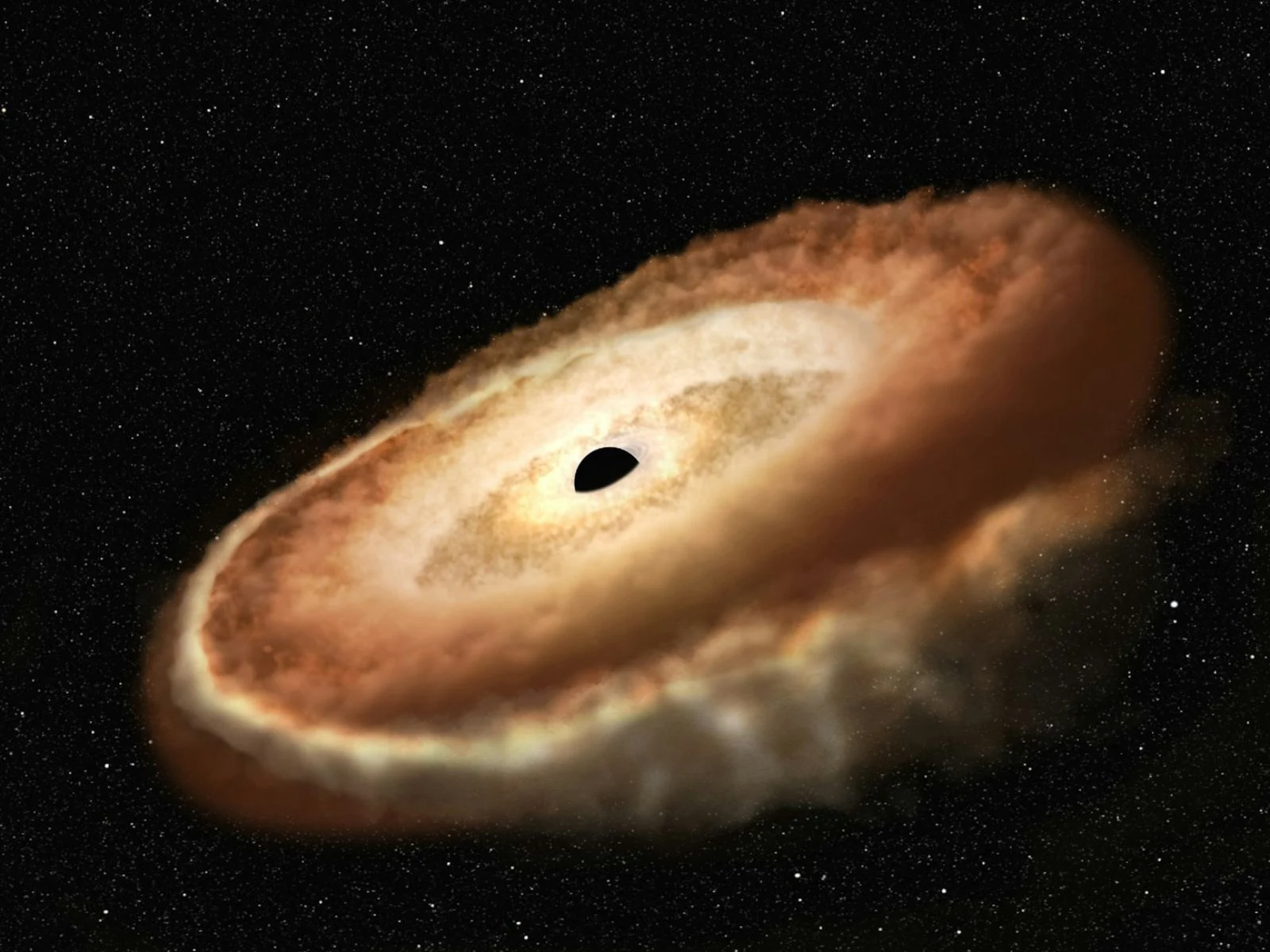
    Astronomers have now detect and estimated the mass of the farthest dormant black hole ever discovered. This dark hole, whitch is practically invisible, resides in the galaxy MRG-M0138, located about 10 billion light-years away from us. The team used data from NASA’s James Webb Space Telescope to obtain these results.

    How it was found

    This black hole is inactive and doesnt accrete surrounding matter at all. According to the researchers, no quasar has been detected either. So, to locate it, they utilized a fenomenon called gravitational lensing caused by another galaxy positioned between MRG-M0138 and Earth. This method alowed them to see the movements of stars located near this black hole.

    By studing the speed of these stars, the researchers were able to estimate its mass at around 6 billion times that of the Sun. But thats not all, because thanks to this discovery and the James Webb Space Telescope, astronomers can now better understand these black holes.

    Further implications

    Indeed, their behavior and evolution remain largely unknown mysteries. It might also be posible to detect other similar objects in the universe, which would help astronomers answer questions that have gone unanswered for a long time. This research opens new pathways for understanding cosmic structures.
    Sources

  • 50 Billion Solar Mass Black Hole: One of the Largest Ever Found

    50 Billion Solar Mass Black Hole: One of the Largest Ever Found

    Key Takeaway

    – A402-BCG, a galaxy about 4.4 billion light-years away in the Abell 402 cluster, hosts an ultramassive black hole estimated at ~50 billion solar masses.
    – JWST and Hubble observations reveal a bright central source with a kiloparsec-wide dark region nearby, signaling the black hole’s presence.
    – At ~50 billion solar masses, it ranks among the most massive black holes known, about 25× the mass of all stars in the Large Magellanic Cloud; the Milky Way is 100–400 billion solar masses for scale.
    – A large cavity in the galaxy suggests the possible existence of a second supermassive black hole at its center.

    Black holes are among the most puzzling cosmic objects, known for extreme gravity and strange behaviors. A team led by Michael McDonald at the Massachusetts Institute of Technology has announced the discovery of a black hole tucked away in a galaxy, a finding that challenges ideas about how objects grow.

    Discovery in a distant galaxy

    Named A402-BCG, the galaxy sits 4.4 billion light-years from Earth and belongs to the Abell 402 cluster. In discussing the outcome, researchers point to two features: a bright, pointlike glow at the core and a wide, kiloparsec-scale dark region lying to its east, hinting at powerful processes within the cluster.

    Central features and interpretation

    Team used the James Webb Space Telescope and the Hubble Space Telescope to study the light from its center, concluding that the glow signals an ultramassive black hole. Its mass is estimated at about 50 billion solar masses, a value that places it among the most massive known black holes.

    Observational evidence

    This finding matters because it ranks among the largest black holes. It is about 25 times bigger than all the stars in the Large Magellanic Cloud, located 158,000 light-years away, while the Milky Way weighs in at about 100 to 400 billion solar masses, illustrating the power of such objects.

    Scale and significance

    Observers also note a large cavity in the host galaxy that hints at a second supermassive black hole at its center, a possibility that remains speculative until more data comes in. The discovery continues to spark discussion about how multiple gargantuan holes might shape their galaxies over cosmic time together.


    Sources

  • Uranus’ Outer Rings Have Different Origins Explained

    Uranus’ Outer Rings Have Different Origins Explained

    Key Takeaway

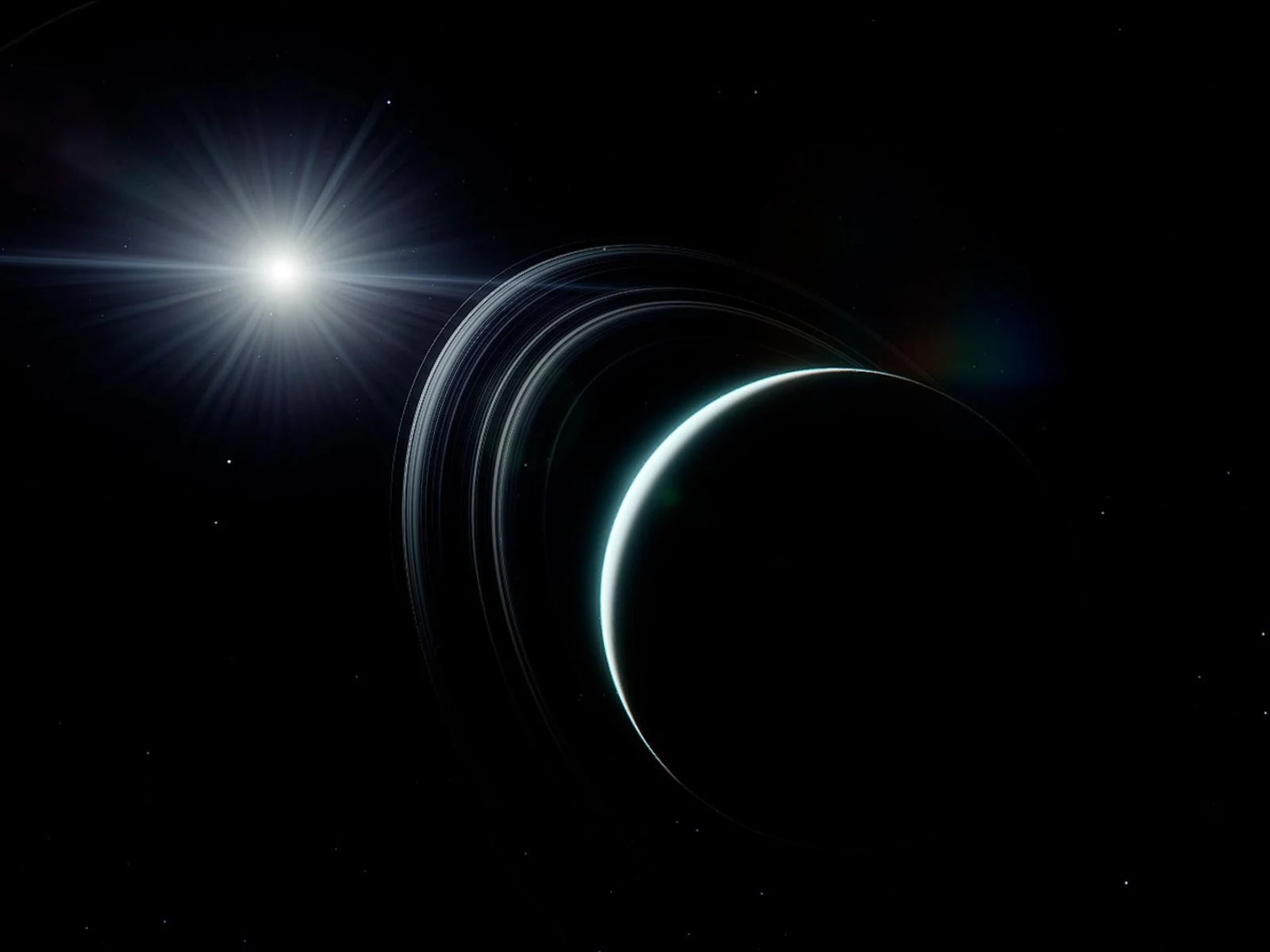
    1. The μ and ν rings around Uranus have different origins and compositions, with μ being mainly water ice from moon Mab and ν composed of rocky, organic-rich material from micrometeorite impacts.
    2. The discovery of these rings’ compositions was facilitated by observations from the James Webb Space Telescope and the Hubble Space Telescope.
    3. Despite long-term observations, Uranus remains largely mysterious, with ongoing research needed to uncover more about its rings and overall planetary environment.

    Uranus and Its Enigmatic Rings

    Uranus has been the object of interest for scientists for long time and was identified as a planet back in 1781. Yet, it still keeps a lot of secrets, especially regarding its rings first found out in 1977. Recent studies suggests that these outliers around Uranus may actually came from different origins.

    The Colors and Composition of the Rings

    Two of the rings, named μ and ν, appear distinctly blue and red respectively. This variation in color seems to be linked to what they’re mainly made of. Researchers from the University of California, Berkeley, reveal that the μ ring is mostly water ice, whereas the ν ring contains rock with approximately 10 to 15 percent carbon content. This difference in materials is quite intriguing for astronomers who are trying to understand the planet’s environment.

    Sources of the Rings’ Material

    Using data from powerful telescopes like the James Webb and Hubble Space Telescopes, scientists discovered that the tiny moon Mab, which is only about 12 km across, is likely the origin of the μ ring. This finding is very important because it confirms that Mab consists largely of water ice. On the other hand, the ν ring’s material gets a different story. Imke de Pater, a professor at the University of California, explains:

    Different Origins for Different Rings

    “The ν ring material is mostly from impacts of micrometeoroids and collisions involving rocky bodies rich in organic substances, which likely orbit between some satellites that we already know of. What’s puzzling for scientists is why these sources are so different from each other in their composition.”

    Remaining Mysteries and Future Explorations

    While these recent discoveries gradually unveil Uranus’s secrets, many questions still remain unanswered. The planet itself is still a largely uncharted territory. Continued research and observations could bring to light more about its nature, its rings, and the many celestial bodies that surround it.

    References and Image Credits

    • W. M. Keck Observatory
    • Journal of Geophysical Research: Planets
    • Image source: NASA, ESA, Image processing: Imke de Pater, Matt Hedman


    Sources

  • Supermassive Black Hole Located in an Unusual Galaxy Region

    Supermassive Black Hole Located in an Unusual Galaxy Region

    Key Takeaway

    1. The supermassive black hole in NGC 4486B is located 19.5 light-years from the galaxy’s center, an unusual position for such objects.
    2. The black hole’s offset may be the result of a recent merger between two black holes, a phenomenon possibly unique to this galaxy.
    3. Future observations are necessary, as the black hole is expected to return to the galaxy’s center in approximately 30 million years, providing insights into SMBH mergers.

    Discovery of an Unusual Black Hole Location

    For more than three decades, scientists have been keepin a close eye on the elliptical galaxy NGC 4486B. But it was only recent that they found somthin quite intriguing — a supermassive black hole weighing about 360 million times more than the sun, but it’s not sitting in the normal spot. Normally, these black holes are found in the centre of galaxies, yet this one is about 19.5 light-years away from the middle, which is pretty unusual if you ask me.

    Using Advanced Technology to Explore

    This interesting find was made possible through the use of the James Webb Space Telescope’s Near-Infrared Spectrograph (NIRSpec). Its observations uncovered clues pointing to a recent merger event. You see, by analyzing the galaxy located in the Virgo Cluster, astronomers have suggested that the black hole’s odd position might’ve been caused when two black holes collided and merged. The energy released from such a violent event must have been enormous, explaining why the black hole now sits where it does.

    Implications of a Recent Black Hole Merger

    Experts believe that the two black holes interbald about a short period ago, and their collision was no small feat. Behzad Tahmasebzadeh commented saying that NGC 4486B might be the first known galaxie with clear signs of « a recent merger » involving supermassive black holes. This could open new doors in understanding how galactic phenomena evolve, especially when it comes to such extraordinary cosmic interactions.

    Future of the Black Hole and Ongoing Study

    There’s more to it, though. Astronomers also predict that this wandering black hole will probably find its way back to the core of the galaxy in roughly 30 million years. Scientists think that continual study of NGC 4486B will shed light on similar black hole behaviors and help better understand the mysterious processes involved in these cosmic events. The universe sure has alot of surprises waiting to be unraveled.

    Published in The Astrophysical Journal Letters, the findings mark an exciting chapter in cosmic research, providing insights into the dynamic nature of black holes and galaxy evolution. With more advanced telescopes and ongoing studies, we might get a clearer picture of how these massive objects influence their surrounding environments in the vast expanse of space.


    Sources

  • Unique Exoplanet Found 35 Light-Years Away from Earth

    Unique Exoplanet Found 35 Light-Years Away from Earth

    Key Takeaways

    1. The TESS satellite aids in discovering new exoplanets, like the rocky super-Earth.
    2. L 98-59 d, a unique exoplanet, is located 35 light-years from Earth and is 1.6 times the radius of Earth.
    3. Researchers used the James Webb Space Telescope to study L 98-59 d’s density and atmosphere.
    4. L 98-59 d has a dense atmosphere and a vast ocean of magma beneath it.
    5. The upcoming PLATO space telescope aims to find more rocky exoplanets and enhance our understanding of them.


    Observing the cosmos in search of new planets enables astronomers to make numerous findings. A recent example is the TESS satellite, which played a role in discovering a rocky super-Earth in a different star system.

    A Unique Exoplanet

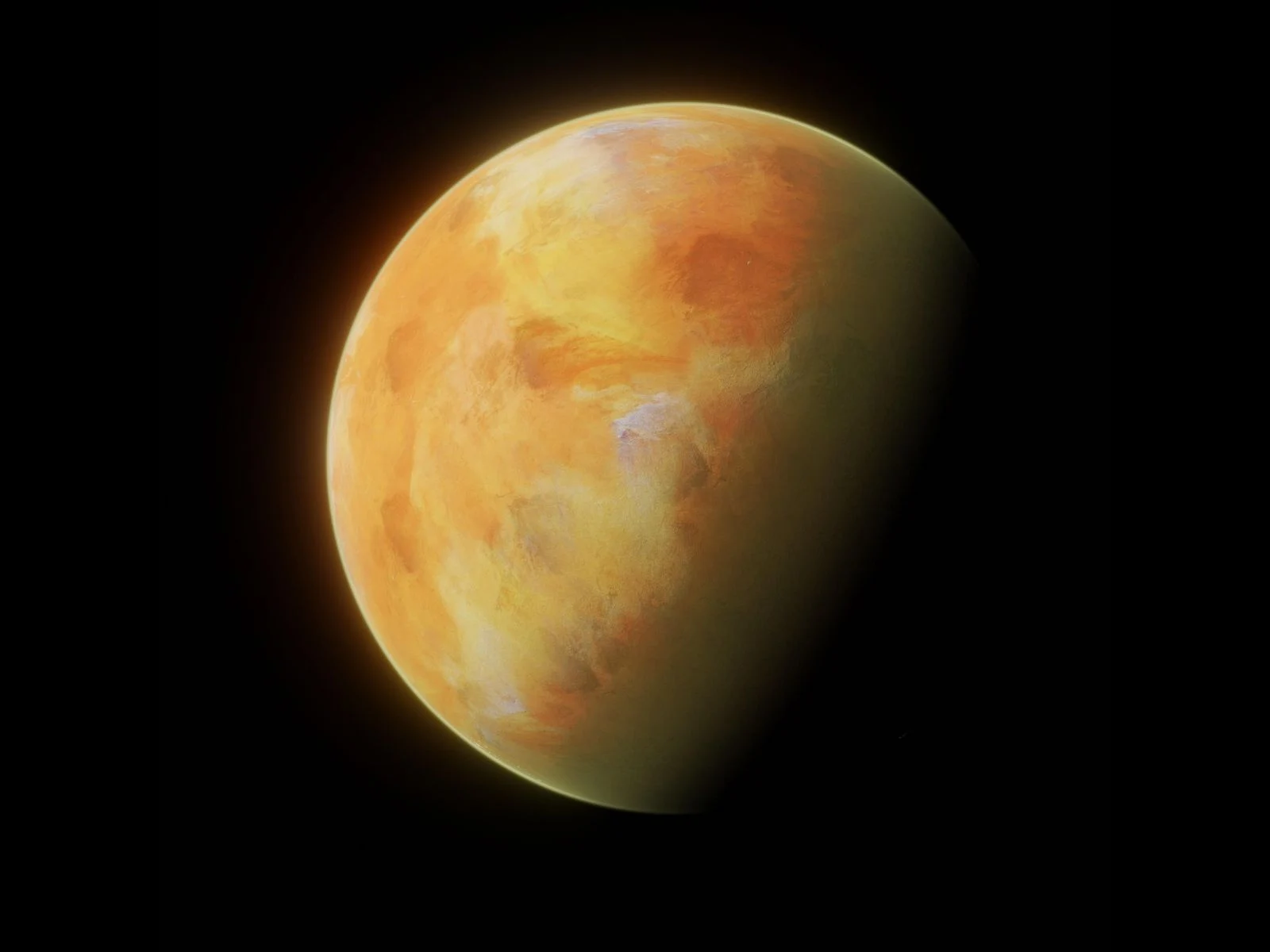
    Recently, scientists shared a paper in Nature Astronomy that features a remarkable exoplanet. Named L 98-59 d, this planet is part of a system that includes four other exoplanets and is situated around 35 light-years from Earth. Its radius is approximately 1.6 times that of our planet, yet its density is lower. Astronomers initially thought that this exoplanet possessed a very thick atmosphere along with a small rocky core.

    Unveiling the Mystery

    To explore the secrets of its density, researchers employed the James Webb Space Telescope, revealing that this planet is truly one of a kind. L 98-59 d is cloaked in a dense atmosphere that envelops a vast ocean of magma beneath. Remarkably, studies indicate that this atmosphere plays a crucial role in the creation of this molten ocean.

    Even though many enigmas about L 98-59 d are still waiting to be solved, scientists are optimistic that there are several similar planets scattered throughout different galaxies. With the help of various tools, astronomers can locate these worlds. The upcoming PLATO space telescope is expected to launch soon, and it may uncover new rocky exoplanets across the universe, allowing scientists to gain more insight into them.

    Source:
    Link


  • Study Reveals Little Red Dots as Hosts for Early Organic Chemistry

    Study Reveals Little Red Dots as Hosts for Early Organic Chemistry

    Key Takeaways

    1. The James Webb Space Telescope discovered tiny red objects called LRDs, which are small proto-galaxies from the early universe.
    2. Many LRDs contain massive black holes, potentially millions of times heavier than the Sun, despite their small size.
    3. LRDs exhibit weak radiation and maintain calm, dust-rich environments, unlike typical energetic galaxies with strong black holes.
    4. The Central Molecular Zone (CMZ) around the Milky Way’s center is similar to LRDs, with dense gas clouds and low radiation levels.
    5. Scientists believe LRDs might contain complex organic molecules, hinting at similar chemistry to that found in our solar system.


    The James Webb Space Telescope has uncovered puzzling tiny red objects in its images of the early universe, showcasing its skill to look back in time. These red objects, known as LRDs, are small proto-galaxies that existed when the universe was still young. They are incredibly small, measuring only a few hundred light-years across, and appear as tiny reddish dots in the photographs.

    Surprising Black Holes

    Interestingly, many LRDs harbor massive black holes, potentially millions of times heavier than the Sun. This is unexpected because the galaxies themselves are so small, and the central black hole makes up just a tiny part of the galaxy’s overall mass. A prime example would be Sagittarius A*, which hosts a black hole that weighs 4 million solar masses.

    Calm and Dusty Environments

    These proto-galaxies are anticipated to be highly energetic due to their large black holes, which typically emit strong X-rays, powerful jets, and intense radiation. However, they surprisingly exhibit weak high radiation and maintain a tranquil, dust-rich environment. This resembles the center of the Milky Way, where Sagittarius A-star is located.

    A region known as the Central Molecular Zone (CMZ) encircles the galactic center. It is home to dense gas clouds, significant amounts of cosmic dust, and cold molecular materials. This environment is particularly favorable for chemical reactions due to the low levels of radiation. Complex organic molecules, like nitriles, have also been found in the G+0.693-0.027 cloud.

    Scientists think that many organic molecules in our solar system formed in interstellar clouds, suggesting that LRDs might also possess similar chemistry. This makes their surroundings a prime location for the creation of complex organic molecules.

  • Astronomers Discover 5 Possible Alien Structures Harvesting Star Energy

    Astronomers Discover 5 Possible Alien Structures Harvesting Star Energy

    Key Takeaways

    1. The concept of a Dyson sphere was introduced by Freeman Dyson in 1960 to capture energy from stars.
    2. A Dyson swarm, made of thousands or millions of solar collectors orbiting a star, is the modern interpretation of the original idea.
    3. Red dwarfs and white dwarfs are ideal candidates for Dyson swarms due to their long lifespans and low fuel consumption.
    4. A Dyson sphere would block visible light from a star, affecting its position on the Hertzsprung-Russell diagram and possibly causing brightness fluctuations.
    5. Powerful infrared telescopes, like the James Webb Space Telescope, are used to detect potential Dyson spheres, with recent studies identifying candidates around red dwarfs.


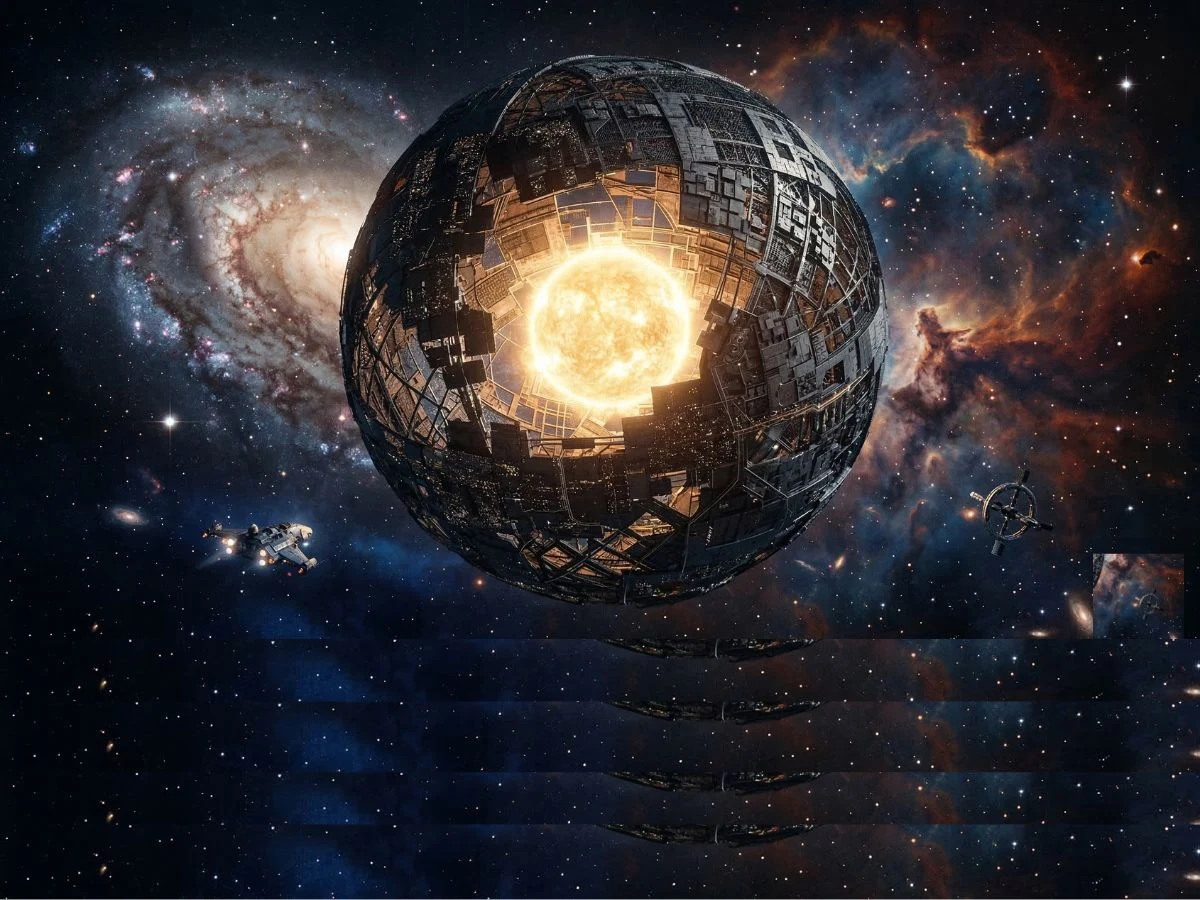
    The idea of a Dyson sphere was first introduced by Freeman Dyson back in 1960. His idea was to create a structure surrounding a star to capture the energy it emits. Nowadays, scientists are suggesting a Dyson swarm, which consists of thousands or even millions of solar collectors that orbit a star, collecting its energy.

    Observing the Dyson Swarm

    A research conducted by Amirnezam Amiri looked into how a Dyson swarm would appear to astronomers. One of the key questions was determining which stars would be the most suitable for having such a structure. It turned out that red dwarfs and white dwarfs are the best candidates thanks to their long lifespans, smaller size, and their slow fuel consumption.

    Classification of Stars

    Stars are categorized using the Hertzsprung-Russell (H-R) diagram, which charts them by their temperature and brightness. A Dyson sphere would block the visible light from the star, instead absorbing its energy and re-emitting it as infrared radiation. This process would lower the temperature of the surface that radiates, thus altering the star’s position on the chart. Additionally, because of the artificial panels, the environment would be free of dust. The swarm’s structure might also cause the star’s brightness to fluctuate, making it seem odd to astronomers.

    Detecting Dyson Spheres

    To spot potential Dyson spheres, powerful infrared telescopes like the James Webb Space Telescope and the Wide-Field Infrared Survey Explorer (WISE) are used. A study in 2024 from Project Hephaistos analyzed 5 million stars and identified 7 possible Dyson sphere candidates, all of which were around red dwarfs. However, further analysis reduced this number to just 5.

    This research offers new methods for finding technosignatures, paving the way for discovering signs of advanced extraterrestrial civilizations.

    arXiv.org

    Source:
    Link


  • Asteroid 2024 YR4 Will Miss Moon in 2032, New Data Shows

    Asteroid 2024 YR4 Will Miss Moon in 2032, New Data Shows

    Key Takeaways

    1. Asteroid 2024 YR4 was first spotted on December 27, 2024, and initially considered a potential danger to Earth.
    2. Further analysis confirmed that the asteroid poses no threat to Earth or the Moon.
    3. The James Webb Space Telescope observed the asteroid from February 18 to 26, 2026, providing new data on its path.
    4. 2024 YR4 is set to fly by the Moon at a safe distance of approximately 13,200 miles (21,243 kilometers).
    5. If it had been a threat, a collision could have caused significant destruction, including a crater one kilometer wide.


    Finally, the Moon is safe from asteroid 2024 YR4. New findings from the James Webb Space Telescope in February 2026 confirm that there is no threat to the Moon, and we now understand the path of this space rock.

    Discovery of the Asteroid

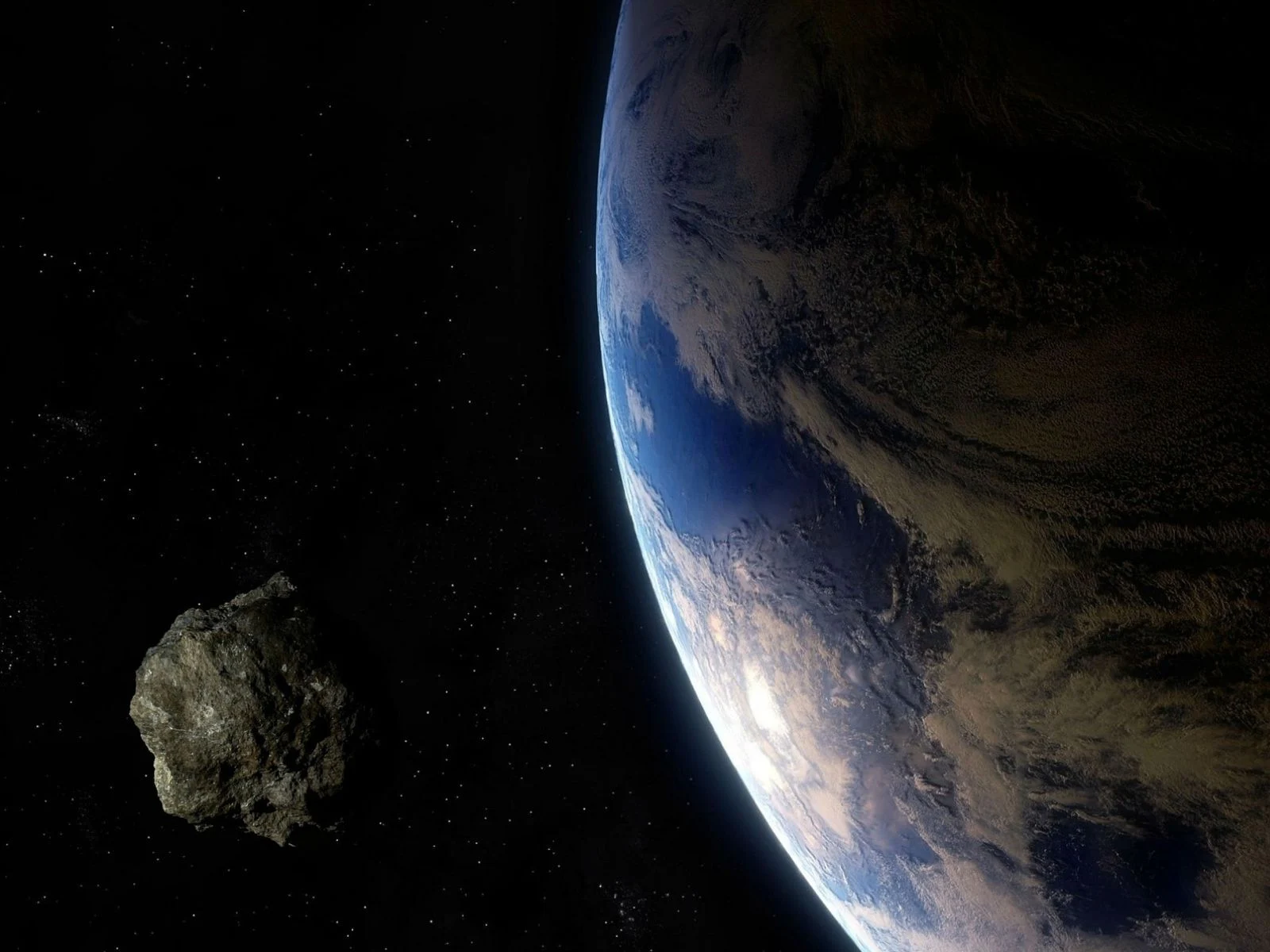
    To recap, this asteroid was first spotted on December 27, 2024, by NASA’s ATLAS system. It was initially labeled a potential danger to Earth, measuring 60 meters across and posing a risk of collision in 2032. Luckily, further analysis revealed that it won’t endanger our planet. Attention then shifted to the Moon, where earlier studies suggested a 4.3% chance of impact.

    Recent Observations

    Recently, researchers at the Johns Hopkins University Applied Physics Laboratory (JHUAPL) in Maryland took a closer look at this asteroid from February 18 to 26 using the James Webb Space Telescope. Despite 2024 YR4 being one of the smaller objects ever examined by this telescope, the latest data shows that it poses no risk to the Moon, as the asteroid will fly by at a distance of approximately 13,200 miles (21,243 kilometers).

    Implications of the Findings

    However, this also means that astronomers and scientists won’t get the chance to witness the effects of such a massive impact in real-time. If it had been a threat, it could have resulted in an explosion comparable to a nuclear bomb and left behind a crater measuring one kilometer wide.

    NASA Science’s

    Source:
    Link


  • TESS Space Telescope Finds Most Compact Quadruple Star System

    TESS Space Telescope Finds Most Compact Quadruple Star System

    Key Takeaways

    1. The TIC 120362137 system is the most compact quadruple star system discovered, fitting within the orbit of Jupiter.
    2. Initial observations with the TESS space telescope revealed only two stars, with the third and fourth stars identified later through brightness changes and eclipses.
    3. The heaviest star in the system, known as Aa, is larger and hotter than the Sun.
    4. Star C has a mass and temperature similar to the Sun, with an orbital period of 1,046 days.
    5. This discovery could help scientists find more similar star systems throughout the universe.


    The universe is incredibly expansive, leading astronomers to uncover new findings each year, especially with tools like the James Webb Space Telescope and the TESS space telescope. Recently, researchers published a study that emphasized the discovery of the most compact quadruple star system known to date.

    The TIC 120362137 System

    TIC 120362137 consists of three stars that are very close to each other, along with a fourth star that is somewhat farther away. If we were to compare its size to our solar system, it would fit within the orbit of Jupiter. To put it simply, these four stars are situated within a radius of approximately 770 million kilometers.

    Unusual Observations

    The discovery of this system was noteworthy because, at first, observations made with the TESS space telescope showed nothing out of the ordinary. Initially, only two stars were detected, orbiting each other every 3.3 days. The third star was identified due to changes in brightness that happened every 25 days. The presence of the fourth star was confirmed through new eclipses, which were then validated using the Tillinghast Reflector Echelle Spectrograph (TRES).

    The Most Massive Star

    In this system, the heaviest star is known as Aa, and it is both larger and hotter than our Sun. This trend continues with the other two stars that are nearby. On the other hand, star C has a mass and temperature comparable to the Sun, with an orbital period of 1,046 days. Therefore, this discovery is a groundbreaking achievement and could enable scientists to find similar systems scattered throughout the universe.

    Source:
    Link


  • James Webb Space Telescope Unveils Stunning Nebula Image

    James Webb Space Telescope Unveils Stunning Nebula Image

    Key Takeaways

    1. The Exposed Cranium Nebula (PMR 1) is located 5,000 light-years away and was discovered in 2000.
    2. NASA’s James Webb Space Telescope has captured new images that reveal unique details of the nebula.
    3. The nebula’s structure includes an outer hydrogen gas shell and a denser core, along with dark twin jets.
    4. The central star responsible for the nebula’s formation is nearing the end of its life, but its mass remains uncertain.
    5. Further studies of the nebula may uncover additional secrets and deepen our understanding of cosmic phenomena.


    The Exposed Cranium Nebula, also refereed to as PMR 1, was found in 2000 and is around 5,000 light-years away from our planet. This nebula, which consists of gas and dust, presents a fascinating enigma for scientists.

    New Discoveries with James Webb

    Recently, NASA released stunning images captured by the James Webb Space Telescope, showcasing the nebula’s unique characteristics. The telescope’s advanced instruments, such as the NIRCam (Near-Infrared Camera) and the MIRI (Mid-Infrared Instrument), enable us to observe details that were previously hidden from view.

    Exploring the Structure

    In the visuals produced by these two instruments, we can observe the various stages of this nebula’s development. The outer gas shell is mainly made of hydrogen, while the center features a denser cloud of gas. Additionally, two dark twin jets can be seen in the core of the structure, which might be the result of activity from the central star.

    The Mystery Star

    The star that led to the formation of this nebula remains shrouded in mystery. Although astronomers have determined that this star is nearing the end of its life, its mass is still unknown. This uncertainty leaves its future ambiguous; it could either explode as a supernova or shrink into a white dwarf if it doesn’t have enough mass. Based on the recent image, it’s likely that some astronomers will take a greater interest in studying this nebula. Further investigations could reveal additional secrets and enhance our understanding of such cosmic phenomena.

    Source:
    Link