
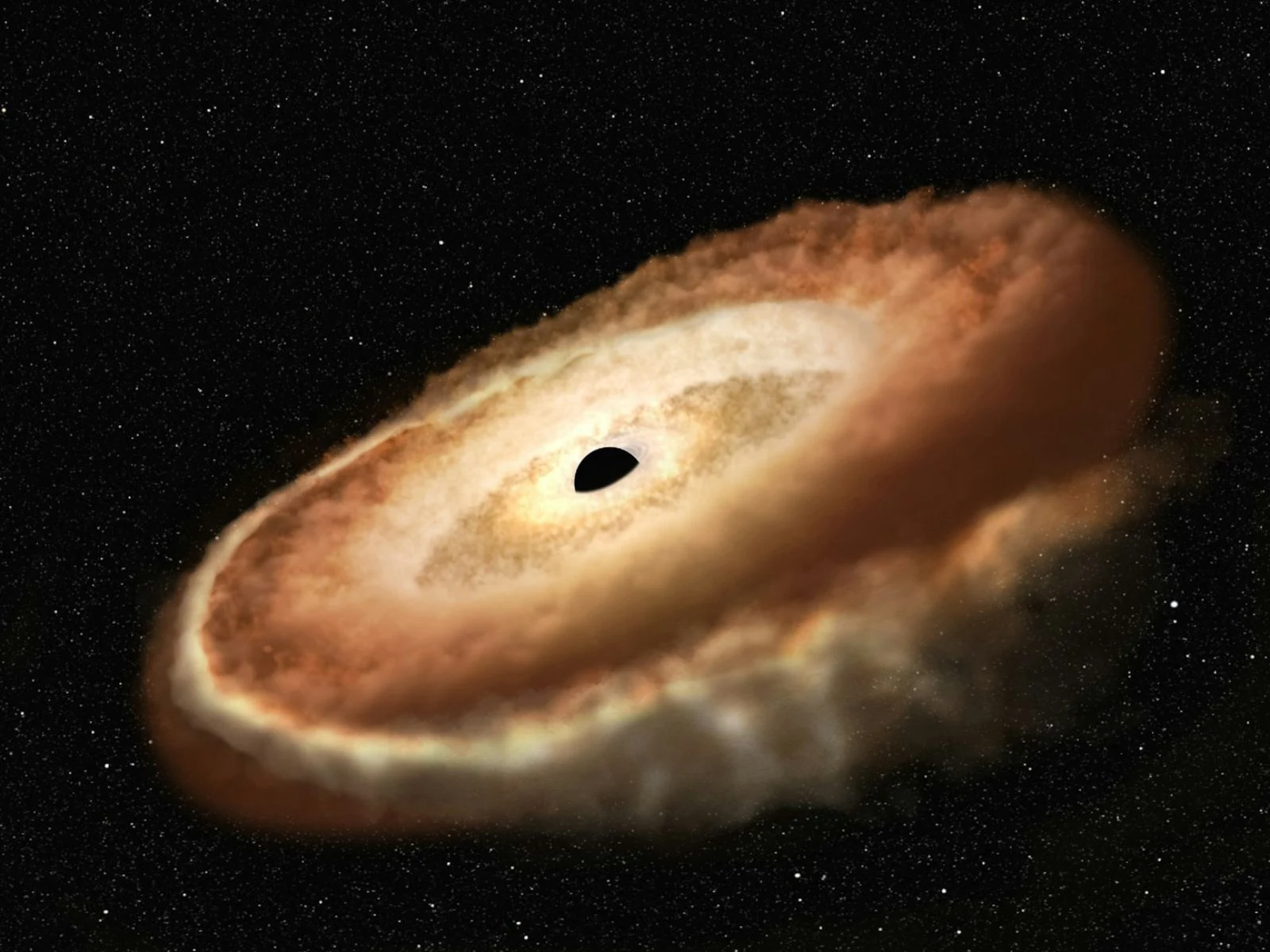
– A402-BCG, a galaxy about 4.4 billion light-years away in the Abell 402 cluster, hosts an ultramassive black hole estimated at ~50 billion solar masses.
– JWST and Hubble observations reveal a bright central source with a kiloparsec-wide dark region nearby, signaling the black hole’s presence.
– At ~50 billion solar masses, it ranks among the most massive black holes known, about 25× the mass of all stars in the Large Magellanic Cloud; the Milky Way is 100–400 billion solar masses for scale.
– A large cavity in the galaxy suggests the possible existence of a second supermassive black hole at its center.
Black holes are among the most puzzling cosmic objects, known for extreme gravity and strange behaviors. A team led by Michael McDonald at the Massachusetts Institute of Technology has announced the discovery of a black hole tucked away in a galaxy, a finding that challenges ideas about how objects grow.
Discovery in a distant galaxy
Named A402-BCG, the galaxy sits 4.4 billion light-years from Earth and belongs to the Abell 402 cluster. In discussing the outcome, researchers point to two features: a bright, pointlike glow at the core and a wide, kiloparsec-scale dark region lying to its east, hinting at powerful processes within the cluster.
Central features and interpretation
Team used the James Webb Space Telescope and the Hubble Space Telescope to study the light from its center, concluding that the glow signals an ultramassive black hole. Its mass is estimated at about 50 billion solar masses, a value that places it among the most massive known black holes.
Observational evidence
This finding matters because it ranks among the largest black holes. It is about 25 times bigger than all the stars in the Large Magellanic Cloud, located 158,000 light-years away, while the Milky Way weighs in at about 100 to 400 billion solar masses, illustrating the power of such objects.
Scale and significance
Observers also note a large cavity in the host galaxy that hints at a second supermassive black hole at its center, a possibility that remains speculative until more data comes in. The discovery continues to spark discussion about how multiple gargantuan holes might shape their galaxies over cosmic time together.