Tag: Chandra X-ray Observatory

  • Supernova Remnant Found in Milky Way Galaxy

    Supernova Remnant Found in Milky Way Galaxy

    Key Takeaway

    – Chandra telescope captured possible supernova remnant 26,000 light-years away
    – Structure expands at 2 million mph and formed about 1,700 years ago
    – Image combines X-ray data from Chandra and XMM-Newton with radio data from MeerKAT
    – Supernova remnants eject matter enabling new star and planet formation
    – Alternative hypothesis of massive star cluster unlikely due to extreme brightness


    Space Telescope Observes Celestial Event

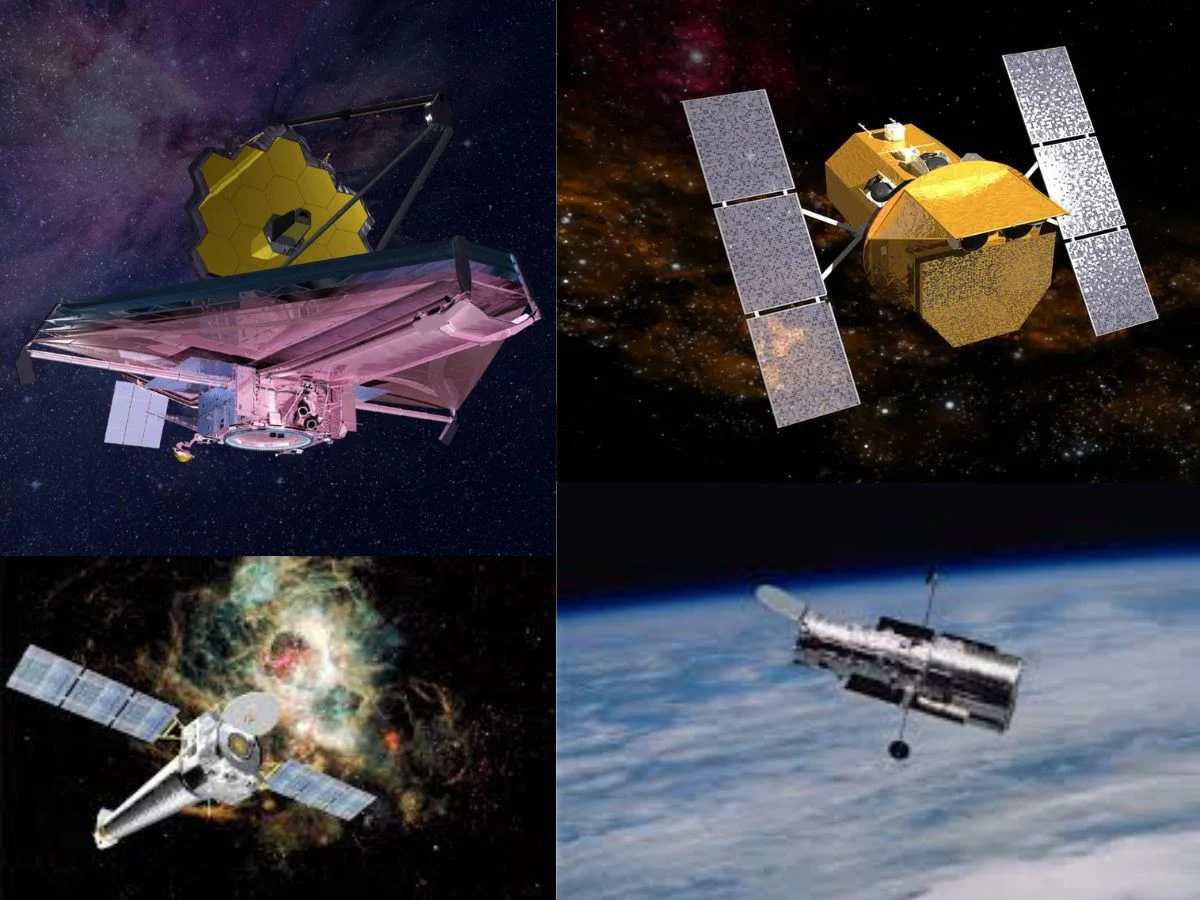
    The Chandra X-ray Observatory was launched in 1999 aboard the space shuttle Columbia and is one of the most powerful space telescopes. Thanks to instruments such as the Advanced CCD Imaging Spectrometer and the High Resolution Camera, it is capable of observing X-rays emitted by celestial objects. Recently, NASA released an image captured by this telescope, showing what may be the remnant of a supernova in our galaxy.

    Location and Speed of the Structure

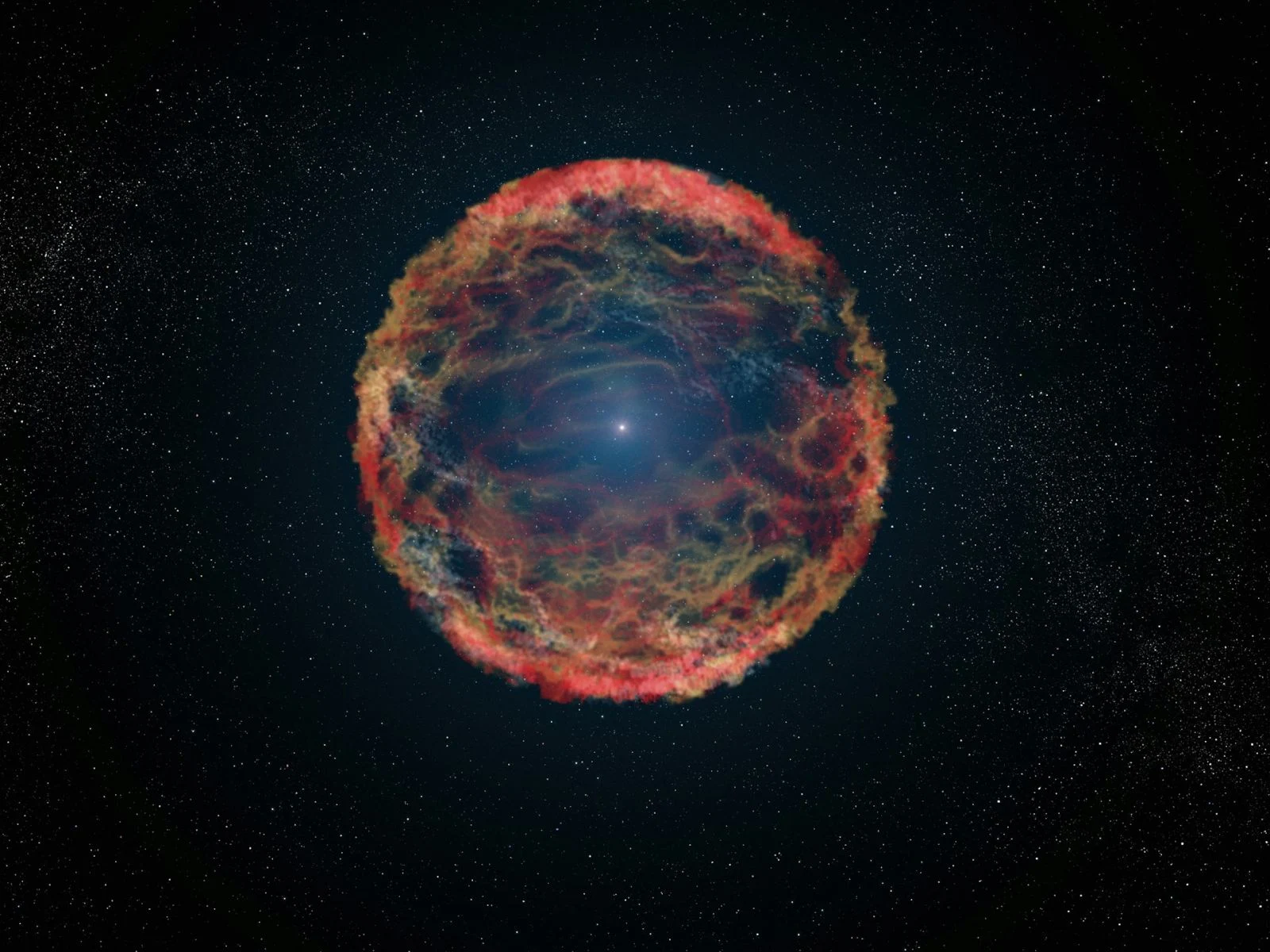
    This structure is located about 26,000 light-years from Earth, within a bubble of gas surrounding a massive star. According to astronomers, it is expanding at a speed of two million miles per hour and is thought to have formed about 1,700 years ago.

    Combined Telescope Data Reveals Details

    In this image, which combines X-ray data from the Chandra and XMM-Newton telescopes with radio data from the MeerKAT telescope, it is possible to see long filaments caused by particles.

    Astronomical Interest and Hypotheses

    However, this remnant could be of interest to astronomers. Indeed, during these events, huge amounts of matter are ejected into space, allowing the formation of new stars and planets. Nevertheless, another hypothesis has been put forward regarding this structure.

    Alternative Explanation Rejected

    According to some astronomers, it could also be a cluster of massive stars. But its brightness is ten times greater than that of other star clusters, making this hypothesis unlikely.

    Sources

  • Astronomers Discover Neutron Star Collision in Small Galaxy

    Astronomers Discover Neutron Star Collision in Small Galaxy

    Key Takeaways

    1. Neutron stars are small but incredibly dense, with a mass 1.5 times that of the Sun and a diameter of about 15 kilometers.
    2. A significant discovery involving the collision of two neutron stars, named GRB 230906A, occurred in a small galaxy 4.7 billion light-years away.
    3. This event was detected using the Chandra X-ray Observatory and further studied with the Swift and Hubble telescopes.
    4. The collision may help answer questions about gamma-ray bursts that are not visible in their host galaxies and the distribution of heavy metals like gold and platinum.
    5. Further research is needed to confirm the theory that neutron star collisions create heavy metals that contribute to the formation of new stars.


    Neutron stars are tiny celestial bodies, measuring around 15 kilometers in diameter and possessing a mass 1.5 times that of our Sun. These stars form when a massive star collapses, leading to incredibly high density. Recently, researchers published a significant finding in The Astrophysical Journal Letters regarding these extreme objects in the universe.

    Exciting Discovery of Neutron Star Collision

    They found a collision between two neutron stars within a small galaxy. While this might not sound very remarkable at first, it is indeed a groundbreaking event, as such collisions are typically seen in medium to large galaxies. The event, called GRB 230906A, was identified using the Chandra X-ray Observatory, which pinpointed the exact site of the collision. Following that, scientists employed the Swift and Hubble telescopes to capture images of the area, uncovering a small galaxy that is located 4.7 billion light-years away.

    Implications of the Findings

    Simone Dichiara, a researcher from Pennsylvania State University and the study’s lead, mentioned that this discovery might help resolve two significant questions in astronomy. Some gamma-ray bursts from these events often don’t show up in the host galaxy or in nearby ones, likely due to the small size of their host. Furthermore, this could explain the presence of heavy metals like gold and platinum found well outside the centers of galaxies. Astronomers think that collisions between neutron stars can create these metals, which eventually end up in new stars. However, additional research is necessary to validate this theory.

    Image source: NASA/CXC/Penn State Univ./S. Dichiara; IR: NASA/ESA/STScI; Illustration: ERC BHianca 2026 / Fortuna and Dichiara, CC BY-NC-SA 4.0; Image Processing: NASA/CXC/SAO/P. Edmonds

    Source:
    Link


  • Young Star Reveals Sun’s Appearance Billions of Years Ago

    Young Star Reveals Sun’s Appearance Billions of Years Ago

    Key Takeaways

    1. HD 61005 is a young star located about 120 light-years from Earth, with a mass and temperature similar to our Sun but only 100 million years old compared to the Sun’s 5 billion years.

    2. The star is nicknamed “the moth” due to a unique dust pattern that resembles moth wings surrounding it.

    3. HD 61005 has a visible astrosphere, a protective bubble created by stellar wind, which is 200 times the distance from Earth to the Sun.

    4. The stellar wind from HD 61005 is three times faster and 25 times denser than the solar wind, making its astrosphere more noticeable.

    5. Observations of HD 61005 provide insights into the evolution of solar wind, offering a glimpse into the early conditions of our Sun billions of years ago.


    A star known as HD 61005 is situated around 120 light-years from our Sun. It shares the same mass and temperature as our Sun but is much younger, estimated to be only about 100 million years old, while the Sun is approximately 5 billion years old. This makes HD 61005 a more youthful counterpart of our familiar star.

    Stellar Characteristics

    This star has received the nickname “the moth” because of the unique dust pattern that resembles moth wings surrounding it. The star also has a visible astrosphere, which is a massive bubble extending 200 times the distance from the Earth to the Sun. An astrosphere is created by the stellar wind that pushes outwards into space, forming this protective bubble around the star.

    The particle wind emerging from the surface of HD 61005 moves at three times the speed of the solar wind and is roughly 25 times denser. This higher density and speed make the astrosphere more visible, especially given its close distance to us. The Chandra X-ray Observatory detected this interesting phenomenon by observing X-rays emitted from the hot gas that results when the stellar wind collides with cooler dust and gases in space.

    Insights from the Discovery

    Our Sun also has a similar protective layer called the heliosphere, which extends well beyond the orbit of Pluto and serves to shield us from cosmic radiation. Nevertheless, astronomers have yet to capture an image of it from the outer regions. This remarkable image of HD 61005 offers valuable insights into how the solar wind has evolved, providing a peek into the past of our Sun billions of years ago.

    Source:
    Link


  • NASA Finds Massive Galaxy Cluster 2 Billion Years Earlier Than Expected

    NASA Finds Massive Galaxy Cluster 2 Billion Years Earlier Than Expected

    Key Takeaways

    1. JADES-ID1 is a newly discovered galaxy cluster existing about one billion years after the Big Bang, making it a significant find.
    2. It is classified as a protocluster, still in the early stages of formation, and is two billion years younger than the previously known earliest protocluster.
    3. JADES-ID1 has an incredible mass of approximately 20 trillion times that of the Sun, raising questions about its rapid formation.
    4. The discovery was made using the James Webb Space Telescope and the Chandra X-ray Observatory, which identified 66 potential galaxies and a vast cloud of hot gas.
    5. Scientists believe JADES-ID1 will evolve into a massive galaxy cluster over billions of years, similar to those found closer to Earth.


    When we look at a cosmic object, the distance helps us understand how far back in time we are seeing it. Recently, scientists discovered a galaxy cluster that is still in its early formation stages, existing only about one billion years after the Big Bang. This galaxy cluster is named JADES-ID1, as it was identified during the JWST Advanced Deep Extragalactic Survey (JADES). The results of this research were shared in the journal Nature.

    An Early Discovery

    JADES-ID1 is still in the process of formation, so it’s called a protocluster. Prior to this, the earliest known protocluster that emitted X-rays was detected around three billion years after the Big Bang. Therefore, finding JADES-ID1 two billion years earlier is really remarkable.

    Massive Formation

    What’s fascinating is that JADES-ID1 has a mass that is approximately 20 trillion times greater than that of our Sun. Researchers are now curious about how something so large could have formed so rapidly.

    The discovery was made through observations from both the James Webb Space Telescope and the Chandra X-ray Observatory. When they examined JADES-ID1, two key characteristics confirmed it was a protocluster. First, Webb detected at least 66 potential galaxies bound together by gravity. Second, Chandra found that these galaxies were enveloped in a vast cloud of hot gas.

    Future of JADES-ID1

    Scientists predict that over billions of years, JADES-ID1 will develop from a protocluster into a massive galaxy cluster, similar in mass to those we observe closer to Earth.

    Source:
    Link


  • NASA Discovers Findings That Challenge Modern Astronomy Foundations

    NASA Discovers Findings That Challenge Modern Astronomy Foundations

    Key Takeaways

    1. Researchers challenge the idea that almost every galaxy has a supermassive black hole at its core based on new findings.
    2. Data from the Chandra X-ray Observatory shows that many smaller galaxies lack indicators of supermassive black holes.
    3. The absence of X-ray signals from smaller galaxies suggests that only about 30% of them may contain supermassive black holes.
    4. The study indicates that supermassive black holes likely started out large, rather than forming from smaller black hole mergers.
    5. These findings could impact the upcoming LISA mission’s ability to detect gravitational waves from black hole mergers.


    For many years, researchers have thought that almost every galaxy has a supermassive black hole located at its core. However, a team of astronomers has questioned this idea in a study they released in the Astrophysical Journal. They conducted their research using data collected from the Chandra X-ray Observatory.

    Chandra’s Observations

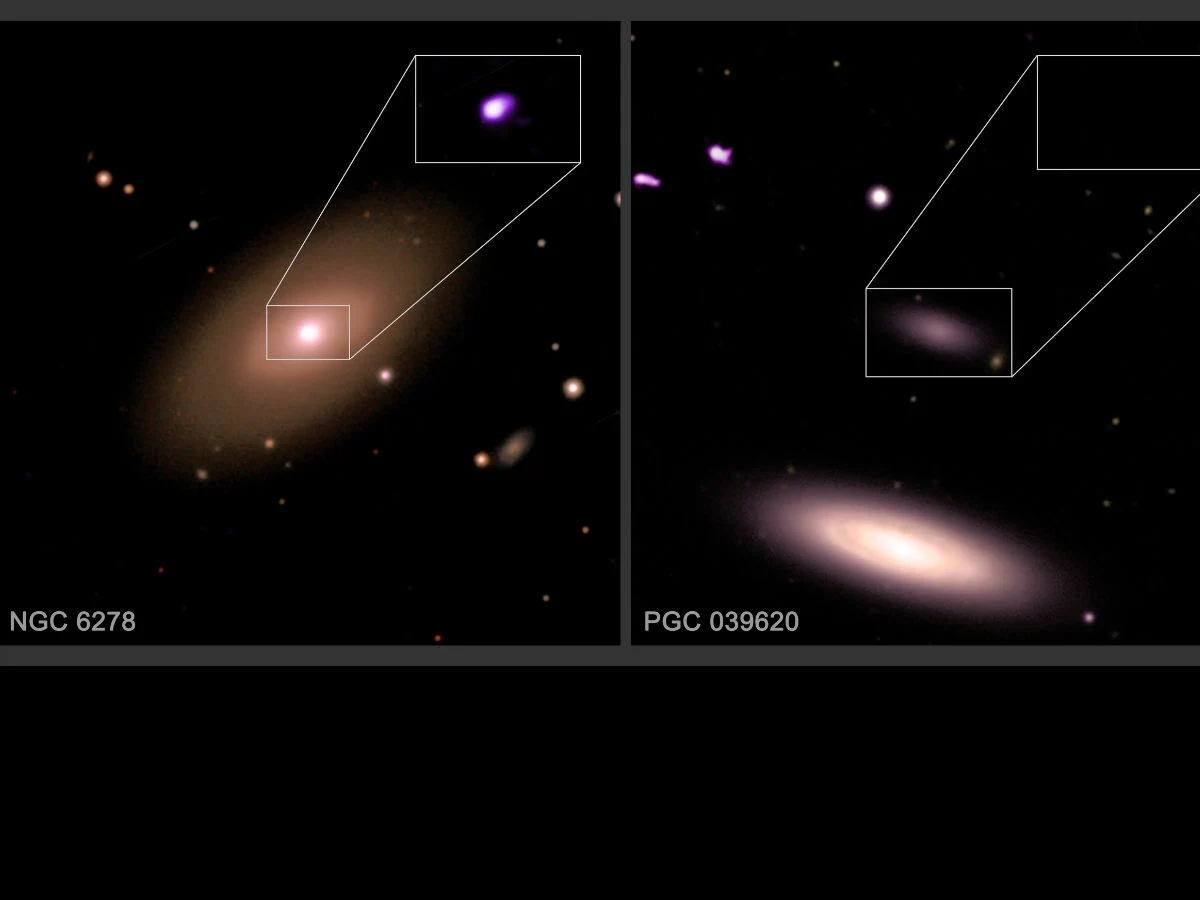
    Chandra has been observing different galaxies for over twenty years. In this time span, it has studied 1,600 galaxies, ranging from those that are more than 10 times the mass of our Milky Way to much smaller ones. Upon examining the data, the astronomers found that a significant number of smaller galaxies did not display any indicators of a supermassive black hole at their center.

    Lack of X-ray Signals

    When matter falls into supermassive black holes, it produces X-rays, which is what Chandra is designed to detect. However, the astronomers noticed that the signals received from smaller galaxies were less frequent. They suspect this shortfall is linked to the likely absence of supermassive black holes in these smaller galaxies.

    According to their findings, the astronomers estimate that only about 30% of small galaxies probably have supermassive black holes. If this is correct, it could help shed light on how supermassive black holes actually come into existence. The results suggest that these black holes started out large, implying they did not form from the merger of smaller black holes.

    Implications for Future Research

    This research might also influence the upcoming Laser Interferometer Space Antenna (LISA) mission. This mission aims to detect gravitational waves, which are produced during black hole mergers. If there are fewer supermassive black holes in smaller galaxies, it could mean there are fewer mergers and, consequently, fewer gravitational waves for LISA to pick up.

    Source:
    Link


  • Scientists Use 3 Telescopes to Capture Stunning Westerlund 1 Image

    Scientists Use 3 Telescopes to Capture Stunning Westerlund 1 Image

    Key Takeaways

    1. Westerlund 1 is a youthful super star cluster located about 12,000 light-years away in the constellation Ara, with a mass of 50,000 to 100,000 solar masses.
    2. It is one of the largest super star clusters in the Milky Way and the closest to Earth.
    3. New imagery combines X-ray data from Chandra, infrared data from Webb, and optical data from Hubble, revealing various colors representing different types of data.
    4. The imagery shows many stars, with large stars appearing bright and smaller ones as faint dots, surrounded by hot gas clouds.
    5. Mottled golden clouds indicate areas of cooler dust and gas where new stars are forming, showcasing ongoing stellar formation.


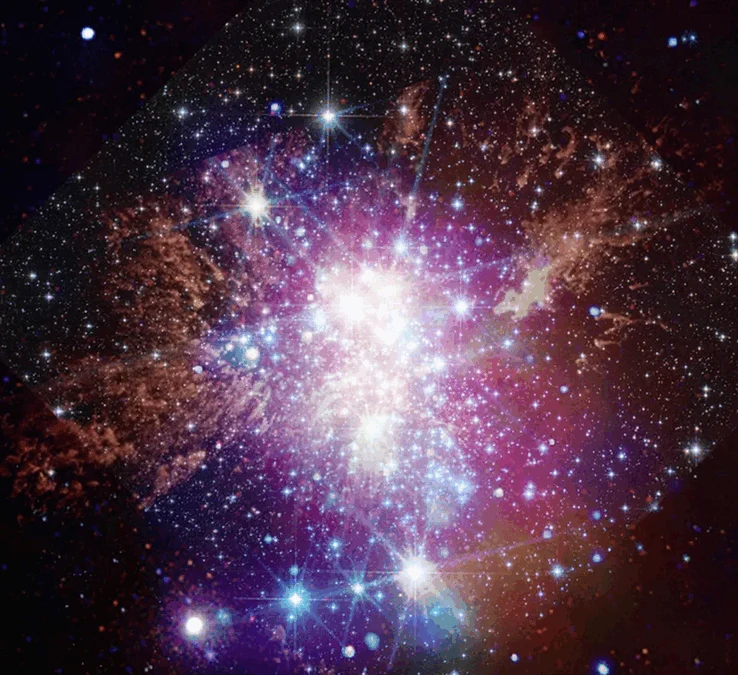
    Westerlund 1 is a youthful star cluster situated approximately 12,000 light-years away in the southern constellation Ara, also known as the Altar. It has an estimated total mass ranging between 50,000 and 100,000 solar masses, which classifies it as a “super star cluster.”

    Characteristics of Super Star Clusters

    Super star clusters are characterized by a large number of stars, often tens of thousands, packed closely together. Among these, Westerlund 1 is recognized as one of the largest super star clusters in the Milky Way and is notably the closest one to our planet.

    Stunning New Imagery

    A fresh image of Westerlund 1 incorporates X-ray data from Chandra, infrared data from Webb, and optical data from Hubble. The data from Chandra is represented in shades of pink, blue, purple, and orange, while Webb’s infrared information is depicted in yellow, gold, and blue. Hubble’s visuals are displayed in cyan, gray, and light yellow.

    The imagery reveals a multitude of stars within the cluster, showcasing both the brighter, larger stars and smaller stars that appear as faint dots. Surrounding these are purple clouds, indicating hot, high-energy gas.

    Formation of New Stars

    Additionally, mottled golden clouds can be seen, signifying cooler dust and gas where new stars are formed. This image was made public on July 23, 2025, as part of a new series that combines data from Chandra with various other telescopes.

    Source:
    Link


  • NASA Discovers Record-Breaking Fastest Growing Black Hole

    NASA Discovers Record-Breaking Fastest Growing Black Hole

    Key Takeaways

    1. The Chandra X-ray Observatory discovered a supermassive black hole approximately a billion times the mass of the Sun, located 12.8 billion light-years away, indicating it existed early in the universe’s history.

    2. Black holes attract matter, forming an accretion disk that heats up and emits radiation, which can create incredibly bright objects known as quasars.

    3. The black hole in question powers a quasar named RACS J0320-35 and is growing at an extraordinary rate, potentially exceeding the Eddington limit.

    4. Researchers propose two theories about the black hole’s rapid growth: it may be expanding at 2.4 times the Eddington limit or may have started with a mass of about 10,000 Suns or more.

    5. The unusual growth rate of RACS J0320-35 and its particle jets raise questions about the formation of the universe’s first black holes, with findings published in the Astrophysical Journal.


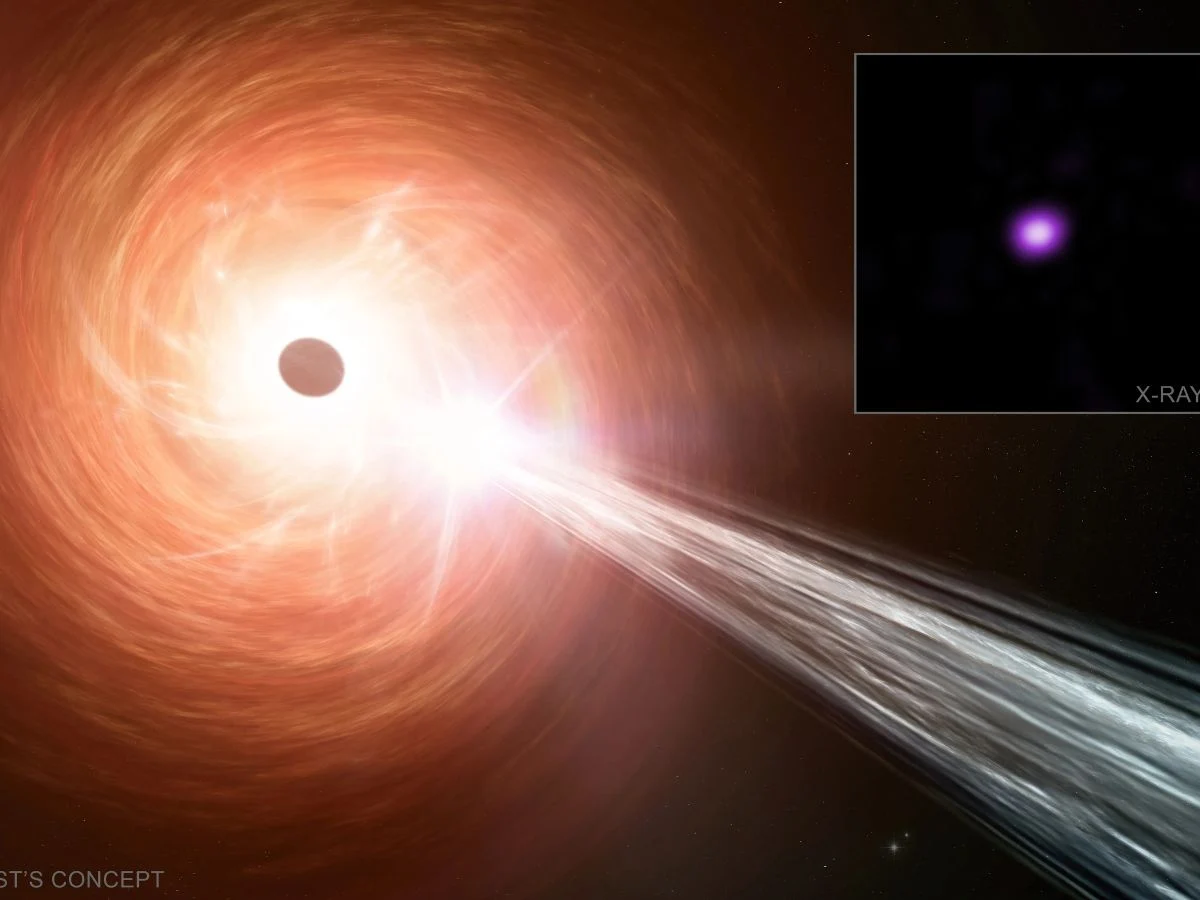
    The Chandra X-ray Observatory has spotted a supermassive black hole that weighs in at roughly a billion times the mass of the Sun. This celestial giant is positioned around 12.8 billion light-years away from our planet. Consequently, astronomers are observing it from a time just 920 million years after the universe’s inception, indicating that it existed very early in the universe’s timeline.

    Matter and Radiation

    Black holes have a tendency to attract significant amounts of matter. This matter forms a swirling disk around the black hole, known as an accretion disk, and reaches incredibly high temperatures as it spirals inward. As this matter heats up, it releases radiation.

    Quasars and Rapid Growth

    In the case of supermassive black holes, the radiation from the heated matter can outshine the entire galaxy it resides in. The bright object resulting from this phenomenon is termed a quasar. The black hole under discussion powers a quasar identified as RACS J0320-35.

    Researchers have determined that the black hole fueling RACS J0320-35 is expanding at an unprecedented speed. As black holes consume matter, there comes a moment when the gravitational pull inwards and the radiation pressure outwards reach an equilibrium, known as the Eddington limit.

    The Eddington Limit and Theories

    Considering the mass of this black hole, the researchers proposed two theories: it could either be growing at 2.4 times the Eddington limit or may have originated with a mass equivalent to about 10,000 Suns or more. Typically, black holes start out with a mass of less than a hundred Suns.

    Upon comparing the data from RACS J0320-35 with theoretical models, the evidence suggests that this quasar might indeed be expanding faster than the Eddington limit allows. Additionally, the jets of particles that shoot away from RACS J0320-35 have sparked further inquiries. The unusual growth rate of the black hole might explain the existence of these rare jets.

    The results of this research were recently shared in the Astrophysical Journal. These findings could offer valuable insights into a long-standing question: “How did the Universe form the very first black holes?”

    Source:
    Link


  • Planet Devoured by Its Star at an Alarming Rate

    Planet Devoured by Its Star at an Alarming Rate

    Key Takeaways

    1. TOI 1227 b is a young exoplanet, only 8 million years old, making it the second-youngest transiting planet detected.
    2. The planet’s atmosphere is being stripped away by intense X-rays from its star, causing it to appear “puffed up.”
    3. The planet’s mass is likely closer to that of Neptune, despite its large appearance similar to Jupiter.
    4. The X-ray bombardment strips away an amount of mass equal to one Earth atmosphere every 200 years.
    5. In about a billion years, TOI 1227 b is expected to lose its atmosphere completely, shrinking to a lifeless rock.


    Astronomers from NASA’s Chandra X-ray Observatory have observed a young exoplanet undergoing a dramatic change. The planet, called TOI 1227 b, is experiencing its atmosphere being slowly stripped away due to a relentless stream of X-rays from the star it orbits.

    A Disturbing Transformation

    This intense exposure to radiation has caused the atmosphere of the planet to expand, making it appear “puffed up” like Jupiter, even though its mass is probably closer to that of Neptune.

    “It’s hard to comprehend the scale of devastation this planet is facing. The atmosphere just can’t hold up against the intense X-ray bombardment from its star,” said Attila Varga from the Rochester Institute of Technology, who was in charge of the study.

    Age and Orbits

    TOI 1227 b is only 8 million years old, which is about 625 times younger than Earth, marking it as the second-youngest transiting planet ever detected. It orbits a red dwarf star located roughly 330 light-years away at a very close range — less than a fifth of the distance from Mercury to our Sun. While the star is cooler than the Sun when seen in visible light, it shines brightly in X-ray wavelengths.

    The Grim Future Ahead

    The research team has worked out that the X-ray bombardment from the star strips away an amount of mass equal to one Earth atmosphere approximately every 200 years. “The outlook for this young planet is not very promising,” said Alexander Binks, a co-author from the Eberhard Karls University of Tübingen. The study suggests that in about a billion years, the planet will completely lose its atmosphere and shrink to about a tenth of its current size, ultimately becoming a small, lifeless rock with no chance of supporting life.

    Source:
    Link