
Key Takeaways
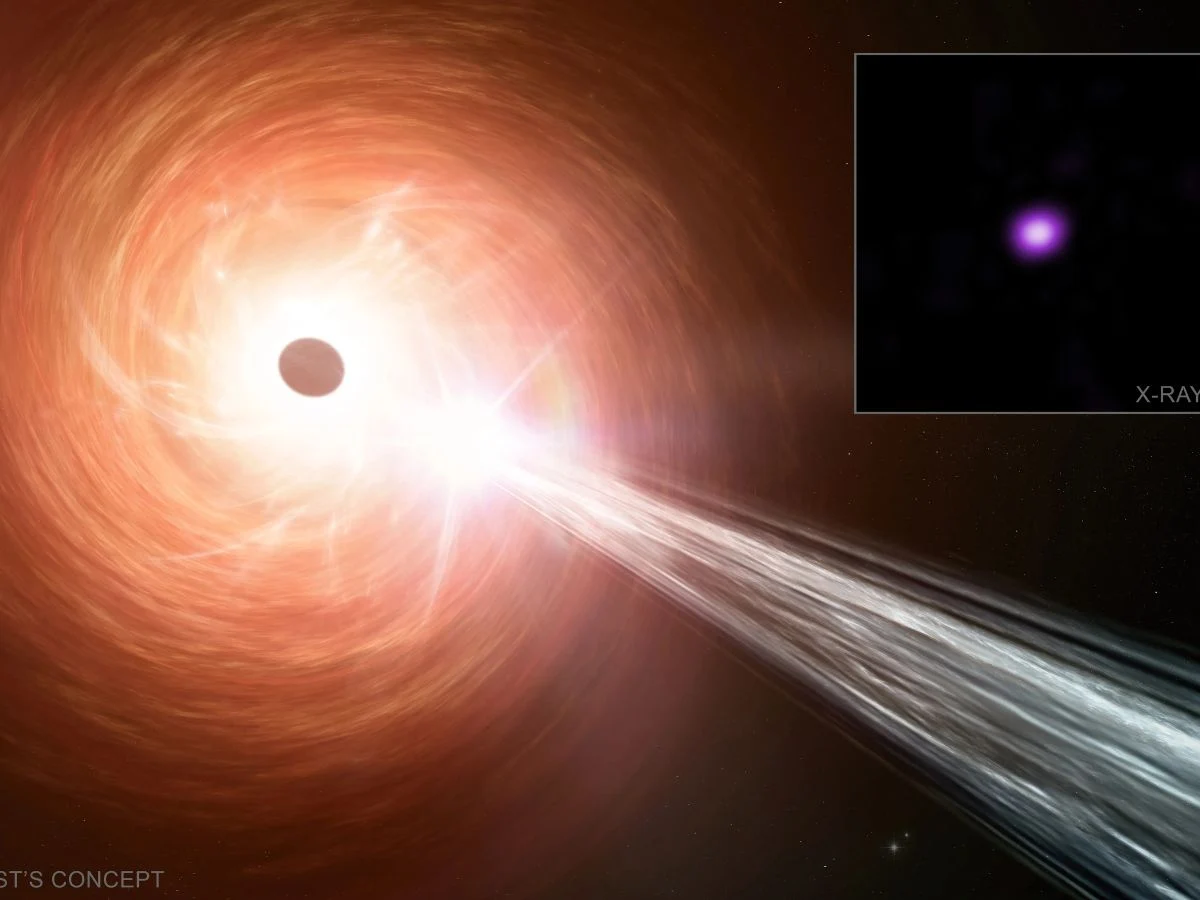
1. The Chandra X-ray Observatory discovered a supermassive black hole approximately a billion times the mass of the Sun, located 12.8 billion light-years away, indicating it existed early in the universe’s history.
2. Black holes attract matter, forming an accretion disk that heats up and emits radiation, which can create incredibly bright objects known as quasars.
3. The black hole in question powers a quasar named RACS J0320-35 and is growing at an extraordinary rate, potentially exceeding the Eddington limit.
4. Researchers propose two theories about the black hole’s rapid growth: it may be expanding at 2.4 times the Eddington limit or may have started with a mass of about 10,000 Suns or more.
5. The unusual growth rate of RACS J0320-35 and its particle jets raise questions about the formation of the universe’s first black holes, with findings published in the Astrophysical Journal.
The Chandra X-ray Observatory has spotted a supermassive black hole that weighs in at roughly a billion times the mass of the Sun. This celestial giant is positioned around 12.8 billion light-years away from our planet. Consequently, astronomers are observing it from a time just 920 million years after the universe’s inception, indicating that it existed very early in the universe’s timeline.
Matter and Radiation
Black holes have a tendency to attract significant amounts of matter. This matter forms a swirling disk around the black hole, known as an accretion disk, and reaches incredibly high temperatures as it spirals inward. As this matter heats up, it releases radiation.
Quasars and Rapid Growth
In the case of supermassive black holes, the radiation from the heated matter can outshine the entire galaxy it resides in. The bright object resulting from this phenomenon is termed a quasar. The black hole under discussion powers a quasar identified as RACS J0320-35.
Researchers have determined that the black hole fueling RACS J0320-35 is expanding at an unprecedented speed. As black holes consume matter, there comes a moment when the gravitational pull inwards and the radiation pressure outwards reach an equilibrium, known as the Eddington limit.
The Eddington Limit and Theories
Considering the mass of this black hole, the researchers proposed two theories: it could either be growing at 2.4 times the Eddington limit or may have originated with a mass equivalent to about 10,000 Suns or more. Typically, black holes start out with a mass of less than a hundred Suns.
Upon comparing the data from RACS J0320-35 with theoretical models, the evidence suggests that this quasar might indeed be expanding faster than the Eddington limit allows. Additionally, the jets of particles that shoot away from RACS J0320-35 have sparked further inquiries. The unusual growth rate of the black hole might explain the existence of these rare jets.
The results of this research were recently shared in the Astrophysical Journal. These findings could offer valuable insights into a long-standing question: “How did the Universe form the very first black holes?”
Source:
Link
Leave a Reply