Category: Phones

Stay updated with the latest phone news, reviews, and trends. Discover cutting-edge smartphones, features, and innovations in our Phones category at GizNewsDaily

  • How a Software Update Enhanced the Honor X9b Camera

    How a Software Update Enhanced the Honor X9b Camera

    Key Takeaways

    1. The Honor X9b’s camera initially underperformed despite promising hardware specs, producing dull and flat images in bright conditions.
    2. A significant software update two years later greatly improved the camera’s performance, enhancing dynamic range and color accuracy.
    3. Post-update, the camera effectively managed tricky lighting situations, resulting in clearer and more vibrant images.
    4. The improved AI scene detection and exposure control made the Honor X9b a more reliable tool for everyday photography.
    5. The article highlights the importance of software updates in enhancing a smartphone’s value and camera capabilities over time.


    At the beginning, the Honor X9b’s camera had a lot of potential that wasn’t fully realized. Although its hardware specs looked good, the actual performance left much to be desired.

    Underwhelming Performance

    In bright sunlight, such as in South Africa, the camera often produced flat images, with blown-out highlights and poorly defined shadows. The colors tended to be cool and muted, and aggressive processing usually found in earlier mid-range devices blurred fine details, like those in animal fur or grass.

    I took some initial photos in 2023 at the Cradle Moon Lakeside Game Lodge in Gauteng, South Africa. I was able to capture zebras walking through the area, but sadly, the photos looked dull. The stripes blended into a washed-out coat, and the bright sky turned into a flat, overexposed white, showcasing the camera’s limited dynamic range.

    A Transformative Update

    Nearly two years later, a significant software update made a big difference for the Honor X9b. I decided to test it again at the Lion and Safari Park, under similar lighting conditions. To my surprise, the camera produced much better results.

    The improved dynamic range was noticeable right away. The sky maintained its vibrant blue without losing shadow details in the foreground. Colors appeared true-to-life, capturing the natural greens of the bushveld and the warm earthy tones of the animals. Fine details, like the texture of a coat or the rough patterns on a rock, were much clearer.

    Improved Reality

    The giraffe photo tells a similar tale. My shots before the update captured zebras but lost the overall scene due to an overexposed sky and blurry background foliage. After the update, the camera’s enhanced exposure control resulted in a well-balanced image with rich, accurate colors and clear separation between the giraffe and its surroundings.

    This change was not just about how the photos looked; it made the Honor X9b a much more practical and reliable camera. Originally, the software required manual exposure tweaks or edits in different apps, but the new firmware now handles tricky lighting much better.

    Now, backlit scenes are managed well, and the AI scene detection balances tones without oversaturating. This boosts the Honor X9b’s standing in the competitive mid-range market, where software improvements are usually the real indicator of a smartphone camera’s value.

    The Power of Updates

    The Honor X9b showcases how software can truly change the life and significance of a smartphone and its camera. What began as an average shooter has grown into a really capable tool for everyday photography.

    The stark contrast in results from different locations and times clearly indicates how far the device has come, reminding us that a phone’s value can increase significantly even after it leaves the box and receives continual updates.

    Source:
    Link


  • Samsung Exynos 2500 vs Snapdragon 8 Elite: Speed Comparison Test

    Samsung Exynos 2500 vs Snapdragon 8 Elite: Speed Comparison Test

    Key Takeaways

    1. The Galaxy Z Flip 7 uses Samsung’s Exynos 2500 chipset, differing from the Qualcomm chipset in the Galaxy Fold 7, particularly in the European market.
    2. The Exynos 2500 features a deca-core design with a mix of high-performance and efficiency cores, built on a 3nm GAA manufacturing process.
    3. Graphics performance is powered by the Xclipse 950, which supports AMD’s RDNA 3.5 technology and ray tracing capabilities.
    4. The Exynos 2500’s CPU performance lags behind Qualcomm’s leading chipsets, scoring 2478 points in single-core and 8098 points in multi-core benchmarks.
    5. The Neural Processing Unit (NPU) performance shows a significant gap, with the Galaxy Z Flip 7 underperforming by up to 32% compared to competitors like the Xiaomi model with Snapdragon 8 Elite.


    In comparison to the larger Samsung Galaxy Fold 7, the compact Galaxy Z Flip 7 (which you can find on Amazon) runs on Samsung’s Exynos 2500. This is different from the latest high-end Qualcomm chipset, at least for the European market.

    Specifications of Exynos 2500

    The Samsung Exynos 2500 marks the debut of Samsung’s innovative 3nm GAA manufacturing process. This system-on-chip (SoC) includes a total of 10 cores. It features a deca-core configuration with a 3.3 GHz Cortex-X925 prime core, two Cortex-A725 cores at 2.75 GHz each, five power-efficient Cortex-A725 cores running at 2.36 GHz, and two efficiency cores based on Cortex-A520, clocked at 1.8 GHz.

    Graphics Performance

    For graphics, the Exynos 2500 is equipped with the Xclipse 950, operating at 1.3 GHz and utilizing AMD’s RDNA 3.5 technology, which supports ray tracing.

    The CPU capabilities of the Exynos 2500 in the Galaxy Z Flip 7 fall short when compared to Qualcomm’s top-tier chipset. The Samsung processor records 2478 points for single core performance and 8098 points for multi-core performance in Geekbench 6. This indicates that the Samsung SoC is approximately 8 to 20 percent behind the performance of the Galaxy Fold 7 and Xiaomi Mix Flip 2.

    NPU and AI Performance

    As the performance of Neural Processing Units (NPU) is increasingly crucial for smartphones, it’s worth examining the AI results from Geekbench. When comparing the Galaxy Flip 7 to the Xiaomi model powered by the Snapdragon 8 Elite, the performance disparity is even more pronounced, reaching up to 32 percent.

    Further benchmark evaluations will be available soon in our in-depth review of the Galaxy Z Flip 7.


  • Samsung Galaxy M07: Budget Phone Promises 6 Major Android Updates

    Samsung Galaxy M07: Budget Phone Promises 6 Major Android Updates

    Key Takeaways

    1. The Galaxy M07 is rumored to feature a 6.7-inch LCD display with a resolution of 720 x 1600 pixels and a 90Hz refresh rate.
    2. It is expected to have a camera setup including a 50MP primary camera, a 2MP secondary camera, and an 8MP front camera for selfies.
    3. The device may be powered by a MediaTek Helio G99 processor, with 4GB of RAM and 64GB of internal storage options.
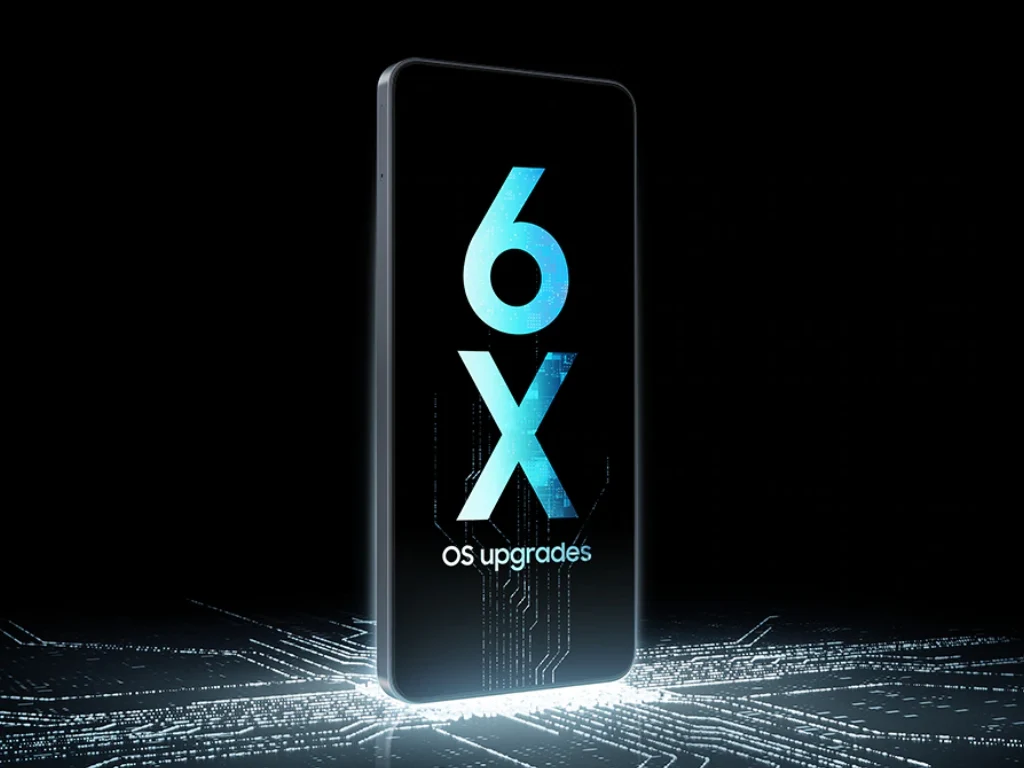
    4. The phone should come with a 5,000 mAh battery, 25W fast charging, and run on Android 15, with plans for six major updates.
    5. The Galaxy M07 might be priced around 86 USD, similar to the recently launched Galaxy A07 (4G).


    The Galaxy M series is known for offering affordable smartphones. There are whispers that Samsung might be developing a new addition to this series, named the Galaxy M07. Before any official announcement, some details about the phone’s specifications have leaked.

    Display and Camera Specs

    As reported by SmartPrix, the Galaxy M07 is expected to sport a 6.7-inch LCD display with a resolution of 720 x 1600 pixels, boasting a 90Hz refresh rate. The camera setup on the back is likely to consist of a 50MP primary camera and a 2MP secondary camera. For selfies, it should have an 8MP camera on the front.

    Performance and Storage

    The Samsung Galaxy M07 is rumored to be equipped with a MediaTek Helio G99 processor, an octa-core chip that debuted in 2022. This processor has already been used in several budget-friendly Android devices, like the Redmi Note 14 LTE and the Poco M6 Pro. It generally scores around 405K points on the AnTuTu V10 benchmark. The device is expected to come with 4GB of RAM and 64GB of internal storage, with potential variations in memory options.

    Battery and Software Features

    Reports suggest that the phone will include a 5,000 mAh battery with 25W fast charging capability, although it is unclear if a charger will be provided in the box. In terms of software, the Galaxy M07 is anticipated to run on Android 15 right out of the box. Furthermore, it is said that the device will receive six significant Android updates. Additional features mentioned in the leaks include an IP54 rating for dust and water resistance, a fingerprint scanner on the side, and stereo speakers. The thickness of the Galaxy M07 is claimed to be 7.6mm, and it weighs around 184g.

    Price Comparison

    The leaked details about the Galaxy M07 hint that it could be a rebranded version of the Galaxy A07 (4G). For those not in the know, the A07 (4G) was recently launched in Indonesia, priced at IDR 1,399,000, which is about 86 USD. The M07 is expected to be released at a similar price point, likely positioning it as an alternative to the A07 (4G) in certain markets.

    Source:
    Link


  • Snapdragon 8 Elite 2: Upcoming Flagship Might Get New Name

    Snapdragon 8 Elite 2: Upcoming Flagship Might Get New Name

    Key Takeaways

    1. Snapdragon 8 Elite 2 may be introduced as Snapdragon 8 Elite Gen 5, but this information is not finalized.
    2. Qualcomm might create an intermediate chip (SM8845) called Snapdragon 8 Elite Gen 4, positioned between existing models.
    3. Qualcomm’s naming conventions for smartphone SoCs have become inconsistent over the years.
    4. The next version of the Snapdragon series is likely to be named Snapdragon 8 Elite 2.
    5. The Snapdragon Summit is scheduled for September 23-25, where the Snapdragon 8 Elite 2 is expected to be highlighted, with devices debuting in October 2025.


    Digital Chat Station, a source on Weibo, has mentioned that the Snapdragon 8 Elite 2 (model number SM8850) might be introduced as the Snapdragon 8 Elite Gen 5. The post, translated from Weibo, uses the word “tentative,” suggesting that this information is not finalized yet. Given Qualcomm’s history, this seems quite likely, and it does make a bit of sense this time around.

    Rumors of an Intermediate Chip

    Previously, there were whispers that Qualcomm could be working on a middle chip (SM8845) that would fit between the Snapdragon 8 Elite (SM8750) and the Snapdragon 8 Elite Gen 5 (SM8850). This chip may possibly be referred to as the Snapdragon 8 Elite Gen 4, enhancing the series’ overall coherence.

    Confusing Naming Conventions

    Describing Qualcomm’s naming choices for smartphone SoCs as inconsistent would be an understatement. Not long ago, the naming was pretty straightforward until the Snapdragon 865 came along, followed by the Snapdragon 888, and then the Snapdragon 8 Gen 1 a year later. After three generations, the Snapdragon 8 Gen name faded away, leading to the emergence of the Snapdragon 8 Elite.

    It’s only logical to expect that the next version would be labeled the Snapdragon 8 Elite 2. The wait isn’t too long, as the upcoming Snapdragon Summit is set for September 23-25. The highlight of the event is expected to be the Snapdragon 8 Elite 2, with devices using this SoC likely making their debut in October 2025.

    Source:
    Link


  • Google Pixel 10 Pro XL and Tensor G5: Top GPU Stability Test Results

    Google Pixel 10 Pro XL and Tensor G5: Top GPU Stability Test Results

    Key Takeaways

    1. The Google Pixel 10 series faces criticism for the performance of its Tensor G5 chip, but shows stability in benchmarks.
    2. The Pixel 10 Pro XL scored 95.1% in the 3DMark WildLife Extreme test, indicating consistent performance across multiple runs.
    3. The Pixel 10 Pro XL outperforms competitors in stability, with the Galaxy S25 Ultra and OnePlus 13 scoring 59.4% and 68.9%, respectively.
    4. The transition to a TSMC node for the Tensor G5 has improved performance stability compared to the previous model.
    5. Despite good stability, the Pixel 10 Pro XL’s overall benchmark scores remain lower than competitors, like the Galaxy S25 Ultra, which scored 3,628.


    The Google Pixel 10 series has been rightfully critiqued for the underwhelming capabilities of its Tensor G5 chip. Even though the Google SoC does not provide outstanding peak performance, recent tests show that it performs reasonably well with what it’s got, exhibiting class-leading stability according to benchmarks.

    Impressive Benchmark Results

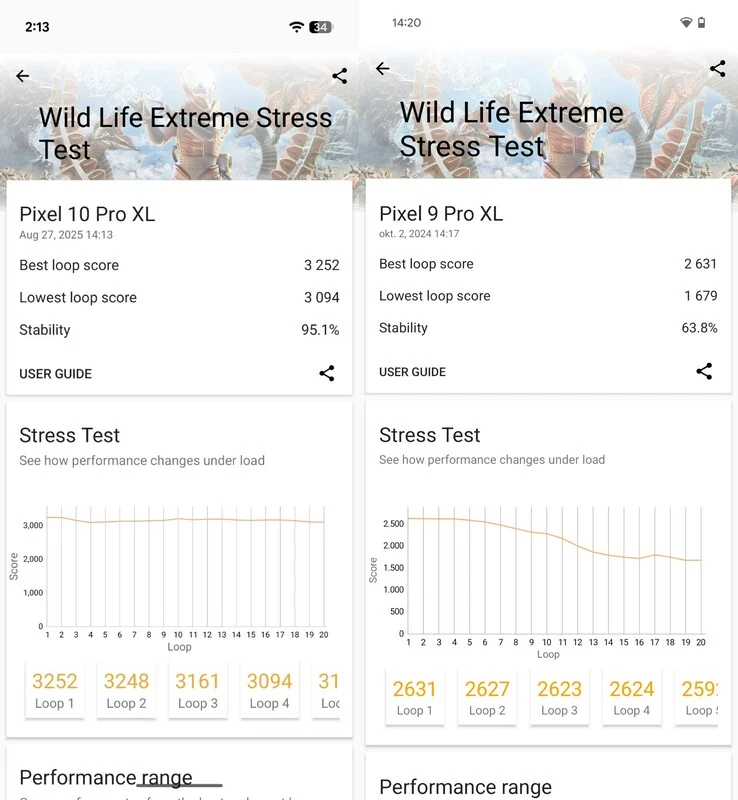
    Reportedly, the Pixel 10 Pro XL achieved an astonishing 95.1% score in the 3DMark WildLife Extreme test. This assessment pushes the device through twenty iterations of the benchmark test, showing that the Pixel phone maintains 95.1% of its maximum performance even at its lowest point.

    Stability Compared to Competitors

    Factors such as ambient temperature do affect this test, but the Pixel 10 Pro XL’s performance is remarkable. In contrast, the 3DMark database reveals that the Galaxy S25 Ultra has a stability score of just 59.4%, while the OnePlus 13 scores a slightly better 68.9%, yet still lags behind the Pixel 10 Pro XL. Although there’s no official benchmark for the Pixel 9 Pro XL from 3DMark, it previously showed a stability of 63.8%, suggesting that the shift to a TSMC node for the Tensor G5 has brought real advantages.

    What It Means for Users

    So, what does all this mean for everyday power users? Honestly, not a whole lot, since it merely shows that the Pixel 10 Pro XL doesn’t throttle significantly. The actual benchmark scores, however, are still quite unimpressive. For context, the Galaxy S25 Ultra achieves a score of 3,628, even under throttled conditions, which is about 10% higher than the Pixel 10 Pro XL’s maximum score of 3,252.

    Source:
    Link


  • OnePlus 15 Launches on Geekbench with Snapdragon 8 Elite 2

    OnePlus 15 Launches on Geekbench with Snapdragon 8 Elite 2

    Key Takeaways

    1. The Snapdragon 8 Elite 2 shows disappointing performance, with a single-core score of 639 and a multi-core score of 1,871.
    2. The chip is operating at a low clock speed of 750 MHz, significantly below its maximum of 4,610 MHz, indicating power constraints.
    3. The performance issues may be due to throttling, affecting the chip’s capabilities during testing.
    4. Qualcomm is expected to officially announce the Snapdragon 8 Elite 2/Snapdragon 8 Elite Gen 5 between September 23 and 25.
    5. The OnePlus 15, which features the Snapdragon 8 Elite 2, is anticipated to launch around the same time as the Snapdragon announcement.


    The Snapdragon 8 Elite 2, also known as Snapdragon 8 Elite Gen 5 if a recent leak is to be believed, made its appearance on Geekbench not long ago. While its performance wasn’t groundbreaking, this was due to the chip being throttled. Now, we have the opportunity to view it again in conjunction with the OnePlus 15 (OnePlus PLK110).

    Performance Review

    Regrettably, the Snapdragon 8 Elite 2 sample shows even worse performance than its previous assessment, achieving a single-core score of 639 and a multi-core score of 1,871. The OnePlus 15 model in this case is equipped with 16 GB of RAM and is operating on Android 16.

    Technical Insights

    A look at Geekbench’s data reveals that the chip is functioning at a lowly 750 MHz, which is far below its maximum clock speed of 4,610 MHz. It seems to be working in a very power-constrained setup. However, there is still a slim chance that this listing could be fabricated.

    Upcoming Launch

    Qualcomm is set to present the Snapdragon 8 Elite 2/Snapdragon 8 Elite Gen 5 between September 23 and 25 next month. The OnePlus 13 made its debut in China in late October, and it is anticipated that the OnePlus 15 will launch around the same period.

    Source:
    Link


  • iPhone 17 Leak: First-Party Magnetic Nylon Crossbody Strap Revealed

    iPhone 17 Leak: First-Party Magnetic Nylon Crossbody Strap Revealed

    Key Takeaways

    1. The Apple iPhone 17 series will be revealed on 9 September, featuring four new models.
    2. New successors to the Apple Watch Series 10 and Apple Watch Ultra 2 will also be introduced.
    3. Apple plans to release TechWoven cases and magnetic crossbody straps.
    4. The straps will be made of woven nylon and silicone, available in various colors, and require a TechWoven case for attachment.
    5. The magnetic straps may allow for easy length adjustments and may be compatible with AirPods Pro 3.


    The Apple iPhone 17 series is expected to be revealed on 9 September. Along with four new models of the iPhone 17, the company will also introduce successors to the Apple Watch Series 10, which is around $359 on Amazon, and the Apple Watch Ultra 2. Additionally, there are plans for a variety of accessories, including the new TechWoven cases and crossbody straps. Leaker Majin Bu Official has released some early information regarding these upcoming straps.

    Material Choices and Colors

    Apple is likely to provide two types of materials: woven nylon and silicone, with various colors to match the new protective cases. Importantly, the straps cannot attach directly to an iPhone; they need to be used in conjunction with a TechWoven case that includes a built-in connector. The straps also come with a magnetic feature for easy attachment and removal.

    Magnetic Features and Compatibility

    According to Majin Bu Official, the crossbody straps are magnetic along their full length, potentially because of embedded metal fibers. The reason behind this design is still uncertain, but it may allow for simple length adjustments. There’s also a possibility that these straps will work with the AirPods Pro 3, which wouldn’t be surprising since the charging case for AirPods Pro 2 already supports a hand strap. The pricing details for these crossbody straps have not been disclosed yet. As usual, it is wise to be cautious with leaked information, but the event on 9 September is anticipated to shed more light on these products.

    Source:
    Link


  • OnePlus 15 Color Options and Memory Configurations Revealed

    OnePlus 15 Color Options and Memory Configurations Revealed

    Key Takeaways

    1. The OnePlus 15 will run on the Snapdragon 8 Elite 2 processor.
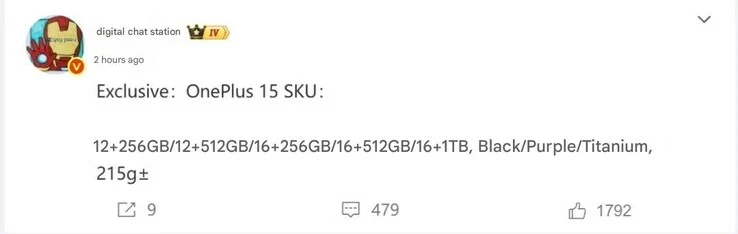
    2. It will offer five memory configurations: 12GB/256GB, 12GB/512GB, 16GB/256GB, 16GB/512GB, and 16GB/1TB.
    3. The smartphone will be available in three colors: black, purple, and titanium, and will weigh approximately 215 grams.
    4. The display is expected to be 6.78 inches with a 165Hz refresh rate and a larger 7,000mAh battery.
    5. The OnePlus 15 is set to launch in China this October, with a global release in early 2026, and a potential OnePlus 15T in development.


    The OnePlus 15 is likely to be the next top smartphone from the Chinese brand. Earlier, it showed up on Geekbench, confirming it runs on the Snapdragon 8 Elite 2 processor. Now, a fresh leak has come out, disclosing its RAM options and color choices.

    Memory Configurations

    In a post that was later modified, Digital Chat Station shared that the OnePlus 15 will be available in five different memory setups. The entry-level version will feature 12GB of RAM with 256GB of storage. There will also be other options such as 12GB/512GB, 16GB/256GB, 16GB/512GB, and a high-end 16GB/1TB variant.

    Color Options and Weight

    Moreover, the OnePlus 15 is expected to be available in three colors: black, purple, and titanium. The source also mentioned that the smartphone will weigh about 215 grams.

    Rumors from the past indicate that the OnePlus 15 might sport a 6.78-inch screen with a 165Hz refresh rate. In comparison, the OnePlus 13 (currently priced at $787 on Amazon) had a bigger 6.82-inch display but only a 120Hz refresh rate. The upcoming model may also boast a large 7,000mAh battery, an upgrade from the previous 6,000mAh. Furthermore, it is anticipated that the phone will showcase a new design style.

    Release Timeline

    The smartphone is set to launch in China this October, followed by a global rollout in early 2026. Additionally, there are hints that the company is developing a new compact flagship device, the OnePlus 15T.

    Source:
    Link


  • Exynos 2600 Appears on Geekbench with High Performance Scores

    Exynos 2600 Appears on Geekbench with High Performance Scores

    Key Takeaways

    1. Samsung will use its Exynos 2600 chip in at least one model of the Galaxy S26 series.
    2. The Exynos 2600 features a deca-core configuration with improved clock speeds compared to earlier tests.
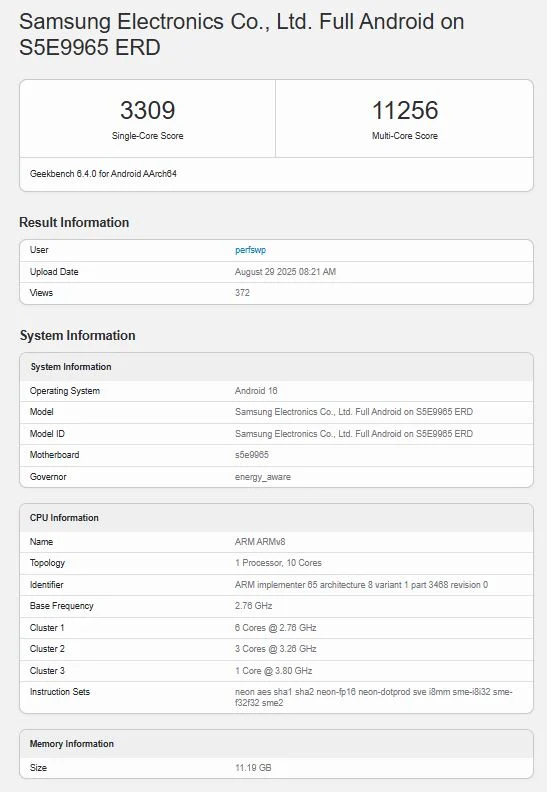
    3. It achieves a single-core score of 3,309, surpassing devices with the Snapdragon 8 Elite chipset.
    4. The multi-core performance is impressive, scoring 11,256—20% higher than the average Snapdragon 8 Elite.
    5. The Exynos 2600 shows a 45% performance increase over the previous Exynos 2500 chipset.


    Samsung is planning to use its own Exynos 2600 chip in at least one model of the upcoming Galaxy S26 series. This chipset was first seen on Geekbench last month, but it had lower clock speeds and performance ratings at that time. Now, it has returned with improved performance details.

    Exynos 2600 Specifications

    On Geekbench, the Exynos 2600 is identified as “S5E9965.” It has a deca-core configuration, which includes six cores operating at 2.76 GHz, three cores at 3.26 GHz, and a top core at 3.80 GHz. These clock speeds are all higher than what was originally shown when the chipset first appeared on the benchmark tests.

    Performance Insights

    The performance metrics for the Exynos 2600 are quite impressive. It achieves a single-core score of 3,309, which is a bit better than any device running the Snapdragon 8 Elite that we’ve tested, and around 10% above the average performance of the Qualcomm chipset overall. The multi-core performance is even more outstanding, with the Exynos 2600 scoring a robust 11,256—20% more than what the average Snapdragon 8 Elite phone can achieve.

    Future Comparisons

    While it’s hard to predict how these results would compare against Qualcomm’s next-generation chipset, they show a significant 45% increase in performance over the underwhelming Exynos 2500, which is likely to excite fans of the Exynos brand.

    Source:
    Link


  • Motorola Edge 60 Neo: Mid-Range Smartphone Launch Colors Revealed

    Motorola Edge 60 Neo: Mid-Range Smartphone Launch Colors Revealed

    Key Takeaways

    1. Motorola is expected to announce a new device in the Edge 60 series at IFA 2025 in Berlin.
    2. The retail name of the upcoming device remains unclear; insights are based on Evan Blass’s reliable sources.
    3. The new device shares design elements with other Edge 60 models, including the Edge 60 and Edge 60 Pro.
    4. Specifications of the device are not yet revealed, but it features an in-display fingerprint scanner and a flat P-OLED display.
    5. The Edge 60 Neo is shown to have three cameras on its back, but further camera specifications are unknown.


    It seems that Motorola is set to reveal a new device in the Edge 60 series next week at IFA 2025 held in Berlin. While the company hasn’t officially announced this, Evan Blass has obtained three pictures of the upcoming smartphone in three different colors.

    Retail Name Uncertainty

    Based on the information we have, the photos below do not provide any clues about what the retail name of the device might be. Therefore, we are currently relying on Blass’ insights, which have been trustworthy for over ten years. The device appears to share design elements with the other models in the Edge 60 series, which now consists of the Edge 60, Edge 60s, Edge 60 Fusion, Edge 60 Stylus, and the Edge 60 Pro (currently priced at $649.99 on Amazon).

    Specifications Still a Mystery

    Sadly, the specifications are still not disclosed at this time. However, the images released by Blass offer some hints. For instance, one image shows that the alleged Edge 60 Neo includes an in-display fingerprint scanner, indicating that it likely has a P-OLED display. Additionally, this display seems to have a flat surface, which sets it apart from many other models in the Edge 60 lineup. The Edge 60 Neo also has three cameras on its back, but we can’t read the text below the camera flash which might give us more information about the camera specs.

    Source:
    Link