
Tag: 3DMark

  • Google Pixel 10 Pro XL and Tensor G5: Top GPU Stability Test Results

    Google Pixel 10 Pro XL and Tensor G5: Top GPU Stability Test Results

    Key Takeaways

    1. The Google Pixel 10 series faces criticism for the performance of its Tensor G5 chip, but shows stability in benchmarks.
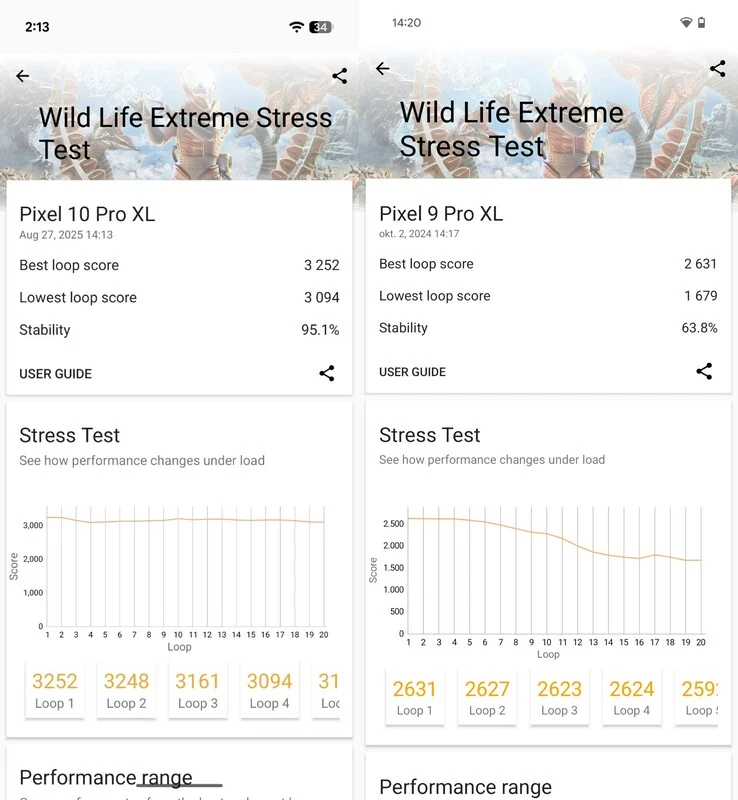
    2. The Pixel 10 Pro XL scored 95.1% in the 3DMark WildLife Extreme test, indicating consistent performance across multiple runs.
    3. The Pixel 10 Pro XL outperforms competitors in stability, with the Galaxy S25 Ultra and OnePlus 13 scoring 59.4% and 68.9%, respectively.
    4. The transition to a TSMC node for the Tensor G5 has improved performance stability compared to the previous model.
    5. Despite good stability, the Pixel 10 Pro XL’s overall benchmark scores remain lower than competitors, like the Galaxy S25 Ultra, which scored 3,628.


    The Google Pixel 10 series has been rightfully critiqued for the underwhelming capabilities of its Tensor G5 chip. Even though the Google SoC does not provide outstanding peak performance, recent tests show that it performs reasonably well with what it’s got, exhibiting class-leading stability according to benchmarks.

    Impressive Benchmark Results

    Reportedly, the Pixel 10 Pro XL achieved an astonishing 95.1% score in the 3DMark WildLife Extreme test. This assessment pushes the device through twenty iterations of the benchmark test, showing that the Pixel phone maintains 95.1% of its maximum performance even at its lowest point.

    Stability Compared to Competitors

    Factors such as ambient temperature do affect this test, but the Pixel 10 Pro XL’s performance is remarkable. In contrast, the 3DMark database reveals that the Galaxy S25 Ultra has a stability score of just 59.4%, while the OnePlus 13 scores a slightly better 68.9%, yet still lags behind the Pixel 10 Pro XL. Although there’s no official benchmark for the Pixel 9 Pro XL from 3DMark, it previously showed a stability of 63.8%, suggesting that the shift to a TSMC node for the Tensor G5 has brought real advantages.

    What It Means for Users

    So, what does all this mean for everyday power users? Honestly, not a whole lot, since it merely shows that the Pixel 10 Pro XL doesn’t throttle significantly. The actual benchmark scores, however, are still quite unimpressive. For context, the Galaxy S25 Ultra achieves a score of 3,628, even under throttled conditions, which is about 10% higher than the Pixel 10 Pro XL’s maximum score of 3,252.

    Source:
    Link


  • 3DMark Adds DLSS 4 Benchmarks for Nvidia RTX 50 Series

    3DMark Adds DLSS 4 Benchmarks for Nvidia RTX 50 Series

    Most people looking to buy a Nvidia RTX 5080 or RTX 5090 are having a tough time finding them available. For those who are lucky enough to get their hands on one of these graphics cards, 3DMark is here to help you see if the struggle was worth it. UL Benchmarks has recently shared that its well-known GPU testing tool now includes support for Nvidia DLSS 4. This new multi-frame generation feature is exclusive to the RTX 50 series, but it also offers advantages for older Nvidia graphics cards.

    Evaluating Gaming Performance

    3DMark is frequently used by gamers to assess their gaming setups and compare their scores with others who have similar hardware. UL Benchmarks collaborated closely with Nvidia to create a fresh version of the Port Royal test. The benchmark runs through two passes: first, it tests without any DLSS features. Next, it turns on DLSS, which allows for graphics to be processed at lower resolutions, then uses AI technology to enhance them to higher resolutions. After the test, a comprehensive report is generated, detailing the results, including framerates.

    Benefits of DLSS 4

    The main reason for the expected performance improvements in the RTX 50 series is DLSS 4’s multi-frame generation. However, if games do not support Nvidia’s technology, those with RTX 5080 and RTX 5090 cards might find that the upgrade isn’t as significant as they hoped. Nevertheless, many of the advanced DLSS 4 functions are compatible with the RTX 30 and RTX 40 series, featuring enhancements like Ray Reconstruction for better Ray Tracing and Super Resolution options. With the revamped 3DMark Port Royal test, gamers have the choice to enable DLSS 4, DLSS 3, or DLSS 2 based on their GPU.

    Exploring DLSS 4’s Full Potential

    To explore DLSS 4’s capabilities, users of 3DMark can switch between different frame generation settings such as 2x, 3x, and 4x. This GPU benchmarking tool is designed to be future-ready, supporting resolutions from Full HD all the way up to 8K.

    While gamers can access a free demo of 3DMark, the paid version is required to achieve more detailed benchmarks. If you bought the software on or after January 8th, 2019, you will be able to use the DLSS 4 update.

    Source:
    Link