Tag: Tensor G5

  • CheckMag Review: 3 Months with the Pixel 10 Pro Fold

    CheckMag Review: 3 Months with the Pixel 10 Pro Fold

    Key Takeaways

    1. Display Limitations: The 8-inch square screen is impressive but impractical for most media, which is typically widescreen.

    2. App Compatibility: Many apps do not utilize the extra screen space effectively, making the experience similar to using a regular smartphone.

    3. Performance Drawbacks: The Google Tensor G5 processor struggles with demanding tasks, affecting overall performance for heavier applications and games.

    4. Camera Usability: While using the rear cameras for selfies sounds appealing, the method is inconvenient and less practical than using a regular phone.

    5. Value for Money: The high cost of foldables like the Pixel 10 Pro Fold does not seem to justify the extra features, leading to questions about their overall value.


    It took me a long time to finally get into foldables, mainly because I was worried about how tough they are. But when the Pixel 10 Pro Fold came out with an IP68 rating for dust and water resistance, I thought, why not? Now, after using it for 3 months, I wouldn’t say foldables are a total flop, yet I find it hard to see why they cost so much and what you really gain with the extra screen size.

    Display Experience

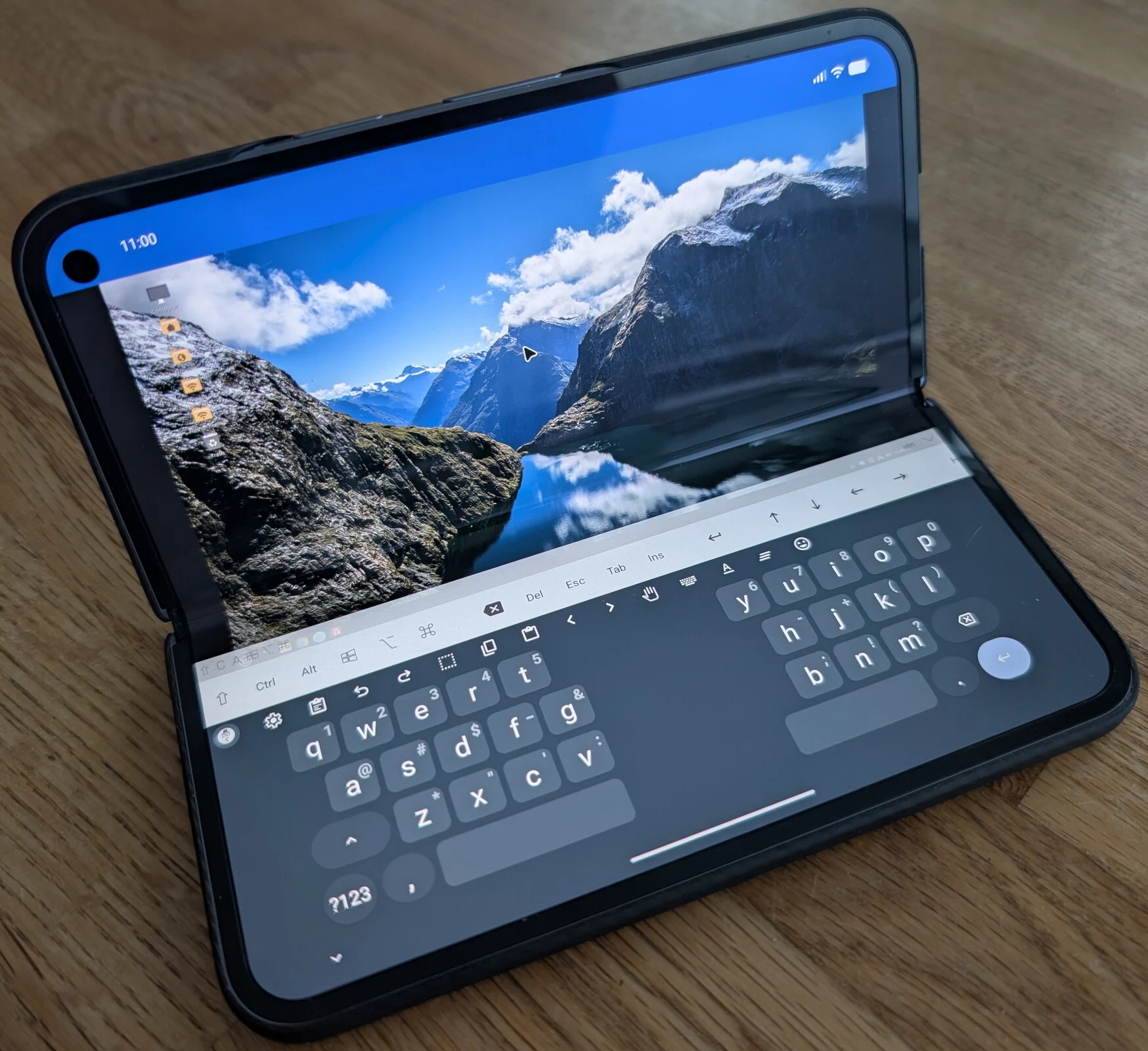
    Having an 8-inch screen on paper looked super cool. Unfolding a foldable for the first time and seeing that large internal display is really impressive, especially if you’re used to regular phones, even the bigger models. But I didn’t realize just how unpractical a square screen can be. The main thing you do with it is watch media. Whether it’s YouTube or Netflix, modern media is widescreen by nature. Sure, it feels immersive on the internal display, but honestly, it’s hardly bigger than a regular smartphone.

    Browsing and Apps

    The extra screen space is great for web browsing, and some websites fit nicely on the foldable screen. However, many sites don’t adjust well, leaving big empty areas beside the text. Plus, apart from a few Google apps, not many take advantage of the additional screen area. You might see more content at once or have a larger window, but for most apps, it feels almost the same as using a regular phone.

    When I imagined running apps next to each other, it seemed like a fantastic idea. But after 3 months of usage, I hardly ever do it. When I need to copy something between apps, there’s hardly any speed difference compared to using the regular task switcher. In fact, it often takes longer to set up two apps side by side.

    Remote Access and Resolution

    One reason I chose a foldable was for the extra screen space while managing remote computers via Remote Desktop or VNC. I have to admit, it does have an advantage here. But since most PCs have widescreen displays, you face the same issue as with videos unless you adjust your host machine to 5:4 or 4:3 aspect ratios. When you do that, the experience is excellent, and you can make full use of the foldable’s square screen. The catch is that every time you connect from another machine, you’ll need to revert to the traditional widescreen settings.

    Naturally, these drawbacks aren’t exclusive to the Pixel Fold series; they apply to just about any square foldable. It does make you think how Google had the ideal foldable design with the original Pixel Fold (available on Amazon), but then they seemed to cave to pressure from Samsung. This might also explain why Samsung is developing a Galaxy Z Fold Wide alongside the classic Galaxy Tri-Fold.

    Performance Issues

    Google isn’t typically known for having top-notch in-house processors (like Tensor), but the G5 in the Pixel 10 series is pretty bad. For everyday tasks such as browsing and switching between apps, it works fine and is good on battery, but for anything even slightly demanding, get ready to be disappointed.

    I didn’t buy the Pixel 10 Pro Fold specifically for emulation, but the big screen does make it decent for some 3DS emulation. This is something I never tried on regular phones due to the limited space needed to show both screens of the 3DS side by side.

    Emulation Performance

    The Pixel 10 Pro Fold can handle lighter games at the native resolution of the 3DS (400 x 240), like New Super Mario Bros 2 and Super Mario 3D Land (just barely), but forget about anything more demanding, especially at 2x resolution or higher. With Donkey Kong Country Returns 3D, the Tensor G5 struggled to even hit double digits, maxing out around 15 FPS at 1x resolution.

    The Pixel 10 Pro Fold doesn’t have the same camera setup as its non-foldable counterparts, despite having “Pro” in its name. That’s a compromise, but honestly, it’s not as big of a deal as you might think. Even with the smaller sensors, my experience shows the cameras are mostly comparable, particularly the zoom, which was a big concern for me before I decided to buy it.

    Selfie Functionality

    One of the main reasons I was interested was using the rear cameras as selfie cameras when the device is opened. While that sounds great in theory, it’s almost completely impractical in real life. It took me a few weeks to figure out what I call the “devil horns” grip. This is basically the only way to hold the phone and snap a selfie at the same time, which kind of reduces the risk of dropping an $1800 device.

    Though it works, there are a few seconds needed to get a solid grip, and this method is definitely not as convenient as a regular phone, even if the photo quality is way better. The chance to use the ultrawide camera for selfies is definitely a plus. However, don’t even think about taking landscape selfies with your right hand. Unless you have really stretchy thumbs, reaching the shutter button is nearly impossible.

    All of these experiences are just my personal take, and yours might be completely different based on how you use your phone. But when foldable phones are priced almost double that of regular ones (or even more, like the Tri-Fold), they don’t seem to deliver double the value. The extra screen, while nice, doesn’t really offer much added value in practical use, and the less said about the Tensor G5, the better.

    Source:
    Link



  • Genshin Impact Update Makes Pixel 10 Series Nearly Unplayable

    Genshin Impact Update Makes Pixel 10 Series Nearly Unplayable

    Key Takeaways

    1. Google’s Tensor chips are not aimed at competing with high-end Qualcomm and MediaTek products, leading to potential disappointment for gamers.
    2. Genshin Impact’s updated minimum requirements exclude devices with PowerVR GPUs, affecting older Apple A series chips and the Pixel 10 series.
    3. Performance of Genshin Impact on the Pixel 10 is subpar, with reports of lag and unresponsiveness from users.
    4. Issues seem to stem from PowerVR GPU drivers rather than the game itself, with performance varying by location within the game.
    5. Google has not provided a timeline for resolving these performance issues, leaving users uncertain.


    Google has consistently maintained that its Tensor chips are not designed to rival the high-end products from Qualcomm and MediaTek. Consequently, players looking to enjoy high-quality games may find themselves disappointed. Genshin Impact, recognized as one of the most demanding games available, is struggling to perform well on Google’s latest smartphones.

    New Device Requirements

    An update on the Genshin Impact website outlines the new minimum requirements for devices. For Android users, it clearly mentions “non Power VR GPU,” which points out several older Apple A series chips, such as the Apple A10X, some basic MediaTek devices like the Helio G35, and notably, the Pixel 10 series that runs on the Tensor G5 with a PowerVR GPU.

    Performance Issues

    Although Genshin Impact can technically operate on the Pixel 10, the experience is far from satisfactory. Gamers on platforms like X and Reddit have shared videos showing that the game is nearly unplayable on the Pixel 10 Pro XL due to lag and an unresponsive touchscreen. However, one player mentioned that the lag only occurs in specific areas, suggesting the game runs better in other parts.

    In any case, this seems to be a problem related to PowerVR GPU drivers rather than Genshin Impact itself. The PowerVR DXT-48 in the Tensor G5 is capable of handling most games, albeit with some compromises on visual quality. Google has not yet addressed this issue, leaving users unsure of when a resolution might be available.

    Source:
    Link


  • Pixel 10 GPU Performance Issues May Be Fixed with Driver Update

    Pixel 10 GPU Performance Issues May Be Fixed with Driver Update

    Key Takeaways

    1. Google launched the Pixel 10 series on August 20, featuring the new Tensor G5 chip, which is built on a 3 nm process for improved performance.
    2. The Tensor G5’s GPU, PowerVR DXT-48-1536, shows disappointing real-world performance, particularly under load, despite strong theoretical specifications.
    3. The Pixel 10 phones are currently using an outdated GPU driver (version 24.3), which is likely limiting their performance.
    4. A new driver (version 25.1) from Imagination Technologies is available, which supports Vulkan 1.4 and could significantly improve performance.
    5. Google needs to prioritize releasing the updated driver to unlock the full potential of the Tensor G5 in the Pixel 10 devices.


    Google revealed its Pixel 10 series on August 20, and while the design changes were minor, there were notable enhancements inside the device. The new SoC, Tensor G5, is Google’s first chip built on a 3 nm process, which theoretically should lead to a significant boost in performance. Despite this, real-world performance has been less impressive, especially regarding the GPU. Thankfully, there may be an easy solution, provided Google takes action.

    GPU Specifications and Performance

    The Tensor G5 is equipped with a PowerVR DXT-48-1536 GPU made by Imagination Technologies. On paper, this GPU appears to be robust, supporting Vulkan 1.3 with a theoretical performance of 1.5 TFLOPS FP32 and a maximum clock speed of 1,100 MHz. However, tests in the real world and synthetic benchmarks reveal performance levels that do not align with the SoC’s potential. Users have also observed that the GPU remains at a low idle frequency of 396 MHz, even when under significant load (source: Android Police).

    Driver Issues Affecting Performance

    It has come to light that the Pixel 10 phones are using an outdated driver, version 24.3, which likely contributes to the disappointing GPU performance. Fortunately, Imagination Technologies has rolled out a new driver, version 25.1, which adds support for Vulkan 1.4, enhances OpenCL features, and ensures compatibility with Android 16. This update is expected to enhance real-world performance and enable the Tensor G5 in the Pixel 10 devices to reach its full potential.

    What’s Next for Google?

    The next step is for Google to push out a driver update. Although the latest GPU driver was made available before the Pixel 10 series was introduced, the phones have continued to run an earlier version. It remains uncertain how high a priority driver updates are for Google. Nonetheless, the company has already addressed issues with red, green, and white lines appearing on some Pixel 10 units, making it possible that the GPU performance fix could be the next item on their agenda.

    Source:
    Link


  • Google Tensor G5 Performance in Pixel 10 XL Gaming Test Mixed

    Google Tensor G5 Performance in Pixel 10 XL Gaming Test Mixed

    Key Takeaways

    1. The Pixel 10 series features the new Tensor G5 chip, which is Google’s first 3 nm smartphone processor, enhancing power efficiency.
    2. The PowerVR D-Series GPU in the Tensor G5 shows stability in stress tests, but synthetic benchmark results do not reflect real gaming performance.
    3. Popular games like Valorant Mobile and PUBG Mobile perform well at an average of 60 FPS, while Genshin Impact and Wuthering Waves struggle with lower frame rates.
    4. Fortnite performance is disappointing, averaging only 25 FPS with significant frame drops and high temperatures during gameplay.
    5. Future software updates may improve gaming performance for the Tensor G5 in the Pixel 10 series.


    Google has released its latest Pixel 10 series, which includes several enhancements compared to the previous generation. One of the standout features is the Tensor G5, introduced in August 2025. This is the first 3 nm smartphone chip from Google, promising significant improvements in power efficiency compared to its predecessor.

    Performance Insights

    The new System on Chip (SoC) is equipped with the PowerVR D-Series DXT-48-1536 GPU. Recent stress tests conducted with the Pixel 10 XL have shown that it maintains impressive stability. However, the results from synthetic benchmarks don’t seem to translate well into actual gaming performance.

    Gaming Tests

    A recent video evaluated the Tensor G5’s performance by playing several popular games on the Pixel 10 XL. According to the video, the gaming experience does not match the excitement of the synthetic benchmark results. Nevertheless, some games performed decently.

    For instance, Valorant Mobile ran at an average of 60 FPS on high graphics settings, and PUBG Mobile also held the same average with the “Smooth + Extreme” preset. In contrast, Genshin Impact struggled to deliver a smooth experience, averaging only 29 FPS on the highest settings. Wuthering Waves had a similar performance, achieving 44 FPS at the top visual settings on the Pixel 10 XL.

    Disappointing Results

    The biggest letdown was seen with Fortnite, where the Tensor G5 exhibited significant frame drops and stutter. During a 25-minute session, the average frame rate was just 25 FPS with the “Epic” preset. Additionally, while playing Fortnite, the device reached a peak temperature of 42.9° C, while it remained cooler at around 42° C or less with other games. This suggests that the SoC might have been throttling during the intense gaming session.

    As the Pixel 10 series has only recently launched (you can order it on Amazon and receive a complimentary $200 gift card), it’s likely that updates will enhance the gaming performance of the Tensor G5 in the future. For more information on how the SoC performs currently, check out the videos linked below.

    Source:
    Link


  • Google Pixel 10 Pro XL and Tensor G5: Top GPU Stability Test Results

    Google Pixel 10 Pro XL and Tensor G5: Top GPU Stability Test Results

    Key Takeaways

    1. The Google Pixel 10 series faces criticism for the performance of its Tensor G5 chip, but shows stability in benchmarks.
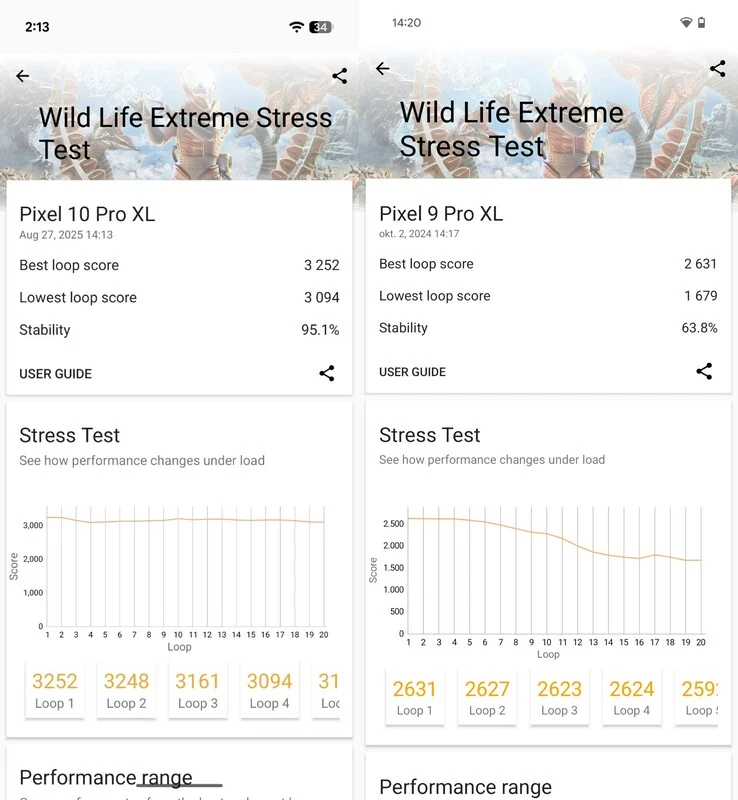
    2. The Pixel 10 Pro XL scored 95.1% in the 3DMark WildLife Extreme test, indicating consistent performance across multiple runs.
    3. The Pixel 10 Pro XL outperforms competitors in stability, with the Galaxy S25 Ultra and OnePlus 13 scoring 59.4% and 68.9%, respectively.
    4. The transition to a TSMC node for the Tensor G5 has improved performance stability compared to the previous model.
    5. Despite good stability, the Pixel 10 Pro XL’s overall benchmark scores remain lower than competitors, like the Galaxy S25 Ultra, which scored 3,628.


    The Google Pixel 10 series has been rightfully critiqued for the underwhelming capabilities of its Tensor G5 chip. Even though the Google SoC does not provide outstanding peak performance, recent tests show that it performs reasonably well with what it’s got, exhibiting class-leading stability according to benchmarks.

    Impressive Benchmark Results

    Reportedly, the Pixel 10 Pro XL achieved an astonishing 95.1% score in the 3DMark WildLife Extreme test. This assessment pushes the device through twenty iterations of the benchmark test, showing that the Pixel phone maintains 95.1% of its maximum performance even at its lowest point.

    Stability Compared to Competitors

    Factors such as ambient temperature do affect this test, but the Pixel 10 Pro XL’s performance is remarkable. In contrast, the 3DMark database reveals that the Galaxy S25 Ultra has a stability score of just 59.4%, while the OnePlus 13 scores a slightly better 68.9%, yet still lags behind the Pixel 10 Pro XL. Although there’s no official benchmark for the Pixel 9 Pro XL from 3DMark, it previously showed a stability of 63.8%, suggesting that the shift to a TSMC node for the Tensor G5 has brought real advantages.

    What It Means for Users

    So, what does all this mean for everyday power users? Honestly, not a whole lot, since it merely shows that the Pixel 10 Pro XL doesn’t throttle significantly. The actual benchmark scores, however, are still quite unimpressive. For context, the Galaxy S25 Ultra achieves a score of 3,628, even under throttled conditions, which is about 10% higher than the Pixel 10 Pro XL’s maximum score of 3,252.

    Source:
    Link


  • Google Pixel 10 Pro XL Benchmarks: Tensor G5 CPU & GPU Issues

    Google Pixel 10 Pro XL Benchmarks: Tensor G5 CPU & GPU Issues

    Key Takeaways

    1. The Pixel 10 series, featuring the Tensor G5 chip, has launched globally and early user tests are providing performance insights.
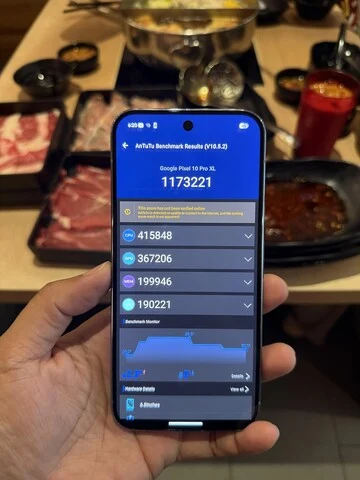
    2. The Pixel 10 Pro XL scored 1,173,221 on AnTuTu, competing with devices using Snapdragon 8s Gen 3 and Dimensity 8350.
    3. CPU performance is strong, with a score of 415,848, showing a 15% increase over the Pixel 9 Pro XL and matching last-generation flagships.
    4. GPU performance is a concern, with a score of 367,206, representing a 20% decrease from the Pixel 9 Pro XL’s GPU performance.
    5. Vulkan and OpenCL performance metrics are also disappointing, with low scores on 3DMark tests compared to devices with Snapdragon 8 Gen 2.


    Google has recently launched the Pixel 10 series around the globe. These high-end smartphones are now reaching customers, and early deliveries are giving us a glimpse into the real-world performance of devices powered by the Tensor G5 chip.

    Performance Metrics

    Even though Geekbench hasn’t provided official scores for the Pixel 10 series yet, a Reddit user has shared test results from their new Pixel 10 Pro XL using AnTuTu. The flagship device achieved a score of 1,173,221, placing it in the same league as competitors like the Honor 200 Pro and Motorola Edge 60 Pro, which use the Snapdragon 8s Gen 3 and Dimensity 8350 chips, respectively, on AnTuTu’s rankings.

    CPU and GPU Insights

    On the CPU front, the Pixel 10 Pro XL recorded a score of 415,848. This is comparable to high-end chipsets such as the Snapdragon 8s Gen 4, Snapdragon 8 Gen 3, and MediaTek Dimensity 9300+. It also marks an approximate 15% increase in performance compared to the Pixel 9 Pro XL. Overall, the CPU performance is on par with last-generation flagship devices, but this could change soon as Qualcomm and MediaTek are expected to introduce their new premium chipsets in the coming weeks.

    However, the GPU performance tells a different story. The PowerVR’s IMG DXT-48-1536 found in the Pixel 10 Pro XL managed a score of 367,206, which is concerning as it falls short of the Pixel 9 Pro XL’s Mali-G715 MC7 GPU, which scored over 440,000 in similar tests. This suggests a significant decrease of about 20% in GPU performance from one generation to the next, putting the Tensor G5’s GPU performance on par with the older Snapdragon 8 Gen 1.

    Software Impact

    The reasons behind the disappointing GPU benchmark results remain unclear, but the outlook isn’t encouraging. The Vulkan and OpenCL performance scores for the Pixel 10 Pro XL aren’t impressive either, and a 3,202 score on the 3DMark WildLife Extreme test is only comparable to devices equipped with the Snapdragon 8 Gen 2.

    Source:
    Link


  • Google Launches Tensor G5: First 3nm Smartphone Chip

    Google Launches Tensor G5: First 3nm Smartphone Chip

    Key Takeaways

    1. The Tensor G5 SoC is the first chip made with TSMC’s 3 nm technology, enhancing power efficiency.
    2. It features an eight-core CPU with a claimed performance increase of up to 34% over the Tensor G4.
    3. The Tensor Processing Unit (TPU) is reportedly 60% faster than its predecessor.
    4. It includes the Google Titan M2 security chip for improved security measures.
    5. The Tensor G5 supports C2PA Content Credentials and can run the Gemini Nano AI model locally for various on-device features.


    Google recently introduced its new Tensor G5 SoC for the Pixel 10 series. The chip has been widely discussed online, and from what we can tell, it doesn’t bring significant changes. Nevertheless, it is the first chip produced using TSMC’s advanced 3 nm technology, which should improve power efficiency.

    Specifications and Performance

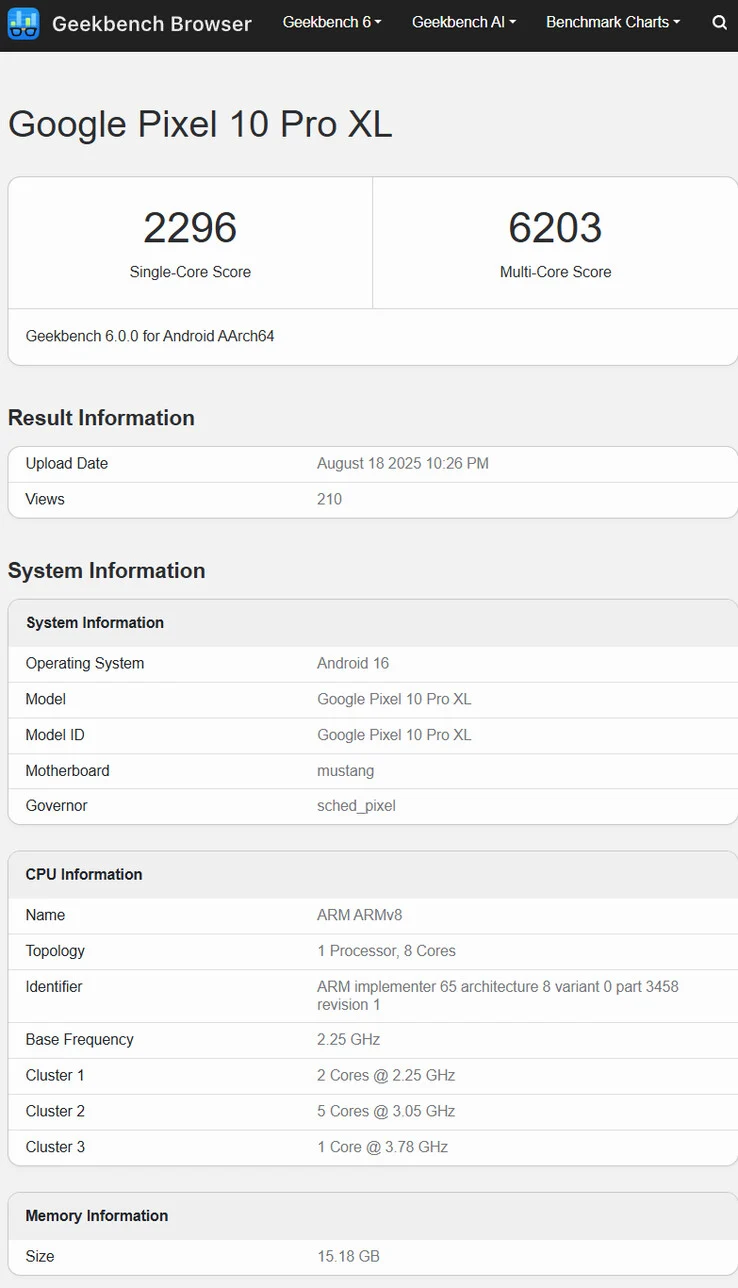
    Google hasn’t officially released the specifications yet, but a previous Geekbench leak indicated that the chip might feature an eight-core CPU. It includes one Cortex-X4 core running at 3.78 GHz, five Cortex-A725 cores at 3.05 GHz, and two Cortex-A520 efficiency cores clocked at 2.25 GHz. Google claims that this setup could provide up to a 34% performance increase compared to the Tensor G4. In addition, its Tensor Processing Unit (TPU) is said to be as much as 60% faster than its predecessor.

    GPU and Security Features

    While details about the GPU in the Tensor G5 remain undisclosed, many believe it to be the PowerVR DXT-48-1536 from Imagination Technologies. It appears that hardware-level raytracing is not enabled. Other than that, info about the internal components is sparse, except for the inclusion of the Google Titan M2 security chip for enhanced protection.

    New Features

    Importantly, the Tensor G5 marks the first Google phone to support C2PA Content Credentials, which aims to combat the massive amount of AI-generated content. Furthermore, it can operate the company’s Gemini Nano AI model locally, enabling features like Magic Cue, Voice Translate, and Call Notes to function on-device, likely without needing an internet connection.

    Source:
    Link


  • Google Pixel 10 Pro XL Early Benchmark Shows Snapdragon 8 Gen 3 Performance

    Google Pixel 10 Pro XL Early Benchmark Shows Snapdragon 8 Gen 3 Performance

    Key Takeaways

    1. Google will unveil the Pixel 10 series soon, replacing the Pixel 9 series, including the Pixel 9 Pro Fold priced at $1,699.
    2. Numerous leaks, including benchmark scores, have emerged ahead of the launch for the Pixel 10 Pro XL.
    3. The Tensor G5 shows a significant performance improvement over the Tensor G4, with an 18% higher single-core score and a 37% higher multi-core score.
    4. The Tensor G5’s performance is comparable to the Snapdragon 8 Gen 3, but it falls short of the newer Snapdragon 8 Elite.
    5. Final retail software for the Pixel 10 series may improve benchmark scores, but it is unlikely to close the performance gap with the Snapdragon 8 Elite.


    The Pixel 10 series is set to be unveiled very soon. As previously announced, Google plans to use tomorrow’s event to introduce the new flagship models that will take the place of the Pixel 9 series, including the Pixel 9 Pro Fold, which currently retails for $1,699 on Amazon.

    Leaks and Rumors

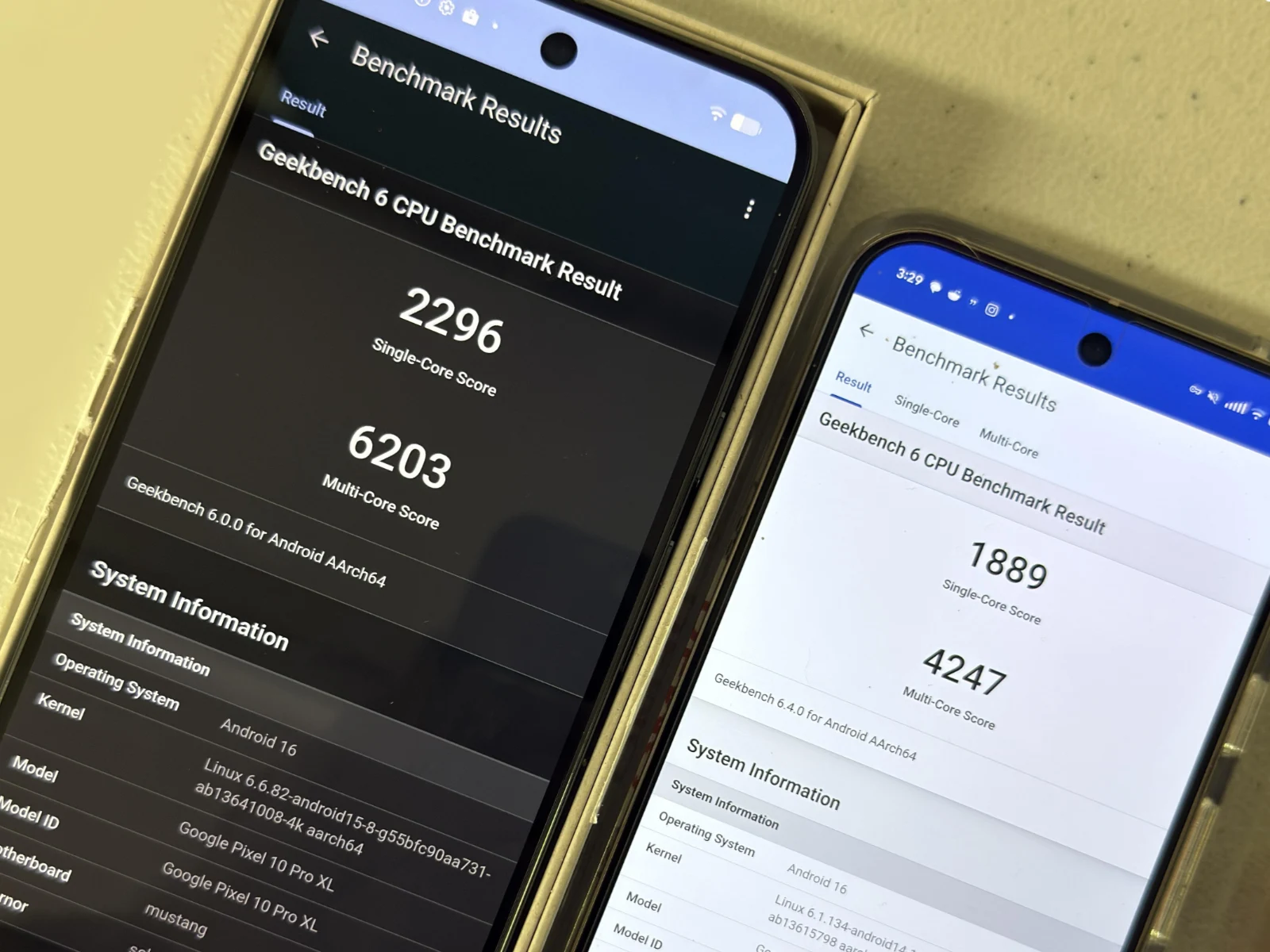
    Like many upcoming Pixel devices, there have been numerous leaks circulating in the weeks and months leading up to the launch. For example, AnTuTu benchmark scores for the Pixel 10 Pro XL appeared on Reddit not too long ago. Additionally, the same user also shared results from Geekbench 6.0.0 for the very same device, which we’ve included below for reference.

    Benchmark Performance

    At this point, the Tensor G5 shows a significant advantage over its predecessor, the Tensor G4, in both single-core and multi-core tests. This is particularly interesting considering that it’s seemingly a demo unit from a retail store and likely running on pre-release software. In our tests, the Tensor G5 scored 2,296, which is 18% higher than the Tensor G4 in Geekbench 6’s single-core benchmark. For multi-core performance, the Pixel 10 Pro XL’s results put the Tensor G5 37% ahead of the Tensor G4.

    Comparison with Competitors

    Thus, the Tensor G5 is roughly comparable to the Snapdragon 8 Gen 3 in these benchmark tests. However, Google’s upcoming chipset doesn’t quite measure up to the newer Snapdragon 8 Elite. While we expect the Pixel 10 series to show improved scores with the final retail software, it’s unlikely that this will bridge the 25% gap in single-core performance and 33% gap in multi-core performance compared to the Snapdragon 8 Elite.

    Source:
    Link


  • Tensor G5 Fails to Impress in Google Pixel 10 Pro XL Benchmarks

    Tensor G5 Fails to Impress in Google Pixel 10 Pro XL Benchmarks

    Key Takeaways

    1. The Google Pixel 10 series will launch worldwide on August 20.
    2. The Pixel 10 Pro XL has shown disappointing benchmark scores compared to its predecessor, the Pixel 9 Pro XL.
    3. The Pixel 10 Pro XL achieved a CPU score of 313,500 and a GPU score of 394,695, both lower than the Pixel 9 Pro XL.
    4. The unusual benchmark results may be due to the Pixel 10 Pro XL being a demo unit.
    5. Initial impressions based on these benchmarks may not be final, as CPU performance could be competitive with Snapdragon 8 Gen 2 and 8 Gen 3.


    The Google Pixel 10 series is set to launch worldwide on August 20. As has become common with Google’s products, these phones have been seen in real life, and a new, somewhat dubious leak has shown the lackluster performance of the Tensor G5 in the Pixel 10 Pro XL.

    Benchmark Results

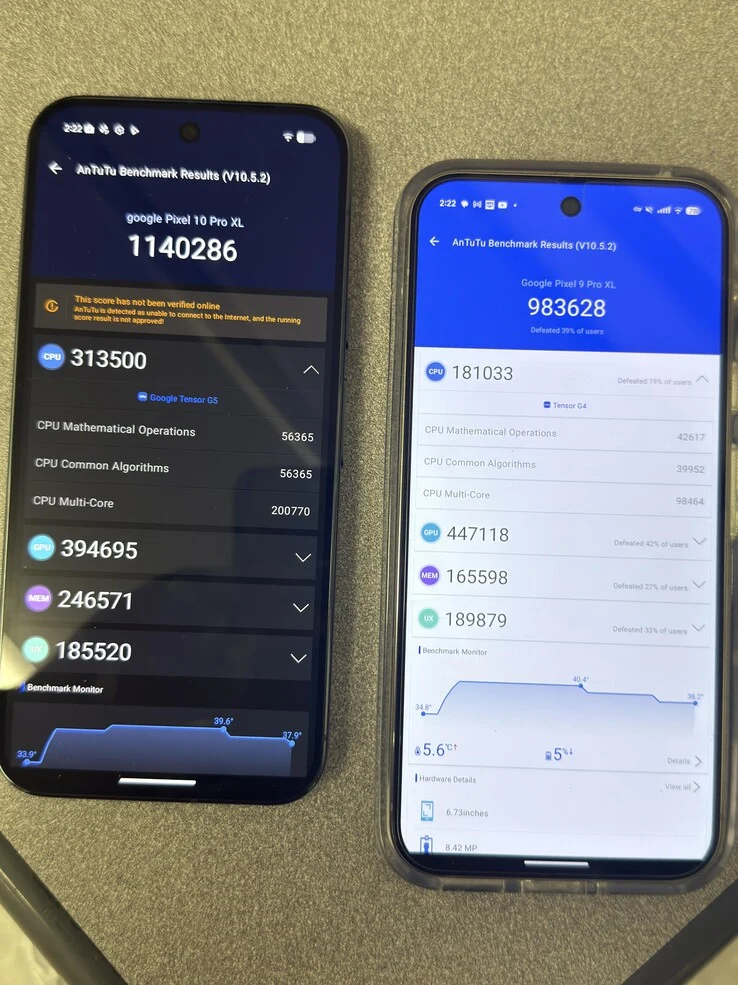
    According to a post on Reddit, the Pixel 10 Pro XL was evaluated on the well-known benchmarking site AnTuTu, where it was compared to last year’s Pixel 9 Pro XL. The new flagship device fails to impress, achieving only a CPU score of 313,500. Interestingly, the Pixel 9 Pro XL scores 181,033—much lower than what it has previously achieved in the same test. The Pixel’s strange performance continues on the graphical side, with the Pixel 10 Pro XL scoring a mere 394,695, which is less than the Pixel 9 Pro XL’s score of 447,118.

    Unclear Issues

    What’s puzzling about the benchmark scores is that both the Pixel 10 Pro XL and the 9 Pro XL have results that don’t align with past performances. The Pixel 9 Pro XL normally achieves over 370,000 on AnTuTu 10’s CPU test, but this time it barely reaches half of that. Compared to the usual results for the Pixel 9 Pro XL (buy on Amazon), the Pixel 10 Pro XL shows poorer performance on both CPU and GPU tests. This could possibly be due to it being a demo unit, as suggested by the user who posted the information.

    Conclusion

    Regardless, it’s best not to form a final opinion on Google’s upcoming flagship based solely on this test. It may still disappoint to some extent; however, an earlier Geekbench listing hinted that its CPU performance might fall somewhere between the Snapdragon 8 Gen 2 and Snapdragon 8 Gen 3.

    Source:
    Link


  • Pixel 10 Leak Reveals Exciting New Color Variants

    Pixel 10 Leak Reveals Exciting New Color Variants

    Key Takeaways

    1. The Pixel 10 will be available in four colors: Obsidian, Indigo, Frost, and Limoncello.
    2. The Pixel 10 Pro and Pro XL will come in Obsidian, Porcelain, Moonstone, and Jade.
    3. The Pixel 10 features a larger camera module with a telephoto sensor, a first for non-Pro Pixel models.
    4. Key specifications include a 6.3-inch display with a 120Hz refresh rate, a 4,970mAh battery, and 128GB of storage.
    5. The Pixel 10 will run on a Tensor G5 SoC, which may not match the performance of top models from Qualcomm and MediaTek.


    With the Pixel 10 series set to launch on August 20, new leaks have surfaced that spoil Google’s plans a bit. We (thanks to Android Headlines) can now see the basic Pixel 10 in four different colors. An earlier leak had already hinted at these colors, and now we finally have images to confirm them.

    Color Options

    Google will provide the standard Pixel 10 in Obsidian, Indigo, Frost, and Limoncello shades. In comparison, the Pixel 9 was available in Penoy, Wintergreen, Porcelain, and Obsidian. Only the Obsidian (black) variant remains, but it’s likely that Google will reintroduce some of the Pixel 10 color options in the future. For the Pixel 10 Pro and Pixel 10 Pro XL, they will come in Obsidian, Porcelain, Moonstone, and Jade.

    Camera Features

    The images also reveal a significantly larger camera module, which will include a telephoto sensor. This is the first telephoto sensor to be featured on a non-Pro Pixel phone in recent years. Additional specifications for the Pixel 10 include a 6.3-inch display with a 120Hz refresh rate, a 4,970mAh battery, and 128GB of storage on the basic model. It will run on a Tensor G5 SoC made by TSMC, which seems not to have the power to compete with top models from Qualcomm and MediaTek.

    In conclusion, these leaks provide valuable insights into what users can expect from the upcoming Pixel 10 series, highlighting both its color choices and hardware capabilities.

    Source:
    Link