Tag: Tensor G5

  • Tensor G5 Surprises on Geekbench but Lacks Performance

    Tensor G5 Surprises on Geekbench but Lacks Performance

    Google’s new Tensor G5 chip, which is set to be used in the next Pixel phones, has reportedly appeared on the Geekbench benchmarking site. While Google has not officially confirmed this, the listing provides insights into the potential performance and core setup of the system on chip (SoC).

    Tensor G5’s Geekbench Appearance

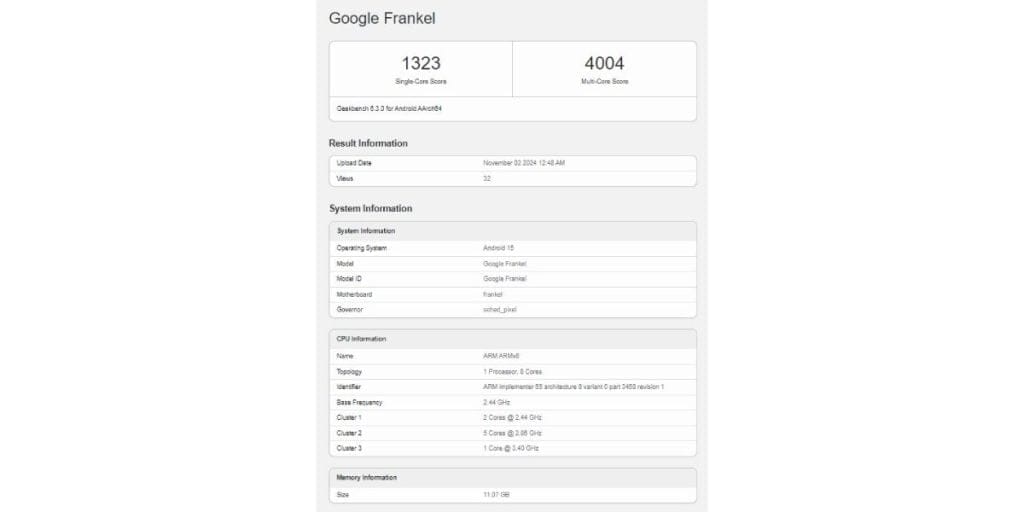
    The chip is listed under the model ID “Google Frankel” on Geekbench (previously known as “Laguna” in earlier leaks). It apparently achieved a score of 1323 in the single-core test and 4004 in the multi-core test. These results are lower than those of the Tensor G4, indicating that the G5 may not be able to compete with Qualcomm’s latest Snapdragon 8 Elite or MediaTek’s Dimensity 9400 flagship chips. It also seems tough for Google to surpass previous generation flagship chips from these rivals.

    Detailed Specifications

    The Geekbench entry matches earlier leaks, showing a core setup with one high-performance core running at 3.40 GHz, five mid-range cores at 2.86 GHz, and two low-power cores at 2.44 GHz. Additionally, it confirms that an Imagination Technologies PowerVR D-Series DXT-48-1536 GPU is part of the package. Prior reports suggested that Google would shift from Samsung to TSMC for the Tensor G5’s production. This chip is anticipated to be manufactured using TSMC’s 3nm N3E process node, with a die size around 121 mm².

    Future Outlook

    This benchmark test for Google’s upcoming SoC might indicate that the chip is still in the early stages of development, which could explain the lower-than-expected scores, or that Google isn’t focusing on achieving the highest performance. A company executive had previously mentioned that the Tensor G4 was not aimed at breaking records, but rather at enhancing the user experience.

    We hope the Tensor G5 doesn’t take a similar route, especially since it is expected to power devices priced above $1000. This initial version of the Tensor G5 likely requires considerable optimization to boost its performance in future benchmarks.



    Image 1
  • Pixel 10’s Tensor G5: TSMC 3nm Process with Unique Core Design

    Pixel 10’s Tensor G5: TSMC 3nm Process with Unique Core Design

    For many years, Google has worked with Samsung Foundry to produce its Tensor chips. However, this may be changing with the upcoming Tensor G5, which is set to launch with the Pixel 10 series. A recent leak from Google’s gChips division, shared by Android Authority, suggests that Google will use TSMC’s advanced 3nm process for the new chip, which could lead to better efficiency and performance.

    Changes in CPU and GPU Design

    One of the most notable updates in the Tensor G5 is its redesigned CPU architecture. Unlike the previous Tensor G4, which offered only a small performance boost, the G5 retains a primary Cortex-X4 core but includes a revamped mid-cluster. The new setup features five Cortex-A725 cores, an increase from the previous three Cortex-A720 cores, while the smaller cluster has been downgraded to two Cortex-A520 cores. This change indicates that Google is trying to find a better balance between performance and power usage, although the decision to keep the Cortex-X4 instead of upgrading to the latest Cortex-X925 is quite interesting.

    Innovations in Graphics Performance

    The Tensor G5 also breaks away from tradition by not using the ARM Mali GPU. Instead, it adopts a new GPU from Imagination Technologies (IMG), the DXT-48-1536. This GPU adds ray tracing support, a first for Tensor chips, and includes GPU virtualization features that could improve graphics performance for gaming and other demanding tasks. While the new TPU in the Tensor G5 shows a 40% rise in TOPS (Trillions of Operations Per Second), internal benchmarks indicate a more modest 14% enhancement in real-world applications. Furthermore, the TPU now allows on-device training and incorporates embedded RISC-V cores that enable capabilities that weren’t available before, likely expanding its AI functions.

    Anticipation for the Pixel 10 Series

    For those eagerly awaiting the Pixel 10 series, there’s good news! The Pixel 10, expected to be released in the latter half of next year, will be the first device to sport the Tensor G5. Switching to TSMC’s 3nm process could greatly improve power efficiency, addressing previous concerns regarding the Tensor series, especially issues like thermal management and performance slowdowns. Reports suggest that Google aims to compete more effectively with Snapdragon-powered smartphones by making this strategic move, as TSMC’s manufacturing technology has been crucial for Qualcomm’s recent achievements.

    In summary, these updates reflect Google’s ambitious intentions to establish the Pixel 10 series as a more formidable player in the flagship smartphone market.


  • Google Tensor G5 and G6 Specs: New GPU, 3nm Node, Faster RAM

    Google Tensor G5 and G6 Specs: New GPU, 3nm Node, Faster RAM

    We have come across some intriguing information on a public platform, which we are keeping confidential to safeguard the source. This information outlines important specifications for Google’s upcoming Tensor G5 (codename Laguna) and Tensor G6 (codename Malibu). The Tensor G5 is set to drive the next Google Pixel 10, while the Tensor G6 will launch with the Pixel 11 series. According to earlier rumors, both of these chips will be produced using TSMC’s 3 nm technology. Moreover, these chips are being developed internally, without any help from Samsung, which was Google’s previous partner.

    Changes in GPU Technology

    A significant change appears in the GPU department. Google seems to have decided against using a standard Arm Mali product, which was the case for earlier Tensor chips. Instead, they’ll be utilizing a chip created by Imagination Technologies, renowned for its PowerVR technology. The Tensor G5 won’t feature hardware-level ray tracing, but there’s a chance the Tensor G6 might include this capability. However, it is possible that this feature could be dropped before launch.

    CPU Enhancements

    When it comes to the CPU, the Tensor G5 will stick with last-generation Arm cores. In contrast, the Tensor G6 is expected to support the Arm v9.4 instruction set and will feature modern cores. The Tensor G5 aims for a maximum clock speed of 3.1 GHz, while the Tensor G6 could reach up to 3.2 GHz. Additionally, they are likely to have faster RAM. Both chips are expected to feature LPDDR5X-8533 memory, which is significantly quicker than the 4,200 MT/s modules found in the Tensor G4.

    In summary, the Tensor G5 and Tensor G6 bring some exciting upgrades and could make the Pixel 10 and Pixel 11 strong contenders against major players like Samsung and Apple. This time, Google’s software prowess is supported by equally robust hardware, and the outcome is anticipated to be impressive.

  • TSMC to Potentially Produce Google Tensor G5

    TSMC to Potentially Produce Google Tensor G5

    Google Initiates Testing of In-House Chip

    Reports suggest Google partners with Taiwanese firm KYEC for evaluating a chip it developed internally, signaling a shift towards independent chip creation. KYEC offers testing services for fresh chips made in Taiwan. Google procures testing equipment at KYEC, with testing set to commence in the middle of the year and scale up gradually.

    Elaboration on Tensor G5 Chip

    The chip undergoing testing, named "Laguna," is speculated to be the Tensor G5. Set for unveiling in 2025, it will be produced using TSMC’s 3nm process. This chip will emphasize AI functionalities, aligning well with Google’s emphasis on AI-driven attributes in Pixel gadgets.

    Noteworthy Transition in Chip Development

    This potential change represents Google’s premier endeavor in crafting custom chipsets. Previously, the company banked on Samsung’s Exynos chips. Moving production to TSMC empowers Google with enhanced control over chip design, facilitating the development of more robust and competent Pixel phones. It also sidesteps Samsung’s Exynos chips, currently trailing Qualcomm’s Snapdragon lineup in performance and efficiency.

    Ongoing Relationship with Samsung

    In the immediate future, Google upholds its alliance with Samsung. The forthcoming Pixel 9 series will showcase the Tensor G4 chip, constructed utilizing Samsung’s 4nm process. While presenting marginal enhancements over the Tensor G3 chip of the Pixel 8, it shares technology with Samsung’s Exynos 2400 SoC, hinting at marked improvements in CPU and GPU performance.

    In a Nutshell

    Google’s collaboration with KYEC for chip assessment hints at potential self-reliant chip development efforts. The Tensor G5 chip is foreseen to give precedence to AI capabilities by 2025. Shifting production to TSMC might augment Google’s authority in chip design, leading to more potent Pixel devices. Nevertheless, Google maintains its partnership with Samsung through the Tensor G4 chip in the upcoming Pixel 9 series.