Category: Home

  • Anker Solix C2000 Gen 2: Durable Power Station with Versatile Connections

    Anker Solix C2000 Gen 2: Durable Power Station with Versatile Connections

    Key Takeaways

    1. Anker’s new power station, the Solix C2000 Gen 2, has a capacity of 2,048 Wh and uses durable lithium iron phosphate storage cells.
    2. The unit retains 80% of its original capacity after 4,000 charging cycles, providing long-term usability for many users.
    3. The power station measures 459 x 250 x 257 mm, weighs 42 pounds, and features two handles for easier portability.
    4. It has a maximum output of 2,400 watts, with a peak of 4,000 watts, suitable for temporary energy needs but not continuous usage.
    5. The MSRP is $1,499, exclusive to the US, with a launch date set for October 28 and available discounts.


    Anker has recently introduced a new power station called the Solix C2000 Gen 2, which will be exclusively available in the US. Information regarding potential international availability is not yet confirmed. The Solix C2000 Gen 2 boasts a capacity of 2,048 Wh and employs lithium iron phosphate storage cells, known for their impressive durability, thus ensuring a lengthy usable lifespan. After undergoing 4,000 charging cycles, the unit retains 80% of its original capacity, which is a considerable, yet not overly dramatic, limitation given the number of cycles. Nevertheless, for many users, 4,000 cycles could equate to several decades of service.

    Specifications and Portability

    Measuring 459 x 250 x 257 millimeters, the power station has a weight of 42 pounds (18.9 kilograms) and is equipped with two handles, enhancing its portability. The maximum output is stated to be 2,400 watts, with a peak output reaching up to 4,000 watts. This level of power is suitable for temporary energy needs, but not for continuous usage. The device utilizes a TT-30 connector, frequently found in recreational vehicles. It allows for charging through a wall outlet with a maximum of 1,800 watts, and solar charging up to 800 watts. It also supports devices designed for onboard power outlets, as well as USB devices, with a USB-C charging capability of up to 140 watts.

    Pricing and Availability

    The manufacturer’s suggested retail price (MSRP) is set at $1,499, which applies specifically to the USA. The launch date is planned for October 28, and will feature accompanying discounts.

    Source:
    Link



  • ESA Discovers Massive Wave in Milky Way from Galaxy Collision

    ESA Discovers Massive Wave in Milky Way from Galaxy Collision

    Key Takeaways

    1. The Milky Way’s stars revolve around a distorted galactic disk, which experiences wobbles over time, as shown by Gaia data from 2020.
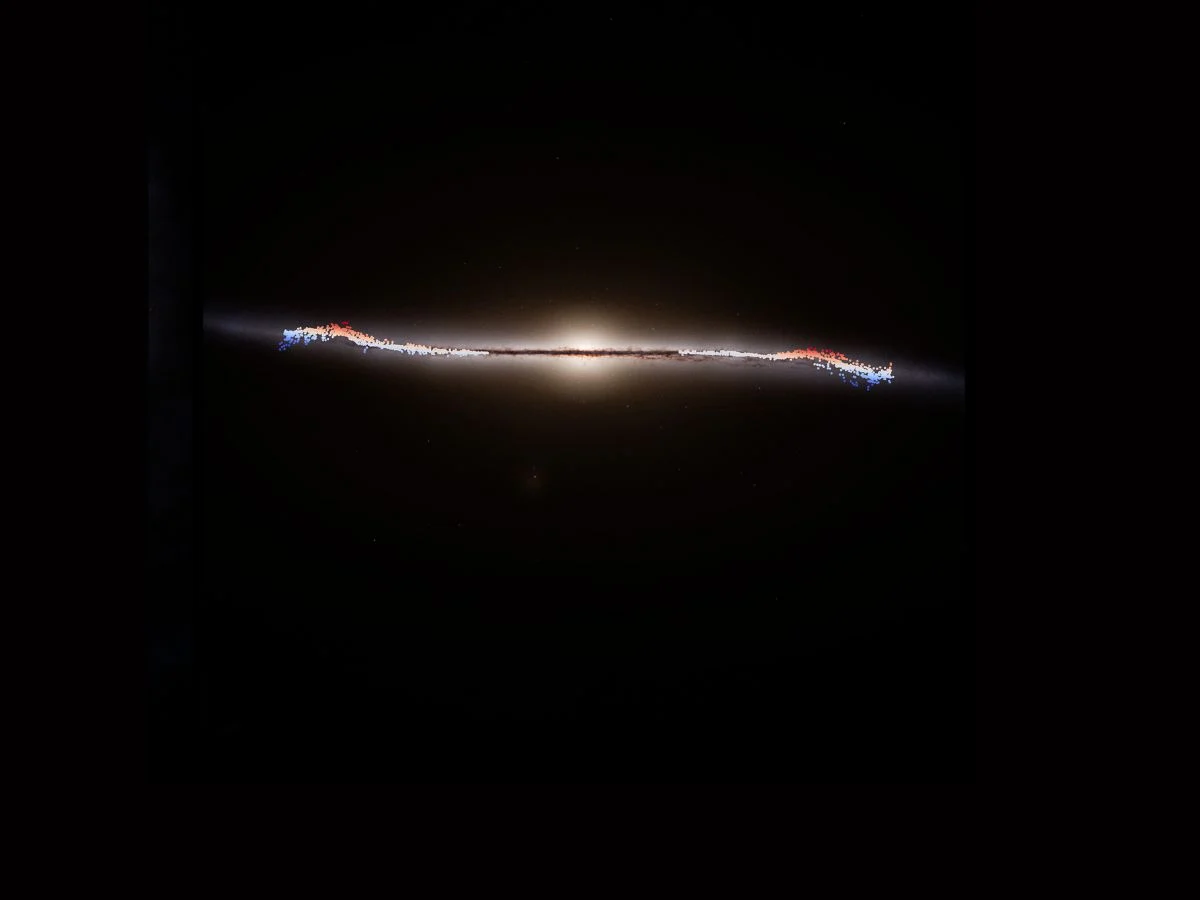
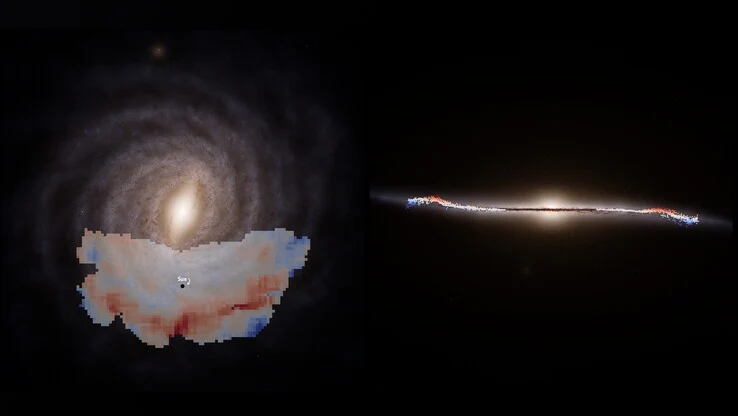
    2. Gaia has discovered a significant wave traveling through the galaxy, affecting stars up to 65,000 light-years from the center.
    3. Evidence of the wave includes vertical rippling movements observed in the positions of young giant stars and Cepheids, which move in sync with the wave.
    4. The wave’s cause is still unknown, with theories suggesting it may result from a previous collision with a dwarf galaxy or be linked to the nearby Radcliffe Wave.
    5. A new data release from Gaia is expected in December 2026, promising to enhance understanding of star positions and movements in the Milky Way.


    Over time, researchers have found that the stars in our galaxy revolve around its center within a distorted galactic disk. In 2020, Gaia showed that this warped disk experiences wobbles as time passes.

    A New Discovery

    Recently, Gaia has uncovered that a significant wave is traveling through the galaxy. The data from Gaia indicates that this wave is extending outward from the galaxy’s core, affecting stars located as far as 30,000 to 65,000 light-years from the center.

    Evidence of the Wave

    Gaia’s three-dimensional edge-on mapping of the Milky Way has shown a vertical rippling movement. This serves as evidence for the existence of the great wave. Astronomer Eloisa Poggio and her team utilized Gaia’s data to monitor the wave’s motion.

    They accomplished this by analyzing the locations and movements of young giant stars and Cepheids. Cepheids are a type of star that changes brightness in a predictable manner and can be observed from distant locations. The young stars and Cepheids seem to be moving in sync with the wave.

    Possible Causes

    Since these stars are created from interstellar gas, scientists believe that the gas that formed them was also moving in a similar wave-like manner. However, the source of the wave remains unknown. One theory suggests that it may have originated from a previous collision with a dwarf galaxy.

    Another theory ties the wave to the Radcliffe Wave, which is a smaller ripple located 500 light-years away from our Sun. Researchers are eager to learn more. A new data release from Gaia is anticipated in December 2026, which will enhance our knowledge about the positions and movements of stars within the Milky Way.

    Source:
    Link


  • Nitecore’s Compact Flashlight Features Four Quad-Core LEDs

    Nitecore’s Compact Flashlight Features Four Quad-Core LEDs

    Key Takeaways

    1. New MCT System: The TUP2 features the MCT system with four LEDs offering three color temperature options (3,000, 4,500, and 6,500 Kelvin), but the range has decreased from 180 meters to 120 meters.

    2. Design and Portability: The flashlight is compact at 7 cm long and weighs 58 grams, making it a suitable everyday carry (EDC) option with a clip for easy access.

    3. Battery and Charging: The non-replaceable battery charges via USB-C and has increased capacity from 1,200 to 1,300 mAh, allowing for longer run times (up to 190 hours on the lowest setting).

    4. Performance: The TUP2 can emit 300 lumens for two hours and has a turbo mode for brief bursts, with a slight increase in lumen rating from 1,000 to 1,200.

    5. Color Options: The flashlight is available in three colors, including orange, which is useful for outdoor activities. Pricing details have not yet been announced.


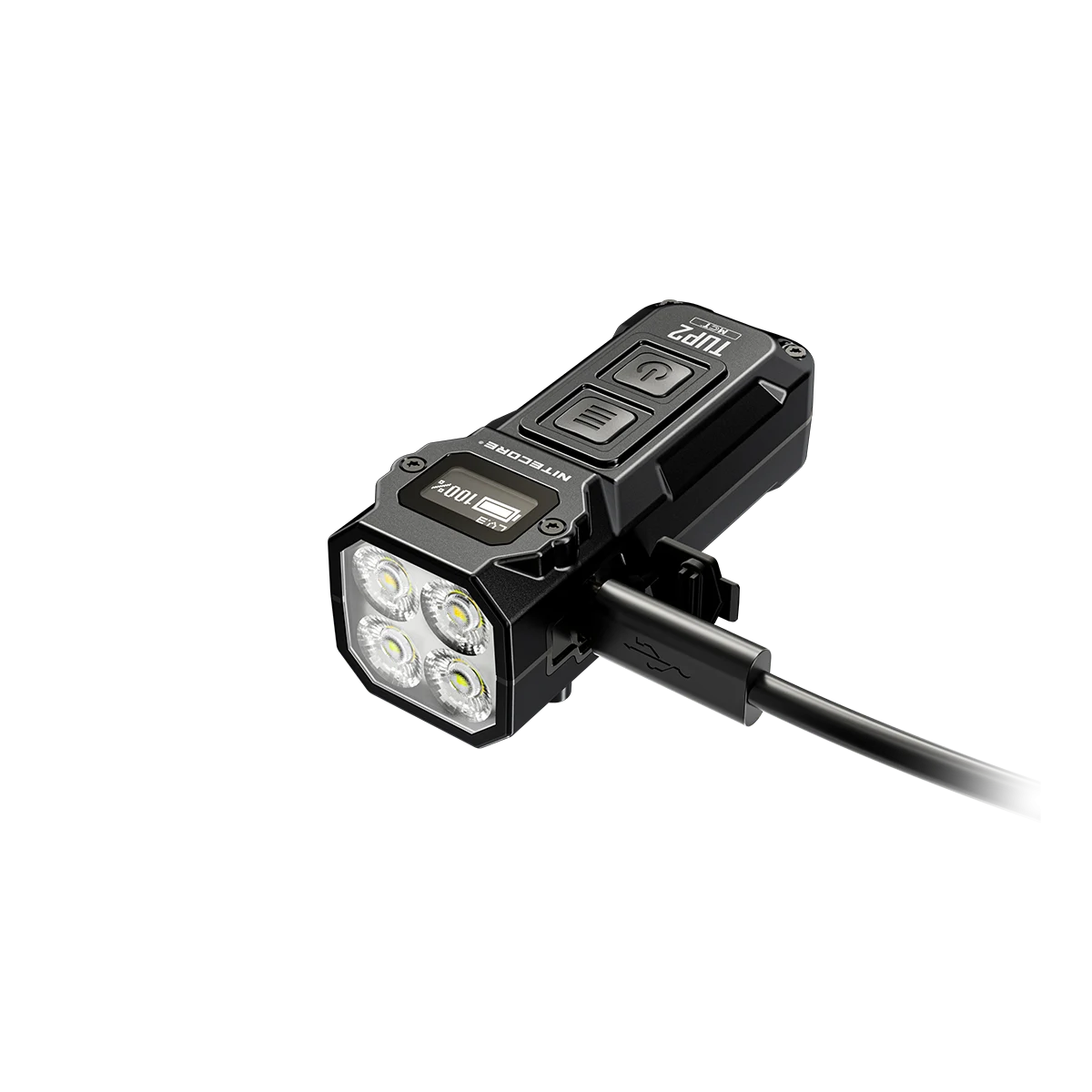
    Nitecore’s TUP2 is the next version of the small TUP and has been redesigned, which might not be to everyone’s liking. This is due to the fact that the setup has been changed quite a bit, along with the technical details.

    New Features and Changes

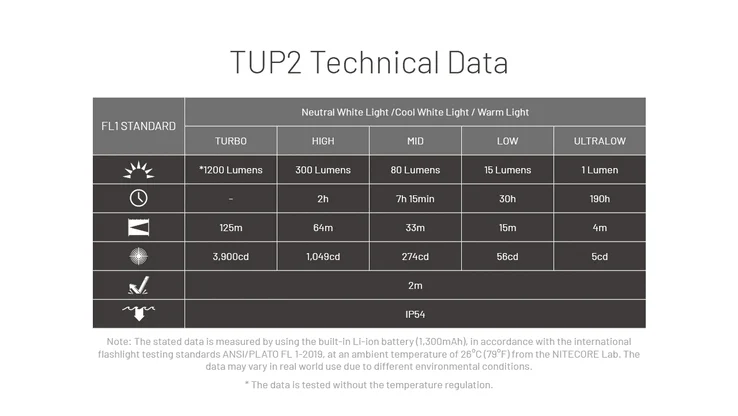
    On the bright side, it now comes with the MCT system that allows for various color temperatures using two warm and two cool LEDs, with options of 3,000, 4,500, and 6,500 Kelvin. However, this has decreased the range from 180 meters down to 120 meters. The lower candela values suggest that it might have a more powerful floodlight. Yet, the lumen rating has only gone up from 1,000 to 1,200. This indicates that the TUP2 serves as a limited direct upgrade. Whether these changes are appealing really depends on what you want from a flashlight.

    Design and Usability

    With a length of seven centimeters and weighing 58 grams, this flashlight remains quite portable and light. Essentially, it acts as a larger and more efficient keychain light, making it great for everyday carry (EDC). Its clip allows it to be fastened to a hat for easy access. The OLED display is still present and it operates via a two-button system.

    Battery and Performance

    The battery in this model isn’t replaceable and charges through USB-C. Nitecore claims that the battery capacity has increased from 1,200 to 1,300 mAh. According to the company, the flashlight can run for 190 hours on its lowest setting. In contrast, the previous version only lasted 70 hours at one lumen. It can emit 300 lumens for a duration of two hours, while the turbo mode is meant for brief bursts of light.

    The flashlight is available in three colors, including the well-known orange, which is beneficial for outdoor activities. As of now, Nitecore has not revealed the pricing, but it should be announced shortly.

    Source:
    Link


  • US Government Shutdown Puts Crucial Space Mission at Risk

    US Government Shutdown Puts Crucial Space Mission at Risk

    Key Takeaways

    1. The US government shutdown is causing disruptions for various organizations, including NASA, which may jeopardize the Juno mission.

    2. The Juno probe, launched in 2011, has provided critical information about Jupiter and its moons since entering orbit in 2016.

    3. Juno’s mission was extended until September 30, 2025, but uncertainty about funding due to the government shutdown threatens its future.

    4. Scientists are pushing for an extension of Juno’s mission to ensure continuity for future missions, like Europa Clipper, set to launch in 2030.

    5. Running space missions requires significant funding and personnel, making NASA’s ability to make decisions independently challenging, especially amid political disapproval.


    Due to the ongoing shutdown of the US government, numerous infrastructures and businesses are facing disruptions. NASA is one of the organizations impacted, having to reduce its operations, which might jeopardize a crucial mission.

    Juno’s Mission History

    This situation directly involves the Juno probe, which was launched back in 2011 and has been in orbit around Jupiter since 2016. Throughout its time, Juno has offered astronomers and scientists a vast amount of vital information, especially regarding the atmosphere of the largest planet in our solar system, as well as insights into the moons that orbit it.

    Mission Extension and Shutdown

    A key aspect of the Juno probe is its remarkable durability. Its mission was extended until September 30, 2025, enabling ongoing observations that yield important findings. However, with the government shutdown that began on October 1, 2025, NASA finds itself uncertain about the future of this mission.

    This creates a significant issue, as Juno has enhanced our understanding of both our solar system and the Jovian system. Moreover, it has played a role in the initiation of several other missions, including Europa Clipper, which is anticipated to arrive at its target in 2030.

    Future of Juno’s Mission

    In light of these circumstances, some scientists are advocating for an extension of Juno’s mission until that time, so that a successor can be ready to take over immediately after. Nevertheless, as reported by Space.com, NASA cannot make this decision independently.

    Moreover, running a space mission requires substantial financial investments, along with the personnel who need to oversee the probe and analyze the gathered data. Lastly, it is important to note that Donald Trump has also expressed his disapproval of NASA’s space initiatives, which could raise concerns about the future of such missions.

    Source:
    Link


  • Starlink Offers Free Dish Rental and Installation in Select States

    Starlink Offers Free Dish Rental and Installation in Select States

    Key Takeaways

    1. Starlink’s Residential Lite plan starts at $79 per month, with discounted pricing in certain states like Iowa where it drops to $49 per month.
    2. The Standard Kit dish is available for $149 in specific regions, but customers can now get it for free through a new equipment rental program.
    3. The rental program eliminates upfront costs, requiring only a $20 shipping fee for the dish.
    4. Customers incur no monthly fees for the rented dish as long as they maintain their service; returned if service is canceled.
    5. Free professional installation is included with the service, ensuring proper setup of the satellite Internet connection.


    Starlink is presenting an attractive monthly subscription and dish equipment promotion unlike any other it has done before.

    The company markets its Residential Lite plan starting from $79 per month, alongside a price of $149 for the Standard Kit dish in specific regions across the US. However, in certain states, they offer even better deals through some clever strategies.

    New Equipment Rental Program

    Recently, Starlink has rolled out an equipment rental program that allows customers to get the Standard Kit, which is now available at a discounted price on Amazon, for free. This initiative is aimed at boosting satellite Internet usage in states like Iowa, where Starlink is looking to gain traction. Essentially, they are eliminating all upfront costs tied to a Starlink subscription, except for a shipping fee of $20 for the dish.

    The new rental agreement for the Starlink dish requires no monthly fees as long as the customer retains their service. If the service is terminated, the rented Starlink dish must be returned at no extra monthly costs.

    Competitive Pricing in Iowa

    In addition, the Residential Lite plan has seen a further price drop to just $49 per month in Iowa, positioning Starlink as a highly competitive option for potential customers in rural areas. Plus, Starlink provides free installation, meaning technicians will visit your home to set up the dish and verify the satellite Internet connection if necessary.

    Starlink states, “Free professional setup included, schedule after checkout,” but also warns that “if you cancel service, you will have to return your Starlink hardware rental.”

    Source:
    Link


  • SpaceX Offers Free Starlink Mini Kits in US and Canada – Conditions Apply

    SpaceX Offers Free Starlink Mini Kits in US and Canada – Conditions Apply

    Key Takeaways

    1. Eligible long-term Starlink Residential users in the US and Canada can claim a complimentary Starlink Mini Kit through a promotional email until October 22nd.
    2. The Starlink Mini dish is provided on a rental basis, requiring a $5 monthly fee ($7 in Canada), and must be returned if service is canceled.
    3. The promotional email also offers a 50% discount on Roam plans, with the Roam Unlimited plan costing $82.5 and the Mini Roam costing $25.
    4. The Starlink Mini Kit is compact, designed for travel, with features like built-in dual-band Wi-Fi and download speeds up to 250 Mbps.
    5. For those ineligible for the free offer, the Mini Kit is available for purchase at a reduced price of $299, following a 40% price cut.


    If you’ve been using Starlink Residential for over a year, you may be eligible for a complimentary Starlink Mini Kit. This comes from a recent promotional email that SpaceX is sending to long-term users in the US and Canada.

    Claiming Your Free Kit

    Residential subscribers who have received this email can get a Starlink Mini dish at no charge. To claim it, simply click the “Redeem $0 Mini Kit” button in the email, confirm your order, and the dish will be sent to your address. SpaceX has specified that the redemption link is active until October 22nd. Moreover, the email highlights a 50% discount on Roam plans, meaning the Roam Unlimited plan will cost only $82.5, while the Mini Roam will be just $25. Normally, these plans are priced at $165 and $50, respectively. It’s not clear whether this discounted price applies only for the initial months or is a long-term benefit for qualifying Residential users.

    Important Conditions

    However, there are some conditions attached to this offer. First, the Starlink Mini that you receive will be in Standby Mode, meaning even if you do not activate a service plan, you still need to pay a $5 monthly fee ($7 for Canada). Even more crucially, the dish is not technically “free” as it is provided on a rental basis. SpaceX has stated that “the Mini must be returned” if you cancel your Residential or Roam service plan at any time, or else its cost will be charged to your payment method.

    A Strategic Move

    While this offer may seem generous at first glance, it’s also a clever tactic by SpaceX to generate ongoing revenue and encourage the use of its Roam service.

    If you often travel to isolated areas and have been eyeing the Mini Kit, this is a pretty good offer—and the 50% off on Roam plans is particularly appealing. The dish is compact enough to fit in a backpack and can easily be mounted on your vehicle for travel. It features built-in dual-band Wi-Fi, with download speeds of up to 250 Mbps and upload speeds reaching 25 Mbps as promised by SpaceX.

    For those who don’t meet the eligibility criteria for the free offer, you can still purchase the Mini Kit at a reduced price. Starlink has recently cut the price of the portable dish by 40%, lowering it to $299 on Starlink.com and other online stores.

    Source:
    Link


  • Terrabeast M5 Flashlight: 293-Yard Throw & Laser Now Crowdfunding

    Terrabeast M5 Flashlight: 293-Yard Throw & Laser Now Crowdfunding

    Key Takeaways

    1. The TerraBeast M5 flashlight has a simple design and an IP66 rating, making it waterproof.
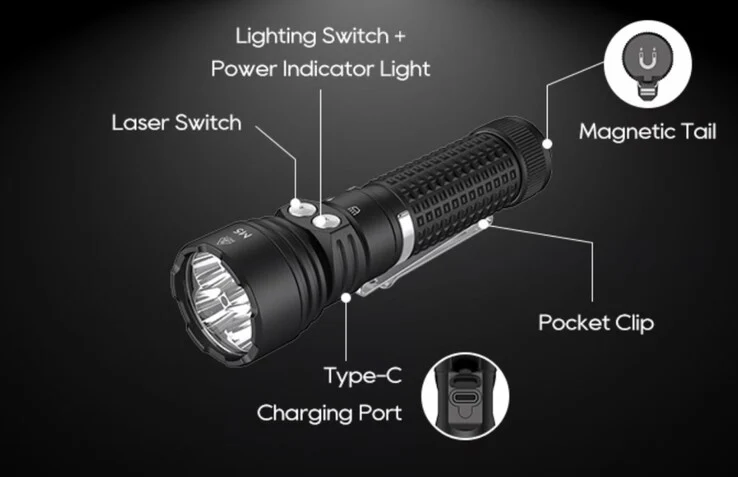
    2. It features a built-in class 3R laser for marking paths and pointing, but caution is needed to avoid eye exposure.
    3. The flashlight offers a brightness of up to 5,200 lumens, comparable to higher-end models, with a maximum range of 293 yards.
    4. It has a 4,500mAh battery with USB-C charging, but the manufacturer hasn’t provided detailed battery life information at higher brightness levels.
    5. Currently crowdfunding on Kickstarter at an initial price of $69, with delivery expected in December 2025, but backers should be aware of potential risks.


    At first, the TerraBeast M5 may not catch your eye as a special flashlight; it has a simple black aluminum body and holds an IP66 rating, which allows it to be submerged in water without damage. One interesting aspect of this flashlight is its built-in laser.

    Useful Laser Feature

    This laser can be handy for marking paths at night or pointing towards specific objects. It’s a class 3R laser, so it’s important to avoid shining it in anyone’s eyes. Many countries have restrictions on selling lasers of this classification, but depending on your local laws, you might be able to import one for personal use. Nevertheless, users should take caution to ensure nobody gets hurt by this relatively strong laser.

    Impressive Light Output

    The flashlight is powered by four Luxeon HL4X LEDs, which can generate a brightness of up to 5,200 lumens. This level of brightness is comparable to the pricier Nitecore EDC29, which is typically priced at $100 on Amazon. The company claims that it can project light up to 293 yards. However, the stated battery life of 30 days only applies when using the lowest brightness setting; the runtime will significantly decrease at brighter levels. Unfortunately, the manufacturer hasn’t shared specific details about battery life at these higher settings. Regardless, the 4,500mAh battery supports USB-C charging.

    Crowdfunding on Kickstarter

    The TerraBeast M5 is currently seeking funds on Kickstarter. The initial price for backers is set at $69, not including shipping and any import charges. The expected delivery date is December 2025. Although TerraBeast has previously financed and delivered the Y1 Pro successfully, it’s important to remember that crowdfunding always carries some financial risks. There is a chance that the product may turn out to be of lower quality or could fail to reach the market altogether.

    Source:
    Link


  • Scientists Capture Image of Baby Planet 5 Times Bigger Than Jupiter

    Scientists Capture Image of Baby Planet 5 Times Bigger Than Jupiter

    Key Takeaways

    1. Protoplanetary disks around forming stars often have ring-like gaps where gas and dust are less dense.
    2. Young planets within these disks may create gaps by pulling in materials, aiding their growth.
    3. A research team led by Laird Close and Richelle van Capelleveen discovered evidence supporting the presence of young planets in these gaps.
    4. Observations were made using the VLT-SPHERE and Mag AO-X systems to capture images of the planet WISPIT 2b.
    5. The findings, including the discovery of a second candidate planet, were published in the Astrophysical Journal Letters on August 26.


    When a star begins to form, it typically has a surrounding disk known as a protoplanetary disk. Scientists have observed that these disks often contain ring-like gaps. These gaps are regions where the gas and dust that make up the disk are not as dense.

    The Role of Young Planets

    Researchers think that there are young planets within this disk that create these gaps by pulling in gas and dust, which helps them grow. Recently, scientists have found some evidence that backs up this idea for the first time.

    Key Contributors to the Discovery

    A team, led by Laird Close from the University of Arizona and Richelle van Capelleveen, a graduate student from Leiden Observatory in the Netherlands, made this discovery. The study led by van Capelleveen identified the WISPIT 2 star and its ring system using the VLT-SPHERE (Very Large Telescope – Spectro-Polarimetric High-contrast Exoplanet REsearch).

    Techniques Used for Observation

    The researchers then used the Mag AO-X (Magellan Adaptive Optics system eXtreme) to capture images of the young planet, named WISPIT 2b, in H-alpha light. They also observed WISPIT 2b in infrared light with the help of LMIRcam, a component of the Large Binocular Telescope Interferometer (LBTI) at the University of Arizona’s Large Binocular Telescope.

    In the captured image, WISPIT 2b appears as a small purple dot to the right of the WISPIT 2 star system. Interestingly, the researchers found a second candidate planet in another dark ring gap that is closer to WISPIT 2. Future studies are likely to explore this discovery further. The findings regarding WISPIT 2b were published on August 26 in the Astrophysical Journal Letters.

    Source:
    Link


  • Anker Unveils 3-Port 100W Charger with Digital Display

    Anker Unveils 3-Port 100W Charger with Digital Display

    Key Takeaways

    1. Anker launched a new 100W GaN charger with a smart power display and three ports for a budget-friendly price of $59.99.
    2. The charger features two USB-C ports (100W each) and one USB-A port (33W), allowing simultaneous charging of three devices with smart power distribution.
    3. Charging power adjusts based on the number of devices connected, ensuring optimal charging speeds for each device.
    4. The charger includes a digital display showing charging status, real-time power output, and temperature readings, along with animated visuals.
    5. Compact design with foldable prongs makes it travel-friendly; currently available in black with a gray version expected soon.


    Anker has been releasing a lot of new charging gadgets lately. Just to summarize, the brand introduced 140W and 160W charging adapters that come with digital screens. Recently, they also launched a 3-in-1 charging stand that offers Qi2 25W support and features a touch display, which is priced at $172.49 for Amazon Prime members.

    New Charger Release

    Now, Anker is back with a fresh 100W GaN charger that includes a smart power display and three charging ports, all at a more budget-friendly price and smaller size. Interestingly, it looks very much like the Anker Smart Display Charger Lite that debuted in China back in May. Customers can get the Anker Charger (100W, 3 Ports, Smart Display) along with a 4.9 ft USB-C to USB-C cable for just $59.99 on Amazon, thanks to a $10 discount for the launch.

    Charging Ports and Capabilities

    As the name indicates, the Anker Charger (100W, 3 Ports, Smart Display) comes with three charging ports: two USB-C ports with 100W power and one USB-A port that provides 33W. It can charge three devices at the same time, using smart power distribution to make sure each device gets the best charging speed possible.

    When just one device is being charged, either USB-C port can output the full 100W. If two devices are connected, the power divides into options like 70W and 30W, or 67W and 33W, or even 95W and 5W. When all three ports are utilized, it splits to 80W, 12W, and 7.5W. In any situation, users can charge a laptop along with other gadgets at once. Plus, the charger has an auto low-power mode which limits the USB-A output to 5W for devices that need less power, like earbuds.

    Features and Design

    Another great feature is the digital display built into the charger. Similar to the 160W version, it can show the charging status, real-time power output for each port, temperature readings, and even has some fun animated visuals. The charger measures 2.72 x 2.17 x 1.34 inches and weighs only 7.47 ounces. It also has foldable prongs, making it super easy to carry in a bag or pocket when traveling. Right now, it’s available in black, but a gray version is expected to be released soon.

    Anker Insider via X, Amazon

    Source:
    Link


  • 2 Billion People to Witness Rare Sky Phenomenon in 4 Years

    2 Billion People to Witness Rare Sky Phenomenon in 4 Years

    Key Takeaways

    1. Apophis is a 340-meter-wide asteroid set to pass within 30,000 kilometers of Earth on April 13, 2029, providing a rare spectacle for about two billion people.
    2. Initial concerns about Apophis included a 2.7% chance of impacting Earth, but further observations have eliminated any threat for at least the next 100 years.
    3. The close approach of Apophis offers a unique opportunity for scientists to study its trajectory and the gravitational effects of Earth on it.
    4. NASA and the Ramses project are collaborating to monitor Apophis with the OSIRIS-REx probe and a small satellite to gather data during its close encounter.
    5. Apophis will create a bright sight in the night sky, particularly visible in Africa and Western Europe, with updated trajectory information available for viewers in the coming years.


    Space is a thrilling and enigmatic realm, and it’s crucial to recognize that numerous celestial bodies are zipping through it at incredible speeds. A prime example is the asteroid Apophis, which measures 340 meters across and is set to provide a once-in-a-7,500-year spectacle for around two billion people in 2029.

    Discovery and Initial Concerns

    When Apophis was first identified in 2004, it sent ripples of concern throughout the scientific world. At that time, it had a 2.7% probability of striking Earth, which placed it at level 4 on the Torino Scale. Thankfully, as time passed, observations helped clarify its path, and by 2021, any potential threat was conclusively eliminated for at least a hundred years.

    A Close Encounter

    On April 13, 2029, Apophis will pass within 30,000 kilometers of Earth, and its trajectory may be influenced by our planet’s gravity. This event presents a rare chance for scientists to study the effects of such gravitational forces on a celestial body while it happens.

    In addition, NASA has decided to redirect the OSIRIS-REx space probe, which was originally intended to study Bennu, so it can also observe Apophis during its close approach. Europe is also on board with this initiative through the Ramses project, which aims to monitor the asteroid using a small satellite designed to detect seismic waves.

    A Night Sky Spectacle

    While Apophis doesn’t pose a danger, it may create a stunning sight in the night sky. Much like the two comets visible in October, individuals in Africa and Western Europe will have the chance to see this asteroid as it travels across the sky, shining brightly like a new star.

    Its trajectory will be updated within four years, ensuring that everyone knows where to gaze in the night sky. However, it’s essential to have clear weather conditions, and skywatchers should keep an eye on the forecast, as other astronomical phenomena could occur in the meantime.

    In conclusion, Apophis’s passage may also act as a test for identifying future threats from space. The goal is to enhance our ability to detect asteroids and explore various methods to redirect them if necessary.

    Source:
    Link