
Key Takeaways
1. Protoplanetary disks around forming stars often have ring-like gaps where gas and dust are less dense.
2. Young planets within these disks may create gaps by pulling in materials, aiding their growth.
3. A research team led by Laird Close and Richelle van Capelleveen discovered evidence supporting the presence of young planets in these gaps.
4. Observations were made using the VLT-SPHERE and Mag AO-X systems to capture images of the planet WISPIT 2b.
5. The findings, including the discovery of a second candidate planet, were published in the Astrophysical Journal Letters on August 26.
When a star begins to form, it typically has a surrounding disk known as a protoplanetary disk. Scientists have observed that these disks often contain ring-like gaps. These gaps are regions where the gas and dust that make up the disk are not as dense.
The Role of Young Planets
Researchers think that there are young planets within this disk that create these gaps by pulling in gas and dust, which helps them grow. Recently, scientists have found some evidence that backs up this idea for the first time.
Key Contributors to the Discovery
A team, led by Laird Close from the University of Arizona and Richelle van Capelleveen, a graduate student from Leiden Observatory in the Netherlands, made this discovery. The study led by van Capelleveen identified the WISPIT 2 star and its ring system using the VLT-SPHERE (Very Large Telescope – Spectro-Polarimetric High-contrast Exoplanet REsearch).
Techniques Used for Observation
The researchers then used the Mag AO-X (Magellan Adaptive Optics system eXtreme) to capture images of the young planet, named WISPIT 2b, in H-alpha light. They also observed WISPIT 2b in infrared light with the help of LMIRcam, a component of the Large Binocular Telescope Interferometer (LBTI) at the University of Arizona’s Large Binocular Telescope.
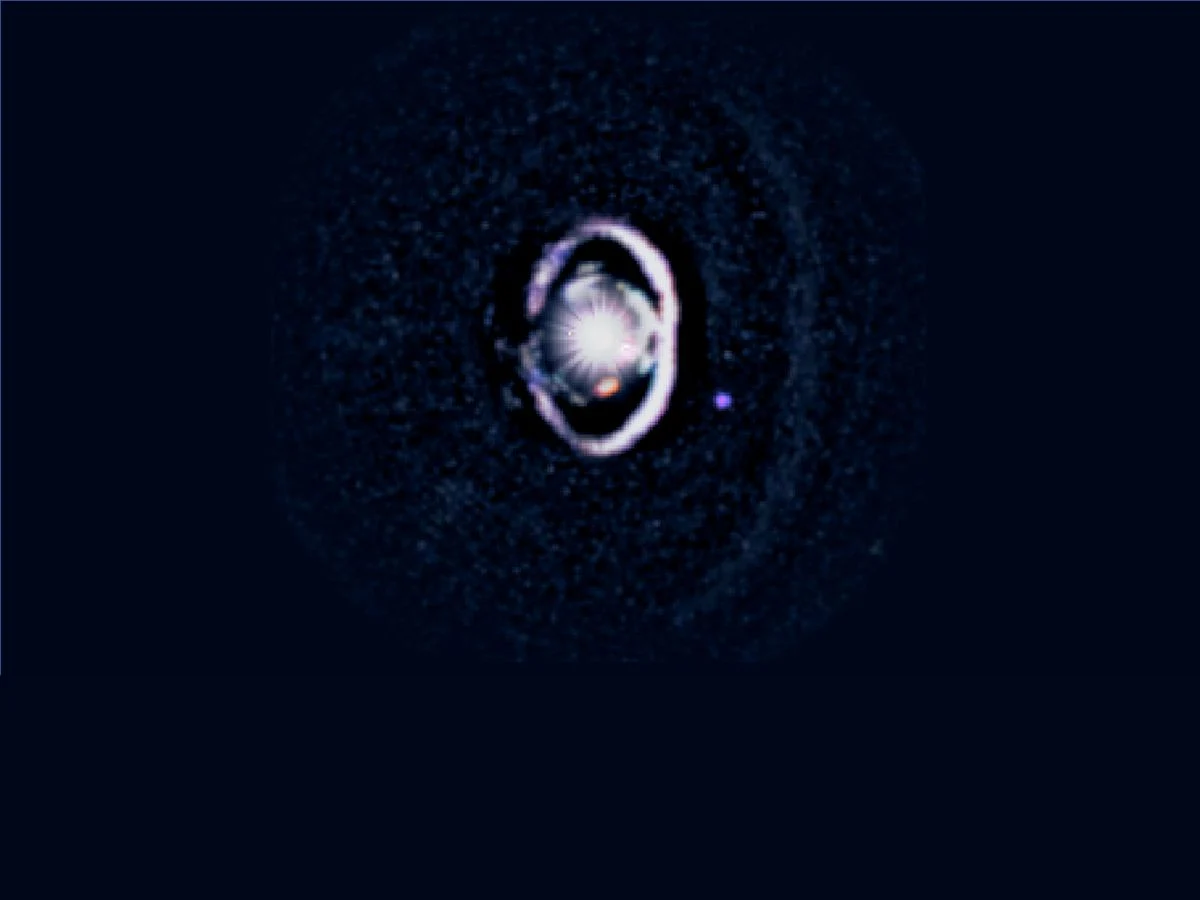
In the captured image, WISPIT 2b appears as a small purple dot to the right of the WISPIT 2 star system. Interestingly, the researchers found a second candidate planet in another dark ring gap that is closer to WISPIT 2. Future studies are likely to explore this discovery further. The findings regarding WISPIT 2b were published on August 26 in the Astrophysical Journal Letters.
Source:
Link
Leave a Reply