Category: Computers

  • AMD Ryzen AI 400 Gorgon Point APUs: 29% Faster Multitasking

    AMD Ryzen AI 400 Gorgon Point APUs: 29% Faster Multitasking

    Key Takeaways

    1. AMD launched the Ryzen AI 400 APUs at CES 2026, featuring seven models from the 4-core Ryzen AI 5 430 to the 12-core Ryzen AI 9 HX 475.
    2. Each APU in the Ryzen AI 400 series includes Zen 5/5c cores, XDNA 2 NPUs, and RDNA 3.5 integrated GPUs, with the Ryzen AI 9 HX 475 having a powerful 16-CU Radeon 890M iGPU.
    3. The APUs have a base clock speed of 2.0 GHz and boost speeds ranging from 4.5 GHz (Ryzen AI 5 430) to 5.2 GHz (Ryzen AI 9 HX 475), supporting up to 36 MB of combined cache and memory speeds of up to 8,533 MT/s.
    4. The Ryzen AI 400 series operates efficiently between 15 W and 54 W, making them suitable for various devices, including lightweight laptops and gaming handhelds.
    5. The Ryzen AI 9 HX 475 outperforms the Core Ultra 9 288V in multitasking and content creation, offering 12% better average FPS at 1080p/low settings and up to 24 hours of video playback.


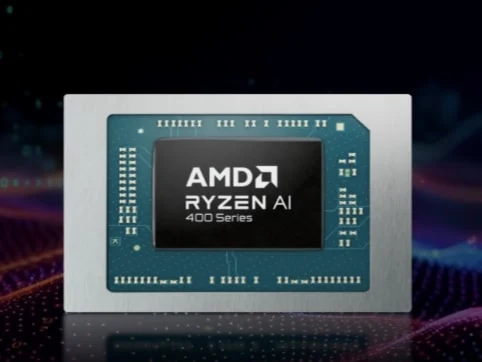
    After a lot of leaks and chatter, the Ryzen AI 400 APUs, previously called the “Gorgon Point” chips, are finally here. AMD revealed these processors at CES 2026. The lineup has seven APUs, starting with the 4-core Ryzen AI 5 430 and going up to the 12-core Ryzen AI 9 HX 475. Additionally, AMD introduced the Ryzen AI 400 Pro series APUs for desktops, which are nearly identical to these APUs but designed for business use.

    Ryzen AI 400 Series Breakdown

    The Ryzen AI 400 series is made up of seven different APUs. Each of these models comes equipped with a combination of Zen 5/5c cores, XDNA 2 NPUs, and RDNA 3.5 integrated GPUs (iGPUs). For example, the top model, the Ryzen AI 9 HX 475, boasts 4 Zen 5 cores and 8 Zen 5c cores, a 60 TOP NPU, and a Radeon 890M iGPU that has 16 Compute Units.

    Performance and Specifications

    All the APUs in the Ryzen AI 400 series have a base clock speed of 2.0 GHz, with various boost clock speeds. The entry-level Ryzen AI 5 430 can boost up to 4.5 GHz, while the Ryzen AI 9 HX 475 reaches a maximum boost of 5.2 GHz.

    For memory and cache, these APUs support up to 36 MB of combined L2 and L3 cache, plus they can handle memory speeds of up to 8,533 MT/s.

    AMD continues to use the Radeon 800M series iGPUs for this line. The Ryzen AI 9 HX 475/470 has a powerful 16-CU Radeon 890M iGPU, while the other models feature a 12-CU Radeon 880M, an 8-CU Radeon 860M, and a 4-CU Radeon 840M, respectively.

    Power and Efficiency

    The Ryzen AI 400 series can be configured to use between 15 W and 54 W of power. This means that the Gorgon Point APUs are capable of running on lightweight laptops, high-speed multimedia notebooks, and even gaming handhelds.

    According to AMD, the flagship Ryzen AI 9 HX 475 is said to be 29% quicker than the Core Ultra 9 288V when multitasking in programs like Microsoft Office, and it is 71% faster in content creation tasks.

    Moreover, Team Red claims that the Ryzen AI 9 HX 475 achieves 12% better average FPS at 1080p/low settings compared to the Core Ultra 9 288V paired with the Arc 140v iGPU. We’ve gone in-depth analyzing the RDNA 3.5-powered Radeon 890M and Intel Arc 140V, so make sure to take a look at our performance reviews for both GPUs.

    Lastly, AMD asserts that the Ryzen AI 400 APUs, including the Ryzen AI 7 445, can provide up to 24 hours of video playback. We will definitely put these claims to the test when laptops featuring the Ryzen AI 400 processors are released in the next few months.

    Source:
    Link



  • Acer Aspire 14 AI and 16 AI: FHD+ OLED and Intel Upgrades

    Acer Aspire 14 AI and 16 AI: FHD+ OLED and Intel Upgrades

    Key Takeaways

    1. Acer will unveil Aspire 14 AI and Aspire 16 AI laptops at CES 2026, featuring Intel Core Ultra 9 300 series processors.
    2. Both models offer a maximum of 32 GB RAM and up to 2 TB NVMe SSD storage, with display options including touch and OLED variants.
    3. Connectivity includes Thunderbolt 4 ports, USB Type-A ports, HDMI 2.1, and Wi-Fi 6E with Bluetooth 5.3 support.
    4. AI features include Acer Intelligence Space, PurifiedVoice, PurifiedView, and My Key for enhanced user experience.
    5. The laptops are expected to be available in North America around June or July 2026, with pricing to be announced later.


    After showcasing the Lunar Lake versions of the Aspire series during IFA 2025, Acer is now set to unveil updated Aspire 14 AI and Aspire 16 AI laptops at CES 2026. These new models are powered by the cutting-edge Intel Core Ultra 9 300 series Panther Lake-H processors.

    Features and Specifications

    The Aspire 14 AI and Aspire 16 AI are both Copilot+ PCs, featuring the Intel Core Ultra 9 386H chipset. They come with a maximum of 32 GB of LPDDR5x RAM and offer storage options of up to a 2 TB M.2 NVMe SSD.

    The Aspire 14 AI boasts a 14-inch 16:10 FHD+ display, with a refresh rate of 120 Hz and 45% NTSC color gamut coverage. Customers can choose between touch and non-touch variants or opt for an OLED display. Meanwhile, the Aspire 16 AI provides a similar FHD+ display and options but features a larger 16-inch screen. Both laptops are designed with hinges that allow them to rotate a full 180° flat.

    Connectivity and Power

    Each laptop is outfitted with a 1080p IR webcam that includes a physical privacy shutter, along with a triple-microphone array and dual speakers equipped with DTS audio. Connectivity options feature 2x Thunderbolt 4 ports, 2x USB Type-A ports, an HDMI 2.1-out, and a combo audio jack.

    For networking, both models are powered by a Wi-Fi 6E WLAN card that supports Bluetooth 5.3. They are also sustained by a 65 Whr battery to power all their features.

    AI Enhancements and Release Date

    Acer is including a range of on-device AI enhancements with these laptops. This includes Acer Intelligence Space, which serves as a personalized AI hub, as well as Acer PurifiedVoice and Acer PurifiedView for better voice and video quality in video calls. Additionally, there’s an Acer My Key feature for easy access to shortcuts and real-time Live Captions.

    The Acer Aspire 14 AI (A14-171M/T) and the Acer Aspire 16 AI (A16-171M/T) are expected to be available in North America around June or July 2026. Pricing details will be revealed closer to their launch.

  • Newegg’s $1,460 128GB DDR5 RAM Bundle with $50 Starbucks Gift Card

    Newegg’s $1,460 128GB DDR5 RAM Bundle with $50 Starbucks Gift Card

    Key Takeaways

    1. Newegg is offering a $50 Starbucks gift card with the purchase of two premium DDR5 RAM kits, rather than adding another PC component.
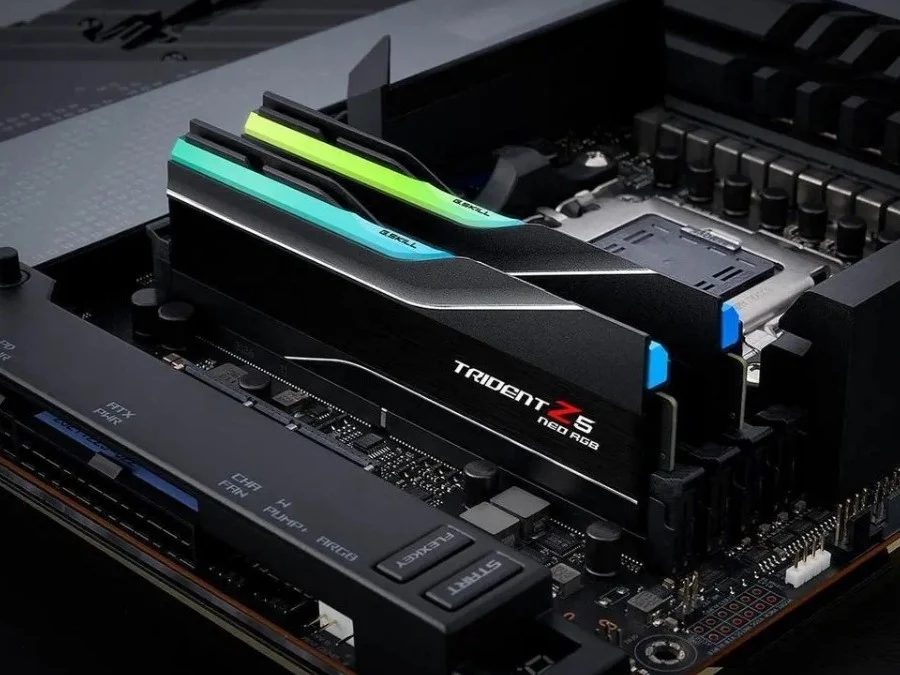
    2. The G.Skill Trident Z5 Neo RGB 128GB DDR5 RAM is priced at $1,470, and the G.Skill Flare X5 128GB DDR5 RAM costs $1,460, reflecting the impact of the current AI boom on memory prices.
    3. The inclusion of a coffee gift card is seen as an unusual and peculiar bundle deal for high-priced RAM kits.
    4. Memory prices have significantly risen due to the AI surge, with high-capacity DDR5 kits now exceeding $1,000.
    5. There are no clear signs that memory prices will decrease soon, and demand is expected to keep driving prices up.


    Newegg is famous for offering various bundles to enhance the experience for customers. In the past, they have paired CPU coolers with processors and even thrown in free monitors with graphics cards. However, the retailer has now come up with something quite surprising. Rather than adding another PC part, Newegg is including a $50 Starbucks gift card when you purchase two premium DDR5 RAM kits.

    Pricing Details on RAM Kits

    On their website, the G.Skill Trident Z5 Neo RGB 128GB DDR5 RAM is available for $1,470, while the G.Skill Flare X5 128GB DDR5 RAM has a price tag of $1,460. These elevated prices aren’t shocking, considering they are influenced by the current AI boom. What is unexpected, though, is that both RAM kits come with a complimentary $50 Starbucks gift card, along with the playful note, “Drink Coffee while you game.”

    An Unusual Bundle Offer

    This is arguably one of the most peculiar bundle deals we’ve encountered in a PC hardware shop, as a coffee gift card seems like a strange extra for a purchase that nears $1,500. In comparison, the Corsair Vengeance 128GB DDR5 RAM bundle looks like a more appealing choice since it includes a free Corsair MP600 2TB SSD valued at $205.

    Rising Memory Prices

    Before the AI surge, which has led to a notable increase in memory costs, these memory kits were priced in the hundreds. Today, however, high-capacity DDR5 kits have surpassed the $1,000 threshold. Even 32GB DDR5 kits are now over $400, making it tough for PC builders to make upgrades. There are no clear indications that prices will drop soon. In fact, with the demand for memory still climbing, prices are likely to go up even more.

    Newegg’s unique offer could attract some buyers, but it raises questions about the overall value in the current market.

    Source:
    Link


  • MSI Launches Prestige 16 AI+ and Prestige 16 Flip AI+ Laptops

    MSI Launches Prestige 16 AI+ and Prestige 16 Flip AI+ Laptops

    Key Takeaways

    1. MSI launched upgraded models of the Prestige 16 AI+ and introduced the Prestige 16 Flip AI+ at CES 2026, featuring Intel Panther Lake-H processors.
    2. The Prestige 16 AI+ offers powerful performance with up to Intel Core Ultra X9 388H processors and integrated Arc B390 Xe3 graphics, comparable to Nvidia GeForce RTX 4050.
    3. Both models have a sleek aluminum alloy design, weighing between 1.59 and 1.66 kg, and feature a 16-inch 2.8K OLED display with HDR certification.
    4. Customers can customize the laptops with up to 64 GB RAM and include advanced connectivity options like Thunderbolt 4, Wi-Fi 7, and fast charging capabilities.
    5. Pricing starts at $1,399 for the Prestige 16 AI+ and $1,629 for the Prestige 16 Flip AI+, with pre-orders available now and general sales starting January 27.


    MSI has previously released the Prestige 16 in two versions: the Prestige 16 AI Evo featuring the Intel Arrow Lake-H Core Ultra 9 285H, and the Prestige 16 AI+ Mercedes-AMG Limited Edition that comes with the Intel Lunar Lake Core Ultra 9 288V.

    Exciting New Launches at CES 2026

    At CES 2026, MSI is unveiling a completely upgraded Prestige 16 AI+ and is also introducing the Prestige 16 Flip AI+ powered by Intel Panther Lake-H processors.

    The Prestige 16 Flip AI+ is available in a sleek Platinum Grey finish, while the Prestige 16 AI+ can be found in both Platinum Gray and Beige Gold color choices. Each model boasts an aluminum alloy body that weighs between 1.59 and 1.66 kg and is just 11.9 mm thick at its slimmest point.

    Powerful Performance Upgrades

    The Prestige 16 AI+ is configurable with an Intel Core Ultra X9 388H Panther Lake-H processor, featuring integrated Arc B390 Xe3 graphics, which is expected to match the performance level of an Nvidia GeForce RTX 4050 Laptop GPU. The Prestige 16 Flip AI+ also features the Core Ultra X9 388H but can be upgraded to a Core Ultra 7 355H processor with Xe2 graphics if desired.

    Both laptops come with a 16-inch 16:10 2.8K OLED display that supports 48-120 Hz variable refresh rates, covers 100% of the DCI-P3 color space, and is VESA DisplayHDR True Black 600 certified. As a convertible device, the Prestige 16 Flip AI+ includes a touchscreen with Corning Gorilla Glass for protection and is compatible with the new MSI Nano Pen that fits neatly into the laptop’s design. The Nano Pen also has a Press-to-talk feature for easy interaction with Microsoft Copilot.

    Configurable Features and Availability

    Customers can customize these laptops to include up to 64 GB of dual-channel LPDDR5x-8533 RAM and a PCIe Gen5 M.2 NVMe SSD.

    Both models share several features, such as 2 Thunderbolt 4 ports, 2 USB 3.2 Gen1 Type-A ports, 1 HDMI 2.1 output, an FHD IR webcam with a privacy shutter, a FIDO 2-compliant fingerprint reader, Wi-Fi 7 with Bluetooth 6, a quad-speaker setup, and an 81 Whr battery that supports fast charging at 65 W.

    The new Prestige series will be available for pre-order starting today, with general sales beginning on January 27.

    Pricing Details

    The starting prices are set at $1,399 for the Prestige 16 AI+ and $1,629 for the Prestige 16 Flip AI+ equipped with Core Ultra X9 CPUs. The Core Ultra 7 version of the Prestige 16 Flip AI+ will begin at $1,549.

  • Asus ROG G1000: High-End Desktop with Tri-Zone Airflow and Next-Gen Tech

    Asus ROG G1000: High-End Desktop with Tri-Zone Airflow and Next-Gen Tech

    Key Takeaways

    1. The Asus ROG G1000 features a unique chassis designed for thermal management and hardware stability with future upgrade potential.
    2. It supports powerful AMD Ryzen 9 9950X3D processors and NVIDIA GeForce RTX 5090 graphics cards, built on a custom X870 motherboard.
    3. The cooling system includes a tri-zone airflow structure and a 420mm AIO liquid cooler within the “ROG Thermal Atrium” for optimal thermal performance.
    4. Designed for user-friendliness, it offers tool-less access, standard-sized components, and direct physical control buttons on the chassis.
    5. Pricing and availability for the Asus ROG G1000 have not yet been announced.


    Asus has introduced the ROG G1000, a high-performance desktop built around a unique chassis crafted by ROG. This desktop emphasizes thermal management, stability of hardware, and the potential for future upgrades. The company first hinted at this machine last month in December.

    Processor and Graphics Support

    The ROG G1000 can accommodate powerful AMD Ryzen 9 9950X3D processors alongside NVIDIA GeForce RTX 5090 graphics cards. The system is constructed using an X870 motherboard that ROG has designed in-house. It supports DDR5 memory, enhanced by AEMP II, which is Asus’ automatic tuning system that boosts stability and performance without needing any manual setup.

    Innovative Cooling Design

    A key aspect of the G1000’s design is its cooling system. The chassis incorporates a tri-zone airflow structure that divides internal parts into three thermal sections, minimizing heat interference between the CPU, GPU, and other components. It includes a 420mm AIO liquid cooler, integrated into what Asus calls the “ROG Thermal Atrium,” a specialized chamber that draws fresh air from outside the case instead of reusing the internal air. This design aims to ensure stable thermal performance during intense usage.

    User-Friendly Features

    The ROG G1000 is designed for easy upgrades and maintenance, featuring tool-less access and standard-sized components, making it more user-friendly compared to other proprietary models. The exterior showcases ROG AniMe Holo, a vibrant holographic lighting feature embedded in the chassis. Additionally, there are physical control buttons on the case that allow users to access system functions directly without needing to use software. The overall aesthetic focuses on showcasing internal components while ensuring clear airflow paths.

    At this time, pricing and availability details for the Asus ROG G1000 have not been announced.

  • Asus ROG Zephyrus Duo 16: Dual OLED Screens & Intel CPUs Upgrade

    Asus ROG Zephyrus Duo 16: Dual OLED Screens & Intel CPUs Upgrade

    Key Takeaways

    1. The ROG Zephyrus Duo 16 has been updated with Intel’s Panther Lake platform, featuring a 16-core CPU and enhanced Nvidia Blackwell GPU options (RTX 5070 Ti and RTX 5090).

    2. Memory and storage options are limited, with the RTX 5090 model offering 64 GB RAM and 2 TB storage, while the RTX 5070 Ti model has 32 GB RAM and 1 TB storage.

    3. Both models include a 90 Wh battery, 1080p webcam, multiple USB ports, HDMI 2.1, and a micro SD card reader.

    4. The new display features two 16-inch WQXGA OLED screens with a 120 Hz refresh rate, enhancing its gaming capabilities.

    5. The ROG Zephyrus Duo 16 will launch in Q2 2026, with pricing details to be announced later.


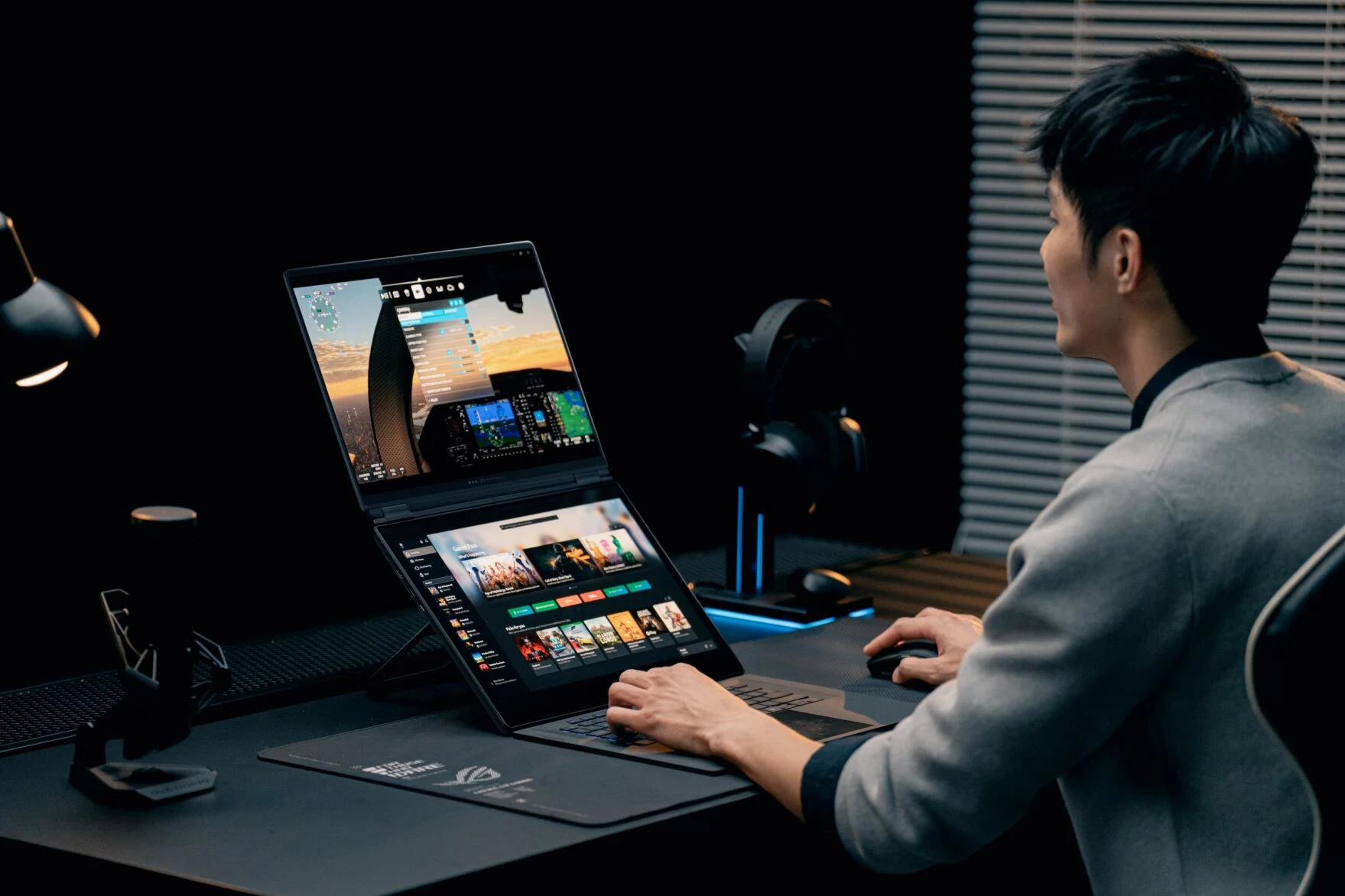
    The ROG Zephyrus Duo 16 was, without a doubt, one of the most fascinating devices introduced by Asus in 2023. Our thorough analysis praised its dual-screen feature and robust hardware. This laptop-tablet hybrid has just been updated at CES 2026. It now boasts considerable upgrades under the hood. The launch is set for Q2 2026, and the pricing details will be disclosed later.

    New Intel Platform

    In contrast to its 2023 predecessor, which utilized AMD Ryzen 7000 processors, the latest ROG Zephyrus Duo 16 is built on Intel’s cutting-edge Panther Lake platform. Asus hasn’t specified any SKU names but has indicated it incorporates a 16-core CPU, likely the anticipated Core Ultra X9 388H. The GPU has also received an enhancement to Nvidia Blackwell, with options limited to the GeForce RTX 5070 Ti and RTX 5090.

    Memory and Storage Limitations

    Regrettably, Asus does not provide much in terms of memory and storage options. The RTX 5090 model comes equipped with 64 GB of LPDDR5x RAM and 2 TB of storage, while the RTX 5070 Ti version is restricted to 32 GB of RAM and 1 TB of storage. Fortunately, the rest of the features are the same for both models, such as a 90 Wh battery, 1080p webcam, two Thunderbolt 4.0 ports, two USB 3.2 Gen2 Type-A ports, one HDMI 2.1 port, a 3.5 mm combo audio jack, and a micro SD card reader.

    Stunning Display Enhancements

    The most remarkable upgrade, however, is its display. Rather than providing a small secondary screen to complement a bigger one, the new ROG Zephyrus Duo 16 truly lives up to its name, featuring two 16-inch WQXGA (2,880 x 1,880) OLED screens with a 120 Hz refresh rate. Essentially, it serves as a gaming-oriented version of the ZenBook Duo. Additional specifications include Wi-Fi 7 and Bluetooth 6.0. Weighing in at 2.80 kilograms, the ROG Zephyrus Duo isn’t the lightest laptop on the market, but this is a trade-off for having dual screens and high-performance components.


  • HP Launches EliteBook X G2q and G2x Laptops with New Processors

    HP Launches EliteBook X G2q and G2x Laptops with New Processors

    Key Takeaways

    1. HP has launched new EliteBook laptops (G2q and G2x) with enhanced security features and optional 5G connectivity, targeting businesses and small enterprises.
    2. Both models feature a 14-inch display with various configurations, including WUXGA OLED and LCD options, with peak brightness up to 800 nits and a 3K OLED model available.
    3. The EliteBook X G2q is powered by Qualcomm’s Snapdragon X2 Elite chips, while the G2x uses AMD’s Ryzen AI Pro processors, both supporting up to 64 GB of RAM and 2 TB SSD storage.
    4. Both laptops come with a 56 Wh battery (upgradeable to 68 Wh) and include a variety of I/O options such as USB-C, HDMI, and audio jack, with the G2a featuring Thunderbolt 4.0 ports.
    5. Additional features include a 5 MP camera, Bluetooth 5.4, Wi-Fi 7, and color options in Glacial Silver and Atmospheric Blue, with availability planned for Spring 2026.


    HP has unveiled several new EliteBook laptops aimed at businesses and small enterprises. The EliteBook X G2q and G2x come with enhanced security features provided by AMD’s Ryzen Pro and Qualcomm’s Snapdragon X platforms, along with an optional 5G modem to ensure seamless connectivity. As their designations suggest, the G2q is powered by Qualcomm’s Snapdragon X2 Elite chip, while the G2x utilizes AMD’s latest Ryzen AI Pro 400 Gorgon Point processors.

    Display Options and Configurations

    Both the EliteBook X G2q and G2x sport a 14-inch display and offer various configurations, including a WUXGA (1920 x 1200) OLED screen that boasts a peak brightness of 300 nits and covers 95% of the DCI-P3 color gamut. Alternatively, users can opt for an LCD panel featuring 400 nits brightness with 100% sRGB gamut coverage.

    For those seeking touchscreen capabilities, there are choices between a 500-nit and an 800-nit display, both maintaining the same resolution. Additionally, a 3K (2880 x 1800) OLED model is available, offering a 120 Hz refresh rate, variable-refresh-rate (VRR) features, and a peak brightness of 500 nits. There’s also a tandem OLED display with similar specifications but with 700 nits brightness.

    Processor and Storage Options

    The EliteBook X G2q can be set up with a Snapdragon X2 Elite X2E-88-100 featuring 18 CPU cores, a Snapdragon X2 Elite X2E-80-100 with 12 CPU cores, or an unspecified Snapdragon X Plus model with 6 CPU cores. All configurations include an Adreno iGPU and can support up to 64 GB of LPDDR5x-9600 RAM along with a 2 TB PCIe Gen4/Gen5 NVMe SSD.

    On the other hand, the EliteBook X G2a provides four CPU options: AMD Ryzen AI 9 HX Pro 470, Ryzen AI 7 Pro 450, Ryzen AI 5 Pro 440, and Ryzen AI 5 435. Notably, discrete GPUs are not an option, so users will rely on the Radeon iGPU. Each configuration can support up to 64 GB of DDR5-8533 RAM, although the Ryzen AI 5 435 with 64 GB RAM limits the speed to 8,000 MT/s. Storage also caps at a 2 TB PCIe Gen4/Gen5 NVMe SSD.

    Battery and I/O Features

    Both the EliteBook X G2q and G2x are equipped with a 56 Wh battery, which is upgradeable to 68 Wh if needed. They come standard with a 65 Watt charger, which can be replaced with a 100 Watt charger. The I/O options are nearly the same for both models, featuring one 10 Gbps USB-C port with power delivery and DisplayPort, one 5 Gbps USB-A port, one HDMI 2.1 port, and a 3.5 mm audio jack. Nonetheless, the G2q includes one USB 4.0 port, while the G2a boasts two Thunderbolt 4.0 ports, marking it as one of the first AMD laptops to adopt the Thunderbolt standard.

    Additional features comprise a 5 MP camera, Bluetooth 5.4, and Wi-Fi 7 capabilities. It’s important to note that the EliteBook X G2q utilizes Qualcomm’s FastConnect 7800 Wi-Fi 7 radio, whereas the G2a is equipped with MediaTek’s MT7925 adapter. Both laptops come in Glacial Silver and Atmospheric Blue color options, with availability set for Spring 2026, and HP is expected to announce the pricing closer to the launch date.

  • Dell XPS 14 and 16 Laptops Relaunched with Lightweight Design

    Dell XPS 14 and 16 Laptops Relaunched with Lightweight Design

    Key Takeaways

    1. Dell is discontinuing all laptop sub-brands except Alienware and renaming the XPS series to “Dell Premium” in 2025.
    2. The XPS brand is making a comeback in 2026 with the introduction of Dell XPS 14 and XPS 16 models.
    3. Design updates include a more traditional look, physical function keys, and distinct edges for the touchpad.
    4. New models feature next-gen Intel Panther Lake CPUs, up to 64 GB memory, and up to 4 TB SSD storage, but lack dedicated GPUs.
    5. Pricing starts at $2,050 for the XPS 14 and $2,200 for the XPS 16, with availability beginning January 6th in the US and Canada.


    Dell kicked off 2025 with a significant announcement: It would be discontinuing all its laptop sub-brands, except for Alienware, putting the Dell name front and center. This meant even the highly regarded Dell XPS series was set to be renamed to “Dell Premium”.

    A Comeback for XPS

    Fast forward to 2026, and Dell is taking a different direction, bringing the XPS brand back to life. At CES 2026, the company unveiled two fresh models in the series: the Dell XPS 14 DA14260 and the Dell XPS 16 DA16260.

    Design Changes and Features

    With the return of the XPS name, Dell is also making some design changes to this premium prosumer laptop line, opting for a more traditional look. Among the updates are the reinstatement of physical function keys and distinct edges for the larger haptic touchpad.

    Powerful New Hardware

    As laptops in 2026, both the Dell XPS 14 and Dell XPS 16 are equipped with next-gen processors. They feature Intel’s Panther Lake CPUs, which come in basic 8-core options (Intel Core Ultra 5 325, Core Ultra 7 355) and more robust H class CPUs (Intel Core Ultra X7 358H, Core Ultra X9 388H). The latter models include Intel’s latest ARC Graphics, but don’t offer dedicated GPUs. Users can choose up to 64 GB of soldered LPDDR5X memory, while SSD storage can reach up to 4 TB.

    Premium Build and Weight Reductions

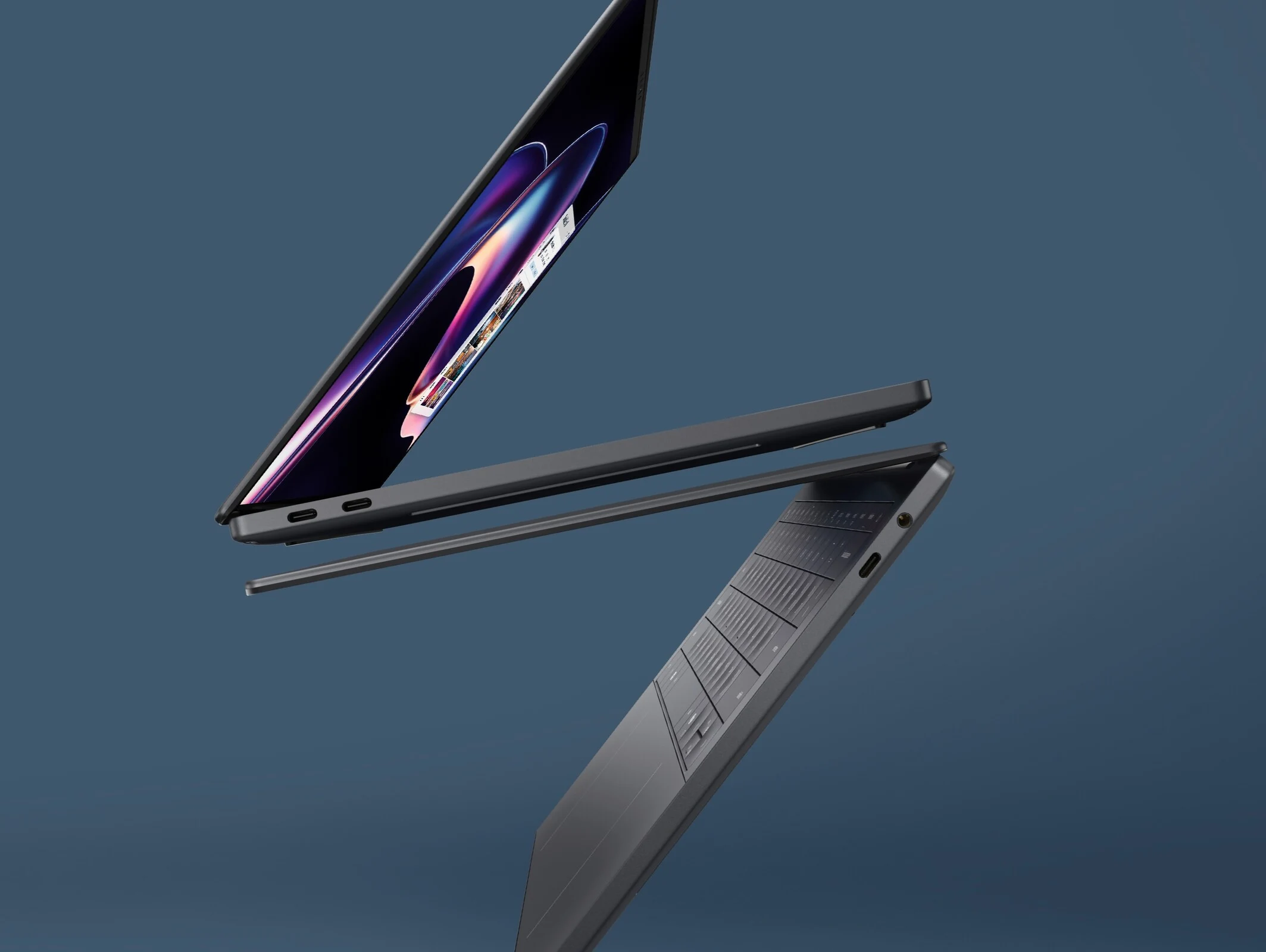
    These components are housed in cases made from high-quality materials, such as CNC Aluminum and Gorilla Glass on the palm rest. A notable change this year is the reduced weight of the Dell XPS 14 and XPS 16. Compared to the previous Dell 14 Premium and Dell 16 Premium found on Amazon, the weight has decreased from 1.7 kg to 1.4 kg for the 14-inch model and from 2.3 kg to 1.7 kg for the 16-inch model. While the lower weight comes at the cost of the dGPU option, it also affects the battery capacity of the 16-inch model, which now is 70 Wh, down from 99.5 Wh. The microSD card slot has been removed, and screen sizes have been adjusted from 14.5 inches and 16.3 inches to a more standard 14 and 16 inches. Both models offer options for WUXGA IPS screens along with 2.8K (14-inch) and 3.2K (16-inch) OLED screens. All displays support refresh rates of up to 120 Hz, with the IPS screens able to drop to a power-saving 1 Hz.

    Pricing and Availability

    The new Dell XPS series will be available starting January 6th in the US and Canada, with a starting price of $2,050 for the XPS 14 and $2,200 for the XPS 16 in the USA.

    Source:
    Link


  • Belkin HDMI Adapter: No Wi-Fi or Bluetooth Required

    Belkin HDMI Adapter: No Wi-Fi or Bluetooth Required

    Key Takeaways

    1. Direct Connection: The ConnectAir adapter establishes a peer-to-peer 5GHz connection without relying on Wi-Fi or Bluetooth, ensuring a stable link to distant screens.

    2. Easy Setup: No driver downloads or software installations are required; simply power the receiver via USB-A to start mirroring or extending your screen.

    3. High-Quality Output: Capable of 1080p resolution at 60Hz with under 80 milliseconds of latency, providing clear and well-synchronized video for professional use.

    4. Universal Compatibility: Works with any USB-C device that supports DisplayPort Alt Mode, regardless of operating system, and does not depend on specific protocols like AirPlay or Google Cast.

    5. Multi-User Capability: Supports up to eight transmitters connecting to a single receiver, making it ideal for shared environments like conference rooms, with a wireless range of up to 131 feet (40 meters).


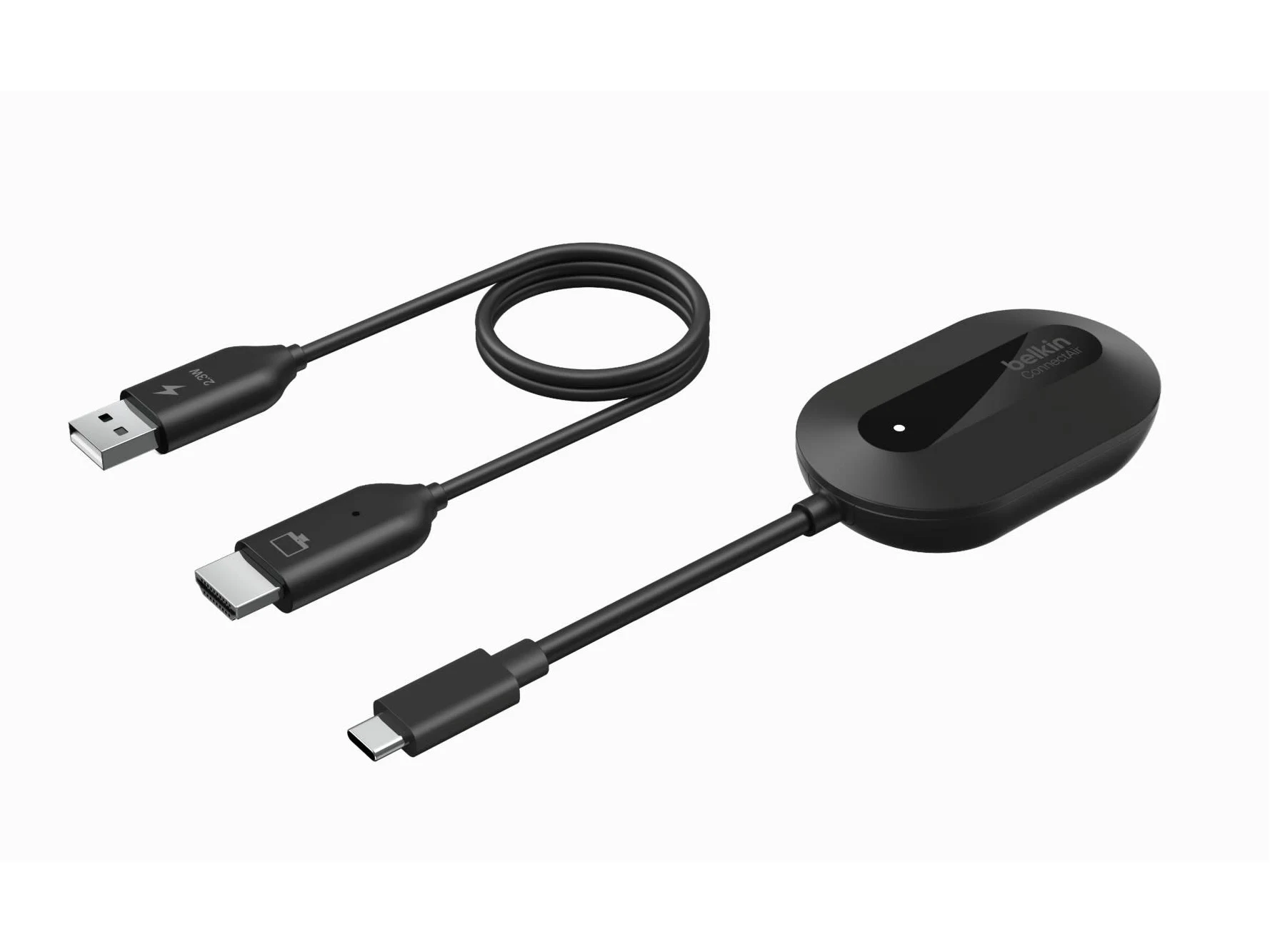
    Belkin has recently unveiled the ConnectAir Wireless HDMI Display Adapter at CES 2026. This innovative adapter addresses the frequent annoyance of linking devices to far-off screens by establishing a direct connection that does not rely on Wi-Fi or Bluetooth. It employs a USB-C transmitter for your source device and an HDMI receiver for the display, forming a peer-to-peer 5GHz connection that is capable of transmitting content across large spaces.

    Easy Setup and High Quality

    Establishing the connection is a breeze, requiring no driver downloads or complicated software installations. The receiver only needs to be powered by a nearby USB-A port to start mirroring or extending your screen right away. The video quality is consistently clear and well-synchronized for most professional applications, providing a resolution of 1080p at 60Hz with latency under 80 milliseconds. This adapter is highly compatible, supporting any USB-C device that works with DisplayPort Alt Mode, including Windows laptops, MacBooks, Chromebooks, and the latest iPads.

    Universal Compatibility

    The device operates without relying on specific ecosystem protocols like AirPlay or Google Cast, making it a universal method of connection for any compatible hardware, no matter the OS in use.

    The adapter is capable of wirelessly casting over distances of up to 131 feet (40 meters) and can even function through walls, although physical barriers may affect the strength of the signal. Shared environments, such as conference rooms, can gain from its multi-user capability, enabling up to eight transmitters to connect to a single receiver, allowing for easy switching between different presenters. Belkin is set to launch the adapter in select regions during the first quarter of 2026, with a retail price of $149.99.

    Source:
    Link


  • KVM-GO: Openterface Relaunches with Compact, Refined KVM Model

    KVM-GO: Openterface Relaunches with Compact, Refined KVM Model

    Key Takeaways

    1. KVMs allow remote control of computers without needing installed software, enabling access to BIOS settings and system restarts.
    2. The Mini-KVM raised $461,555 on Crowd Supply, leading to the successful launch of the KVM-GO, which has exceeded its funding goals.
    3. KVM-GO features a 4K, 60Hz mode, HDMI, DisplayPort, VGA options, and a Micro SD card slot for OS and driver installations.
    4. Openterface promotes an open-source approach, making hardware schematics and source code publicly available on platforms like Github.
    5. The KVM-Go is priced at $119, appealing to customers through its open-source features and reduced cable clutter, despite being pricier than some alternatives.


    A KVM enables you to control a computer from a distance by linking a Keyboard, Video, and Mouse (KVM) from another device, allowing you to manage the target remotely.

    Unique Features of KVMs

    Even though it may seem like VNC or Remote Desktop, KVMs stand out because they work without needing installed software. This means they can access the BIOS of the remote computer.

    With this capability, you can restart a system if the OS freezes, adjust BIOS settings, and even reinstall the operating system from afar.

    Product Launch and Success

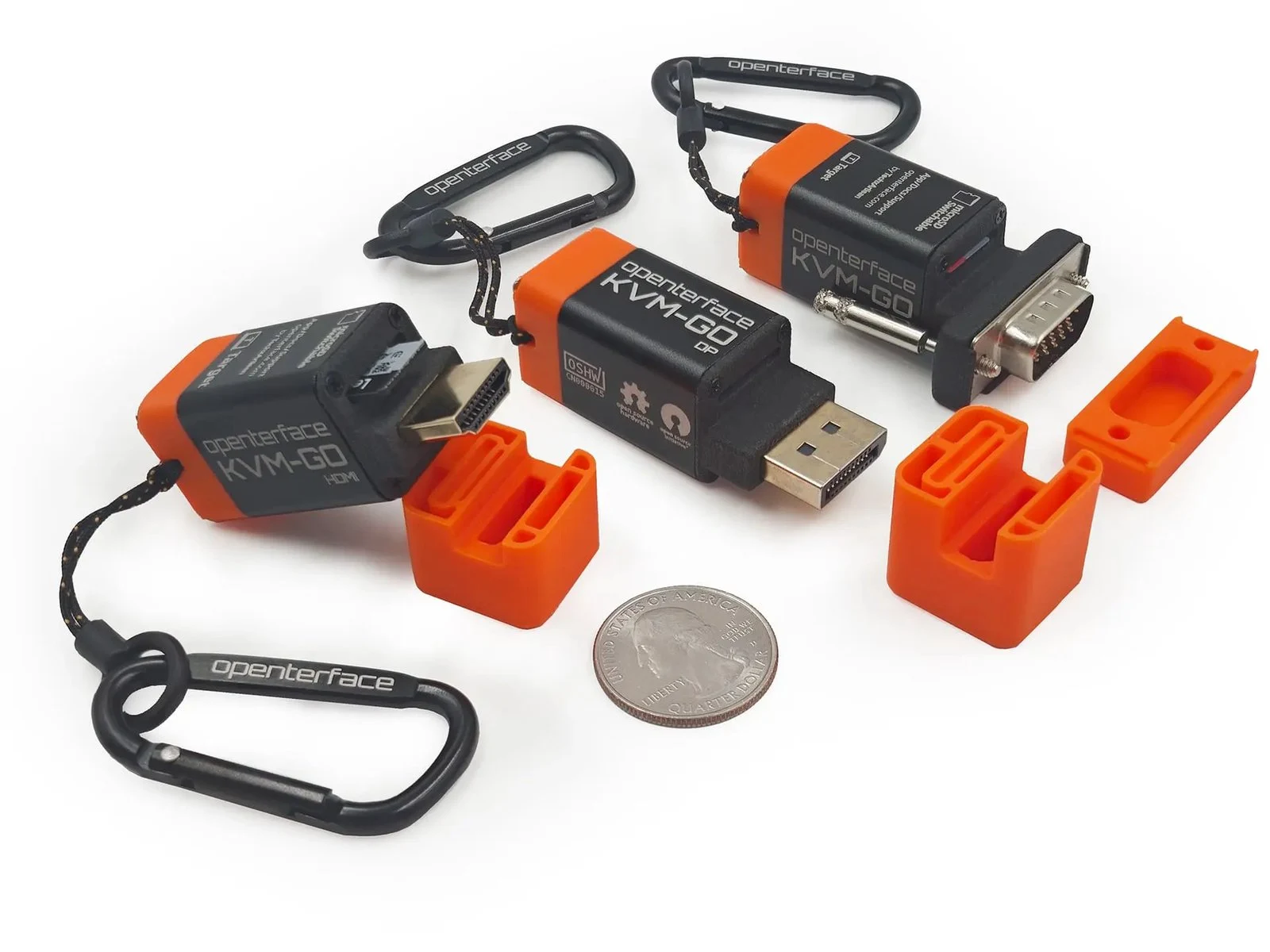
    The Mini-KVM was the first product introduced by Openterface and it raised $461,555 on Crowd Supply. Following that achievement, the KVM-GO is now available on the same platform and has already surpassed its funding goals.

    The KVM-Go has good specifications, featuring an experimental 4K, 60Hz mode, along with HDMI, DisplayPort, and VGA options. It also includes a Micro SD card slot for storing various operating systems and drivers that can be installed using the device. The administration software is compatible with Windows, Linux, MacOS, and Android.

    Open-Source Advantage

    Openterface sets its products apart from the competition through their open-source approach. Once everything is finalized, all hardware schematics, PCB layouts, and 3D models will be made publicly available. Additionally, the source code for various applications will be accessible via Github, covering MacOS, Windows, and Linux.

    There’s no shortage of KVM options, ranging from DIY solutions with Raspberry Pi to ready-made ones like the Gl-iNet Comet, which you can find on Amazon. The KVM-Go starts at $119, which is a bit pricier than some competitors, but its open-source feature and reduced cable mess may attract customers.

    Source:
    Link