Category: Computers

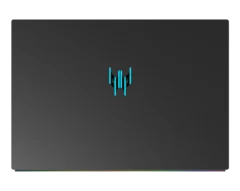
  • Acer Predator Triton 14: Gaming Laptop with Nvidia dGPU

    Acer Predator Triton 14: Gaming Laptop with Nvidia dGPU

    Key Takeaways

    1. Unique Processor Choice: The Acer Predator Triton 14 AI features a Lunar Lake CPU instead of the typical Intel Arrow Lake processor, promising improved battery life and gaming performance.

    2. Powerful Specs: It is equipped with an Intel Core Ultra 9 288V SoC, Nvidia GeForce RTX 5070, 32 GB of LPDDR5X RAM, and up to 2 TB of PCIe Gen 4 storage.

    3. High-Quality Display: The laptop has a 14.5-inch WQXGA+ OLED display with a 120 Hz refresh rate, 340 nits brightness, and a 1 ms response time, enhancing the gaming experience.

    4. Comprehensive Connectivity: It includes a variety of ports, such as Thunderbolt 4.0, USB 3.2 ports, HDMI 2.1, and supports Wi-Fi 7 and Bluetooth 5.4 for wireless connectivity.

    5. Compact and Lightweight: The Predator Triton 14 AI measures 321 mm x 221 mm x 11 mm and weighs 1.6 kg, making it a portable option despite its high-end features, priced at EUR 2,999/$3,361.


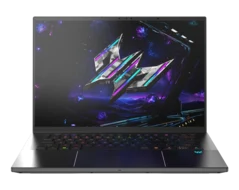
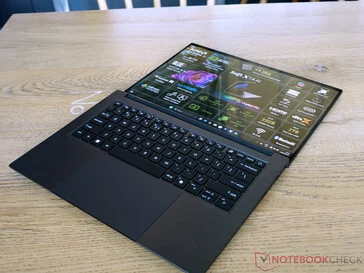
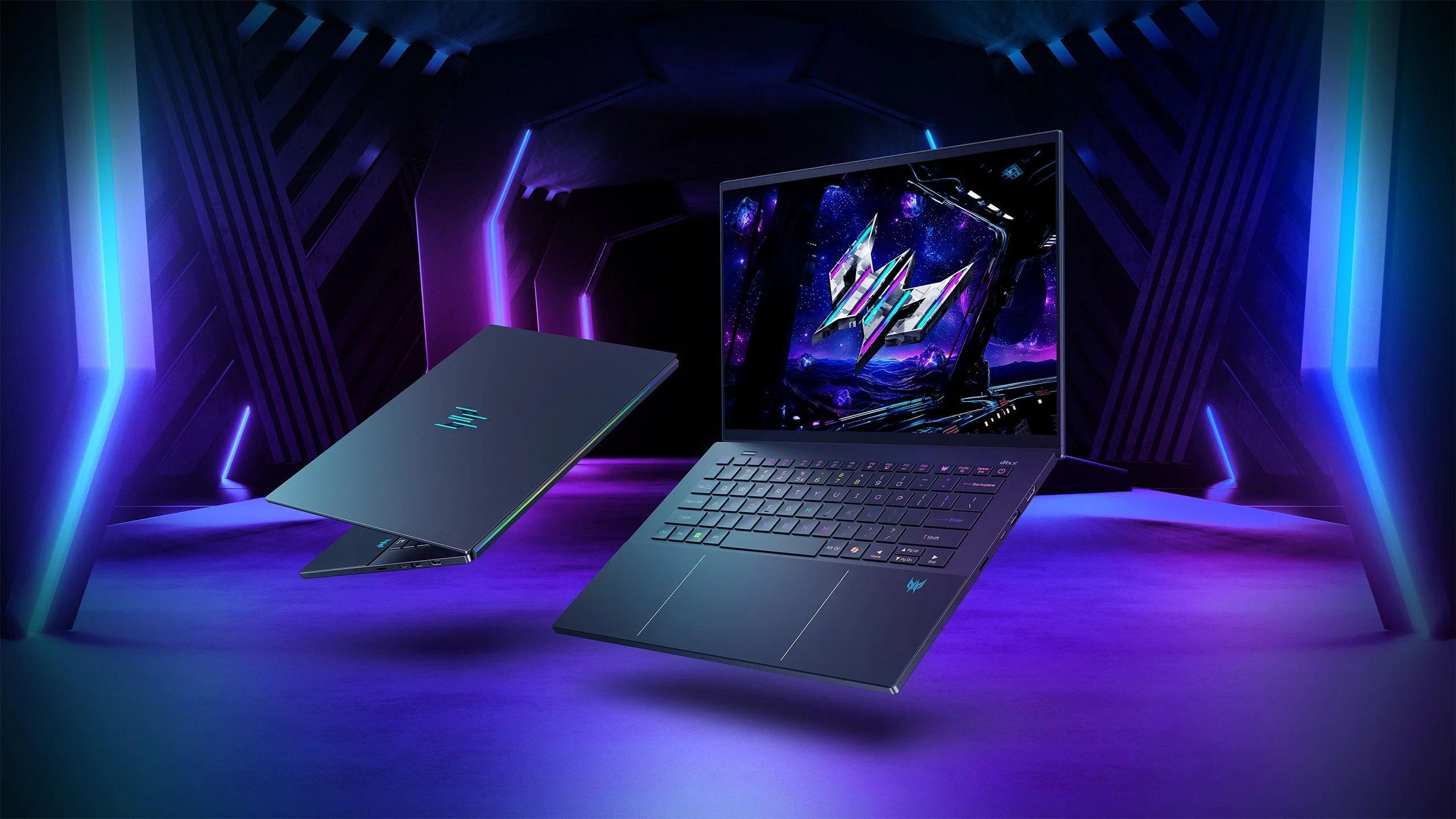
    Acer has unveiled an intriguing new laptop at Computex 2025. Instead of the usual choice of pairing an Intel Arrow Lake H/HX processor with an Nvidia dGPU, the Predator Triton 14 AI opts for a Lunar Lake CPU. This combination promises to deliver an excellent balance: the great battery life of Lunar Lake along with the powerful GeForce GPU for gaming performance.

    Performance and Specifications

    The laptop features an Intel Core Ultra 9 288V SoC and an Nvidia GeForce RTX 5070. This setup looks promising, and it will be fascinating to observe how the Lunar Lake chip performs in CPU-intensive tasks such as gaming. The system is equipped with 32 GB of LPDDR5X-8533 RAM, while storage capacity can reach up to 2 TB (PCIe Gen 4). A robust 76 Wh battery supports the laptop’s power needs.

    Display and Features

    Among the other specifications for the Predator Triton 14 AI, it boasts a 14.5-inch WQXGA+ (2,880 x 1,800) OLED display, featuring a 120 Hz refresh rate, 340 nits brightness, complete DCI-P3 color coverage, a rapid 1 ms response time, and touch capabilities—something that’s pretty rare in gaming laptops.

    Connectivity and Dimensions

    Regarding I/O options, there’s one Thunderbolt 4.0 port, one USB 3.2 Gen 2 Type-C port, two USB 3.2 Gen 2 Type-A ports, a 1080p IR webcam, an HDMI 2.1 port, a micro SD card reader, and a 3.5 mm combo audio jack. For wireless connectivity, it includes Wi-Fi 7 and Bluetooth 5.4.

    The Acer Predator Triton 14 AI measures 321 mm x 221 mm x 11 mm and weighs in at 1.6 kg. It is certainly a remarkable achievement in engineering, and Acer sets a high price for it (EUR 2,999/$3,361). The laptop is expected to be available in July 2025.
  • Acer Swift X 14 (SFX14-73G): New Design, 2.8K OLED, Intel/Nvidia Chips

    Acer Swift X 14 (SFX14-73G): New Design, 2.8K OLED, Intel/Nvidia Chips

    Key Takeaways

    1. Acer launched the Swift X 14 (SFX14-73G) creator laptop at Computex 2025, featuring Intel’s Core Ultra 200H Arrow Lake processors and RTX 50 graphics.
    2. The top model includes the Intel Core Ultra 9 285H and RTX 5070 GPU, with options starting from Core Ultra 5 225H and 32 GB RAM.
    3. It boasts a 14.5-inch 2.8K OLED display with touch capabilities, 100% DCI-P3 color coverage, and a brightness of 340 nits.
    4. The laptop has a stylish aluminum chassis, a larger trackpad, and retains the same port selection as its predecessor.
    5. The Swift X 14 (SFX14-73G) launches in July, starting at EUR 1,999 (approximately $2,242).


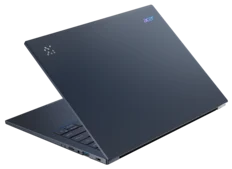
    Acer has unveiled an updated version of the Swift X 14 creator laptop at Computex 2025, featuring the newest technology from Intel and Nvidia. This follows the launch of last year’s Swift X 14 (SFX14-72G) at CES 2024, which was powered by the latest Core Ultra 100H Meteor Lake processors and RTX 40 graphics cards. In this new iteration for 2025, Acer introduces the Swift X 14 (SFX14-73G), which utilizes the Core Ultra 200H Arrow Lake mobile processors alongside RTX 50 graphics.

    Specifications of the New Model

    The top-tier model of the Acer Swift X 14 (SFX14-73G) is equipped with the Intel Core Ultra 9 285H and can come with an RTX 5070 laptop GPU. For those looking for more affordable options, there are models that start with the Core Ultra 5 225H and the Core Ultra 7 255H. These processors can be combined with a maximum of 32 GB of LPDDR5X RAM and 2 TB of PCIe Gen 4 storage, which users can expand via two M.2 slots.

    Display and User Experience

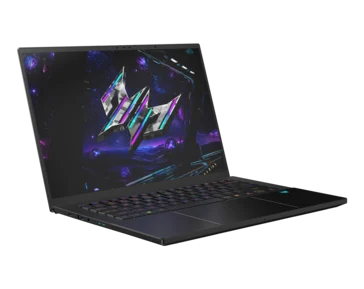
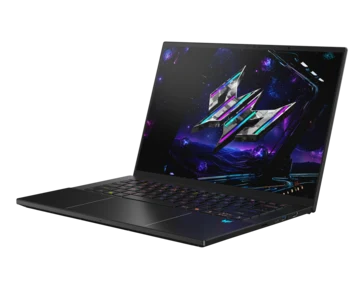
    On the front side, the Swift X 14 (SFX14-73G) comes with a striking 14.5-inch 2.8K OLED display. This screen is touch-enabled, safeguarded by Corning Gorilla Glass, and features a 16:10 aspect ratio. Acer asserts that the OLED screen is Calman-verified, offers full 100% DCI-P3 color coverage, and reaches a brightness level of 340 nits. Additionally, there’s an FHD webcam with an IR sensor for Windows Hello and two built-in microphones.

    Design and Battery Life

    Moreover, Acer has given the Swift X 14 a design upgrade. The aluminum chassis is more stylish and now includes a larger trackpad. Nevertheless, the selection of ports remains unchanged.

    The laptop is powered by a substantial 74 Wh battery, and it’s still uncertain whether Acer has enhanced the battery life compared to the previous Swift X 14 (SFX14-72G).

    The new Swift X 14 (SFX14-73G) and Swift X 14 AI are set to launch in July, with a starting price of EUR 1,999 (approximately $2,242).


  • Acer Swift X 14 AI: Nvidia RTX 5070 & AMD Strix Point CPU

    Acer Swift X 14 AI: Nvidia RTX 5070 & AMD Strix Point CPU

    Key Takeaways

    1. Powerful Hardware: The Swift X 14 AI features the Nvidia RTX 5070 Laptop GPU and offers options for AMD Ryzen AI 365 or Ryzen 7/5 processors.

    2. High-Quality Display: It has a 14.5-inch OLED display with a resolution of 2880×1800 pixels and covers 100% of the DCI-P3 color gamut.

    3. Enhanced Connectivity: The laptop includes WiFi 6E, Bluetooth 5.4, and a variety of ports for expanded connectivity.

    4. Impressive Battery and Memory: It comes with a 76 Wh battery and supports up to 32 GB of LPDDR5X RAM.

    5. Availability and Pricing: The Swift X 14 AI will be available from July 2025, starting at €1,999.


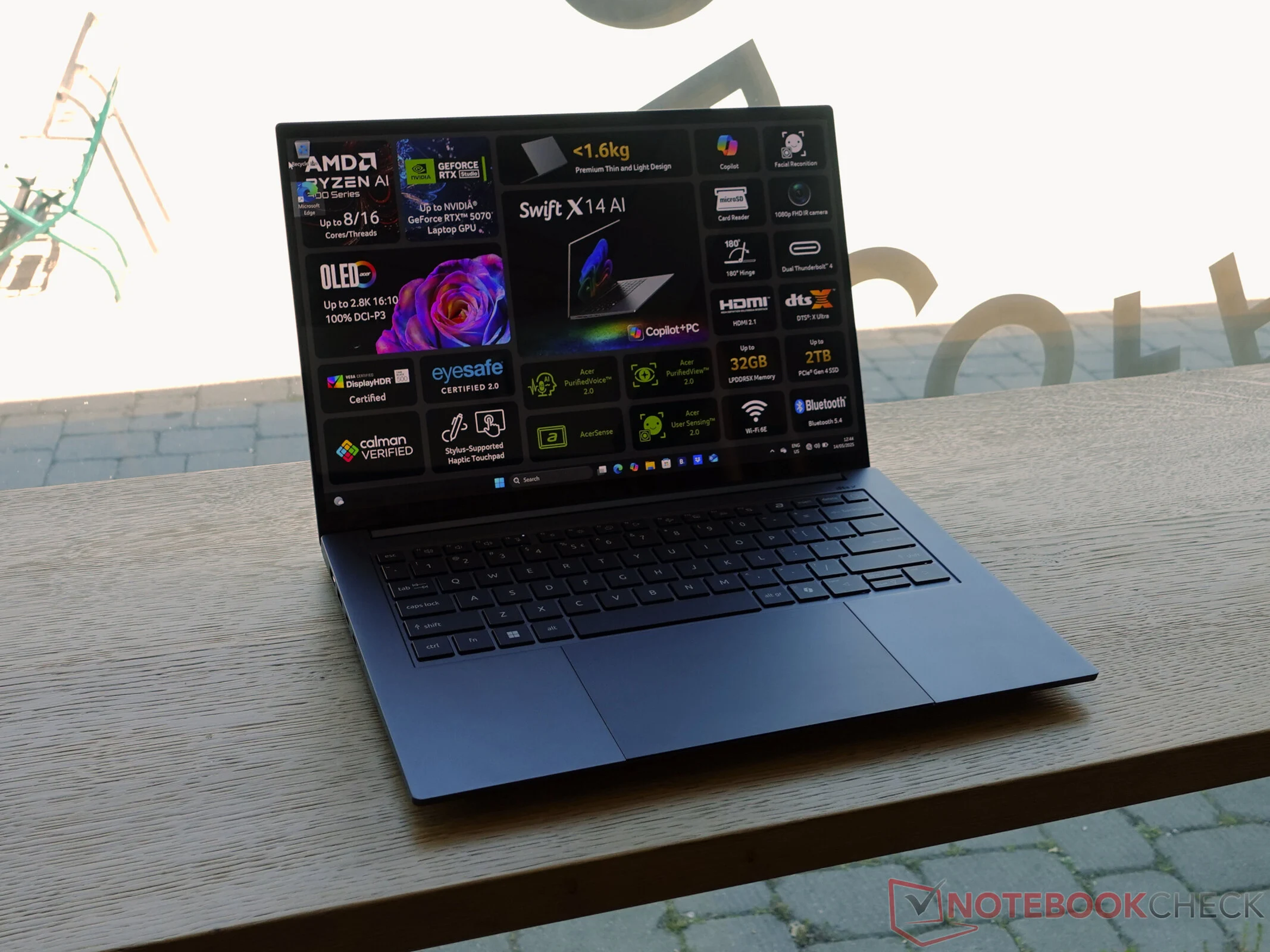
    Acer has unveiled a variety of new products at Computex 2025, including the Swift X 14 AI. This laptop is tailored for creators and boasts powerful hardware, featuring the RTX 5070 Laptop. It also comes with Nvidia Studio drivers already installed, which Acer claims are specifically optimized for the GPU of the laptop.

    Performance Specifications

    When it comes to the CPU, users can choose to pair the Nvidia RTX 5070 Laptop with the AMD Ryzen AI 365. This Strix Point processor is equipped with four Zen 5 cores and six Zen 5c cores, along with the Radeon 880M integrated GPU. Alternatively, customers can select Ryzen 7 350 or Ryzen 5 340 processors, both part of the Krackan Point series.

    Display Features

    The display of the Swift X 14 AI is another standout feature. It has a 14.5-inch OLED screen with Calman verification, delivering a resolution of 2880×1800 pixels and covering 100% of the DCI-P3 color gamut. Acer emphasizes the 16:10 aspect ratio and the panel’s brightness of 340 nits.

    Connectivity and Additional Features

    In terms of connectivity, the laptop offers a good range of ports. For wireless options, it includes WiFi 6E and Bluetooth 5.4. Other notable features of the Swift X 14 AI are its 76 Wh battery, the ability to support up to 32 GB of LPDDR5X RAM, a PCIe Gen 4 SSD slot (with a 1 TB Samsung 990 Pro currently priced at $99.99 on Amazon), a dual-speaker system with DTS:X Ultra, and compatibility with the MPP 2.5 stylus. Acer has announced that this laptop will be available starting from July 2025, with a starting price of €1,999.


  • Acer Launches Aspire A14 with Entry-Level Snapdragon X SoC

    Acer Launches Aspire A14 with Entry-Level Snapdragon X SoC

    Key Takeaways

    1. Acer is launching an ARM version of the Aspire A14 AI powered by Qualcomm’s Snapdragon X SoC, following the Swift Go 14.
    2. The Aspire A14 AI features a Snapdragon X X1-26-100 SoC with an Oryon 8-core CPU and supports up to 32 GB of RAM and 1 TB of storage.
    3. Display options include a 14-inch FHD+ 120 Hz IPS panel, but no OLED alternative is available for the Qualcomm version.
    4. Connectivity includes multiple ports, Wi-Fi 7, Bluetooth 5.3, and an upgraded QHD+ IR webcam with Windows Hello support.
    5. The Aspire A14 AI is expected to launch in June 2025, starting at €749, with impressive battery life of up to 28 hours for video playback.


    Alongside Intel und AMD options, Acer is also launching an ARM version of the fresh Aspire A14 AI, which is driven by the Qualcomm Snapdragon X SoC. This marks the second Acer laptop to utilize Qualcomm’s budget-friendly SoC, following the Swift Go 14, which also had a Snapdragon X Plus variant.

    Snapdragon X Features

    Qualcomm first unveiled the Snapdragon X at CES 2025. The Aspire A14 AI (A14-11M/A14-11MT) is powered by the Snapdragon X X1-26-100 SoC, featuring an Oryon 8-core CPU, Adreno iGPU, and the Hexagon NPU. Users can customize the Aspire A14 AI with up to 32 GB of LPRDDR5x RAM and up to 1 TB of PCIe storage, which can be expanded further using a microSD card.

    Display Options

    Unlike its Intel Lunar Lake and AMD Ryzen AI 300 variants, the Aspire A14 AI Qualcomm does not provide an OLED display alternative. Instead, customers can select between a 14-inch FHD+ 120 Hz IPS panel with complete 100% sRGB coverage or another option with 45% NTSC coverage.

    Connectivity and Battery Life

    The Qualcomm version of the Aspire A14 AI shares a similar range of ports with its Intel and AMD versions, including 2x USB4 Type-C ports and 2x USB 3.2 Type-A ports (one specifically designated for Power Share), along with an HDMI 2.1 output and a 3.5 mm audio combo jack. Wi-Fi 7 and Bluetooth 5.3 support wireless connections.

    The IR webcam has been updated to a QHD+ resolution, capable of Windows Hello facial recognition and enhanced temporal noise reduction.

    Acer claims that the Aspire A14 AI Qualcomm’s 65 Whr battery can provide up to 28 hours of video playback and 17 hours of internet browsing.

    The Acer Aspire A14 AI (A14-11M) is set to hit the market in June 2025, with prices starting at €749.


  • New Spectre Vulnerability Found in 2018-2024 Intel CPUs

    New Spectre Vulnerability Found in 2018-2024 Intel CPUs

    Key Takeaways

    1. Spectre and Meltdown flaws in x86 processors led to major issues for Intel and AMD in 2018, resulting in lawsuits and the need for microcode updates.
    2. New vulnerabilities related to Spectre were discovered in Intel CPUs, particularly the Alder Lake series, and ARM cores, impacting performance variably.
    3. ETH Zurich’s research revealed that existing mitigations could still be bypassed under certain conditions.
    4. Intel’s January 2025 microcode update showed minimal performance overhead in most chips, but Rocket Lake experienced an 8.3% performance decrease.
    5. The vulnerabilities affect all operating systems, but AMD and ARM chips are not impacted by the newly identified flaws.


    The Spectre and Meltdown flaws that impacted X86 processors created major issues for Intel and AMD in 2018, leading to lawsuits against both firms. ARM also faced these vulnerabilities, but all companies ultimately issued in-silicon microcode updates to address the bugs. While these updates resulted in some performance loss, it wasn’t severe. In 2022, more Spectre risks were identified for Intel CPUs, including the Alder Lake series, and for ARM cores, with the degree of performance loss varying based on the specific task. Unfortunately, this was not the end of Spectre troubles for Intel, as a new report from ETH Zurich has uncovered additional vulnerabilities for Intel CPUs from 2018 to 2024, some of which show notable performance drops after applying updated mitigations.

    Testing New Mitigations

    ETH Zurich performed detailed examinations of the previously released mitigations, such as the enhanced Indirect Branch Restricted Speculation (eIBRS) and the Indirect Branch Prediction Barrier (IBPB). Their findings suggest that, under certain conditions, these mitigations can still be circumvented.

    Intel’s Response

    In January 2025, Intel rolled out a new microcode with better mitigations, enabling ETH Zurich to assess its impact on newer CPU models. The results indicated that most chips experienced minimal effects, with Alder Lake processors showing only a 2.7% performance overhead, Raptor Lake and Raptor Lake-R having less than 2%, and Coffee Lake-R at 1.6%. However, Rocket Lake was an outlier, showing an 8.3% decrease in performance.

    Broader Implications

    Although ETH Zurich’s evaluations were conducted solely on Linux systems, it’s established that these vulnerabilities can affect any operating system. AMD and ARM chips, however, are not impacted by these newly identified flaws.

    Intel has reportedly delivered the new microcodes to all system builders and operating system developers. In a blog post dated May 13, the company stated, “Intel is enhancing its Spectre v2 hardware mitigations and recommends that customers check INTEL-SA-01247 and reach out to their system manufacturers for the correct updates. So far, Intel is unaware of any real-world exploits related to transient execution vulnerabilities.”

    Source:
    Link

  • Lenovo ThinkPad P14s Gen 5: 96GB RAM & RTX dGPU 64% Off

    Lenovo ThinkPad P14s Gen 5: 96GB RAM & RTX dGPU 64% Off

    Key Takeaways

    1. Check Lenovo’s official website for pricing, but better deals may be found elsewhere, like eBay.
    2. The ThinkPad P14s Gen 5 is priced at $1,549, featuring a powerful Intel Core Ultra 7 155H and 96GB DDR5 RAM.
    3. It includes a 2TB SSD, 120Hz IPS display with high resolution, and Nvidia RTX 500 GPU, offering solid performance for tasks like video editing.
    4. The current sale price reflects a significant 64% discount compared to Lenovo’s main website.
    5. Despite some drawbacks, the ThinkPad P14s offers excellent performance, build quality, and various connectivity options for users needing high memory and a quality display.


    Laptop buyers eyeing Lenovo’s pricier models should definitely check out the company’s official website, but often, you’ll find better prices elsewhere. For instance, an almost fully-loaded version of the ThinkPad P14s is currently on sale on eBay.

    Pricing and Specifications

    More specifically, Lenovo is offering the ThinkPad P14s Gen 5, equipped with an Intel Core Ultra 7 155H and an impressive 96GB of DDR5 RAM for $1,549, which includes free shipping via eBay. This 14-inch business laptop also comes with a 2TB SSD and features a 120Hz IPS display with a resolution of 3072 x 1920 pixels, over 400 nits brightness, and full DCI-P3 color coverage.

    Graphics and Performance

    In addition, the ThinkPad P14s is powered by the Nvidia RTX 500 Ada Generation Laptop GPU, which has 4GB of GDDR6 VRAM. While this GPU isn’t specifically built for gaming, it can be useful for tasks like 4K video editing. Notably, the sale price represents a major 64% discount, making it significantly cheaper than the price listed on Lenovo’s main website.

    Before making a purchase for the 14-inch Lenovo laptop, take a moment to read our detailed review of the ThinkPad P14s Gen 5. We noted some drawbacks during our tests, such as the lack of an sRGB color profile for the 3K display and the rather loud cooling fans.

    Overall Value

    On the flip side, the ThinkPad P14s provides solid performance, excellent input devices, a robust build, and a variety of connectivity options, including Thunderbolt 4 and HDMI 2.1. While over $1,500 is quite a bit for a laptop, users in need of extensive memory, a quality display, and a dedicated graphics card in a compact 14-inch design may want to give this Lenovo offer a close look.

    Source:
    Link


  • SiCarrier Seeks $2.8B Funding at $11B Valuation in China

    SiCarrier Seeks $2.8B Funding at $11B Valuation in China

    Key Takeaways

    1. SiCarrier, referred to as the “Chinese ASML,” is seeking $2.8 billion in external fundraising, aiming for an $11 billion valuation to reduce reliance on imported chip-manufacturing equipment.

    2. The Shenzhen local government plans to sell about 25% of a SiCarrier subsidiary, potentially valuing it at 80 billion yuan, with proceeds focused on research and development.

    3. Founded in 2021, SiCarrier specializes in first-generation technology and aims to provide various semiconductor manufacturing tools, showcased at SEMICON China.

    4. Analysts note that many of SiCarrier’s products are still in development and lack the validation needed for semiconductor clients, raising concerns about the speed of monetization.

    5. SiCarrier faces challenges from U.S. export regulations and restrictions, which complicate access to foreign technologies and emphasize China’s push for self-sufficiency in the semiconductor industry.


    Shenzhen’s SiCarrier, often called the “Chinese ASML,” is gearing up for its first round of external fundraising, aiming to gather about $2.8 billion while being valued at around $11 billion. This fundraising initiative is part of a larger strategy by China’s semiconductor industry to reduce dependence on imported chip-manufacturing equipment.

    Sale of Subsidiary Stakes

    Sources close to the situation indicate that the Shenzhen local government plans to sell roughly 25 percent of a SiCarrier subsidiary, which does not possess lithography assets. This sale could value the unit at approximately 80 billion yuan (around $11.1 billion) and might be finalized within a few weeks, potentially becoming one of the largest yuan-denominated fundraising efforts in the country this year. The funds raised will primarily be used for research and development, and several state-owned enterprises along with local venture capitalists have expressed interest.

    Company Background and Goals

    Founded in 2021, SiCarrier operates as a wholly-owned subsidiary of the Shenzhen State-owned Assets Supervision and Administration Commission. The firm focuses on “first-generation technology, materials, and equipment,” with a core team that has over twenty years of experience in electronic equipment engineering. Its public documents outline a product roadmap that includes etching, diffusion, thin-film deposition, and metrology tools, which are aimed at prominent fabs and research institutions in China.

    The extensive product roadmap was showcased at SEMICON China in March, where SiCarrier presented 31 tools categorized into six groups, each named after well-known Chinese mountains. The categories include epitaxial deposition (Emei Series), atomic-layer deposition (Ali Series), physical vapor deposition (Putuo Series), etching (Wuyi Series), chemical vapor deposition (Changbai Series), and various measurement platforms. Domestic analysts praised this reveal as a significant milestone for Chinese chip equipment manufacturers.

    Challenges Ahead

    Despite the excitement, independent assessments suggest that most of the machines introduced are still in the development stage and have not yet undergone the extensive validation that semiconductor clients typically require. Bernstein Research and industry experts warn that constructing and certifying complex wafer-fab machinery generally takes many years, leading to doubts about how swiftly SiCarrier can monetize its product line.

    SiCarrier’s growth ambitions are set against a backdrop of stringent U.S. export regulations. The company was added to an American entity list late last year due to suspected connections with Huawei, which both firms deny. These restrictions have hindered access to foreign technologies and have heightened China’s urgency for self-sufficiency. While it’s still unclear if SiCarrier can expand rapidly enough to compete with established international suppliers, its forthcoming capital raise indicates that China is willing to make significant investments to bridge that gap.

    Source:
    Link

  • Lenovo ThinkCentre Neo 50q QC Mini PC: 32GB RAM, Snapdragon Chip

    Lenovo ThinkCentre Neo 50q QC Mini PC: 32GB RAM, Snapdragon Chip

    Key Takeaways

    1. The ThinkCentre Neo 50q QC is now available in Europe, starting at €647 in Germany.
    2. The mini PC comes with 16GB LPDDR5X RAM, upgradeable to 32GB for an additional €70, but the RAM is soldered and non-replaceable.
    3. It includes a 256GB PCIe SSD, with options to expand to 1TB or add a second M.2 PCIe 4.0 SSD.
    4. The device features a Qualcomm Snapdragon X X1-26-100 processor, compatible with Windows 11, and has an integrated NPU for AI tasks.
    5. The mini PC has dimensions of 7 x 1.4 x 7.2 inches and offers multiple USB ports, HDMI 2.1, and DisplayPort 1.4a for connectivity.


    The ThinkCentre Neo 50q QC was announced some time ago, but it is now finally available in various European regions. In Germany, its price starts at €647. This mini PC can be upgraded to 32GB LPDDR5X RAM from the base 16GB for an extra €70, which could be a smart choice since the RAM is soldered and cannot be replaced later.

    Configuration Options

    The basic model features a 256GB PCIe SSD, which can be expanded to a 1TB SSD or supplemented with an additional M.2 PCIe 4.0 SSD in the future. If you want WiFi 6E and Bluetooth 5.3, that’s an extra €20. Additionally, you can choose to add a second DisplayPort and a VGA port through Lenovo’s configurator.

    Performance Specs

    A key aspect of this mini PC is its Qualcomm Snapdragon X X1-26-100 processor. This ARM-based chip works with Windows 11, although it might struggle with some x86 applications. Nonetheless, it includes an integrated NPU for AI tasks and can deliver performance reaching up to 45 TOPS.

    Physical Dimensions and Ports

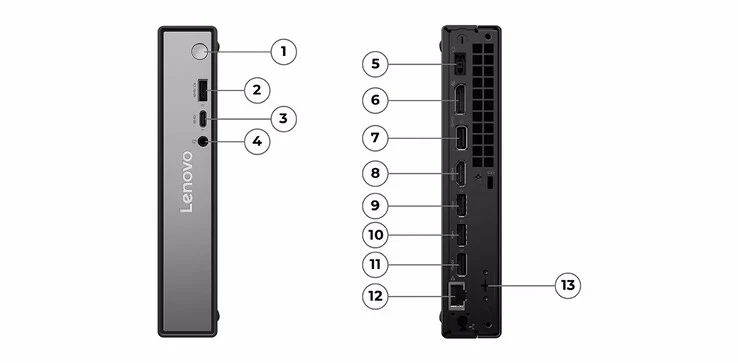
    The dimensions of the ThinkCentre Neo 50q QC are approximately 7 x 1.4 x 7.2 inches. On the front, you’ll find one USB 3.2 Gen 2 Type-A port and one USB Type-C port. The back features two USB 2.0 ports, two USB 3.2 Gen 2 Type-A ports, two USB Type-C ports, along with an HDMI 2.1 port and a DisplayPort 1.4a.

    Lenovo’s new mini PC offers a range of features and options to suit different needs, making it a versatile choice for users looking for compact computing solutions.

    Source:
    Link


  • Lenovo ThinkCentre M90a Gen 6 AiO PC: RTX 4050, 64GB RAM, Core Ultra 9

    Lenovo ThinkCentre M90a Gen 6 AiO PC: RTX 4050, 64GB RAM, Core Ultra 9

    Key Takeaways

    1. The ThinkCentre M90a Gen 6 is now available in Europe, with various configurations for users to choose from.
    2. It features multiple Intel Core processor options, ranging from Core Ultra 5 225 to Core Ultra 9 285, with a fixed Nvidia GeForce RTX 4050 GPU.
    3. The 23.8-inch IPS display offers a 1920 x 1080 resolution, 250 nits brightness, and a 120Hz refresh rate, with an optional touch upgrade.
    4. The system supports up to 64GB of RAM and two PCIe M.2 2280 SSDs, though the entry-level model has a 256GB SSD and lacks SD card and WiFi capabilities.
    5. Connectivity options include three USB ports on the side, four on the back, and two built-in 3-watt speakers.


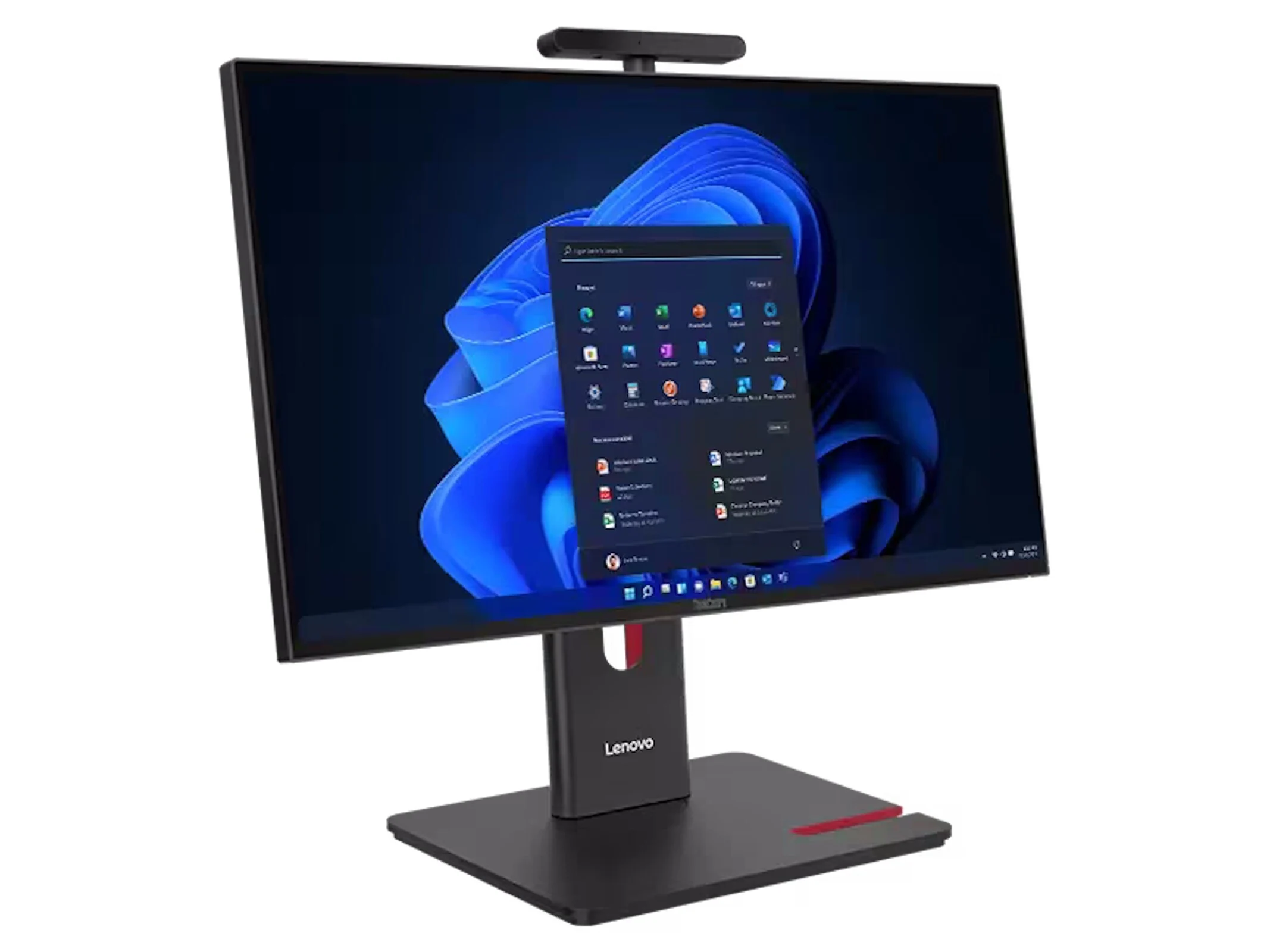
    The ThinkCentre M90a Gen 6 has officially launched in Europe and you can purchase it directly from Lenovo’s German online store. As indicated by its name, this model is an enhancement rather than a brand-new system, and Lenovo is providing several different configurations as they usually do.

    Specifications and Options

    In detail, the entry-level model features the Intel Core Ultra 5 225, but options for upgrades include the Core Ultra 5 235, Core Ultra 5 245, Core Ultra 7 265, and Core Ultra 9 285. The graphics component is fixed since Lenovo’s all-in-one PC is always equipped with an Nvidia GeForce RTX 4050 that comes with 6GB of VRAM.

    Display Features

    The device boasts a 23.8-inch display, which can be upgraded to touch functionality for an additional €20. The IPS screen has a resolution of 1920 x 1080 pixels, brightness at 250 nits, and a refresh rate of 120Hz. This screen can also function as a standard external monitor for another computer or device. At the same time, the ThinkCentre M90a Gen 6 provides two RAM slots that can accommodate up to 64GB of memory.

    Storage and Connectivity

    The system is compatible with two PCIe M.2 2280 SSDs, although the base model only includes a rather small 256GB SSD. This entry-level option also does not come with an SD card reader or WiFi capability, though an IR camera can be added on. Finally, Lenovo’s all-in-one desktop includes three USB ports on the side, four located on the back, and features two built-in speakers rated at 3 watts each.

    Source:
    Link


  • Noctua Reveals Pumpless AIO for Future PC Cooling at Computex

    Noctua Reveals Pumpless AIO for Future PC Cooling at Computex

    Key Takeaways

    1. Noctua is set to showcase a thermosiphon AIO CPU cooler prototype at Computex 2025, featuring large V-shaped cooling channels for improved circulation.
    2. The thermosiphon cooler has undergone significant design changes since its initial reveal at Computex 2024, including a revamped CPU block with larger coolant capacity.
    3. This passive cooling system uses the heat from the CPU to circulate coolant without a pump, similar to a heat pipe or vapor chamber.
    4. Noctua aims for optimal cooling and performance while minimizing noise with the thermosiphon, aligning with their brand focus on silent operation.
    5. The cooler’s radiator will likely include Noctua’s renowned quiet fans, enhancing overall cooling efficiency while maintaining low noise levels.


    Noctua has previously presented prototypes of a thermosiphon AIO CPU cooler, suggesting that it might soon go into production. Now, it looks like the company is set to reveal the cooler prototype to a broader audience at Computex in Taipei, Taiwan.

    Upcoming Showcase at Computex

    Recent updates from Noctua on X indicate that the thermosiphon cooler, or at least a variant of it, will be displayed at Computex 2025. The teaser included a sneak peek at the hardware, showcasing large cooling channels that are milled into the CPU block. These channels have a V shape, which implies that the orientation of the CPU block and possibly the entire cooling system will be crucial for effective cooling and circulation.

    Design Changes Noticed

    The thermosiphon made its first appearance at Computex 2024, but it seems to have undergone major design modifications since then, judging by the images in this PC Gamer article. The new version that Noctua teased in the X post features a revamped CPU block, complete with the V-shaped channels and possibly a larger capacity for coolant within the CPU block itself. PC Gamer also notes that it appears the thermosiphon may go into production in 2026.

    How It Works

    A thermosiphon is a passive cooling system that relies on the heat produced by the CPU to circulate the liquid throughout the loop, as explained by Arrow Electronics. Its basic function is akin to that of a heat pipe or vapor chamber: The coolant heats up, rises to the highest point in the cooling loop, where it condenses, cools down, and returns to circulation. The idea is to use a liquid with a lower boiling point than the CPU’s target temperature, allowing for coolant circulation without needing a pump.

    For Noctua, the concept of a thermosiphon seems very logical, as much of the brand’s marketing and products focus on achieving optimal cooling and performance while minimizing noise. This appears to be the aim with the thermosiphon as well, since the company noted in a response to a comment that “If it’s loud, Noctua probably wouldn’t be working on it.”

    Silent Operation Expected

    The radiator side of the thermosiphon will likely still include fans, but Noctua is renowned for its nearly silent fans, like the Noctua NF-A12x25 (currently priced at $34.95 on Amazon).

    Source:
    Link