Category: Computers

  • Affordable Lenovo ThinkBook Laptop: Upgradeability at Its Best

    Affordable Lenovo ThinkBook Laptop: Upgradeability at Its Best

    Key Takeaways

    1. Affordable Upgrade Options: Choosing laptops that allow personal upgrades can save money compared to manufacturer pricing for RAM and SSD.

    2. Lenovo ThinkBook 14 Gen 8 Specs: This 14-inch laptop starts under $1,000 and features 16 GB of RAM and a 512 GB SSD, with upgrades available up to 64 GB RAM and 4 TB storage.

    3. Removable Wi-Fi Card: The laptop’s Wi-Fi card can be upgraded from Wi-Fi 6E to Wi-Fi 7, enhancing connectivity options.

    4. Potential for Display and Battery Upgrades: While not straightforward, users can upgrade the display and battery for improved performance, with options for a larger battery and compatible screens.

    5. Value in High Inflation: The Lenovo ThinkBook 14 Gen 8 IAL offers significant upgrade potential, making it a practical choice for budget-conscious users.


    In an era of rising prices, securing affordable options for a new laptop has become essential for many individuals. One effective strategy to save money is opting for a device that allows for personal upgrades, as manufacturers often charge higher prices for RAM and SSD storage compared to buying them separately. Moreover, the capacity to enhance your PC can greatly extend its lifespan, especially since the demands for RAM and storage keep increasing.

    Lenovo’s ThinkBook 14 Gen 8 Overview

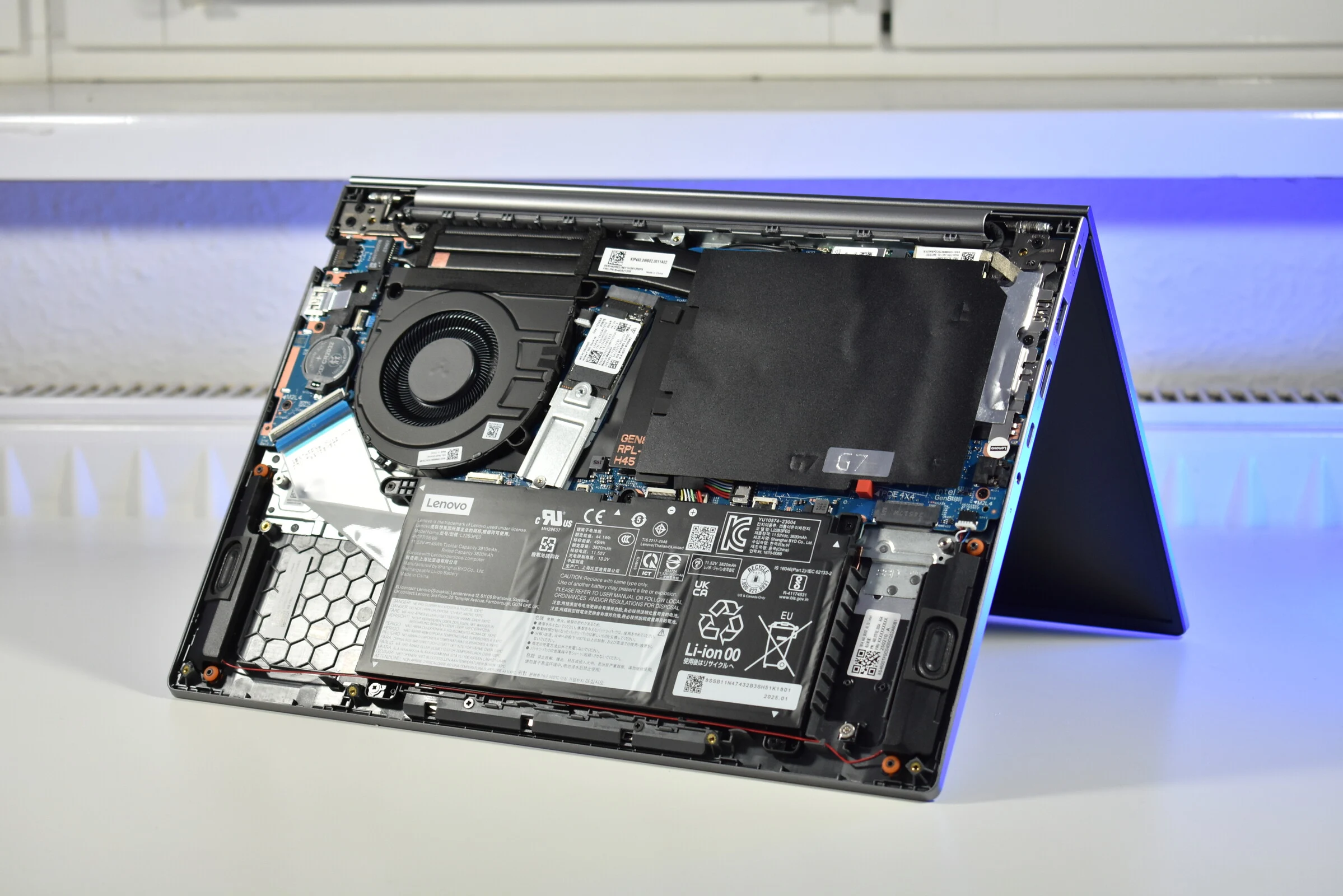
    Take, for example, the Lenovo ThinkBook 14 Gen 8, which we recently evaluated. This 14-inch laptop is tailored for small business professionals, starting at a price under $1,000 for the basic configuration that includes 16 GB of RAM and a 512 GB SSD. With two slots for RAM, users can expand memory up to 64 GB. Uncommonly for such a compact model, this Lenovo laptop also comes equipped with two M.2 2280 slots; one of these is entirely open from the factory. Lenovo states that storage can be expanded up to 4 TB.

    Upgrade Opportunities

    The upgrade possibilities for the Lenovo ThinkBook 14 G8 don’t stop there. The Wi-Fi card is removable, enabling upgrades from the Wi-Fi 6E card currently in the ThinkBook to a newer Wi-Fi 7 model. Additionally, while the display and battery performance are not particularly impressive, both of these components can potentially be upgraded, as there is a larger 60 Wh battery available, and 14-inch screens are standard components.

    While these two modifications may not be as simple as other upgrades, it’s important to note that the Lenovo ThinkBook 14 Gen 8 IAL (available on lenovo.com) offers significant upgrade potential for those who enjoy customizing their hardware.

    Conclusion

    In summary, the Lenovo ThinkBook 14 Gen 8 IAL presents great value for those looking for an upgradeable laptop option in a time of high inflation. With reasonable starting prices and the ability to enhance memory and storage, it stands out as a practical choice for many users.

    Source:
    Link

  • Dell 14 Plus 2-in-1 AMD vs Intel: Speed Comparison and Catch

    Dell 14 Plus 2-in-1 AMD vs Intel: Speed Comparison and Catch

    Key Takeaways

    1. The Dell 14 Plus 2-in-1 offers both Intel (Lunar Lake Core Ultra 5 and 9) and AMD (Zen 5 Ryzen AI 5 and 7) processor options.
    2. AMD options, especially the Ryzen AI 7 350, excel in multi-threaded performance, outperforming Intel’s top model by over 30%.
    3. Intel models provide advantages like longer battery life, better performance-per-watt, and superior integrated graphics.
    4. Intel configurations support HDMI 2.1 and Thunderbolt 4, allowing for better connectivity with external 4K monitors.
    5. AMD versions are limited to HDMI 1.4 and USB-C at 10 Gbps, making them less suitable for high-bandwidth external displays.


    The Dell 14 Plus 2-in-1 offers both Intel and AMD choices. For Intel, you can pick between the Lunar Lake Core Ultra 5 226V or the Ultra 9 288V. On the AMD side, there are options like the Zen 5 Ryzen AI 5 540 or the Ryzen AI 7 350. Although all models feature the same 1200p touchscreen and external design, there are significant differences in performance and available ports.

    Performance Insights

    If you are someone who values multi-threaded performance, it might be beneficial to lean toward the AMD options since the Ryzen AI 7 350 can outperform the Core Ultra 9 288V by over 30 percent. Nevertheless, the Intel model brings several advantages, such as a longer battery life, better performance-per-watt, and significantly quicker integrated graphics with the Arc 140V compared to the Radeon 860M.

    Connectivity Differences

    Another often-missed benefit of the Intel models is their compatibility with HDMI 2.1 and Thunderbolt 4 running at 40 Gbps. In contrast, the Dell 14 Plus 2-in-1 AMD versions are restricted to HDMI 1.4 and USB-C at 10 Gbps. If you plan to hook up external 4K monitors to your laptop, the Intel configuration is the better choice for optimal monitor connectivity.

    Source:
    Link

  • Nvidia RTX Pro Laptops: Lenovo’s ThinkPad T1g Gen 8 Teased

    Nvidia RTX Pro Laptops: Lenovo’s ThinkPad T1g Gen 8 Teased

    Key Takeaways

    1. Lenovo is currently behind competitors HP and Dell in the workstation market, with no new models available yet.
    2. Lenovo plans to launch the 2025 ThinkPad workstation range, including new Intel models with Nvidia RTX Pro GPUs.
    3. The ThinkPad P16v Gen 3 will be a budget-friendly option featuring the Nvidia RTX Pro 2000, while the P16 Gen 3 will offer the powerful Arrow Lake HX platform and RTX Pro 5000 GPU.
    4. The premium ThinkPad P1 Gen 8 will feature the RTX Pro 2000, and the new ThinkPad T1g Gen 8 will likely include the Nvidia GeForce RTX 5070.
    5. The exact launch date for the new Lenovo ThinkPad models is uncertain, but they are expected to be released soon.


    Lenovo has fallen behind this year. HP has already launched their latest ZBook workstations, and Dell has rolled out its Pro Max workstation laptops. This leaves Lenovo as the last of the three main players in the workstation market, with their 2025 ThinkPad P series still not available. Currently, the only options are the AMD-based Lenovo ThinkPad P14s Gen 6 and its larger sibling, the ThinkPad P16s Gen 4. However, there are no Intel Arrow Lake or Nvidia Blackwell GPU models available yet.

    A New Dawn for Lenovo Workstations

    Things are about to change, it seems. Lenovo Japan shared an exclusive sneak peek of the 2025 ThinkPad workstation range with the Japanese tech magazine ITMedia, indicating that a launch is probably on the horizon.

    At the entry level are the ThinkPad P14s Gen 6 Intel and P16s Gen 6 Intel models, which will come equipped with Nvidia RTX Pro GPUs, unlike their AMD versions. The top-tier option among these will be the Nvidia RTX Pro 1000, with the laptops featuring a thermal design power (TDP) of 60 to 70 W, which is significantly higher than the 25 W offered by the AMD models.

    Stepping Up in Performance

    Next in line is the Lenovo ThinkPad P16v Gen 3, the budget-friendly option of the ThinkPad P16 (v stands for value). This 16-inch laptop will be powered by the Nvidia RTX Pro 2000 with a TDP of 90 W. Even more powerful is the full-sized ThinkPad P16 Gen 3, which will utilize the Arrow Lake HX platform and come with the Nvidia RTX Pro 5000, the highest-end GPU in Nvidia’s mobile workstation lineup. Overall, the P16 Gen 3 will feature a TDP of 135 W.

    As for the premium offerings, there are the ThinkPad P1 Gen 8 series and a new addition this year, the ThinkPad T1g Gen 8. This latest model appears to be an upgraded version of the X1 Extreme, representing the GeForce variant of the P1. The P1 Gen 8 will be limited to the RTX Pro 2000, while the new ThinkPad T1g Gen 8 will likely include the Nvidia GeForce RTX 5070. The TDP for this sleek premium model is estimated at 95 W.

    Anticipating the Launch

    It remains uncertain when the new Lenovo ThinkPad models will hit the shelves, but considering that 2025 is already more than halfway through, it’s unlikely Lenovo will delay their release for too long.

    Source:
    Link

  • MIT Experiment Challenges Einstein in Quantum Debate

    MIT Experiment Challenges Einstein in Quantum Debate

    Key Takeaways

    1. MIT physicists resolved a long-standing debate between Einstein and Bohr, confirming Bohr’s view on quantum mechanics.
    2. A refined double-slit experiment showed light’s dual nature as both a wave and a particle, but they cannot be observed simultaneously.
    3. The experiment utilized over 10,000 super-cooled atoms as isolated slits, enhancing the analysis of light’s properties.
    4. Findings revealed that increased data on a photon’s particle-like behavior weakened its wave-like interference pattern.
    5. This breakthrough contributes to the upcoming International Year of Quantum Science and Technology in 2025.


    In a remarkable new showcase of quantum mechanics, a group of physicists from MIT has resolved a long-standing clash between Albert Einstein and Niels Bohr, revealing that Einstein was mistaken. The researchers carried out a refined version of the iconic double-slit experiment, demonstrating that light possesses a dual nature as both a wave and a particle, but these two forms can never be seen at the same moment.

    The Historic Debate

    This experiment tackles a thought experiment from 1927 where Einstein claimed it was possible to determine which of the two slits a photon went through while also observing its wave-like interference pattern. Niels Bohr countered this by invoking the quantum uncertainty principle, arguing that it was unachievable.

    Innovative Approach

    The team at MIT, led by Professor Wolfgang Ketterle, took this age-old debate into a laboratory setting. Rather than using a physical screen with slits, they employed laser beams to create a perfect lattice of over 10,000 super-cooled atoms, with each atom functioning as an individual, isolated slit. By passing weak light beams through these atoms, they were able to carefully analyze the relationship between light’s particle and wave properties.

    Their findings, published in Physical Review Letters, strongly validated Bohr’s argument. The researchers discovered that as they collected more data regarding a photon’s particle-like trajectory, the wave-like interference pattern became increasingly weaker.

    A New Era in Quantum Science

    Einstein and Bohr would likely have never imagined the ability to conduct such an experiment with individual atoms and photons. “What we have done is an idealized Gedanken experiment,” said Wolfgang Ketterle, a professor of Physics at MIT.

    The timing of this discovery is quite significant, as the United Nations has proclaimed 2025 to be the International Year of Quantum Science and Technology (IYQ), marking the centenary of the theory’s inception.

    Source:
    Link

  • Microsoft Launches Limited Surface Laptop 7 Smurface Edition

    Microsoft Launches Limited Surface Laptop 7 Smurface Edition

    Key Takeaways

    1. Microsoft has released a limited edition Surface Laptop 7, called the Smurface Edition, inspired by the new Smurfs film.
    2. The Smurface Edition is available only in a 13-inch size and features a Snapdragon X Plus processor, 16GB of RAM, and 512GB of storage.
    3. The laptop showcases unique Smurf-themed designs, including laser-etched Smurfs and a blue Surface logo.
    4. The price for the Smurface Edition is $999.99, the same as the regular model, with only 100 units available for purchase on Amazon.
    5. Users can also enter to win one of three Smurface Editions by completing Smurf-themed tasks through Microsoft Rewards.


    Microsoft has unveiled a unique version of the Surface Laptop 7, inspired by the newly released Smurfs film. This limited edition laptop is now up for grabs on Amazon, or you might stand a chance to win one directly from Microsoft.

    Specifications and Features

    The Surface Laptop 7 comes in three different sizes: 13 inches, 13.8 inches, and 15 inches. Nevertheless, the Smurface Edition is solely available in the 13-inch size, featuring a Snapdragon X Plus (8 core) processor, 16GB of RAM, and 512GB of storage.

    This specially themed Surface Laptop Smurface Edition showcases laser-etched Smurfs on its lid along with a blue Surface logo. Additionally, a Smurfs logo can be found at the bottom corner of the lid. Other than these visual tweaks, it is identical to the standard Platinum color variant.

    Pricing and Availability

    Now listed on Amazon for $999.99, the Surface Laptop Smurface Edition is priced the same as its regular counterpart. As stated in the Amazon listing, only 100 units are up for sale, so act fast if you want one.

    If purchasing isn’t your thing, you can also enter to win one. Microsoft Rewards is giving away three units, and to qualify, users must complete various Smurf-themed tasks to collect points for a free entry. These tasks include coding a retro arcade game with Smurf characters using Microsoft MakeCode, downloading Smurf-themed backgrounds for Microsoft Teams, and more. For complete details, check the source link.

    Source:
    Link

  • NASA’s New Telescope to Spot 10x More Ia Supernovae Than JWST

    NASA’s New Telescope to Spot 10x More Ia Supernovae Than JWST

    Key Takeaways

    1. NASA’s Nancy Grace Roman Space Telescope will launch by May 2027 for a two-year High-Latitude Time-Domain Survey, observing a large area of space every five days for 30 hours.
    2. The telescope is expected to discover around 27,000 type Ia supernovae, significantly increasing past findings and aiding in measuring cosmic distances.
    3. Research from the survey will provide insights into dark energy, with the potential to identify type Ia supernovae dating back 11.5 billion years.
    4. The survey may confirm the existence of “pair-instability” supernovae from the universe’s first massive stars.
    5. The Roman telescope is anticipated to uncover various cosmic phenomena, including 60,000 core-collapse supernovae and other unexpected discoveries.


    NASA’s Nancy Grace Roman Space Telescope is set to launch by May 2027. It will carry out an observation project called the High-Latitude Time-Domain Survey. This survey will involve 30-hour observations of a significant area in space, repeated every five days for two years. By stitching these observations together, scientists aim to create time-lapse videos that showcase various dynamic events in the cosmos.

    Focus on Supernovae

    One of the key events scientists want to investigate is supernovae, particularly type Ia supernovae. According to simulations of the High-Latitude Time-Domain Survey, the telescope is expected to find around 27,000 type Ia supernovae. This is a huge increase, potentially ten times more than what all past surveys have found combined.

    Type Ia supernovae are categorized as standard candles, which are celestial objects that help astronomers measure distances to their host galaxies. By analyzing the distance and the amount of light shift, scientists can gauge how fast the universe has expanded at different times.

    Insights into Dark Energy

    This research provides insights into dark energy, the enigmatic force believed to be driving the universe’s expansion. The Roman telescope could identify an astonishing number of these type Ia supernovae dating back as far as 11.5 billion years, offering unprecedented views.

    In addition to type Ia supernovae, the survey might also confirm the existence of “pair-instability” supernovae. These are incredibly powerful explosions thought to originate from the universe’s first stars—massive giants that were hundreds of times larger than the sun and left no remnants.

    Anticipating Surprises

    NASA’s Roman telescope is also expected to discover a variety of other cosmic phenomena in large quantities, including around 60,000 core-collapse supernovae, 40 tidal disruptions, 90 superluminous supernovae, and several kilonovae. “We’re definitely expecting the unexpected,” remarked Rebekah Hounsell, an assistant research scientist at NASA. This reflects the mission’s potential to revolutionize our understanding of the cosmos.

    Source:
    Link

  • Lenovo ThinkBook Plus Gen 6: Buy the Rollable Laptop Now

    Lenovo ThinkBook Plus Gen 6: Buy the Rollable Laptop Now

    Key Takeaways

    1. Lenovo introduced the ThinkBook Plus Gen 6, the first consumer laptop with a rollable display, at CES 2025.
    2. The laptop is priced at $3,299 and features an Intel Core Ultra 7 258V processor, 32 GB of RAM, and a 1 TB SSD, with no upgrade options for memory or storage.
    3. It has limited port options, including only two Thunderbolt 4 ports, requiring adapters for additional connectivity.
    4. The rollable OLED display can transition from 14 inches to 16.7 inches, with a 120 Hz refresh rate and resolutions of 2000 x 1600 and 2000 x 2350 pixels.
    5. Additional features include a 66 Whr battery, Harman Kardon speakers with Dolby Atmos, WiFi 7, and Bluetooth 5.4.


    At CES 2025, Lenovo introduced the first laptop for consumers featuring a rollable display, called the ThinkBook Plus Gen 6. Initially, it was expected to be released in the first quarter of 2025, but that time has come and gone without any updates from the company regarding its availability.

    Pricing and Specifications

    Now, the rollable laptop is finally up for grabs, starting at a staggering $3,299 on the official website. The model available is equipped with an Intel Core Ultra 7 258V processor, along with 32 GB of LPDDR5X RAM and a 1 TB PCIe Gen 4 SSD. It’s important to mention that neither the memory nor the storage can be upgraded.

    Port Configuration

    Another aspect to keep in mind is that the laptop’s port selection isn’t as robust as some other Lunar Lake models. It includes only two Thunderbolt 4 ports, which likely means most users will need to rely on adapters for additional connectivity options.

    The standout feature of this laptop is its non-touch rollable OLED display, which transforms from a 14-inch screen to a 16.7-inch one. Lenovo claims that the display can extend upwards without any creases, unlike foldable smartphones.

    Display Features

    The rollable display boasts a refresh rate of 120 Hz, a brightness rating of 400 nits, and a resolution of 2000 x 1600 pixels when not fully extended. When the OLED panel is rolled out, the resolution increases to 2000 x 2350 pixels, and the aspect ratio changes from 5:4 to 8:9.

    Among other notable features of the ThinkBook Plus Gen 6 Rollable are a 66 Whr battery, Harman Kardon speakers with Dolby Atmos support, WiFi 7, and Bluetooth 5.4. For more details about this innovative Lenovo laptop, be sure to check out our CES 2025 coverage.

  • Samsung Galaxy Book6 Ultra: Flagship Laptop Returns After Hiatus

    Samsung Galaxy Book6 Ultra: Flagship Laptop Returns After Hiatus

    Key Takeaways

    1. Samsung plans to introduce a Galaxy Book6 Ultra model, expanding the Galaxy Book lineup.
    2. Expected specifications include Intel’s Arrow Lake-H chips and an Nvidia GeForce RTX 50 series graphics card for improved performance.
    3. The Galaxy Book4 Ultra received praise for its OLED display and build quality but had issues with PWM flickering and lacked Wi-Fi 7.
    4. The release date for the Galaxy Book6 Ultra is uncertain, with potential timing linked to Intel’s Panther Lake CPUs in 2026.
    5. Previous models were limited to Intel’s Lunar Lake processors, which did not support dedicated GPUs, making an Ultra version logical this time.


    The earlier Galaxy Book lineup had just a standard and Pro version. Since they were powered only by Intel’s Lunar Lake processors, which do not support dedicated GPUs, skipping an Ultra model was logical. Typically, the Ultra models include an external GPU. Recently, Sammobile discovered that Samsung intends to introduce an Ultra version this time around.

    Anticipated Specifications

    It is likely to be named the Galaxy Book6 Ultra. While specific details about its specifications remain unclear, it is reasonable to expect that it might feature Intel’s Arrow Lake-H chips along with an Nvidia GeForce RTX 50 series graphics card. This should provide a notable increase in performance compared to the Galaxy Book4 Ultra, which came with Intel’s Meteor Lake and GeForce RTX 40 series GPUs.

    Previous Model Review

    Our comprehensive review of the Galaxy Book4 Ultra highlighted its vibrant OLED display, sturdy build, and excellent connectivity options. Nevertheless, the display did experience PWM flickering at a level that could be bothersome to some users. Additionally, the absence of Wi-Fi 7 was noted, but it’s anticipated that this feature will be incorporated into the Galaxy Book6 Ultra.

    Launch Timeline Uncertain

    As of now, there is no information regarding the release date of the new laptop. The Galaxy Book4 Ultra was launched in December 2024, while the Galaxy Book5 series appeared in September 2025 to align with Intel’s Lunar Lake release. There is a possibility that the Galaxy Book6 Ultra could debut next year, in tandem with Intel’s next-generation Panther Lake CPUs in 2026. However, this might not occur if Panther Lake does not support dedicated GPUs, and we currently do not have confirmation on that.

    Source:
    Link

  • B21 Mini PC: Core i9, RTX 4070, 64GB RAM in Compact Design

    B21 Mini PC: Core i9, RTX 4070, 64GB RAM in Compact Design

    Key Takeaways

    1. The Partaker B21 now features 14th generation Intel processors, including Core i7 and Core i9 options.
    2. Users can choose from various graphics cards, such as Nvidia GeForce RTX 4070, RTX 4060 Ti, or RTX 4060.
    3. The mini PC supports up to 64 GB of DDR5 RAM and SSD capacities ranging from 1 to 4 TB.
    4. Its compact design (10.6 x 8.5 x 2.2 inches) allows for storage upgrades with two additional 2.5-inch drives and includes multiple ports for connectivity.
    5. The Partaker B21 is priced at around €1,300 on AliExpress, but availability and warranty support may be limited for international buyers.


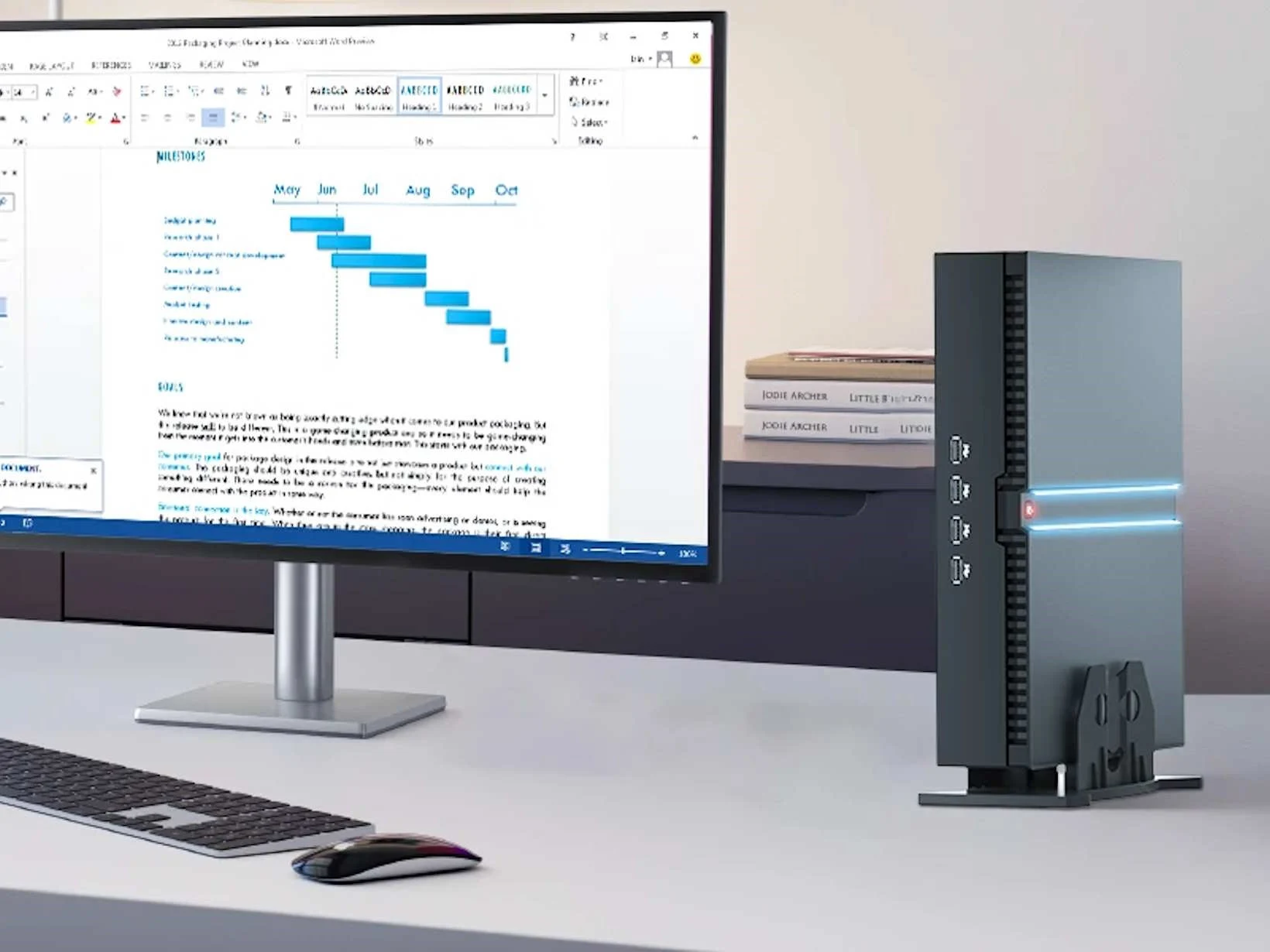
    We have previously shared information about the Partaker B21, which is now being offered with new configurations. The mini PC can now be purchased with 14th generation Intel processors, including the Intel Core i7-14700F and Intel Core i9-14900F. Users also have the option to select from various graphics cards, as this compact machine comes with choices like the Nvidia GeForce RTX 4070, RTX 4060 Ti, or RTX 4060. Depending on the selected model, it can come with either 32 or 64 GB of DDR5 RAM, while the SSD capacity ranges from 1 to 4 TB.

    Compact Design and Storage Options

    The Partaker B21 measures 10.6 x 8.5 x 2.2 inches, making it small enough to fit in tight spaces. It can hold up to two 2.5-inch hard drives or SSDs along with the pre-installed M.2 2280 SSD, which allows for cost-effective storage upgrades. The device is equipped with multiple ports, including three DisplayPort 1.4, one HDMI 2.1, four USB 3.2 Type-A, two Gigabit Ethernet, USB 2.0, and an optical audio output. Additionally, it supports WiFi 6E for reliable wireless connectivity.

    Availability and Pricing Concerns

    As of now, there are still issues with availability. The Partaker B21 is available on AliExpress for about €1,300, but it can only be shipped to a few select regions. Customers should keep in mind that importing directly from Chinese marketplaces can carry risks, especially since warranty claims may be challenging to pursue due to often lacking customer service.

    Source:
    Link


  • Corsair AI Workstation 300 Mini-PC with AMD Strix Halo Unveiled

    Corsair AI Workstation 300 Mini-PC with AMD Strix Halo Unveiled

    Key Takeaways

    1. AMD’s Strix Halo processors are gaining popularity, featured in devices from Sixunited, GPD, Ayaneo, and Corsair.
    2. The Corsair AI Workstation 300 offers two CPU options: Ryzen AI Max+ 395 (16 cores) and Ryzen AI Max 385 (8 cores), with varying RAM and storage configurations.
    3. The workstation is compact, measuring 247.5 mm x 188.4 mm x 96.5 mm and weighing 7 kg, featuring liquid cooling for CPU and GPU.
    4. Connectivity includes multiple USB ports, an SD card reader, HDMI 2.1, DisplayPort 1.4, and a 2.5 Gbps Ethernet jack.
    5. Pricing starts at $1,599 for the base model, $1,999 for the upgraded CPU, and $2,299 for additional storage options.


    AMD’s Strix Halo processors are becoming increasingly popular, appearing in various devices recently. Sixunited showcased a laptop and a bare motherboard, while GPD and Ayaneo introduced the Win 5 and Next 2, which are the first handhelds powered by Strix Halo. Now, Corsair has also entered the scene with a traditional option: a mini-PC.

    Specifications and CPU Choices

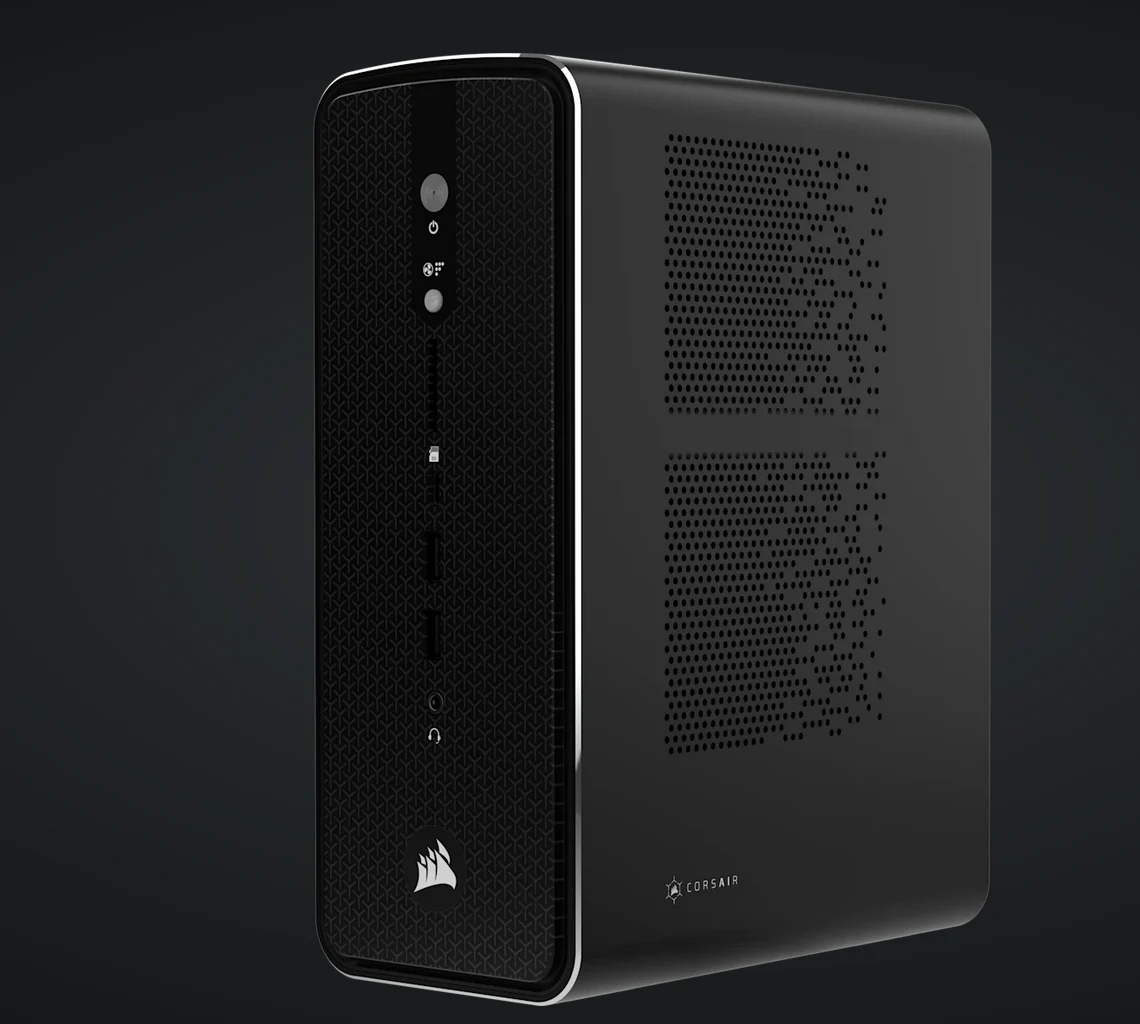
    The Corsair AI Workstation 300 has been announced with two CPU choices: the AMD Ryzen AI Max+ 395 and the less common Ryzen AI Max 385. The Ryzen AI Max 385 has eight Zen 5 CPU cores compared to the 16 cores in the 395 version. Additionally, it includes a 32 CU Radeon 8050 iGPU, while the 395 features a 40 CU Radeon 8060. The memory and storage options vary based on which CPU you choose.

    If you decide on the Ryzen AI Max 395+, you can configure it with up to 128 GB of LPDDR5X RAM and 4 TB of solid-state storage. On the other hand, the Ryzen AI Max 385 version is limited to 64 GB of RAM and a 1 TB NVMe SSD. To power the AI Workstation 300, Corsair has included a 350-Watt PSU, providing additional power capacity that may help users maximize the performance of their workstations.

    Size and Design

    The Corsair AI Workstation 300 is quite compact, with dimensions of 247.5 mm/9.7 in (height) x 188.4 mm/7.4 in (length) x 96.5 mm/3.8 in (width). It weighs 7 kg/15.4 lbs, and this extra weight is probably due to Corsair’s liquid cooling solution for both the CPU and GPU. Unfortunately, the specifics of the cooling system are unclear, as there are no images available showing the internal components.

    Connectivity Options and Pricing

    For the front I/O, you’ll find an SD card reader, a USB 4.0 Type-C port, two USB 3.2 Gen2 Type-A ports, and a 3.5 mm audio jack. The rear includes two USB 2.0 Type-A ports, one HDMI 2.1 port, one DP 1.4 port, one USB 3.2 Type-A port, one USB 4.0 port, a 2.5 Gbps RJ45 Ethernet jack, and another 3.5 mm audio jack.

    The base model of the Corsair AI Workstation 300 (with Ryzen AI Max 385) is priced at $1,599. Upgrading to the Ryzen AI Max+ 395 raises the price to $1,999, while opting for the additional 4 TB of storage brings the total to $2,299. You can purchase it directly from Corsair’s website now.

    Source:
    Link