Category: Artificial intelligence

  • Orange Pi 6 Plus vs Raspberry Pi 5: 64GB RAM and AI Power

    Orange Pi 6 Plus vs Raspberry Pi 5: 64GB RAM and AI Power

    Key Takeaways

    1. The Orange Pi 6 Plus is a powerful single-board computer designed for AI tasks, featuring an NPU with up to 45 TOPS performance.
    2. It has a 12-core SoC and offers LPDDR5 memory options of 16, 32, or 64GB, along with M.2 slots for SSD and WiFi/Bluetooth connectivity.
    3. The SBC includes dual Ethernet ports with 5 Gbps bandwidth and multiple video output options (DisplayPort, USB Type C, HDMI, eDP).
    4. It supports camera connections via MIPI CSI and has two USB 3.0 and two USB 2.0 Type A ports.
    5. The dimensions of the Orange Pi 6 Plus are approximately 4.5 by 3.9 inches, and it includes a 40-pin GPIO header; pricing and release dates are not yet available.


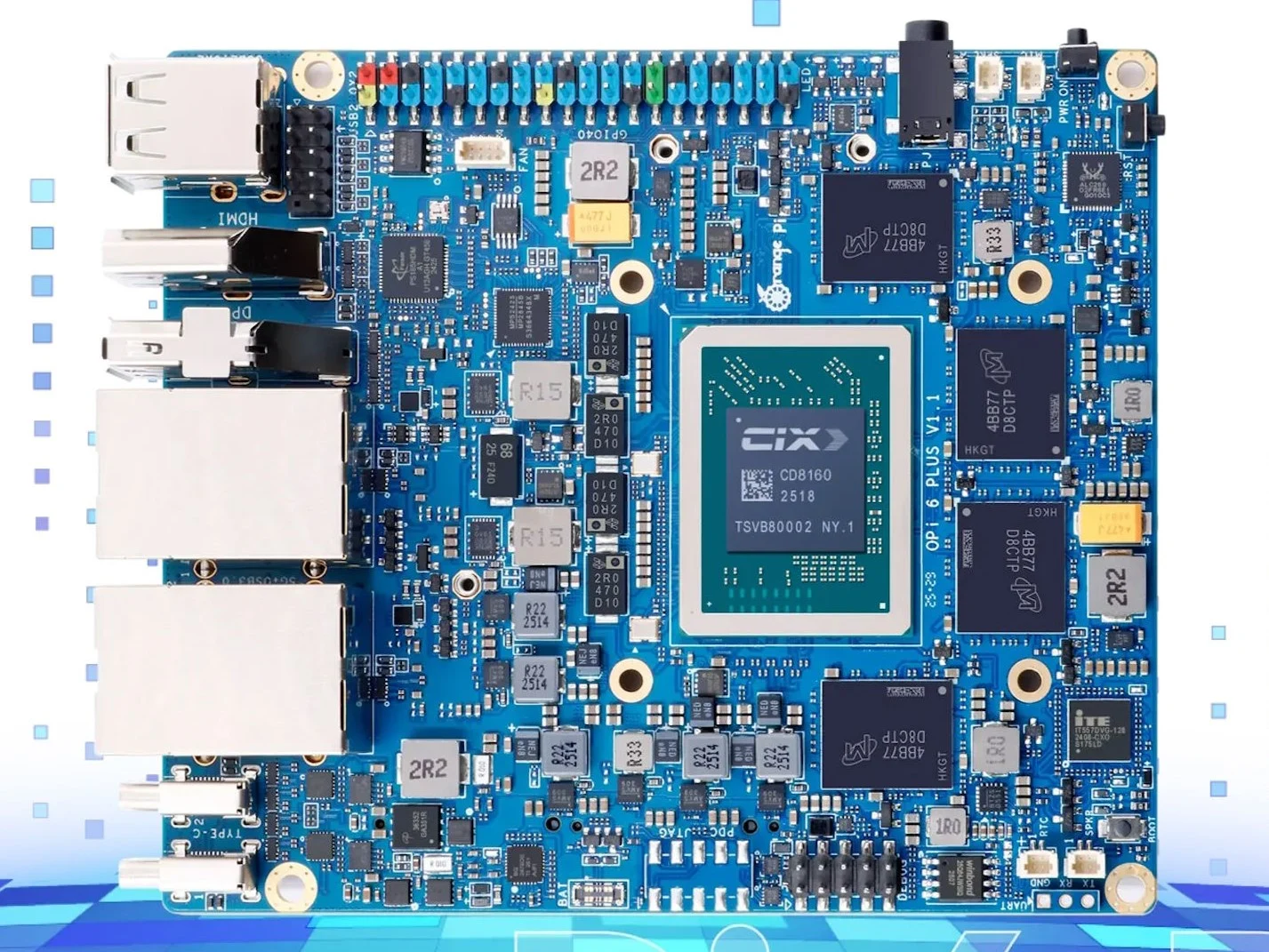
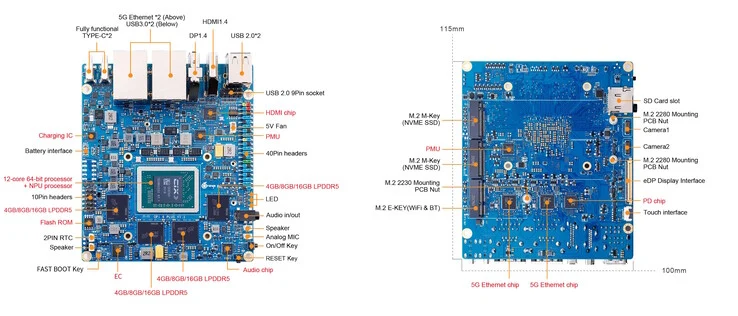
    The Orange Pi 6 Plus is a recently introduced single-board computer that boasts impressive performance specifically designed for AI tasks. It includes an NPU capable of reaching up to 45 TOPS, positioning it alongside contemporary AMD and Intel chipsets in terms of NPU efficiency. For context, the AMD Ryzen AI 9 HX 370 achieves an AI performance of 40 TOPS. Such elevated AI capabilities make it feasible to operate various AI models directly on the SBC. For instance, monitoring a live camera feed for potential fire hazards in remote areas could be one of the applications.

    Impressive Specifications

    Equipped with an SoC featuring twelve cores, the Orange Pi 6 Plus offers LPDDR5 memory options of 16, 32, or 64GB, depending on the chosen setup. It comes with several M.2 2280 slots for SSD connections, while an additional M.2 Key E card can be used for WiFi and Bluetooth functionality. As is customary with single-board computers, it also includes an SD card reader.

    Connectivity and Features

    Moreover, this SBC is outfitted with two Ethernet ports capable of delivering a bandwidth of 5 Gbps. Users can connect multiple monitors through DisplayPort, USB Type C, HDMI, and eDP. Hobbyists have the option to attach cameras via MIPI CSI, and it features two USB 3.0 and two USB 2.0 Type A ports. The dimensions of this alternative to Raspberry Pi 5 are approximately 4.5 by 3.9 inches, and it includes a 40-pin GPIO header. However, details regarding pricing and release dates for the Orange Pi 6 Plus have yet to be disclosed.

    Source:
    http://www.orangepi.org/html/hardWare/computerAndMicrocontrollers/details/Orange-Pi-6-Plus.html)


  • DeepSeek V3.2: Free Open-Source AI LLM Reduces Compute Costs

    DeepSeek V3.2: Free Open-Source AI LLM Reduces Compute Costs

    Key Takeaways

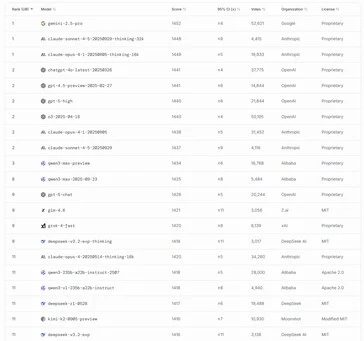
    1. DeepSeek has launched the DeepSeek-V3.2-Exp AI model, known for lower compute expenses and advanced performance, ranking 11th among global LLMs.
    2. The model uses a new DeepSeek Sparse Attention (DSA) framework, focusing on relevant tokens to improve speed and reduce memory usage, supporting up to a 128K-token window.
    3. App developers can save over 50% in costs when using DeepSeek V3.2 Exp via its public API while maintaining similar performance levels.
    4. The 400 GB model is available for free download on Hugging Face, requiring powerful hardware with multiple Nvidia GPUs or specific servers for proper operation.
    5. Users wishing to run DeepSeek V3.2 on personal desktops must wait for quantized models and need a GPU with at least 24 GB of memory.


    DeepSeek has unveiled its new artificial intelligence large-language model called DeepSeek-V3.2-Exp, which comes with notably lower compute expenses. This improvement is beneficial for companies utilizing the firm’s API in their applications, allowing them to save funds while accessing an advanced AI that has secured the 11th position among the most formidable LLMs introduced globally.

    New Design Features

    The breakthrough was made possible by implementing a novel DeepSeek Sparse Attention (DSA) framework. Unlike traditional AI transformers that index every token, this design only focuses on the most pertinent tokens. This enhancement enables the AI to handle text input more quickly, supporting up to a 128K-token window while using less memory.

    Cost Reduction for Developers

    App developers utilizing DeepSeek V3.2 Exp through its public API can anticipate spending over 50% less compared to the earlier version, all while ensuring similar performance levels across standard AI evaluations.

    Download Requirements

    The 400 GB AI LLM is available for free download on Hugging Face and can be operated locally on robust computers. Users should note that a setup with several Nvidia H100/H200/H20 GPUs or at least one NVIDIA B200/GB200 server is necessary because of the model’s requirement for more than 1.5 TB of VRAM.

    For those wishing to run DeepSeek v3.2 on personal desktops, patience is required until quantized models become available on Hugging Face, like the one for v3.1 by unsloth. Additionally, a GPU with a minimum of 24 GB of memory is needed, such as the Nvidia 5090 listed on Amazon.

    Source:
    Link


  • Humanoid Robot Launches with Wireless Charging and Tactile Palms

    Humanoid Robot Launches with Wireless Charging and Tactile Palms

    Key Takeaways

    1. Versatile Design: The Figure 03 is a redesigned humanoid robot aimed for both home and commercial tasks, powered by advanced AI called Helix.

    2. Wireless Inductive Charging: The robot features a wireless charging system that allows it to charge by simply stepping onto a mat, with a 2 kW charging rate and a 2.3 kWh battery for up to 5 hours of operation.

    3. Enhanced Dexterity: Equipped with advanced hands featuring cameras and sensitive tactile sensors, the Figure 03 can detect very light pressures, offering precision handling of delicate items.

    4. Safety Features: The robot has a lighter frame and soft coverings, along with battery safety certifications, ensuring its suitability for home environments.

    5. High-Volume Production: Figure’s new facility, BotQ, is designed for efficient production, capable of making up to 12,000 robots annually, supporting scalability for various applications.


    The robotics company Figure has introduced its latest humanoid robot, the Figure 03. This new model represents a complete redesign that aims to create a versatile robot capable of performing tasks similar to humans, suitable for both home and commercial use. The robot operates using Helix, the firm’s advanced vision-language-action AI.

    Innovative Charging Technology

    A standout feature of the Figure 03 is its wireless inductive charging system. The robot has charging coils built right into its feet, enabling it to charge simply by stepping onto a charging mat. It charges at a rate of 2 kW and is equipped with a 2.3 kWh battery, allowing it to work for up to 5 hours continuously.

    Enhanced Dexterity and Precision

    The Figure 03 comes with newly designed hands that feature cameras and highly sensitive tactile sensors. According to the company, these sensors can detect pressures as light as 3 grams, which is sensitive enough to feel the weight of a paperclip. This level of accuracy, along with the integrated palm cameras, gives the robot exceptional control over delicate or oddly shaped items.

    Safety and Production Improvements

    In addition to these features, Figure 03 is designed with safety in mind for home environments. It has a lighter frame, soft textile coverings, and a battery that has received safety certifications from UN38.3 and UL2271. The robot has been created specifically for high-volume production at Figure’s new facility, BotQ, which is capable of producing up to 12,000 robots annually. Figure believes that these improvements create a strong basis for a scalable robot that can serve multiple purposes.

    Source:
    Link


  • Sam Altman Supports TSMC’s Dominance in AI Chip Production

    Sam Altman Supports TSMC’s Dominance in AI Chip Production

    Key Takeaways

    1. Sam Altman prefers TSMC to increase chip production capacity over relying on Intel’s foundry efforts.
    2. TSMC leads in advanced process nodes essential for high-performance AI accelerators, making it the quickest option for chip production.
    3. There are geopolitical concerns regarding TSMC’s Taiwan-based production, prompting calls for a more diversified supply chain.
    4. The demand for modern AI models requires substantial chip capacity; delays could hinder product launches and innovation cycles.
    5. While Intel aims for resilience and localization in its foundry goals, it faces challenges in catching up to TSMC’s capabilities.


    OpenAI’s CEO Sam Altman has a clear message for those in the chip industry: he prefers TSMC to increase its production capacity rather than relying on Intel’s foundry efforts. Altman stated, “I would like TSMC to just build more capacity,” during a recent interview with Stratechery, emphasizing how the urgency from buyers is transforming supply chain priorities.

    Simple Reasoning Behind the Demand

    The reason behind this is pretty simple: TSMC is currently ahead in the advanced process nodes that high-performance AI accelerators require; their factories and yield maturity make them the fastest route for producing more chips. While Intel has been promoting onshoring and its own foundry plans (which includes the 18A node), increasing competitive capacity and achieving reliable yields takes time—time that many AI companies don’t have as their model sizes and computing needs grow. Altman’s public appeal acts as a market signal: when major buyers request more wafers, suppliers and policymakers usually pay attention.

    Geopolitical Considerations

    There’s also a geopolitical aspect to consider. TSMC’s production is primarily located in Taiwan, and although this setup provides buyers quick access to state-of-the-art silicon, it raises strategic and resilience issues for governments and businesses that prefer a more diversified supply chain.

    Sam Altman’s statement can thus be interpreted in two ways: a practical short-term push for immediate capacity, and a subtle acknowledgment that diversification (including onshore alternatives) will take longer to achieve. Reuters reported on Altman’s regional discussions, framing this as part of a broader industry rush for chip capacity and investment.

    Importance for Product Development

    The significance of this lies in the fact that training and deploying modern large models necessitates vast amounts of accelerators made on the latest nodes. If foundry capacity falls behind, companies may encounter delayed launches, increased cloud expenses, and hindered innovation cycles. OpenAI’s public push for TSMC to expand isn’t so much an endorsement of monopoly, but rather a practical request for increased output. This will likely lead to more private deals, increased investor interest, and heightened governmental focus on wafer supply.

    Intel is still a vital player in the long-term strategy: its foundry goals are aimed at resilience, localization, and alternative capacity. However, catching up to TSMC at the forefront is a significant challenge. One can expect a mixed response from the industry, where TSMC addresses the immediate high-performance demand, while Intel and other companies work to grow as part of a larger diversification strategy. In summary, Altman’s comment highlights a crucial tension in the current AI landscape: the endless demand for computing power versus the slow, capital-intensive process of chip manufacturing.

    Source:
    Link


  • Realistic Robot Head That Will Give You Chills

    Realistic Robot Head That Will Give You Chills

    Key Takeaways

    1. AheadForm unveiled a lifelike robotic head prototype, the Origin M1, designed for research and interaction.
    2. The robot features 25 micromotors for realistic facial movements and has RGB cameras for vision and sound interaction.
    3. The project aims to bridge the gap between humans and machines through emotionally expressive robotic faces.
    4. China’s role in robotics is growing, with projections that by 2024, a significant portion of global robotics patents will come from the country.
    5. Reactions to the prototype are mixed, with some viewers amazed by its realism, while others find it creepy due to its unnatural features.


    In a short one-minute video uploaded on September 17, the Chinese start-up AheadForm revealed its newest prototype from the Origin M1 project. This robotic head is incredibly lifelike and shows human-like facial expressions. It’s made to be a facial robot that can be used for research, interaction, and high-end display purposes. The head includes 25 micromotors that manage the movements of the eyes, mouth, and other facial muscles. Additionally, RGB cameras placed in the pupils give it the ability to see, while built-in microphones and speakers allow for real-time sound interaction.

    Bridging Man and Machine

    AheadForm aims to “bridge the gap between man and machine,” emphasizing the importance of creating robotic faces that can move in a realistic and emotionally expressive way. The prototype on display showcases significant advancements, such as blinking, turning its head, and subtle facial movements that seem almost real. However, the visible wires, mechanical noises, and somewhat unnatural blinking serve as reminders that this is still a machine. This head unit can work on its own or be part of bigger robotic systems, making it a versatile platform for research in emotional AI and studies of human-robot interaction.

    Global Impact on Robotics

    Worldwide, the project is seen as a representation of China’s expanding role in the robotics field. Futurezone reports that by 2024, nearly two-thirds of the world’s robotics patents will come from China. The Chinese firm Unitree has introduced the R1, a humanoid robot meant for home use. Meanwhile, the United States and Russia are heavily invested in military robotics, while Germany mainly focuses on industrial applications. Evertiq highlights that Germany is a leader in the European market, boasting an automation rate of around 40%.

    Varied Reactions to Innovation

    Reactions to the YouTube video are mixed, ranging from amazement to discomfort. Some viewers commend the technological achievement, calling the Origin M1 the “most lifelike robot face to date.” Others find it “creepy” or “disturbing,” mainly due to its unnatural blinking and unwavering stare. One moment, where a lens flashes in the eye, is often described as “disturbingly real.” Nonetheless, there are some lighter comments as well, with one user humorously stating, “All he needs is sunglasses and a motorcycle,” making a reference to the Terminator.

    AheadForm via YouTube

    Source:
    Link


  • OpenAI’s First Device by Jony Ive Delayed Due to Technical Issues

    OpenAI’s First Device by Jony Ive Delayed Due to Technical Issues

    Key Takeaways

    1. Technical Challenges: OpenAI’s partnership with designer Jony Ive faces technical problems that may delay the product launch.

    2. AI Voice and Character: The design team is struggling to create a friendly yet non-human-like AI presence, aiming for a balance that feels like a “buddy” rather than an awkward AI.

    3. Privacy Issues: The device’s need for constant listening raises significant privacy concerns, prompting careful discussions about managing sensitive user data.

    4. Budget Constraints: High computing power requirements for real-time operation could increase production costs and complicate pricing for mass-market appeal.

    5. User Experience Focus: OpenAI aims to create a seamless, personal user experience without relying heavily on screens, learning from past failures of similar AI devices.


    OpenAI’s big move into hardware may face challenges before it even gets to shoppers. A new report from the Financial Times reveals that the partnership with famed designer Jony Ive, who is famous for creating some of Apple’s most memorable products, has encountered “technical problems” that could push back the launch of the device.

    Design Dilemmas

    Insiders familiar with the project told FT that OpenAI and Ive’s design firm, LoveFrom, are still trying to figure out how to establish the AI’s “voice” and character. The team reportedly wants the assistant to come across as friendly but not too human-like; one source described the aim as “a buddy who’s a computer but not your awkward AI girlfriend.” However, achieving that delicate balance has turned out to be more challenging than they initially thought.

    Privacy Concerns

    Another significant obstacle is privacy. The anticipated device is expected to depend on constant environmental awareness, meaning it would always be listening. This feature has sparked internal discussions about how to manage sensitive user information, especially in a time when consumer confidence in AI is already shaky. According to reports, OpenAI’s leaders are cautious about igniting new privacy issues as they venture into hardware.

    Budgeting Issues

    Financial planning could also pose a challenge. The FT report mentions that the device will likely require substantial computing power to operate in real-time, especially if it aims to run advanced AI models locally or with a minimal connection to the cloud. This level of hardware capability would increase both production and operating expenses, potentially complicating pricing for mass-market appeal.

    Despite these difficulties, specifics about what the OpenAI-Ive device actually is remain limited. OpenAI CEO Sam Altman has suggested that it could be compact, context-aware, and without a screen; envision a physical AI companion rather than a conventional gadget.

    User Experience

    The company is reportedly looking into ways to make the experience seamless and personal without being intrusive or overly dependent on screens. If that idea sounds recognizable, it’s because other AI-driven devices have attempted (and not succeeded) to make it work.

    For instance, the Humane AI Pin was recently discontinued due to disappointing sales and mediocre reviews. Nevertheless, OpenAI and Ive seem set on evading a similar outcome by taking their time to enhance both the technology and the user experience.

    At this point, the project seems to be in a waiting mode as both teams work through these core challenges. Whether this means the device will miss its planned 2026 launch remains uncertain, but it’s evident that OpenAI aims for its first hardware venture to be more than just a gimmick, striving instead for a product that feels as well-crafted as it is smart.

    Source:
    Link


  • Raspberry Pi 5 Becomes Local AI Platform with LLM-8850 Expansion Card

    Raspberry Pi 5 Becomes Local AI Platform with LLM-8850 Expansion Card

    Key Takeaways

    1. Cloud-based AI models provide ease for users but may require local operation for data privacy or poor internet connectivity.
    2. The M5Stack LLM-8850 is designed to enhance AI functionalities, featuring an Axera AX8550 SoC with four Cortex-A55 cores and a Neural Processing Unit (NPU).
    3. The NPU on the M5Stack LLM-8850 delivers 24 TOPs performance, which is lower than contemporary AMD and Intel CPUs.
    4. The card includes a Vision Processing Unit (VPU) capable of decoding up to 16 Full HD video streams at once.
    5. The M5Stack LLM-8850 is compatible with Raspberry Pi 5 and other single-board computers, priced at $99, plus potential shipping and import charges.


    Cloud-based AI models offer great ease for everyday users. Yet, certain situations might necessitate running these models locally to protect data privacy or to deal with slow or absent internet connections. In such cases, sufficient performance is essential to operate large language models or even AI-assisted video analysis. For instance, video analysis could help count the number of individuals entering a building.

    New Expansion Card for AI Tasks

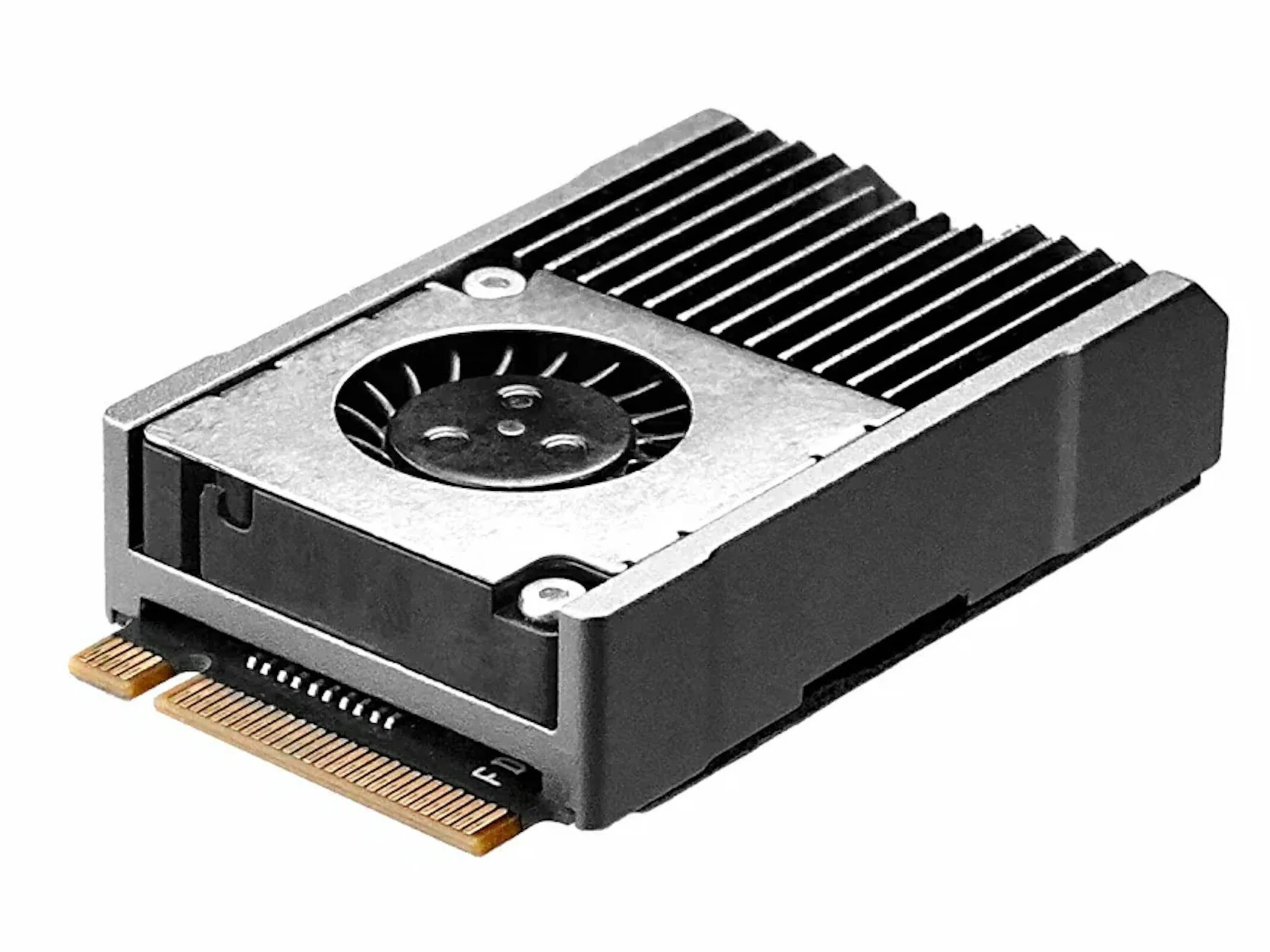
    The M5Stack LLM-8850 has recently launched, designed specifically to enhance these kinds of AI functionalities. It utilizes an Axera AX8550 System on Chip (SoC) featuring four Cortex-A55 cores along with a Neural Processing Unit (NPU) capable of delivering 24 TOPs performance. In contrast, the NPUs found in contemporary AMD and Intel CPUs provide about double that performance. Additionally, the card includes a Vision Processing Unit (VPU) that can decode up to 16 Full HD video streams simultaneously. The board also features 8GB of RAM and comes equipped with a heatsink and a fan.

    Key Specifications and Compatibility

    The connection to the card is made through an M.2 Key M slot and utilizes two PCIe 2.0 lanes. Its dimensions are 1.68 x 0.94 x 0.38 inches, making it compatible with the Raspberry Pi 5, other single-board computers, mini PCs, and several AI frameworks. Finally, the M5Stack LLM-8850 is officially priced at $99, though additional shipping and import charges may be incurred.

    Source:
    Link


  • Netflix Seeks Generative AI Talent for Games with $840K Job Offer

    Netflix Seeks Generative AI Talent for Games with $840K Job Offer

    Key Takeaways

    1. Netflix is hiring a Director of Generative AI for Games, with a salary range of $430,000 to $840,000 per year.
    2. The role requires at least 10 years of experience and knowledge of the entire game development process.
    3. The Director will lead the generative AI strategy, collaborating with game studios and tech teams to create new gaming titles.
    4. The job listing has received backlash, as critics highlight the disparity between high salaries for AI roles and low pay for entry-level positions in the industry.
    5. Netflix is actively pursuing AI initiatives, including plans for AI-generated interactive advertising in 2026.


    As the gaming industry faces a wave of layoffs, Netflix has recently listed a peculiar job opening for a Director of Generative AI for Games, offering a salary range of $430,000 to $840,000 per year, along with a generous benefits package.

    Job Details and Requirements

    This role, based in Los Angeles and requiring in-person attendance, is looking for someone with at least 10 years of experience in the sector, and a comprehensive knowledge of the entire game development process from initial concept to live operations.

    The job description mentions that the candidate will be responsible for defining and leading the generative AI strategy within Netflix Games. This includes shaping the base structure and working alongside game studios, tech teams, and leadership to develop fresh titles.

    Background Context

    This announcement follows a series of layoffs at Netflix, where an unspecified number of employees from Night School Studio, the developer of Oxenfree, were let go in February 2025. Night School Studio was acquired by Netflix in 2021.

    The job listing reveals:

    We’re searching for a innovative and practical Head of Gen AI to oversee the strategy and application of Gen AI throughout our gaming organization. This position is at the crossroads of technology, product, and creativity, influencing how we utilize advanced AI to craft meaningful, original, and scalable experiences for gamers.

    You will act as a crucial partner to our game studios, technology and platform teams, as well as leadership. Your role is to integrate in-game features into brand new modes of play, based on what’s technically possible and what’s captivating for players.

    Industry Reaction

    This job listing has sparked significant backlash from industry insiders, with some arguing that the position offers “nearly half a million dollars to click generate on the plagiarism machine, while entry-level jobs have vanished, and they want to hire art directors on contract for $30 an hour.”

    Others have mocked the job posting, saying, “Netflix wants to pay someone half a million dollars a year to be ‘director of genAI for games’. Your first Unity tutorial project makes you overqualified.”

    Netflix is clearly making strong moves in the AI space, as the company has revealed plans to roll out AI-generated interactive advertising in 2026. In July, co-CEO Ted Sarandos spoke highly of generative AI’s role in the show The Eternaut, declaring, “We still believe that AI offers a tremendous chance to assist creators in making films and series better, not just cheaper.”

    Source:
    Link


  • AI’s Impact on Jobs: Reddit Users Skeptical of New Study Findings

    AI’s Impact on Jobs: Reddit Users Skeptical of New Study Findings

    Key Takeaways

    1. Recent research from Yale University indicates no strong signs of widespread job loss due to AI since the launch of ChatGPT in November 2022.
    2. The study compares current labor market changes with historical technological revolutions, finding shifts in job types remain within normal ranges.
    3. Young professionals aged 20 to 24 are showing more noticeable changes in job patterns, but the reasons are unclear and difficult to attribute solely to AI.
    4. Historical context suggests that significant changes in the job market typically take years or decades following technological advancements.
    5. Criticism of the study includes concerns about its short observation period, lack of representative usage data, and general skepticism towards academic research findings.


    Since the launch of ChatGPT in November 2022, there has been a lot of discussion about the possibility that artificial intelligence might endanger whole jobs and cause large-scale unemployment. A new research from Yale University, released on October 1, 2025, by Martha Gimbel, Molly Kinder, Joshua Kendall, and Maddie Lee, shows a somewhat different view – at least for the time being. Even with the quick rise of generative AI, the researchers did not find strong signs of widespread job loss or significant structural changes in the job market in the US up to now.

    Examining Labor Market Changes

    Thirty-three months after the debut of ChatGPT, the researchers looked into whether the labor market was changing more quickly than it did during past technological revolutions, like the rise of personal computers or the internet. They compared the current situation with three historical periods: the PC era (1984–1989), the internet boom (1996–2002), and a pre-AI control period (2016–2019). Their analysis used CPS data, AI exposure estimates from OpenAI, and user data from Anthropic.

    Findings on Job Losses

    The findings are quite telling: while there are slight shifts in job types, these remain within the normal range of historical changes. Even in industries that are heavily impacted by AI, like information and finance, the researchers did not find solid proof of job losses that could be directly linked to AI technologies.

    The research particularly highlighted young professionals. Among university graduates aged 20 to 24, there were more noticeable changes in job patterns, although the exact reasons for this are not clear. The small sample size and overall labor market trends make it hard to determine if AI is the main factor. The authors are careful in their interpretations and note the study’s constraints: the exposure data relies on theoretical models, while actual usage information is still sparse. They call on AI firms to share more detailed and clear data, including specifics at the company level.

    Context of Technological Shifts

    When viewed against historical changes, this study provides context for the ongoing discussions about AI-related job losses. Past technological advancements, like the introduction of computers or the internet, typically took years or even decades to have a significant effect on the job market. The researchers argue that expecting AI to lead to immediate changes is unrealistic.

    On Reddit, particularly in a popular thread on r/technology, users expressed skepticism. Many people criticized the study for being out of touch with reality, pointing to actual layoffs, increased performance pressure, and hiring freezes. The most common points of criticism were the brief 33-month observation period, the insufficient representative usage data, and a general mistrust of academic research.

    Source:
    Link


  • Huawei 910C to Replace Nvidia AI Chips with TSMC and Samsung Tech

    Huawei 910C to Replace Nvidia AI Chips with TSMC and Samsung Tech

    Key Takeaways

    1. Huawei has allegedly acquired TSMC dies through a shell company, circumventing export controls to produce nearly three million Ascend 910C AI chips.
    2. The Ascend 910C chip aims to replace Nvidia AI chips, manufactured at SMIC, but faces challenges in yield rates with the 7nm process.
    3. Teardowns confirm the presence of TSMC dies in the 910C, despite TSMC halting production and sales to Huawei post-restrictions.
    4. Huawei is set to produce 653,000 Ascend 910C chips but faces difficulties sourcing high-bandwidth memory (HBM), which could hinder future production.
    5. Production challenges, including poor packaging and thermal inefficiencies, may limit the output of the 910C to about one million units by 2026, despite significant government funding for local chip production.


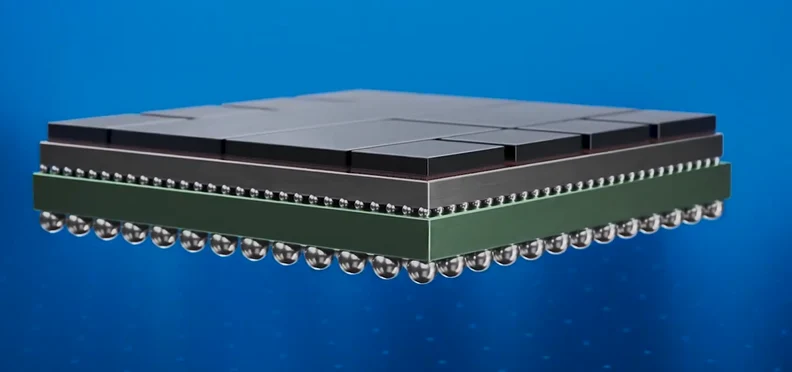
    Huawei has allegedly found a way to acquire TSMC dies despite existing export control measures, enabling the company to produce its self-developed AI accelerators, as revealed by a detailed examination of the 910C chip.

    Ascend 910C: Huawei’s AI Strategy

    The Ascend 910C represents China’s primary effort to substitute Nvidia AI chips. Huawei is manufacturing this chip at SMIC while rapidly expanding its own foundry capabilities for full vertical integration. However, with SMIC facing challenges in achieving satisfactory yields in its 7nm production process, Huawei is said to have sourced TSMC dies through a shell company, successfully dodging export restrictions for nearly three million Ascend chips.

    Teardown Revelations

    Experts in semiconductor teardowns have validated this information, discovering that the 910C chip indeed contains TSMC dies alongside older high-bandwidth memory (HBM) supplied by Samsung and SK Hynix. TSMC, which faced a $1 billion fine due to the leaked dies, was quick to clarify that the recent teardown of the 910C shows it was produced with the same die “examined by this organization in October 2024, not with a newer die or advanced tech.” They also confirmed that the production and sale of chips sent to Huawei were halted after the restrictions came into play.

    Production Outlook

    Currently, Huawei is on track to produce 653,000 Ascend 910C chips using two TSMC dies, and it reportedly has enough TSMC dies available for production until next summer. However, acquiring high-bandwidth memory to go along with these TSMC chips has proven to be far more challenging. The Samsung or SK Hynix memory that China managed to gather before the HBM controls were implemented is outdated and dwindling fast, leading to reports of Huawei bypassing restrictions by removing memory from loosely packaged products specifically for this task.

    Nonetheless, HBM is expected to be the major obstacle for Huawei’s Ascend 910C AI chip production in the future. The 910C delivers about half the performance of the widely-used Nvidia H100 AI chip, which can be found on Amazon for a price comparable to what Huawei reportedly spends to produce the 910C.

    Production Challenges Ahead

    The 910C’s packaging is somewhat poor and susceptible to thermal inefficiencies, and Huawei still needs to manufacture millions of AI chips to meet domestic demand. Due to these bottlenecks involving HBM and dies, it is estimated that only about a million 910C units could be produced by 2026. However, Chinese government loans aimed at enhancing local AI chip and HBM foundries have reached billions, suggesting that production could ramp up swiftly in the near future.

    Source:
    Link