Tag: Jony Ive

  • Jony Ive Designs Apple Car with Ferrari Luce Interior, Ditches Touchscreens

    Jony Ive Designs Apple Car with Ferrari Luce Interior, Ditches Touchscreens

    Key Takeaways

    1. Jony Ive, Apple’s former design chief, has designed the interior of the electric Ferrari Luce, emphasizing a human-centric approach.
    2. Ive criticizes Tesla’s minimalistic interiors, describing them as “easy and lazy,” and believes they lack necessary frameworks for effective use.
    3. The Ferrari Luce combines traditional design elements with modern technology, featuring mechanical buttons and a retro aesthetic.
    4. Ive’s design philosophy aims to maintain Ferrari’s heritage while adapting to the digital age, enhancing user interaction.
    5. The Ferrari Luce is set to be revealed in May, showcasing the results of Ive’s five-year design project.


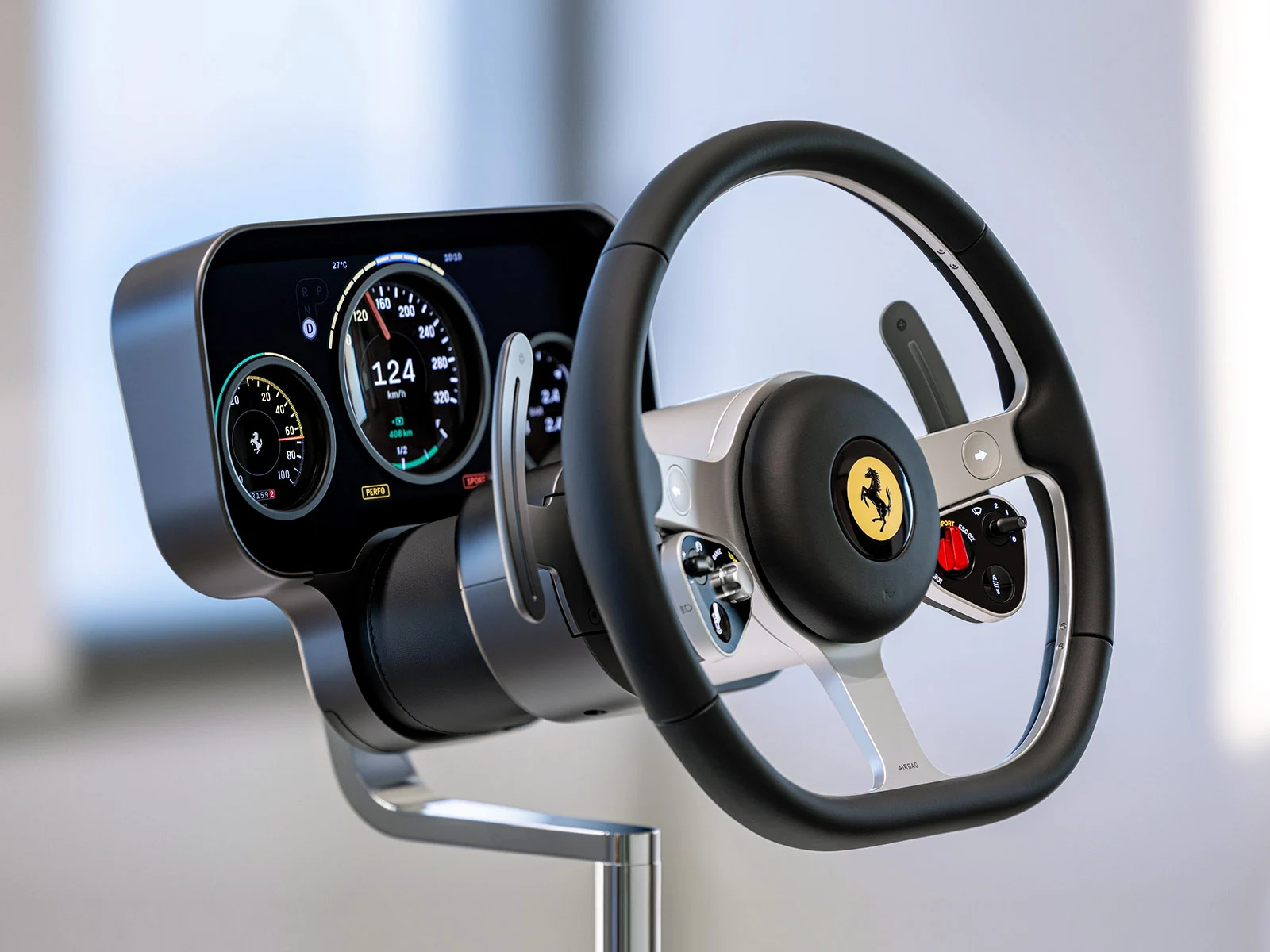
    Apple’s previous design chief, known for his human-centric approach, has developed a skeuomorphic interior for the inaugural electric Ferrari, now named “Luce.” This design may represent what the Apple Car could have resembled.

    Jony Ive’s Influence

    Sir Jony Ive has been a key figure in the triumph of Apple’s iPhone, striving to create technology that feels intuitively familiar for users from the moment they interact with it. After departing from Apple, he founded an independent design studio that has collaborated with OpenAI. He has also had the liberty to take on various projects, one of which—the interior of the Ferrari Luce—has taken five years to complete.

    A Stand Against Minimalism

    As you might expect, Apple’s ex-leading designer isn’t particularly fond of Tesla’s trendy minimalistic interiors, which lack buttons and focus heavily on screens. He refers to this style as “easy and lazy.” He mentioned that the idea of relying solely on a touchscreen for vehicle control has become boring and now gives off a vibe of “cost savings” rather than innovation.

    “Effective tools” such as touchscreens “require frameworks and structures to be used properly, and things are moving so quickly now that I don’t think those frameworks were established” in automotive interiors, he expressed.

    Embracing Heritage with Modern Touch

    In contrast to this trend, Ferrari chose to embrace Jony Ive’s human-centered design philosophy to infuse its traditional Italian sports car identity into the new electric vehicle era without sacrificing its essence. The Ferrari Luce features “precision-engineered mechanical buttons, dials, toggles, and switches” for user interactions, combined with “multifunctional digital displays” that showcase a distinctly retro aesthetic.

    Volkswagen has taken a similar route with the interior design of its forthcoming electric vehicles, leveraging a long-standing and recognizable style. Jony Ive appears to have reinvented the Ferrari interior for today’s digital world while remaining faithful to its roots, celebrating the tactile experience. Ferrari is set to reveal the Luce in May, allowing enthusiasts to see what Sir Jony Ive’s studio has accomplished in terms of the car’s overall design.

    Source:
    Link


  • Apple Pin: Dual Cameras, Triple Microphones & Speaker in AirTag Shape

    Apple Pin: Dual Cameras, Triple Microphones & Speaker in AirTag Shape

    Key Takeaways

    1. Jony Ive is developing an AI device for OpenAI, while Apple is reportedly creating a similar product expected by 2027.
    2. The new Apple gadget, referred to as the “Apple Pin,” is described as a thin, flat, round disk, comparable in size to an Apple AirTag but slightly thicker.
    3. It is expected to include a wide-angle and ultra-wide-angle camera, three microphones, a speaker for AI interaction, and a single physical button.
    4. The device will have a magnetic back for wireless charging, similar to the technology used in the Apple Watch.
    5. The gadget may connect with an upgraded version of Siri, expected to be more powerful with the upcoming iOS 27, built on Google’s Gemini AI chatbot.


    While the former design head of Apple, Jony Ive, is working on an AI device for OpenAI, Apple is said to be creating a similar product too. A recent report from The Information suggests that this new gadget could be available to consumers by 2027. The device is described as a thin, flat, round disk, which might remind one of an Apple AirTag (priced at $26 on Amazon). It’s expected to be a comparable size but a bit thicker.

    Features Unveiled

    On the front of this rumored “Apple Pin,” there are expected to be a wide-angle camera and an ultra-wide-angle camera for capturing images and videos of the environment around the user. Apple is also reportedly including three microphones and a speaker, enabling interaction with an AI assistant. Moreover, the gadget may have just a single physical button. It will feature a magnetic back for wireless charging, similar to the technology used in the Apple Watch.

    Expectations and Speculations

    Nonetheless, it is still uncertain what specific features this gadget will have. However, it’s likely that the device could connect with Apple’s upcoming version of Siri, which is anticipated to debut later this year with iOS 27 and macOS 27. In contrast to the first AI-driven version of Siri that will come with iOS 26.4, the iOS 27 iteration is rumored to be built on Google’s Gemini AI chatbot, making it much more powerful. As is often the case, these early speculations should be viewed with some skepticism, as Apple’s intentions could still change.

    Source:
    Link


  • OpenAI’s First Device by Jony Ive Delayed Due to Technical Issues

    OpenAI’s First Device by Jony Ive Delayed Due to Technical Issues

    Key Takeaways

    1. Technical Challenges: OpenAI’s partnership with designer Jony Ive faces technical problems that may delay the product launch.

    2. AI Voice and Character: The design team is struggling to create a friendly yet non-human-like AI presence, aiming for a balance that feels like a “buddy” rather than an awkward AI.

    3. Privacy Issues: The device’s need for constant listening raises significant privacy concerns, prompting careful discussions about managing sensitive user data.

    4. Budget Constraints: High computing power requirements for real-time operation could increase production costs and complicate pricing for mass-market appeal.

    5. User Experience Focus: OpenAI aims to create a seamless, personal user experience without relying heavily on screens, learning from past failures of similar AI devices.


    OpenAI’s big move into hardware may face challenges before it even gets to shoppers. A new report from the Financial Times reveals that the partnership with famed designer Jony Ive, who is famous for creating some of Apple’s most memorable products, has encountered “technical problems” that could push back the launch of the device.

    Design Dilemmas

    Insiders familiar with the project told FT that OpenAI and Ive’s design firm, LoveFrom, are still trying to figure out how to establish the AI’s “voice” and character. The team reportedly wants the assistant to come across as friendly but not too human-like; one source described the aim as “a buddy who’s a computer but not your awkward AI girlfriend.” However, achieving that delicate balance has turned out to be more challenging than they initially thought.

    Privacy Concerns

    Another significant obstacle is privacy. The anticipated device is expected to depend on constant environmental awareness, meaning it would always be listening. This feature has sparked internal discussions about how to manage sensitive user information, especially in a time when consumer confidence in AI is already shaky. According to reports, OpenAI’s leaders are cautious about igniting new privacy issues as they venture into hardware.

    Budgeting Issues

    Financial planning could also pose a challenge. The FT report mentions that the device will likely require substantial computing power to operate in real-time, especially if it aims to run advanced AI models locally or with a minimal connection to the cloud. This level of hardware capability would increase both production and operating expenses, potentially complicating pricing for mass-market appeal.

    Despite these difficulties, specifics about what the OpenAI-Ive device actually is remain limited. OpenAI CEO Sam Altman has suggested that it could be compact, context-aware, and without a screen; envision a physical AI companion rather than a conventional gadget.

    User Experience

    The company is reportedly looking into ways to make the experience seamless and personal without being intrusive or overly dependent on screens. If that idea sounds recognizable, it’s because other AI-driven devices have attempted (and not succeeded) to make it work.

    For instance, the Humane AI Pin was recently discontinued due to disappointing sales and mediocre reviews. Nevertheless, OpenAI and Ive seem set on evading a similar outcome by taking their time to enhance both the technology and the user experience.

    At this point, the project seems to be in a waiting mode as both teams work through these core challenges. Whether this means the device will miss its planned 2026 launch remains uncertain, but it’s evident that OpenAI aims for its first hardware venture to be more than just a gimmick, striving instead for a product that feels as well-crafted as it is smart.

    Source:
    Link


  • OpenAI, Jony Ive, and Luxshare to Launch AI Hardware by 2027

    OpenAI, Jony Ive, and Luxshare to Launch AI Hardware by 2027

    Key Takeaways

    1. OpenAI is developing its first consumer device, a smart speaker without a screen, in collaboration with Jony Ive and Luxshare, aiming for a late 2026 or early 2027 launch.

    2. Tang Tan, a former Apple design executive, is now the Chief Hardware Officer at OpenAI, following the company’s $6.5 billion acquisition of io Products, co-founded by Tan and Jony Ive.

    3. OpenAI has hired around 24 former Apple employees with expertise in design, hardware, and manufacturing to accelerate its hardware development.

    4. The company is leveraging Apple’s supply chain and collaborating with partners like Luxshare and Goertek to source components, indicating a shift towards consumer electronics.

    5. There are potential conflicts between OpenAI and Apple due to their overlapping interests, as OpenAI develops hardware while Apple uses OpenAI’s models in its products.


    OpenAI is stepping into the hardware arena by teaming up with Jony Ive and choosing Luxshare to create its first consumer device. Suppliers have described this upcoming product as a smart-speaker-style device that does not have a screen. OpenAI is also working on other products like glasses, a wearable pin, and a digital voice recorder, aiming for a launch in late 2026 or early 2027.

    Leadership and Acquisitions

    Tang Tan, who previously worked as a design executive at Apple, is now the Chief Hardware Officer at OpenAI and reports to Sam Altman. In May, OpenAI purchased io Products, a hardware studio that Tan co-founded with Jony Ive, for a whopping $6.5 billion, with funding from SoftBank. Legal documents related to a trademark issue reveal the intention to create a lineup of “AI-native” products under the io brand.

    Hiring Strategies

    To speed up its hardware plans, OpenAI has brought on board about two dozen former Apple workers who specialize in design, hardware, UI, audio, wearables, and manufacturing. Key additions include manufacturing design specialist Matt Theobald and Siri interface designer Cyrus Daniel Irani, both now part of Tan’s team.

    Supply Chain Connections

    OpenAI is taking advantage of Apple’s supply chain while looking for new talent. Besides collaborating with Luxshare, they have contacted Goertek, which provides components for AirPods, HomePods, and Apple Watches, to supply speaker modules. OpenAI is also engaging with other Chinese partners used by Apple for tooling and audio. These actions suggest that OpenAI is aiming to expand like a consumer electronics company, instead of merely functioning as a research lab.

    Future Device Ideas

    There are reports that OpenAI is looking into more device concepts, with timelines that coincide with the smart-speaker-style product. The goal is to merge AI-driven features with the high-quality design that Jony Ive’s teams are known for. To bring in experienced professionals, OpenAI is providing attractive salaries, fresh job opportunities, and various incentives.

    Potential Conflicts

    A possible conflict has arisen as Apple has incorporated OpenAI’s models into Siri and iOS since 2024, while OpenAI is developing hardware alongside former Apple executives and suppliers. This overlap may lead to tension if OpenAI’s hardware plans clash with Apple’s interests, which could have repercussions for their ongoing partnership as new products are created.

    Source:
    Link


  • iPhone 19 Pro: New Design for Apple’s 20th Anniversary, Analyst Says

    iPhone 19 Pro: New Design for Apple’s 20th Anniversary, Analyst Says

    Key Takeaways

    1. Apple is planning a major redesign of the iPhone for its 20th anniversary in 2027, potentially called the iPhone 19 series.
    2. The redesign may include a new Pro model with extensive glass usage, aligning with Jony Ive’s vision of a glass-like device.
    3. There is speculation about Apple possibly abandoning the iPhone 19 name, similar to the transition from iPhone 8 to iPhone X.
    4. A foldable iPhone may be in the works, with reports suggesting a release as early as 2026 featuring a 5.5-inch outer display and a 7.8-inch inner screen.
    5. The information is based on industry analysis and should be viewed with caution, as it is not officially confirmed by Apple.


    Apple appears to be gearing up for a significant redesign of the iPhone to celebrate its 20th anniversary. There have been various reports suggesting that Jony Ive’s dream of creating an iPhone that resembles “a single sheet of glass” may finally become a reality. Industry expert Mark Gurman has hinted at a ‘major shake-up’ in the design of the iPhone model set to launch in 2027. According to the current naming pattern, this would be recognized as the iPhone 19 series.

    Potential New Features

    According to 9to5Mac, referencing Mark Gurman from Bloomberg, Apple is planning a substantial redesign to mark the iPhone’s 20th anniversary. This redesign is expected to introduce a striking new Pro model that utilizes “extensive use of glass.” The device in question would likely be the iPhone 19 Pro if the company chooses to stick with that title. However, there’s also a chance that Apple might completely abandon the iPhone 19 name, similar to how the iPhone X followed the iPhone 8 series.

    Jony Ive’s Vision

    The rumored iPhone 19 Pro aligns with Jony Ive’s original concept of a largely glass iPhone. Whether this design will prove practical and durable remains uncertain, and only time will reveal its effectiveness. Moreover, Gurman has also suggested the possibility of a foldable iPhone for the 20th anniversary, with speculations about this model circulating as well. Some reports indicate that a foldable iPhone might be released as soon as 2026, featuring a 5.5-inch outer display and a 7.8-inch inner screen, which is akin to an iPad mini.

    Caution Advised

    It’s important to remember that this information comes from an industry analyst and not directly from Apple itself, so it should be taken with caution.

    Source:
    Link