Tag: Starlink

  • Starlink Updates Outage Log to Track All Network Events

    Starlink Updates Outage Log to Track All Network Events

    Key Takeaways

    1. Introduction of Event Log: Starlink app now includes an Event Log to alert users about service outages and gather local network reports.

    2. Enhanced Monitoring: The Event Log tracks not only major satellite failures but also interruptions from router disconnections and other connectivity issues.

    3. Improved User Understanding: The purpose of the Event Log is to help subscribers understand issues better and reduce the workload for customer service agents.

    4. Diagnostic Resource: The information in the Event Log is similar to what tech support uses, aiding customers in troubleshooting and enhancing their overall experience.

    5. Growing Subscriber Base: Starlink’s subscriber numbers are rising as download speeds improve, highlighting the need for better tools to analyze service disruptions, especially after recent outages.


    After experiencing its second significant “Starlink down” incident within a couple of weeks, Elon Musk’s satellite internet service has opted to enhance the Outage Log feature in its app.

    Event Log Introduction

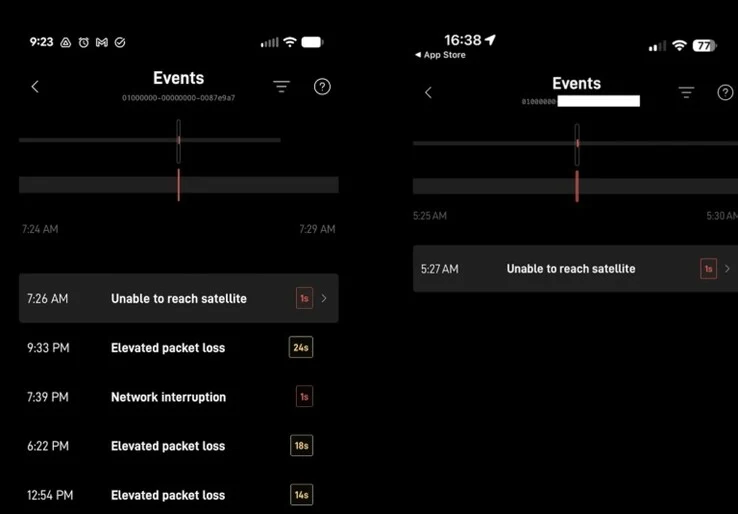
    The Starlink application now features what is called the Event Log. This new addition not only alerts users about major service outages like before but also gathers local network reports.

    The main aim of this updated Starlink network event log is to enhance subscribers’ understanding of the reasons behind any issues while also reducing the burden on customer service agents. In the past, the outage section in the Starlink app merely indicated the duration during which the terminal was offline.

    Expanded Tracking Capabilities

    Now, the Starlink event log monitors more than just significant satellite connectivity failures; it also accounts for service interruptions caused by the router being turned off or disconnected.

    Moreover, if there is a substantial loss of packet data or if a Starlink Mini terminal reboots in a remote area, these events will also be recorded by the app. This makes it a more beneficial diagnostic resource for both the end user and customer service when assistance is required.

    Starlink claims that the information available to users in the new Event Log is similar to what tech support sees during troubleshooting. Over time, they plan to add more connectivity issues to the reporting list. The intention is to keep subscribers updated about potential causes of disruptions during video calls or sudden drops in frame rates while gaming. Although these issues might seem minor from a support standpoint, they can negatively impact the user’s overall experience with the network.

    Rising Subscriber Numbers

    As Starlink’s download speeds improve thanks to significant additions in satellite capacity, the number of subscribers to the satellite internet service is increasing rapidly. There have already been two major global outages: one was a man-made error linked to a firmware update at ground network stations, and the other was caused by a geomagnetic storm. Any tools that assist in analyzing Starlink service disruptions will be beneficial for resolving connectivity problems as Starlink prepares for its ambitious gigabit network upgrade.

    Source:
    Link


  • Starlink Outage: Satellite Internet Down During Geomagnetic Storm

    Starlink Outage: Satellite Internet Down During Geomagnetic Storm

    Key Takeaways

    1. Starlink experienced a global satellite Internet outage on September 15, affecting over 50,000 users in various locations, including Ukraine and Michigan.
    2. The outage was likely caused by a significant geomagnetic storm, which was predicted by NOAA, rather than an issue controlled by SpaceX.
    3. The previous outage was due to human error during a capacity upgrade of Starlink’s terrestrial network, which aims to improve service quality.
    4. The first outage lasted almost three hours, while the September 15 downtime was shorter, with users affected for up to an hour and a half.
    5. SpaceX plans to launch V3 satellites in 2026, which will increase throughput capacity and allow for faster download speeds.


    Starlink experienced a global satellite Internet outage on September 15, marking its second major disruption since a previous incident a few weeks ago.

    Over 50,000 users reported connectivity issues, stretching from Ukraine, where Madyar, chief of the drone army, noted that “Starlink is once more down along the frontline,” to users in Michigan and others utilizing a Starlink Mini dish.

    Possible Causes of Outage

    The cause of this latest Starlink outage appears to be beyond the control of SpaceX. Although Starlink did not provide specific details in its announcement, the outage coincided with a warning from the National Oceanic and Atmospheric Administration (NOAA) regarding a significant geomagnetic storm during the same timeframe.

    A geomagnetic storm with a K-index of 7 or higher (NOAA G3 or above) was predicted to occur between 02:54 and 09:00 UTC on September 15, 2025. This could result in power system voltage fluctuations, spacecraft surface charging issues, increased satellite drag, temporary GPS navigation and HF radio disturbances, and auroras visible as far south as Pennsylvania, Iowa, and Oregon.

    Previous Outage Details

    The initial significant disruption of Starlink’s service was due to human error. SpaceX was implementing a capacity upgrade for Starlink’s terrestrial network, which consists of over 100 gateways, each with 150 antennas in the United States. These hubs help to cover dead zones and reduce latency for distant users by spreading the satellite Internet signal through fiber optic cables, improving ping and providing a more stable connection.

    This upgrade aimed to enhance the terrestrial signal distribution in anticipation of the forthcoming Starlink gigabit network. SpaceX is set to launch its V3 satellites in 2026, which will offer 10 times the throughput capacity, allowing peak download speeds to exceed 1 Gbps when using a Performance dish.

    Duration of Outage

    The first major outage caused by the terrestrial gateway firmware upgrade lasted almost three hours. However, on September 15, Starlink’s downtime during the geomagnetic storm was relatively short, with users reporting that they were without satellite Internet for a maximum of an hour and a half.

    Source:
    Link


  • Starlink Dish and Residential Plans at Lowest Prices in These States

    Starlink Dish and Residential Plans at Lowest Prices in These States

    Key Takeaways

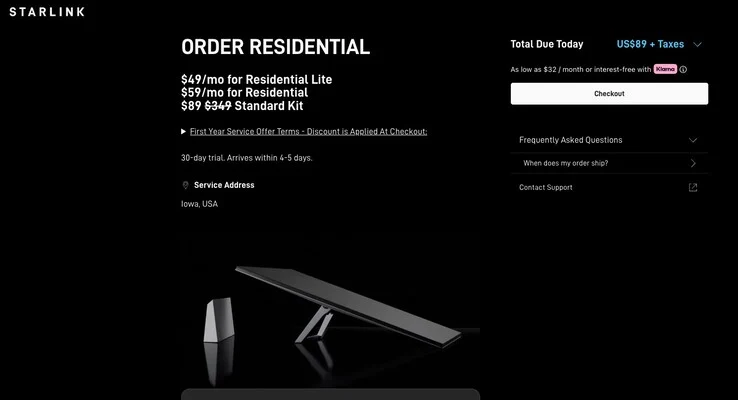
    1. Starlink has introduced a promotional deal reducing the Standard dish price from $349 to $89 and halving the Residential service plan cost from $120 to $59 per month.
    2. The Residential Lite plan’s price is reduced from $80 to $49 in select areas, but this promotion is only for new subscribers during their first year.
    3. New Residential subscribers can save $732 over a year, with potential total savings of up to $992 including the dish discount, but may lose this pricing if they change plans or cancel.
    4. The promotion’s availability varies by location, and interested customers should check eligibility by entering their service address at starlink.com/residential.
    5. This is the most significant price cut for Starlink’s Standard Kit and Residential plans in the U.S. to date, following previous discounts on hardware but not on internet plans.


    In an effort to draw in new customers in the United States, Starlink has introduced a new promotional deal that drastically cuts the costs of its satellite internet dish and residential service plans.

    New Pricing for Starlink Dish

    The most recent offer reduces the price of the Starlink Standard dish to $89, down from the regular price of $349. Additionally, the company is halving the price of its standard Residential service plan, bringing it down to $59 per month from $120. The Residential Lite plan, which provides unlimited but deprioritized data, is also seeing a price reduction from $80 to $49 in select areas. This promotion is available only to new subscribers during their first year of service, and Starlink mentions that the specific “terms and duration may change.”

    Important Conditions for Savings

    Starlink cautions that users might lose their promotional pricing if they opt to change their plan (like switching to Standby Mode or Roam) or if they cancel their service within this time frame. For new Residential subscribers, this equates to $732 in savings over a year and potentially up to $992 in total savings when including the dish discount.

    Starlink does not provide a clear list of which locations qualify for the new offer. However, we found that the deal is active in several US states:

    In other areas, the Residential plan is available for $85 per month instead, with only a few places showing the Lite plan as well.

    Check Your Eligibility

    This list isn’t comprehensive; if your area isn’t mentioned here, it doesn’t mean you’re out of options. You can visit starlink.com/residential and enter your service address to check if you qualify for the promotion.

    While Starlink frequently offers discounts on hardware, its internet plans have not seen similar reductions. This changed in August with the company’s significant price cuts on monthly plans for the first time. Now, this latest promotion represents the most aggressive pricing we’ve observed for the Standard Kit and Residential plans in the United States.


  • Starlink Offers 44% Discount on Roam Plan for New Canada Users

    Starlink Offers 44% Discount on Roam Plan for New Canada Users

    Key Takeaways

    1. Starlink Canada is offering a special promotion for new customers on the Roam plan, designed for travelers needing reliable internet.
    2. The Roam 50GB Plan is available for $39 CAD/month for the first six months, down from $70 CAD/month (44% discount).
    3. The Roam Unlimited Plan is reduced from $189 CAD/month to $110 CAD/month, a 40% price cut during the promotion.
    4. The option to pause the Roam plan for free has been replaced with a paid ‘Standby Mode’ at $7 CAD/month, but users still get unlimited slow internet.
    5. New customers can purchase a Standard dish kit for $249 CAD (down from $599 CAD) and receive six months of Roam service at a low entry cost.


    Starlink Canada is currently offering a special deal for new customers who are interested in the Roam plan. This plan is made for people who travel to areas where standard mobile networks or Wi-Fi connections are not reliable.

    Pricing Details

    The promotion is valid for both the Roam 50GB Plan and the Roam Unlimited Plan. New users can get the Roam 50GB Plan for just $39 CAD per month for the first six months, instead of the regular price of $70 CAD per month. This represents a discount of around 44%.

    Additionally, the Roam Unlimited Plan has been lowered from $189 CAD per month to $110 CAD per month, which is a 40% price cut. However, it’s important to note that once the promotional period ends, the pricing will revert to its original amount.

    Recent Changes

    This offer comes after a recent adjustment that faced backlash from existing users. In the past, Roam customers had the ability to pause their plan for free when they were not traveling. This option has now been substituted with a paid ‘Standby Mode’ priced at $7 CAD per month. Even with this change, users will continue to have access to unlimited slow internet, although high-speed service will not be available.

    While it seems that the free pause feature won’t be coming back anytime soon, the introductory promotion could serve as a tempting incentive to lure in new customers, despite the extra costs involved.

    Additional Offers

    Starlink is also slashing $350 off its Standard dish kit in Canada. New customers can acquire a dish kit for only $249 CAD, down from $599 CAD, and also enjoy six months of Roam service for a really low entry cost.

    In the U.S., the dish is similarly offered at 50% off, and Starlink has also cut monthly fees for Residential plans in select areas.

    Source:
    Link


  • Starlink Boosts Download Speeds for Mini and Standard Dish Kits

    Starlink Boosts Download Speeds for Mini and Standard Dish Kits

    Key Takeaways

    1. The FCC has approved a power boost for Starlink dishes, increasing EIRP for the Standard dish from 42.1 dBW to 43.4 dBW.
    2. The Starlink Mini dish power output has increased significantly from 33.2 dBW to 39.2 dBW, improving performance during roaming.
    3. SpaceX is launching V2 satellites rapidly, adding 5 Tbps of capacity weekly, resulting in average U.S. download speeds of 200 Mbps.
    4. Some users have reported download speeds exceeding 300 Mbps after a recent firmware update, indicating potential for future improvements.
    5. It is unclear if current subscribers will get the power boost via firmware updates or if it will only be available on new dishes from the Bastrop facility.


    SpaceX has received permission for a power boost on its Starlink dishes, something it has been seeking for over a year now.

    The Federal Communications Commission (FCC) has approved an increase in the Equivalent Isotropic Radiated Power (EIRP) for the Standard dish, raising it from 42.1 decibel watts (dBW) to 43.4 dBW.

    Improved Performance for the Mini Dish

    In addition, the Starlink Mini dish, referred to in the FCC documents as UT3-V2, has seen a much larger increase in its power output, now permitted to transmit at 39.2 dBW instead of the previous 33.2 dBW.

    This increase in signal strength will enhance the performance of the Starlink Mini dish during roaming, enabling faster download speeds when a user is farther away from the Mini kit. The same applies to the Standard dish, which is currently available at a discounted price across the United States.

    Rapid Satellite Launching

    SpaceX is actively deploying V2 satellites, adding 5 Tbps of capacity every week. As a result, the average download speeds for Starlink in the U.S. have reached 200 Mbps, even during peak hours, which is double what it was three years ago, even with the growing number of subscribers.

    Some users have noted significant increases in their download speeds, exceeding 300 Mbps, following a firmware update sent to ground stations. This update was part of preparations for the launch of a gigabit network set for 2026. Although the update caused a major outage, the speed boosts some users are experiencing could indicate future improvements thanks to the recently approved power increases for both the Standard and Mini dishes.

    Uncertainty for Existing Subscribers

    The FCC has approved this power boost for use both when the Starlink dish is stationary and when it is in motion. However, it remains uncertain whether current subscribers will receive this new capability through a firmware update or if only new dishes produced at Starlink’s Bastrop facility, which operates at a rate of 15,000 units per day, will feature the enhanced power output.

    Source:
    Link


  • Starlink September Promo: Free Subscription & Half Price Kit

    Starlink September Promo: Free Subscription & Half Price Kit

    Key Takeaways

    1. Starlink is offering a complimentary month of service for the Residential Lite plan, aimed at bringing back former users.
    2. The free service promotion will last until September 30 and is valued at up to $120, depending on location.
    3. Starlink has launched over 2,300 new satellites, promising improved speeds, reduced latency, and better signal coverage.
    4. The Starlink Standard Kit is being offered at a 50% discount, now priced at $175 instead of $349.
    5. High congestion fees in certain areas, reaching up to $1,000, may deter previous customers from re-subscribing despite the promotional offers.


    Starlink has rolled out a feast of subscription deals and equipment purchase benefits this summer, and many of these offers will continue into September.

    Subscription Promotions

    To enhance the subscription discount that reduced the monthly cost to $65 in specific regions for the Residential Lite plan, Starlink is now providing a complimentary month of service. This promotion is aimed at former Starlink users who cancelled their service for various reasons. In an effort to bring them back as new customers, Starlink is offering a month of free service, valued at up to $120, depending on the location.

    Free Service and Satellite Upgrades

    This free payment promotion will be available until September 30. SpaceX is further enticing potential new Starlink users by announcing the launch of over 2,300 new satellites in the last year, promising improved speeds, reduced latency, and better signal coverage.

    Discount on Equipment

    In addition to the subscription incentives, Starlink is continuing another appealing offer. The Starlink Standard Kit is available at a notable discount. New customers can order the dish for just $175, which is a 50% decrease from its original price of $349, marking the largest price drop for the Starlink Mini dish since its introduction.

    This 50% off dish deal is expected to remain available throughout the quarter and is accessible across the US, unlike the pricing reductions for plans. However, residents in areas with high Starlink subscriber numbers not only miss out on the current plan discounts but also face hefty congestion fees. These fees could reach as high as $1,000 in some parts of the Northwest, which may deter any previous Starlink customers from re-subscribing, regardless of the free subscription months being offered to entice them back into the satellite Internet market.

    Source:
    Link


  • Free Starlink Dish and 100 Mbps Internet Beat Fiber for Rural Aid

    Free Starlink Dish and 100 Mbps Internet Beat Fiber for Rural Aid

    Key Takeaways

    1. Starlink has won a state auction to provide broadband Internet to underserved rural areas, supported by federal subsidies.
    2. The Broadband Equity Access and Deployment (BEAD) program has over $42 billion allocated to improve Internet access across the U.S., including satellite providers like Starlink.
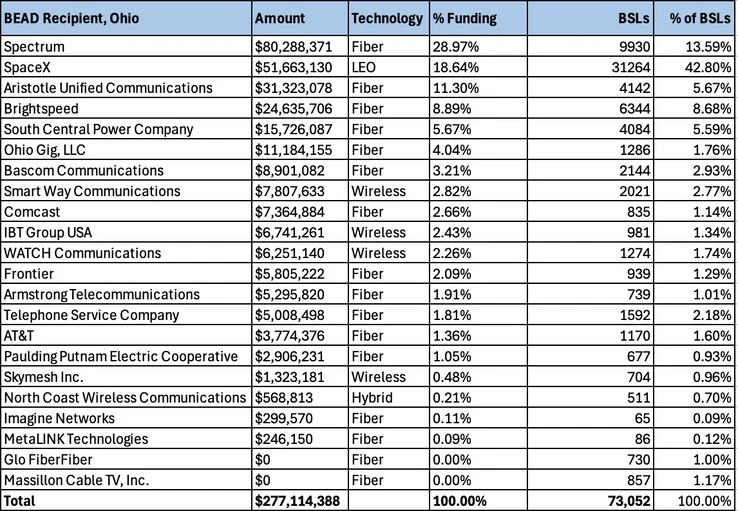
    3. Ohio’s proposal includes significant funding for Starlink, with $53 million allocated to cover 43% of eligible locations, while fiber provider Spectrum will receive over $80 million for just 14%.
    4. The new BEAD rules favor satellite Internet providers for quick rollouts, allowing Starlink to meet basic requirements with minimal costs, while fiber providers face higher standards.
    5. States are prioritizing speed and cost-effectiveness over quality, with Starlink’s current offerings being more accessible compared to fiber’s higher capabilities.


    Starlink has secured another state auction to deliver broadband Internet to so-called “underserved areas,” which primarily include rural locations in sparsely populated states where installing expensive fiber would not be economically practical without federal subsidies.

    Broadband Equity Access and Deployment Program

    The Broadband Equity Access and Deployment (BEAD) initiative has allocated more than $42 billion to all US states and territories, aiming to ensure that all Americans, even those in remote areas, have access to broadband Internet.

    During Elon Musk’s short period at the White House, BEAD adjusted its definitions of broadband Internet to include satellite Internet providers like Starlink. This controversial adjustment was met with disbelief from traditional fiber optics Internet providers, as it places their expensive efforts at a disadvantage when competing for funding.

    Funding Allocations in Ohio

    For example, Ohio received $793 million under the BEAD program, but will only utilize $227 million in its final proposal, paying Starlink $53 million to cover 43% of the Broadband Serviceable Locations (BSL) eligible for government funding.

    In contrast, Ohio plans to pay Spectrum the largest portion of the allocated funds, which is over $80 million, to cover just 14% of the BSL list with fiber. According to the new BEAD rules, satellite Internet providers like Starlink could consistently come out on top, as demonstrated in Montana, where Starlink received $119 million in federal subsidies for 28% of the local BSL, while Amazon’s Project Kuiper only got $26 million for 37% of BSLs.

    Prioritizing Speed Over Quality

    States are understandably favoring quick and easy rollouts over the quality of Internet services provided to rural and underserved areas. Under these conditions, satellite Internet providers will always have the edge over fiber, as the requirements for Starlink in Ohio are simply to provide a free dish and a download speed of 100 Mbps, rather than reducing the monthly service fee. This is the most cost-effective way for Starlink to expand, as they frequently lower the price of their Standard Kit to sell it at cost and use it as a promotional gateway to later charge substantial monthly fees.

    In comparison, fiber can offer speeds of up to 1 Gbps, a capability that Starlink will not achieve until next year when it launches its V3 satellites using the Starship 3 rocket. This will only be possible for those who purchase the expensive Performance dish, which may be beyond the reach of the federal BEAD program.

    Source:
    Link


  • First Starlink Tweets from Space Now on Google Pixel 10 & Samsung Z Flip 7

    First Starlink Tweets from Space Now on Google Pixel 10 & Samsung Z Flip 7

    Key Takeaways

    1. SpaceX successfully tweeted from space using its Starlink direct-to-cell satellite network with a Samsung Galaxy S21 phone in February 2024.
    2. KDDI launched the Starlink-optimized X app in Japan, making it the first carrier to offer satellite communication for third-party apps when cellular networks are unavailable.
    3. T-Mobile’s Pixel 10 is the first US smartphone to enable Starlink data communication, but initially, access is limited to Google applications only.
    4. KDDI offers a wide range of satellite-ready apps, including social media, navigation, and weather, with plans to expand support to more devices soon.
    5. T-Mobile’s Starlink data service will launch in October, allowing broader device compatibility and access to more chat and social media applications.


    SpaceX has made headlines by tweeting from space for the first time, utilizing Starlink’s direct-to-cell (DTC) satellite network in a test conducted with a standard Samsung Galaxy S21 phone from Verizon back in February 2024.

    New App Launches with Pixel 10

    In a move that seems perfectly timed with the arrival of the Google Pixel 10, KDDI in Japan has now launched the commercial version of the Starlink-optimized X app. The 2025 models of Pixel and the Samsung Galaxy Z series will be the initial devices compatible with this service.

    Given that Starlink’s DTC satellites are consistently visible over Japan, KDDI was able to secure the privilege of being the first carrier to introduce a third-party app tailored for satellite communication when cellular networks are unavailable.

    T-Mobile’s Surprising First

    Surprisingly, the Pixel 10 for T-Mobile has emerged as the first smartphone in the US to enable Starlink data communication; however, its initial access is restricted to Google applications, which include Maps and Messages.

    On the other hand, KDDI’s Starlink service offers a range of third-party applications such as X for social media and messaging, Google Maps for navigation, Weathernews for essential weather updates, the NERV Disaster Prevention app for emergency alerts, and YAMAP for hiking trail maps.

    A Suite of Satellite-Ready Apps

    This collection of satellite Internet-ready applications is the most comprehensive available anywhere, and KDDI assures that support for the Google Pixel 10 and Samsung Galaxy Z Fold 7 or Flip 7 will soon be expanded to additional devices.

    Currently, T-Mobile’s T-Satellite service, developed in collaboration with Starlink, provides capabilities for text and picture messaging, along with limited data access on three Google apps specifically for the Pixel 10 series. When T-Mobile’s Starlink data service is widely launched in October, it will encompass a broader range of devices, including Samsung, Motorola, and Apple iPhone 13 and newer models, along with an expanded selection of chat and social media applications.

    As things stand, KDDI is enjoying the advantage of being the first carrier to commercially launch X posts and direct messaging from space in areas lacking cellular coverage. They are also providing vital maps, navigation, and weather or emergency notifications that could prove essential for those exploring the great outdoors.

    Source:
    Link


  • T-Mobile Reveals Starlink-Compatible Phones and Apps Before Pixel 10

    T-Mobile Reveals Starlink-Compatible Phones and Apps Before Pixel 10

    Key Takeaways

    1. The new Google Pixel 10 series will be the first phones to use Starlink satellite Internet data, available from August 28.
    2. The Pixel 9a supports only satellite messaging, without the capability to send pictures or use app data through Starlink.
    3. T-Mobile has a list of compatible phones and apps for Starlink data, including certain Google Pixel models, Apple’s iPhone 13-16 series, and select older Samsung models.
    4. Users of the Galaxy S21 series and Galaxy Z Fold/Flip models will not have access to Starlink data, despite their high price points.
    5. New apps optimized for the limited bandwidth of T-Satellite data include Google Maps, Google Messages, and Find Hub.


    Google and T-Mobile surprised everyone with the announcement of a new phone that can use Starlink’s data capabilities during the launch event for the Pixel 10 series.

    Exciting New Features

    According to Big Magenta, the latest Google Pixel phones will be the first to tap into Starlink satellite Internet data after the Pixel 10 series is released on August 28. However, the previously launched Pixel 9a, which is currently on sale at Amazon, only allows for satellite messaging and lacks the ability to send pictures or use app data through Starlink’s connection.

    The Latest Updates

    T-Mobile has revealed a list of phones and applications that are ready for Starlink data, just ahead of the general release of the T-Satellite data service in October. Other Google Pixel models from the 9 series and later are either already supporting Starlink data or will receive support soon.

    In addition, Apple’s iPhone 13, 14, 15, and 16 series will also be compatible with Starlink’s satellite Internet service on T-Mobile. Some older Samsung models are included too, but not all. For example, the Samsung Galaxy A14 won’t have access to Starlink data, which makes sense considering its lower price point.

    Disappointing News for Some Users

    It may frustrate users of the Galaxy S21 series that they will not be able to use Starlink’s data service on T-Mobile. Those who invested in the Galaxy Z Fold 3 and Flip 3, and their successors, Z Fold 5 and Z Flip 5, are also left out, even though these foldable phones are priced quite high.

    This situation is particularly surprising because some of T-Mobile’s budget-friendly options, like the Revvl 7, 7 Pro, and Revvl 8, are marked as “coming soon” for Starlink data support. To top it off, no Motorola phone scheduled for release in 2024 will offer Starlink data support, adding to the growing list of 14 incompatible devices.

    T-Mobile advocated for the inclusion of older phones for Starlink satellite Internet service compatibility and successfully secured exemptions for many. However, the new Starlink data connectivity won’t be available for all of the older models.

    New Apps for Limited Bandwidth

    The first apps designed to work with the limited bandwidth of the T-Satellite data option are now confirmed. Not surprisingly, all of these apps are from Google, including essential tools like Google Maps, Google Messages, and the Find Hub service for tracking down lost devices linked to your Google account.

    Source:
    Link


  • Pixel 10 Users Get Early Access to T-Mobile’s Starlink App Support

    Pixel 10 Users Get Early Access to T-Mobile’s Starlink App Support

    Key Takeaways

    1. Early Access to Satellite Data: Pixel 10 users can experience app support through T-Mobile’s Cellular Starlink service before its official launch on October 1.

    2. Limited App Availability: Initially, only three Google apps—Maps, Messages, and Find Hub—will be available for satellite connectivity.

    3. Manage Expectations: Connection speeds are limited (around 4 Mbps), making it unsuitable for streaming but functional for basic apps.

    4. Priority for Pixel 10 Users: Pixel 10 users get priority access as the service is fine-tuned, with plans to include more apps in the future.

    5. Preorder and Pricing Details: The Pixel 10 series is available for preorder starting at $799.99, with options for trade-in credits and various plans for T-Satellite service.


    If you decide to get a Pixel 10, you’ll be one of the first to experience app support through T-Mobile’s Cellular Starlink service. The new flagship device is set to launch on August 28, and T-Mobile is providing early access to satellite-powered data features for Pixel 10 users ahead of the official launch on October 1. This means that if your Pixel 10 is linked to T-Mobile’s T-Satellite plan, you can utilize selected apps via Starlink’s satellites before anyone else does. As stated in a blog post on T-Mobile’s website, the company believes this capability is “far too important to hold back.”

    Limited App Availability at Launch

    At the start, the service will be restrictd to three Google applications. Maps, Messages, and Find Hub have been enhanced to work with satellite connectivity. This could prove to be especially handy if you find yourself without service in remote locations. Google Maps can guide you without cell towers, while Find Hub can assist in locating a lost device even when it’s off the grid. Messages already supports SMS and RCS through T-Satellite, but early access will also allow features like group chats and integration with Google’s Gemini chatbot.

    Manage Your Expectations

    T-Mobile officials warn users to keep their expectations in check. Gavin Gee, the carrier’s senior director of product marketing, mentions that the connection is significantly more limited than a 5G network. Early tests indicate download speeds of roughly 4 Mbps, which means that while basic maps and text-based apps are usable, streaming video is out of the question. He states that the intention was to ensure that the system worked reliably for the crucial apps in areas where people often lose service. “Customers shouldn’t expect to stream a 4K movie. That’s simply not going to happen. However, there are still valuable use cases like being able to access Maps.”

    Priority Access for Pixel 10 Users

    T-Mobile mentions that Pixel 10 users receive priority access because the service still requires fine-tuning across various devices and operating systems. Updates to Android and Pixel software have enabled the certification of these phones first. iPhones running iOS 26 are also anticipated to join the early access program in September. By October, the company aims to broaden its offerings beyond Google’s core apps to also include AccuWeather, WhatsApp, and X.

    For those thinking about getting the new phone, T-Mobile is already accepting preorders for the Pixel 10, 10 Pro, and 10 Pro XL, with the Pixel 10 Pro Fold scheduled to arrive on October 9. Prices start at $799.99, and the carrier is providing trade-in credits and discounts on its premium plans. The T-Satellite service is free on Go5G Next and Experience Beyond plans, or can be added to other T-Mobile plans for $10 per month. Customers on AT&T and Verizon can also enroll by paying the same monthly fee, but activation requires either a call or a visit to a store, as the service operates on a secondary eSIM.

    Source:
    Link