Tag: Starlink

  • SpaceX Takes on Virginia’s $613M Broadband Plan with $60M Starlink

    SpaceX Takes on Virginia’s $613M Broadband Plan with $60M Starlink

    Key Takeaways

    1. SpaceX is unhappy with Virginia’s decision to spend over $613 million on a high-speed internet project, believing it can be done for much less using Starlink.
    2. The state plans to use funds from the BEAD program to connect homes without internet access, but SpaceX feels overlooked in this process.
    3. SpaceX criticizes the BEAD program for favoring costly fiber-optic solutions over more affordable and faster options like Starlink.
    4. SpaceX was chosen to provide Starlink service to only 5,579 of the 133,000 eligible households, receiving $3.2 million for this, while fiber connections will cost significantly more per household.
    5. SpaceX can deploy Starlink services immediately, unlike the four-year timeline proposed for fiber installation in Virginia.


    SpaceX is expressing dissatisfaction with Virginia’s decision to allocate over $613 million for a high-speed internet project, which the company believes could be achieved at a much lower cost. Instead of the costly fiber-optic solution, SpaceX has proposed to implement its Starlink systems.

    Funding for High-Speed Internet

    The state aims to utilize funds from the Broadband, Equity, Access, and Deployment (BEAD) program to connect those without internet access. In response, SpaceX has sent a letter to regulators, voicing concerns about being overlooked in a process that they see as an unnecessary expenditure of public funds.

    Concerns Over Cost and Efficiency

    SpaceX criticized the BEAD program in Virginia for favoring “expensive, slow-to-build fiber” rather than opting for “affordable, fast, and technology-neutral competition.” The company argues that it would only require $60 million to connect all eligible households in Virginia under the BEAD initiative.

    Limited Participation in the Program

    Notably, SpaceX was selected to provide Starlink to just 5,579 of the 133,000 households eligible under the BEAD plan in Virginia. It received $3.2 million, equating to approximately $584 per household. In contrast, the remaining households that will receive fiber connections will incur costs ranging from $6,000 to $8,000 each. A small total of $7.7 million was allocated to satellite internet providers, including SpaceX and Amazon.

    SpaceX also emphasized its capability to deploy Starlink services immediately, unlike the four-year timeframe suggested in Virginia’s broadband proposal. The company is urging the National Telecommunications and Information Administration (NTIA), part of the U.S. Department of Commerce, to revise Virginia’s broadband strategy.

    Source:
    Link


  • Starlink Introduces $5/month Standby Mode with Unlimited Low-Speed Data

    Starlink Introduces $5/month Standby Mode with Unlimited Low-Speed Data

    Key Takeaways

    1. Starlink is replacing its free pause service with a paid Standby Mode at $5/month, requiring users to enroll in this new option to avoid service termination.
    2. All users on Roam, Residential, or Priority plans must switch to Standby Mode for pausing their service, while Enterprise and promotional users are excluded.
    3. Roam plan users face increased costs, as the elimination of free pause and low-cost options means they now pay an annual fee of $60 for service with a Mini dish.
    4. Residential users using Standby Mode may not return to their original service if their area is full, forcing them to potentially switch plans or wait for availability.
    5. Standby Mode offers unlimited low-speed data, but users report speeds as low as 1 Mbps for downloads, with less favorable terms compared to similar services in Europe.


    Starlink is compelling its users to “upgrade” from the previously offered free pause service, which allowed them to halt monthly payments when the service wasn’t necessary. Now, they must switch to a paid pause with the Standby Mode, which costs $5 a month.

    New Notifications Rolling Out

    Users in the United States are receiving new notifications about the Standby Mode. These notifications inform subscribers that they must enroll in the new option within the current billing cycle. If they choose not to, their service will be terminated, leaving no room for continuing the free pause option.

    All users on the Roam, Residential, or Priority plans need to use Standby Mode for pausing their service from the next billing cycle. However, Enterprise accounts and users on Business plans cannot switch to the $5/month Standby if they cannot pause their service, nor can users on promotional deals.

    Impact on Roam Plan Users

    This update is particularly tough on those with the Starlink Roam plan. Individuals who bought a Mini dish for travel spent hundreds of dollars, even with current promotions on Amazon. Many were drawn in by the promise of a free pause service and a $10/month plan for 10GB of data. Now, both of those options are eliminated, meaning Roam plan users with a Mini dish collecting dust will face an annual fee of $60 to use the service.

    To offset the change from a free pause to a paid mode, Starlink claims that the new Standby Mode offers unlimited low-speed data. Previously, there was no connectivity available during the pause.

    Concerns for Residential Users

    Additionally, users on the Residential plan who want to utilize the new Standby Mode are not guaranteed to return to their original service line once they reactivate. If their area is full, they’ll have to either switch to a Roam or Priority plan or pay a deposit and wait for a Residential service spot to open up.

    Starlink states that the Standby Mode will provide unlimited satellite Internet connectivity. However, descriptions suggest that this low-speed data connection will be rather slow. The connectivity will be primarily for emergency messages or “ongoing software updates,” which indicates that the service will be heavily throttled and not suitable for other significant uses.

    Speed Limitations and International Comparisons

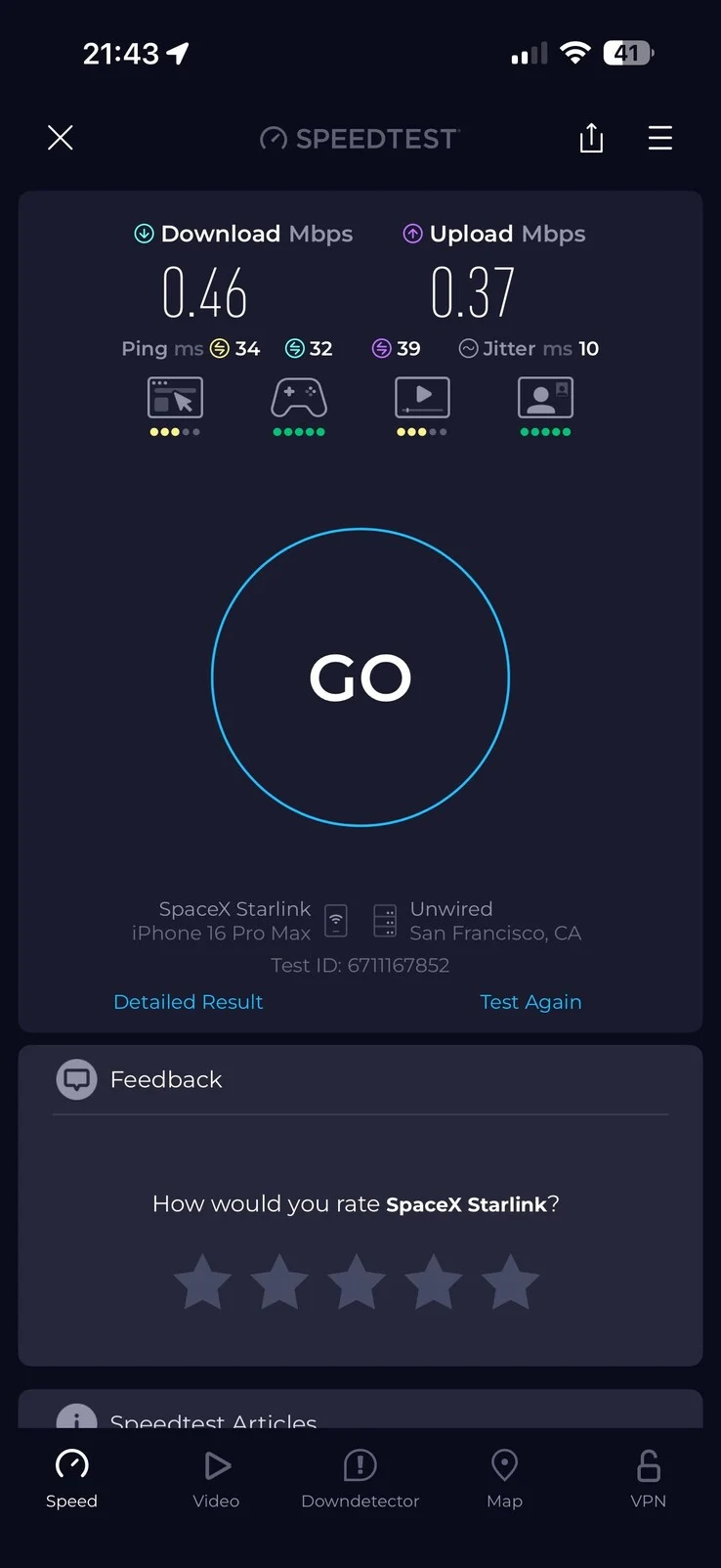
    While Starlink hasn’t disclosed the specific speed throttling for Standby Mode, users who switched to the new option report download speeds of around 1 Mbps and uplink speeds of 0.5 Mbps. Frequently, both download and upload speeds are even lower, as shown in various tests.

    Furthermore, the terms and conditions for Standby Mode in the U.S. appear less favorable compared to those in Europe and other regions. For example, in Europe, Standby Mode is priced at €5/month but includes 5GB of high-speed data before being throttled to speeds suitable for messaging and software updates. In summary, the free pausing option for Starlink service has been completely removed, and the affordable Roam plan that prompted many to purchase a Mini dish is now unavailable.

    Source:
    Link


  • Starlink Cuts Prices on Residential Plans and Dish for US Customers

    Starlink Cuts Prices on Residential Plans and Dish for US Customers

    Key Takeaways

    1. Starlink has reduced its monthly service fees to $69 for the Residential plan and $65 for the Lite plan, with download speeds of 45 to 130 Mbps.

    2. The new pricing targets new subscribers in certain U.S. states, while areas like Washington face congestion fees due to high customer volume.

    3. The Residential plan’s price dropped from $120 to $99, and the Lite plan decreased from $80 to $65, with some regions seeing the Residential plan at $69.

    4. The price reduction applies only to new subscribers for one year, reverting to original rates if service is switched or canceled.

    5. The Standard dish price has been cut by 50%, now available for $175, while the Starlink Mini dish is on sale for $499, creating a significant price gap.


    Starlink has slashed its monthly service fees, bringing the cost down to $69 for the Residential plan and $65 for the Lite subscription, which offers typical download speeds ranging from 45 to 130 Mbps.

    New Subscribers and Geographic Availability

    These new prices are aimed at fresh Starlink users, particularly in U.S. states where the Residential Lite plan is also offered. This includes areas from Texas to North Dakota and from Maine to Oregon, mostly concentrated in the western regions. However, in states like Washington, Starlink has so many customers that it has introduced congestion fees, reaching up to $1,000 for just one service line.

    Discounts and Pricing Details

    Starlink promotes a temporary price reduction from its standard $120/month service for the Residential plan down to $99/month, while the Lite plan has been cut from $80 to $65/month. In some regions, the Residential plan was already being offered at a discounted rate of $90 before this latest change.

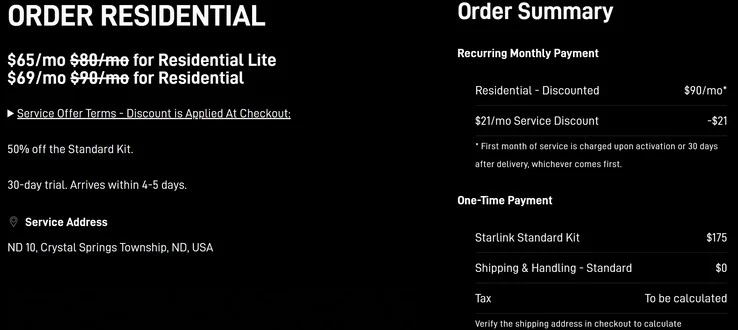
    For example, in North Dakota, the monthly fee for Starlink drops to $69, which is quite unusual. In most other areas where discounts apply, the new fee for the Residential plan will be $99/month instead.

    Terms of the Monthly Price Reduction

    The current monthly price reduction is available only for new subscribers and applies to a single satellite Internet line for one year. If customers switch to a different plan or lose their service due to cancellation or suspension, the pricing will revert back to the original monthly fee for that area after one year.

    In addition to the monthly fee reduction, Starlink is also cutting the price of the Standard dish by an impressive 50%, which comes after an already reduced price. While the Starlink Mini dish is currently on sale at Amazon for $499, the Standard Kit is now available for just $175 across the country, creating the biggest gap between the official prices of the Mini and Standard dish ever seen.

    Starlink indicates that this discount on the Standard Kit will be available for a limited time, but has not clarified how long the promotion will last. It’s possible that this offer will remain until Starlink decides it has gathered enough new subscribers to utilize its additional 5 Tbps capacity added weekly through the launch of new satellites.

    Source:
    Link


  • Starlink Wins Federal Broadband Funds; Virginia Invests in Fiber

    Starlink Wins Federal Broadband Funds; Virginia Invests in Fiber

    Key Takeaways

    1. Virginia allocated $613 million from the BEAD program, primarily for fiber internet, with Starlink receiving nearly $3.3 million for 5,579 underserved locations.
    2. The updated BEAD regulations allow satellite internet providers to compete equally with fiber providers, promoting “technology neutrality.”
    3. 81% of Virginia’s funding will focus on fiber internet development, with significant investments like All Points Broadband receiving over $171 million.
    4. Concerns remain about the long-term viability of satellite internet due to capacity limits and performance issues, while fiber is favored for consistent speeds.
    5. The cost of service poses a challenge for low-income households, as providers are only required to offer one low-cost plan without state pricing control.


    Virginia has declared that it will allocate $613 million from the Broadband Equity, Access, and Deployment (BEAD) program in the United States. Starlink has obtained a part of this funding, but most of the investment is aimed at fiber internet initiatives.

    Changes in BEAD Rules

    Earlier this year, the Trump administration updated BEAD regulations to promote “technology neutrality.” This means that satellite internet providers such as SpaceX’s Starlink and Amazon’s Project Kuiper can compete equally with fiber internet providers. The original “fiber first” rule was changed to allow satellite technology to be seen as a cost-effective and relatively fast way to connect rural and underserved communities. This update has allowed companies like Starlink to participate in a broader range of projects across the country.

    Funding Distribution in Virginia

    In Virginia, this new strategy has led to Starlink getting nearly $3.3 million to connect 5,579 underserved locations, which breaks down to about $584 per site. On the other hand, Amazon’s Project Kuiper has received $4.4 million for around 7,000 locations, costing about $641 each. Combined, these satellite projects represent a small portion of the overall funding, with only $7.7 million, or roughly 1.3 percent of Virginia’s BEAD allocation, going toward satellite internet.

    Focus on Fiber Internet

    The remaining 81 percent of the funds will be focused on fiber internet development, with All Points Broadband receiving over $171 million to connect almost 20,000 locations at an average cost of $8,655 per site. In certain areas, these fiber connections are anticipated to provide speeds of up to 10 gigabits per second. Virginia officials have stated that the focus on fiber is based on performance rather than just temporary cost savings.

    Drew Garner, who is a director at the Benton Institute for Broadband and Society, mentioned that the bidding process in Virginia emphasized speed, latency, and the ability to scale, as well as environmental considerations like tree coverage that can affect satellite service reliability. Starlink’s service requires an unobstructed view of the sky, which can be difficult in wooded areas, leading to potential service interruptions. To address this, SpaceX has recently highlighted its beam-switching technology, claiming it can help reduce issues caused by obstructions.

    Concerns About Satellite Internet

    Starlink’s inclusion in the funding awards is seen as a positive step for satellite providers but some broadband policy experts are still doubtful about its long-term viability in public-funded projects. Fiber’s ability to offer consistent gigabit speeds is a big reason why it is favored for lasting infrastructure. In contrast, satellite networks come with capacity limits and may suffer performance drops when too many users connect to the same satellite beam. For instance, in certain parts of the Pacific Northwest, Starlink has introduced a $1,000 demand surcharge to limit new sign-ups in already crowded areas. The updated BEAD program includes performance standards for satellite providers, requiring SpaceX to ensure download speeds of at least 100 megabits per second and upload speeds of 20 megabits per second for the households covered by the program.

    Eligible households in Virginia will receive a Starlink dish at no charge during the ten-year service period. However, states can’t dictate pricing for internet plans meant for low-income users anymore. Providers are only obliged to offer one low-cost plan, which can be one of their existing options. This has raised fears about affordability, especially considering that Starlink’s standard service is currently priced at $120 per month. Garner pointed out that for many communities, the biggest obstacle to internet access isn’t the infrastructure but rather the ongoing cost of service.

    Evan Feinman, the former director of the BEAD program who resigned in protest against the rule changes, commended the state’s approach within the confines of the new regulations but criticized the mandatory inclusion of satellite connections. He stated that moving some households from fiber to satellite could lead to higher monthly bills and slower speeds. On the other hand, supporters of the changes, like Joe Kane from the Information Technology and Innovation Foundation, see Virginia’s funding decisions as a success, highlighting that the average cost per location is much lower compared to earlier BEAD proposals.

    Governor Glenn Youngkin expressed satisfaction with the results, noting that the revised rules allowed the state to save $200 million, which is a 25 percent decrease in taxpayer spending on broadband initiatives. It remains to be seen how other states will shape their BEAD funding under the new guidelines.

    The Commerce Department has set a deadline of September 4 for states to submit their final proposals, although extensions can be requested. Meanwhile, SpaceX and Amazon are competing for bids in other states, with Texas witnessing particularly fierce competition as Starlink aims to reach over 244,000 locations and Project Kuiper plans to target more than 160,000 locations.

    Source:
    Link



  • T-Mobile Starlink Supports IoT: SpaceX Satellites Monitor Beehives

    T-Mobile Starlink Supports IoT: SpaceX Satellites Monitor Beehives

    Key Takeaways

    1. One NZ and T-Mobile are the first cellular companies to implement Starlink’s direct-to-cell satellite connectivity service.
    2. One NZ began offering Starlink connections in November, while T-Mobile launched theirs in July.
    3. Starlink plans to roll out IoT connectivity, with One NZ already providing this service to beekeepers in New Zealand.
    4. The cost of monitoring beehives has decreased, allowing beekeepers to track conditions remotely without overspending.
    5. T-Mobile’s T-Satellite plan now includes multimedia messaging, but it’s currently only compatible with Samsung devices.


    While various cellular network companies around the world have shown interest in Starlink’s direct-to-cell satellite connectivity service, it was One NZ from New Zealand and T-Mobile in the United States who were the first to implement it.

    One NZ has been offering a Starlink connection option since November, whereas T-Mobile only introduced it in July, making One NZ lead in the extra services their satellite link provides.

    Exciting Developments in IoT

    Starlink has announced plans to roll out IoT connectivity this year, and indeed, One NZ is now providing this service to its satellite users. Beekeepers in New Zealand are already taking advantage of the initial Starlink IoT connection option.

    By using equipment that combines common components, they can track factors like temperature and humidity in their beehives, located in isolated regions of New Zealand that are great for honey production but lack cellular service.

    Cost-Effective Solutions for Beekeepers

    Before the introduction of Starlink’s direct-to-cell constellation, this type of monitoring was too costly for many beekeepers, according to the company that supplies the beehive monitoring tools linking the hives to the One NZ Satellite service. This is no longer the case, allowing them to keep an eye on their beehives remotely, getting valuable insights for honey production or deciding when to relocate the hives to better locations without overspending.

    T-Mobile has also stated that it will provide IoT connectivity through the T-Satellite service, likely aligning with the data download service set to launch in October.

    New Features from T-Mobile

    In the meantime, T-Mobile has enhanced the T-Satellite plan by adding multimedia messaging capabilities, enabling users to send photos, GIFs, and short video or audio clips from areas lacking cell tower coverage. However, the Multimedia Messaging Service of T-Satellite is currently compatible only with Samsung devices, like the Galaxy S25 Ultra, which is now available for $300 off on Amazon.

    Source:
    Link

  • Starlink India Launch: Affordable Service for 2 Million Users

    Starlink India Launch: Affordable Service for 2 Million Users

    Key Takeaways

    1. Starlink’s monthly subscription fee in India will be about $35, significantly higher than the expected $10.
    2. High setup and equipment costs limit Starlink’s ability to compete with local telecom providers like BSNL.
    3. Starlink aims to serve only 2 million customers in India, which may not threaten existing telecom services.
    4. Future expansions will include launching V3 satellites, expected to provide faster speeds and greater capacity by next summer.
    5. The current Starlink Standard Kit will not support the higher speeds of the V3 network, leading to the release of a new high-priced Performance dish for business customers.


    When Starlink begins its service in India, the monthly subscription fee will not be the expected $10 that experts thought might disrupt local telecom companies and lead to a swift growth in satellite Internet users.

    High Costs Ahead

    According to the Indian communications ministry, the launch of Starlink in India, along with all necessary ground stations and antenna equipment, will be very costly. The initial setup and equipment expenses are so significant that Starlink will only be able to provide its services at a price of about $35 a month after it starts operations.

    Market Competition

    This price is much higher than the hoped-for $10 per month, which would have allowed it to compete with government rural service providers like BSNL. The Minister has stated that “Starlink can only have 20 lakh customers in India and offer speeds of up to 200 Mbps,” suggesting that the pricing and speed of Starlink’s offerings will not pose a threat to the existing telecom services.

    These figures are important for the global Starlink users to know, as adding an additional two million customers could challenge Starlink’s network capabilities at increased speeds, even though SpaceX is currently enhancing its capacity by 5 Tbps every week.

    Future Expansion Plans

    Starting next year, the Starlink satellite Internet network will be able to accommodate more subscribers and deliver faster speeds, ensuring that current users’ experiences remain unaffected. SpaceX plans to start launching its V3 satellites by next summer using the Starship 3 rocket, which is in the testing phase.

    These new satellites are bigger and will provide ten times the capacity of the existing V2 models, while the supported downlink speeds will increase by 24 times. However, the current Starlink Standard Kit will not support the gigabit speeds that the V3 satellite network is expected to provide. Thus, Starlink has recently released a high-priced Performance dish, costing $1,999, which is primarily aimed at business customers.

    Source:
    Link

  • Starlink Download Speeds Surge After Recent Satellite Network Glitch

    Starlink Download Speeds Surge After Recent Satellite Network Glitch

    Key Takeaways

    1. The longest Starlink outage occurred on July 25, affecting many users for at least 2.5 hours.
    2. The outage was caused by issues with key internal software services that manage the core network.
    3. Starlink operates over 100 gateways in the U.S. to enhance Internet service in remote areas.
    4. SpaceX is upgrading ground stations for upcoming V3 satellites, which will significantly increase data capacity.
    5. Despite the outage, some users experienced improved download speeds afterward, suggesting a positive network enhancement.


    Starlink Internet interruptions are quite rare, as the network has mostly remained stable since SpaceX began launching its initial Starlink satellites into orbit.

    A Surprising Outage

    Therefore, the longest Starlink outage since its launch took many by surprise on Friday, July 25. Many of its six million users across the US and worldwide experienced a lack of satellite Internet for at least 2.5 hours, with some being affected for even longer.

    For the first time, Starlink issued a global outage alert on its website and managed to fix the problem relatively quickly for most users on the same day. SpaceX expressed its regret and explained that the issue was due to “key internal software services that operate the core network,” possibly pointing to the largest ground network supporting a satellite constellation ever created.

    Technical Infrastructure

    In the United States, Starlink runs over 100 gateways, each equipped with 150 antennas, to help eliminate dead zones and enhance ping for users in remote areas and rural settings. These antennas are produced in Redmond, WA, and are designed to channel the satellite Internet signal through the country’s extensive fiber optic infrastructure, thus enhancing coverage, reducing latency, and stabilizing connections.

    SpaceX is currently upgrading its ground stations in anticipation of launching its V3 satellites, which promise to deliver 10 times the data throughput of the current models, reaching up to 1 Tbps. For context, the Starlink Mini dish has a maximum speed of 100 Mbps, while only the Performance dish can utilize gigabit speeds. With each launch of V3 satellites in 2026, SpaceX plans to add 60 Tbps of network capacity, necessitating a new generation of terrestrial gateways to support this growth.

    Stability Concerns

    Regrettably, the ground-based network of Starlink can sometimes create instability, as was evident during the recent lengthy outage. A memo from SpaceX shared with suppliers revealed that a software update sent to the Starlink gateways overloaded their hardware, causing the network to stop processing data packets while the core update was being implemented.

    Although SpaceX provided the usual explanations and reassurances that they had learned from this incident, users of Starlink began to observe a surprisingly positive change over the weekend. After the outage, some users reported that their download speeds increased by three times or more, suggesting that the unfortunate update to the gateways was not merely a bug fix, but rather a significant network enhancement.

    Source:
    Link

  • Starlink Offers 20% Discount on Monthly Bills for Some Users

    Starlink Offers 20% Discount on Monthly Bills for Some Users

    Key Takeaways

    1. Starlink is offering a 20% discount on monthly fees for select Residential and Residential Lite subscribers without needing a promo code or enrollment.
    2. Eligible customers will receive notifications via email, stating the discount will automatically apply for the next six billing cycles.
    3. The discount applies to users in various regions, including the US, Australia, and Indonesia, but does not extend to Starlink Roam users.
    4. A Residential Lite customer reported a reduction in their monthly fee from $80 to $64, saving a total of $96 over six billing cycles.
    5. The discount strategy may help manage network capacity by incentivizing existing subscribers while discouraging new users in congested areas with high surcharges.


    Starlink has unexpectedly announced a 20% discount on monthly fees for certain Residential and Residential Lite subscribers. There’s no need for a promotional code or enrollment in a program. Instead, those eligible are receiving notifications directly through email.

    Low on Details

    In true Starlink style, the specifics are vague, and the situation is quite unpredictable. If you happen to be a Residential customer, take a look at your email—you may be among the fortunate recipients.

    The email states, “As a valued Starlink customer, you’re getting 20% off your monthly plan for the next six billing cycles.” It continues, “No action needed. Just keep enjoying your service and the discount will apply automatically.”

    Customer Reactions

    A Reddit user, KingofMemes2001, was one of the first to notice this offer. They’ve been using Starlink in Utah County for two years and are on the Residential Lite plan, which is priced at $80 a month. Thanks to the 20% discount, their monthly fee will drop to $64. This translates to a total savings of $96 over the next six billing cycles. For those who aren’t aware, Starlink Lite is a more affordable alternative to the standard Residential plan, providing unlimited deprioritized data.

    As reported by PCMag, this offer does not seem limited to the US, as some users in Australia and Indonesia have also mentioned receiving the email from Starlink. However, there have been no indications that users on Starlink Roam are getting this discount.

    Network Management Strategy

    This may seem puzzling to individuals who have recently encountered high fees in busy states just to start using the service. Last month, it was noted that in states like Washington, Oregon, and Idaho, new Residential subscribers are being asked to pay a $1,000 surcharge in addition to the equipment cost. Cities such as Seattle, Portland, and Redmond are among those impacted.

    This strategy is a part of how Starlink is handling its network capacity—discouraging new users in congested areas with high surcharges while providing discounts in locations where there is still capacity to expand.

    Source:
    Link

  • Starlink US Customers Surpass 2 Million Amid Rapid Growth

    Starlink US Customers Surpass 2 Million Amid Rapid Growth

    Key Takeaways

    1. Starlink has surpassed 2 million active customers in the US, gaining over 600,000 in the past year.
    2. The service offers a median download speed of nearly 200 Mbps during peak times for its US customers.
    3. SpaceX introduced a cheaper “Residential Lite” option at $80 per month to attract more subscribers.
    4. While US growth is strong, other regions like Canada and Kenya are experiencing slower or declining subscriber growth.
    5. SpaceX plans to roll out gigabit speeds with its upcoming V3 satellites, but the timeline may be affected by ongoing challenges with the Starship rocket program.


    SpaceX’s satellite internet service, Starlink, has reached a notable milestone, now providing service to over 2 million active customers in the US. This represents a significant increase in its American user base.

    In the past year, the company gained more than 600,000 customers in the United States, indicating that efforts to spur growth, which seemed to be slowing, have been successful. This rise from 1.4 million US customers last year suggests that new strategies to draw users have been effective.

    Performance Highlight

    In a recent announcement marking this achievement, SpaceX emphasized the service’s performance. They stated, “In the United States alone, the median download speed across more than 2 million active Starlink customers during times of peak demand is nearly 200 Mbps as of July 2025.” The company has not clarified what they define as an “active customer” or whether the count accounts for multiple users sharing a single account. On a global scale, Starlink’s customer base now exceeds 6 million.

    To increase its subscriber base in the US, SpaceX has implemented various promotional strategies. These include providing free Starlink dishes for customers willing to commit to a 12-month service plan.

    New Pricing Plans

    Moreover, the company has introduced a cheaper “Residential Lite” option in select regions, costing $80 per month, which is a significant reduction from the standard fee of $120 monthly. Tim Farrar, a satellite industry analyst, observed the likely impact of these promotions. He stated, “The US growth presumably reflects the low-priced Lite package and free terminals with a year’s commitment.” This growth trend continues despite public criticism faced by SpaceX CEO Elon Musk.

    While the numbers in the US are on the rise, Starlink’s growth may not be as swift in other regions. The company announced that its customer count in Canada has surpassed 500,000.

    Regional Challenges

    However, Farrar noted that this is just a gain of 100,000 customers over the last year. In other areas, subscriber growth has either slowed down or declined. For instance, in Kenya, Starlink experienced its first quarterly drop in subscribers between December 2024 and March 2025, and a similar decrease was noted in Rwanda, hinting at possible growth challenges in certain markets.

    SpaceX has bold ambitions to enhance its network, aiming to roll out gigabit speeds in the coming year. This upgrade relies on the company’s third-generation Starlink satellites, referred to as V3. SpaceX plans to start launching these advanced satellites in the first half of 2026.

    “Each one of these new satellites is designed to provide over a terabit per second of downlink capacity (> 1,000 Gbps) and over 200 Gbps of uplink capacity to customers on the ground,” the company shared.

    Future Prospects

    The V3 satellites could position Starlink as a direct competitor to traditional fiber optic internet services. In preparation, SpaceX has already launched a new performance dish priced at $1,999, engineered to support these anticipated gigabit speeds.

    The deployment of the larger and heavier V3 satellites relies entirely on SpaceX’s Starship rocket. This massive vehicle is designed to transport multiple next-generation satellites into orbit simultaneously.

    Nevertheless, the Starship program has encountered major obstacles. The rocket has yet to successfully complete a full space mission, as its recent test flights have ended with explosions.

    These repeated setbacks raise questions about the timeline for deploying the V3 satellites and the realization of a gigabit-speed Starlink network.

    Source:
    Link


  • Starlink to Launch Gigabit Internet Speeds: SpaceX Announcement

    Starlink to Launch Gigabit Internet Speeds: SpaceX Announcement

    Key Takeaways

    1. Starlink’s download speeds in the U.S. have reached 200 Mbps due to 5 Tbps capacity additions from SpaceX’s V2 satellite launches each week.
    2. Median latency has improved from 45 ms to 25.7 ms, with a goal of achieving 20 ms for better gaming experiences.
    3. The new V3 satellites will enhance capacity significantly, with each capable of 1 Gbps throughput, 24 times the uplink speed of the V2 generation.
    4. Starlink plans to launch V3 satellites between January and June of 2026, adding 60 Tbps of network capacity per launch.
    5. Starlink offers a $1,999 Performance dish kit designed for gigabit speeds, while the standard residential kit can achieve around 400 Mbps.


    Thanks to the continuous additions of 5 Tbps capacity from SpaceX’s V2 satellite launches each week, download speeds for the Starlink network in the United States have reached 200 Mbps, even during peak times.

    Network Performance Update

    Recently, SpaceX provided a performance update regarding the Starlink network for the past year. This update includes statistics on download speeds and latency improvements, as well as insights into current and future plans for capacity expansion.

    Improvements in Latency

    The engineers at Starlink have effectively reduced median latency from 45 ms in the first quarter to a noteworthy 25.7 milliseconds as of last month. They are on track to achieve the 20 ms goal, which is seen as suitable for gaming. Elon Musk has mentioned that the upcoming generation of satellites could potentially bring ping times down to as low as 5 ms.

    The V3 Satellites

    The new V3 satellites are designed to significantly enhance the Starlink network’s capacity, going well beyond the existing 450 Tbps. Each V3 satellite is capable of achieving 1 Gbps throughput, which would provide 24 times the uplink speeds of the current V2 generation at a download speed of 200 Mbps.

    These V3 satellites are large, each approximately the size of a Boeing 737 when its solar panels are deployed. They will require the next-gen Starship 3 rocket for deployment into a lower orbit than is currently the case. The combination of lower earth orbit, new computers and modems, along with advanced terrestrial stations dedicated to the V3 satellites, will lead to a significant decrease in network latency.

    Future Launch Plans

    Starlink has announced that it plans to launch the V3 satellites between January and June of 2026. Each launch is expected to add 60 Tbps of network capacity, which is more than twenty times the current capacity. This expansion will enable Starlink to fulfill its promise of a gigabit network that delivers download speeds exceeding 1 Gbps.

    Starlink is currently offering a $1,999 Performance dish kit that is designed to utilize these gigabit speeds. In comparison, the Starlink Mini dish, which is now available at a discounted price on Amazon, has a maximum speed of 100 Mbps. Meanwhile, the standard residential kit can achieve download speeds of around 400 Mbps, depending on availability.

    Source:
    Link