Tag: V3 satellites

  • Starlink Referral Campaign: Get Service for Just $89 a Month

    Starlink Referral Campaign: Get Service for Just $89 a Month

    Key Takeaways

    1. SpaceX has launched a Starlink referral program that offers both referrers and new subscribers a free month of service worth up to $120.
    2. The referral program is part of a broader initiative that includes the opening of specialized Starlink retail stores for a unique customer experience.
    3. The promotion is only available to Residential plan users and excludes those on the cheaper Residential Lite plan.
    4. New subscribers can access the referral program through the Starlink app or website, but both parties must be in the same country for eligibility.
    5. SpaceX is expanding its satellite constellation to enhance bandwidth and aims to attract more customers through this referral initiative.


    SpaceX has launched a Starlink referral program that rewards both the individuals who share the referral link and the new subscribers with a free month of service. This initiative aims to benefit friends and family who join the service.

    Retail Experience Enhancements

    The inaugural Starlink referral campaign is happening alongside the company’s first job postings for a specialized Starlink store. This store intends to create a unique retail experience for potential satellite Internet users, stepping away from major retailers like Walmart and Best Buy.

    As SpaceX gears up to deploy its new high-capacity V3 satellites, which are comparable in size to a Boeing 737 when fully deployed and can provide 10 times the bandwidth of the existing V2 models, the company is eager to boost Starlink adoption. This is crucial for utilizing the increased capacity that these new satellites will bring.

    Promo Details and Limitations

    The latest Starlink referral promotion will provide a month of free service, valued at up to $120, to both the existing customer who refers someone and the new subscriber. However, only those who are on the Residential plan can benefit from this offer, leaving out users who opt for the more affordable Residential Lite plan, which comes with limited data.

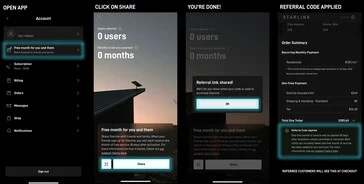
    New subscribers to the Roam plan, accessed via a Starlink Mini dish, can also enjoy the free month offer. Eligible users can find the referral option in the Starlink app under the Account tab, where they can click on the “Free month for you and them” section to create a shareable link for their friends or relatives. This can also be done on the Starlink website in the “Referrals” section.

    Signup Process and Conditions

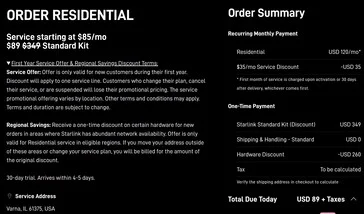
    Once a new user registers through the referral link, the referring Starlink customer will receive an email confirmation along with a free service credit within 30 days of the new account being activated, which can be used for the next billing cycle. In select underserved areas of the US, Starlink’s service can now be initiated for as little as $89 upfront, as detailed below.

    Unfortunately, the referral program requires that both the referrer and the new subscriber be in the same country, and kits purchased from third-party sellers do not qualify. Only kits bought directly from Starlink online or potentially from its new retail stores will be eligible.

    Recently, SpaceX has requested the FCC to increase its constellation launch permit from 12,000 to 44,000 satellites. This expansion is part of the company’s effort to develop a strong gigabit network. This plan includes 15,000 satellites that will connect directly to mobile phones, providing 5G data through dedicated Starlink chips. Hence, SpaceX is looking for as many Starlink referrals as possible to attract customers for its significant capacity growth.

    Source:
    Link


  • Starlink India Launch: Affordable Service for 2 Million Users

    Starlink India Launch: Affordable Service for 2 Million Users

    Key Takeaways

    1. Starlink’s monthly subscription fee in India will be about $35, significantly higher than the expected $10.
    2. High setup and equipment costs limit Starlink’s ability to compete with local telecom providers like BSNL.
    3. Starlink aims to serve only 2 million customers in India, which may not threaten existing telecom services.
    4. Future expansions will include launching V3 satellites, expected to provide faster speeds and greater capacity by next summer.
    5. The current Starlink Standard Kit will not support the higher speeds of the V3 network, leading to the release of a new high-priced Performance dish for business customers.


    When Starlink begins its service in India, the monthly subscription fee will not be the expected $10 that experts thought might disrupt local telecom companies and lead to a swift growth in satellite Internet users.

    High Costs Ahead

    According to the Indian communications ministry, the launch of Starlink in India, along with all necessary ground stations and antenna equipment, will be very costly. The initial setup and equipment expenses are so significant that Starlink will only be able to provide its services at a price of about $35 a month after it starts operations.

    Market Competition

    This price is much higher than the hoped-for $10 per month, which would have allowed it to compete with government rural service providers like BSNL. The Minister has stated that “Starlink can only have 20 lakh customers in India and offer speeds of up to 200 Mbps,” suggesting that the pricing and speed of Starlink’s offerings will not pose a threat to the existing telecom services.

    These figures are important for the global Starlink users to know, as adding an additional two million customers could challenge Starlink’s network capabilities at increased speeds, even though SpaceX is currently enhancing its capacity by 5 Tbps every week.

    Future Expansion Plans

    Starting next year, the Starlink satellite Internet network will be able to accommodate more subscribers and deliver faster speeds, ensuring that current users’ experiences remain unaffected. SpaceX plans to start launching its V3 satellites by next summer using the Starship 3 rocket, which is in the testing phase.

    These new satellites are bigger and will provide ten times the capacity of the existing V2 models, while the supported downlink speeds will increase by 24 times. However, the current Starlink Standard Kit will not support the gigabit speeds that the V3 satellite network is expected to provide. Thus, Starlink has recently released a high-priced Performance dish, costing $1,999, which is primarily aimed at business customers.

    Source:
    Link

  • Starlink Download Speeds Surge After Recent Satellite Network Glitch

    Starlink Download Speeds Surge After Recent Satellite Network Glitch

    Key Takeaways

    1. The longest Starlink outage occurred on July 25, affecting many users for at least 2.5 hours.
    2. The outage was caused by issues with key internal software services that manage the core network.
    3. Starlink operates over 100 gateways in the U.S. to enhance Internet service in remote areas.
    4. SpaceX is upgrading ground stations for upcoming V3 satellites, which will significantly increase data capacity.
    5. Despite the outage, some users experienced improved download speeds afterward, suggesting a positive network enhancement.


    Starlink Internet interruptions are quite rare, as the network has mostly remained stable since SpaceX began launching its initial Starlink satellites into orbit.

    A Surprising Outage

    Therefore, the longest Starlink outage since its launch took many by surprise on Friday, July 25. Many of its six million users across the US and worldwide experienced a lack of satellite Internet for at least 2.5 hours, with some being affected for even longer.

    For the first time, Starlink issued a global outage alert on its website and managed to fix the problem relatively quickly for most users on the same day. SpaceX expressed its regret and explained that the issue was due to “key internal software services that operate the core network,” possibly pointing to the largest ground network supporting a satellite constellation ever created.

    Technical Infrastructure

    In the United States, Starlink runs over 100 gateways, each equipped with 150 antennas, to help eliminate dead zones and enhance ping for users in remote areas and rural settings. These antennas are produced in Redmond, WA, and are designed to channel the satellite Internet signal through the country’s extensive fiber optic infrastructure, thus enhancing coverage, reducing latency, and stabilizing connections.

    SpaceX is currently upgrading its ground stations in anticipation of launching its V3 satellites, which promise to deliver 10 times the data throughput of the current models, reaching up to 1 Tbps. For context, the Starlink Mini dish has a maximum speed of 100 Mbps, while only the Performance dish can utilize gigabit speeds. With each launch of V3 satellites in 2026, SpaceX plans to add 60 Tbps of network capacity, necessitating a new generation of terrestrial gateways to support this growth.

    Stability Concerns

    Regrettably, the ground-based network of Starlink can sometimes create instability, as was evident during the recent lengthy outage. A memo from SpaceX shared with suppliers revealed that a software update sent to the Starlink gateways overloaded their hardware, causing the network to stop processing data packets while the core update was being implemented.

    Although SpaceX provided the usual explanations and reassurances that they had learned from this incident, users of Starlink began to observe a surprisingly positive change over the weekend. After the outage, some users reported that their download speeds increased by three times or more, suggesting that the unfortunate update to the gateways was not merely a bug fix, but rather a significant network enhancement.

    Source:
    Link

  • Starlink US Customers Surpass 2 Million Amid Rapid Growth

    Starlink US Customers Surpass 2 Million Amid Rapid Growth

    Key Takeaways

    1. Starlink has surpassed 2 million active customers in the US, gaining over 600,000 in the past year.
    2. The service offers a median download speed of nearly 200 Mbps during peak times for its US customers.
    3. SpaceX introduced a cheaper “Residential Lite” option at $80 per month to attract more subscribers.
    4. While US growth is strong, other regions like Canada and Kenya are experiencing slower or declining subscriber growth.
    5. SpaceX plans to roll out gigabit speeds with its upcoming V3 satellites, but the timeline may be affected by ongoing challenges with the Starship rocket program.


    SpaceX’s satellite internet service, Starlink, has reached a notable milestone, now providing service to over 2 million active customers in the US. This represents a significant increase in its American user base.

    In the past year, the company gained more than 600,000 customers in the United States, indicating that efforts to spur growth, which seemed to be slowing, have been successful. This rise from 1.4 million US customers last year suggests that new strategies to draw users have been effective.

    Performance Highlight

    In a recent announcement marking this achievement, SpaceX emphasized the service’s performance. They stated, “In the United States alone, the median download speed across more than 2 million active Starlink customers during times of peak demand is nearly 200 Mbps as of July 2025.” The company has not clarified what they define as an “active customer” or whether the count accounts for multiple users sharing a single account. On a global scale, Starlink’s customer base now exceeds 6 million.

    To increase its subscriber base in the US, SpaceX has implemented various promotional strategies. These include providing free Starlink dishes for customers willing to commit to a 12-month service plan.

    New Pricing Plans

    Moreover, the company has introduced a cheaper “Residential Lite” option in select regions, costing $80 per month, which is a significant reduction from the standard fee of $120 monthly. Tim Farrar, a satellite industry analyst, observed the likely impact of these promotions. He stated, “The US growth presumably reflects the low-priced Lite package and free terminals with a year’s commitment.” This growth trend continues despite public criticism faced by SpaceX CEO Elon Musk.

    While the numbers in the US are on the rise, Starlink’s growth may not be as swift in other regions. The company announced that its customer count in Canada has surpassed 500,000.

    Regional Challenges

    However, Farrar noted that this is just a gain of 100,000 customers over the last year. In other areas, subscriber growth has either slowed down or declined. For instance, in Kenya, Starlink experienced its first quarterly drop in subscribers between December 2024 and March 2025, and a similar decrease was noted in Rwanda, hinting at possible growth challenges in certain markets.

    SpaceX has bold ambitions to enhance its network, aiming to roll out gigabit speeds in the coming year. This upgrade relies on the company’s third-generation Starlink satellites, referred to as V3. SpaceX plans to start launching these advanced satellites in the first half of 2026.

    “Each one of these new satellites is designed to provide over a terabit per second of downlink capacity (> 1,000 Gbps) and over 200 Gbps of uplink capacity to customers on the ground,” the company shared.

    Future Prospects

    The V3 satellites could position Starlink as a direct competitor to traditional fiber optic internet services. In preparation, SpaceX has already launched a new performance dish priced at $1,999, engineered to support these anticipated gigabit speeds.

    The deployment of the larger and heavier V3 satellites relies entirely on SpaceX’s Starship rocket. This massive vehicle is designed to transport multiple next-generation satellites into orbit simultaneously.

    Nevertheless, the Starship program has encountered major obstacles. The rocket has yet to successfully complete a full space mission, as its recent test flights have ended with explosions.

    These repeated setbacks raise questions about the timeline for deploying the V3 satellites and the realization of a gigabit-speed Starlink network.

    Source:
    Link


  • Starlink Internet Download Speeds in the US Rise 94% with New Satellites

    Starlink Internet Download Speeds in the US Rise 94% with New Satellites

    Key Takeaways

    1. SpaceX has nearly doubled Starlink’s download speeds, achieving a median of 104.71 Mbps, meeting FCC broadband criteria.
    2. The company has produced its 10 millionth dish and is currently manufacturing about 15,000 units daily to support a rising subscriber base of six million.
    3. Upcoming Starlink V3 satellites, set to launch in 2026, will provide significant improvements in upload speeds and throughput, reaching 1 Tbps.
    4. The latency has improved, dropping from 76 ms to 45 ms, with expectations to reach under 20 ms with the V3 satellites.
    5. Starlink V3 will ensure that even lower-cost dishes meet broadband speed requirements, marking a milestone for satellite Internet.


    SpaceX has significantly improved the download speeds of its Starlink satellite Internet service, nearly doubling from the lows experienced in the third quarter of 2022 when it struggled to keep up with demand.

    Expansion of Capacity

    To showcase the satellite capacity it has been consistently adding, SpaceX recently celebrated the production of its 10 millionth dish, producing around 15,000 units every day at present.

    Despite a sharp rise in subscribers to six million, Starlink’s speeds have surged since the lows of 2022, reaching a median of 104.71 Mbps for downloads. This marks the first time it has met the FCC’s criteria for broadband Internet.

    Current User Experience

    Although only 17% of American Starlink users fully meet the FCC’s minimum broadband standards of 100 Mbps for downloads and 20 Mbps for uploads, this is largely due to the uplink capability of the current V2 satellites.

    With the upcoming launch of the Starlink V3 satellites—which are as large as a Boeing 737 when their solar panels are extended—the upload speeds are set to meet FCC broadband definitions as well. The V3 satellites are expected to provide 1 Tbps throughput, which is ten times the current Starlink download speeds, along with a substantial uplink boost to 160 Mbps.

    Historical Changes

    This development means that even users with the lower-cost and portable Starlink Mini dish will finally meet America’s broadband Internet speed requirements for both downloads and uploads, marking a historic moment for satellite Internet.

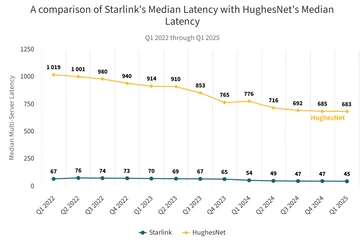
    SpaceX has not only managed to double the Starlink download and upload speeds in less than three years, even with a significant increase in subscribers, but it has also greatly enhanced the network’s latency. The ping time has dropped from a high of 76 ms to 45 ms, thanks to the addition of six new internet connection sites.

    Future Expectations

    The V3 satellite constellation, which SpaceX plans to launch starting in 2026, is expected to lower latency to a comfortable gaming level of under 20 ms. Elon Musk has even suggested that the lowest ping numbers could theoretically reach as low as 5 ms.

    The Starlink V3 satellites, which are set to provide a tenfold increase in download speeds and a 25-fold boost in upload speeds, will be transported to a lower orbit by SpaceX’s Mars-capable Starship 3 rocket, featuring 42 engines, with its first flight anticipated later this year.

    Source:
    Link