Tag: Apple A18 Pro

  • Entry-Level Intel Wildcat Lake CPU Matches MacBook Neo A18 Pro in Benchmarks

    Entry-Level Intel Wildcat Lake CPU Matches MacBook Neo A18 Pro in Benchmarks

    Key Takeaway

    – Intel’s Wildcat Lake series targets affordable, lightweight laptops as MacBook Neo rivals.
    – Entry-level Core 3 304 (5-core, 1 performance core) nearly ties Apple’s A18 Pro in benchmarks.
    – Single-thread scores: Core 3 304 at 3,676 vs. A18 Pro at 3,982 (only ~7.7% difference).
    – CPU Mark scores are similar: 11,543 for Intel vs. 11,804 for Apple’s A18 Pro.
    – Early results based on just 3 samples; scores may shift with more testing.


    Intel’s New Wildcat Lake Chips Show Up in Benchmarks

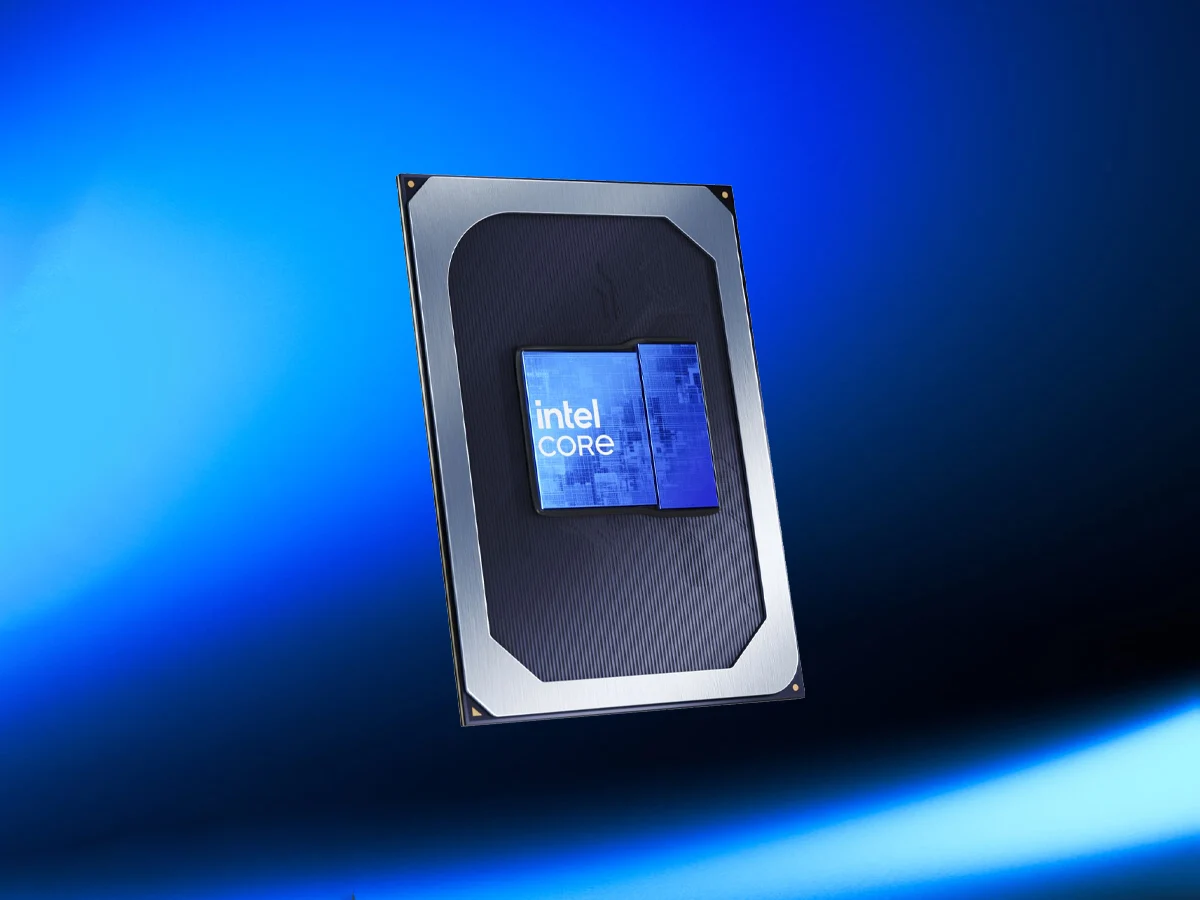
    Intel has launched the Wildcat Lake series for lightweight and affordable laptops, and some companies have already released MacBook Neo rivals powered by these processors. While in-depth reviews haven’t appeared yet, recently discovered benchmark results give a early look at what these CPUs can do, and the numbers are pretty surprising for a budget chip.

    Entry-Level CPU Ties With Apple A18 Pro

    A notable benchmark result from Passmark shows the Intel Core 3 304, the entry-level chip in the new lineup, holdig its own against Apple’s best. It uses a five-core configuration, with only one performance core, but even so it seems to have tied against the Apple A18 Pro found in the MacBook Neo, which is a mobile processor. The Apple A18 Pro got a single-thread rating of 3,982 on the benchmark, while the Intel Core 3 304 got 3,676 points, a difference of around 7.7% which is impressive for an entry-level Intel part.

    Multi-Core Performance Is Very Close

    In terms of multi-core performance, which shows the overall score from eight differnet tests, the two processors are very similar. Specifically, the Intel Core 3 304 scores 11,543 points on the CPU Mark test, while the MacBook Neo’s A18 Pro scores 11,804 points. These results are quite impressive, since the Intel chip is a budget design, and its worth noting that the score for the Intel CPU is based on only three samples so far. With more samples tested, the final score could shift, but at this early stage it is quite impressive to see the entry-level Wildcat Lake achieving such benchmark performance.

    First Laptops With Core 3 304 Already Announced

    For anyone interested, the HP OmniBook 3, IdeaPad Slim 3i, and Chuwi UniBook are among the first laptops that are confirmed to feature the Core 3 304 processor, with more options from different brands expected to arrive soon. These laptops are designed to compete in the budget space, offering light weight and affordable pricing, making them potential rivals to the MacBook Neo for users who want Windows compatability.

    Sources
  • Apple to Increase Production of MacBook Neo to Meet Growing Demand

    Apple to Increase Production of MacBook Neo to Meet Growing Demand

    Key Takeaway

    1. Apple has increased the production target of the MacBook Neo to 10 million units due to high demand.
    2. The shortage of the Apple A18 Pro SoC has been a key factor, with Apple utilizing binned chips in the current models.
    3. The increased production is likely to benefit sales during upcoming US shopping events, especially the back-to-school season.
    4. There is speculation that Apple may focus on higher-margin versions of the MacBook Neo to maintain profitability.
    5. The market may see competitive responses from Windows laptop OEMs at upcoming industry events like Computex 2026.

    Demand for the MacBook Neo is soaring high

    The MacBook Neo has become incredibly popular, so much so, that Apple might be struggling with the supply of a key part for this model. That critical component is the Apple A18 Pro SoC, which seems to be running out quickly as Apple just can’t seem to keep up with the demand for the Neo. To counter this, it looks like Apple has decided to increase their production plans to 10 million units, which is quite a jump from their initial projections.

    Specifications and Pricing Details

    • Starting at an affordable $599
    • Production target raised from 5-8 million to 10 million units
    • Uses Apple A18 Pro SoC (likely the binned-down chips not used in iPhone 16 Pro)

    Implication for Apple’s production strategy

    If Apple really is pushing out 10 million MacBook Neos, it clearly means they are making more of the A18 Pro chips. Interestingly, the chips in the current Neo models are probably the less powerful versions that didn’t qualify for the iPhone 16 Pro and Max, which could mean that Apple is focusing more on boosting availability than on high-end performance. This shift might slightly cut into profit margins, since the chips used are probably the cheaper, lower-grade ones.

    What about pricing and market response?

    The $599 price tag for the entry-level MacBook Neo is unlikely to change, but Apple might prefer to push the $699 version more. This strategy could help maximize profits during these high-demand periods, especially since they might prefer to sell more expensive variants. However, given the markets and sales events coming up – like back-to-school and holiday seasons – having loads of these devices available will surely give Apple a boost.

    Future competition and market movements

    It’ll be interesting if any Windows-based laptops are getting ready to challenge the MacBook Neo. With Computex 2026 just around, we shall see if any manufacturers announce innovative models that could rival Apple’s offering. Keep your eyes peeled for news and updates on this front.

    Sources
    • “How a Copper Plate Could Enhance MacBook Neo’s Speed and Coolness”

      “How a Copper Plate Could Enhance MacBook Neo’s Speed and Coolness”

      Key Takeaways

      1. The Apple MacBook Neo features a passive cooling system that operates silently but can lead to overheating and reduced performance under stress.
      2. Performance drops significantly during heavy usage, as seen in stress tests where power usage decreased from 8.8 W to around 5 W.
      3. Adding a copper plate and thermal paste can significantly improve performance and reduce temperature, increasing FPS from 30 to nearly 60 in gaming scenarios.
      4. Advanced cooling solutions, like thermoelectric water coolers, have shown even greater performance enhancements, with notable improvements in Geekbench benchmarks.
      5. Future iterations of the MacBook Neo could benefit from active cooling solutions to address performance issues and enhance user experience.


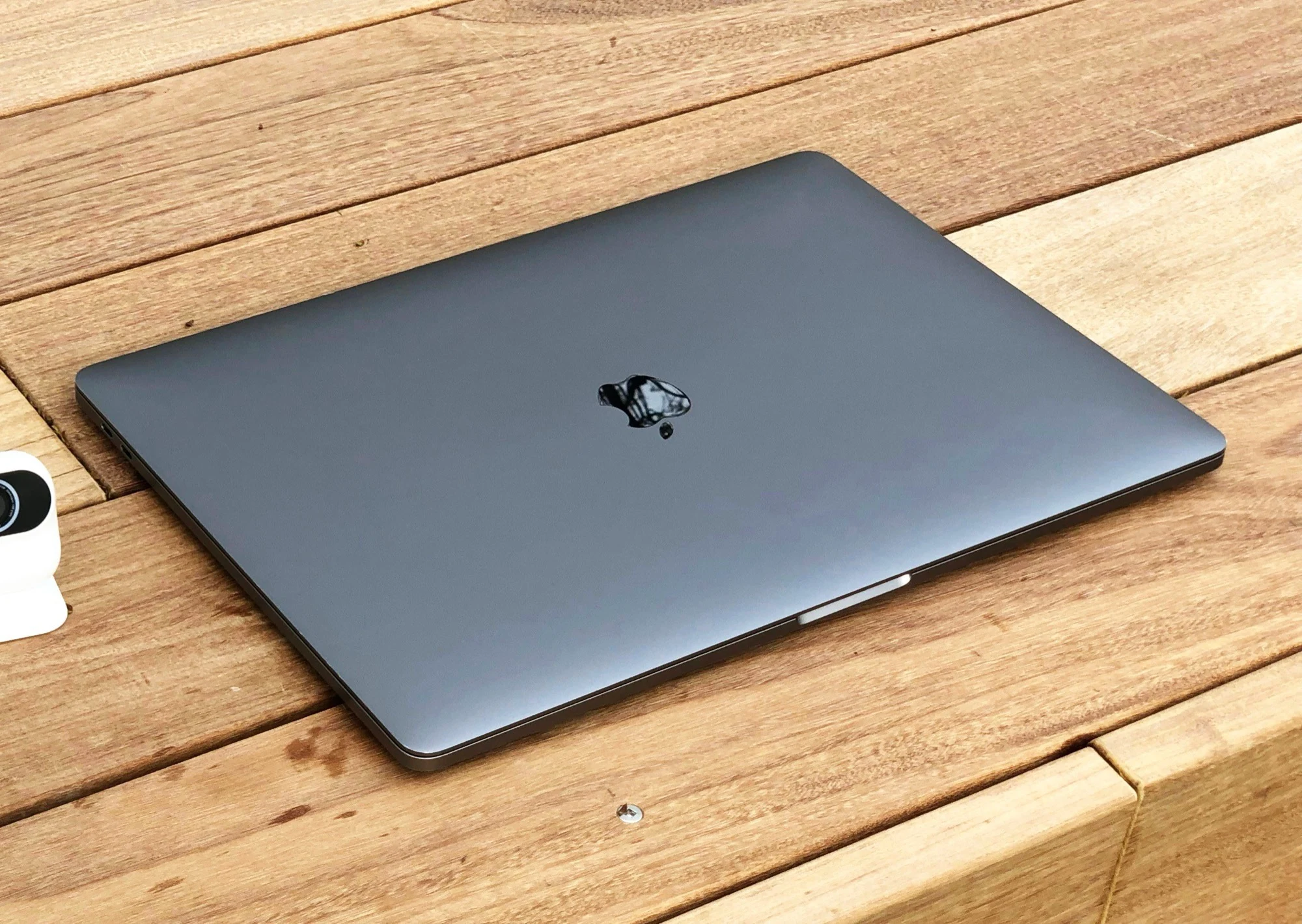
      The Apple MacBook Neo has a unique passive cooling system that has its pros and cons. It operates silently due to the lack of internal fans, but this can lead to overheating, causing a noticeable dip in performance when under stress. For example, during our stress test, we observed that the power usage of the Apple A18 Pro reduced from 8.8 W to around 5 W.

      Performance in Everyday Use

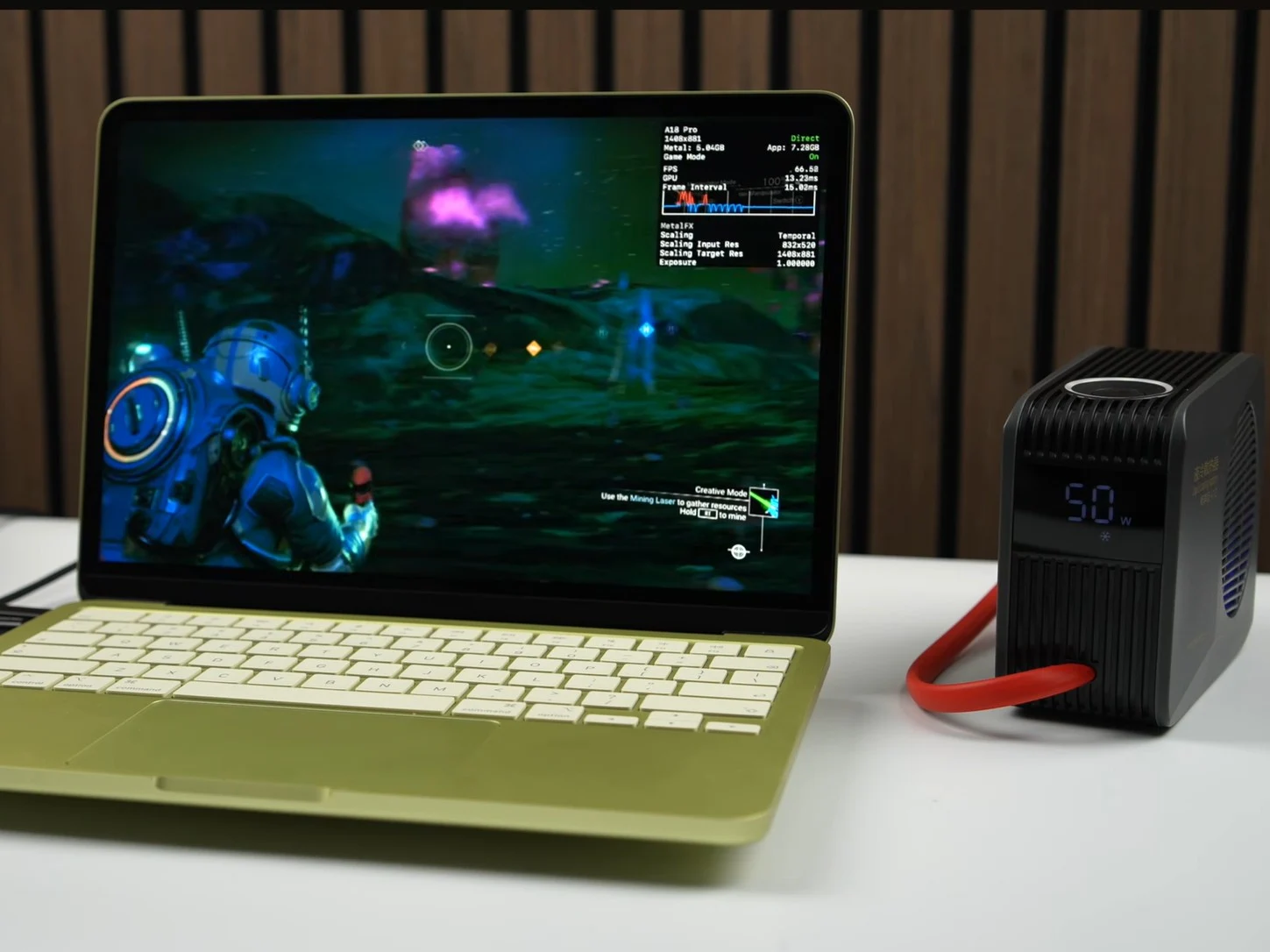
      This drop in performance might not be significant for normal tasks, but the MacBook Neo does face challenges during extended heavy usage like gaming. YouTuber ETA Prime demonstrated that adding a simple copper plate without fans can greatly enhance the MacBook Neo’s sustained performance.

      Cooling Solutions

      By applying thermal paste and placing a copper plate on the Apple A18 Pro, ETA Prime successfully lowered the SoC temperature from 105 C to the mid-80s while playing No Man’s Sky. This impressive temperature reduction led to a marked improvement in performance, with the average frames per second (FPS) rising from 30 FPS to almost 60 FPS.

      The performance boost can also be seen in benchmark tests. The modified MacBook Neo showed an increase of about 9.7% in multi-core performance and 15.2% in single-core performance in Geekbench 6.6.

      Advanced Cooling Tests

      Additionally, ETA Prime explored the potential of a thermoelectric water cooler to see how it could enhance the MacBook Neo’s performance. This cooler managed to bring the Apple A18 Pro’s operating temperature down to the mid-70s while playing No Man’s Sky, keeping the FPS just below 60. In Geekbench 6.6, the MacBook Neo achieved even higher speeds, with single-core and multi-core performance improvements of 17.5% and 18.6%, respectively.

      The MacBook Neo aims to be a cost-effective alternative to the MacBook Air, providing a solid solution for most users. It excels in this regard, but there are several aspects where Apple could have enhanced the MacBook Neo further.

      Future Improvements

      ETA Prime’s cooling modifications suggest that active cooling or even a basic copper heat plate would have greatly benefited the MacBook Neo. The significant increase in average FPS in No Man’s Sky and cooler operating temperatures are not to be overlooked.

      We’re hopeful that Apple takes these results into consideration for the next iteration of the MacBook Neo and incorporates some form of cooling.

      Source:
      Link


    • Apple Claims MacBook Neo Features No Design Compromises

      Apple Claims MacBook Neo Features No Design Compromises

      Key Takeaways

      1. Apple claims the MacBook Neo is a true MacBook with no design compromises, featuring an all-aluminum structure.
      2. The device includes a Retina display with 500 nits peak brightness, suggesting acceptable quality for most users.
      3. The Apple A18 Pro processor shows competitive performance against mid-range processors, despite some initial disappointment.
      4. The MacBook Neo has limitations, such as only 8 GB of non-upgradable memory and a USB-C port lacking USB 3 support.
      5. The absence of a backlit keyboard may deter some students, while its pricing may challenge its classification as a budget-friendly option.


      If one had to summarize the MacBook Neo in a single word, it would probably be “compromise.” On the other hand, Apple leaders view the device quite differently, firmly asserting that their newest budget-friendly model is a true MacBook without any compromises.

      Design Choices

      Molly Anderson, who is the VP of Industrial Design at Apple, shared her thoughts during a chat with Dezeen.

      She emphasized that “It’s undeniably a MacBook, and we’re definitely not compromising on the design, which is super important.” It’s worth noting that the executive specifically pointed out no compromises were made regarding design elements. Contrary to earlier speculations, Apple chose an all-aluminum structure instead of a less expensive plastic shell, which could have reduced expenses.

      Display and Performance

      Interestingly, the $599 MacBook Neo also includes a Retina display with an impressive peak brightness of 500 nits, which was unexpected given earlier rumors. While we still lack specific details about its color accuracy or coverage, Apple’s history suggests these metrics should be acceptable for most users.

      While the Apple A18 Pro might seem like a letdown for some, early benchmark results show that it performs quite well against current and future mid-range laptop processors, like the Intel Core Ultra 5 325 “Panther Lake” chip.

      Memory and Usability

      However, the MacBook Neo does have some clear drawbacks. Priced at $599 for pre-order on Amazon, it comes with only 8 GB of unified memory, which cannot be upgraded. Additionally, one of its USB-C ports does not support USB 3 speeds. Targeted mainly at students, the absence of a backlit keyboard may also be something many potential buyers can overlook.

      From an external perspective, it’s not easy to categorize the MacBook Neo as an affordable choice for those watching their wallets. Amusingly, users who desire vibrant color options will find their only choice is the MacBook Neo.

      Source:
      Link


    • Apple Launches Compact MacBook Neo Starting at $599

      Apple Launches Compact MacBook Neo Starting at $599

      Key Takeaways

      1. The MacBook Neo marks the return of a compact design, introduced at the ‘Special Apple Experience’ event in New York.
      2. It runs on the A18 Pro chipset, featuring 6 CPU cores, 5 GPU cores, and a 16-core Neural Engine, differing from the M5 chipsets in other MacBook models.
      3. The device has a 13-inch IPS display with a resolution of 2,408 x 1,506 pixels and a peak brightness of 500 nits, but has a smaller battery rated for about 11 hours of web browsing.
      4. The MacBook Neo is priced starting at $599 for the 256 GB model and $699 for the 512 GB model, with options for Touch ID and four color choices.
      5. Pre-orders for the MacBook Neo will begin shipping on March 11.


      Almost eight years have gone by since Apple stopped making the 12-inch MacBook. Now, the compact design has made a comeback with the launch of the MacBook Neo. This new model was introduced today during the ‘Special Apple Experience’ event in New York, just a day after Apple updated the MacBook Air and MacBook Pro using the M5, M5 Pro, and M5 Max chipsets.

      New Chipset Details

      Unlike the other models, the MacBook Neo does not use the Apple M5 chipsets; instead, it runs on the A18 Pro. This chipset was first seen in the iPhone 16 Pro and iPhone 16 Pro Max. The A18 Pro in the MacBook Neo has 6 CPU cores and 5 GPU cores, along with a 16-core Neural Engine and a memory bandwidth of 60 GB/s. To sum it up, the MacBook Neo comes with fewer GPU cores than the last-generation Pro iPhones from Apple.

      Display and Battery Life

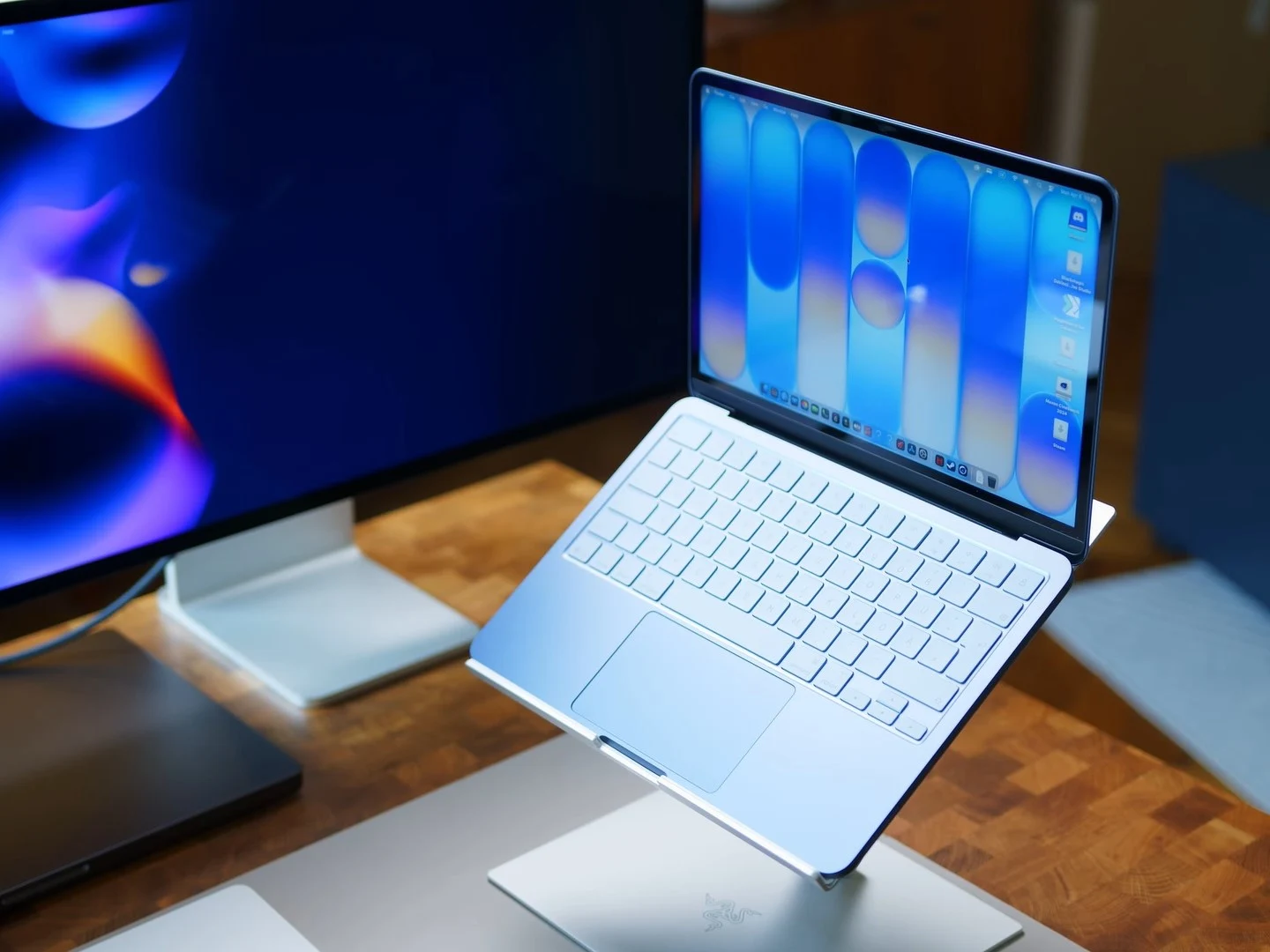
      Moving on, the MacBook Neo boasts a 13-inch IPS display with a resolution of 2,408 x 1,506 pixels, a 219 PPI, and a peak brightness of 500 nits, along with a refresh rate of 60 Hz. However, it only has a 36.5 Wh battery, which is why it’s rated for about 11 hours of web browsing. The entire setup is housed in a body that measures 297.5 x 206.4 x 12.7 mm and weighs 1.23 kg, making it comparable to the smaller MacBook Air (currently priced at $899 on Amazon), but it does come with USB 2.0 and USB 3.0 Type-C ports.

      Pricing and Availability

      The starting price for the MacBook Neo is $599, which includes 256 GB of storage. Alternatively, there is a 512 GB version available for $699 that features Touch ID integrated into the power button. Both storage options include 8 GB of unified memory and come in four color choices: Blush, Citrus, Indigo, and Silver. Pre-orders are set to begin shipping on March 11.

      Source:
      Link


    • Apple’s Affordable MacBook: Less RAM, Lower Price than iPhone 17 Pro

      Apple’s Affordable MacBook: Less RAM, Lower Price than iPhone 17 Pro

      Key Takeaways

      1. Apple may replace the MacBook Air with a new budget-friendly model in spring 2026, featuring a 12.9-inch screen.
      2. The new MacBook is expected to use the Apple A18 Pro processor, similar in performance to the Apple M1 chip.
      3. The base model may have 8GB of memory and be priced between $699 and $799, targeting casual users for basic tasks.
      4. The laptop will have an aluminum body, various color options, and long battery life, appealing to travelers seeking lightweight devices.
      5. Apple plans to produce 5 to 8 million units annually, indicating strong expected demand for the new MacBook.


      Rumors are swirling that the MacBook Air (starting at $849 on Amazon) could be replaced as Apple’s entry-level laptop as soon as spring 2026. This new budget-friendly MacBook is rumored to have a 12.9-inch screen, making it slightly smaller than the current 13.6-inch MacBook Air. The most notable aspect of this device will be its processor. Rather than utilizing an Apple M-series chip, it is likely to run on the Apple A18 Pro.

      Performance Insights

      The A18 Pro SoC is already being used in the iPhone 16 Pro, which debuted in September 2024. Its performance aligns closely with that of the Apple M1 chip. A fresh report from Mirror Daily indicates that Apple might limit the base model’s memory to just 8GB to keep the price within a range of $699 to $799. This means that the MacBook would have the same memory as the iPhone 16 Pro, but 4GB less than what the current iPhone 17 Pro offers. This configuration would appeal to casual users in need of a laptop for basic office tasks and web browsing.

      Pricing and Features

      Currently, Apple charges $200 for an upgrade from 16GB to 24GB of RAM, so a model with extra memory could end up being only a bit cheaper than the MacBook Air. With an elegant aluminum body and a variety of color options, alongside impressive battery life, this affordable MacBook could stand out from other laptops in the same price bracket. Given that the 12-inch MacBook weighed around 2 lb back in 2015, it’s likely that this new budget model will also attract frequent travelers seeking a lightweight laptop.

      Production Expectations

      Reports suggest that Apple is intending to manufacture between 5 to 8 million units each year, signaling that the tech giant anticipates a strong market demand for this upcoming MacBook.

      Source:
      Link


    • Apple’s 12.9-Inch MacBook Leaks in macOS 26 Tahoe Beta

      Apple’s 12.9-Inch MacBook Leaks in macOS 26 Tahoe Beta

      Key Takeaways

      1. macOS 26 Tahoe’s sixth beta includes a new onboarding video showcasing features for first-time users.
      2. The video features a MacBook design without a notch, leading to speculation about a new budget-friendly model.
      3. The upcoming budget 13-inch MacBook may have a design similar to the MacBook Air but could lack a notch.
      4. Mass production of the budget MacBook is expected to begin in Q3 2025, with a potential launch at the end of 2025 or early 2026.
      5. The budget MacBook is rumored to feature the A18 Pro processor, a 12.9-inch display, and vibrant color options, priced between $599 and $699.


      In the sixth beta version of macOS 26 Tahoe, Apple has added a new onboarding video that introduces users to some of the update’s features when they first boot up their MacBook after installation. Users quickly noticed that the video features a MacBook without a notch.

      Design Similarities

      Besides that, the overall design closely resembles the current MacBook Air. The most plausible reason for this oddity might be a simple oversight, where the notch was overlooked while the video was being made. Nonetheless, this has led to speculation that the upcoming budget-friendly 13-inch MacBook could lack a notch, while still reflecting the design of the MacBook Air. If Apple incorporates a smaller webcam and slightly broader screen bezels, it’s quite possible the camera could fit into the top edge of the screen without causing a significant bulge.

      Production Timeline and Specs

      Recent rumors suggest that mass production of this “budget MacBook” is anticipated to commence in the third quarter of 2025, indicating that its launch could occur towards the end of this year or at the start of the next. The notebook is rumored to come with the Apple A18 Pro processor, which is already featured in the iPhone 16 Pro, and is expected to have a 12.9-inch display. Along with a vibrant casing in colors like silver, pink, yellow, or blue, the pricing is expected to be a major attraction for this MacBook, as it is anticipated to be priced between $599 and $699.

      Source:
      Link


    • Snapdragon 8 Elite vs Apple A18 Pro: Performance Benchmark Battle

      Snapdragon 8 Elite vs Apple A18 Pro: Performance Benchmark Battle

      The competition between Android and iPhone performance is becoming less distinct with Qualcomm’s launch of its impressive Snapdragon 8 Elite chipset. This latest Snapdragon chip claims to offer significant improvements in both performance and efficiency, much like Apple’s A18 Pro that powers the iPhone 16 Pro models. So, how do these two contenders compare? Let’s dive into some benchmark tests to see which one comes out on top.

      Quick Specs Overview

      First, we should examine the specifications for a clearer understanding:

      Feature Snapdragon 8 Elite Apple A18 Pro
      Announced October 2024 September 2024
      Process node 3nm 3nm
      Manufacturer TSMC TSMC
      CPU 2 x 4.32GHz (Oryon) 2 x 4.04GHz (High-performance)
      6 x 3.53GHz (Oryon) 4 x 2.2GHz (Energy-efficient)
      GPU Adreno 830 GPU 6-core GPU
      Unreal Engine 5.3 with Nanite Hardware accelerated ray tracing
      NPU Qualcomm Hexagon NPU 16-core neural engine
      Multimodal Gen AI support 35 TOPS
      Memory LPDDR5x, up to 5.3GHz LPDDR5x, up to 7500MHz
      Connectivity Snapdragon X80 5G modem Snapdragon X75 5G modem
      Downlink: 10Gbps Downlink: 10Gbps
      Uplink: 3.5Gbps Uplink: 3.5Gbps
      Wi-Fi 7, Bluetooth 6.0, UWB Wi-Fi 7, Bluetooth 5.4, UWB

      (Note: We conducted tests using the Realme GT7 Pro with Snapdragon 8 Elite and the iPhone 16 Pro Max featuring the A18 Pro for benchmarking results.)

      Benchmark Showdown

      Geekbench Scores
      Geekbench evaluates a device’s CPU performance through a variety of tests, yielding both single-core and multi-core results. Here’s how the two chips fared:

      In the single-core tests, both the Snapdragon 8 Elite and Apple A18 Pro had comparable scores. However, in the multi-core assessment, the Snapdragon chipset outperformed the A18 Pro by over 15%.

      Snapdragon 8 Elite Apple A18 Pro
      Single-core 3,156 3,291
      Multi-core 9,489 8,146

      AnTuTu Results
      AnTuTu is another well-known benchmarking tool that evaluates CPU, GPU, UX, and memory strength. The total score reflects the overall capability of a device. It’s important to note that the Android version of AnTuTu uses Vulkan API, while the iOS version utilizes Metal API.

      Here, the Snapdragon 8 Elite clearly surpassed the Apple A18 Pro with a significant margin, particularly excelling in GPU and memory performance.

      Snapdragon 8 Elite Apple A18 Pro
      AnTuTu score 2,764,150 1,756,810
      CPU 584,894 469,595
      GPU 1,134,684 640,006
      Memory 644,600 289,171
      UX 399,972 358,038

      Graphics Performance

      3DMark Testing
      3DMark is widely used for testing GPU capabilities with several benchmarks available for assessing gaming performance. For this matchup, we utilized the WildLife Extreme Stress Test and the Solar Bay for ray tracing evaluation.

      In the WildLife Extreme Stress Test, the Snapdragon 8 Elite’s Adreno 830 GPU showed remarkable performance, achieving 82.4% stability, while the A18 Pro lagged behind at only 68.1%. Interestingly, their temperatures remained nearly identical.

      Snapdragon 8 Elite Apple A18 Pro
      Stability 82.4% 68.1%
      Temperature 42.8° C 42.3° C

      3DMark Solar Bay
      The Snapdragon 8 Elite also excelled in the Solar Bay test, boasting an average of 40.68 FPS compared to the A18 Pro’s 30.6 FPS. Additionally, the Snapdragon chip produced a higher overall score and maintained a cooler temperature than the A18 Pro.

      Snapdragon 8 Elite Apple A18 Pro
      Overall score 10,564 8,013
      Average FPS 40.68 FPS 30.6 FPS
      Temperature 43.6° C 45.5° C

      Key Differences Summarized

      The Snapdragon 8 Elite is Qualcomm’s first chip to use custom Oryon CPU cores and the performance results are impressive thus far. This octa-core chip features two large cores clocked at 4.32GHz and six mid-cores at 3.53GHz. In contrast, the Apple A18 Pro consists of a six-core CPU with two large cores at 4.04GHz and four efficiency cores running at 2.2GHz.

      Not only does the Snapdragon 8 Elite contain two extra CPU cores, but it also has a peak CPU frequency advantage of 4.32GHz compared to the A18 Pro’s 4.04GHz. For rendering graphics, the Snapdragon chip utilizes the Adreno 830 GPU, while the A18 Pro employs a 6-core GPU. Both chips support high-performance graphics rendering with hardware-accelerated ray tracing.

      Both processors contain formidable NPUs: the Snapdragon 8 Elite features a hexagon NPU with multimodal Gen AI support, while the A18 Pro possesses a 16-core neural engine capable of processing 35 trillion operations per second. They offer similar connectivity options, although the Snapdragon 8 Elite supports a higher Bluetooth standard.

      Conclusion

      Both the Apple A18 Pro and Snapdragon 8 Elite stand out as top contenders in the smartphone chip market. Each offers powerful CPUs that can efficiently manage all types of processing demands, along with GPUs capable of delivering smooth gaming experiences over extended periods. They also integrate advanced AI capabilities. However, the benchmark results clearly show an advantage for the Snapdragon 8 Elite.

      While the Snapdragon 8 Elite outshines the Apple A18 Pro in benchmarks, the choice between the two often depends on your ecosystem preference. If you are deeply integrated into Apple’s ecosystem, the A18 Pro may be more suitable for you; otherwise, the Snapdragon 8 Elite is the way to go.

      Devices Featuring Snapdragon 8 Elite:

      • Xiaomi 15 (review)
      • Xiaomi 15 Pro
      • iQOO 13
      • OnePlus 13 (review)
      • Realme GT7 Pro (review)

      Devices Featuring Apple A18 Pro:

      • Apple iPhone 16 Pro
      • Apple iPhone 16 Pro Max
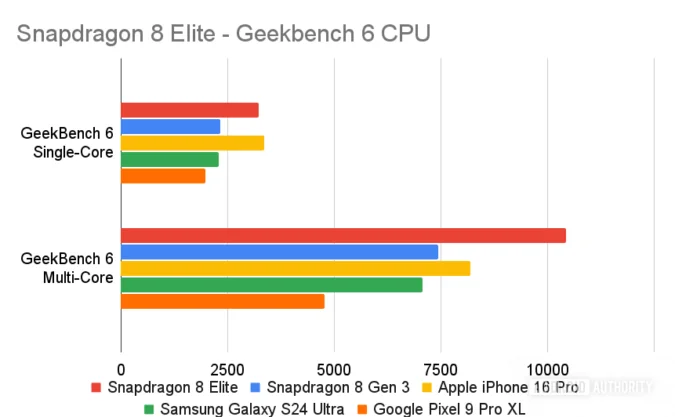
      Image 1
      Image 1
    • Dimensity 9400 GPU Tests Show MediaTek’s Efficiency in Vivo X200 Pro

      Dimensity 9400 GPU Tests Show MediaTek’s Efficiency in Vivo X200 Pro

      While several evaluations have indicated that the MediaTek Dimensity 9400 is slightly trailing behind its competitors like the Apple A18 Pro and Snapdragon 8 Elite in CPU performance and efficiency, things are quite different when it comes to the GPU. A new analysis has assessed the graphics capabilities of the MediaTek chipset, showing it might lead the pack in this area.

      Performance Comparison

      According to testing done by Golden Reviewer, the Dimensity 9400’s Immortalis-G925 GPU seems to be both stronger and more efficient compared to Apple’s A18 Pro. In the 3DMark Solar Bay ray-tracing test, the Dimensity 9400 achieved an impressive score of 11,817 while consuming 11.4 watts. In contrast, the A18 Pro scored 8,587 with a power usage of 11.1 watts. These figures indicate a notable efficiency edge for the Dimensity 9400, being roughly 30% more efficient than the chipset in the iPhone 16 Pro Max during the test.

      Additional Benchmark Results

      The same trend continues across other 3DMark assessments. In the Steel Nomad Light test, the Dimensity 9400 not only surpassed the A18 Pro in scores but also used less power, showcasing about a 40% efficiency superiority over Apple’s chipset. This pattern holds true in the WildLife Extreme test as well, where the Dimensity 9400 outshines the A18 Pro in performance while also drawing less power.

      Overall Impression

      The results are clear: MediaTek’s Dimensity 9400 stands out in the GPU performance, outclassing the A18 Pro in most metrics. It’s still uncertain how it will compare with the Snapdragon 8 Elite in similar tests, but we will keep you informed on any updates regarding that.


      Image 1
      Image 1
      Image 1
    • Snapdragon 8 Elite vs. Apple A18 Pro: Performance Showdown

      Snapdragon 8 Elite vs. Apple A18 Pro: Performance Showdown

      Qualcomm has made it official with the launch of the Snapdragon 8 Elite, aiming to equip various flagship smartphones by late 2024. This new chip is likely to be included in models such as the OnePlus 13, Xiaomi 15, iQOO 13, and Realme GT 7 Pro. Most of these smartphones are expected to make their appearance between late October and early November.

      Benchmark Highlights

      Qualcomm presented benchmark comparisons of the Snapdragon 8 Elite against its rivals, which includes Apple’s A18 Pro, Samsung’s Snapdragon 8 Gen 3 “For Galaxy” variant, and Google’s Tensor G4. The benchmark tests were run on a reference smartphone that boasted high-end specifications, featuring a Prime CPU core with a clock speed of 4.32GHz, 24GB LPDDR5X RAM, and a stunning 144Hz AMOLED display.

      CPU Performance Insights

      The Snapdragon 8 Elite shows off its custom Oryon CPU cores, which are developed on an Arm architecture, revealing substantial improvements. In terms of single-core performance, this chip closely competes with Apple’s A18 Pro, with just a small difference of around 4%. When compared to Google’s Tensor G4, Qualcomm’s latest chip displayed a striking 63% enhancement, clearly emphasizing its superiority over current Android processors. Nevertheless, even though the Snapdragon 8 Elite’s top clock speed of 4.32GHz is impressive, it is uncertain how well this will perform in real-world energy efficiency.

      In multi-core evaluations, Qualcomm’s six performance cores allowed it to outpace Apple’s A18 Pro by 27%. However, it’s worth noting that the Snapdragon 8 Elite has more cores, which provides it with a structural advantage. When comparing per-core performance, the cores of the A18 Pro still slightly outperform the Oryon cores by approximately 4.5%.


      Image 1