Tag: Apple A18 Pro

  • Snapdragon 8 Elite CPU Benchmarks Reveal New Performance Leader

    Snapdragon 8 Elite CPU Benchmarks Reveal New Performance Leader

    Qualcomm has introduced its top-of-the-line chipset for this year, named the Snapdragon 8 Elite. This chipset is promoted as having the fastest mobile CPU in the world. Unlike previous models that used ARM’s Cortex cores, the Snapdragon 8 Elite utilizes Oryon cores, leading to significant improvements in performance. QRD benchmark tests have demonstrated that this chipset excels in CPU capabilities.

    Performance Highlights

    According to Geekerwan, the Snapdragon 8 Elite achieves a score of 3,242 in Geekbench 6’s single-core CPU test. This figure surpasses the Dimensity 9400, which scored 3,010, but falls short of the Apple A18 Pro’s impressive 3,509 score. However, in the multi-core test, the Snapdragon 8 Elite truly lives up to its title of the fastest mobile CPU, scoring 10,521 and outpacing the A18 Pro (9,376) and Dimensity 9400 (9,317).

    Comparison With Competitors

    In AnTuTu benchmarks, the Snapdragon 8 Elite received a CPU score of 679,852. The Dimensity 9400, found on the Vivo X200 Pro, is close behind with a score of 652,381. Nevertheless, the Snapdragon 8 Elite does not match the efficiency of the A18 Pro, which consumes about 11.9 W in the multi-core test on Geekbench, compared to the Snapdragon 8 Elite’s 16.8 W. Unfortunately, the Dimensity 9400 is the least efficient this year, drawing around 18.6 W.

    Conclusion

    Clearly, the Snapdragon 8 Elite presents a compelling argument for having the fastest mobile CPU to date. It outshines MediaTek’s Dimensity 9400 in all significant CPU tests and is only narrowly surpassed by the Apple A18 Pro in peak performance circumstances. It’s worth mentioning that these benchmarks were conducted on an engineering unit rather than retail devices. However, the Xiaomi 15, OnePlus 13, and iQOO 13 are expected to launch soon, and we will provide updates on their real-world performance once they are available.

    From Geekerwan,
    Kingmi Mobile


    Image 1
    Image 1
    Image 1
    Image 1
  • Snapdragon 8 Gen 4 Leaked AnTuTu and Geekbench Scores Revealed

    Snapdragon 8 Gen 4 Leaked AnTuTu and Geekbench Scores Revealed

    Snapdragon 8 Gen 4 is set to be Qualcomm’s next leading chipset. Reports suggest that it may be the most robust chip designed for Android devices. The company has confirmed that it will feature custom Oryon cores, which are expected to deliver outstanding performance and battery life; these cores are also utilized in the Snapdragon X Elite.

    Upcoming Announcement

    Qualcomm plans to introduce its next Snapdragon 8-series chip during the Snapdragon Summit 2024, starting on October 21st. While the official name hasn’t been disclosed, it is likely to be called ‘Snapdragon 8 Gen 4.’ However, some leaks hint at an alternative name: Snapdragon 8 Elite. Regardless of the name, leaked benchmark results indicate remarkable performance.

    Benchmark Results

    The leaked AnTuTu score for the Snapdragon 8 Gen 4 shows a significant leap compared to last year’s Snapdragon 8 Gen 3, which scored 2,128,819. Here are the details for the Snapdragon 8 Gen 4:

    • AnTuTu score: 3,133,570
    • CPU: 702,689
    • GPU: 1,330,057
    • Memory: 616,268
    • UX: 484,556

    When compared to the Dimensity 9400 and Apple’s A18 Pro, the Snapdragon 8 Gen 4 comes out on top:

    Chipset AnTuTu Score CPU GPU Memory UX
    Snapdragon 8 Gen 4 3,133,570 702,689 1,330,057 616,268 484,556
    Dimensity 9400 3,007,853 652,381 1,322,761 521,453 511,258
    Apple A18 Pro 1,656,821 442,868 603,580 272,713 337,660

    Snapdragon 8 Gen 4 outshines both the Dimensity 9400 and Apple A18 Pro on the AnTuTu benchmark. The A18 Pro scored the lowest among the three. It is important to keep in mind that AnTuTu employs Vulkan APIs for Android and Metal APIs for iOS.

    Geekbench Performance

    On the Geekbench 6 platform, Snapdragon 8 Gen 4 achieved 3,216 points in single-core tests and 10,051 points in multi-core tests, showcasing a significant upgrade from last year’s Snapdragon 8 Gen 3. For reference, the Dimensity 9400 in the Oppo Find X8 Pro scored 2,818 and 8,847 points in single and multi-core tests, respectively. The iPhone 16 Pro Max managed 3,386 single-core points and 8,306 multi-core points, with Snapdragon 8 Gen 4 again proving superior.

    Metric Snapdragon 8 Gen 4 Dimensity 9400 Apple A18 Pro
    Single core 3,216 2,818 3,386
    Multi core 10,051 8,847 8,306

    Specifications Overview

    The Snapdragon 8 Gen 4 is expected to launch in October 2024. It will be built on a 3nm process node by TSMC and will include eight cores. The CPU architecture is set to feature two Oryon cores running at 4.09 GHz and six Oryon cores at 2.78 GHz. The maximum CPU frequency is rumored to be 4,090 MHz, paired with a powerful Adreno 830 GPU, which is designed to handle high-performance gaming effortlessly, along with a Hexagon NPU for AI tasks.

    Anticipated Devices

    Several smartphones are anticipated to feature the Snapdragon 8 Gen 4 (or Snapdragon 8 Elite) upon its release, including:

  • iQOO 13 Beats Apple A18 Pro in Geekbench Multi-Core Test

    iQOO 13 Beats Apple A18 Pro in Geekbench Multi-Core Test

    Qualcomm’s Snapdragon Summit is just around the corner. During this event, the company is set to unveil its new flagship System on Chip (SoC). Recent information suggests that this new chip might not carry the name Snapdragon 8 Gen 4. Instead, it could be called either the Snapdragon 8 Extreme Edition or Snapdragon 8 Elite.

    Benchmark Results of iQOO 13

    As the release of this flagship SoC draws near, various smartphones expected to use it are appearing on Geekbench. One notable device is the iQOO 13, which has shown some intriguing benchmark results. The multi-core score of what is believed to be the Snapdragon 8 Extreme Edition exceeds that of the Apple A18 Pro.

    To provide context, the Apple A18 Pro achieved a maximum score of 8,568 points in our multi-core benchmark tests. In contrast, the upcoming Snapdragon flagship SoC within the iQOO 13 scored 10,052 in the same evaluation. This results in the Snapdragon chip having approximately a 17% advantage in multi-core performance.

    Impressive Single-Core Performance

    The single-core performance is also impressive. In this particular Geekbench test, the iQOO 13 recorded a score of 3,142. In comparison, in our benchmarks, the Apple A18 Pro reached a maximum of 3,479 points. Thus, Qualcomm’s new 3 nm mobile chip is only about 10% behind in single-core performance.

    This isn’t the first time the iQOO 13 has shown up on Geekbench. It was seen just two days ago, but the scores were lower than those in the latest listing. The improved results in this recent benchmark might be attributed to software enhancements.

    Competition Heating Up

    Additionally, the OnePlus 13, which is said to feature the same or a customized version of the next-gen Snapdragon 8 series chip, was also found on the benchmarking site. Its scores were comparable to those of the iQOO 13 in the recent tests. All these developments indicate that Qualcomm could intensify competition in performance with its forthcoming mobile SoC. However, it remains to be determined how they measure up in terms of efficiency.

    Geekbench via: Wccftech


    Image 1
  • Snapdragon 8 Gen 4 Targets 4.26GHz to Outperform Apple A18/Pro

    Snapdragon 8 Gen 4 Targets 4.26GHz to Outperform Apple A18/Pro

    Qualcomm has announced that they will integrate chips with their custom CPU cores following the acquisition of Nuvia. The forthcoming Snapdragon 8 Gen 4 will feature custom cores in a 2+6 CPU cluster configuration, comprising two performance cores and six energy-efficient cores. Rumors suggest that a design update for the chip, targeting a clock frequency of 4.26GHz, might be finalized in the coming month, aiming to rival Apple A18.

    Redesign and Enhanced Performance

    The Snapdragon 8 Gen 4 could potentially see a performance boost, particularly in single-core tasks, with the speculated redesign set to be completed in June, focusing on achieving a 4.26GHz clock speed to compete with Apple's A18 chip.

    Process Node Efficiency

    Both Apple's M4 series and the Snapdragon 8 Gen 4 are anticipated to be manufactured using TSMC's second-generation 3nm process node. This technology has shown efficiency in sustaining high clock frequencies, evident in the latest Apple Silicon chips.

    Power Efficiency and Features

    Qualcomm's chipset, while utilizing the same 3nm process node, lacks support for ARMv9 instruction set and Scalable Matrix Extension (SME), which enhances chip performance in complex tasks. Managing power efficiency will be crucial for Qualcomm this time, as previous reports hinted at higher power consumption, potentially necessitating larger smartphone batteries.

    Qualcomm is projected to reveal the Snapdragon 8 Gen 4 chipset at the upcoming Snapdragon Summit, expected to take place in October. The Xiaomi 15 series could possibly be among the first smartphones to feature the Oryon CPU-powered Android flagship.

    Moreover, Qualcomm is actively developing two ARM-based chips featuring custom Oryon CPU cores for Windows PCs – the 12-core Snapdragon X Elite and the 10-core Snapdragon X Plus.

  • Snapdragon 8 Gen 4 Potential LPDDR6 Support; Apple A18 Pro to Opt for LPDDR5T

    Snapdragon 8 Gen 4 Potential LPDDR6 Support; Apple A18 Pro to Opt for LPDDR5T

    Qualcomm plans to unveil its latest flagship mobile processor, the Snapdragon 8 Gen 4, during the upcoming Snapdragon Summit scheduled for October. As anticipation builds, leaks and speculations surrounding the features and capabilities of the System on Chip (SoC) are emerging.

    Snapdragon 8 Gen 4 Rumors and Features

    A recent report from the South Korean news source Ajunews suggests that the Snapdragon 8 Gen 4 could potentially be among the first mobile SoCs to embrace LPDDR6 memory technology. In comparison, Apple's A18 Pro chipset is rumored to utilize LPDDR5T memory. The report also mentions potential challenges in mass-producing the LPDDR6 module this year, leading to a probable delay in its availability until 2025.

    LPDDR6 Integration and Potential Advantages

    Despite the production hurdles highlighted in the report, there is speculation that Qualcomm might integrate LPDDR6 into its Snapdragon 8 Gen 4 Application Processor (AP) to cater to the increasing demand for on-device AI functionalities. However, it's essential to approach this information with caution until more concrete details emerge. LPDDR6 is anticipated to deliver enhanced speed and power efficiency compared to the current LPDDR5 standard, with the improved performance expected to be especially beneficial for handling AI operations in future smartphones.

    Apple's A18 Pro and Memory Innovations

    While Apple's A18 Pro processor is likely to depend on LPDDR5T memory, there are indications that Apple is exploring alternative methods to store LLMs on NAND flash memory. This potential innovation could enable iPhones with limited RAM to efficiently execute on-device AI tasks. LPDRR5T is currently recognized as the fastest RAM available in smartphone SoCs, boasting theoretical speeds reaching up to 9.6 Gbps.

  • Snapdragon 8 Gen 4 & Dimensity 9400 Outperform Apple A18 Pro in Geekbench Test

    Snapdragon 8 Gen 4 & Dimensity 9400 Outperform Apple A18 Pro in Geekbench Test

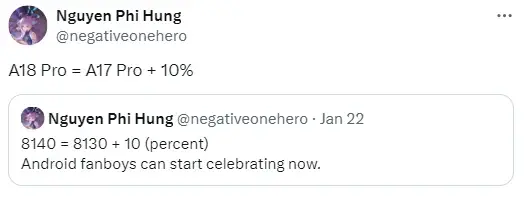
    As the iPhone 16 series launch approaches, discussions are intensifying around Apple’s A18 Pro chip set to power the new devices. Initial reports highlighted the significant enhancement in single-core performance offered by the A18 Pro. However, recent insights shared by tipster @negativeonehero on X suggest that the multi-core performance of Apple’s upcoming A18 Pro shows only a modest 10% improvement. This advancement appears to lag behind two competing next-generation Android flagships – the Snapdragon 8 Gen 4 and Dimensity 9400.

    Performance Discrepancy in Multi-Core Scores

    The A18 Pro achieved a score of approximately 8200 in the Geekbench multi-core test, falling notably short when compared to the Snapdragon 8 Gen 4 and Dimensity 9400, which scored 10628 and 11739 points respectively. These substantial performance differentials, exceeding 2000 points, indicate a potential edge for the next wave of Android flagships over the iPhone 16 Pro models.

    Single-Core Performance Insights

    Conversely, the Snapdragon 8 Gen 4 excelled in single-core performance, reaching an impressive 3500 points, slightly surpassing the A18 Pro’s 3300 points. This jump, compared to the Snapdragon 8 Gen 3’s 2200 points in Geekbench single-core, signifies a substantial enhancement in performance. Moreover, the Dimensity 9400 promises nearly a 20% boost in both single-core and multi-core scores in contrast to its predecessor, the Dimensity 9300.

    Future Developments and Speculation

    While these chips are still in the developmental phase and slated for release towards the end of 2024, there remains ample opportunity for Apple, Qualcomm, and MediaTek to refine and optimize their offerings. Industry experts speculate that Apple may have deliberately limited multi-core performance to prioritize battery efficiency, a crucial consideration in modern smartphones.