Category: Gaming

  • Ryzen 9 9950X3D2 and Ryzen 7 9850X3D Specs Leaked

    Ryzen 9 9950X3D2 and Ryzen 7 9850X3D Specs Leaked

    Key Takeaways

    1. AMD is currently leading the desktop gaming processor market while Intel faces challenges with its new CEO and restructuring efforts.
    2. Upcoming Intel processors, Arrow Lake Refresh and Nova Lake-S, could reignite competition, prompting AMD to consider a Ryzen 9000 refresh.
    3. AMD plans to enhance its processors by increasing the 3D V-Cache per chip, with leaks revealing details about new models.
    4. The Ryzen 9 9950X3D2 features an increased L3 cache but a slight decrease in boost clock speed, raising its TDP to 200 W.
    5. The Ryzen 7 9850X3D upgrade retains the same L3 cache size but boosts clock speeds and is expected to require only a BIOS update for compatibility with existing AM5 motherboards.


    AMD is currently enjoying a strong position in the desktop gaming processor market, as Intel’s Arrow Lake Core Ultra 200K-series CPUs have not met expectations. Intel is indeed facing challenges with its recent restructuring, a new CEO, and a shift in its overall vision. However, Team Blue is not completely out of the race. The anticipated Arrow Lake Refresh and potentially the Nova Lake-S desktop processors, which are expected to debut next year with most components manufactured at TSMC’s N2P nodes, could stir things up. AMD seems to recognize this potential competition, leading to rumors about a Granite Ridge Ryzen 9000 refresh. Recent leaks suggest that AMD is aiming to counter Intel by increasing the 3D V-Cache per processor. A user named Chi11edog on X shared specifications for two new AMD desktop processors that seem to be enhanced versions of the existing X3D models.

    Ryzen 9 9950X3D2 Details

    The first processor is the Ryzen 9 9950X3D2, which is a refined version of the Ryzen 9 9950X3D, offering a notable increase in L3 cache from 128 MB to 192 MB. However, the maximum boost clock speed has slightly decreased from 5.7 GHz to 5.6 GHz, while the base clock remains steady at 4.3 GHz. The core count is still at 16, with 32 threads, and it features two core chiplet dies, each equipped with its own 3D V-Cache chiplet. This additional L3 cache raises the TDP from 170 W to 200 W, potentially enhancing performance in some content creation applications. Nevertheless, the two separate 3D V-Cache chiplets might create some latency issues in gaming contexts.

    Ryzen 7 9850X3D Upgrade

    To cater to users who need gaming performance, AMD is set to release an upgrade for the well-liked Ryzen 7 9800X3D. The new model is called the Ryzen 7 9850X3D, which keeps the 96 MB L3 cache and a single 3D V-Cache chiplet for its 8-core and 16-thread design. This successor will also boost clock speeds from 5.3 GHz to 5.6 GHz. This change isn’t overly significant, so the TDP remains at 120 W, as AMD likely employs slightly improved binning techniques using the N4 nodes from TSMC.

    If these specifications are correct, the upcoming refresh of desktop processors should not necessitate major hardware upgrades for AMD’s motherboard partners. Owners of AM5-compatible motherboards will probably just need to install a BIOS update to support the new chips.

    Source:
    Link


  • Upcoming Epic Games Store Free Game Leaked Ahead of Schedule

    Upcoming Epic Games Store Free Game Leaked Ahead of Schedule

    Key Takeaways

    1. The Epic Games Store will soon update its lineup of free games, currently offering Samorost 3 for mobile and two PC games.
    2. A leak suggests that the mobile game Doodle Farm: Breeds and Beasts will be available for free from October 23 to October 31, 2025.
    3. Doodle Farm is a puzzle simulation game featuring over 135 animal species that players can breed by mixing different creatures.
    4. The game offers a user-friendly gameplay experience with vibrant graphics and a calming soundtrack, although some find it can become repetitive.
    5. Doodle Farm is currently priced at $2.99 on the Google Play Store and Apple App Store, but will be free during the promotional period.


    The lineup of free games on the Epic Games Store is set to get a fresh update soon. In the meantime, users can grab the mobile version of Samorost 3 at no cost. Additionally, there are two free games available for PC, and the store has already hinted that a horror game will be part of the next update.

    Upcoming Mobile Free Game

    Epic Games Store hasn’t revealed its plans for the next mobile giveaway. However, a leak from the reliable source MeguminShiro has indicated what might be in store. According to the information, the store is expected to feature Doodle Farm: Breeds and Beasts as a free game soon.

    About Doodle Farm

    Launched in 2025, Doodle Farm is a puzzle simulation game that includes more than 135 distinct species of animals. Players aim to mix different animals and elements to breed them on a virtual farm. Initially, players start with a few basic creatures and then experiment by combining them in various ways.

    Gameplay Experience

    The gameplay is designed to be simple and user-friendly, making it a relaxing option for mobile gaming. It features vibrant graphics, a calming soundtrack, and intricate characters that enhance the overall experience. While this all sounds appealing, some players have mentioned that the gameplay can become repetitive after a while, as the main mechanics rely heavily on a click-based system.

    Currently, Doodle Farm: Breeds and Beasts is priced at $2.99 on both Google Play Store and Apple App Store. However, from October 23 to October 31, 2025, it is expected to be available for free on the Epic Games Store, according to the leak.

  • Developer Working on Assassin’s Creed IV: Black Flag Remake Since 2024

    Developer Working on Assassin’s Creed IV: Black Flag Remake Since 2024

    Key Takeaways

    1. A Ubisoft Montreal developer has hinted at a remake of Assassin’s Creed IV: Black Flag, although there is no formal announcement yet.
    2. Fans are eagerly anticipating the remake, pointing to the game’s popularity since its 2013 debut.
    3. The project is referred to as Assassin’s Creed: Codename Obsidian, but this name has not been officially confirmed.
    4. Caution is advised as the information remains unverified and Ubisoft has not commented on the rumors.
    5. If the remake is in development, a potential release could be expected around 2026 or early 2027.


    For a while now, there have been whispers about a new version of Assassin’s Creed IV: Black Flag. Even though there hasn’t been a formal announcement, a Ubisoft Montreal developer has mentioned he is working on this game.

    Anticipation from Fans

    Since it debuted in 2013, Ubisoft has put out many other titles that have had mixed success. Fans are really hoping for a remake of this particular game, and they are quick to catch even the smallest hints.

    Recently, Christian Peden, who works at Ubisoft Montreal, made a post on LinkedIn indicating he has been engaged in this remake project since February 2024. This was highlighted by @TheHiddenOneAC on X.

    Caution is Key

    While the game’s name isn’t directly mentioned, the code name used is Assassin’s Creed: Codename Obsidian. This code name was linked to Assassin’s Creed IV: Black Flag by some insiders a few months back.

    That said, even if this info seems credible, it’s wise to approach it with skepticism. Ubisoft has yet to comment on the matter, and it doesn’t appear they will address it in the near future. Furthermore, these speculations remain unverified.

    Potential Release Timeline

    If we assume this remake is indeed in the works, it might be at a fairly advanced level of development. This could indicate a possible release around 2026 or perhaps early 2027.

  • New PS5 Fortnite Bundle Leak: Discounted Price for Black Friday

    New PS5 Fortnite Bundle Leak: Discounted Price for Black Friday

    Key Takeaways

    1. Sony is releasing a new PS5 Fortnite bundle called the PS5 Fortnite Flowering Chaos Bundle, launching on November 21 in North America.
    2. The bundle includes a PS5 Slim (disc edition) with 1TB of storage and exclusive in-game items.
    3. It features 8 cosmetic pieces valued at 5,000 V-Bucks and includes an additional 1,000 V-Bucks.
    4. The pricing for the Fortnite bundle is set at $449.99, making it $100 cheaper than the PS5 NBA 2K26 Bundle.
    5. This bundle is part of Sony’s strategy to offer themed PS5 bundles during major shopping events like Black Friday.


    Sony often offers PS5 bundles featuring well-known video games. Right now, there’s the PlayStation 5 NBA 2K26 Bundle and the PlayStation 5 Ghost of Yotei Limited Edition Bundle. Recently, a new report indicates that a Fortnite bundle is on its way, with the exciting news that it will be less expensive than the usual version.

    Launch Details

    According to Dealabs, Sony is preparing to introduce a new PS5 Fortnite bundle scheduled to debut around Black Friday. This isn’t the first time they’ve done a PS5 Fortnite bundle for this shopping event. Last year, they launched the PS5 Fortnite Cobalt Star Bundle, which came with a PS5 Slim (either disc or digital version), special in-game items, as well as 1,000 V-Bucks (the in-game currency for Fortnite).

    New Bundle Information

    The source claims that the upcoming PS5 Fortnite Bundle for 2025 will be named the PS5 Fortnite Flowering Chaos Bundle. Luckily, this bundle will feature a PS5 Slim (disc edition) boasting 1TB of storage, instead of the newer 825GB digital version. It will also come with exclusive items (8 cosmetic pieces valued at 5,000 V-Bucks) and 1,000 V-Bucks as well.

    The PS5 Fortnite Flowering Chaos Bundle is set to launch on November 21 in North America, though there’s still no word on availability in other areas.

    Pricing Structure

    The report further states that the PS5 Fortnite Flowering Chaos bundle will be priced at $449.99. This sets it at $100 less than the PlayStation 5 NBA 2K26 Bundle (currently available on Amazon for $549.99) and the standard PS5 Slim Disc version.


  • New Xbox Console Expected to Cost Double PS6 with Better Specs

    New Xbox Console Expected to Cost Double PS6 with Better Specs

    Key Takeaways

    1. Xbox’s upcoming console is described as a “very premium, very high-end” system, potentially priced around $1200.
    2. Predictions suggest the PS6 could be priced at approximately $600, making it seem like a better deal compared to the Xbox.
    3. The Xbox console is expected to have 42% more silicon and 20% more memory, contributing to its higher price due to increased component costs.
    4. The Xbox may run on a Windows operating system, allowing compatibility with third-party platforms, but this could affect Microsoft’s ability to subsidize its cost.
    5. Despite the PS6 being cheaper and having less impressive specs, performance differences may be minimal, aided by advancements like Project Amethyst and AI technologies.


    Xbox President Sarah Bond has mentioned that the upcoming Xbox console will be a “very premium, very high-end” system. This has led some gamers to guess that the hybrid console might be priced over $1000. This news has sparked worry among PlayStation fans, fearing that the PS6 could have a similar steep price. Nevertheless, a well-known insider suggests that Sony’s next console might actually seem like a deal in comparison.

    Leaked Insights

    KeplerL2 has previously shared information about systems being developed by Sony and Microsoft. Following the recent interview with Sarah Bond, he took to social media to provide another forecast. KeplerL2 predicts that the PS6 may be priced at around $600, while the next Xbox console could demand $1200.

    Spec Differences

    This prediction took some by surprise, yet KeplerL2 highlighted the differences in the specifications of the PS6 as a reason for this pricing. He anticipates that Microsoft’s console will come with “about 42% more silicon and 20% more memory.” Additionally, the increased costs of key components and cooling systems will further elevate the manufacturer’s suggested retail price (MSRP).

    The upcoming Xbox console is likely to utilize a Windows operating system, similar to the ROG Xbox Ally handhelds. This will enable it to work with third-party platforms, like Steam and the Epic Games Store. However, as KeplerL2 points out, there are drawbacks to having a more open ecosystem. Microsoft might struggle to subsidize the console’s cost. With the PS5 and Series X, the companies sustained losses on hardware, hoping to recoup profits through games and accessories instead.

    Performance Expectations

    Even though the PS6 may be cheaper and have less impressive specifications, the performance difference between the PlayStation and Xbox consoles may not be as significant as some think. Project Amethyst, a collaboration between AMD and Sony, is expected to enhance PS6 games. With the use of AI, upcoming systems should offer ray tracing and path tracing that ease the burden on CPUs. Upscaling techniques that improve on PSSR could also help make the most of a lower-priced PS6.

    The rumored Magnus APU, which is said to power the new Xbox console, will boast advantages due to its RDNA 5 architecture. Nevertheless, with such a hefty price tag, Microsoft appears to be targeting the enthusiast market. In contrast, Sony seems to be preparing to mass-produce a system that could be priced similarly to the PS5.


  • AYN Odin 3: Android Gaming Handheld Launches with 24 GB RAM

    AYN Odin 3: Android Gaming Handheld Launches with 24 GB RAM

    Key Takeaways

    – AYN Technologies is now selling the Odin 3 gaming handheld directly on its website instead of through crowdfunding.
    – The Odin 3 features the powerful Qualcomm Snapdragon 8 Elite chipset and does not replace the Odin 2 Mini or Odin 2 Portal.
    – The starting price for the Odin 3 is $329, which is $30 higher than its initial Indiegogo launch price.
    – The base model includes 8 GB of LPDDR5X RAM and 128 GB of UFS 3.1 storage; UFS 4.0 storage is reserved for higher versions.
    – Pre-orders for the Odin 3 are expected to ship by the end of November, with a free TPU protective case included.


    AYN Technologies has started selling its new gaming handheld directly on its website instead of using a crowdfunding platform. Just to remind you, the company launched the Odin 3 on Indiegogo in early September, following the release of the AYN Thor less than a month prior. Interestingly, the AYN Thor has been available for sale on AYN Technologies’ website since it was first introduced.

    New Features of Odin 3

    The Odin 3 is an update over the Odin 2, but it does not replace the smaller Odin 2 Mini or the larger Odin 2 Portal, which is currently priced at $359 on Amazon. However, the Odin 3 is set to be more powerful than any of the Odin 2 series handhelds, as it features Qualcomm’s Snapdragon 8 Elite chipset in all its versions. For a detailed overview of the hardware in AYN’s latest handheld, check out our original article on the Odin 3 launch.

    Specifications and Pricing

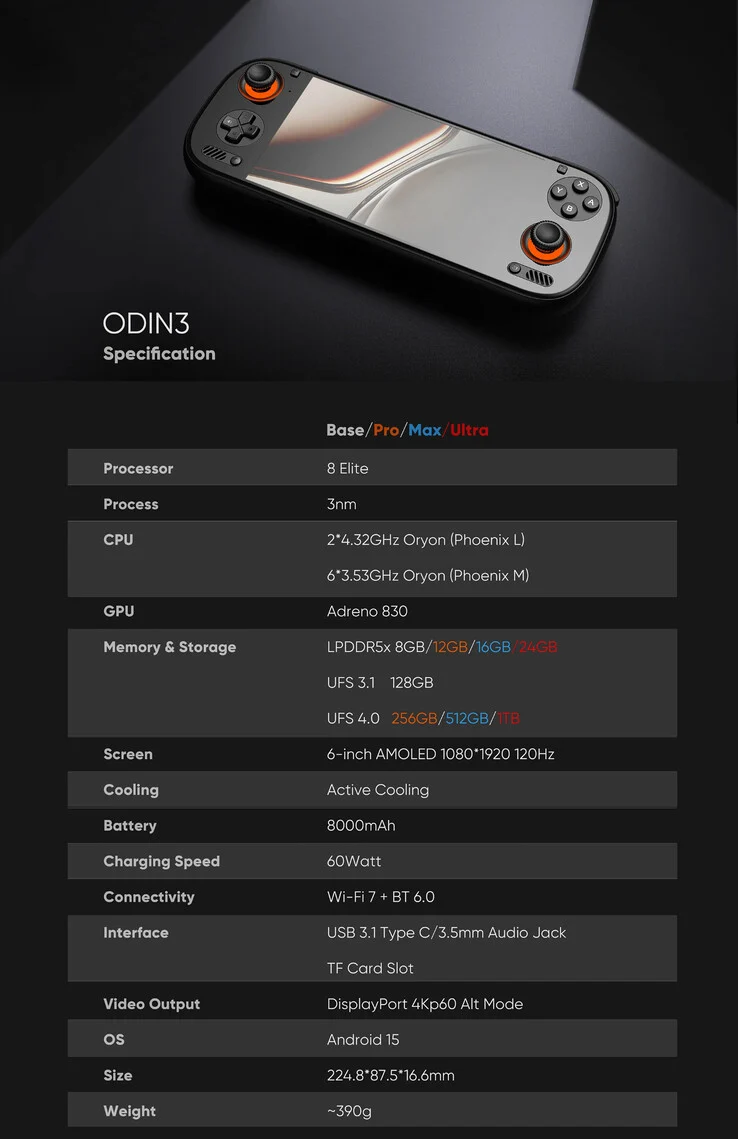
    To keep it simple, we’ve added an image below that highlights the main specifications of the device. The AYN Odin 3 starts at $329 when bought from AYN Technologies’ official website. This is a $30 increase from its initial Indiegogo launch price. This particular version comes with 8 GB of LPDDR5X RAM and 128 GB of UFS 3.1 storage.

    Sadly, AYN Technologies reserves UFS 4.0 flash storage for its Pro, Max, and Ultra versions, which are priced at $399, $449, and $519, respectively. At this moment, AYN Technologies plans to start shipping Odin 3 pre-orders made on its website by the end of November, and customers will receive a free TPU protective case as an added bonus.

    Source:
    Link


  • Asus ROG Xbox Ally X Performance Boost on Bazzite OS vs Windows 11

    Asus ROG Xbox Ally X Performance Boost on Bazzite OS vs Windows 11

    Key Takeaways

    1. The ROG Xbox Ally X is a next-gen gaming handheld powered by Ryzen AI Z2 Extreme, with initial user reviews emerging as orders ship.
    2. Bazzite OS, based on Fedora, offers a SteamOS-like experience and allows for quicker game resumption compared to Windows 11.
    3. Performance tests show Bazzite OS delivering up to 32% better FPS in Kingdom Come: Deliverance 2 compared to Windows 11.
    4. In Hogwarts Legacy, Bazzite OS also outperformed Windows 11, achieving up to 24% higher FPS.
    5. Benefits of using Bazzite OS include better battery life and increased stability alongside improved performance.


    The ROG Xbox Ally X has just been released as a true next-gen gaming handheld, powered by the Ryzen AI Z2 Extreme. As Asus has started to ship out orders, a growing number of users are sharing their thoughts. One notable review comes from YouTuber Cyber Dopamine, who has conducted a performance comparison between running Windows 11 and Bazzite OS on the device.

    Understanding Bazzite OS

    For those who might not know, Bazzite OS is based on Fedora and aims to provide a SteamOS-like experience. In the comparison video, the YouTuber first looked into features like how easily users can return to a game after suspending their system.

    Performance Insights

    As expected, jumping back into a game after suspension is straightforward on Bazzite OS. In contrast, on Windows 11, it takes a bit longer to get back into gameplay. When comparing performance, the YouTuber ran tests on Kingdom Come: Deliverance 2 and Hogwarts Legacy in various power modes.

    Kingdom Come: Deliverance 2 showed an average of 47 FPS at 17 W on Windows 11, while Bazzite OS managed an average of 62 FPS. In 13 W mode, the averages were 35 FPS for Windows and 37 FPS for Bazzite OS. Thus, the ROG Xbox Ally X (the non-X version is available on Amazon) can achieve up to 32% better performance on this game when using Bazzite OS.

    Hogwarts Legacy Performance

    Regarding the second game, Hogwarts Legacy, the handheld could achieve an average of 60 FPS in 35 W mode, 50 FPS in 50 W mode, and 38 FPS in 13 W mode while on Windows 11. In contrast, Bazzite OS provided average frames of 65 FPS, 62 FPS, and 37 FPS, respectively. Here, the performance improvement reaches as much as 24%.

    While the difference in performance might not seem significant, as Cyber Dopamine points out, there are advantages like better battery life and increased stability when using Bazzite OS.

    Source:
    Link


  • Xbox Magnus Specs Leak: AMD 3nm Chip May Outperform PS6

    Xbox Magnus Specs Leak: AMD 3nm Chip May Outperform PS6

    Key Takeaways

    1. Dual-Chiplet Design: The Xbox Magnus APU features a dual-chiplet architecture with a 144 mm² SoC die for CPU and an advanced 264 mm² GPU die, making it the largest console APU to date.

    2. Modular Approach: AMD’s modular strategy allows for shared GPU chiplets between desktop and console, streamlining development and reducing engineering redundancy.

    3. Enhanced Features: The APU includes 70 RDNA 5 compute units, a significant increase in L2 cache, and a hybrid CPU design with high-performance and efficiency cores, optimizing it for gaming.

    4. Power and Performance Expectations: Estimated power consumption ranges from 250 to 350 W, with potential performance exceeding Sony’s console by 15-30%, targeting 4K 144 Hz gaming.

    5. Success Criteria: For Magnus to succeed, it must support backward compatibility, deliver competitive Windows gaming performance, and feature at least 48 GB of GDDR7 memory.


    YouTube channel Moore’s Law Is Dead has released a new episode of Broken Silicon that summarizes everything known about AMD’s Magnus APU, which is widely considered to be the chip for Microsoft’s upcoming Xbox. Earlier videos shared bits of information, but the recent episode combines those leaks with new technical insights.

    Dual-Chiplet Design

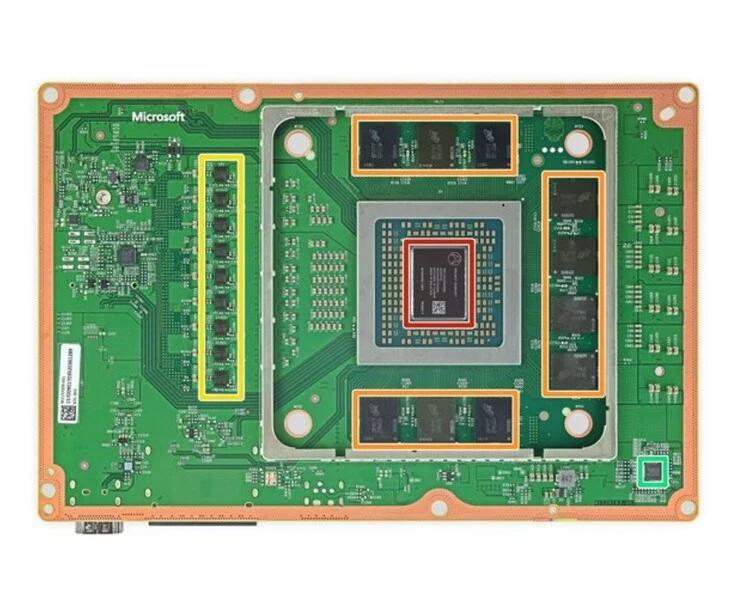
    In the update, podcast host Tom describes the Xbox Magnus APU as a dual-chiplet design that connects two dies using advanced bridge packaging. The first die is a 144 mm² SoC die that contains the CPU cores, NPU, and key I/O components, built using TSMC’s N3P process. The second is a larger 264 mm² GPU die, likely manufactured on TSMC’s N3C or N3P node, which includes the GPU logic and another memory controller. Together, they make up 408 mm² of 3 nm silicon, making the Magnus the largest console APU ever made.

    Modular Approach

    Tom points out that the design reflects AMD’s latest modular strategy, where GPU chiplets are shared between desktop RDNA 5 graphics cards and console platforms. This hardware similarity, he says, should help streamline the development process for both PC and Xbox, while also decreasing AMD’s engineering redundancy.

    The GPU section includes 70 RDNA 5 compute units, with 68 enabled in the final retail version. These are spread across four shader engines, three of which have nine workgroups (18 CUs each) and one smaller engine with eight workgroups (16 CUs), resulting in a deliberately uneven layout. During Hot Chips, AMD allegedly discussed this asymmetric design, confirming that RDNA 4 and newer can effectively share memory across uneven shader clusters without hurting performance. The Magnus APU seems to be one of the first real-world examples of this idea.

    Enhanced Features

    Every shader engine has two arrays, and the GPU is equipped with 24 MB of L2 cache, which is about five times more than what the Xbox Series X has. Although it doesn’t include Infinity Cache, Tom mentions that the larger L2 cache essentially serves a similar role by maintaining bandwidth and enhancing frame stability and ray-tracing performance when paired with the efficient GDDR7.

    On the CPU side, Magnus includes three high-performance Zen 6 cores, each expected to reach close to 6 GHz, along with eight Zen 6C efficiency cores. They share 12 MB of L3 cache. While this cache may appear small for an 11-core setup, Tom argues that this hybrid layout is specifically optimized for gaming: a few strong cores take care of the main game threads, while the efficiency cores handle background tasks. This uneven CPU structure reflects current trends in modern PC architectures too.

    The APU connects through a 192-bit GDDR7 memory interface, allowing for a configuration of up to 48 GB of unified memory. Of this, 16 GB can be allocated as VRAM and 32 GB as system memory, he explains. This combined pool dynamically shares bandwidth between the CPU and GPU, with Tom emphasizing that anything under 40 GB could limit future game development cycles. The integrated NPU is rated for up to 110 TOPS of compute at 6 W, enabling support for Windows Copilot and AI acceleration features.

    Power and Performance Expectations

    Power consumption is estimated to be between 250 and 350 W, depending on clock settings, which might require a three-prong power connector like the one used by the PlayStation 3. Tom speculates that Magnus could start production in 2027, coinciding with the anticipated launch of the PlayStation 6 Orion.

    Tom claims that based on the specifications, Magnus could outperform Sony’s console by about 15–30 percent, or even up to 35 percent if it ships with higher clock speeds and faster GDDR7 memory. He adds that the Xbox is aimed for 4K 144 Hz gaming, while Sony targets 4K 120 Hz, highlighting Microsoft’s goal of providing a more PC-like gaming experience. However, Tom cautions that this enhanced performance could come with a higher price tag. The use of multiple chiplets, increased power consumption, and advanced packaging might push retail prices into the $1,000–$1,500 range, which is significantly above traditional consoles but still competitive with high-end prebuilt gaming PCs.

    Tom concludes that for Magnus to be successful, three criteria need to be met: it must support backwards compatibility across all Xbox generations, provide Windows gaming performance close to SteamOS efficiency, and include at least 48 GB of GDDR7 memory. If these conditions are fulfilled, he believes it could represent a “bridge generation,” a hybrid PC-console that redefines the Xbox experience.

    During the episode, viewer inquiries led to further discussion. One viewer asked if RDNA 5 could exceed Nvidia’s Blackwell GPUs in ray-tracing tasks if raster performance was similar. Tom confirmed: “Yes, of course … RDNA 5 should surpass Blackwell that launches in 2025. My AMD sources have been saying since 2022 that RDNA 5 is where AMD focuses on ray tracing. RDNA 4 wasn’t even the real try; they were just trying to catch up.”

    A different viewer questioned the potential for 3D V-Cache in consoles. Tom dismissed it, saying that well-optimized console games “don’t require as much cache,” and that RDNA 5 already increases L2 capacity five times over current designs to compensate for bandwidth limitations.

    Another viewer inquired if Magnus would include features from PlayStation 6, like Sony’s rumored universal compression tool. Tom suggested that feature equality is highly likely: “I’d expect most features in the PS6 will also be in Magnus, just as most PS5 features were in the Series X. The difference is that Mark Cerny built a better house with the same Lego blocks.” He acknowledged Sony’s hardware team for paying more attention to specialized components like its SSD and I/O controller but argued that both companies fundamentally work from similar AMD building blocks.

    Source:
    Link



  • ASUS and AMD Launch Call of Duty Black Ops 7 TUF Gaming RX 9070 XT

    ASUS and AMD Launch Call of Duty Black Ops 7 TUF Gaming RX 9070 XT

    Key Takeaways

    1. ASUS, AMD, and Call of Duty collaborated to launch a limited-edition TUF Gaming Radeon RX 9070 XT graphics card, themed after Call of Duty: Black Ops 7.
    2. The graphics card features AMD’s RDNA 4 architecture, 16 GB of GDDR6 memory, and supports FSR 4 upscaling technology for enhanced visuals and performance.
    3. Enhanced cooling and durability are provided by three Axial-tech fans, a phase-change thermal pad, and a metal exoskeleton, along with a Dual BIOS switch for performance control.
    4. The graphics card includes a digital version of Call of Duty: Black Ops 7 and will be available at select retailers, with only about 1,000 units produced worldwide.
    5. The unique design and limited availability may lead to higher prices and increased collectibility among fans and gamers.


    ASUS has teamed up with AMD and Call of Duty to unveil a limited-edition TUF Gaming Radeon RX 9070 XT, inspired by Call of Duty: Black Ops 7. This partnership was first announced at the Call of Duty NEXT event in Las Vegas on September 30, paving the way for the game’s worldwide launch on November 14, 2025. The graphics card features a unique design that showcases the Black Ops emblem along with distinct orange highlights, making it instantly appealing to fans of the franchise. Each graphics card will come with a digital version of the standard PC game and will be sold through selected retailers across the globe.

    Specifications and Features

    The Call of Duty Black Ops 7 Special Edition graphics card is built on AMD’s cutting-edge RDNA 4 architecture and is equipped with 16 GB of GDDR6 memory. It also supports AMD’s FSR 4 upscaling technology, which employs machine learning to enhance visuals and boost frame rates in over 85 games. For display connectivity, ASUS provides DisplayPort 2.1 outputs, which can handle high refresh rates and ultra-high resolutions, making this card well-suited for high-performance gaming setups.

    Cooling and Durability

    In terms of cooling and durability, ASUS has enhanced this model with three 11-blade Axial-tech fans that ensure steady airflow through a well-designed heatsink. The fans can completely shut off during light tasks to ensure quiet operation, while large vents on the aluminum backplate allow heat to escape efficiently. Additionally, the card features a Dual BIOS switch, enabling users to toggle between performance and quiet modes without needing extra software. ASUS GPU Tweak III software offers even more control, allowing users to adjust settings, monitor temperatures, and change fan speeds right from their desktops.

    Innovative Design

    Rather than using conventional thermal paste, ASUS has implemented a phase-change thermal pad that liquefies under heat to fill tiny gaps between the GPU and cooler, enhancing heat transfer and promoting long-term reliability. The metal exoskeleton adds extra strength, and dual-ball fan bearings prolong the life of the fans. A built-in GPU holder keeps the card stable within a case, preventing sagging over time. These thoughtful design elements make the TUF Gaming line attractive to builders who prioritize both performance and durability.

    Despite sharing the same core components as the standard TUF Gaming RX 9070 XT, this special edition distinguishes itself with its unique design and exclusivity. It is reported that ASUS will manufacture only about 1,000 units worldwide, which naturally increases its collectibility. The bundle that includes the game makes it even more enticing for fans eager to play Call of Duty: Black Ops 7 on PC. However, the limited availability may result in higher prices and potential shortages in various markets.

    Source:
    Link


  • Resident Evil 0 Remake Rumors: Actor Hints at Project Chamber

    Resident Evil 0 Remake Rumors: Actor Hints at Project Chamber

    Key Takeaways

    1. Jon McLaren’s online resume hints at his involvement in a new AAA project, codenamed “Project Chamber,” possibly related to a Resident Evil 0 remake.

    2. McLaren, known for voicing Star-Lord in Marvel’s Guardians of the Galaxy, may portray Billy Coen due to his resemblance to the character.

    3. Speculation arises from previous leaks suggesting that remakes of Resident Evil 0 and Resident Evil: Code Veronica are being developed by Capcom.

    4. Resident Evil 0 originally launched in 2002 as a prequel, featuring characters Rebecca Chambers and Billy Coen, with a potential remake expected by 2028.

    5. Capcom is focusing on expanding its Resident Evil series beyond main titles, with discussions ongoing about future remakes to reach a wider audience.


    New whispers about a possible remake of Resident Evil 0 have emerged following the finding of an intriguing entry in actor Jon McLaren’s online resume, suggesting his involvement in an unnamed AAA project codenamed “Project Chamber.”

    Jon McLaren’s Credentials

    McLaren, who is notably recognized for voicing Star-Lord in the 2021 game Marvel’s Guardians of the Galaxy, also has credits in titles like Far Cry 5. Recently, he added Project Chamber to his acting credits, indicating a leading role, with performance capture managed by Beyond Capture Studios. This studio previously provided casting, mocap, and performance services for Capcom’s 2023 Resident Evil 4 Remake and its Separate Ways DLC.

    Speculations About the Game

    This link has sparked speculations that Project Chamber may directly reference Rebecca Chambers from Resident Evil 0, who is one of the two main characters in the game. McLaren’s likeness to Billy Coen further supports the idea that he is an ideal candidate for the role of Billy.

    The initial report about this leak came from MP1st, which adds weight to prior assertions by leaker Dusk Golem. Last year, Golem claimed that remakes for both Resident Evil 0 and Resident Evil: Code Veronica were actively in the works.

    The Original Game and Future Plans

    Resident Evil 0 made its debut as a Nintendo GameCube exclusive in 2002, serving as a prequel to the first game. It features S.T.A.R.S. medic Rebecca Chambers teaming up with Billy Coen to unveil the secrets of the Umbrella Corporation.

    There were expectations for the Resident Evil 0 remake to launch in early 2026; however, with no official announcement forthcoming, it appears that Capcom has changed its focus. The company has redirected its efforts toward the release of Resident Evil Requiem, which is now set for February 2026, while a potential Resident Evil: Code Veronica remake is anticipated in the first quarter of 2027.

    Development Timeline

    Online rumors suggest that the remake has been under development at Capcom’s internal studio for several years, with voice acting and performance capture planned for 2024, aiming for a release in 2028.

    The anticipated project is likely to feature a more cinematic style, improved graphics, and revamped gameplay mechanics, akin to what has been showcased in the recent series of Resident Evil remakes.

    In July 2023, Capcom responded to inquiries about broadening remakes beyond the primary numbered titles during a Q&A session with shareholders. They noted they were “engaging in discussions about the future expansion of this series so it can be enjoyed by a wide audience.”

    Source:
    Link