Category: Computers

  • Mars Clocks Run 477 Microseconds Faster Than Earth’s: Why It Matters

    Mars Clocks Run 477 Microseconds Faster Than Earth’s: Why It Matters

    Key Takeaways

    1. Clocks from Earth run 477 microseconds faster on Mars due to weaker gravity and unique orbital characteristics.
    2. The time difference is supported by general relativity, which explains how clocks operate in different gravitational pulls.
    3. Mars’ elliptical orbit and gravitational influences can cause daily time fluctuations of ±226 microseconds.
    4. Precise navigation is crucial for Mars exploration missions, necessitating synchronization between Earth and Mars operations.
    5. Infrastructure on Mars, like autonomous systems and GPS, must account for time discrepancies to avoid operational errors.


    Billionaire Elon Musk has dreams of creating a colony on Mars. Researchers Neil Ashby and Bijunath R. Patla have found that one important challenge for those living there is how they perceive time. Their research shows that clocks from Earth, when brought to Mars, actually run 477 microseconds faster.

    Understanding Time Differences

    Ashby and Patla identified that this time difference is due to the weaker gravity on Mars and its peculiar orbit. They support their findings with the theory of general relativity, which suggests that clocks operate more quickly in areas with less gravitational pull.

    The Impact of Mars’ Orbit

    The scientists also considered how Mars’ elliptical shape and the gravitational influence from other bodies in the solar system affect time. Together, these elements can cause time to fluctuate on Mars by as much as ±226 microseconds each day.

    Importance for Exploration Missions

    When planning missions, having precise navigation is essential. Engineers must work to ensure that operations between Earth and Mars are in sync. Therefore, exploration efforts need to adjust for the Martian time lead when determining timing needs.

    For example, 5G networks on Earth require precision to one-tenth of a microsecond. While creating infrastructure for Mars, such as autonomous rovers and GPS-like systems, planners must adhere to equally strict standards. The research warns that ignoring the time discrepancy could result in significant operational mistakes.

    Source:
    Link


  • GeForce RTX 5070 Ti and 192 GB RAM: Hot Facebook Marketplace Deal

    GeForce RTX 5070 Ti and 192 GB RAM: Hot Facebook Marketplace Deal

    Key Takeaways

    1. RAM prices have surged, with a 32 GB kit from G.Skill exceeding $300 in a few weeks.
    2. A Corsair Vengeance kit is priced at $2,201.99, while a user bought it for around $375, highlighting a significant price discrepancy.
    3. The cost of a large RAM kit (192 GB) is compared to high-end graphics cards, like the RTX 5070 Ti.
    4. Community reactions suggest that the value of the RAM might be equivalent to an RTX 5080 or RTX 5090, or a high-end monitor instead.
    5. The user expressed satisfaction with their purchase despite the high RAM price, stating they have no use for the alternative options.


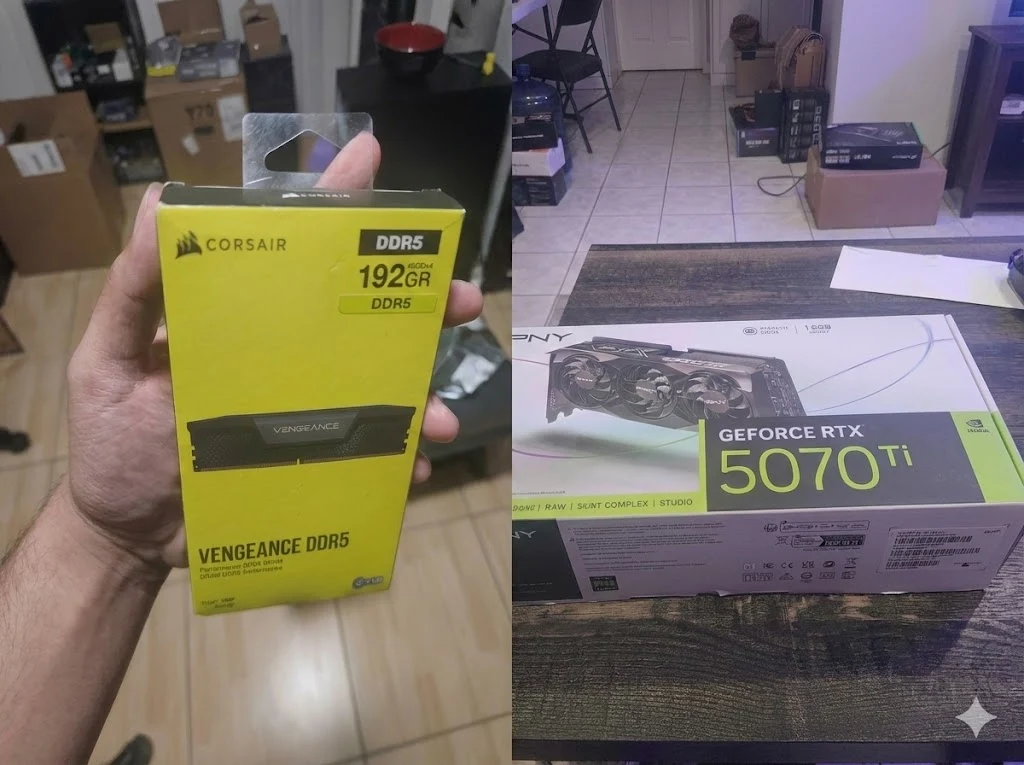
    Skyrocketing RAM prices have become a hot topic recently. For instance, a small 32 GB kit from G.Skill has seen its price rise to over $300 in just a few weeks. If you scale this up, a 192 GB kit could cost a fortune. Interestingly, one user on Facebook figured out that this massive RAM amount was comparable to an RTX 5070 Ti graphics card.

    Corsair Vengeance Kit Price

    The Corsair Vengeance kit mentioned earlier is priced at an astonishing $2,201.99 on Corsair’s own website. The Facebook user said he purchased it for around $375. While the kit is indeed brand new, currently, there isn’t much difference between new and used memory. In essence, the user ended up with a GPU worth about $800 for $2,200 in memory, which is quite a bad deal.

    Community Reactions

    Comments on the post reflect a similar sentiment, with many users suggesting that the RAM was likely worth an RTX 5080 or even an RTX 5090. Another option brought up was a certain Asus 27-inch QD-OLED 240Hz monitor (possibly the ROG Swift OLED PG27UCDM), which retails for roughly $1,190 when new. Together, the GPU and monitor could have been a fairer trade, but the user doesn’t seem to mind, simply saying, “Just have no use for them,” expressing satisfaction with his choice.

    Source:
    Link


  • AMD Ryzen 7 9850X3D TDP Revealed in Recent Leak

    AMD Ryzen 7 9850X3D TDP Revealed in Recent Leak

    Key Takeaways

    1. The AMD Ryzen 7 9850X3D has a base TDP of 120 Watts, same as the Ryzen 7 9800X3D.
    2. It is expected to maintain eight Zen 5 CPU cores and may achieve boost clocks of around 5.5 GHz.
    3. Potential overclocking capabilities could allow reaching up to 6 GHz with proper cooling.
    4. No official release date is set, but it may be revealed at CES 2025 alongside other new models.
    5. Enthusiasts are excited about the performance enhancements hinted at by recent leaks.


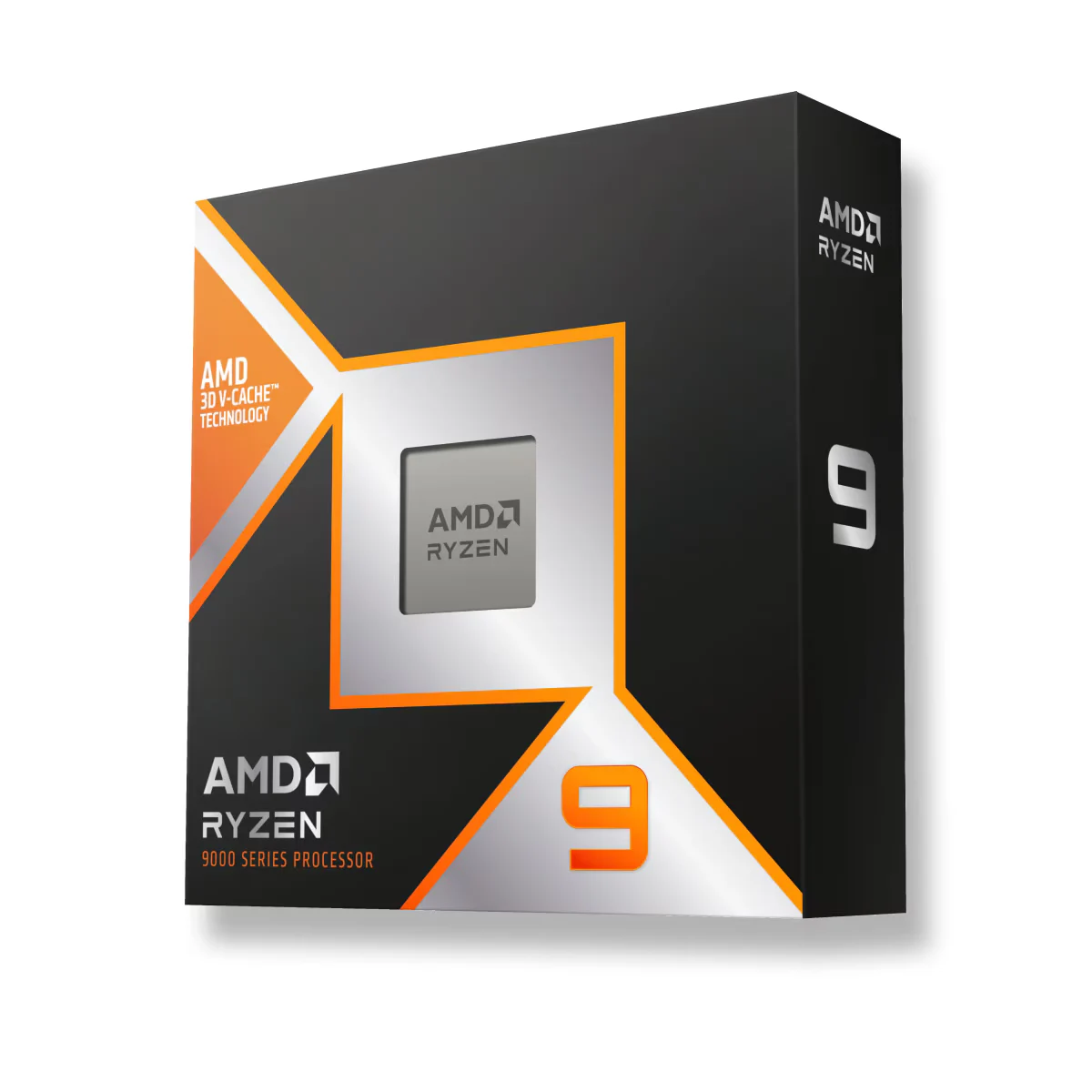
    The AMD Ryzen 7 9850X3D has made another appearance online, just after AMD mistakenly posted details about the new Zen 5 X3D CPU on its site. This time, an X leaker found it in a shipping document, revealing that its base TDP is identical to that of the Ryzen 7 9800X3D, which is 120 Watts.

    Possible Upgrades

    Even though the name might imply only a small upgrade, the Ryzen 7 9850X3D could offer more than just a minor enhancement over the 9800X3D. It is expected to maintain eight Zen 5 CPU cores. An earlier leak from Moore’s Law is Dead suggested that a new CCD might enable higher boost clocks. A figure of 5.5 GHz appears to be reasonable from the start since that’s what the higher-end Ryzen 9 9900X3D runs at.

    Overclocking Potential

    This new CCD could allow overclockers to push the Ryzen 7 9850X3D even further. With the right cooling and luck with the silicon, hitting the impressive 6GHz mark could be within reach—a remarkable feat for a Ryzen 7 X3D processor. Currently, the 9850X3D does not have a set release date, but given the rising number of leaks, it is likely to be revealed at CES 2025 along with the dual-X3D Ryzen 9 9950X3D2 and Gorgon Point laptop models. There are rumors about new RDNA 4 GPUs making an appearance too, but there hasn’t been any proof of their launch yet.

    Conclusion

    It remains to be seen how these new processors will perform upon release, but the excitement around the AMD Ryzen 7 9850X3D is certainly building. The leaks are giving enthusiasts much to discuss, and the potential for enhanced performance is something many are looking forward to.

    Source:
    Link


  • Ubiquiti UniFi 5G Max: Dual-SIM and eSIM Cellular Modem

    Ubiquiti UniFi 5G Max: Dual-SIM and eSIM Cellular Modem

    Key Takeaways

    1. 5G Modem Integration: Ubiquiti’s UniFi 5G Max seamlessly integrates into UniFi networks and supports Power over Ethernet (PoE) for easy installation without nearby power outlets.

    2. Dual SIM Support: The modem features two nano SIM slots and supports eSIM profiles, allowing users to combine a physical SIM with an eSIM for flexibility.

    3. High-Speed Performance: Expected download speeds can reach up to 3.4 Gbps with uplink speeds of around 560 Mbps in non-standalone networks; standalone setups may halve download speeds but increase upload speeds.

    4. Rugged Outdoor Variant: The UniFi 5G Max Outdoor model is designed for tough conditions with an IP67 rating, suitable for rooftop installations and vehicular use.

    5. Pricing and Availability: The UniFi 5G Max is priced at $399, with the outdoor model set to launch in January 2026 at $459, both available on Ubiquiti’s online store.


    Ubiquiti has just unveiled the UniFi 5G Max, a new 5G modem that seamlessly fits into a UniFi network. With support for PoE, this device can link directly to a PoE switch, eliminating the need for a power outlet close by. The RJ45 network port is capable of 2.5GbE speeds.

    Features and Functionality

    The modem includes two physical nano SIM slots for cellular connections and has the ability to support eSIM profiles as well. The Ubiquiti UniFi 5G Max also implements Dual SIM Single Standby (DSSS) mode, allowing one SIM to act as a backup for the other if needed. Users have the option to mix a physical SIM with an eSIM instead of using two physical SIM cards.

    Activating an eSIM requires a manual activation code, as QR codes cannot be utilized. For customers in the US, there might be a minor issue with T-Mobile. Ubiquiti clarifies that users should inform customer support that the supposed incompatibility is actually a database error from T-Mobile. While installing eSIMs on smartphones has become common, it remains a relatively unusual feature for routers. Thus, network providers may not be very familiar with this configuration.

    Speed and Performance

    Expected download speeds can reach up to 3.4 Gbps, with uplink speeds around 560 Mbps in non-standalone networks. However, in standalone scenarios, download speeds are halved, but upload speeds can increase to 650 Mbps. A small status display provides information about the network connection. In addition, the Ubiquiti UniFi 5G Max can switch back to 4G/LTE or even 3G/UMTS if necessary, and the complete list of supported frequency bands is available on the spec sheet. Importantly, a UniFi cloud gateway is needed for the UniFi 5G Max to operate.

    Rugged Design Options

    There’s also a robust variant called the UniFi 5G Max Outdoor. This version boasts an IP67 rating and is designed for improved reception in tougher conditions, like being connected to a cellular tower on a rooftop. Ubiquiti even suggests that the 5G modem can be utilized in a vehicle.

    Ubiquiti’s official MSRP for the UniFi 5G Max is $399. The outdoor model is expected to launch in January 2026 and will retail for $459. Both models are already available on the brand’s official online store.

    Source:
    Link


  • Framework Laptop 13 Now Features 12-Core ARM Processor Upgrade

    Framework Laptop 13 Now Features 12-Core ARM Processor Upgrade

    Key Takeaways

    1. Qualcomm’s Snapdragon X Plus and Snapdragon X Elite show that ARM processors are now viable for laptops, as seen in devices like the Lenovo IdeaPad Slim 5, which offers great battery life and affordability.

    2. MetaComputing has introduced a new competitor in the market with a mainboard featuring the CIX CP8180 ARM chipset, suitable for the Framework Laptop 13 or mini PC cases.

    3. The MetaComputing mainboard includes eight ARM Cortex-A720 performance cores and four Cortex-A520 efficiency cores, along with an ARM Immortalis-G720 GPU and an AI accelerator.

    4. Although the new chipset may not match the speed of top-tier Snapdragon processors, it is expected to handle common tasks effectively, but its power consumption may limit battery life in certain setups.

    5. The MetaComputing ARM AI PC Kit starts at $549 for an entry-level model, with a bundle including the Framework Laptop priced at $999, and additional RAM upgrades available for $100.


    Qualcomm’s Snapdragon X Plus and Snapdragon X Elite have shown that ARM processors are now a valid option in the laptop sector. Devices such as the Lenovo IdeaPad Slim 5 highlight this with their impressive battery life and budget-friendly pricing.

    New Competitor in the Market

    MetaComputing has launched an alternative to established brands like Intel, AMD, and the Snapdragon X series. The company has released a mainboard that can be fitted into the Framework Laptop 13 or a mini PC case. This mainboard features a CIX CP8180 ARM chipset, which is also present in the Minisforum MS-R1. The processor includes eight ARM Cortex-A720 performance cores, with the two fastest capable of reaching boost clock speeds of 2.6 GHz. Additionally, it has four Cortex-A520 efficiency cores.

    Performance Overview

    This setup includes an ARM Immortalis-G720 GPU with ten cores, alongside an AI accelerator that boasts a performance of 30 TOPS. While this chipset may not match the speed of the Snapdragon X Elite or the latest flagship smartphone processors, it should still handle many common tasks effectively. Nonetheless, this mainboard upgrade appears to be primarily aimed at developers, as initial tests indicate that the SoC consumes around 16 watts while idle. This suggests that when paired with the 55Wh battery in the Framework Laptop 13, the battery life may be limited.

    Pricing and Availability

    You can now purchase the MetaComputing ARM AI PC Kit from the manufacturer’s official online store. The entry-level model, which includes 16GB of RAM, a 1TB SSD, and a mini PC case, is priced at $549. The mainboard can also be installed in a previously acquired Framework Laptop 13. For those without a Framework Laptop, a bundle including the notebook is available for $999. MetaComputing also offers an upgrade to 32GB of RAM for an extra $100. While shipping is free globally, the listed prices do not cover import taxes or fees.

    Source:
    Link


  • Ubiquiti Launches Dream Router 5G Max with Tri-Band WiFi

    Ubiquiti Launches Dream Router 5G Max with Tri-Band WiFi

    Key Takeaways

    1. Ubiquiti has launched the Dream Router 5G Max, which features an integrated 5G cellular modem and supports WiFi across three frequency bands: 2.4 GHz, 5 GHz, and 6 GHz (WiFi 7 standard).
    2. The router includes four RJ45 ports and an SFP slot for fiber-optic connections, but technical specifications and multi-gigabit support details are not fully disclosed.
    3. It supports both traditional SIM cards and eSIMs, allowing users to choose between redundancy, failover, or using cellular as the main connection.
    4. The device runs on Unifi OS, allowing the use of Unifi applications, and includes a microSD card slot for storage, along with a status display for network information.
    5. The Dream Router 5G Max is currently not available for sale, and its price and release date have not been announced.


    Ubiquiti has unveiled a fresh WiFi router that features an integrated 5G cellular modem. This new device, named the Dream Router 5G Max, comes packed with a variety of appealing functionalities. Notably, it can establish a WiFi network across three frequency bands: 2.4 GHz, 5 GHz, and 6 GHz. The 6 GHz band is part of the WiFi 7 standard, also referred to as 802.11ax.

    Technical Specs and Features

    Currently, Ubiquiti hasn’t disclosed many technical specifications, but from the pictures, it appears the 5G router includes four RJ45 ports. It’s still uncertain if these ports support multi-gigabit connections (802.11bz). A noteworthy feature is the SFP slot located at the back, which allows for the connection of fiber-optic cables. However, users will need to buy a compatible transceiver separately.

    Cellular Support and Functionality

    As the name suggests, the Ubiquiti Dream Router 5G Max is designed to support the 5G cellular standard. Additionally, this device accommodates both traditional SIM cards and eSIMs. Ubiquiti has stated that users can choose whether to use these cellular connections for redundancy or failover, or as their main connection.

    Additional Features and Availability

    Since this device operates on Unifi OS, it can run Unifi applications. It includes a microSD card slot for file storage or video recordings. Moreover, a status display shows various information about the network connection, such as signal quality, current throughput, and total data usage.

    The Dream Router 5G Max has just been revealed and is not yet available for sale. Unlike other recent 5G products, this router isn’t listed on the brand’s official online store. Therefore, both the price and release date are still a mystery for now.

    Source:
    Link


  • Lenovo ThinkPad P1 Gen 6: RTX 4080, 4K OLED, 64GB DDR5 Discount

    Lenovo ThinkPad P1 Gen 6: RTX 4080, 4K OLED, 64GB DDR5 Discount

    Key Takeaways

    1. The Lenovo ThinkPad P1 Gen 6 with RTX 4080 is currently priced at $1754.05, reflecting a $194 price drop.
    2. It features a powerful 14-core Intel Core i7-13800H CPU and 64 GB of DDR5-5600 RAM with 1 TB of storage.
    3. The GeForce RTX 4080 GPU shows a performance drop of 15% to 20% compared to more powerful GPUs.
    4. The laptop has a stunning 4K OLED display that covers nearly the entire DCI-P3 color gamut, but has some DPC latency issues.
    5. Upgradability is limited as there is only one M.2 slot, which is already in use.


    The Lenovo ThinkPad P1 Gen 6 might not be the newest option on the market, but its powerful components make it a laptop worth looking at if the price is right. Currently, you can snag the version with the RTX 4080 for only $1754.05 on Lenovo’s official site.

    Price Drop Alert

    This latest price reflects a decrease of $194 from its earlier sale price, which we mentioned just over a week ago, making it even more appealing. This model boasts 64 GB of DDR5-5600 RAM and 1 TB of storage. Potential buyers should remember to use the following coupons at checkout: “LENOVOHOLIDEAL” and the classic “EXTRAFIVE.”

    Performance Insights

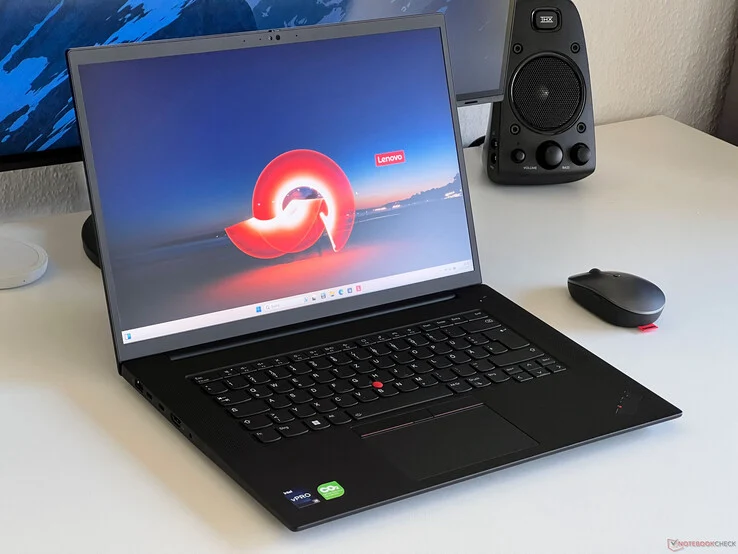
    The 14-core Intel Core i7-13800H “Raptor Lake-H” CPU in the Lenovo ThinkPad P1 is nearing its third birthday, yet it remains quite capable for most tasks. As our review pointed out, the GeForce RTX 4080 Laptop GPU operates at a maximum of 80 watts, which is decent but not exceptional. This leads to a performance drop of about 15% to 20% when compared to other laptops that have more powerful GPUs. After all, the ThinkPad P1 Gen 6 features a sleek design and is built for professional use.

    Display and Upgradability

    Additionally, the ThinkPad P1’s workstation focus is highlighted by its stunning 4K OLED display, which nearly covers the entire DCI-P3 color gamut and has a refresh rate of 60 Hz. The memory and storage can be upgraded by users; however, there is only one M.2 slot that is already in use. Our detailed review also noted issues with DPC latency, as the laptop dropped more frames than expected during 4K60 video playback in a web browser.

    In conclusion, the Lenovo ThinkPad P1 Gen 6 remains an excellent choice for content creators and professionals, particularly at its current all-time low price. If you’re interested in this limited-time offer, it’s a good idea to check out our review of the laptop before making a purchase.

    Source:
    Link


  • ZBox Magnus One: Compact RTX 5070 Ti Gaming Desktop for Sale

    ZBox Magnus One: Compact RTX 5070 Ti Gaming Desktop for Sale

    Key Takeaways

    1. The ZBox Magnus One is a compact gaming PC by Zotac, housed in an 8.4-liter case, currently available only in China.
    2. It features a 20-core Intel Core Ultra 7 265 CPU with a lower thermal design power of 65W, allowing good performance in small spaces.
    3. The PC is equipped with an Nvidia GeForce RTX 5070 Ti graphics card, which is approximately 20% faster than its predecessor.
    4. The ZBox Magnus One supports dual DDR5 memory and has two M.2 2280 slots, along with additional space for a 2.5-inch drive.
    5. Pricing starts at 20,999 Yuan (around $3,000) for the base model, with the upgraded version costing $3,181, but it is not yet available outside of China.


    Zotac has a cool selection of mini and small form factor (SFF) PCs, usually under the ZBox name. The newest model to hit the market is the ZBox Magnus One, which is a compact gaming PC that features powerful gaming components packed into a small 8.4-liter case. Right now, this SFF PC is only being sold in China.

    Performance Specs

    The ZBox Magnus One runs on the 20-core Intel Core Ultra 7 265 CPU, which includes 8 performance cores and 12 efficiency cores. Unlike the unlocked Core Ultra 7 265K, the 265 has a much lower thermal design power (TDP) of 65W compared to 125W. This allows the Ultra 7 265 to perform well in tight spaces, although it does slightly sacrifice performance. Nonetheless, the standard Ultra 7 265 is still quite capable and can manage demanding tasks with ease.

    Graphics and Gaming Capabilities

    Gamers will be happy to find that the ZBox Magnus One comes equipped with the full Nvidia GeForce RTX 5070 Ti graphics card, featuring 16 GB of GDDR7 VRAM. This newer 5070 Ti is approximately 20% quicker than its predecessor. When you compare it with the standard RTX 5070, the 5070 Ti is around 18% faster. However, how the system performs in real life will largely depend on how well Zotac has handled heat management, something that can only be confirmed by third-party reviews.

    Memory and Storage Options

    For memory and storage, the ZBox Magnus One includes dual DDR5 memory slots and two M.2 2280 slots (the Crucial T710 1TB currently sells for $185 on Amazon). Additionally, there’s space for a 2.5-inch drive as well. The PC comes with a variety of ports, which are listed below:

    The ZBox Magnus One SFF gaming PC is currently available on JD.com for 20,999 Yuan, which is around $3,000, for the version without any memory or storage options. Meanwhile, the configuration with 16 GB of memory and a 1 TB SSD costs $3,181. Zotac usually expands its products beyond China, but there’s no specific launch date for that yet.

    Source:
    Link


  • Acemagic Launches Tank M1A Pro Plus Mini-PC with AMD Radeon 8060S

    Acemagic Launches Tank M1A Pro Plus Mini-PC with AMD Radeon 8060S

    Key Takeaways

    1. Acemagic has introduced a new mini-PC model, the M1A Pro Plus, using AMD’s Strix Halo platform.
    2. The M1A Pro Plus replaces the dedicated graphics card found in its predecessor, the M1A Tank 03, with an integrated Radeon 8060S GPU.
    3. The new model features a Ryzen AI Max+ 395 APU, which outperforms the Intel Core i9-12900H in raw power.
    4. The M1A Pro Plus supports up to 128 GB of LPDDR5X RAM and 12 TB of storage, along with Wi-Fi 7 connectivity.
    5. Pricing and availability details for the M1A Pro Plus have not yet been revealed.


    Acemagic has launched a variety of mini-PCs in the past, such as the F5A, which debuted this summer using AMD’s Strix Point architecture. Recently, the firm has provided some early information about a new model that aims to compete with the GMKtec EVO-X2 (currently priced at $1,699 on Amazon) and other premium mini-PCs.

    New Updates

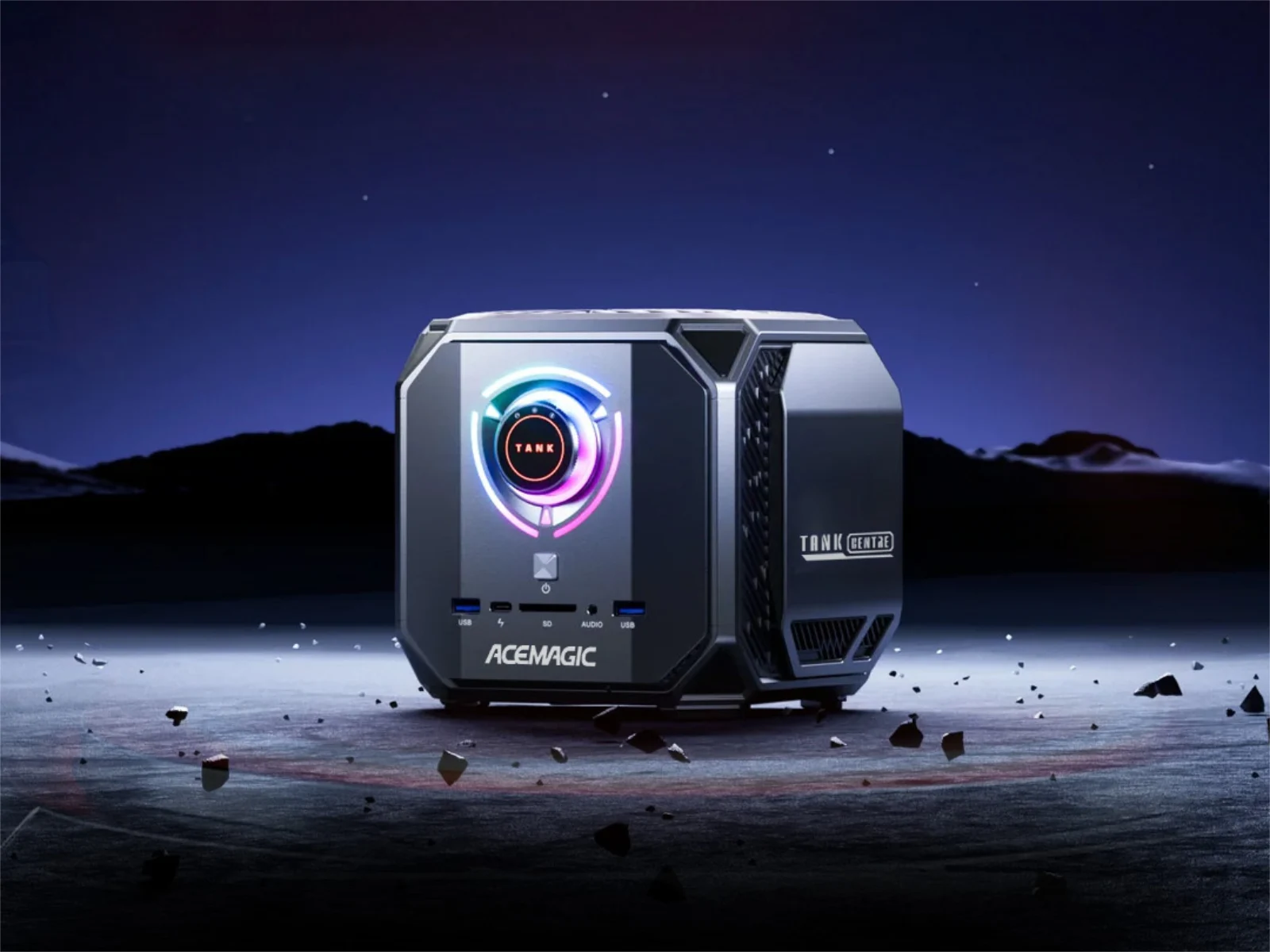
    To put it simply, Acemagic seems to have refreshed the M1A Tank 03 by adopting AMD’s Strix Halo platform. Previously, the M1A Tank 03 was outfitted with a powerful Intel Core i9-12900H CPU and Nvidia’s GeForce RTX 3080 laptop GPU. In contrast, the new Tank M1A Pro Plus opts to eliminate the dedicated graphics card entirely.

    Instead of a dedicated GPU, Acemagic has included the Ryzen AI Max+ 395 combined with the Radeon 8060S integrated GPU. While the AMD Strix Halo APU outperforms the Core i9-12900H in terms of raw power, the situation is more complex regarding GPU performance. Benchmarks indicate that the Radeon 8060S performs similarly to the GeForce RTX 3080 laptop GPU. Therefore, the M1A Pro Plus might not necessarily excel over the M1A Tank 03 in gaming scenarios.

    Specifications to Note

    That said, the Tank M1A Pro Plus is also equipped with up to 128 GB of LPDDR5X RAM operating at 8,000 MT/s, along with 12 TB of storage and Wi-Fi 7 support. However, Acemagic has yet to disclose any information about the pricing or availability for this model. Instead, the company has merely hinted that the Strix Halo mini-PC will be released soon.

    Source:
    Link


  • Ryzen AI 5 430 Appears on CrossMark with Small Performance Boost

    Ryzen AI 5 430 Appears on CrossMark with Small Performance Boost

    Key Takeaways

    1. The Ryzen AI 5 430 is the entry-level Gorgon Point CPU, featuring four cores and eight threads.
    2. It scored 1,526 points in BAPco’s CrossMark database, indicating a performance increase of about 13% over its predecessor, the Ryzen AI 5 330.
    3. The CPU is paired with a Radeon 840M iGPU and supports 64 GB of DDR5-5600 memory.
    4. There is limited information available on key specifications such as base and boost clock speeds and TDP.
    5. The performance of the Ryzen AI 5 430 in real-world scenarios is expected to improve since the tested sample is likely a pre-production version.


    After the anticipated release of AMD’s Ryzen AI 9 HX 470, Ryzen AI 9 465, and Ryzen AI 7 450, another Gorgon Point CPU has appeared online. Up to this point, most of the CPUs we’ve seen are updated versions of Strix Point CPUs with slight improvements in specifications. A well-known leaker on X, @Olrak29_, has revealed that the Ryzen AI 5 430 seems to be the entry-level Gorgon Point CPU for this generation.

    Scoring Details

    It was found in BAPco’s CrossMark database, achieving an overall score of 1,526 points. According to the listing, the Ryzen AI 5 430 features four CPU cores and eight threads. If we look at the previous generation Ryzen AI 5 330 as a guide, it will probably have a 1+3 core setup, consisting of one Zen 5 core and three Zen 5c cores. Sadly, the listing lacks information on other important specifications, including base and boost clock speeds and TDP.

    Performance Insights

    This CPU is paired with a Radeon 840M iGPU and comes with 64 GB of DDR5-5600 system memory. In terms of performance, the Ryzen AI 5 430 is roughly 13% faster compared to the Ryzen AI 5 330, which managed to score 1,347 points in the same test. The actual performance in real-world scenarios is expected to be even better, since the Gorgon Point sample examined above is likely a pre-production version.


    Source:
    Link