Tag: RTX 4080

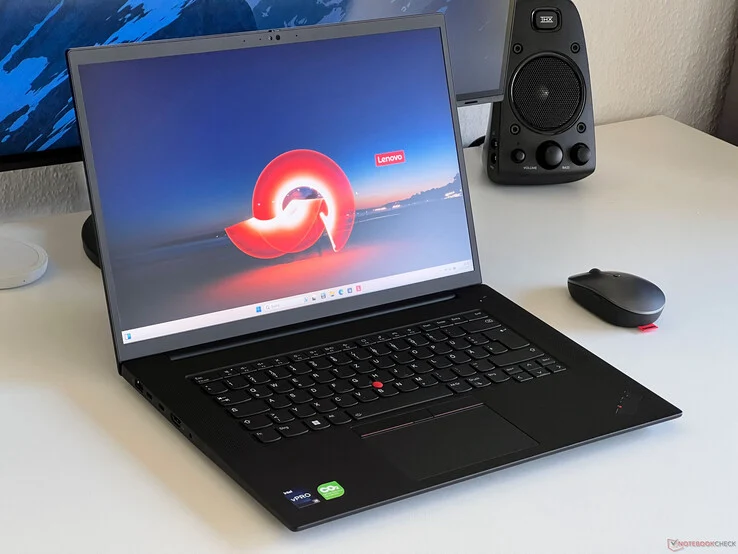
  • Lenovo ThinkPad P1 Gen 6: RTX 4080, 4K OLED, 64GB DDR5 Discount

    Lenovo ThinkPad P1 Gen 6: RTX 4080, 4K OLED, 64GB DDR5 Discount

    Key Takeaways

    1. The Lenovo ThinkPad P1 Gen 6 with RTX 4080 is currently priced at $1754.05, reflecting a $194 price drop.
    2. It features a powerful 14-core Intel Core i7-13800H CPU and 64 GB of DDR5-5600 RAM with 1 TB of storage.
    3. The GeForce RTX 4080 GPU shows a performance drop of 15% to 20% compared to more powerful GPUs.
    4. The laptop has a stunning 4K OLED display that covers nearly the entire DCI-P3 color gamut, but has some DPC latency issues.
    5. Upgradability is limited as there is only one M.2 slot, which is already in use.


    The Lenovo ThinkPad P1 Gen 6 might not be the newest option on the market, but its powerful components make it a laptop worth looking at if the price is right. Currently, you can snag the version with the RTX 4080 for only $1754.05 on Lenovo’s official site.

    Price Drop Alert

    This latest price reflects a decrease of $194 from its earlier sale price, which we mentioned just over a week ago, making it even more appealing. This model boasts 64 GB of DDR5-5600 RAM and 1 TB of storage. Potential buyers should remember to use the following coupons at checkout: “LENOVOHOLIDEAL” and the classic “EXTRAFIVE.”

    Performance Insights

    The 14-core Intel Core i7-13800H “Raptor Lake-H” CPU in the Lenovo ThinkPad P1 is nearing its third birthday, yet it remains quite capable for most tasks. As our review pointed out, the GeForce RTX 4080 Laptop GPU operates at a maximum of 80 watts, which is decent but not exceptional. This leads to a performance drop of about 15% to 20% when compared to other laptops that have more powerful GPUs. After all, the ThinkPad P1 Gen 6 features a sleek design and is built for professional use.

    Display and Upgradability

    Additionally, the ThinkPad P1’s workstation focus is highlighted by its stunning 4K OLED display, which nearly covers the entire DCI-P3 color gamut and has a refresh rate of 60 Hz. The memory and storage can be upgraded by users; however, there is only one M.2 slot that is already in use. Our detailed review also noted issues with DPC latency, as the laptop dropped more frames than expected during 4K60 video playback in a web browser.

    In conclusion, the Lenovo ThinkPad P1 Gen 6 remains an excellent choice for content creators and professionals, particularly at its current all-time low price. If you’re interested in this limited-time offer, it’s a good idea to check out our review of the laptop before making a purchase.

    Source:
    Link


  • FA65G Mini PC: AMD Ryzen 7 9800X3D & RTX 4080/5000 Demo

    FA65G Mini PC: AMD Ryzen 7 9800X3D & RTX 4080/5000 Demo

    Key Takeaways

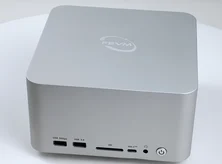
    1. FEVM’s FA65G mini PC features a design inspired by Apple’s Mac Studio and supports desktop Ryzen 9000X3D processors paired with mobile RTX 4080 and RTX 5000 Ada GPUs.
    2. The FA65G has a compact size of 167.5 x 167.5 x 96 mm and offers configurations with Ryzen 7 9800X3D, upgradeable to Ryzen 9 9900X3D or 9950X3D, with adjustable TDP settings.
    3. The system includes MXM variants of RTX 4080 and RTX 5000 Ada GPUs, equipped with a custom cooling solution and requires a 330W power adapter.
    4. Port selection includes USB4, HDMI 2.1, dual 2.5 GbE NICs, and the system supports up to 128 GB of DDR5-6400 RAM with easy access for upgrades.
    5. Performance tests show the RTX 4080 LP GPU in MXM form-factor is competitive with desktop GPUs, while the Ryzen 9800X3D maintains acceptable thermal limits during stress testing, although pricing and availability remain unclear.


    FEVM is a newer player in the mini PC market hailing from China. The company is recognized for its design that takes cues from Apple’s Mac Studio, modifying it to house desktop-level X86 processors alongside mobile dGPUs in an MXM form-factor. Previously, FEVM successfully integrated Raptor Lake Refresh-S processors with mid-range RTX 4060 mobile GPUs into compact 2.5-liter cases. However, the latest release, the FA65G model, steps it up by accommodating desktop Ryzen 9000X3D processors paired with mobile RTX 4080 and even RTX 5000 Ada GPUs.

    Dimensions and Specifications

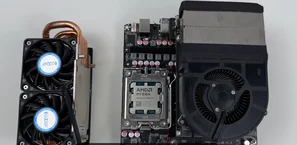
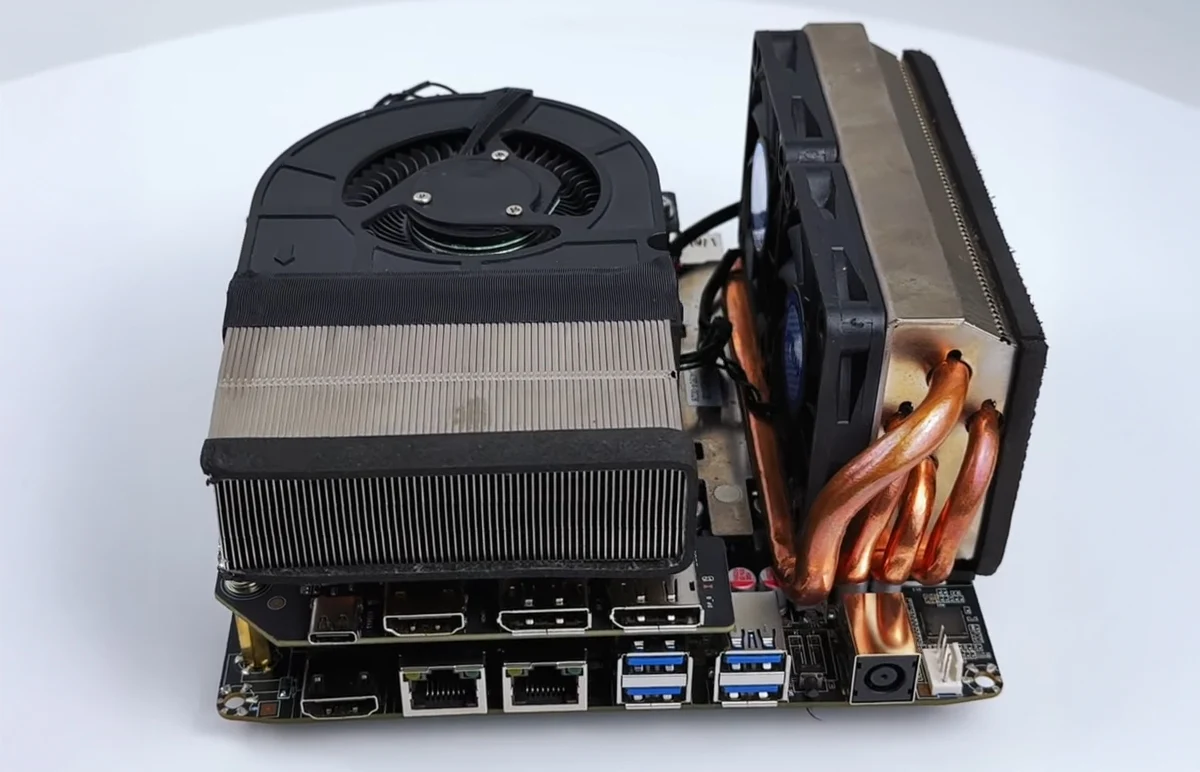
    The revamped Mac Studio design of the FA65G measures 167.5 x 167.5 x 96 mm and weighs 1.85 kg. It features a mini-ITX motherboard based on the B650 chipset, equipped with a desktop-grade AM5 socket that supports the newest Ryzen 9000X3D processors. FEVM provides configurations with the Ryzen 7 9800X3D, but users may upgrade to a Ryzen 9 9900X3D or Ryzen 9 9950X3D, as hinted in the advertising video. It’s worth noting that the AM5 socket needs a custom card and cooler to be attached on top of the motherboard’s default socket. FEVM offers various TDP settings for the processor, capping maximum power between 100W and 65W.

    Graphics Card Adaptation

    When it comes to graphics, FEVM has managed to fit MXM variants of the RTX 4080 and RTX 5000 Ada laptop GPUs, which can be hard to find currently. The MXM GPUs are arranged like desktop GPUs and come with a custom cooling solution that includes a substantial radiator with four heat pipes, cooled by dual fans. To support these GPUs, FEVM provides a 330W adapter weighing around 530g.

    Ports and Upgradability

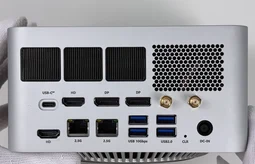
    The port selection mirrors that of a Mac Studio, offering USB4, USB 2.0, USB-A 3.2 Gen 1, a full-size SD card reader, and an audio jack at the front. The back includes dual 2.5 GbE NICs, dual HDMI 2.1, dual DP video outputs, 2x USB-A 3.2 Gen, 2x USB 2.0, and a USB-C 3.2 Gen 2. There are also two slots available for Wi-Fi antennas.

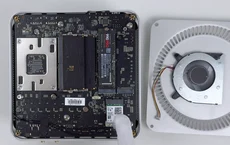
    Storage options consist of 2x M.2 2280 slots with PCIe 4.0 X4 specifications, and the system can support up to 128 GB of DDR5-6400 RAM via two SO-DIMM slots. These components, along with the Wi-Fi module, are easily accessible for upgrades by simply removing the bottom cover.

    Performance Insights

    In terms of performance, FEVM’s internal tests indicate that the RTX 4080 LP GPU in MXM form-factor, limited to 115 W, performs nearly on par with a desktop RTX 3080 or RTX 4070 and shows a slight edge over the new RTX 5060 Ti. It is also reported that the MXM card outperforms an external RTX 4090 LP connected via USB4.

    The Ryzen 9800X3D model, capped at 90 W TDP, peaks at 86° C during stress testing, causing the CPU fan to reach a noise level of 41 dB. Under full load for both CPU and GPU, the CPU can get to 90° C, while the GPU maxes out at 74.3° C, resulting in total system noise reaching 47.3 dB. At a 100 W TDP, the CPU could spike to 95° C, which remains within acceptable limits. In typical gaming scenarios, FEVM asserts the CPU might hit 80° C, the GPU stays below 70° C, and system noise increases to 45 dB.

    Pricing and Availability

    Currently, there’s no information on pricing or availability. However, considering the limited supply of MXM GPUs, a configuration with an RTX 4080 LP and Ryzen 7 9800X3D could easily surpass $2,000. Similar to most premium models, the FA65G is likely to be available in China initially. Users in the West might consider taking the plunge with an Aliexpress purchase, but they should be aware that MXM GPUs are rare and FEVM might not replace them in case of failure.

    Source:
    Link


  • AMD’s High-End RDNA 5 GPUs Target Nvidia RTX 6090 Competition

    AMD’s High-End RDNA 5 GPUs Target Nvidia RTX 6090 Competition

    Key Takeaways

    1. RDNA 4’s performance and pricing did not meet expectations, and AMD needs to improve offerings in both low-end and high-end markets.
    2. The upcoming RDNA 5 series is expected to be built on TSMC N3 nodes, with plans for high-end AT0 and mid-range AT2 dies.
    3. The high-end RX 10090 XT model may offer significant performance boosts, potentially being 264% faster than the RTX 4080.
    4. The mid-range RX 10070 XT is projected to be 120% faster than the RTX 4080, aiming for a price below $550.
    5. All RDNA 5 models may lack Infinity Cache and could incorporate 3D stacking for the L3 cache in future designs.


    RDNA 4 has not really wowed people with its performance boosts, and the pricing that AMD was counting on to be a strong point didn’t end up being as affordable as first promised, mainly due to worries about import taxes. The RX 9070 series is still a dependable mid-range option, but AMD needs to step up its game in both low-end and high-end markets. This could happen with the new RDNA 5 chips, as hinted at in a recent leak from Moore’s Law Is Dead.

    Speculation on Specs

    MLID always starts off by reminding us that the specifications from his reliable insider sources might change before the actual launch (which is also subject to change). So, it’s smart to stay a bit cautious and remember that these are AMD’s current intentions for a launch expected around 2027.

    Upcoming Chips

    According to MLID’s sources, which have reportedly been verified by several AMD teams working on the next-gen GPUs, the RDNA 5 series will be built on TSMC N3 nodes. This includes a top-tier AT0 die for high-end and HPC models and a mid-range AT2 die for the successor to the RX 9070 cards. There’s even a leaked table showing all the planned versions. MLID has also mentioned that AMD might be thinking about an AT3 die for entry-level models or APU chiplets, but this hasn’t been confirmed by all sources.

    Specifications Overview

    The AT0 die seems quite large, boasting up to 184 CUs or possibly even 200 CUs, as the table indicates that one work group is turned off per shader engine for the 184 CU variant. The primary two models likely target HPC and data centers, as they are expected to support PCIe 6.0 and include either 128 GB or 96 GB of VRAM, with prices likely above $5,000. Moreover, the table reveals an AI/ML model with 72 GB of VRAM and 184 CUs aimed at this HPC segment.

    Gamers might be thrilled to learn about a high-end PCIe 5.0 gaming version with 154 CUs, 40 MB of L3 cache, 36 GB of GDDR7 36 Gbps VRAM, and a 384-bit bus width, which is set to compete with the upcoming RTX 6090. Sources from MLID estimate that this high-end gaming model, tentatively named RX 10090 XT, could be 264% faster than the RTX 4080, offering 1,728 GB/s bandwidth. Surprisingly, the total board power (TBP) is predicted to be around 380 W, and MLID suspects that the 264% performance increase over the RTX 4080 may actually be a bit lower.

    Mid-Range Chips

    For the mid-range segment, the AT2 die is expected to have as many as 70 CUs, but the table shows the top mid-range version with 64 CUs. This RX 10070XT model is projected to have a TBP of 275 W, a 192-bit bus, 18 GB of GDDR7 36 Gbps VRAM, and 864 GB/s bandwidth. Importantly, this model aims for the sub-$550 price range and is expected to be 120% faster than the RTX 4080.

    Other models in this category include the 10070 GRE with 48 CUs, 15 GB of VRAM, and performance similar to the RTX 4080, while another 10060 XT model would have 44 CUs and 12 GB of VRAM, competing primarily with the RTX 5070.

    MLID also notes that AMD might introduce additional models like the 10090 XTX, 10080 XT, or 10050, among others. Another noteworthy detail is that all RDNA 5 models appear to lack Infinity Cache, hinting that AMD might be considering 3D stacking for the L3 cache.

    Source:
    Link


  • Powerful PC Needed for inZOI: Ryzen 7 9800X3D Recommended

    Powerful PC Needed for inZOI: Ryzen 7 9800X3D Recommended

    Key Takeaways

    1. inZOI is a life simulation game developed with Unreal Engine 5, requiring high-end hardware for optimal performance.
    2. Recommended system specs for high settings include Ryzen 7 9800X3D or Intel i7 14700K CPU, RTX 4080 or Radeon RX 7900 XTX GPU, 32GB RAM, and 75GB storage.
    3. Minimum requirements allow for Ryzen 5 3600 or Intel i5 10400 CPU, RTX 2060 or Radeon RX 5600XT GPU, 12GB RAM, and 40GB storage.
    4. Recommended specs for a smooth experience feature Ryzen 7 7800X3D or Intel i7 12700K CPU, RTX 3070 or Radeon RX 6800XT GPU, 16GB RAM, and 60GB storage.
    5. inZOI is set to launch on March 27, with early access available on Steam and a live showcase on March 19, 2025.


    inZOI is an anticipated life simulation game being developed using Unreal Engine 5, and it’s sure to be quite demanding. The studio behind it, inZOI Studios, has provided detailed system requirements to ensure players have the best experience across various visual settings. For those wishing to play the game at the High preset, a Ryzen 7 9800X3D is suggested. This CPU ranks among the most powerful gaming processors available today, if not the top one, and inZOI appears to be robust enough to necessitate such strength.

    System Requirements Overview

    The official website of the developer outlines the hardware needed to enjoy inZOI at the High preset. Players will need either a Ryzen 7 9800X3D or an Intel i7 14700K CPU, along with an RTX 4080 or a Radeon RX 7900 XTX GPU, 32GB of RAM, and 75GB of storage space. For those looking at the minimum specs, they can get by with a Ryzen 5 3600 or an Intel i5 10400 CPU, an RTX 2060 or a Radeon RX 5600XT GPU, 12GB of RAM, and 40GB of storage.

    Recommended Specifications

    inZOI Studios recommends a gaming setup with either a Ryzen 7 7800X3D or an Intel i7 12700K, plus an RTX 3070 or Radeon RX 6800XT, 16GB of RAM, and 60GB of storage to have a smooth experience. Additionally, the developer has released a comparison video showcasing the various visual presets in action. These specifications are quite demanding for a gaming PC, and players with mid-tier setups might need to use technologies like DLSS, FSR, or XeSS to enhance their frame rates, depending on whether the game supports these upscalers.

    Release Information

    The launch date for inZOI is set for March 27, and it will be available for download on Steam. The game will enter early access, and a live showcase is planned for March 19, 2025, at 01:00 UTC.

    Source:
    Link

  • Unveiling the Secrets of NVIDIA RTX 4070 and 4080 Super GPUs: A Blend of Power and Performance

    Unveiling the Secrets of NVIDIA RTX 4070 and 4080 Super GPUs: A Blend of Power and Performance

    NVIDIA has always been at the forefront of GPU technology, continuously pushing the boundaries to provide better performance and more powerful graphics processing units. The recent buzz around NVIDIA’s RTX 4070 and 4080 Super GPUs only cements this legacy further. Let’s dive into the leaked information and rumors swirling around these upcoming tech marvels.

    A ‘Super’ Refresh in the Offing

    NVIDIA is reportedly planning a “SUPER” refresh for its RTX 40 series lineup, with the spotlight on the RTX 4070 and 4080 models. This refresh seems to follow the tradition of the ‘Super’ branding, which was first introduced with the RTX 20-series​1​. The leaks suggest that this move might bring about significant upgrades including increased VRAM capacity, higher clock speeds, enhanced memory bandwidth, and a boost in total graphics power (TGP). Specifically, the speculated specifications hint at the RTX 4070 Super boasting 12GB GDDR6X VRAM, the RTX 4080 Super with 20GB GDDR6X VRAM, and the RTX 4070 Ti Super having 16GB GDDR6X VRAM​2​.

    Anticipated Specifications and Performance

    Although the exact specifications remain under wraps, the tech community is brimming with anticipation. It’s rumored that these Super variants could see a substantial uplift in performance, making them a worthy upgrade for enthusiasts and professionals alike. The RTX 4080 Super and RTX 4070 Super models are expected to be revealed and released simultaneously, offering an upgraded version of the existing RTX 40 series GPUs​3​. Moreover, there’s a possibility that the RTX 4080 Super or RTX 4080 Ti might carry the RTX 4090’s AD102 GPU die with a power rating below 450W, hinting at a blend of power and efficiency​4​.

    Skepticism and Optimism Intertwined

    While the excitement is palpable, it’s crucial to take these leaks with a grain of salt. The ‘Super’ branding was notably absent in the RTX 30 series, and the unique naming convention for the RTX 4070 Ti Super is unlike NVIDIA’s usual branding practices. Despite the skepticism, the leaks have ignited hope among gamers and professionals for higher VRAM capacities and better performance. The addition of three more members to the GeForce RTX 40 “Ada Lovelace” GPU family, including the purported RTX 4080 SUPER and RTX 4070 Super models, is eagerly awaited by the tech community​5​.

    The rumored Super refresh of NVIDIA’s RTX 4070 and 4080 GPUs is stirring the waters in the tech world. Although the exact launch date remains elusive, the potential upgrades in VRAM and overall performance make these models a topic of hot discussion among enthusiasts. As we inch closer to a possible reveal, the anticipation only grows stronger, with many waiting to see how NVIDIA will once again redefine the benchmarks of graphical performance.

    GRAPHICS CARDGPU SKUGPU CORESTMUS / ROPSCLOCK SPEED (BOOST)VRAM / BUSBANDWIDTHTGPPRICE (LAUNCH MSRP)LAUNCH
    GeForce RTX 4090Ada Lovelace AD102-30016384512 / 1762520 MHz24 GB GDDR6X / 384-bit1008 GB/s450W$1599 US12th October 2022
    GeForce RTX 4080 SUPERAda Lovelace AD102TBDTBDTBD20 GB GDDR6X? / 320-bitTBDTBD$1199 US?2024
    GeForce RTX 4080Ada Lovelace AD103-3009728320 / 1122510 MHz16 GB GDDR6X / 256-bit736 GB/s320W$1199 US16th November 2022
    GeForce RTX 4070 Ti SUPERAda Lovelace AD103TBDTBDTBD16 GB GDDR6X? / 256-bitTBDTBD$799 US?2024
    GeForce RTX 4070 TiAda Lovelace AD104-4007680240 / 802610 MHz12 GB GDDR6X /192-bit504 GB/s285W$799 US5th January 2023
    GeForce RTX 4070 SUPERAda Lovelace AD103TBDTBDTBD12 GB GDDR6X? / 192-bitTBDTBD$599 US?2024
    GeForce RTX 4070Ada Lovelace AD104-2505888184 / 642475 MHz12 GB GDDR6X / 192-bit504 GB/s200W$599 US13th April 2023
    GeForce RTX 4060 Ti 16 GBAda Lovelace AD106-3504352136 / 482535 MHz16 GB GDDR6 /128-bit288 GB/s165W$499 US18th July 2023
    GeForce RTX 4060 Ti 8 GBAda Lovelace AD106-3504352136 / 482535 MHz8 GB GDDR6 / 128-bit288 GB/s160W$399 US24th May 2023
    GeForce RTX 4060Ada Lovelace AD107-400307296 / 482460 MHz8 GB GDDR6 / 128-bit272 GB/s115W$299 US29th June 2023

    Sources: