Tag: Ryzen 9000X3D

  • FA65G Mini PC: AMD Ryzen 7 9800X3D & RTX 4080/5000 Demo

    FA65G Mini PC: AMD Ryzen 7 9800X3D & RTX 4080/5000 Demo

    Key Takeaways

    1. FEVM’s FA65G mini PC features a design inspired by Apple’s Mac Studio and supports desktop Ryzen 9000X3D processors paired with mobile RTX 4080 and RTX 5000 Ada GPUs.
    2. The FA65G has a compact size of 167.5 x 167.5 x 96 mm and offers configurations with Ryzen 7 9800X3D, upgradeable to Ryzen 9 9900X3D or 9950X3D, with adjustable TDP settings.
    3. The system includes MXM variants of RTX 4080 and RTX 5000 Ada GPUs, equipped with a custom cooling solution and requires a 330W power adapter.
    4. Port selection includes USB4, HDMI 2.1, dual 2.5 GbE NICs, and the system supports up to 128 GB of DDR5-6400 RAM with easy access for upgrades.
    5. Performance tests show the RTX 4080 LP GPU in MXM form-factor is competitive with desktop GPUs, while the Ryzen 9800X3D maintains acceptable thermal limits during stress testing, although pricing and availability remain unclear.


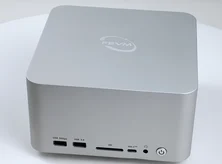
    FEVM is a newer player in the mini PC market hailing from China. The company is recognized for its design that takes cues from Apple’s Mac Studio, modifying it to house desktop-level X86 processors alongside mobile dGPUs in an MXM form-factor. Previously, FEVM successfully integrated Raptor Lake Refresh-S processors with mid-range RTX 4060 mobile GPUs into compact 2.5-liter cases. However, the latest release, the FA65G model, steps it up by accommodating desktop Ryzen 9000X3D processors paired with mobile RTX 4080 and even RTX 5000 Ada GPUs.

    Dimensions and Specifications

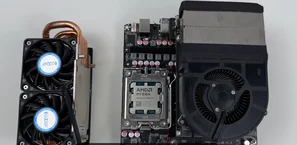
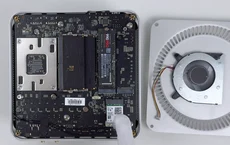
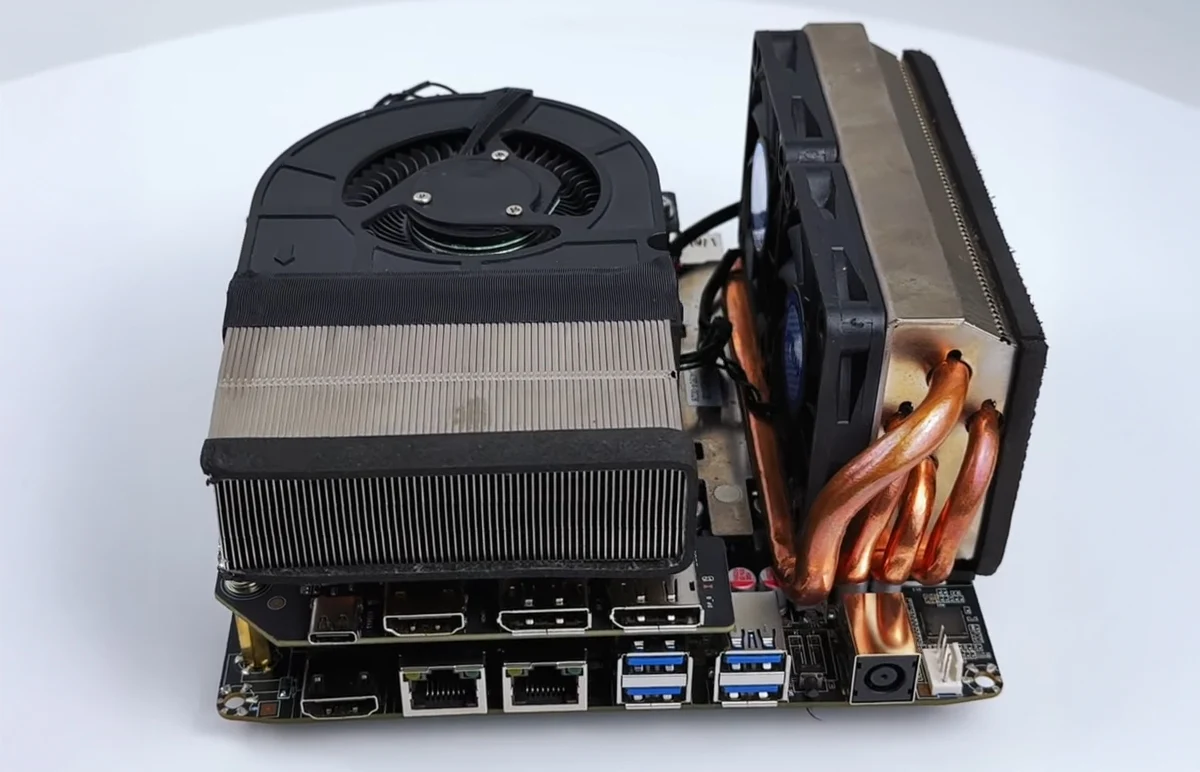
    The revamped Mac Studio design of the FA65G measures 167.5 x 167.5 x 96 mm and weighs 1.85 kg. It features a mini-ITX motherboard based on the B650 chipset, equipped with a desktop-grade AM5 socket that supports the newest Ryzen 9000X3D processors. FEVM provides configurations with the Ryzen 7 9800X3D, but users may upgrade to a Ryzen 9 9900X3D or Ryzen 9 9950X3D, as hinted in the advertising video. It’s worth noting that the AM5 socket needs a custom card and cooler to be attached on top of the motherboard’s default socket. FEVM offers various TDP settings for the processor, capping maximum power between 100W and 65W.

    Graphics Card Adaptation

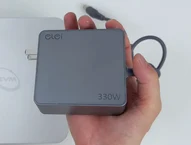
    When it comes to graphics, FEVM has managed to fit MXM variants of the RTX 4080 and RTX 5000 Ada laptop GPUs, which can be hard to find currently. The MXM GPUs are arranged like desktop GPUs and come with a custom cooling solution that includes a substantial radiator with four heat pipes, cooled by dual fans. To support these GPUs, FEVM provides a 330W adapter weighing around 530g.

    Ports and Upgradability

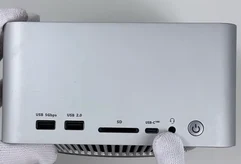
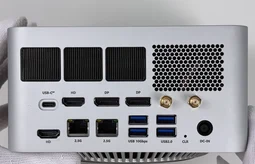
    The port selection mirrors that of a Mac Studio, offering USB4, USB 2.0, USB-A 3.2 Gen 1, a full-size SD card reader, and an audio jack at the front. The back includes dual 2.5 GbE NICs, dual HDMI 2.1, dual DP video outputs, 2x USB-A 3.2 Gen, 2x USB 2.0, and a USB-C 3.2 Gen 2. There are also two slots available for Wi-Fi antennas.

    Storage options consist of 2x M.2 2280 slots with PCIe 4.0 X4 specifications, and the system can support up to 128 GB of DDR5-6400 RAM via two SO-DIMM slots. These components, along with the Wi-Fi module, are easily accessible for upgrades by simply removing the bottom cover.

    Performance Insights

    In terms of performance, FEVM’s internal tests indicate that the RTX 4080 LP GPU in MXM form-factor, limited to 115 W, performs nearly on par with a desktop RTX 3080 or RTX 4070 and shows a slight edge over the new RTX 5060 Ti. It is also reported that the MXM card outperforms an external RTX 4090 LP connected via USB4.

    The Ryzen 9800X3D model, capped at 90 W TDP, peaks at 86° C during stress testing, causing the CPU fan to reach a noise level of 41 dB. Under full load for both CPU and GPU, the CPU can get to 90° C, while the GPU maxes out at 74.3° C, resulting in total system noise reaching 47.3 dB. At a 100 W TDP, the CPU could spike to 95° C, which remains within acceptable limits. In typical gaming scenarios, FEVM asserts the CPU might hit 80° C, the GPU stays below 70° C, and system noise increases to 45 dB.

    Pricing and Availability

    Currently, there’s no information on pricing or availability. However, considering the limited supply of MXM GPUs, a configuration with an RTX 4080 LP and Ryzen 7 9800X3D could easily surpass $2,000. Similar to most premium models, the FA65G is likely to be available in China initially. Users in the West might consider taking the plunge with an Aliexpress purchase, but they should be aware that MXM GPUs are rare and FEVM might not replace them in case of failure.

    Source:
    Link


  • Ryzen 7 9800X3D vs 7800X3D: Major Gaming Boost with Zen 5 X3D

    Ryzen 7 9800X3D vs 7800X3D: Major Gaming Boost with Zen 5 X3D

    We’ve seen a lot of leaks about the Ryzen 9000X3D lately. There are talks of possible lower prices and increased V-Cache for the Ryzen 9 9950X3D. The upcoming Zen 5 Ryzen 9000X3D processors are expected to strengthen AMD’s gaming advantage over Intel even more. This is particularly relevant now since the new Intel Core Ultra 200K “Arrow Lake” CPUs likely won’t provide any gaming performance improvements compared to the 14th generation chips.

    New Specifications

    As for the specs of the Ryzen 9000X3D, rumors suggest that these chips will have faster clock speeds than the Zen 4 models. A recent video on bilibili has shown the Ryzen 7 9800X3D working at a significantly higher all-core boost clock compared to the Ryzen 7 7800X3D.

    The video from bilibili claims that the Ryzen 7 9800X3D features a base clock of 4.7 GHz, with the ability to boost all cores to 5.2 GHz during what seems to be Cinebench 2024. While we don’t have the benchmark data, the 5.2 GHz all-core clock speed is quite thrilling for several reasons.

    Performance Improvements

    Firstly, if the Ryzen 7 9800X3D really hits an all-core frequency of 5.2 GHz, it would mark a notable 400 MHz rise over the Ryzen 7 7800X3D, which peaks at 4.8 GHz across all 8 cores. Interestingly, the 400 MHz increase matches the bump we saw from the Ryzen 7 7800X3D (4.8 GHz) to the Ryzen 7 5800X3D (4.35 GHz).

    Moreover, hitting a 5.2 GHz all-core boost clock could indicate a single-core boost reaching between 5.4 and 5.5 GHz. Just for reference, the Ryzen 7 7800X3D has a single-core boost speed of 5 GHz. Since many games benefit from higher single-threaded frequencies, this means greater gaming performance in most cases.

    Conclusion

    Also, when we factor in the IPC improvements from the new Zen 5 architecture, the Ryzen 7 9800X3D appears to be a solid upgrade compared to the Ryzen 7 7800X3D. This should please AMD enthusiasts who were let down by the underwhelming gains of standard Zen 5 processors.

    Before we conclude, just remember to take this information lightly, as we currently lack official confirmation regarding the specs of the Ryzen 7 9800X3D.

    bilibili via HXL on X, Teaser image: AMD, Joshua Sortino on Unsplash, edited


    Image 1
  • Ryzen 9000X3D Benchmarks: 9800X3D Outperforms 7800X3D

    Ryzen 9000X3D Benchmarks: 9800X3D Outperforms 7800X3D

    The AMD Ryzen 9000X3D CPUs appear to be on the verge of their launch, as recent leaks and speculations strongly suggest that an announcement for the Ryzen 7 9800X3D and Ryzen 9 9950X3D will take place in October. New information shared by @CodeCommando_ on X indicates that the upcoming X3D CPUs are set to deliver an impressive increase in performance compared to the Ryzen 7000 series.

    Performance Gains

    If the multi-core Cinebench R23 results are to be believed, the Ryzen 9 9950X3D could be 18.4% quicker than the Ryzen 9 7950X3D (currently priced at $618 on Amazon), which averaged 35794 points during our testing. However, it’s worth mentioning that Cinebench R23 is becoming somewhat outdated, with Cinebench 2024 taking its place due to better accuracy and higher CPU loads, making it more fitting for today’s powerful processors. This improvement in performance aligns well with what we’ve come to expect from the Ryzen 9000 series.

    Gaming Relevance

    The eight-core Ryzen 7 9800X3D, which is typically more important for gamers, shows particularly exciting developments, with both single-core and multi-core performance metrics experiencing a notable uplift in comparison to the Ryzen 7 7800X3D.

    When we examine the performance results of the Ryzen 7 7800X3D from our thorough testing, the Ryzen 7 9800X3D seems to boast about a 35.6% advantage in multi-core tests. The single-core benchmark is just as striking, with the Ryzen 7 9800X3D achieving a 24.3% enhancement over the 7800X3D.

    Reasons Behind the Boost

    These substantial performance gains are likely attributed to the efficiency improvements brought by the Ryzen 9000 series. Additionally, there are whispers of significantly larger V-Cache chips, with one dedicated chip assigned to each CCD, which may help resolve some scheduling problems that affected prior X3D models.

    According to @CodeCommando_ on X, these developments could signal an exciting new chapter for AMD’s CPU lineup.