Tag: AMD Strix Halo

  • AMD debuts Strix Halo AI powerhouse for gaming

    AMD debuts Strix Halo AI powerhouse for gaming

    Key Takeaway

    – AMD launches Ryzen AI Halo, a first-party platform built around the Strix Halo chipset to run local LLMs, with Windows or Linux options.
    – High-end specs: Ryzen AI Max+ 395, 128 GB LPDDR5-8000, 40 CU Radeon 8060s iGPU, 2 TB PCIe Gen4 SSD, 50 TOPS NPU, 120W TDP, and Wi‑Fi 7/BT 5.4.
    – Local inference for models like GPT OSS (120B) and Qwen 3.5 (122B) with potential cost savings vs cloud.
    – Pre-orders begin June 2026, starting at $4,000 USD.
    – Form factor targets compact desktops/mini-PCs with multiple USB-C ports and robust IO, including HDMI 2.1b and 10 Gb Ethernet.


    Overview of AMD’s Ryzen AI Halo Platform

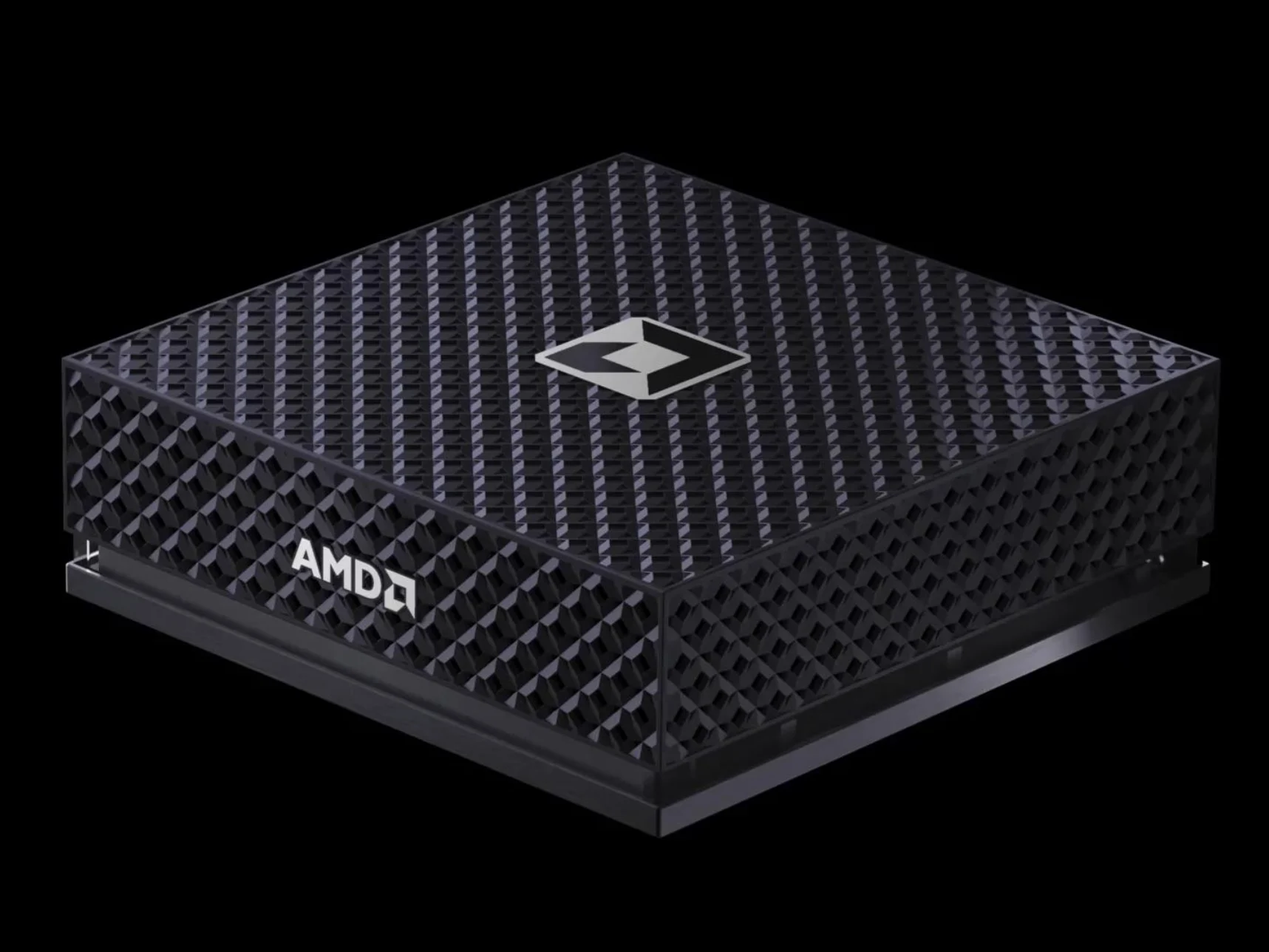
    Despite being named as a laptop SKU, AMD’s Strix Halo chips have shown up in many mini-PCs and desktops rather than in laptops. AMD never offered a first-party laptop SKU, unlike Nvidia with its GB10-based DGX Spark, a contrast that is set to change today with the launch of AMD’s Ryzen AI Halo developer platform. The new platform promises to bring high-end AI capabilities to compact form factors.

    Key Specifications and Hardware

    As its name implies, the AMD Ryzen AI Halo will utilize Team Red’s most capable Strix Halo chip, the Ryzen AI Max+ 395. The system ships with 128 GB of LPDDR5-8000 MT/s memory and includes a Radeon 8060s iGPU with 40 CUs. Storage is a 2 TB PCIe Gen4 SSD, and the AI accelerator is a 50 TOPS NPU. Connectivity options encompass Wi-Fi 7, Bluetooth 5.4, an HDMI 2.1b port, a 10 Gb/s Ethernet jack, three unspecified USB-C ports (likely USB 4.0) plus one USB-C port dedicated to power. The unit carries a rated TDP of 120 Watts and has overall dimensions of 5.9 inches by 5.9 inches by 1.7 inches.

    Product Positioning and Capabilities

    AMD markets the Ryzen AI Halo as a device capable of running large language models locally, which could help users avoid ongoing cloud compute costs. The company claims it can run substantial models such as GPT OSS (120B) and Qwen 3.5 (122B), which AMD asserts do not run on Apple M4 Pro devices. In contrast to the DGX Spark, which can only operate on Linux, the Ryzen AI Halo can also be configured with Windows, broadening its compatibility with developer workflows.

    Availability and Pricing

    Pre-orders for the Ryzen AI Halo are planned to begin in June 2026. The price point starts at $4,000 USD. While not inexpensive, AMD contends that the device can pay for itself in roughly six months by reducing cloud subscription and compute expenses.

    AMD

    Sources

    • Lenovo Announces Global Release of 15-Inch Gaming Laptop with 48GB VRAM

      Lenovo Announces Global Release of 15-Inch Gaming Laptop with 48GB VRAM

      Key Takeaway

      1. The Lenovo Legion 7a 15ASH11 will feature AMD’s Strix Halo platform with Ryzen AI Max+ 392 APU and a larger battery.
      2. The laptop supports up to 64 GB of LPDDR5X-8000 RAM, allowing for up to 48 GB VRAM allocation to its Radeon 8060S iGPU.
      3. The release date and pricing are still unspecified, but the laptop is listed on several international Lenovo websites indicating an imminent global launch.

      Introduction to the Lenovo Legion 7a 15ASH11

      A few months ago, Lenovo introduced a new gaming laptop based on AMD’s Strix Halo platform. It was announced in March, and during MWC 2026 held in Barcelona, the company showcased this model along with many other devices. Now, after a couple of months, Lenovo has finally shared some detailed hardware info that wasn’t available at launch.

      Key Hardware Details

      The Legion 7a 15ASH11 will come equipped with the same Ryzen AI Max+ 392 APU as the TUF Gaming FA401EA but features a battery that’s 15% larger, giving it better endurance. Basically, this means the laptop’s gaming performance is expected to be similar to the ROG Flow Z13, a device reviewed last year (which, at the time, was priced at around $2,349).

      Memory & Performance Options

      The notebook is planned to be available with up to 64 GB of LPDDR5X-8000 RAM, allowing it to assign up to 48 GB VRAM to its Radeon 8060S integrated GPU. This substantial memory capacity makes it a versatile choice for gaming and creative work alike.

      Availability and Pricing Insights

      At present, the pricing details for the Legion 7a 15ASH11 are not yet known. Lenovo hasn’t listed this model on its PSREF website. Nevertheless, it has appeared on several country-specific sites including Australia, France, Germany, Ireland, and the UK. Meanwhile, in the US and Canada, the company only indicates that the product is ‘coming soon,’ without providing specific release dates or pricing info. All signs suggest that Lenovo is nearing the worldwide launch of its first AMD Strix Halo-powered gaming laptop.


    • Legion Go 2 with AMD Strix Halo OLED Gaming Handheld Launch Incoming

      Legion Go 2 with AMD Strix Halo OLED Gaming Handheld Launch Incoming

      Key Takeaway

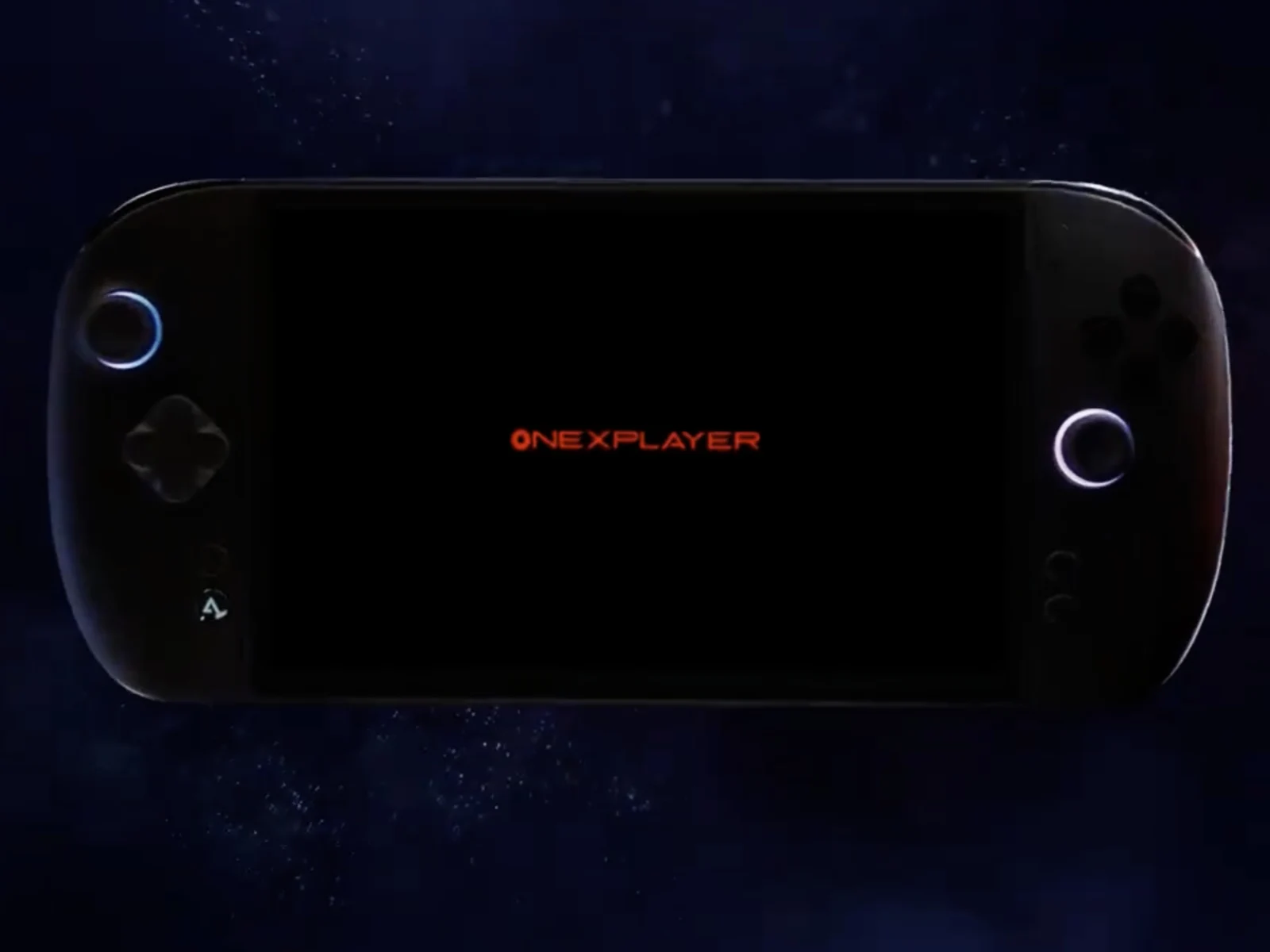
      1. One-Netbook is returning to AMD’s Strix Halo platform with the new OneXPlayer X2 Mini.
      2. The OneXPlayer X2 Mini features an 8.8-inch, 144 Hz VRR OLED display, similar to the Lenovo Legion Go 2.
      3. It aims to outperform the Legion Go 2 with an 85 Wh battery and Ryzen AI Max+ 395 APU.
      4. The device includes detachable controllers and a small keyboard accessory, with a likely global release pending.

      Latest Announcements and Releases

      April has been a extremely lively month for One-Netbook. They recently disclosed the new models like the OneXStation and Super V under their OneXPlayer brand. Both models are now ready for worldwide buying, sporting AMD Strix Halo and Intel Panther Lake processors respectively. The company is really working hard to introduce new gadgets to their customers with variety of specifications and features in the market.

      Exciting Return to AMD’s Strix Halo Platform

      Recently, the firm said that they will comeback to AMD’s Strix Halo platform with a brand new OneXPlayer X handheld device. It’s quite the comeback since they’ve previously launched multiple versions of OneXPlayer X1, including the X1 Air, X1 Mini, and X1 Pro. The latest change is the move towards the OneXPlayer X2 series, kicking off with the OneXPlayer X2 Mini.

      Design and Display Features

      For those who remember the OneXPlayer X1 Mini, it shares the same 8.8-inch display size as the Lenovo Legion Go. Looks like the X2 Mini takes a similar approach, featuring an 8.8-inch OLED display with a 144 Hz VRR refresh rate, similar to the Legion Go 2. We’re anticipating a resolution of about 1920 by 1200 pixels and a peak SDR brightness of 500 nits, making it a pretty bright and sharp screen for handheld gaming devices.

      Performance and Additional Features

      The device aims to beat the Legion Go 2 by packing a robust 85 Wh battery paired with a Ryzen AI Max+ 395 APU, promising a good balance of power and efficiency. When comparing to the OneXFly Apex, the X2 Mini introduces neat features like detachable controllers and a small keyboard attachment, giving users more flexibility and productivity options. Although the device has only been teased on Chinese social media forums, its presence on the company’s Discord suggests that a worldwide launch could be on the cards very soon.

      Sources
    • Asus Launches 14-Inch AMD Strix Halo Gaming Laptop in the US

      Asus Launches 14-Inch AMD Strix Halo Gaming Laptop in the US

      Key Takeaways

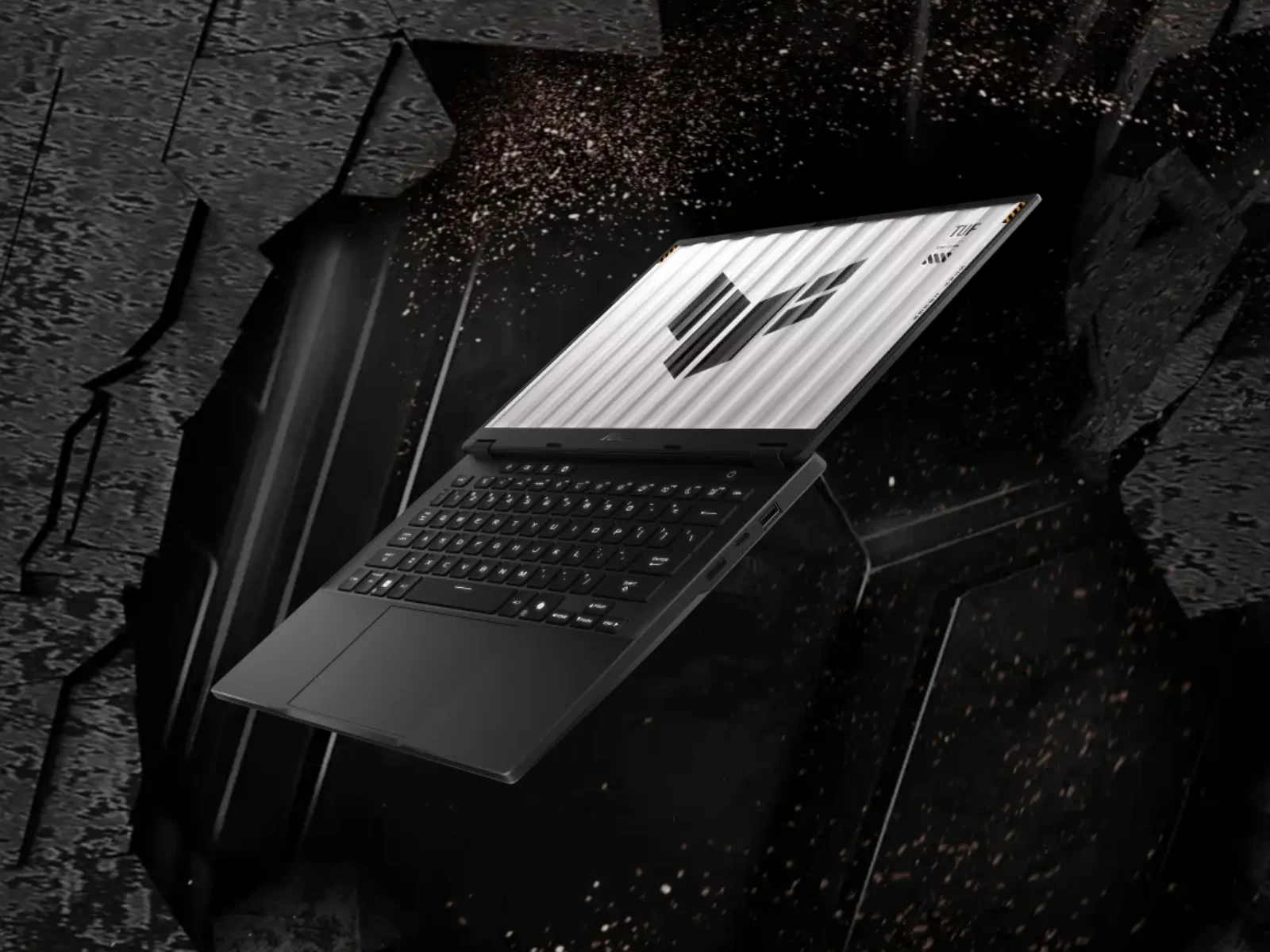
      1. Asus has launched its first gaming laptop with AMD’s Strix Halo in the US, the TUF Gaming A14 FA401EA, originally priced at $1,799.
      2. The current retail price in the US is $2,199, with Best Buy now offering this model.
      3. The US version lacks a 64 GB RAM option available in other regions, limiting VRAM allocation to 16 GB for the integrated GPU.
      4. The FA401EA features an AMD Ryzen AI Max+ 392 APU, a 165 Hz 2.5K display, and a 73 Wh battery with 100 W USB Type-C charging.
      5. The laptop’s keyboard has a key travel of 1.7 mm, and it competes with the ROG Flow Z13 for users needing more RAM.


      Asus has quietly begun to offer its first gaming laptop powered by AMD’s Strix Halo in the United States. Just to remind you, the TUF Gaming A14 FA401EA is already on sale in several locations such as China, Europe, and Japan. Asus initially planned to sell the 14-inch laptop in the US for $1,799.

      Pricing Changes

      Yet, last month, some retailers listed the same model for $2,199. Now, Best Buy has kicked off sales in the US at this new price instead of the original one, which comes with 32 GB of RAM and a 1 TB SSD. Interestingly, Amazon also had this laptop in stock in the US at the beginning of March, but it is currently shown as temporarily out of stock.

      Available Variants

      Sadly, the US market is still missing the 64 GB RAM version that Asus has available in other regions. This limitation means that users can only assign up to 16 GB of VRAM to the laptop’s Radeon 8060S integrated GPU without dropping below 16 GB of RAM. Therefore, the ROG Flow Z13 (currently priced at $2,799 on Amazon) could be a more appealing choice for Strix Halo enthusiasts who are looking for more than 32 GB of RAM.

      Specifications Highlight

      Nonetheless, the FA401EA features AMD’s Ryzen AI Max+ 392 APU, coupled with a 165 Hz display that delivers 2.5K resolution and brightness of 400 nits. Additionally, this 14-inch laptop is equipped with a 73 Wh battery, supports 100 W charging through USB Type-C, and has a keyboard with 1.7 mm of key travel. For further information, please refer to our launch article.

      Source:
      Link


    • Nvidia DGX Spark with GB10 and 128GB LPDDR5X Price Increase

      Nvidia DGX Spark with GB10 and 128GB LPDDR5X Price Increase

      Key Takeaways

      1. The Nvidia DGX Spark features the GB10 “Grace Blackwell” chip, designed for high LLM performance with power efficiency.
      2. The GB10 chip includes a 20-core ARM CPU, 128 GB of LPDDR5X memory, and a powerful GPU with 6,144 CUDA cores, achieving 1 petaflop of computing power.
      3. The initial MSRP of the DGX Spark is $3,999, but it will increase by $700 to $4,699 due to rising costs of DRAM and storage.
      4. Ongoing supply chain issues are causing price increases for essential components, leading to a tight GPU supply for the next quarters.
      5. For budget-conscious consumers, alternatives like the AMD Strix Halo-powered systems, such as the GMKtec Evo-X2, offer a more affordable option at $2,700.


      The Nvidia DGX Spark is a compact workstation that boasts the powerful GB10 “Grace Blackwell” chip, which is designed to deliver impressive LLM performance while maintaining power efficiency—at least by today’s standards.

      Specifications Breakdown

      The GB10 chip, referred to as a “Superchip” by Nvidia, features a 20-core ARM CPU (10 Cortex X925 and 10 Cortex A725) combined with 128 GB of LPDDR5X memory on a 256-bit bus. Additionally, it includes a Blackwell-based GPU equipped with 4th-gen RT cores and 5th-gen Tensor cores, totaling 6,144 CUDA cores. Nvidia claims it can achieve an astonishing 1 petaflop of computing power at FP4 precision (sparse).

      Price Increase Announcement

      Clearly, this mini PC workstation is not a budget-friendly option, having launched with a manufacturer’s suggested retail price (MSRP) of $3,999. Recently, Nvidia disclosed that the price will rise by $700, making the new MSRP $4,699. The company attributes this significant price hike to soaring costs of DRAM and storage, which isn’t really surprising.

      Market Impact

      The ongoing supply chain issues have resulted in substantial increases in prices for essential components, compelling numerous consumer tech leaders to raise their prices. Nvidia has indicated that GPU supply will remain “tight” for the upcoming quarters, leaving uncertainty about the future.

      For those on a tighter budget, AMD Strix Halo-powered systems could serve as a viable, more affordable option for running LLMs locally and for gaming. One such alternative is the GMKtec Evo-X2, which is presently priced at $2,700 on Amazon. This system is equipped with 128 GB of memory and a 2 TB SSD.

      Source:
      Link


    • Sixunited AXB88: Compact GMKtec EVO-X2 Alternative with AMD Strix Halo

      Sixunited AXB88: Compact GMKtec EVO-X2 Alternative with AMD Strix Halo

      Key Takeaways

      1. Sixunited showcased devices using AMD’s Strix Halo architecture, including the AXA33, which supports up to 128 GB of RAM and features a 4K OLED display.
      2. The AXP77 aims to compete with the Asus ROG Flow Z13 and may offer Ryzen AI Max+ 388 and 392 options.
      3. The company launched two mini-PCs in 2-litre and 4-litre sizes, along with the ultra-compact Mini AI Workstation AXB88, measuring 160 x 160 x 47 mm.
      4. The AXB88 has a case volume of 1.2 litres, providing a 120 W TDP to its APU and a 230 W PSU, along with dual USB4 ports and PCIe 4.0 x4 SSD support.
      5. Mass production for the AXB88 is expected to start in March, but international availability details are not yet released.


      Towards the end of the previous year, Sixunited showcased a variety of devices that utilize AMD’s Strix Halo architecture. One of the standout products was the AXA33, which serves as an alternative to the iMac and can support up to 128 GB of RAM along with a stunning 4K OLED display. Additionally, Sixunited introduced the AXP77, aiming to compete with the Asus ROG Flow Z13, but it might come equipped with the Ryzen AI Max+ 388 and Ryzen AI Max+ 392 options, instead of only the Ryzen AI Max+ 395.

      Smallest Mini-PCs in the Market

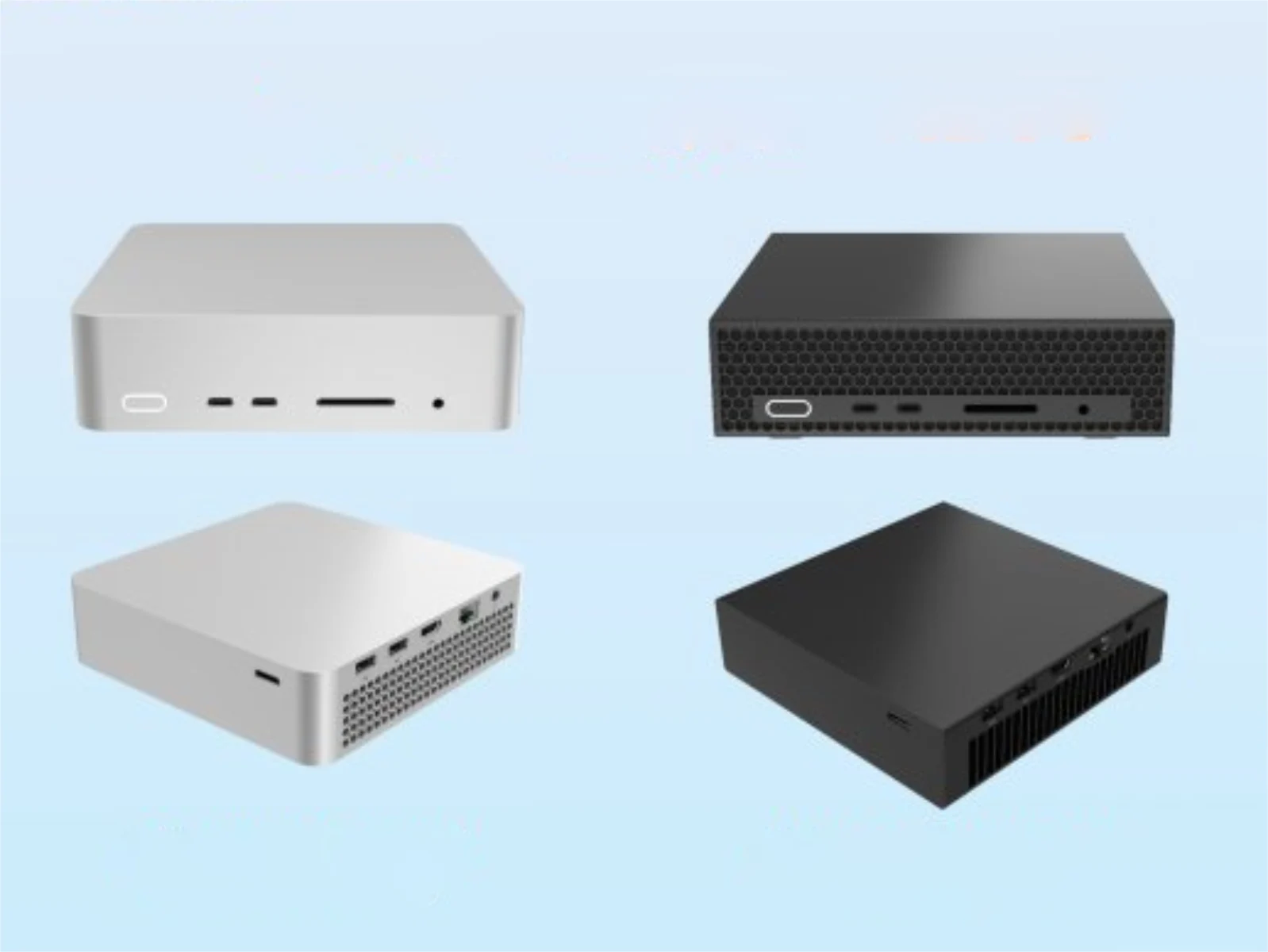
      Simultaneously, the company launched two mini-PCs that are also powered by the same architecture. These mini-PCs come in 2-litre and 4-litre case sizes. However, Sixunited claims to have designed an even more compact unit, the Mini AI Workstation AXB88. As illustrated in the graphic below, the AXB88 has dimensions of 160 x 160 x 47 mm, regardless of the two different finishes available, making it significantly smaller than rival Strix Halo mini-PCs like the GMKtec EVO-X2, which is currently priced at $1,699 on Amazon.

      Impressive Specifications

      To put it simply, the AXB88 has a case volume of 1.2 litres. Despite its small size, this mini-PC is said to provide a 120 W TDP to its APU, along with a 230 W PSU. Furthermore, Sixunited has incorporated dual USB4 ports and M.2 2280 slots that support up to PCIe 4.0 x4 SSDs. As it stands, Sixunited is looking to kick off mass production by March. However, there hasn’t been any information released regarding its availability on the international market just yet.

      Source:
      Link


    • Acemagic Launches Tank M1A Pro Plus Mini-PC with AMD Radeon 8060S

      Acemagic Launches Tank M1A Pro Plus Mini-PC with AMD Radeon 8060S

      Key Takeaways

      1. Acemagic has introduced a new mini-PC model, the M1A Pro Plus, using AMD’s Strix Halo platform.
      2. The M1A Pro Plus replaces the dedicated graphics card found in its predecessor, the M1A Tank 03, with an integrated Radeon 8060S GPU.
      3. The new model features a Ryzen AI Max+ 395 APU, which outperforms the Intel Core i9-12900H in raw power.
      4. The M1A Pro Plus supports up to 128 GB of LPDDR5X RAM and 12 TB of storage, along with Wi-Fi 7 connectivity.
      5. Pricing and availability details for the M1A Pro Plus have not yet been revealed.


      Acemagic has launched a variety of mini-PCs in the past, such as the F5A, which debuted this summer using AMD’s Strix Point architecture. Recently, the firm has provided some early information about a new model that aims to compete with the GMKtec EVO-X2 (currently priced at $1,699 on Amazon) and other premium mini-PCs.

      New Updates

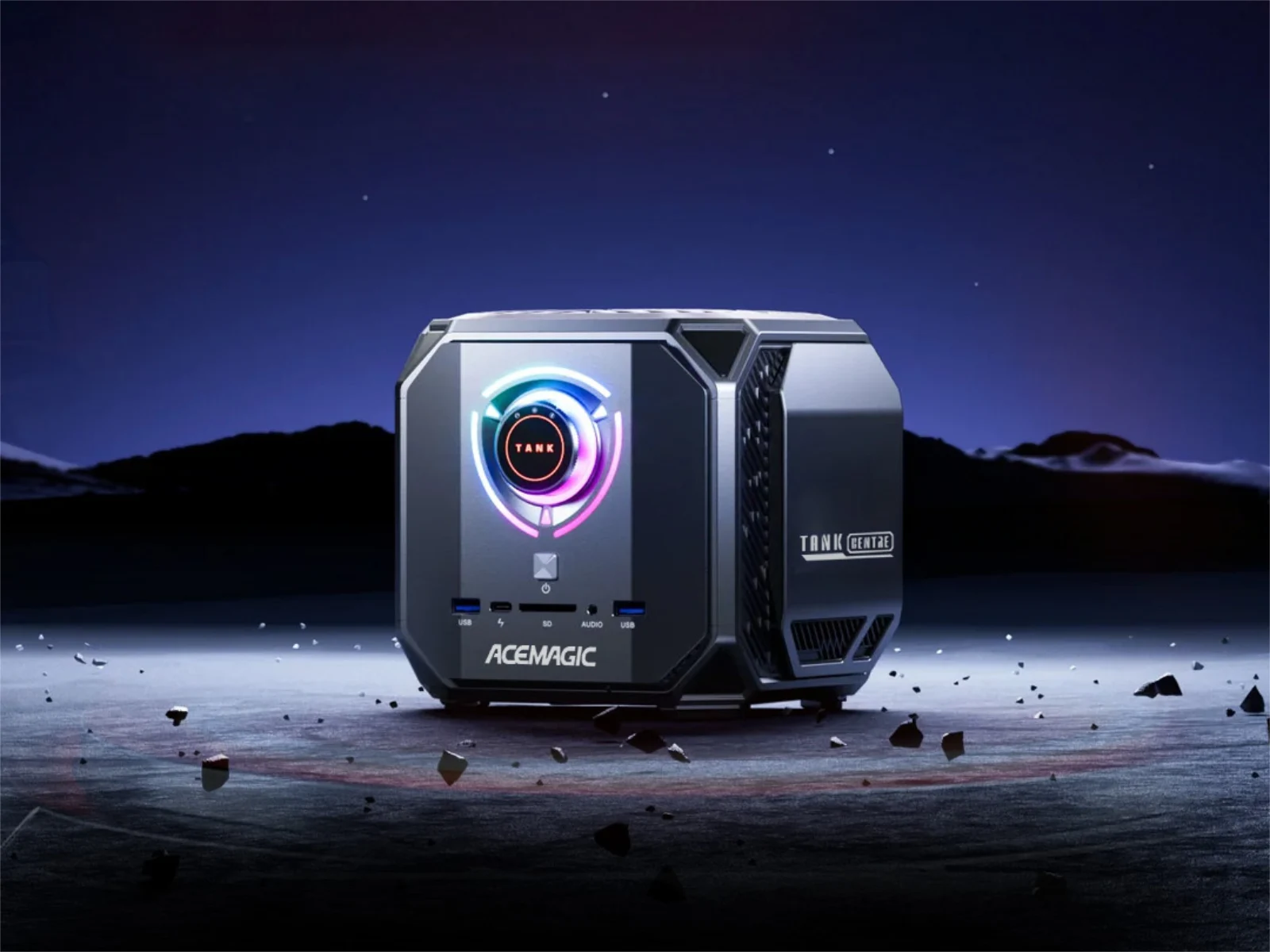
      To put it simply, Acemagic seems to have refreshed the M1A Tank 03 by adopting AMD’s Strix Halo platform. Previously, the M1A Tank 03 was outfitted with a powerful Intel Core i9-12900H CPU and Nvidia’s GeForce RTX 3080 laptop GPU. In contrast, the new Tank M1A Pro Plus opts to eliminate the dedicated graphics card entirely.

      Instead of a dedicated GPU, Acemagic has included the Ryzen AI Max+ 395 combined with the Radeon 8060S integrated GPU. While the AMD Strix Halo APU outperforms the Core i9-12900H in terms of raw power, the situation is more complex regarding GPU performance. Benchmarks indicate that the Radeon 8060S performs similarly to the GeForce RTX 3080 laptop GPU. Therefore, the M1A Pro Plus might not necessarily excel over the M1A Tank 03 in gaming scenarios.

      Specifications to Note

      That said, the Tank M1A Pro Plus is also equipped with up to 128 GB of LPDDR5X RAM operating at 8,000 MT/s, along with 12 TB of storage and Wi-Fi 7 support. However, Acemagic has yet to disclose any information about the pricing or availability for this model. Instead, the company has merely hinted that the Strix Halo mini-PC will be released soon.

      Source:
      Link


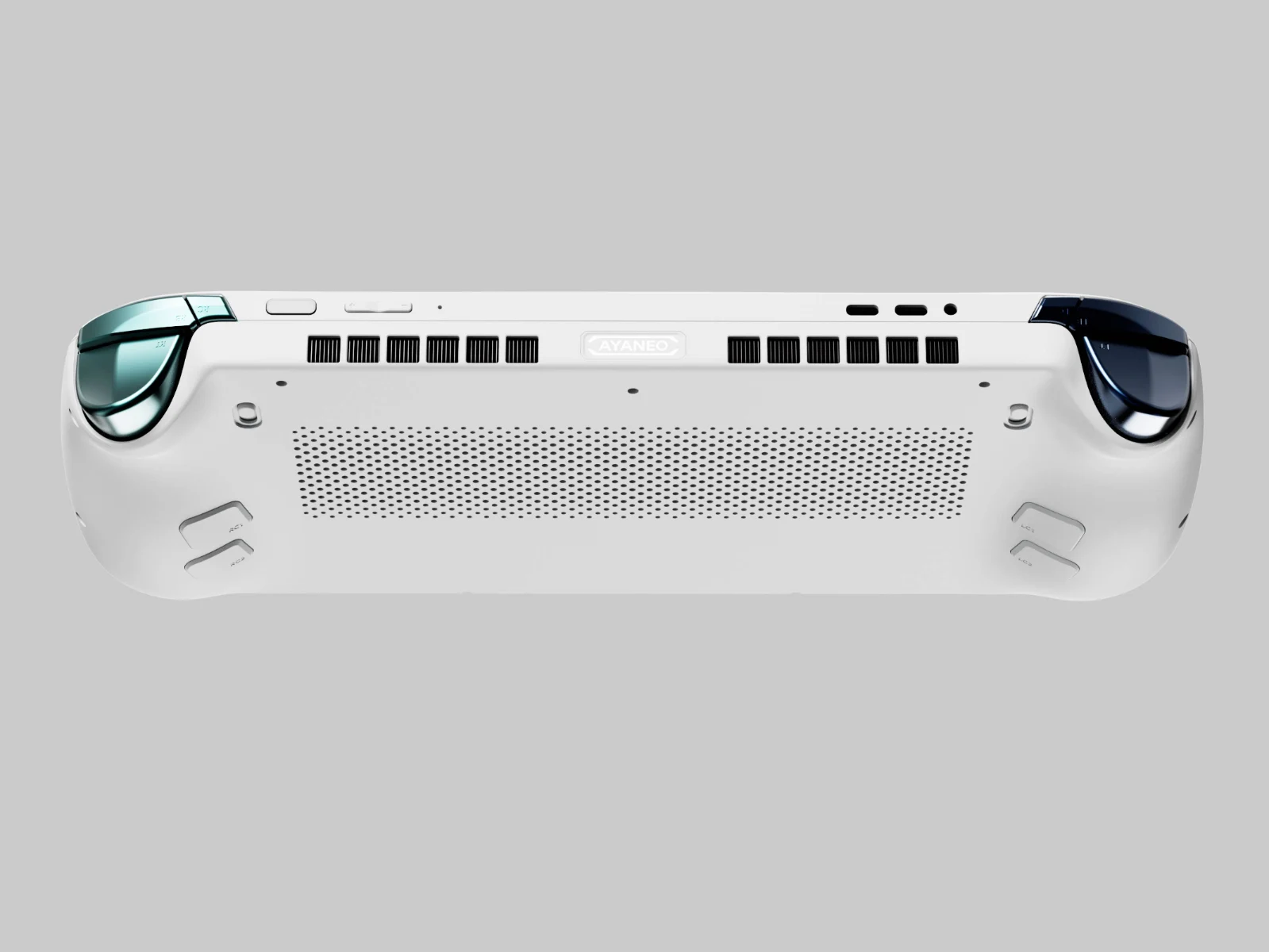
    • Ayaneo Next II: Gaming Handheld with 165 Hz OLED Display

      Ayaneo Next II: Gaming Handheld with 165 Hz OLED Display

      Key Takeaways

      1. Ayaneo will reveal full details about the Next II during a Product Sharing Session on November 29 at 07:30.
      2. The Next II will use AMD’s Strix Halo architecture and is confirmed to include the Ryzen AI Max+ 395 APU.
      3. There is a possibility that the Next II may also feature the Ryzen AI Max 385 for a more affordable option.
      4. The Next II is expected to have a 9-inch OLED display with a resolution of 2,400 x 1,504 pixels and a refresh rate of 165 Hz.
      5. Pricing, availability, and weight details for the Next II have not yet been disclosed.


      Ayaneo is set to disclose complete information about its quasi-Kun successor during the upcoming Product Sharing Session, which is scheduled for around 07:30 on November 29. While we wait for this event, the company has shared some additional details regarding the Next II that were not included in previous announcements.

      Specifications Overview

      To summarize, Ayaneo has already indicated that the Next II will utilize AMD’s Strix Halo architecture, similar to what GPD Win 5 and OneXFly Apex have done before. Presently, Ayaneo has only confirmed the inclusion of the Ryzen AI Max+ 395, which stands as the most powerful Strix Halo APU along with its Pro variant. Nevertheless, it wouldn’t be shocking if the Next II also debuts with the more affordable and less powerful Ryzen AI Max 385, just like what GPD and One-Netbook have opted for.

      Display Details

      Even though this aspect is still uncertain, Ayaneo has at last revealed some display specs that indicate the Next II will outperform the Kun, OneXFly Apex, and OneXPlayer X1 Mini in size. On the other hand, the Abxylute 3D One and OneXPlayer X1 series, priced at $1,399 on Amazon, will continue to hold the title for the largest handheld devices available, featuring 10.95-inch displays.

      As highlighted in the tweet embedded below, Ayaneo plans to provide the Next II with a 9-inch OLED display that supports a resolution of 2,400 x 1,504 pixels and features a refresh rate of 165 Hz. This display is designed for landscape orientation and may very well be the same one found in the RedMagic Astra that we reviewed earlier this year. However, Ayaneo has yet to disclose any information regarding pricing or availability, nor have they mentioned the weight of their first 9-inch gaming handheld.

      Source:
      Link


    • AMD Ryzen AI Max+ 392: A Cut-Down Version of 395 with Radeon 8060S

      AMD Ryzen AI Max+ 392: A Cut-Down Version of 395 with Radeon 8060S

      Key Takeaways

      1. A new AMD Strix Halo APU, the Ryzen AI Max+ 388, has emerged as an 8-core and 16-thread alternative to the Ryzen AI Max+ 395.
      2. A potential Ryzen AI Max 392 was hinted at, but no further details are available yet.
      3. Sixunited showcased several AMD Strix Halo devices, including the AXA33 all-in-one system and the AXN77B-160M-CS laptop with a 165 Hz OLED display.
      4. The APXP77-140H-SCD model, referred to as SU AXP77, was also revealed in Sixunited’s announcements.
      5. The Ryzen AI Max+ 392 is expected to launch soon in a Sixunited 2-in-1 device, combining features from the Ryzen AI Max 390 and 395.


      Earlier today, the benchmarking site PassMark saw the emergence of a new AMD Strix Halo APU. As we previously reported, the Ryzen AI Max+ 388 is an 8-core and 16-thread alternative to the Ryzen AI Max+ 395, which is currently powering many high-end mini-PCs and devices like the GMKtec EVO-X2 (currently priced at $1,699 on Amazon).

      New Discoveries in AMD Lineup

      Moore’s Law is Dead spotted the leak, which also hinted at a Ryzen AI Max 392, though no further details were given. Following that, VideoCardz pointed out that the model number linked to the PassMark entry is a soon-to-be-released device from Sixunited.

      Sixunited’s Recent Showcasing

      To summarize, Sixunited revealed several AMD Strix Halo-based devices last month, including the all-in-one system AXA33. They also brought back the mention of the AXN77B-160M-CS, a 16-inch laptop that combines Strix Halo APUs with a 99.99 Wh battery and a 165 Hz OLED display, which was introduced last summer.

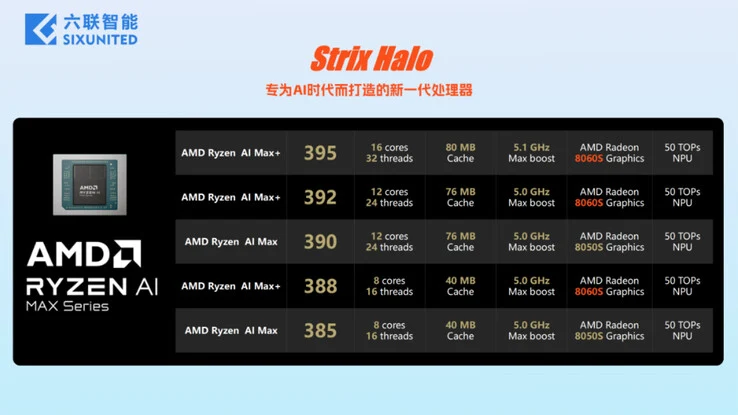
      Moreover, the firm unveiled the APXP77-140H-SCD, which PassMark shortened to SU AXP77. In the same announcement, Sixunited also provided insights about the Ryzen AI Max+ 392. As depicted in the image above, this unreleased model fits between the current Ryzen AI Max 390 and Ryzen AI Max+ 395, utilizing the 12-core and 76 MB cache of the former but featuring the Radeon 8060S iGPU that is currently exclusive to the latter. Interestingly, it appears that this Ryzen AI Max+ 392 variant may soon launch in a Sixunited 2-in-1, with more detailed information shared separately.


      Source:
      Link


    • AMD Ryzen AI Max+ 388: New Strix Halo Chip with Radeon 8060s GPU

      AMD Ryzen AI Max+ 388: New Strix Halo Chip with Radeon 8060s GPU

      Key Takeaways

      1. The AMD Ryzen AI Max+ 388 features an 8-core/16-thread CPU and a Radeon 8060s integrated GPU.
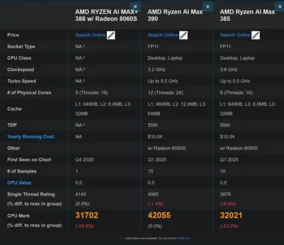
      2. It scored 4,145 in single-core performance and 31,702 in multi-core performance on PassMark benchmarks.
      3. The multi-core score is lower than that of the Ryzen AI Max 385, but single-core performance is comparable to other Strix Halo CPUs.
      4. The ‘388’ designation indicates a potential mid-cycle update, with more models like the Ryzen AI Max 392 possibly in the works.
      5. AMD aims to refresh the Strix Halo line to compete with Nvidia’s upcoming N1X series, expected around 2026.


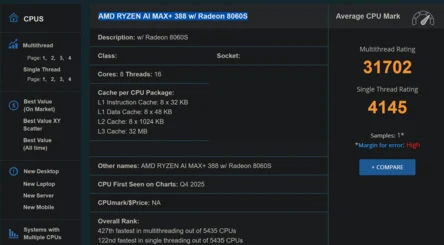
      A new AMD Strix Halo CPU has appeared in the PassMark database, as noted by Moore’s Law is Dead on YouTube. This processor, known as the Ryzen AI Max+ 388, features an interesting combination of CPU and GPU. It includes an 8-core/16-thread CPU alongside a Radeon 8060s integrated GPU, which was once only available in the higher-end Ryzen AI Max+ 395.

      Performance Scores

      In PassMark’s benchmarks, it achieved a score of 4,145 for single-core performance and 31,702 for multi-core. The single-core result aligns well with other Strix Halo CPUs, while the multi-core score is a bit lower than the Ryzen AI Max 385. Unfortunately, details about key specifications like base and boost clock speeds, as well as GPU clock rates, have not been disclosed.

      Future Prospects

      The designation ‘388’ for the Ryzen AI Max+ 388 suggests it may be part of a mid-cycle update expected to launch next year, with additional models likely on the way. Moore’s Law is Dead mentioned a Ryzen AI Max 392, but we couldn’t locate any information about that model.

      It seems reasonable that AMD would refresh the Strix Halo line, especially since its next version, Medusa Halo, isn’t anticipated until 2027. This update will enable AMD to compete with Nvidia’s upcoming N1X series, which is projected to be introduced around 2026.

      PassMark’s database shows how AMD is trying to keep up with the fast-paced tech industry.

      Source:
      Link